(translated) Environmental activist Gustavo Castro is in danger in the community of La Esperanza, Honduras

[Not my translation, but I urge you to take action in response. Want to act immediately? Click here. —CBJ]

[March 8 update: Gustavo Castro Soto remains in Honduras, where the government has extended its order forbidding him to depart to his native Mexico for 30 more days. Gustavo’s anti-mining organization, the Movimiento M4, has a new action alert (in English here|Spanish original) urging continued pressure.  ]

Below is an action alert put out this morning, March 7, by Otros Mundos/Friends of the Earth Mexico, the organization headed by Mexican Gustavo Castro Soto, who is the sole witness to the assassination of COPINH leader Berta Caceres. (Gustavo is also co-founder and board member of Other Worlds, and coordinator of the Central American-wide anti-dam network, M4.) Gustavo was providing peace accompaniment to Berta on her last night of life; he himself was shot twice. Gustavo was immediately detained in inhumane conditions by the Honduran government for days for “questioning.” Thanks to national and international pressure, he was finally released and was accompanied by the Mexican ambassador and consul to the airport in Tegucigalpa. He was just about to go through customs when Honduran authorities tried to forcibly grab him. The Mexican government successfully intervened, and put Gustavo into protective custody in the Mexican Embassy. Now, the Honduran government has prevailed and reclaimed Gustavo, taking him back to the town of La Esperanza, where Berta lived and was killed. Gustavo is in terrible danger in Honduran custody, as what he witnessed is an impediment to the government’s attempts to pin Berta’s murder on COPINH itself.

Please take the actions requested below. Like Berta, Gustavo is a key leader to popular struggles against corporate extraction, government malfeasance, and US intervention in Mesoamerica. As Berta was, Gustavo’s life is in grave danger.

(from Otros Mundos [original here])…

BREAKING! Gustavo Castro is in danger in the community of La Esperanza, Honduras
March 7, 2016

– To the Secretary of Human Rights, Justice, Interior, and Decentralization of Honduras
– To the Secretary of Foreign Affairs of Honduras
– To the Secretary of Foreign Affairs of Mexico
– For national and international attention
– To all organizations defending human rights

At present, the Mexican environmentalist Gustavo Castro Soto, Coordinator of Other Worlds AC/Friends of the Earth Mexico, is adding to his statement in La Esperanza, Intibucá, southeastern Honduras, where he was the victim of an assassination attempt in which indigenous rights defender Berta Cáceres was murdered on March 3.

We are on HIGH ALERT because his departure from the Embassy of Mexico and transfer back to La Esperanza represent a high risk for his physical security and psychological wellbeing.

On Sunday, March 6, upon trying to leave Honduras, legally and under the protection of the Mexican Embassy in Honduras, he was arbitrarily intercepted by Honduran authorities before passing through immigration at the Tegucigalpa International Airport. They detained him under the justification that he needed to expand upon his declaration, but without notifying him of this previously.

We want to point out that Gustavo Castro in no way resisted making the full declaration that was asked of him, and he has accepted this request to expand his statement in the interest of clarifying the facts surrounding the assassination of Berta Cáceres, and to avoid the criminalization of members of COPINH.

Despite all of the requests made to ensure that this new declaration be made under proper conditions, to guarantee his physical safety and psychological well-being within the Mexican Embassy in Tegucigalpa, the General Prosecutor decided that Gustavo needed to make his statement in La Esperanza. We believe that this puts him in physical and psychological danger. We demand guarantee for Gustavo’s safety and security during the process of expanding his declaration and during his travel from the Embassy of Mexico in Tegucigalpa. We demand that the government of Honduras fulfill its promise to lift the immigration hold that prevented Gustavo Castro from immediately leaving Honduras after completing his required statement, since there is no reason to keep him in the country.

We ask everyone to act and help us demand Gustavo’s safety and security by contacting:

The Secretary of Foreign Affairs of Mexico/Secretaría de Relaciones Exteriores de México, (55) 3686 – 5100 y (55) 3686 – 5581
gobmx@funcionpublica.gob.mx
@SRE_mx

The National Commission on Human Rights of Mexico/Comisión Nacional de Derechos Humanos de México
(55) 56 81 81 25 |  (55) 54 90 74 00
cenadeh@cndh.org.mx
@CNDH

The Secretary of Human Rights, Justice, Interior and Decentralization of Honduras/La Secretaría de Derechos Humanos, Justicia, Gobernación y Descentralización de Honduras
(504) 2232-7800 y (504) 2232-8900
@sdhjgdhn

Secretary of Foreign Affairs of Honduras
(504) 2236-0200 y (504) 2236-03-00
cancilleria.honduras@gmail.com
@SRECIHonduras

Further contacts recommended by the Center for International Environmental Law. You can also use their online solidarity letter generator.

Honduran Embassy in United States
Email:consulado.washington@hondurasemb.org
Fax:202.525.4004

Honduran Embassy in Canada
Email:ambassador@embassyhonduras.hn
Fax:613 232 0193

Canadian Embassy in Honduras
Email:sjcra@international.gc.ca

US Embassy in Honduras
Email:irctgu@state.gov

CONADEH
Email:centrooriente@conadeh.hn
Email:secretaria.despacho@conadeh.hn

Deadly El Alto protest casts shadow on Bolivian referendum

On Wednesday, February 17, a local protest in El Alto, Bolivia, became a national tragedy as flames engulfed several rooms of El Alto’s City Hall and six municipal employees died from inhaling the fumes from the blaze.

LaRazón-9999_20160218PB7JaE.jpg

The protest, sponsored by the Federación de Padres de Familia de El Alto (an association of parents demanding better school facilities), arrived at El Alto’s City Hall at 9:00 am. Aggressive actions by the crowd, including using a rocks and kicks to break the front door lock, began by 10am. As protesters turned aggressive outside El Alto’s City Hall, Mayor Soledad Chapetón repeatedly sent messengers to the Regional Police Command, asking for help. (The police command is less than two blocks away, per La Razón’s graphic.)

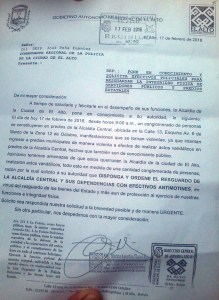
carta_a_policia
Letter to police seeking protection, received at 10:20am

Shockingly, they asked her to put her request in writing. A letter demanding police intervention “to safeguard the central City Hall … with anti-riot troops” was delivered to the police at 10:20am. A significant police attachment then took over an hour to arrive on scene. Protesters had seized numerous files and computers, set fires inside offices and on the street, and burned out rooms inside the building. Six municipal workers sought refuge in a rear bathroom of the building. The room was unventilated and they asphyxiated from the smoke. By the time the police arrived, the six employees had already lost their lives.

El Alto protests: Militant, destructive, but rarely deadly in the past decade

Neither property destruction nor the use of fire is unusual in El Alto protests, but these tactics have rarely led to deadly casualties. El Alto, Bolivia’s second largest city and the larger if poorer twin to the capital of La Paz, is rightly seen as the most militant place for urban protest in the country. During February 2003, protesters against a suddenly-imposed new income tax broke into government offices and burned files in El Alto and La Paz, including the property records in El Alto’s City Hall. The tax plan was cancelled. Later that year, El Alto saw the fiercest confrontations in the Gas War protests, opposing the export of natural gas by foreign corporations. Alteños’ militancy, however, is typically unarmed and involves the greatest use of force against security forces and property rather than individual opponents. While both of the 2003 events saw dozens of deaths in the city, they were nearly all protesters killed by police or military forces.

Since the 2005 election of President Evo Morales, security forces have been less aggressive in their use of deadly force on protesters. Militant crowds in El Alto have kept the looting of government offices and the setting of fires in their repertoire of tactics, used at occasional moments of public outpouring, such as the December 2010 protests against the removal of subsidies for fuel. As part of a national wave of protest, Alteños sacked and burned the toll booths on the main highway to La Paz. The protest was also marked by dissension as some pro-government organizations tried to dissuade protest. Their offices were looted by angry crowds. However, protest actions had not led to any deaths in El Alto between 2005 and this past week.

Nationally, February 18, 2016, was the deadliest day in Bolivian protest since 2008.

Political implications for Sunday referendum

Evo Morales, who is seeking public backing for constitutional amendment allowing him a fourth term, has had a very bad month. On February 3, an opposition journalist revealed his 2007 affair with Gabriela Zapata, then a young law student who has since become exceptionally wealthy representing a major government contractor. The Vice President’s claims to academic credentials as a mathematician and sociologist have been called into question. But this deadly El Alto protest may have been the worst blow to the president’s image.

Many of the protagonists of Wednesday’s protest were affiliated with the president’s Movement Towards Socialism party, and they seem to have been protecting themselves from charges of local corruption through targeted arson, and killed six government workers in the process. The tragedy was compounded, and perhaps made possible, by government inaction. Once protesters had broken down the front door, they targeted the Investigating Unit (Oficina Sumariante) of the city government’s legal office. The head of that office told the press: “They came directly to attack first the Sumariante office and have burned my filings. What they were trying to cover up was the phantom billings, illegal contracts, and legally certified photocopies concerning the 33 vehicles that were to be sent for the [ongoing] criminal process, filings on illegal land occupations and charges.” The administration of former mayor Edgar Patana, affiliated with the MAS, is now under extensive investigation for corruption. Patana himself faces at least 11 denunciations of corruption and was jailed in San Pedro Prison last December.

Cenizas-encontraban-documentos-investigados-Alcaldia_LRZIMA20160218_0011_4
One of the destroyed offices in the aftermath of the fire.

Wednesday’s conflict pitted MAS affiliates against a City Hall led by Mayor Soledad Chapetón, affiliated with the center-right Unión Nacional. Two leaders of the protest singled out by the mayor in an emotional speech Wednesday night were Braulio Rocha and Wilmer Sarzuri, both MAS candidates for the El Alto municipal council in 2015. Rocha, leader of the shopkeepers union (Federación de Trabajadores Gremiales de El Alto) had been a close ally of outgoing Mayor Patana, whose administration redirected shopkeepers’ taxes into the control of the union. When Chapetón ended this practice, Rocha declared to Chapetón, “I will be your nightmare for the rest of your life,” reports El Diario. It now seems more likely that Wednesday’s deaths will haunt Braulio Rocha.

These elements of political dispute implicate the governing MAS party, at least on a local level. It might all look like a local crisis were it not for police inaction and the words of Marcelo Elío, the Vice Minister in charge of policing. Within hours of the fire, he blamed SOL.Bo for “provoking” the fire and described it as a self-directed attack (“auto-atentado”) and “a plan orchestrated from within City Hall.” Other national government figures initially emphasized the need for investigation and clarification of events. State-run media passed on allegations that vandals had “infiltrated” the protest causing the destruction, and the state-aligned Venezuelan channel Telesur even mis-captioned the event as an act by anti-Morales protesters opposed to the Sunday referendum. But by Friday prosecutors had accepted Chapetón’s version and arrested Rocha and Sarzuri, as well as two young MAS activists and charged them with homicide and other crimes. Even with these moves, death, corruption, and state complicity with both hang in air ahead of Sunday’s referendum on the future of President Evo Morales


Bolivians to vote on a fourth Evo Morales term

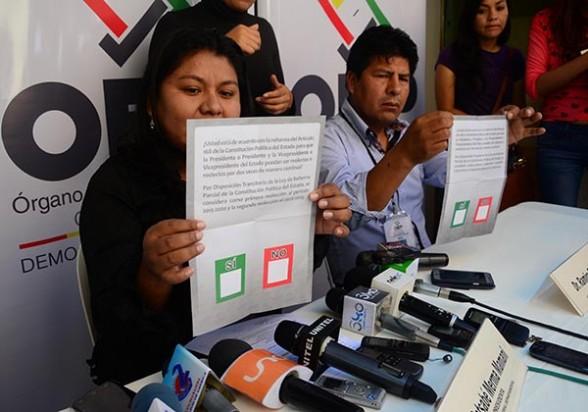
On Sunday, February 21, Bolivians will vote in a constitutional referendum. A yes vote would authorize incumbent President Evo Morales to run for a fourth term in 2019, and to rule the country for an unprecedented twenty years, ending in 2025. Morales and his Movement Towards Socialism party (MAS-IPSP) have a long streak of national victories stretching back to his election in 2005 (with 54% of the vote), through a special vote of confidence in 2008 (67%), and two re-elections in 2009 (64%) and 2014 (61%). All of these contests involved face-offs against right-wing politicians associated with two decades of neoliberal economic policies from 1985 to 2005.

On the other hand, regional and local government elections in 2010 and 2015 showed more mixed results for the MAS-IPSP. Independent center-left parties like the Without Fear Movement (MSM) and its successor SOL.bo have gained important ground in these elections, while right wing forces have maintained a base in the country’s eastern departments. In the 2011 judicial elections a MAS-IPSP-backed slate of nominees was elected amid heavy abstention and massive numbers of blank or voided ballots. Likewise, five western departments rejected regional autonomy statutes in a September 2015 poll. While Vice President Álvaro García Linera tried to spin the result as validation of a strong central state, all of the statutes had been drafted by MAS-IPSP legislators.

Enter the present referendum. In 2008, Evo Morales agreed to a constitutional limit of two terms. In the run-up to the 2014 vote, he re-interpreted this limit as beginning with the 2009 constitution. During the 2014 political campaign, rumors of a constitutional amendment to extend his office began to circulate. While MAS-IPSP party activists backed the campaign from the beginning, it has been framed as an initiative arising from the Pact of Unity organizations—principally the CSUTCB peasant confederation and the “intercultural” federation of agrarian colonists—as well as the COB labor confederation, whose national leadership aligned with the MAS in 2013. While his party campaigned for it to happen, Evo only “agreed to the grassroots demand” that he run again four years from now.

The present campaign has the first effective collaboration between Evo Morales’ critics on the left and his long-time opponents on the right. With no political offices at stake, these two sides have been free to collaborate for the first time. Recent polls show the race to be a toss-up. You can read more about the vote here:

What’s at stake in the Paris climate talks

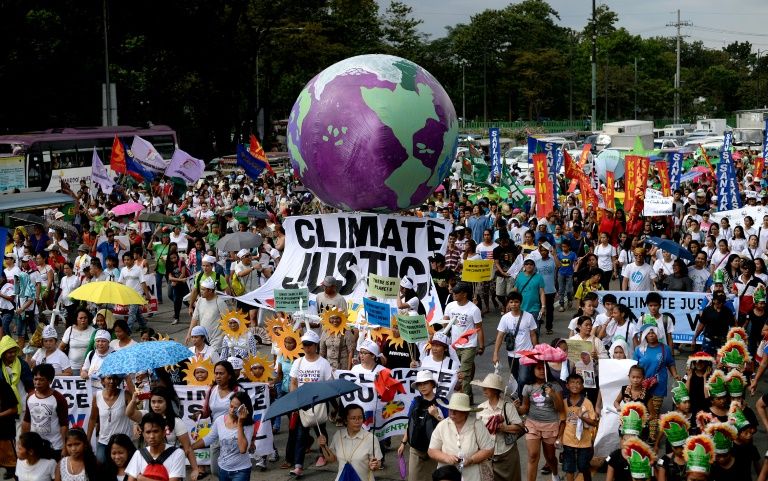
Addressing climate change is one of the most important collective decisions facing us as humans living in 2015. Based on decisions made in the next two weeks, the states of the world will either commit to restrain global climate change to under 2° Celsius above pre-industrial levels, or plan for modest reductions in pollution that still put us on track for 4°C of warming by 2100 (with greater increases beyond that).

Let’s assume you know the importance of this choice in theory, but maybe not in its details. Or even that you knew what the major risks of a 4°C warmer world back when the climate talks were held in Copenhagen, but haven’t updated your knowledge since then. Or that you know, and want something to share with those who don’t. Here are some places to get informed, in way that speaks to the immensity of the risks ahead, relatively fast…

  • Getting To Four Degrees: This hour-long  BBC radio drama puts a typical British family in a world warmed by 2°C and 4°C, while climate experts interrupt and discuss the details of what those world will look like. (original weblink dead; archived here)
  • Five possible scenarios for our future climate (The Guardian, 2009) — Degree by degree summaries of the world at 1°C through 5°C. Begins with our unavoidable future: Most of the world’s corals will die, including the Great Barrier Reef. Glaciers that provide crops for 50m people with fresh water begin to melt.
  • Turn Down the Heat — A series of reports from the Potsdam Institute and the World Bank spelling out the case for limiting warming to 2°C. Remember, the World Bank technocrats are people who have prioritized market-based growth and resource extraction, but they’re not afraid of the science on global warming. In this series, they’ve brought together detailed analyses of how much worse 4°C is than 2°C. If you’re doubting that controlling climate change matters, read about somewhere you love. Comes in three parts: A global summary released in 2012; and regional details for Sub-Saharan Africa, South East Asia and South Asia, and for Latin America and the Caribbean; the Middle East and North Africa; and Eastern Europe and Central Asia.
  • Professor Kevin Anderson on what’s under negotiation in Paris.
  • Understanding key positions of the Least Developed Countries in climate change negotiations: “Warming and associated risks will still be unevenly and unfairly distributed with a global average rise of 2°C, and temperature change will be highest in those regions where particularly vulnerable countries are located. A more ambitious ‘1.5°C pathway’ for limiting global average temperature increase is essential to minimise the risks to Least Developed Countries, Small Island Developing States, and Africa.”
  • The state of the carbon budget to reach 2°C (Washington Post, November 29).

And when you’re wondering how to feel about all this, read these for some company in the face of stark realities:

Bolivia’s climate pledge triples down on fossil fuels, megadams

Screen Shot 2015-11-30 at 1.01.55 PM

Last month, Bolivia submitted its pledge (English|Spanish) on addressing climate change to the UN FCCC, the body charged with overseeing global negotiations to prevent dangerous global warming. While much of the document is addressed towards global issues, the quantitative details show just how committed the Evo Morales government is to accelerated, and environmentally destructive, development.

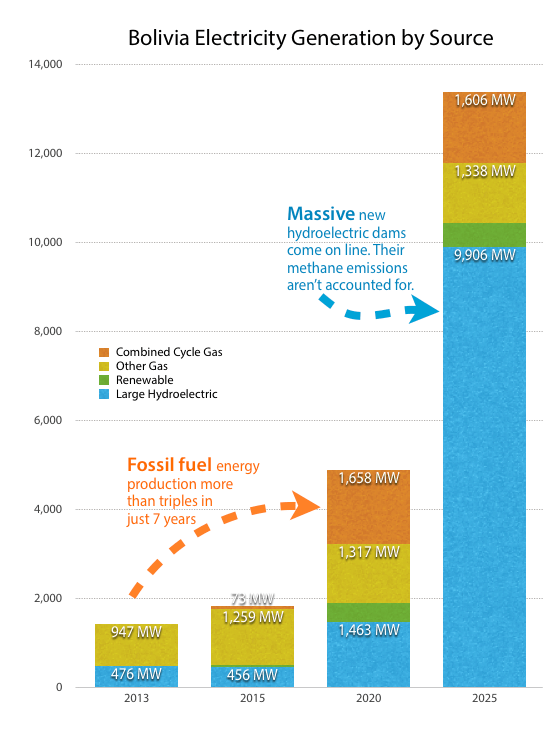
The document follows  ambitious government announcements this year about expanding agribusiness, gas and oil exports, and electricity generation. I isolated the electricity numbers, with help filling in the details from this October 2015 report covering the Ministry of Energy and Hydrocarbons.

As you can see from the graph above, there are two big stories to be told about Bolivia’s electricity production plans. First, over the next five years, the country plans to massively expand its domestic burning of natural gas, more than tripling the 947 megawatts (MW) supplied by gas in 2013. Second, in a series of larger-scale projects, the country plans to bring 9,450 MW of hydroelectric power on line by 2025. This enormous expansion would require megadams at Rositas, El Bala, Miguillas, Río Grande, and Cachuela Esperanza (to name just a few of the sixteen proposed). These dams are likely to have severely damaging environmental consequences, particularly since some are located in fragile or protected natural areas. A third story is just as important: the government predicts that domestic power demand will only reach 3,000 MW in 2025, meaning that the vast bulk of the new electricity is intended for foreign consumers, mostly in Brazil and Argentina.

Bolivia’s climate pledge or Intended Nationally Determined Contribution manages to misrepresent this shift as a green move in two ways. First, it deals only in percentages: “Increased participation of renewable energy to 79% by 2030 from 39% in 2010.” In fact, the smaller percentage of nonrenewable energy reflects a massive increase. Second, it counts large-scale hydroelectricity as renewable and the carbon emissions numbers seems to treat these dams as zero emissions, despite the fact that entire biomass flooded by new dams is gradually converted into methane and released to the atmosphere.

Other unlikely claims are advanced in the area of land use change and forestry, including a unexplained promise to reduce illegal deforestation to zero, and to somehow reforest 4.5 million hectares of the country. These pledges coexist with a government plan to expand agricultural land by 10 million hectares over the coming decade, with the most coveted land for planting located squarely in the Amazon rainforest.

Noam Chomsky in his office, 1967

Liberal Imperialism, a classic definition

“Three years have passed since American intervention in a civil war in Vietnam was converted into a colonial war of the classic type. This was the decision of a liberal American administration. Like the earlier steps to enforce our will in Vietnam, it was taken with the support of leading political figures, intellectuals, and academic experts, many of whom now oppose the war because they do not believe that American repression can succeed in Vietnam and therefore urge, on pragmatic grounds, that we “take our stand” where the prospects are more hopeful. If the resistance in Vietnam were to collapse, if the situation were to revert to that of Thailand or Guatemala or Greece, where the forces of order, with our approval and assistance, are exercising a fair degree of control, then this opposition to the Vietnam war would also cease; in the words of one such spokesman, we might then ‘all be saluting the wisdom and statesmanship of the American government.’ If we are forced to liquidate this enterprise … the liberal ideologists will continue to urge that we organize and control as extensive a dominion as is feasible in what they take to be ‘our national interest’ and in the interest of the elements in other societies that we designate as fit to rule.

Noam Chomsky, Introduction to American Power and the New Mandarins, 1969.

The term liberal imperialism makes two distinctions: liberal imperialists are not radicals and are not always hawks. They accept exercising national power over other societies, whereas radical critics of war are simply against that goal, and the military mean of exercising it. Liberal imperialists make themselves against this or that war, precisely and only when the costs are too great, which boils down to when the resistance, abroad and at home, is too great. At the height of the Vietnam War, radical critic Noam Chomsky wrote a devastating moral challenge to the American public acceptance of their country’s power over others. He laments that his opposition to the war “ten or fifteen years too late” once American boots began to be on the ground in 1965, and not when the US military support began. He observes that “The war is simply an obscenity, a depraved act by weak and miserable men, including all of us, who have allowed it to go on and on with endless fury and destruction—all of us who would have remained silent had stability and order been secured.”

NYC lecture, October 26: Dense and Nimble Activisms in Bolivian Radical Politics

On Monday, October 26, I’ll be giving a talk on “Dense and Nimble Activisms in Bolivian Radical Politics,” hosted by the Department of Anthropology at Queens College-CUNY. The talk will be in the President’s Conference Room 2 at the Rosenthal Library (campus map) at 12:15pm. If you’re in New York City or someplace nearby, please join me.

Abstract:

This paper explores the radical political values that circulate and develop across Bolivia’s dense and nimble forms of activism, with a focus on the increasingly indigenous metropolis. Bolivia’s largest social movement organizations—including its labor unions, rural communities, and neighborhood organizations—are bound together by a hierarchical organizational structure and a countervailing ethic that subordinates leaders to the grassroots bases from which they emerge. This worldview separates an enduring, morally legitimate world of community organization (“the organic”) from a corrupted world of political parties, staffed by self-advancing, individualist politicians who engage in transactional, corrupt practices (“the political”). Inside the organic domain, unions and other mass organizations replicate and extend the ayllu, an Andean structure for community self-management of the lands inherited from ancestral spirits. They valorize ethical principles of complementarity, solidarity, anti-individualism, and obligatory participation, blending ethical and political life.

Conversely, other organizations structure themselves horizontally, without a formal hierarchy or official leadership. People join these efforts voluntarily and individually without a joint decision of the others with whom they live or work; the organization is defined by ideological and social affinity, its common purpose. They achieve their political effects by networking: that is, by interacting with a far larger numbers of people than just its membership, through public spectacles, training, writing, and open gatherings. While less internationally visible, these nimble activists participate in the global circulation of practices of decentralized decision making, ideas like the de-commodification of water, and transnational movement networks.

Rather than mutually opposed poles, organic grassroots and participatory network organizations interchange ideas and collaborate in common efforts. A former Marxist union militant in the mines explains, “Solidarity is what is called ayni, right?,” offering a translation between languages for political visioning. Across town, an urban anarchafeminist collective embraces an indigenous identity while pointing out patriarchal attitudes within both revolutionary movements and traditional communities. For at least a generation, Bolivian activists have conceptualized radical political values as of form of decolonization, as a return to ways of living that are inherently opposed to the colonial and capitalist state. At the same time, liberatory political praxis involves the incorporation of new ideas, in silent contradiction to rhetoric of cultural revival. Drawing on multiple experiences, I describe both the recovery and the innovation of ways of doing politics.

On Allegra: Can a gas pipeline heal Bolivia’s wounded geo-body?

Screen Shot 2015-09-11 at 8.41.42 PMMy latest essay on Bolivia was published by Allegra Laboratory. It looks at the deeply felt woundedness around Bolivia’s loss of coastal territory to Chile, and the surprising notion that exporting natural gas from a Peruvian port could heal that wound.

Allegra is a fascinating site dedicated to the anthropology of politics, law, and art. You can read about them here, and check out their Academic Slow Food Manifesto on the same page.

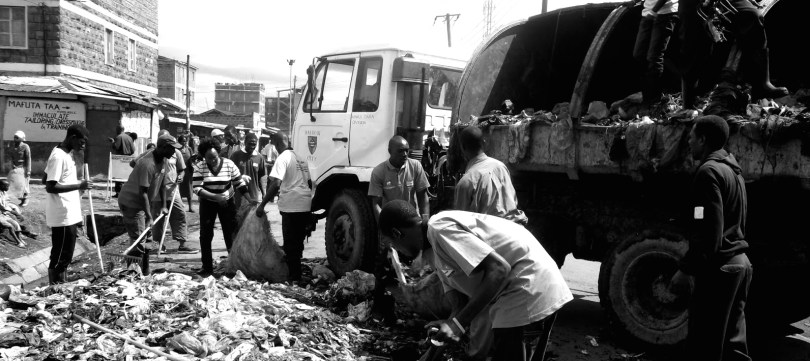
Men and women rake and shovel a plie of garbage into bags as part of the Kariobangi Waste Management Allianc

“Every day the poor people dig, scavenge, and gather.”

Poverty is there, however, unbearable and discreet. On every page it manifests itself, in three elementary actions: carrying, scavenging, pilfering.

In all the capitals of poverty, the poor carry bundles. They always keep them close by. When they sit down, they place them by their side and watch over them. What do they put in them? Everything: wood gathered in a park, hastily, crusts of bread, bits of wire pulled off a fence, scraps of cloth. If the bundle is too heavy, they drag it along, in wheelbarrows or handcarts.

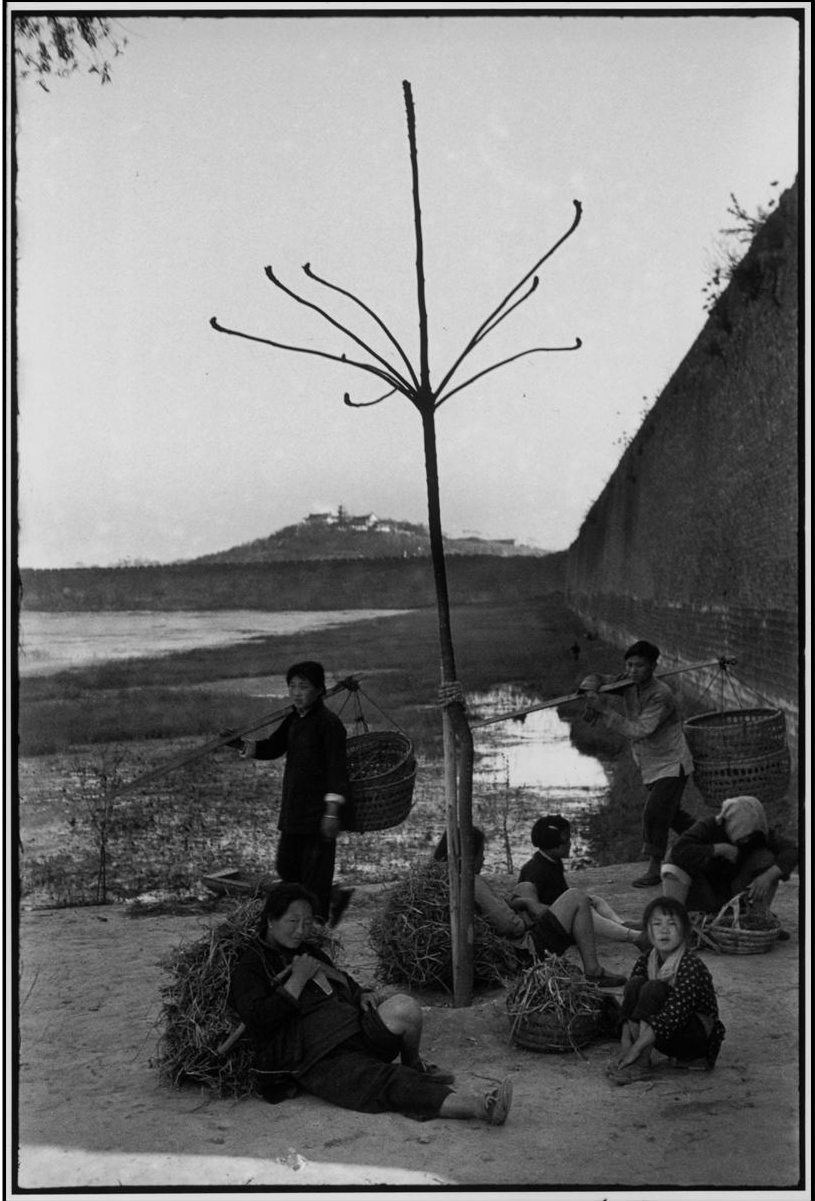
Peasants rest at the foot of the ancient walls of Nanking after collecting lotus roots for fuel. In the background: Jade Mountain, and the lake where sailors received their training during the days of the Ming Emperors. In all the capitals of poverty, people scavenge. They scavenge in the soil and the subsoil; they gather round refuse bins; they slip right into the rubble: ‘What others throw away is mine; what is no longer of any use to them is good enough for me.’ On waste ground near Peking, the rubbish piles up. This is the refuse of the poor; they have sifted through everything, they have already rummaged through their own rubbish; they have only left, reluctantly, what is uneatable, unusable, unspeakable, revolting. And yet the flock is there. On all fours. They will scavenge all day, every day.

In all the capitals of poverty, there is pilfering. Is it stealing? No, just picking things up. These bales of cotton have just been unloaded. If they stay an hour longer on the dock, they will disappear. No sooner have they been put down than the crowd rushes forward and surrounds them. Everyone attempts to pull off a handful of cotton. Many handfuls of cotton, gathered day after day – that makes an item of clothing. I recognize the look on the women’s faces, I have seen it in Marseilles, in Algiers, in London, in the streets of Berlin; it is serious, quick and hounded, anguish mingles with greed. You have to grab before you are grabbed. When the bales have been loaded onto a lorry, the kids will run after it with outstretched hands.

Every day the poor people dig, scavenge and gather.

Jean-Paul Sartre
Preface to D’une Chine à l’autre,
by Henri Cartier-Bresson and Jean-Paul Sartre,
Paris, Editions Robert Delpire, 1954.
(a book of photographs taken in China by Cartier-Bresson)

The image above is from the Kariobangi Waste Management Alliance in Nairobi, Kenya, over 300 young Kenyans who have made a waste collection system for the slum of Kariobangi; photograph borrowed from this 2013 article. The image below is a photograph by Henri Cartier-Bresson taken in Nanking in April 1949. Original caption: “Peasants rest at the foot of the ancient walls of Nanking after collecting lotus roots for fuel. In the background: Jade Mountain, and the lake where sailors received their training during the days of the Ming Emperors.”

Marchers raise their hands on first day of CONAIE March, Tundayme, Zamora Chinchipe

Demands from Ecuadorian indigenous movement CONAIE’s August mobilization

A major protest mobilization by Ecuador’s indigenous movement, led by the Confederation of Indigenous Nationalities of Ecuador (Confederación de Nacionalidades Indígenas del Ecuador, CONAIE | website facebook twitter) began on Sunday, August 2. The following is my translation the document produced by the organization’s July assembly spelling out its demands.

Resolutions of the Annual Ordinary Assembly of CONAIE
Salasaca, Tungurahua
July 17 and 18, 2015

The Confederation of Indigenous Nationalities of Ecuador, meeting in its General Assembly with the participation of official delegates from grassroots organizations and from the regional affiliates CONFENIAE, ECUARUNARI, and CONAICE, faced with current political conjuncture and the situation of the indigenous movement, resolve:

EcuadorMarchMap-Aug20151. To convene the grassroots of all the peoples and nationalities of Ecuador to the Great Indigenous Uprising, in unity with sectors of society and the Ecuadorian people in all the provinces of the country, on August 10, 2015. Putting forward the national demands of our people and our own agenda as an indigenous movement. We ratify our firm position of No to the Dialogue [as proposed] with the national government.

2. To recover the autonomy of Intercultural Bilingual Education and to demand the immediate reopening, instead of the closure, of intercultural bilingual education schools, teaching institutes, colleges, Childhood Centers for Good Living (Centro Infantil del Buen Vivir; [an early childhood education program for poor children]), and the Amawtay Wasi University [an indigenous university co-founded by CONAIE in 1989], free access to public education, as well as the creation of research centers at the regional level to strengthen the process of autonomous education on the part of the nationalities and peoples.

3. To halt the plunder of the land and territories that government promotes by means of the new land, water, and mining laws; and thus, we call for the land law to be shelved and for the repeal of the laws that affect the development and rights of indigenous peoples. To strengthen control over our territories and to not permit the entry of any government functionary nor of a single transnational corporation.

4. To shelve the proposal to amend the constitution, which promotes the restriction of the rights which we, by our struggle, managed to have included in the Constitution.

5. To stop political persecution and the judicialization [of politics; i.e., using court cases to pursue political opponents] implemented by the government of Rafael Correa against the leaders of social movements, and the leaders within indigenous peoples, students, doctors, retired people, defenders of nature, and of human rights, and other organized social sectors. To do away with institutionalized corruption and the state of repression so as to build plurinational democracy.

6. To strengthen a unified agenda together with the other sectors of society. To organize the mobilizing process that begins with the great march of the peoples from Tundayme-Zamora Chinchipe on August 2, the Indigenous and Popular Uprising on August 10, and the national strike organized by the Unitary National Collective on August 13.

7. To ratify our full commitment to defeat the capitalist economic model built upon oil and mining exploitation implemented by this government and to establish an alternative community-based economy coherent with the [concept of a] Plurinational State.