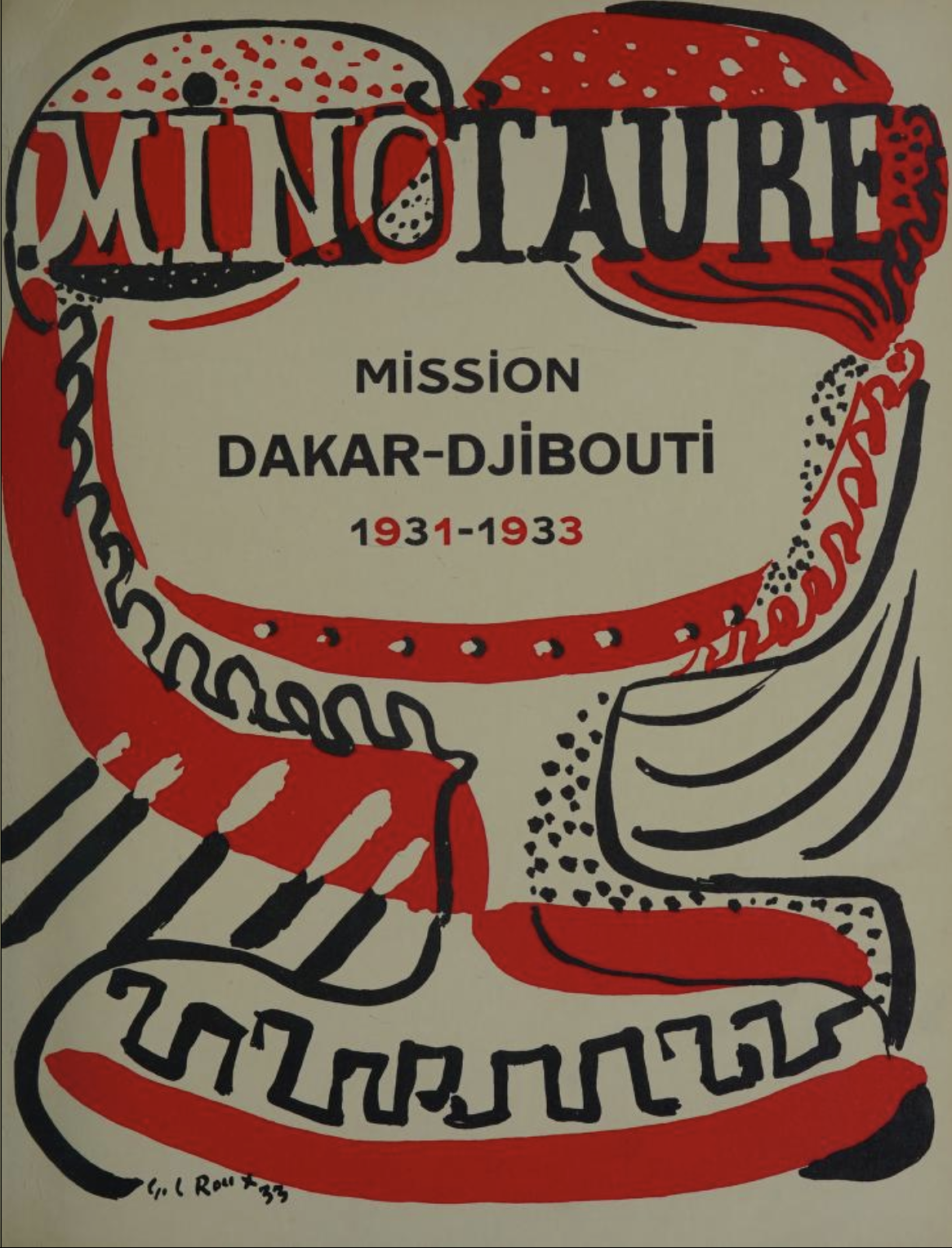
1933: It was celebrated as a great achievement in the practice of anthropology. It was organized alongside the other organizational cornerstones of Paris’ Museum of Man (Musée de l’Homme) and under the sponsorship of the museum’s leading figures. It brought to Paris over 3,500 objects of African traditional art and religion. And in so doing, it was celebrated in one of the two premiere issues of the surrealist magazine Minotaure, making it part of the closest approach between high art and ethnography. It fed into the galleries of the Museum of Ethnography at the Trocadero, and soon its successor on the same site, the Museum of Man.
Organized by the Institute of Ethnology at the University of Paris and the National Museum of Natural History, and established by the law of March 3, 1931, passed unanimously by the French [Parliamentary] Chambers, the Dakar-Djibouti Ethnographic and Linguistic Mission received, in addition to grants from numerous private individuals, the active patronage of twenty-three official institutions or organizations recognized as being of public utility, including three French ministries, the Académie des Inscriptions et Belles-Lettres, the University of Paris, the Museum of Ethnography, the National Library, the School of Oriental Languages, etc. In addition, the Rockefeller Foundation awarded the head of the mission a substantial grant, in addition to the regular fellowships.
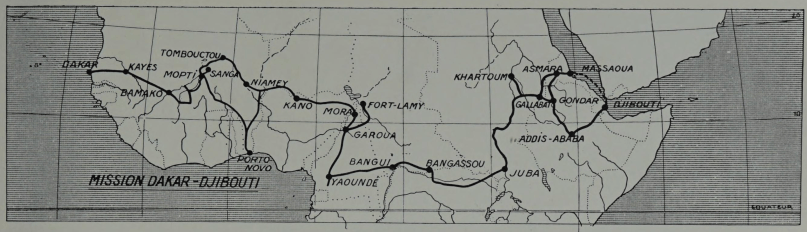
Having departed from Paris on May 10, 1931, the Dakar-Djibouti Mission arrived in Dakar on May 31. From June 12, 1931, to February 7, 1933—the date on which it embarked in Djibouti to return to France—it traveled through French West Africa, Nigeria, Cameroon, French Equatorial Africa, the Belgian Congo, Anglo-Egyptian Sudan, Abyssinia, Eritrea, and the French Somali Coast. Throughout its travels—which it undertook by train, automobile, boat, and caravan—the mission conducted surveys and assembled collections.
Rivet, Paul, and Georges-Henri Rivière. “La Mission Ethnographique et Linguistique DAKAR-DJIBOUTI.” Minotaure (Paris), no. 2 (June 1933): 3–5. https://archive.org/details/bwb_p9-btl-400_2/page/n111/mode/2up.
And yet in 2025, the Dakar–Djibouti Mission could not be remembered as a simple landmark of French anthropological history, not without a new investigation that put its organizers and participants under the microscope. The Quai Branly Museum, which has taken charge of the vast religious and art collections of Musée de l’Homme, hosted a new exhibit, Mission Dakar-Djibouti (1931-1933): Contre-enquêtes (Mission Dakar-Djibouti (1931-1933): Counter-Investigations). The exhibit was co-curated by six scholars from Africa—at the Museum of Black Civilisations, Senegal; National Museum of Cameroon; National Museum of Mali; University of Gondar, Ethiopia; and University of Abomey-Calavi, Benin—and two from France (official announcement; English visitor’s guide).
And that results of that investigation are frankly devastating.
Witness the museum’s official video on the exposition (subtitled in French and English).
A deeper look into the Mission comes in Marc Petitjean’s documentary Dakar – Djibouti, 1931. Le butin du musée de l’Homme [The Booty of the Museum of Man], which was screened as part of the exhibition. The 58-minute film is currently available on YouTube.
In a world where criticism of power and inequality have acquired a certain visibility, there is a common defense: one should only judge past crimes by the standards of the time. If so, a startling document allows us to judge.
1934: Michel Leiris, secretary of the Mission Dakar–Djibouti, a surrealist with a long career at the pinnacle of French social science in his future, wrote Africa Fantôme, a diary of his experiences in the expedition. Its most famous passage reads as something between a confession and a self-indictment. Leiris is describing the carrying off of a Boli from Kéméni, Sudan. As Simon Harel explains: “The Boli is one of the most sacred objects in the Bambara and Malinkee cultures of Mali. The Boli is mostly made of unbaked clay and consists of sacrificial layers that incorporate human and animal fragments. This ritual object can be in the shape of an animal, a human, or it can remain shapeless. There are many such objects in the Musée du quai Branly–Jacques Chirac.”
Here is Leiris’ narrative:
At the same time Griaule dispatches Lutten to the cars to prepare our departure and to send Makan back immediately with a large packing cloth to wrap the kono (which neither the women nor the uncircumcised may see, under pain of death) and two raincoats, one for Griaule, the other for me, as it is beginning to rain.
Michel Leiris, Phantom Africa, translated by Brent Hayes Edwards, Calcutta, Seagull Books, 2017, p. 154–155.
We wait outside the house of the kono. The village chief is crushed. The chief of the kono has declared that under such conditions, we can remove the fetish. But a few of the men with us seem horrified, to such a degree that the fumes of sacrilege are beginning to waft around our heads; with a single leap, we find ourselves completely out of our depth. I give the chicken to the chief with a theatrical gesture and now, as Makan has just arrived with the tarp, Griaule and I demand that the men go and fetch the kono. They all refuse, so we go ourselves, wrapping the holy object in the tarp and creeping out like thieves while the devastated chief flees and, some distance away, drives his wife and children into a hut with heavy blows of his stick. We cross through the village, now completely deserted, and reach our vehicles in dead silence. The men are gathered in the distance. When we come into the square, one of them sets off running toward the fields and hastily breaks up a group of boys and girls just arriving. They vanish into the corn even more quickly than the little girl we saw a little while ago in the maze of mud-walled lanes; when she saw us she made an about-face, holding her calabash on her head and weeping.
[…]
Before leaving Dyabougou, we visit the village and make off with a second kono, which Griaule found by slipping surreptitiously into the special hut. This time, Lutten and I carry out the operation. My heart is beating very loudly because, since yesterday’s fiasko, I am more keenly aware of the enormity of our crime.
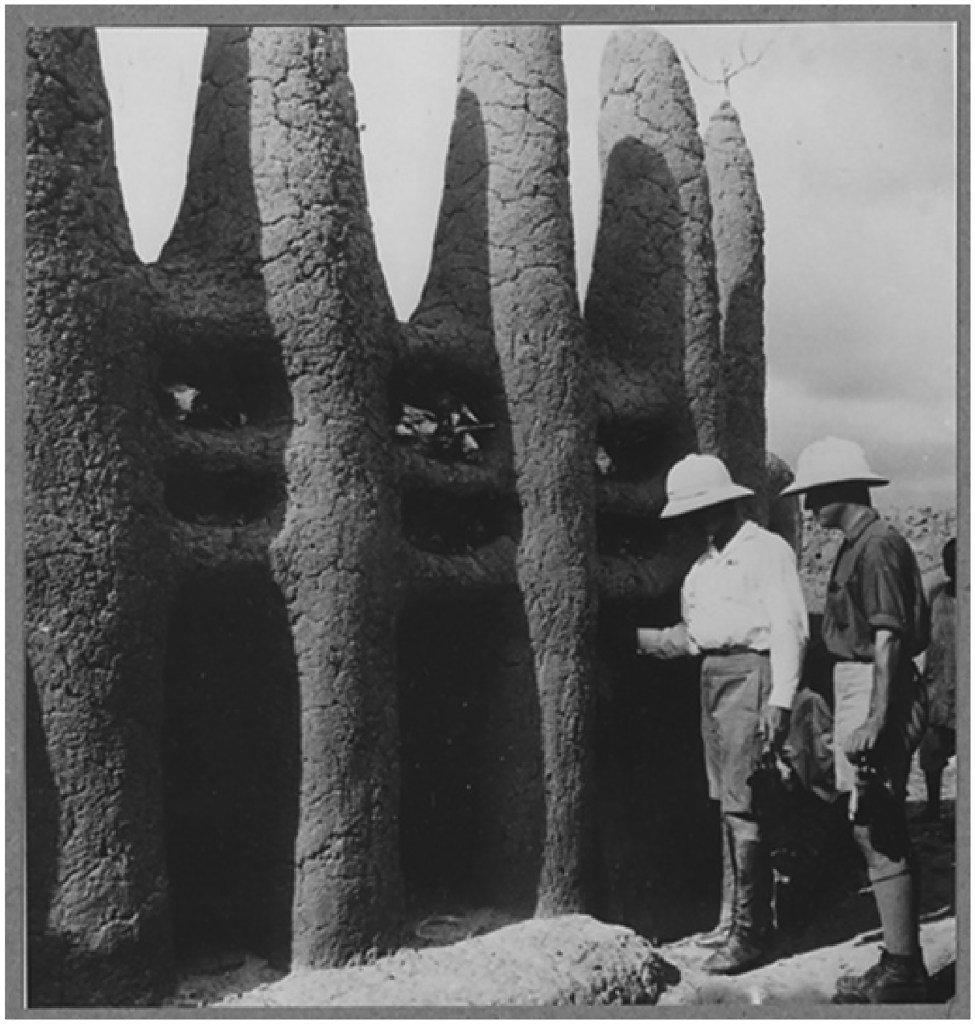
Marcel Griaule and Michel Leiris in front of the sanctuary in Kéméni, 6 September 1931.
Daouda Kéita, head of the National Museum of Mali explains in the video how the counter-investigation in Kéméni found the community’s memory of the same scene, “just as it was written in Michel Leiris’ account.” They returned with pictures of the taken objects, which the community remembered:
“They remember all these items, they pronounce the names of all these items, and also, the story of the kidnapping of the Boli in Kéméni, was told to us… Because the owner was there, and when they took the object out, he closed his eyes, he didn’t want to see the scene because it was as if they were taking away part of his identity, as if part of himself was being taken away. Because the value and importance of this object in the village is such that seeing this object depart, without being able to oppose it, was seen as a tragedy. Because these objects are items that protect them, that care for them, that protect the village and are there to ensure peace and quietude in the village. So, by taking these items away, you see, it’s as if we were taking away a part of the village’s soul.”
In the 2020 film and the 2025 exposition, these two halves of the narrative—the fieldworker troubled by guilt and the community, remembering its loss—have come together. There can be no complete understanding of the objects themselves, or of the discipline that requisitioned them, without understanding what was broken when they were torn away.
For more, see: Simon Harel’s article “From Spectral Africa to the Ventriloquist Object: Journeys of Mobility in Dakar – Djibouti, 1931. Le butin du musée de l’Homme and L’Afrique fantôme (2020)” in Transtext(e)s Transcultures. (Original French version)
Photos: Map at top from Minotaure 2, where it appears above the table of contents. Fieldwork photo from the collection of Musée du Quai Branly–Jacque Chirac, as it appears here.

