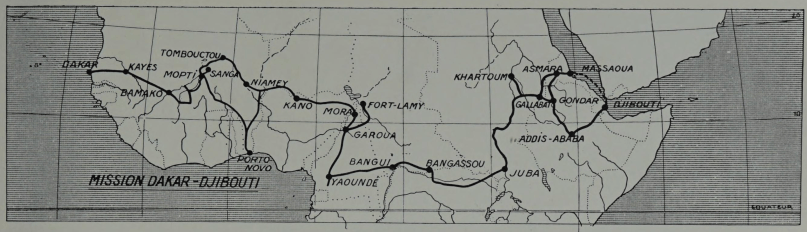
Map of central Africa from Senegal to the Horn of Africa showing the route of the Dakar-Djibouti Mission of 1931-33

“The fumes of sacrilege”: Retracing colonial theft in the Dakar–Djibouti Mission

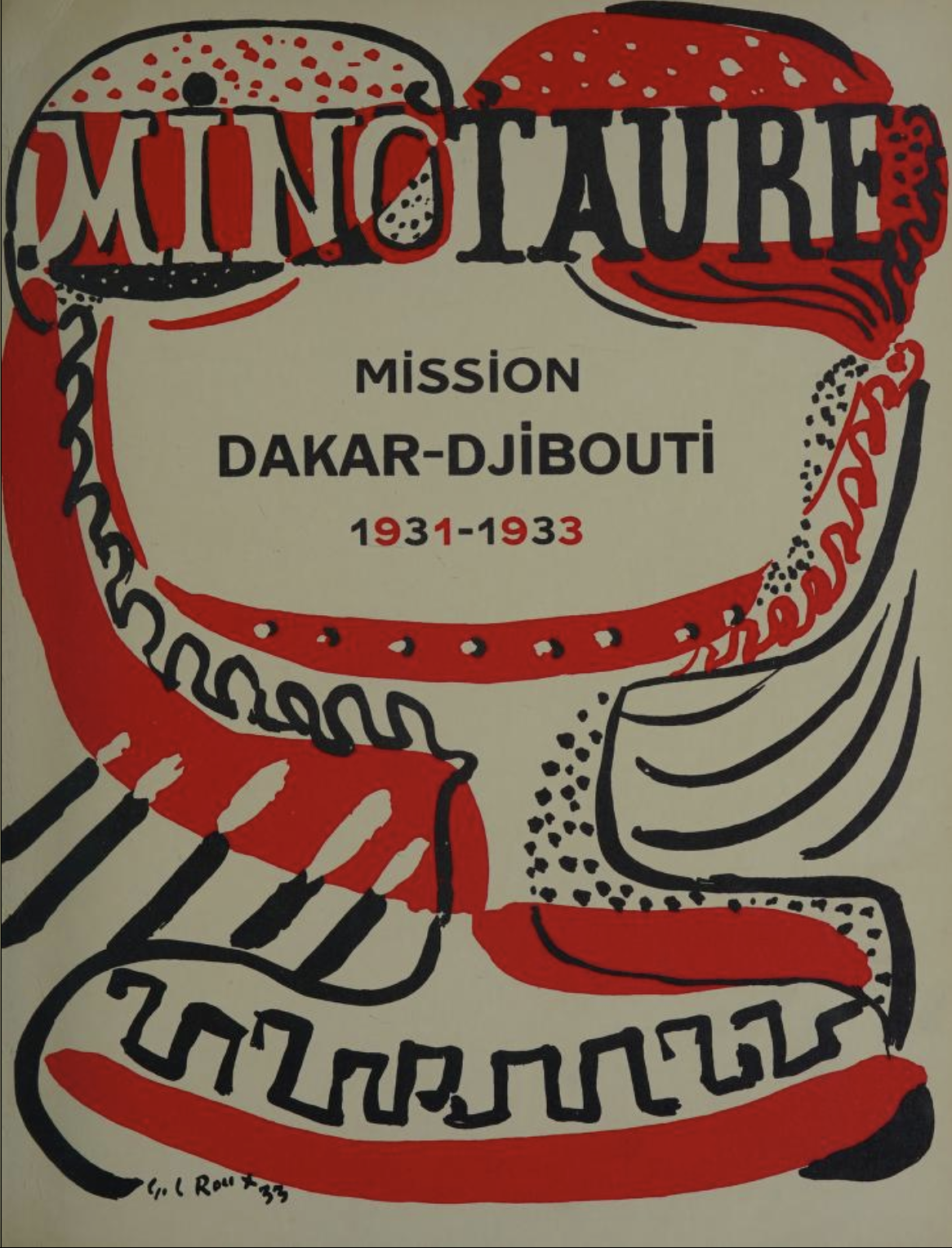
Cover of Minotaure 2, devoted to the Mission

1933: It was celebrated as a great achievement in the practice of anthropology. It was organized alongside the other organizational cornerstones of Paris’ Museum of Man (Musée de l’Homme) and under the sponsorship of the museum’s leading figures. It brought to Paris over 3,500 objects of African traditional art and religion. And in so doing, it was celebrated in one of the two premiere issues of the surrealist magazine Minotaure, making it part of the closest approach between high art and ethnography. It fed into the galleries of the Museum of Ethnography at the Trocadero, and soon its successor on the same site, the Museum of Man.

Organized by the Institute of Ethnology at the University of Paris and the National Museum of Natural History, and established by the law of March 3, 1931, passed unanimously by the French [Parliamentary] Chambers, the Dakar-Djibouti Ethnographic and Linguistic Mission received, in addition to grants from numerous private individuals, the active patronage of twenty-three official institutions or organizations recognized as being of public utility, including three French ministries, the Académie des Inscriptions et Belles-Lettres, the University of Paris, the Museum of Ethnography, the National Library, the School of Oriental Languages, etc. In addition, the Rockefeller Foundation awarded the head of the mission a substantial grant, in addition to the regular fellowships.

Having departed from Paris on May 10, 1931, the Dakar-Djibouti Mission arrived in Dakar on May 31. From June 12, 1931, to February 7, 1933—the date on which it embarked in Djibouti to return to France—it traveled through French West Africa, Nigeria, Cameroon, French Equatorial Africa, the Belgian Congo, Anglo-Egyptian Sudan, Abyssinia, Eritrea, and the French Somali Coast. Throughout its travels—which it undertook by train, automobile, boat, and caravan—the mission conducted surveys and assembled collections.

Rivet, Paul, and Georges-Henri Rivière. “La Mission Ethnographique et Linguistique DAKAR-DJIBOUTI.” Minotaure (Paris), no. 2 (June 1933): 3–5. https://archive.org/details/bwb_p9-btl-400_2/page/n111/mode/2up.

And yet in 2025, the Dakar–Djibouti Mission could not be remembered as a simple landmark of French anthropological history, not without a new investigation that put its organizers and participants under the microscope. The Quai Branly Museum, which has taken charge of the vast religious and art collections of Musée de l’Homme, hosted a new exhibit, Mission Dakar-Djibouti (1931-1933): Contre-enquêtes (Mission Dakar-Djibouti (1931-1933): Counter-Investigations). The exhibit was co-curated by six scholars from Africa—at the Museum of Black Civilisations, Senegal; National Museum of Cameroon; National Museum of Mali; University of Gondar, Ethiopia; and University of Abomey-Calavi, Benin—and two from France (official announcement; English visitor’s guide).

And that results of that investigation are frankly devastating.

Read More »

Jean-Paul Sartre on his own anarchism

Iconic French philosopher Jean-Paul Sartre is best remembered for his existentialism and efforts to integrate radical individual freedom with a left politics committed to opposing both colonialism and capitalism. One of the most visible intellectuals of his generation, Sartre engaged personally with the Algerian independence movement and Frantz Fanon (whose The Wretched of the Earth was published with his introduction); with the Vietnam War by serving on the Russell Tribunal and writing a condemnation of the American war effort as genocidal; and with Che Guevara, Communist China, and the Soviet Union.

Yet the dramatic events of May 1968 in Paris, when first a student revolt then mass factory occupations raised banners of revolution in one of Europe’s major capitals, re-shaped Sartre’s politics. Even amid the protests, Sartre was attempting to rethink the role of revolutionary vanguards and communist parties in dialogue with student leader Daniel Cohn-Bendit (interview). By June, Sartre co-wrote an editorial in Le Temps Moderne arguing:

The taking of power can only result from revolutionary processes developing from the periphery toward the center. The State cannot be conquered through the confiscation, peaceful or otherwise, of its power apparatus so long as it has been kept intact. Its conquest will result from its own crumbling and paralysis following the rise of self-organized popular forces in the factories, administrations, public services, towns, cities, and regions. The taking of power in the decision-making centers; and in the centers of production, physically within the grasp of the organized workers, emptying the bourgeois state of its substance, thereby breaking its resistance.

“A Beginning,” editorial in Le Temps Moderne, June 6, 1968. Translation appeared in the SDS publication CAW #3, fall 1968.

Here, in a 1975 interview is Sartre framing his stance as, in the long-term, anarchist:

Michel Contat: After May 1968 you said to me: “If one rereads all my books, one will realize that I have not changed profoundly, and that I have always remained an anarchist.”

Jean-Paul Sartre: That is very true. And it will be evident in the television broadcasts I am preparing. Still, I have changed in the sense that I was an anarchist without knowing it when I wrote La Nausée: I did not realize that what I was writing there could have an anarchist interpretation; I saw only the relation with the metaphysical idea of “nausea,” the metaphysical idea of existence. Then, by way of philosophy, I discovered the anarchist being in me. But when I discovered it I did not call it that, because today’s anarchy no longer has anything to do with the anarchy of 1890.

Contat: Actually, you never identified yourself with the so-called anarchist movement!

Sartre: Never. On the contrary, I was very far from it. But I have never accepted any power over me, and I have always thought that anarchy, which is to say a society without powers, must be brought about.

Sartre: To express it another way, it is the experienced certainty of my own freedom, to the extent that it is everyone’s freedom, which gives me at the same time the need for a free life and the certainty that this need is felt in a more or less clear, more less conscious way by everyone.

The coming revolution will be very different from the previous ones. It will last much longer and will be much harsher, much more profound. I am not thinking only of France; today I identify myself with the revolutionary battles being fought throughout the world. … I can only say that at least fifty years of struggle will be necessary for the partial victory of the people’s power over bourgeois power. There will be advances and retreats, limited successes and reversible defeats, in order to finally bring into existence a new society in which all the powers have been done away with because each individual has full possession of himself. Revolution is not a single movement in which power is dismantled.

Portrait: CC-BY Arturo Espinosa, Jean Paul Sartre for PIFAL, 2012

Storming the Bastille, and what makes an event revolutionary

Etching depicting the assault of the Bastille

Historian William Sewell makes a striking claim about how the taking of the Bastille, 226 years ago today, marked not just the key moment in the French revolution, but an originary point for the very concept of revolution in the Western world. “It was by this process,” Sewell claims, “that the modern concept of revolution definitively entered French political cuiture, effecting a hitherto undreamed of but henceforth enduring articulation of popular violence to popular sovereignty.” The argument takes up a whole chapter in his book Logics of History (2005), and it’s worth your time, but here are three excerpts on the Bastille and its place.Read More »

Just in: French Opposition end support for “Occupation” of Afghanistan

A major crack in the Euro-USAmerican consensus…

The Taleban are fast regaining territory and the allies are losing the support of the Afghan people because of poor American tactics, said Jean-Marc Ayrault, the Socialist parliamentary leader. “We do not accept this slide towards a war of occupation,” he told Parliament. “Our troops are manifestly lacking in equipment,” he added.

Public opinion was against Mr Sarkozy’s decision to send more combat troops last spring. Emotion over the August ambush has raised demands for an immediate pullout, an option now backed by more than 60 per cent of the public, polls show.

Soldiers’ families have been stirring passions with public attacks on the President and the military for sending young soldiers to their deaths. Wives of soldiers complained that they could not stand the strain of knowing that their men were in possible combat. “If he doesn’t phone by 8pm I start worrying myself sick,” said one. (more from the Times of London)