Big conference, bigger questions
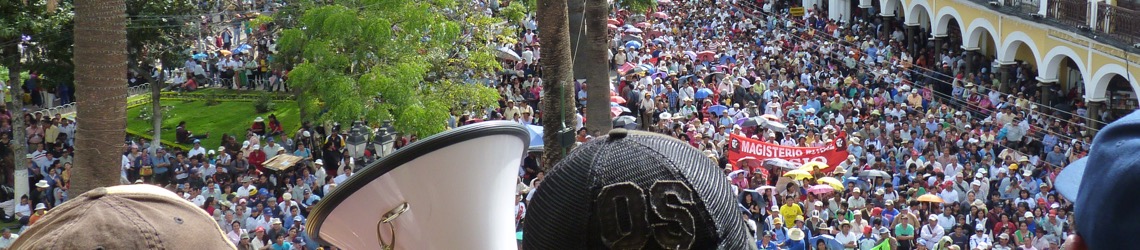
Tuesday at the CMPCC was the first day of truly massive events, besides the 17 (+1) Working Groups (Mesas de Trabajo) which themselves reached up to 500 people each. Yesterday morning was devoted exclusively to a massive opening ceremony held at Tiquipaya’s stadium. The New Bolivia has a combination of faces: the grassroots movements gathered in a stadium face, the indigenous tradition face, and the we’re running the state face. All three were on display in the pageantry of yesterday morning: dozens of banners and hundreds of wiphalas (indigenous flag of the Andes whose rainbow colors symbolize inclusion) marked the first side; the ceremony was inaugurated with requests for permission from Mother Earth and Father Cosmos; and Evo’s entrance began with a massive salute from hundreds of red-coated soldiers.
The content of the speeches was more interesting (Evo’s personal content was extended and rambling, but had its good moments which are already beginning to be overshadowed by tactless and factless comments about male sexuality and European baldness), and led into the afternoon session on “The Root Causes of Climate Change.”
The morning speeches were marked first by representatives of five continents (no one from Australia or Antarctica) addressing the summit: Faith Gemill (a Gwich’in from Alaska) spoke about a shared need to decolonize indigenous peoples; a member of the European Parliament’s left-green alliance said that the summit has allies on the European left willing to challenge the Copenhagen Accord; Nnimmo Bassey of Friends of the Earth-Nigeria/International called for an end to fossil fuels (“Keep the oil in the soil, the coal in the hole, and the tar sands in the lands”) and a rejection of false solutions; Suma Dutra argued that more than 90% of her native India has not been part of the new fossil-fuel-dependent economy and that this majority is waking up to the issue; and Eveldina Mazioli (Brazil) spoke to the systemic change towards small-scale agriculture advocated by Via Campesina, one of the world’s largest and most dynamic transnational alliances.
This brought us to Evo, who addressed with props differences between the capitalist and indigenous way of life. What I found striking was the personal animus involved on the part of people wanting show they are “better than” indigenous people, by using commodities. Contrasting a ceramic, fancy china, and plastic plates, Evo pointed out that capitalism/consumerism encouraged people to leave behind the plates that return to being earth when they break, in favor of modern versions that contaminate the world around them.
The massively attended afternoon session on “Root causes of Climate Change” kept its focus more exclusively on capitalism, with activists, a sociologist, an ethicist, and a vice president all framing the issue. Real aspects of capitalism are driving factors in the global ecological crisis: the quest for expansion, relentless incorporation of resources into the economy, an inability to settle for sufficiency, the promotion of consumerism as an economic strategy, treating environmental costs as externalities, and on and on.
Of course, however reasonable it is to put capitalism at the center of the ecological crisis, doing so raises more questions than it answers. Let me put this another way for people who aren’t as skeptical of capitalism as I am: suppose we accept that the dynamics of capitalism are provoking a crisis in the liveability of the planet; and that those same dynamics make any kind of solutions extremely difficult. What other questions does that raise?
First, what kind of economic and social systems might substitute for endless growth? How will they provide incentives for a “people-centered economy”? Unlike when I was growing up, the other possible are less unified, but far more diverse. The plural left here in Bolivia is one example of the kind of diversified solutions: nationally direct industries function alongside communal indigenous economies, and small and massive cooperatives. What is not capitalism is many things.
Second, how in the world does the political groundswell needed for real transformations get built? Third, what alternatives? (This is the easy one, actually: There’s a ton of movement, planning, and visioning work done on this question.)
Fourth, and most complicated, given that capitalism isn’t going anywhere in most of the world for at least a few decades, how much inside-capitalism response to the climate crisis is necessary? This may be the hardest question, since capitalism and its critics will have to work together to solve one of the most difficult technical and social problems ever, even as the critics remain skeptical that an end to the crisis is possible through such cooperation.
Beyond our economic system (as if that were a small matter), I think we have to ask real questions about the other issues raised by our five continental representatives.
Culture: We are talking about a real ethical transformation, built atop many cultures that have got used to relentless consuming more as a chief measure of personal status. And we’re also talking about internalizing all the consequences of our decisions for other people and the planet in our economic and social choices. What in the world will that look like.
Colonialism: The power states exercise over indigenous peoples, and that a powerful few countries exercise over the rest ends up being a key factor in climate change. The oil and mining industries operate through inequality between regions of production and consumption. Simply put, the kind of people who drive SUVs wouldn’t put a conventional oil pit in their backyard to do so. Instead they rely on less fortunate communities to supply the fuel, and pay the price. The one nice thing about this arrangement is that confronting it creates a virtuous cycle. To the degree that drillsite and fence line communities demand respect or gain in power, the whole system gets an incentive to switch to green ways of being. The difficult part is that very real systems of power have to be challenged in the process.
False solutions: In the short term, there are both real and false solutions to climate change. Some things will in fact slow, and one day reverse, the increase in carbon dioxide in the atmosphere. Others won’t. How do we tell the difference? And how do we stop the false solutions from being implemented? This is extremely important in a “flexible” climate change regime like the one that exists since the Kyoto Protocol: any country can pay another to implement a cheaper false solution, and avoid real emissions cuts in return.
Finally, in writing this I feel torn geographically. Half of these questions may seem un-askable in the United States. They are daily matters of discussion in movements here. And from the looks of the conference not just here. The thing about the global climate crisis is that it makes asking difficult questions a necessity. Since the 1990s, the small island states of the world have regarded these kinds of global discussion as life or death matters, because they are: they might be literally underwater without comprehensive solutions. In recent years, much of Africa (facing desertification and major food production loss) and countries like the low-lying, very-dense Bangladesh (not as low-lying or dense as the Netherlands, but money works wonders) have been added to the list. In circumstances like these, you must move very quickly along a chain of logic like this: “If capitalism is the problem, what might be the solution.” Or along a different chain of logic: “If the global economy can’t feed over one billion people, what good is it?” Part of seeing this week’s conference for what it is, is to recognize that thousands of people from movements across the global South, and some of the North as well, are here asking themselves just these kinds of questions. It may be a while before such questions seem reasonable to North Americans, and longer before they seem practical. This post hopes to make that possible.