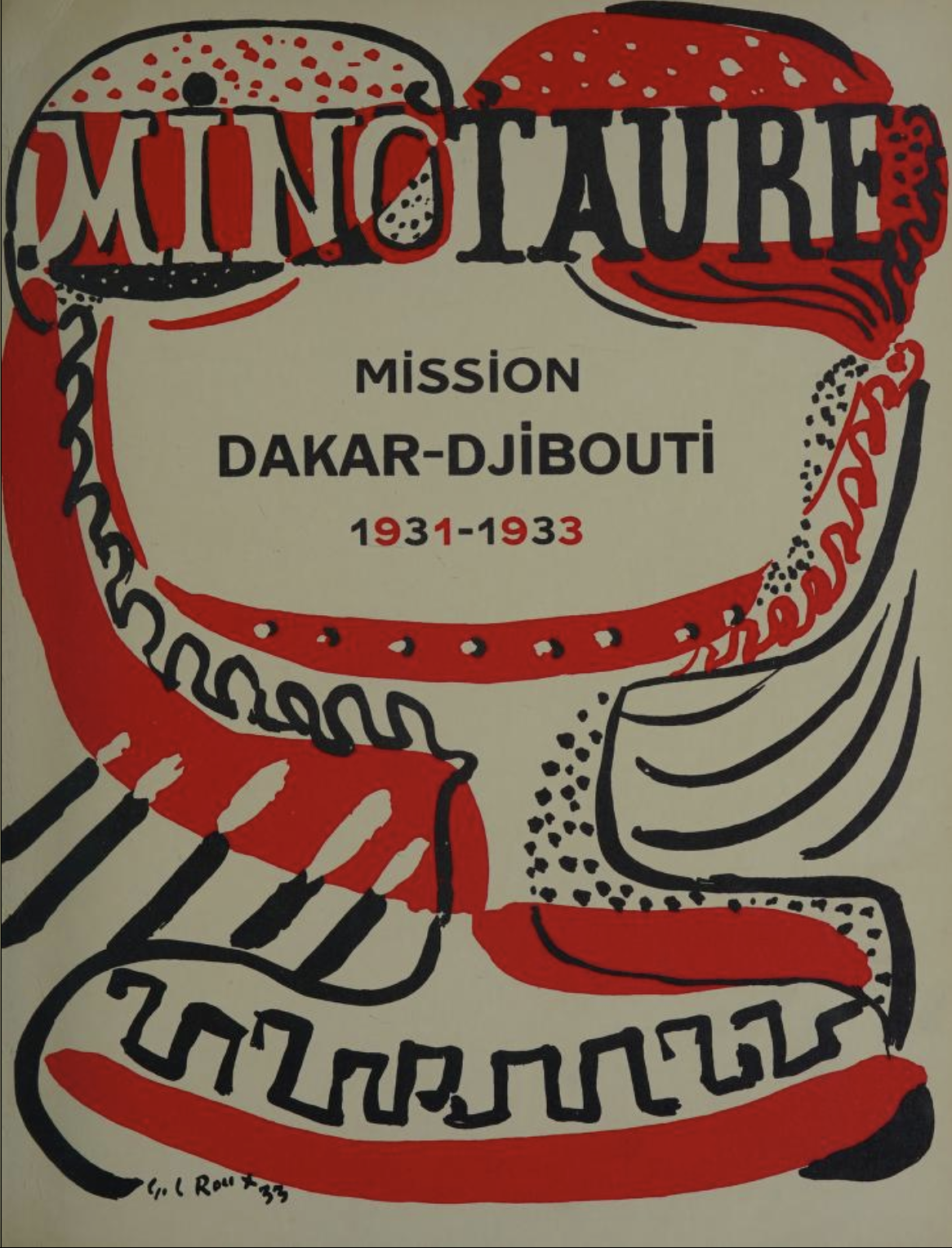
1933: It was celebrated as a great achievement in the practice of anthropology. It was organized alongside the other organizational cornerstones of Paris’ Museum of Man (Musée de l’Homme) and under the sponsorship of the museum’s leading figures. It brought to Paris over 3,500 objects of African traditional art and religion. And in so doing, it was celebrated in one of the two premiere issues of the surrealist magazine Minotaure, making it part of the closest approach between high art and ethnography. It fed into the galleries of the Museum of Ethnography at the Trocadero, and soon its successor on the same site, the Museum of Man.
Organized by the Institute of Ethnology at the University of Paris and the National Museum of Natural History, and established by the law of March 3, 1931, passed unanimously by the French [Parliamentary] Chambers, the Dakar-Djibouti Ethnographic and Linguistic Mission received, in addition to grants from numerous private individuals, the active patronage of twenty-three official institutions or organizations recognized as being of public utility, including three French ministries, the Académie des Inscriptions et Belles-Lettres, the University of Paris, the Museum of Ethnography, the National Library, the School of Oriental Languages, etc. In addition, the Rockefeller Foundation awarded the head of the mission a substantial grant, in addition to the regular fellowships.
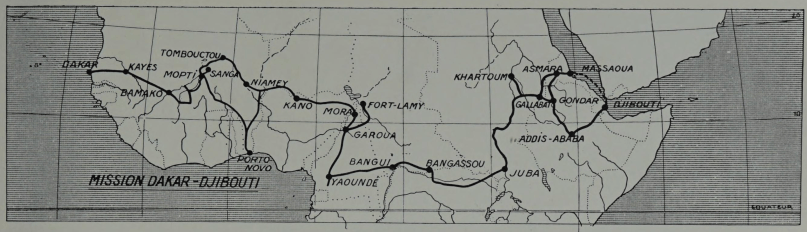
Having departed from Paris on May 10, 1931, the Dakar-Djibouti Mission arrived in Dakar on May 31. From June 12, 1931, to February 7, 1933—the date on which it embarked in Djibouti to return to France—it traveled through French West Africa, Nigeria, Cameroon, French Equatorial Africa, the Belgian Congo, Anglo-Egyptian Sudan, Abyssinia, Eritrea, and the French Somali Coast. Throughout its travels—which it undertook by train, automobile, boat, and caravan—the mission conducted surveys and assembled collections.
Rivet, Paul, and Georges-Henri Rivière. “La Mission Ethnographique et Linguistique DAKAR-DJIBOUTI.” Minotaure (Paris), no. 2 (June 1933): 3–5. https://archive.org/details/bwb_p9-btl-400_2/page/n111/mode/2up.
And yet in 2025, the Dakar–Djibouti Mission could not be remembered as a simple landmark of French anthropological history, not without a new investigation that put its organizers and participants under the microscope. The Quai Branly Museum, which has taken charge of the vast religious and art collections of Musée de l’Homme, hosted a new exhibit, Mission Dakar-Djibouti (1931-1933): Contre-enquêtes (Mission Dakar-Djibouti (1931-1933): Counter-Investigations). The exhibit was co-curated by six scholars from Africa—at the Museum of Black Civilisations, Senegal; National Museum of Cameroon; National Museum of Mali; University of Gondar, Ethiopia; and University of Abomey-Calavi, Benin—and two from France (official announcement; English visitor’s guide).
And that results of that investigation are frankly devastating.
Read More »
