
Bad science journalism: Gay facial recognition

Journalistic accounts of soon-to-be-published study called “Deep neural networks are more accurate than humans at detecting sexual orientation from facial images” (by Michal Kosinski and Yilun Wang) have gone viral and already prompted some outraged reactions from LGBT groups GLAAD and the Human Rights Campaign. The study primed a deep neural network face recognition program on photos of white homosexual and heterosexual adults obtained on a dating website, and used it to create a “classifier” that rates which photographs were most distinctively those of gay or lesbian people. This classifier’s ability to distinguish gays and lesbian individuals was compared with human observers on test samples from the data, and on Facebook profile pictures with a stated sexual orientation.

This is all a vaguely interesting computer science project about self-presentation (all of the images were curated by the people involved and put on profiles stating an “interest in” one sex or  the other), machine learning, and perception. Interesting, that is, until it is attached to fears about artificial omniscience and ubiquitous surveillance, and debates about nature and nurture. Then it becomes at turns frightening and polemical.

Before we get there (and I’ll update this post with some comments about the authors’ dubious understanding of the many social layers that separate, say pre-natal hormones and early adult physical presentation, the fluidity of sexual orientation, and the presumed future capacity of artificial intelligence to make omniscient predictions), we have to ask whether the results of this study justify this kind of grand implications. In other words, we first need to know what exactly the study shows.

Let me begin with two simple asks for journalists reporting on science:

  1. Read the whole scientific paper and explain to readers what actual evidence is being presented!
  2. Also, remember that “discussion” sections of papers lack the scientific validity that is attached to results of the research method involved.
  3. Be literate in math.
  4. Never ever present a numerical result without explaining what that number means.

Unfortunately, major accounts of the paper (such as this one in the Guardian) fail to follow this simple rule. And, as is often the case, the problem starts with the headline:

New AI can guess whether you’re gay or straight from a photograph
An algorithm deduced the sexuality of people on a dating site with up to 91% accuracy, raising tricky ethical questions

Now, does the paper show that the AI can guess your sexuality from a photograph with 91% accuracy? Nope.

As the paper states:

The AUC = .91 does not imply that 91% of gay men in a given population can be identified, or that the classification results are correct 91% of the time.

Here’s the 91% claim. The AI is shown five photos from two individuals on the dating website. Based on what it has learned from other photos, it offers a guess as to which is more likely to be gay. In 91% of the cases where there is a gay man and a straight man being compared it guesses correctly. Accurate headline:

AI can distinguish gay men based on five dating profile pics 91% of the time.

When presented with just one pair of images of men, the AI guessed right 81% of the time. Human judges—recruited by Mechanical Turk and untrained on any images—guessed right just 61% of the time. For women, both were right less often: 71% for the AI and 54% for the humans. In this test, 50% is rock bottom, the equivalent of zero gaydar.)

But it gets worse. Let’s try to apply the paper to original question raised by the headline. How well can this AI judge an individual person’s sexuality? That’s the critical ability, from which dystopian surveillance fears arise. For this, the researchers seemed to have tuned the data very carefully. Remember too, this is still an operation performed on profile pics, this time from Facebook.

First, the AI classifier still seems to work, though not as well:

The classifier could accurately distinguish between gay Facebook users and heterosexual dating-website users in 74% of cases…
But when presented with the task not of telling a gay profile pic from a straight one, but of evaluating a whether given profile pic is gay, the machine’s performance fell apart:

The performance of the classifier depends on the desired trade-off between precision (e.g., the fraction of gay people among those classified as gay) and recall (e.g., the fraction of gay people in the population correctly identified as gay). Aiming for high precision reduces recall, and vice versa.

Let us illustrate this trade-off… We simulated a sample of 1,000 men by randomly drawing participants, and their respective probabilities of being gay, from the sample used in Study 1a. As the prevalence of same-gender sexual orientation among men in the U.S. is about 6–7%, we drew 70 probabilities from the gay participants, and 930 from the heterosexual participants. We only considered participants for whom at least 5 facial images were available; note that the accuracy of the classifier in their case reached an AUC = .91. Setting the threshold above which a given case should be labeled as being gay depends on a desired trade-off between precision and recall. To maximize precision (while sacrificing recall), one should select a high threshold or select only a few cases with the highest probability of being gay. Among 1% (i.e., 10) of individuals with the highest probability of being gay in our simulated sample, 9 were indeed gay and 1 was heterosexual, leading to the precision of 90% (9/10 = 90%). This means, however, that only 9 out of 70 gay men were identified, leading to a low recall of 13% (9/70 = 13%). To boost recall, one needs to sacrifice some of the precision. Among 30 individuals with the highest probability of being gay, 23 were gay and 7 were heterosexual (precision = 23/30= 77%; recall = 23/70= 33%). Among the top 100 males most likely to be gay, 47 were gay (precision = 47%; recall = 68%).
Tuned to its highest setting, the machine could find nine of the seventy gay men and threw one straight man in the gay box. Set to a broader setting, the machine found 47 of the 70 gay men, but also labelled 53 straight men as gay.
Now, we have a big technical problem: the artificial gaydar can only find most of the gay people when it produces a pool of “gay looking” people that is majority straight. So no matter how repressive and homophobic the society, it’s hard not to imagine that the “gay looking” 5% of the population will put up with this kind of system.
Of course, if we imagine that gay and straight people really have different faces and we just haven’t found the magic formula yet (and the authors seem to leap to this conclusion, for what it’s worth) then we can imagine a better AI figuring out how to tell the difference. But there are plenty of reasons to doubt that this ever has been or ever will be the case.

Making immigration illegal has always been a racist move

From the beginning, US immigration law has been about race.

The 1790 Naturalization Act offered US citizenship only to “free white persons.”

The Chinese were nearly all banned by the 1882 Chinese Exclusion Act, which also made those Chinese already here ineligible for naturalization.

The 1917 Immigration Act created the Asiatic Barred Zone, added a vast zone of East, Southeast, and South Asians and the Persian and Arab world to the exclusions.

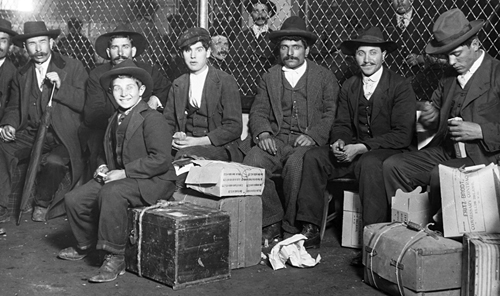
Until 1921, all white immigrants to the United States were legal immigrants, although a variety of entry criteria were made to exclude the poorest, radicals, homosexuals, and the disabled.

Then, explicitly racist people passed two immigration acts (in 1921 and 1924) designed to rebalance immigration away from Southern and Eastern Europe. They created the concept of illegal immigrants, and quotas. They  You can read President Calvin Coolidge’s intentions here:

"We might avoid this danger were we insistent that the immigrant, before he leaves foreign soil, is temperamentally keyed for our national background.  There are racial considerations too grave to be brushed aside for any sentimental reasons.  Biological laws tell us that certain divergent people will not mix or blend.  The Nordics propagate themselves successfully.  With our races, the outcome shows deterioration on both sides.  Quality of mind and body suggests that observance of ethnic law is as great a necessity to a nation as immigration law.  We must remember that we have not only the present but the future to safeguard; our obligations extend even to generations yet unborn.  The unassimilated alien child menaces our children, as the alien industrial worker, who has destruction rather than production in mind, menaces our industry.  It is only when the alien adds vigor to our stock that he is wanted.  The dead weight of alien accretion stifles national progress.  But we have a hope that cannot be crushed; we have a background that we will not allow to be obliterated.  The only acceptable immigrant is the one who can justify our faith in man by a constant revelation of the divine purpose of the Creator.  President Calvin Coolidge, “Whose Country is This?” Good Housekeeping, volume 72 number 2 February 1921, pages 13-14, 109"

Criminalizing  immigration has always been a racist move. And illegal alien has always been a legal gloss on racially undesirable immigrant.

Heroes

Among the immigrants on the white side of my family: a German fleeing conscription and the Franco-Prussian War, and Polish Jews in an era of pogroms. Draft dodgers and war refugees. They got here before 1921, so they didn’t break the law to enter. Instead, fear of people like them inspire those racist laws.

It’s easy to see now how the Chinese who overstayed their bonded labor status and gave birth to citizen children were heroes. Likewise the Chinese who became “paper sons” to bring their families and countrymen in. And so we’re the Italians and Slavs and Jews who defied the 1924 law (many of whose relatives, like mine, would not make it through World War II and the Holocaust). People who come here so their kids can have a better life, racist laws be damned, were heroes then and are heroes now.

Image at top: Racial types and criminality infographic by anthropologist and eugenicist Earnest Hooton, an advocate of immigration controls.

Ignoring new TIPNIS law, Bolivian government restarts roadway construction

Bolivian newspaper Página Siete has published photos of the ongoing construction of the Villa Tunari–San Ignacio de Moxos highway inside of the Isiboro Sécure National Park and Indigenous Territory. The current active construction continues work that began before the enacting of Law 266, which ends special protections for the territory, on August 13. The prior activity, revealed by indigenous residents was clearly in violation of Law 180 of 2011, which the new law repealed.

However, Law 266 also placed some legal limits on road building (see the full text of Law 266 (es)). Officially termed the Law of Protection, and Integral and Sustainable Development of the Isiboro Sécure National Park and Indigenous Territory (TIPNIS), it requires:

Article 9 … Integration and Articulation Activities [i.e., transportation infrastructure], which improve, establish, or maintain rights of indigenous peoples such as freedom of movement, whether through the opening of neighborhood roads, highways, systems of river navigation, or of aerial transportation, etc. shall be designed in a participatory manner with the indigenous peoples …

The law also establishes a planning process for development and integration:

A timeframe of 180 days is established for the elaboration of a Protection Plan for TIPNIS, the Integral Plan for Transportation in TIPNIS, and the Development Agenda for the Indigenous Peoples of TIPNIS to Live Well, in accordance with the results of the Consultation. Insofar as those documents are approved, the instruments of planning and management of TIPNIS shall be applicable, so long as they don’t contradict that which is established in this law, and in agreements resulting from the Consultation.

Right now, of course there is no Integral Plan for Transportation in TIPNIS, nor has any highway been designed in a participatory manner. Whether before or after the passage of the new law, the Bolivian government shows no sign of following the legal limits on its road building in TIPNIS.

Bolivian Senate approves law to de-protect TIPNIS amid protests across the country

The Bolivian Senate has approved Law 266, which allows for the construction of highways and exploitation of resources within the Isiboro Sécure National Park and Indigenous Territory (TIPNIS). Their vote came less than six hours after the law was brought to the Senate. In so doing, they set the stage for Bolivian President Evo Morales to abrogate Law 180 of 2011, legislation won by the Eighth National Indigenous March of the same year which declares TIPNIS to be an “intangible zone” and prohibits any highways from crossing it. The government has already secretly contracted with two contractors to build the controversial Segment II of the Villa Tunari–San Ignacio de Moxos highway, and journalists and residents have confirmed the presence of building equipment and construction parts inside the park.

Protests occurred throughout the last week in La Paz, Trinidad, Santa Cruz, San Ignacio de Moxos, and Cochabamba, organized by the Confederation of Indigenous Peoples of Bolivia, the Fundación Solón—led by former UN Ambassador Pablo Solón–, environmentalists, feminists, and indigenous solidarity activists. Protests continue today in La Paz, coinciding with the scheduled opening of the Senate session; with vigils in Santa Cruz de la Sierra and Trinidad (Beni Department), and in Cochabamba. Activists will gather for a “direct action” demonstration in Cochabamba at 7 pm local time.

Read More »

As he ordered attack on indigenous march, Bolivian Vice Minister saw raid as a fight to industrialize the country

Nearly six years ago, members of the Bolivian Army and National Police carried out a raid on some six hundred indigenous marchers at Chaparina. In a startlingly frank conversation addressing members of the National Police, Vice Minister of Police and the Interior Regime Marcos Farfán described the next day’s raid as a battle to preserve the government’s economic program and political future. (A video recording of his conversation was leaked to the press, and published this week by the Fundación Solón as part of an article by Pablo Solón). The Eighth National Indigenous March had as its first demand the defense of Isiboro-Sécure National Park and Indigenous Territory (TIPNIS), and put forward a general right of indigenous communities to say no to destructive projects within their territories.

On September 25, police mounted an attack on the indigenous marchers, beating and teargassing them, seeking out and arresting prominent leaders, and leaving behind a chaotic scene of injury, flight, and fear. Marchers, including prominent leaders, were grabbed, tackled, and handcuffed in front of network television cameras. Between 70 and 280 were injured in the assault, including Celso Padilla (president of the Guaraní People’s Assembly), hospitalized with multiple hematomas. Hundreds of marchers were taken on buses overnight in a frustrated attempt to return them by land or airplane to the starting point of the march. The raid at Chaparina was the breaking point for the lowland Confederation of Indigenous Peoples of Bolivia’s alliance with the government.

While the motives of the raid have long been evident, this forthright statement crystalizes the government’s motives in carrying it out. It will appear in any future historical account of when and how the Evo Morales government shifted from a rhetorical embrace of indigenous rights to a committed advocate of putting extractive industrial development first.

One must have a global, integrated vision of the matter, although it can be reduced to just the operation that we will carry forward tomorrow, it has to do with overall issues in terms of what our Constitution and program [of government] have proposed, which is rooted in industrializing, highways, hydroelectric dams, electricity, and energy.

But they [the indigenous marchers, presumably] are with their program attempting to avoid that going forward. They have their own political objectives behind it. The less able this government is to fulfill its programs, the fewer possibilities it will have in the future to gain votes.

Because if we don’t produce, if we don’t create industries, if we don’t build highways, if we don’t diversify our production, if we don’t transform our gas into other products, if we don’t generate added value from our raw materials, this government will fail. Everything will be ruined. This is the bottom-line objective that it [the march] has, to say that they were with Evo and his lovely proposals, but he didn’t carry them out. And he didn’t carry them out because of these kind of elements who put up hindrances and obstacles against carrying out that which is the job of nobody else in the country [but us]. A country in which we have been reduced to backwardness, to economic dependence, and to political dependence over years and years and years.

What we need to do is consolidate our sovereignty as a nation. To be sovereign, we must be productive, rich as a nation, and to be rich we need to produce and industrialize our country.

Thank you for listening to me. It doesn’t have much to do with the matter [at hand], but I believe it’s important to clarify those elements that have to do with all Bolivians, police officers or not, with the whole country. But it is within this framework that we, lamentably, are entering into carrying out this operation… Tomorrow, we will be working.

“Hay que tener una visión global, integral del tema, aunque se reduzca al operativo que vamos a llevar mañana adelante, pero tiene que ver con temas de fondo en relación a lo que establece nuestra Constitución Política y el programa por supuesto que se ha planteado, que radica en industrializar, carreteras, hidroeléctricas, electricidad, energía.

Pero están con este programa tratando de evitar que se lleve adelante. Tienen sus objetivos políticos ahí atrás. (Mientras) menos pueda dar cumplimiento a sus programas este gobierno, menos posibilidades va tener en el futuro de ganar más votos.

Porque si no producimos, no creamos industrias, no construimos carreteras, no diversificamos la producción, no transformamos nuestro gas en otro elemento, no generamos valor agregado a nuestro producto, este gobierno va a fracasar. Todo se viene al tacho. Este es el objetivo de fondo que se tiene, para decir estuvo el Evo con sus lindas propuestas pero no las cumplió. No las cumplió porque hay este tipo de elementos que ponen trabas y obstáculos para que se pueda dar cumplimiento a eso que no es en función de nadie mas que del país. Un país que hemos estado reducidos al atraso, a la dependencia económica, a la dependencia política durante años y años y años.

Lo que necesitamos es consolidar nuestra soberanía como nación. Para ser soberanos tenemos que ser productivos, ricos como nación, para ser ricos tenemos que producir e industrializar nuestro país.

Gracias por escucharme no tenía mucho que ver con el tema pero creo que es importante aclarar estos elementos que tienen que ver con todos los bolivianos, policías no policías, con todo el país. Pero en ese marco es que estamos, lamentablemente, entrando a realizar este operativo… Mañana vamos a estar trabajando”.

Within 48 hours, Marcos Farfán resigned his post as Vice Minister, reportedly to facilitate a public inquiry into the raid. A report leaked in 2013 revealed that prosecutors found that the raid was carried out in accordance with the chain of command. Interior Minister Sacha Llorenti, who was involved in the decision, was reappointed to serve as Bolivia’s Ambassador to the United Nations. In April 2015, prosecutors relieved Farfán, Llorenti, and other senior officials of criminal responsibility for Chaparina. Six officials then indicted have yet to face trial.

What’s wrong with the 2012 TIPNIS consultation?

At the core of the current legislative push to reverse the 2011 special protection law for the Isiboro-Sécure National Park and Indigenous Territory is the 2012 government-run consultation process. Government advocates and the sponsors of the legislation, Patricia Chávez and Romona Moye, repeatedly claim:

It’s the request of the people, the community members, their corregidores [a traditional leadership post] and leaders, through the prior consultation carried out within the territory itself. We have exercised our right to be consulted as Bolivians and as indigenous people who inhabit the region.

“Es el pedido del pueblo, comunarios, los corregidores y dirigentes, a través de la consulta previa desarrollada en el mismo territorio; nosotros hemos ejercido nuestro derecho a ser consultados como bolivianos e indígenas que habitamos esa región”

When proponents of the law have talked about how the law, the highway, and the revocation of the protective law have been discussed among the communities of TIPNIS, they are referring only to one and only one thing, the 2012 consultation. While there are real disagreements about it, all signs indicate that the consultation process was fundamentally flawed.Read More »

Emergency protests as Bolivian legislature considers bill to allow TIPNIS highway (live-blogging)

This morning, Thursday August 3, the Chamber of Deputies of Bolivia’s Plurinational Legislative Assembly is considering a bill that would authorize the country’s most controversial infrastructure project, the Cochabamba–Beni highway, to be built through the Isiboro-Sécure National Park and Indigenous Territory.

Ramona Moye and Patricia Chávez, two MAS-affiliated Deputies in the Plurinational Legislative Assembly, introduced the legislation on July 3, and it recently passed out of committee, and will be considered today. The bill, called the “Ley de Protección, desarrollo integral y sustentable del Territorio Indígena Parque Nacional Isiboro Sécure – Tipnis” (Law for the Protection, Integral and Sustainable Development of the Isiboro-Sécure National Park and Indigenous Territory) would repeal and replace Law 180, the 2011 law that protects the territory, declares it an “intangible zone,” and prohibits any highway project from passing through it. That law was the fruit of the a national march led by the Confederation of Indigenous Peoples of Bolivia and a wave of nationwide support of the cause of protecting the territory.

Where can I get a quick overview of the TIPNIS conflict?

If you understand Spanish, watch this documentary:

Other overviews in English are in Emily Achtenberg’s article Contested Development: The Geopolitics of Bolivia’s TIPNIS Conflict (2012), and Rob Key’s documentary The Dividing Line – TIPNIS and Bolivia’s Road (2013). An up-close look of the arduous path of resisting the highway comes is offered by this recent Mongabay profile of Fernando Vargas (in Spanish), the former President of the Subcentral TIPNIS.

What is the current state of construction of the highway?

The original funder of the highway, Brazil’s National Bank for Economic and Social Development, withdrew all funds from the project in 2012. Since then, the Bolivian government has funded the northern and southern segments of the project, located north of the park and inside the colonized Polygon 7 at the south end. Both of these segments have been troubled by delays and adverse construction conditions, but the southern Segment I was opened in 2016.

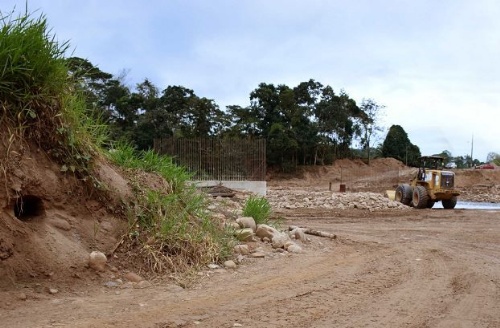
Screen Shot 2017-07-05 at 3.52.38 PM Despite the legal prohibition on Segment II, TIPNIS community members have recently shared photographic evidence that the government is actively building bridges inside of the Territory that would become part of the highway.

TIPNIS-Unauthorized Construction-July17 170998

Emergency Protests in Defense of TIPNIS

On Wednesday, August 2, activists in La Paz marched and set up an encampment (plantón) in Plaza Camacho opposing the new law. Here is a half-hour video of their demonstration. Present in the video are Fabián Gil and Marqueza Teco from the Subcentral TIPNIS and a representative of CONAMAQ Orgánico.  Press coverage: Página Siete.

A protest is being held on Thursday, August 3 in Cochabamba.

Resources for following the controversy:

Live coverage today

  • The press service Agencia Nacional Fides is covering the debate live on Twitter: Follow @noticiasfides
  • The government line within the Plurinational Legislative Assembly is being live tweeted at @Diputados_Bol
  • Twitter hashtags: TIPNIS, #TIPNISenEmergencia

Tense session in the Assembly

Fides reports Fides reports that security has prevented three opponents of the highway from entering the chamber during debate: Rafael Quispe, former head of CONAMAQ and currently an alternate deputy in the Assembly; Senator Edwin Rodríguez, head of the UD delegation; and Fernando Vargas, leader of the 2011 March and former President of the Subcentral TIPNIS. Vargas was later admitted into the gallery.

Inside the session, one opposition tactic was deputies wearing masking tape over their mouths to recall the police use of the same tape on captured members of the pro-TIPNIS march in September 2011. Another was protest signs within the session.

The debate included extended statements from MAS-IPSP deputies Patricia Chávez and Ramona Moye (indigenous seats, Cochabamba), Gabriel Montaño (Santa Cruz), Juana Quispe (Chimoré in the Chapare), and Emilio Vilche (alternate deputy and an affiliate of CONISUR). The official Twitter feed of the Chamber of Deputies (@Diputados_Bol) broadcast these statements but not those of opponents of the legislation. Opposition deputy Shirley Franco (UD) complained about a lack of parity in participation, but Montaño counted 16 opposition speeches, which she claimed lasted over 4 hours out of 11 hours of debate so far.

In the end, the Chamber of Deputies approved both the overall bill and the detailed text as presented.

Even before this approval, the Senate’s Committee on Land, Territory, Natural Resources and Environment put the legislation on its agenda (see image to the right). Minutes later, a vote in that committee resulted in a tie vote. A rapid-fire consideration of the bill is well underway. Late in the evening, Senate President José Alberto “Gringo” Gonzalez stated publicly that the chamber as whole will take up the bill next Tuesday morning, August 8, at 11am.
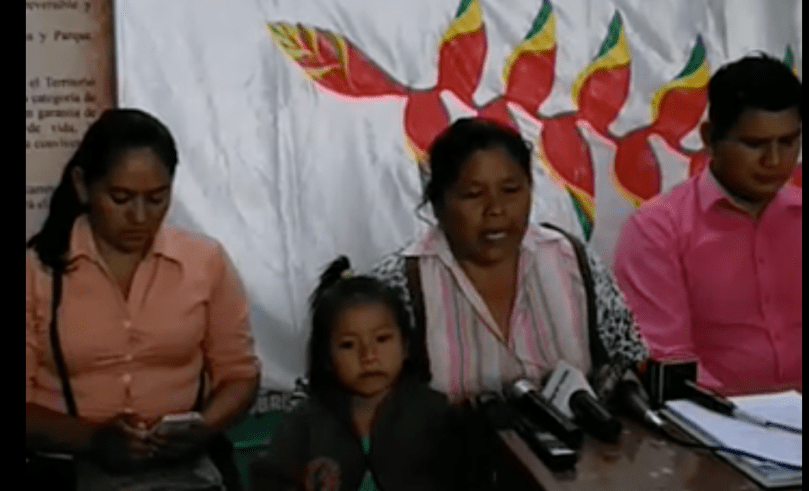


Video: TIPNIS leaders speak out against law that threatens their territory

Screen Shot 2017-08-05 at 6.35.29 AM

Press conference featuring leaders of the Subcentral TIPNIS
Conferencia de prensa dirigentes de la Subcentral TIPNIS

Marqueza Teco, President of the Subcentral of Women of TIPNIS
Fabián Gil, President of the Subcentral TIPNIS (elevated from Vice President by community resolution repudiating Domingo Nogales’ role in supporting the proposed law)

Available as Facebook live video segments: 1 | 2 (es)

Departmental Civic Committees: Build highway outside of TIPNIS

An assembly of Bolivia’s departmental Civic Committees has called on the government of Evo Morales to re-route a controversial highway to the east of the Isiboro-Sécure National Park and Indigenous Territory (TIPNIS). In their joint statement issued on July 20, the establishment organizations write,  “We categorically reject the Villa Tunari-San Ignacio de Moxo highway project for destroying TIPNIS and propose that the connecting of Beni and Cochabamba should be [instead] articulated along a Villa Tunari–Camiaco–Loreta–Trinidad route. Rechazamos categóricamente el proyecto carretero Villa Tunari-San Ignacio de Moxos por destruir el Parque Nacional y Territorio Indígena Isiboro Sécure (TIPNIS) y proponemos que la articulación entre Beni y Cochabamba sea: Villa Tunari-Camiaco-Loreto-Trinidad.” This alternative route is one of several that has long been ignored as the Morales government pressed to build a highway northwards out of the coca-growing Chapare and directly through the national park, inhabited by Mojeño-Trinitario, Tsimané, and Yuracaré communities who have campaigned against it for over a decade. I last reported on these option in 2012, when the Isiboro Sécure Defense campaign estimated that the route (number 2 on the map below) would be 250km in length, about 50km shorter than the project underway.

Map of four options to the Cochabamba-Beni highway through TIPNIS

Bolivia’s civic committees are coalitions of mainstream organizations, equivalent to an amalgam of a Chamber of Commerce, assembly of government officials, church leadership, and charitable organizations. While in the 1960s and 1970s, they played a key role as an independent voice for civil society amid Bolivia’s military dictatorship, they emerged as a right-wing counterweight to the Morales government in 2005. The right-wing civic movement encompassed committees in the eastern and central provinces, while civic committees in Potosí, La Paz, and Oruro have tilted leftwards. (Oruro and Potosí civic committees have organized important protests making regional demands of the national government.) This week’s report of a joint statement represents an important new voice in the ongoing conflict. It builds upon an alliance of indigenous and center-right project skeptics that backed Carmelo Lens in the 2015 governor’s race in Beni department. As can be seen below, civic committees from Cochabamba, El Alto, Tarija, Oruro, Pando, Camiri, and Chuquisaca, issued the statement, in cooperation with TIPNIS leaders Fabian Gil, Marqueza Teco, and Fernando Vargas.

Images of the resolution provided by Lelponi Maria Alba Guillén de Vargas.

How Johnson, white Americans ignored the commission that investigated the riotous summer of 1967

Michigan (Public) Radio, currently remembering the Detroit riots of 1967 (Wikipedia), has produced a dramatic and fascinating account of the Kerner Commission’s findings on the causes and possible solutions to the summer of racial unrest in 1967, which came to be known as the Long, Hot Summer. And why and how they have been ignored for forty-nine years.

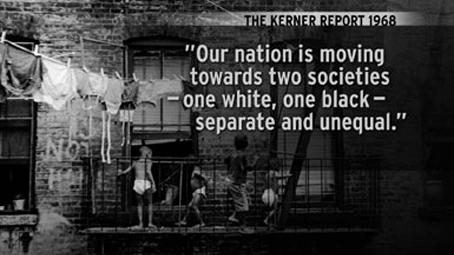
When the Kerner Commission spoke, proclaiming the United States was “moving toward two societies, one black, one white –  separate and unequal,” a fearful Democratic Party shut its ears:

“The report put the responsibility for all of this stuff on white society and white institutions. That, I think, was a surprise to some white Americans and I think that was part of the reason he [President Lyndon Johnson] was very careful not to upset the large segment of white society. That was why I think it happened like that.” — Professor Joe T. Darden, Michigan State University

President Lyndon Johnson’s response was more personal. He was hurt that his Great Society programs weren’t praised by the Commission and had made the Vietnam War, not the so-called War on Poverty his budget priority.

“And Bobby [Kennedy] just gave me hell today for not carrying out the Kerner Commission study. Well, I didn’t realize when I appointed Kerner that this son-of-a-bitch from New York, [Mayor John] Lindsey, would take charge. He did take charge and he recommended I hire two-and-a-half million people on federal payroll. And I just, I’ve not wanted to reflect on Kerner and criticize the Commission. At the same time, I couldn’t embrace it because I’ve got a budget,” Johnson said in a secretly recorded phone conversation.

Yesterday’s radio report is also remarkable for its frank admission that economic inequality among races in the United States may be getting worse, not better. Have a listen.

Previous coverage on this blog of the Kerner Commission’s investigation of who rioters were, and what tactics they chose, is here: Kerner Commission report on 1967 riots seems eerily familiar.

Documentary offers local perspective on TIPNIS conflict: “The rivers are our road.”

If you’re new to the re-emerging conflict over the Isiboro-Sécure National Park and Indigenous Territory (TIPNIS), or if you simply want a visual look at the lush environment that is being fought over, there is no better place (for Spanish-speakers) to start than the 2016 documentary El camino es el río [The River is the Road]. Beautifully shot in the TIPNIS communities of Nueva Lacea and Puerto San Lorenzo, it is also co-narrated by Marquesa Teco, the President of the Women’s Subcentral of TIPNIS and one of the most important voices within the territory in 2017.

The name of the documentary says a lot. For proponents of running the Villa Tunari–San Ignacio de Moxos highway through TIPNIS, connecting the territory to outside markets offers the promise of development. However, as the documentary shows, these promises run counter to the actual needs of longtime Tsimané, Yuracaré, and Mojeño-Trinitario residents, whose communities are linked by rivers that generally flow from east to west.

“We the Yuracarés and the Trinitarios are people who live on the rivers, we make our communities by their banks,” Silverio Muiba, a Mojeño-Trinitario resident of Santíssima Trinidad observed to Sarela Paz a generation ago. “On the other hand, the Quechuas always live were there is a road: where the road runs out, so do the collas [highland indigenous people].”[1] The different needs of Quechua- and Aymara-speaking cocaleros, who have steadily turned the forests of TIPNIS into new plots for growing coca connect readily to the highway. Their livelihoods are built around a cash crop that serves distant markets.

Should the highway be built, it will literally pass by (and far away from) most indigenous communities. They will feel its effects in the increased deforestation of the interior of the park without ever receiving transportation benefits.

CEDIB-Carretera, Comunidades
Graphic by CEDIB illustrates how few indigenous communities (magenta dots) are connected to the proposed (dark grey) highway. source

[1] Sarela Paz Patiño, “El Limite Yuracaré,” Facetas, July 24, 1994, sec. Datos e Análisis, http://www.bibvirtual.ucb.edu.bo/etnias/digital/106000425.pdf.

Image above: still from El camino es el río.