dispatches across boundaries of states, and states of mind
Author: Carwil Bjork-James
Assistant Professor of Anthropology at Vanderbilt University. (My opinions are my own, and not my employer's.) Author of The Sovereigns Street: Making Revolution in Urban Bolivia (sovereignstreet.org). I conduct immersive and historical research on disruptive protest, grassroots autonomy, state violence, and indigenous collective rights in Bolivia.
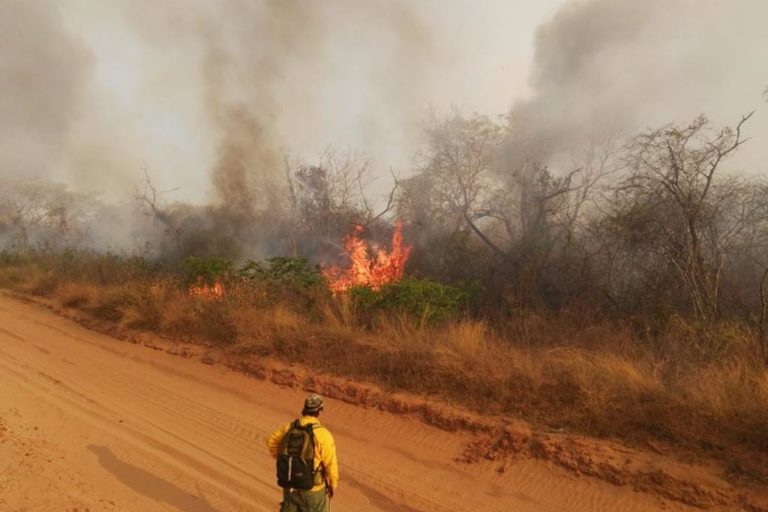
The ongoing fire crisis in the Eastern Bolivia department of Santa Cruz has burned 187,800 hectares of the Ñembi Guasu Area of Conservation and Ecological Importance, scorching forests and leaving behind burnt out wildlife carcasses. The destruction in one-sixth of the Ñembi Guasu comes just four months after the Guaraní Charagua Iyambae autonomous government designated the park as protected on April 29, 2019.
According to reporting from El Deber, the Fires started in Roboré municipality, which has received much of the local attention during the ongoing Chiquitano dry forest fire crisis. But Charagua is the worst-affected municipality in the country, with 239,073 hectares burned according to recently released satellite analysis from the Fundación de Amigos de la Naturaleza.
El Deber reports the fire rages uncontrolled:
Today, it is the largest fire in the country; the only one that no one has taken care of up til now. Since August 9, when a chaqueo [slash and burn fire] got out of control 15 kilometers from Roboré, the flames have devoured land, reaching over 100 km away… and spilling over as far as Paraguay, towards Otoquis [Park] and still no one has done anything to put it out.
Hoy es el incendio más grande del país; el único que nadie ha atendido hasta ahora. Desde el 9 de agosto, cuando un chaqueo se descontroló a 15 kilómetros de Roboré, las llamas han devorado más de 100 kilómetros en línea recta, 187.800 hectáreas hasta ayer, ya se ha desbordado hasta Paraguay y hacia el Otuquis y aún nadie hace nada por apagarlo.
Pablo Ortiz, “Nadie atiende el incendio de Ñembi Guasu: el área protegida más joven,” El Deber, August 27, 2019.
The current fire in Ñembi Guasu stands as a potent metaphor of the risks that agricultural deforestation poses to both indigenous autonomy and conservation. Unless they have the resources to defend the territory, manage disasters, and shape policy, so-called Protected Areas will remain unprotected.
FAN visualization of fires in 2019 in Santa Cruz department
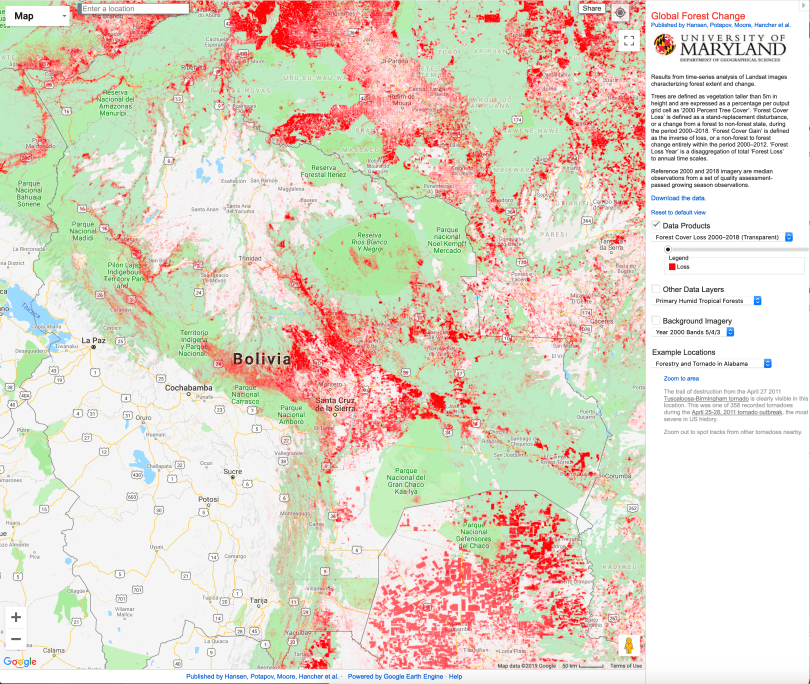
The image above, produced by the University of Maryland’s Global Forest Change explorer, shows the loss of forest in Bolivia and surrounding countries from 2000 to 2018. As the fires continue to burn in Bolivia’s Chiquitano dry forest in Santa Cruz department, as well as in Beni, Pando, and Cochabamba departments, it’s important to take a longer look at the problem of deforestation in Bolivia. This post discusses its scale, hot spots, and how the current trend will break Bolivia’s climate pledges to the international community.
Deforestation is an ongoing, massive problem in Bolivia
According to official figures by the Bolivian government, deforestation exceeded 200,000 hectares (494 thousand acres) in 11 of the 13 years from 2004 to 2017, the last year for which I could find data from ABT, Bolivia’s Forest and Lands Authority. Here are their annual estimates.
With the world’s eyes turned towards the fires in the Amazon rainforest, and primarily on Brazil, there is good reason to survey the larger problem of deliberate deforestation across South America. Right now Bolivia is several weeks into the most devastating season of fires in at least a decade. As of August 22, the Bolivian government reported that 744,000 hectares of the country were affected by the blazes, and by Saturday, August 24, the regional government of Santa Cruz raised that estimate to over one million hectares.
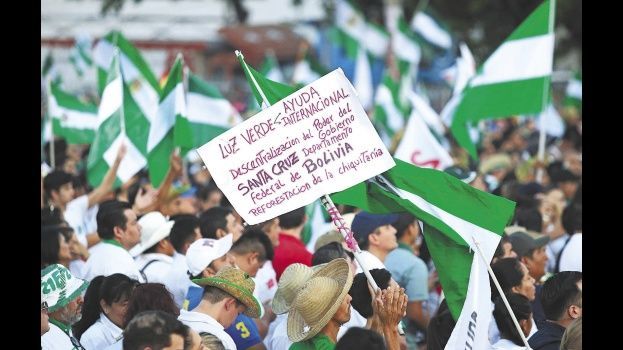
A key driver of the fires in both countries is the deliberate clearing of forest land for agricultural production, which has been prioritized by left-wing government of Evo Morales as well as the right-wing government of Jair Bolsonaro. Last week, both presidents reacted flippantly to the growing international attention surrounding the fires. (On August 19, Morales called the fires “natural phenomena” that “will continue” in years to come and seemed preoccupied with avoiding blame: “This is not the first time that there have been fires, they have always been around. Now they want to blame Evo Morales for the fires.” ) After the fires became a key discussion point at the G7 meeting, and following growing protests demanding international aid in eastern Bolivia, however, both men have attempted to show their governments are proactively responding to the emergency. Nonetheless, government policy in Brazil and Bolivia is fueling and authorizing the underlying drive to convert more of primary forests into croplands and grazing fields for cattle. This fact has been widely recognized for the government of Bolsonaro, who defied environmental regulators on his own private property before taking office, and who has dismantled environmental protections as president.
Unfortunately, the same policy priorities are at work in Bolivia under President Evo Morales. While from a different social class, as the leader of the Chapare coca grower’s union, Morales shares a similar orientation towards the forests of their respective countries. Both men see the Amazon rainforest (and in Bolivia’s case, the Chiquitano dry forest as well) as underpopulated areas of land that ought to be incorporated into the national economy through production for the market. (Contrary to some wild-eyed Twitter claims, however, the current fires in Bolivia are in the service of cattle and lowland export crops like soy, not coca.)
In 2013, the Morales government laid out its territorial vision as part of its 2025 Patriotic Agenda, a thirteen-point series of goals whose target date is the bicentennial of Bolivian independence. The plan, describing “how we want our beloved Bolivia to be” in Morales’ words, proposes an ambitious reterritorialization of Bolivia that will affect large portions of the country’s land surface, with millions of hectares altered by new agricultural, hydrocarbon, and infrastructural initiatives. It offers quantitative targets for the use of Bolivia’s land, water, and natural resources. In writing the plan, Bolivian government planners worked on a wide canvas: the full area of Bolivia’s national territory, which consists of nearly 110 million hectares and land and domestic waters.
The most dramatic shift proposed in the Patriotic Agenda is the so-called “expansion of the agrarian frontier”: increasing the total land under cultivation from 3.3 million hectares (in 2013) to as many as 13 million hectares by 2025. This staggering figure has been put forward by the president, vice president, and ministers, but their reach exceeds their grasp. The technical data used by the government’s planning staff, according to Fundación Tierra researcher Enrique Castañón Ballivián, corresponds to a still-startling 6-million-hectare cultivated area. Nearly half of the projected expansion would come in the eastern department of Santa Cruz, where soy (and soy oil)-exporting agribusiness dominates the economy. Costañón argues that this expansion would inevitably clash with indigenous collective titles, as well as forested areas.
While this agricultural land goal seemed unrealistically ambitious at the time, it has set the direction for Bolivia’s forest and land management agencies and for new decrees like the one that set off the current fires in the Chiquitanía.
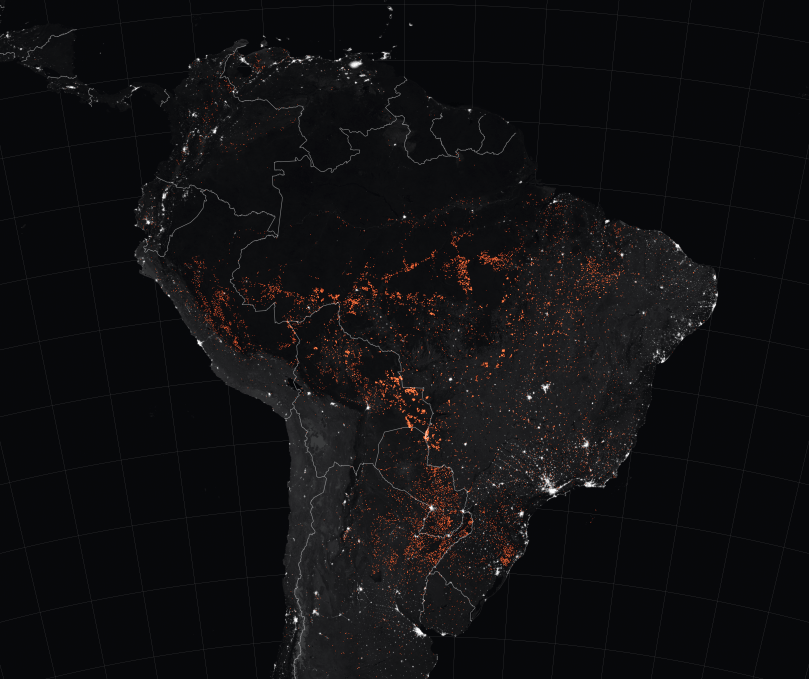
This image from NASA offers a panorama of the fires raging across South America during the week of August 15 – 22, 2019. World attention has turned to the Amazon rainforest fires in Brazil, where ultra-right President Jair Bolsonaro has drastically cut back environmental enforcement. This week, there has been needed attention brought to Bolivia’s rapidly expanding fires, primarily in the Chiquitano dry forest. Claire Wordley offers a solid primer on the situation in English.
As of August 22, the Bolivian government reported that 744,000 hectares of the country were affected by the blazes, and by Saturday, August 24, the regional government of Santa Cruz raised that estimate to over one million hectares. These are parallel crises, caused by independently set fires. A key driver of the fires in both countries is the deliberate clearing of forest land for agricultural production, which has been prioritized by left-wing government of Evo Morales as well as the right-wing government of Bolsonaro.
Earlier this month, I spent ten days in La Paz working on Ultimate Consequences: A database of deaths in Bolivian political conflict during the democratic era. This project is a compilation of detailed information about the human cost of political struggle in the country I have been research and writing about for over a decade. It includes people killed when movements challenged the state and the state responded with violence—the initial spark for my research—but also a variety of deaths associated with coca erradication and resistance to it, deaths caused and endured by guerrilla and paramilitary forces, prolonged inter-ethnic conflict (mainly the “war of the ayllus” between the Laymi and Qaqachaka communities), political assassinations (both due to partisan politics and patriarchal rejection of women coming to forma leadership), and the times when self-sacrificial protest (hunger strikes and prolonged marches under adverse conditions) claimed the lives of protesters and their children.
As of today, we have 512 deaths recorded, 477 of them with names. It has been a grim, if captivating tour through recent Bolivian history. While I’ve had the collaborative support of two research assistants over the course of the project, I think I’ve read every story of death, and the process has been at turns sobering, enraging, frustrating, and deeply informative.
Right now, I am focused on getting two things done with this database: ensuring that our dataset is as complete as we can make it, and making several of the many variables that we are recording—starting with location and the role of the state—as completely specified as possible so that we can share complete summary data, maps, and other statistical visualizations with the public. In La Paz, this meant taking my camera on a lot of trips to the Archive of the Plurinational Legislative Assembly, which has decades of Bolivian newspapers bound into massive volumes, and coordinating with colleagues in a Bolivian NGO on a graphic visualization front-end for the database.
Can we retell history and write an encyclopedia as if all people are equally valuable?
Yes.
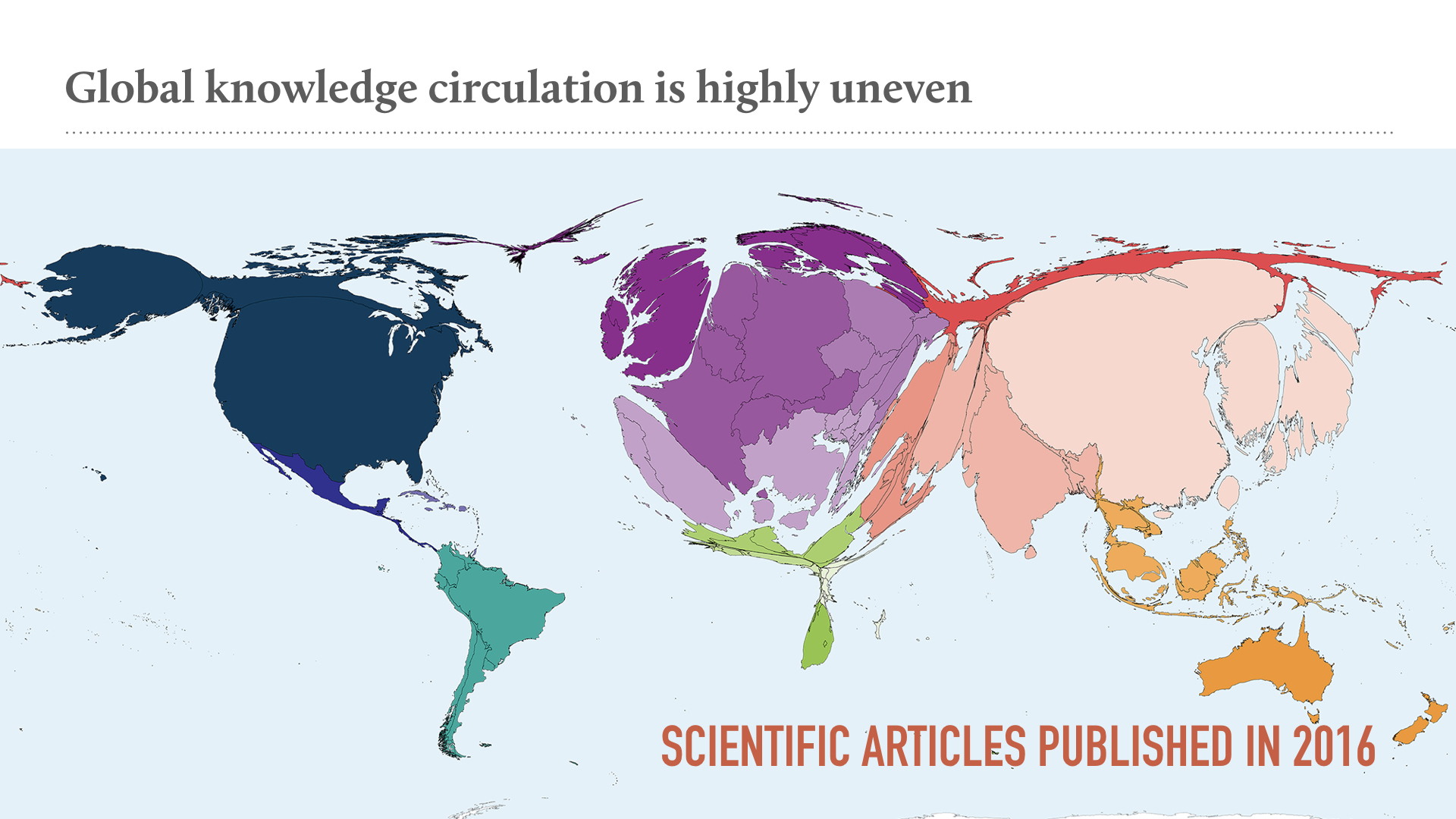
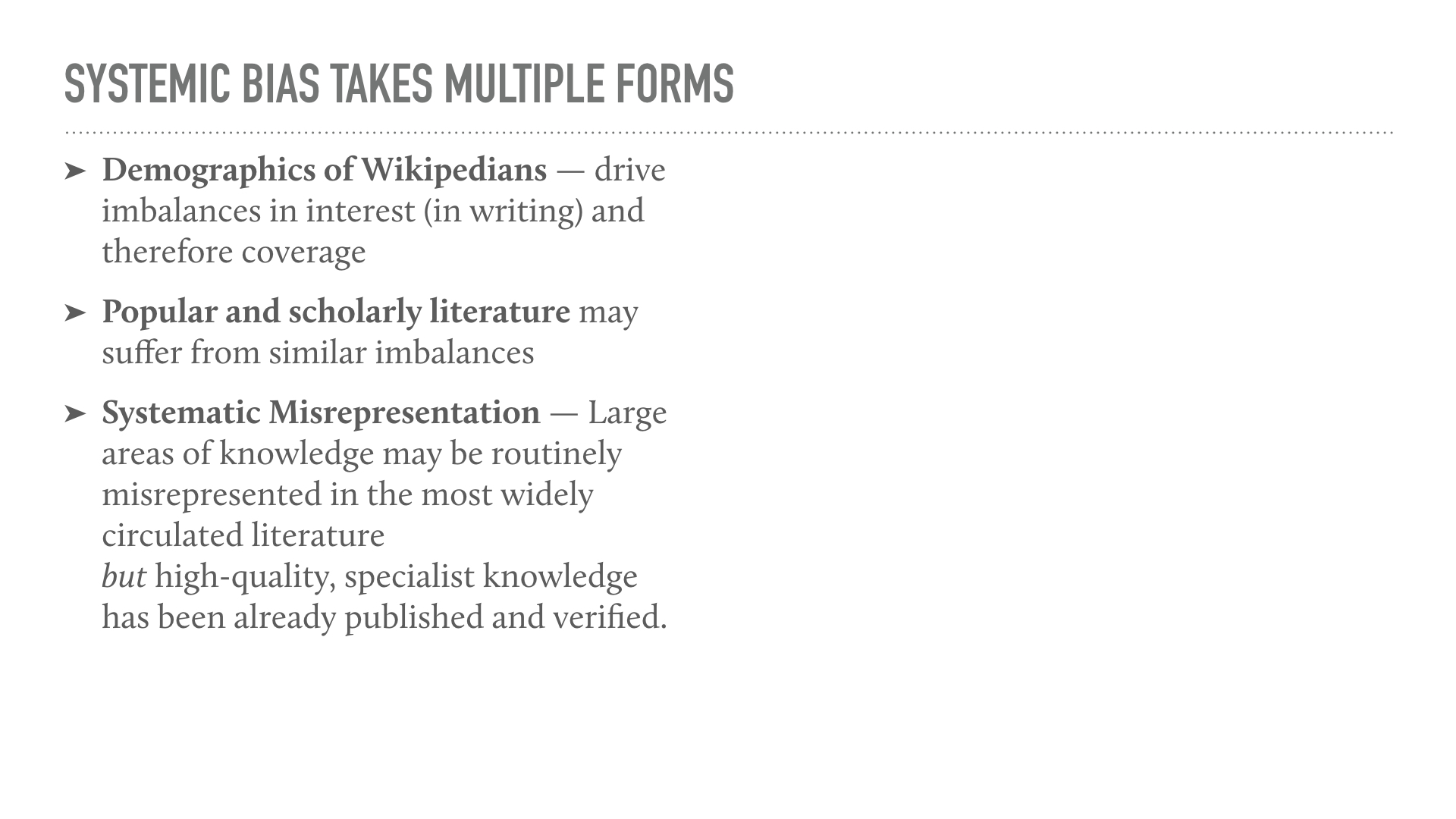
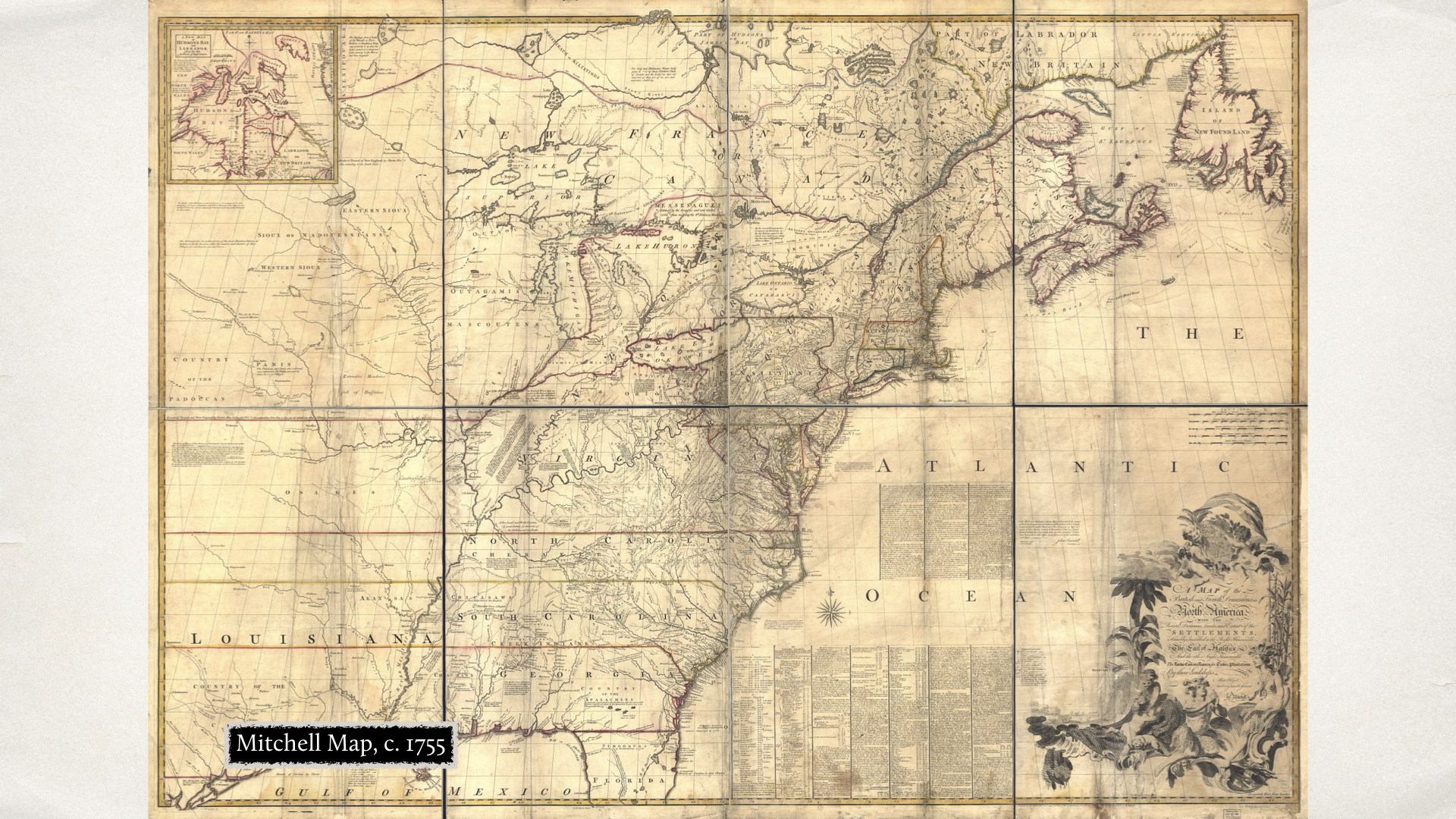
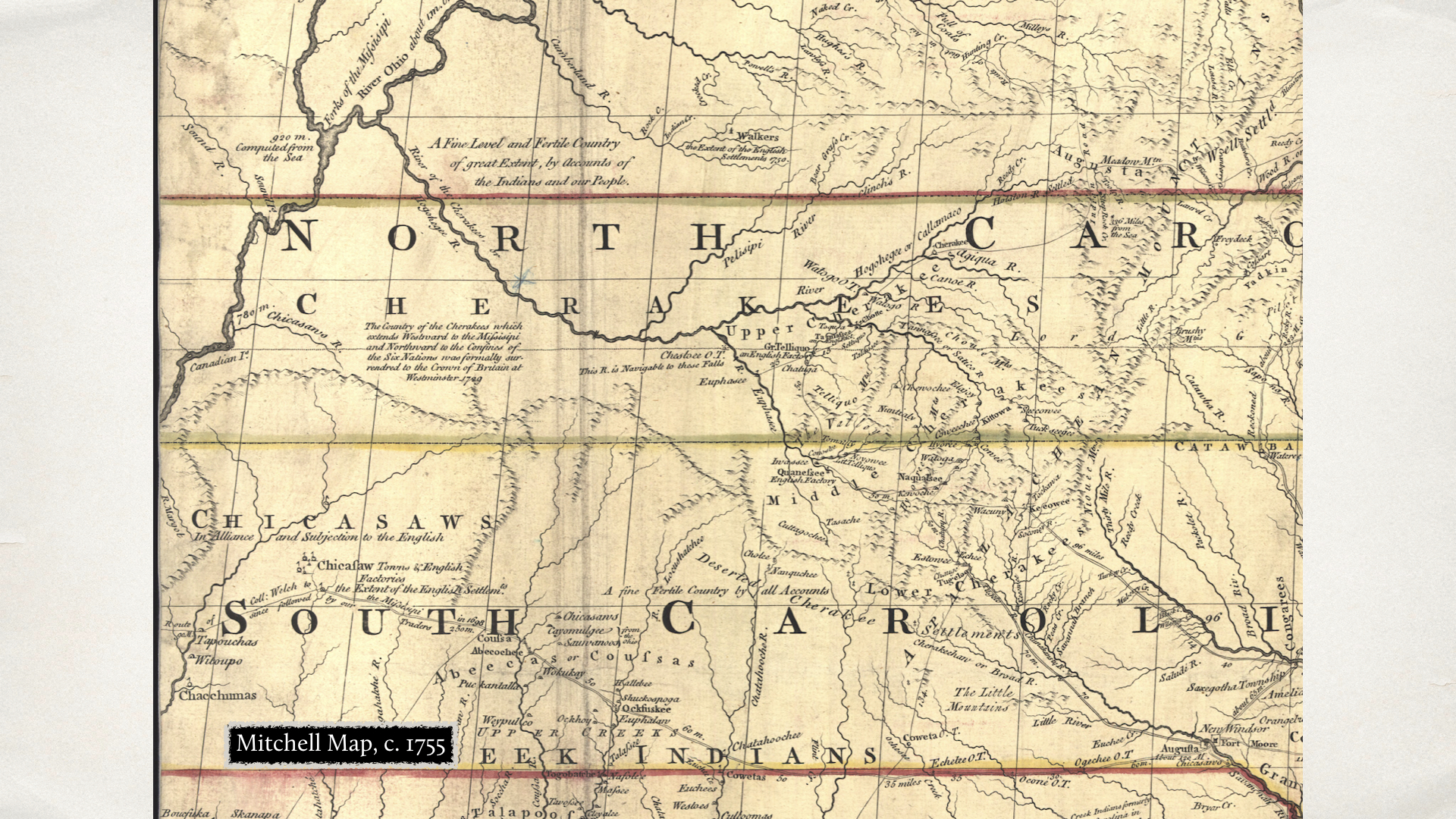
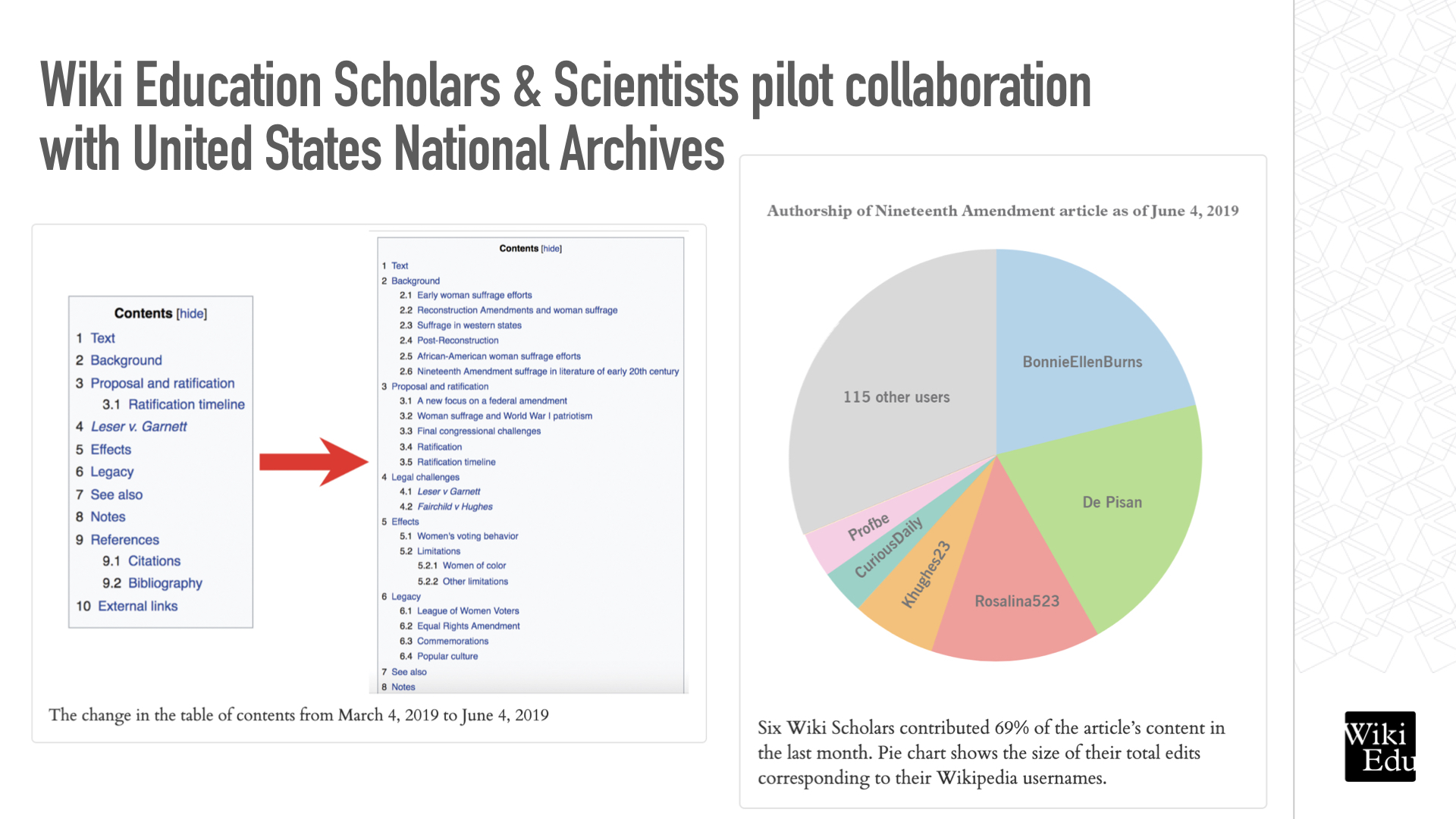
On January 13, I invited to Wikimedia NYC’s celebration of the 18th birthday of Wikipedia to address this question, which I answer strongly in the affirmative. I talk about how long-running changes in the academy have created a font of high quality, well-sourced knowledge about marginalized people: women, indigenous people, Afro-descendant communities, sexual minorities, disabled people, working-class and poor people, and on and on. The challenge now—at least for Wikipedia—is to share this knowledge with the widest possible public in free form. But to do so, we will have draw new maps of geography, history, and our own collective writing process that put those who have been left out back on the map.
Just published in Journal of Latin American and Caribbean Anthropology. Bjork-James, Carwil. 2018. Binding Leaders to the Community: The Ethics of Boliva’s Organic Grassroots (full text). Journal of Latin American and Caribbean Anthropology 23, no. 2 (July): 363–82. Abstract: Bolivia’s largest social movement organizations—including its labor unions, rural communities, and neighborhood organizations—are bound together by a hierarchical […]
Think of this as the trailer for my ethnography, photography, and the book I’m revising for publication…
On June 23, 2008, three of us ascend an eerily empty highway from the tropical town of Coroico to Bolivia’s capital, La Paz. Foreigners, we stare at the majestic valley below as we pass above the line where the tropical tree cover of the Yungas gives way to pure rock. The so-called Death Highway has been rebuilt on a more secure footing, but it is still marked by hairpin turns, intruded upon by fallen boulders of a terrifying scale, and undermined by landslides. Its predecessor, once calculated as the world’s deadliest roadway, has been preserved as a downhill biking path for tourists seeking “100 percent adrenaline.” Where the road has fallen or washed out, drivers let their wheels dig tracks into the mud and gravel tracks, and peer over the edges of their vehicles to avoid falling off the side.
Today, however, both roads are nearly silent. None of the half dozen minibus unions are operating their vehicles, bike tours are cancelled, and the taxi we found cruises over empty roads and easily steers clear of both the rock faces and the treacherous edges. Once finally inside La Paz however, it comes to a stop at the cause of all the earlier silence: an urban road blockade. Residents of the northeastern District 13, organized through 46 neighborhood councils, have plugged the main arteries through their neighborhood with stones and their collective presence. They are calling on the municipality to meet an eight-point platform of demands concerning crime, public works, and water provision. Taxis like ours can approach the protest zone but only to discharge their passengers. Dozens of men and women walk—their goods stacked on their heads, bundled in fabric on their backs, or dragged along in suitcases—across the vehicle-free stretch of urban pavement, littered with stones and occupied by protesters who gather in the middle.
Every point along the road we have travelled is a potential chokepoint. Since the main road from La Paz to the Yungas passes through this district, a single blockade is enough to cut off all traffic to Coroico, the Yungas, Caranavi, and the northern Bolivian Amazon. Whether accomplished by simply sitting down in the street, dragging in boulders and tree limbs, or coordinating crowds of thousands to take over key thoroughfares, road blockades bring a sudden urgency to political protest. By blocking the circulation of people and goods, they ensure that the impacts of protest ripple across an entire region.
In the wake of Donal Trump’s executive order (text) that promised to replace family separation with joint detention of undocumented migrant families, the US government’s actions have been fractured. Over two thousand children remain separated from their parents. As I noted on the day it was issued, the Executive Order codifies the “zero tolerance” policy of prosecuting all arriving adults as criminals for crossing the border.
However, unexpectedly, Customs and Border Protection (part of the Department of Homeland Security) has retreated from zero tolerance and stopped prosecuting arriving families through criminal courts, for now. CBP’s new approach was announced informally on June 21 and formally on June 25. In both announcements, the agency said its reasons are logistical, though the mass public pressure and media embarrassment associated with separating families are obvious major factors. CBP’s head reaffirmed yesterday that he would like to imprison families if he only had the room:
Kevin K. McAleenan, the commissioner of Customs and Border Protection, said his agency and the Justice Department should agree on a policy “where adults who bring their kids across the border — who violate our laws and risk their lives at the border — can be prosecuted without an extended separation from their children.”
Because Immigration and Customs Enforcement does not have enough detention space for the surge of families crossing the border, many families will be quickly released, with a promise to return for a court hearing. Mr. McAleenan said that the agency would continue to refer single adults for prosecution for illegally crossing the border, and that border agents would also separate children from adults if the child is in danger or if the adult has a criminal record.
Meanwhile, Attorney General Jeff Sessions claims that the Department of Justice is holding fast to its zero-tolerance policy, under which it instructed prosecutors on April 6, 2018 (memo|2017 memo authorizing aggressive prosecution), to prosecute all adults referred to them for the crime of unlawful entry. Dogged by protests in Reno, Nevada, Sessions insisted that
The president has made this clear. We are going to continue to prosecute those adults who enter here illegally. We are going to do everything in our power, however, to avoid separating families. All federal agencies are working hard to accomplish this goal.
Squaring this circle requires more jails for families. On Monday, June 25, Defense Secretary Mattis announced that Fort Bliss (near El Paso, Texas) and Goodfellow Air Force Base have been selected as the first detention facilities on military bases.
Migrant families who were taken into custody will be housed at Fort Bliss, an Army base outside El Paso, according to Bowman. Unaccompanied migrant children will be housed at Goodfellow Air Force Base, near San Angelo in central Texas.
As the Department of Defense constructs family detention facilities, they will be solving CBP’s “logistical problem.” Accepting the agencies at their word, we should expect families housed at Fort Bliss to be put through zero-tolerance prosecutions.