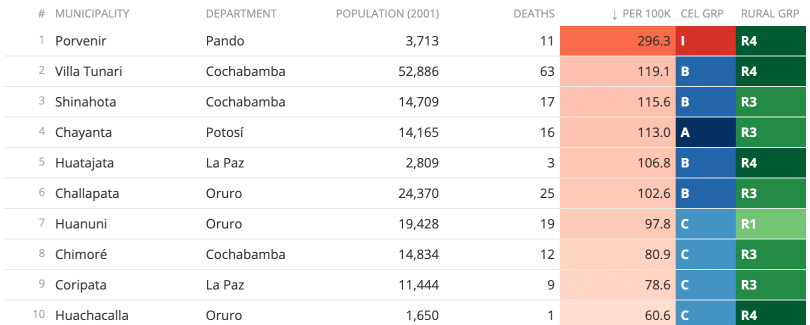
Rural, majority-Indigenous Bolivian municipalities have experienced deadly political violence at nearly four times the rate of urban, minority-Indigenous municipalities. Cities with an indigenous majority experience experience such violence at 2.7 times the rate of their minority-Indigenous counterparts. These disparities were strongest during the neoliberal governments of 1985–2003, but persisted under the left governments of the Movement Towards Socialism (2005–19, 2020–25). Violence during the interim governments of 2019–2020 was largely in Indigenous-plurality cities and rural areas, as well.
The overall patterns is far too dramatic to have occurred by chance even if the clustering of around 700 deaths into around 250 localized events is simulated, making the overall disparity statically significant. The analysis here covers the period from the October 1982 return of democracy to the end of the Luis Arce administration in November 2025.
Read More »
