Indigenous march for TIPNIS survives blockade and violent police raid

What just happened?
(a capsule summary)

The 500-km (300-mile) indigenous march to preserve Isiboro-Sécure Indigenous Territory and National Park (TIPNIS) was held back for the week of September 20-25 by Bolivian police and a blockade set up by agrarian colonists loyal to the MAS government. Tensions rose as police turned back supplies for the march and indigenous women in the march compelled government negotiator David Choquehuanca to walk with the marchers through the police blockade on Saturday, September 24. Then, on Sunday, September 25, police launched a sudden and violent attack on the hundreds of marchers. The police use of tear gas, baton blows, zip ties and adhesive tape against an intergenerational cross-section of the indigenous movement, and direct targeting of its leadership sent shock waves through the political system. On Monday, three things were in rapid motion: the still-unconfirmed reports of deaths during the raid; some 300 marchers-turned-prisoners the government was attempting to fly out of the region; and a growing sense of outrage at the Evo Morales government for carrying out the attack. Rapidly organized protests by indigenous people and town-dwellers in Rurrenabaque compelled the police to release the arrested marchers before they could be flown out. Meanwhile, protests spread across the country and attracted support from all parts of the political spectrum, including the Defense Minister and figures who had been loyal allies of Morales.

Criticism of the Villa Tunari–San Ignacio de Moxos highway, planned to run through the ecological heart of TIPNIS, was reinforced by major voices this week, even as an international petition by Avaaz sped towards a half-million signature goal. Solidarity protests with TIPNIS were held in nine cities of Bolivia and across the department of Beni, where the raid occurred. On Wednesday, the national labor confederation held a general strike in solidarity with TIPNIS, among numerous other moves in support of the indigenous march.

Most dramatically, the hundreds of marchers bused by the police to Rurrenabaque have reunited with those dispersed during the raid. Together, they re-started the march at 7:00am on Saturday, October 1, less than a week after the raid. Their destination continues to be La Paz.

However, despite President Evo Morales’ apology for the raid, his government continues to support the proposed road. Government announcements that road construction is suspended remain unconfirmed on the ground, while we learned this week that construction of the road inside TIPNIS is well underway. Morales’ pre-raid Sunday morning proposal to hold a referendum on the highway for all residents of Cochabamba and Beni departments is not even close to “indigenous consultation,” much less “free, prior, and informed consent” by the indigenous communities directly affected by the route. Despite the upheavals of past week, Evo Morales and the MAS party remain committed to defeating opposition to this road project, and to avoiding a precedent for a local veto over infrastructure projects. To buttress this position, they are continuing to rally loyal supporters (primarily colono federations, but also some peasant unions) to upcoming marches in Cochabamba and La Paz departments. The possibility of direct confrontation between supporters and opponents of the road (or equivalently, critics of, and loyalists to Evo Morales), or further violent police action “to avoid confrontations” continues to loom large.

International solidarity statement with Bolivian indigenous march and Isiboro Sécure

An international sign-on letter has been released in support of the Isiboro-Secure National Park and Indigenous Territory in the Bolivian Amazon and plains, currently threatened by a proposed highway that would cut the territory in two. The letter calls for the Bolivian government to recognize the right of indigenous people to freely accept or reject development projects, including the highway, and to negotiate in good faith with the cross-country indigenous march in its defense.

The signers—sixty-one environmental, human rights, indigenous, health, anti-privatization, and global justice organizations— hail from five continents and identify as supporters of Bolivian social movements and the Plurinational State of Bolivia’s proactive diplomacy on environmental and human rights issues. However, they warn: “the country’s pioneering work on all these issues
also comes with a great responsibility. Bolivia’s continued ability to press forward this vital agenda will be affected by its consistency and moral credibility on matters of human rights and environmental protection.”

The Eighth Grand Indigenous March, which set off from Trinidad in mid-October, has travelled half of its planned route to La Paz, but currently faces a blockade by some members of the Union Confederation of Intercultural Communities of Bolivia (formerly the Union Confederation of Colonizers, that is agricultural settlers on frontier lands). Both the blockaders and Bolivian police are currently preventing the advance of the march towards La Paz, as well as additional volunteers, food, medicine, and supplies sent from La Paz.

In Spanish after the jump / En castellano después

Read More »

Bolivian officials on the TIPNIS highway

Here is a compendium of statements from the Evo Morales government on the proposed Villa Tunari–San Ignacio de Moxos highway, with Spanish and my English translation side-by-side. What started as a single controversy is rapidly spreading to a defining moment in the Morales presidency, and an illustration of its “paradigm of respect for Mother Earth.” The quotes grow increasingly disconcerting and the stakes get higher as officials repeatedly suggest that further expansion of extraction industries and megaprojects is on their agenda.

June 23: President Evo Morales lamented that other social movements had not persuaded the indigenous “that they are being confused, that they ought to reject the NGOs, the enemies of integration, of the national economy, of the indigenous people who lack electricity. It’s not just on the matter of the road, but also hydroelectric dams and petroleum.”…
“Some [of the indigenous people] want the road to pass through their community, but lamentably there are some NGOs, some foundations that [under] the pretext of conserving the environment want to disadvantage [others],” explained the head of state, arguing that some sectors advance other interests because “it’s a business for them, they live off of it, and they are uninterested in the road for its own sake”
También lamentó que las fuerzas sociales de Cochabamba y del Beni no coadyuven y no persuadan a los indígenas “que están siendo confundidos, que no rechacen rotundamente a las ONG, enemigos de la integración, de la economía nacional, de los pueblos indígenas que no tienen luz. No sólo es el tema del camino, sino de hidroeléctricas y petróleo”

“Algunos (indígenas) quieren que el camino pase por sus comunidades, pero lamentablemente hay algunas ONG, algunas fundaciones que so pretexto de conservar el medio ambiente quieren perjudicar”, explicó el Jefe de Estado y argumentó que algunos sectores buscan otros intereses, porque “es negocio para ellos, viven de ello, a ellos no les interesa el camino por el camino”.
(La Razón, July 13)
June 29: Evo Morales:Whether they want it or not, we are going to build this road and we are going to deliver under [my] current administration the Cochabamba-Beni/Villa Tunari-San Ignacio de Moxos road.” “Quieran o no quieran vamos construir este camino y lo vamos a entregar en esta gestión el camino Cochabamba-Beni, Villa Tunari-San Ignacio de Moxos” (Página Siete, June 30)
Evo Morales, July 12: “Those who oppose the exploration of oil or of gas, or finally the construction of roads are not my indigenous brothers, whether they are from the Chaco, from Isiboro[-Sécure] or other places. How can they oppose themselves?; I cannot understand the indigenous brothers.”  “No son mis hermanos indígenas sean del Chaco, de la zona del Isiboro o de otras zonas que se oponen a la exploración del petróleo o del gas o finalmente a la ejecución de la construcción de caminos. Cómo pueden oponerse, no puedo entender a los hermanos indígenas.” (Erbol community radio network, July 12)
July 12: José Luis Gutiérrez, Minister of Hydrocarbons and Energy, opened the possibility of oil exploration in the Isiboro Sécure National Park and Indigenous Territory, where there would be an important hydrocarbon reserve according to inhabitants of the territory itself.  El ministro de Hidrocarburos y Energía, José Luis Gutiérrez, abrió la posibilidad de realizar trabajos de exploración petrolera en el Territorio Indígena Parque Nacional Isiboro Sécure (TIPNIS), donde existiría un importante reservorio hidrocarburífero según versión de los propios habitantes de la zona. (Erbol community radio network, July 12)
Evo Morales, July 31 at a meeting of cocaleros in the Chapare: “We will consult, but they should know it will not be a binding consultation. Just because they say no, doesn’t mean it won’t be done.””You, comrades, have to explain, to orient the indigenous comrades—the mayor himself is mobilized—to convince them that must not oppose [the road]”Later, he added, “If I had the time, I would go seduce the Yuracaré female comrades [literally make them fall in love]; so then, youth, you have instructions from the president to [sexually] conquer the Trinitario and Yuracaré female comrades so that they do not oppose the construction of the road. Then he asked, “Approved?” and applause could be heard from the crowd. “Las consultas vamos a hacerlas, pero quiero que sepan que no tienen carácter vinculante. No porque ellos (los indígenas) digan no, no se va a hacer.”“Ustedes compañeras y compañeros tienen que explicar, orientar a los compañeros indígenas, el propio alcalde está movilizado, para convencerlos y que no se opongan”, dijo.Luego, agregó: “Si yo tuviera tiempo, iría a enamorar a las compañeras yuracarés y convencerlas de que no se opongan; así que, jóvenes, tienen instrucciones del Presidente de conquistar a las compañeras yuracarés trinitarias para que no se opongan a la construcción del camino”. Enseguida consultó: ¿Aprobado?” y se escucharon aplausos del público.(La Razón, August 1)
Félix Cárdenas, Vice-Minister of Decolonization, August 4: “The Bolivian people need development and this will not be the only road that will cross through protected areas, there will be many others besides, all with the goal of connecting us internationally, of exploiting our natural resources, and to have a network of communication, in all senses, with other countries.”
Cárdenas repeated that he rejects “the fundamentalism” of environmentalists and indigenous people who “think that the paradigm proposed by the MAS of respect for Mother Earth means that we must care for all of the forests and lands. If that were so, what would we eat?”
El viceministro de Descolonización, Félix Cárdenas, aseguró que “el pueblo boliviano necesita desarrollo y éste (el que divide las tierras protegidas del TIPNIS) no será el único camino que atravesará zonas protegidas, serán muchos otros más, todo con el fin de conectarnos internacionalmente, de explotar nuestros recursos y para tener una red de comunicación, en todo sentido, con los demás países”
Cárdenas repitió que se rechaza “el fundamentalismo” de ambientalistas y originarios que “piensan que el paradigma planteado por el MAS de respeto a la Madre Tierra significa que se debe cuidar todos los bosques y tierras. Si así fuera, entonces ¿qué comemos?”
(La Prensa, August 5)

Resolution by indigenous communities of Isiboro-Sécure rejecting Cochabamba-Beni highway

The following is a translation of the original Spanish text posted here.—C

Summary: Indigenous peoples of the Isiboro-Securé Indigenous Territory and National Park resolved in May 2010:

•    To overwhelmingly and non-negotiably reject the construction of the Villa Tunari – San Ignacio de Moxos highway and of any highway segment that would affect our territory, our [collective] big house.

•    To demand that the Government of the Plurinational State and the governments of the world act with consequence and coherence in their respect for the rights of Mother Earth and of Indigenous Peoples.

•    Declare a state of emergency and of permanent and immediate mobilization in defense of our rights, of territorial integrity, and of the rights of Mother Earth.

•    Instruct our traditional authorities and our representatives within the Plurinational State at all levels to realize all necessary actions for the defense of the rights of Mother Earth and of our rights as indigenous peoples before all national and international institutions.

complete text after the jump…Read More »

Bolivia: A Year in Ten Protests

I returned this week from nearly a full year researching mass protest in Bolivia. As luck would have it, 2010 has seen protests in greater numbers (67 per month!) than any year since 1971 , when the Center for Studies of Economic and Social Reality (Centro de Estudios de la Realidad Económica y Social) began keeping records on the subject. And based on both a comparative look at Bolivian history and pure population growth, it’s safe to extend that title to the most protests in a single year since the beginning of the 19th century, or even Bolivia’s history as an independent country.

Unlike 2003 and 2005, Bolivian protests did not mount into an overarching national wave capable of toppling a sitting government. However, many of the forces involved in those years are showing increasing independence from President Evo Morales and the Movement towards Socialism (MAS) party. Morales was ratified by a 64% majority in the December 2009 presidential elections and his party won the mayor’s office in nearly two-thirds of the country’s 337 municipalities in the April 2010 elections. However, this year many of the voters who backed the MAS in national fights showed their willingness to take to the streets to denounce its policies. Meanwhile, the MAS itself mobilized its base in a spectacular welcome to a global summit of climate change activists and against a 2011 workers’ strike.

Here, then, are the one election and ten mass mobilizations that defined the past year.

Read More »

Bolivia in Price Crisis (part I)

Eighteen months ago, when I was applying for funds to conduct research in Bolivia, one of the criticisms I had to respond to was this: How do you know that mass protest events will be going on while you’re there? In the end, I resorted to putting a table of recent events of large-scale space-claiming protests in my two focus cities in my proposal to make this point: there has not been a 12-month period without such protests since last century.

And here we are again.

On the day after Christmas, the Vice President (then acting president since Bolivian law requires that the office must always be filled by someone physically in the country) announced that the Bolivian government would remove all subsidies on fuel: primarily gasoline and diesel, and let the prices float to international levels. Fuel prices went up 70-80% overnight. This was not the first time that such a drastic move has happened in Bolivia, but it was the first time that the popular movement-linked MAS government had taken the step. In fact, the MAS had led major protests against exactly the same move less than a decade ago.

The politics of subsidies in general and the gasolinazo in particular are fascinating, and fully getting the arguments requires putting aside everything that Westerners are taught about prices, markets, and subsidies, but that’s a whole other post (several pages of which are in my notebook waiting to be typed into an article).

In any case, the social movements that brought the MAS to power, including Evo Morales’ coca grower base, did not hesitate to mobilize against the gasolinazo. (And the transport sector quickly moved to double fares.) Despite some pressure on their leadership, the Neighborhood Councils, Factor Workers, labor confederation, and others mobilized mass protests. The scene in El Alto in particular, especially on December 29 and 30, brought back collective memories of the mobilizations that toppled presidents in 2003 and 2005, even though the numbers were not yet as great. Evo and Álvaro reversed course, and returned fuel prices to their former levels.

However, the price hike genie was out of the bottle. While some in the government promised the gasolinazo was over, others have made it clear that the prices will be raised in smaller doses over the coming year. Several weekends in January and February, there has been panic buying in La Paz over rumors of an imminent price hike.

More pressingly, this year’s extremely late rainy season (normally beginning around November 1, it didn’t really kick in until the New Year) and other factors have led to a national sugar shortage, grain price hikes, and a squeeze on the milk producing industry. The national government’s response was first to use its agricultural production support company, Emapa, to supply sugar directly at low prices to the cities, in an attempt to push the price down. However, Emapa itself abruptly raised prices in late January, and the government has been embarrassed by former ministers and senators illegally wholesaling government sugar out of their homes. Finally this month, the transport sector has moved to increase urban transit fares in a half dozen cities, and began charging the new fares without official approval.

The economic situation has brought multiple sectors into the streets, although without unified demands. Buyers and sellers of the same product are both mobilizing. Ideologies conflict as well: some are demanding the enforcement of the free-market principals of Supreme Decree 21060, while more are calling for it to be revoked. Shopkeepers demand that Emapa be abolished, while neighborhood councils in Oruro demand that it distribute basic goods directly to neighborhood suppliers. And in Cochabamba, drivers demanding higher fares and factory workers and neighborhood council marchers who oppose them have each attacked the property of the other side.

On February 18, the national worker confederation known as the COB (Bolivian Worker’s Central) carried out a 24-hour strike. And when Bolivians strike, they march. That included a 10,000+ worker march down the main highway from El Alto to La Paz. The COB is demanding either wages or wage increases in line with a study it performed on the cost of basic goods in the country. However, this analysis showed that the baseline cost of living is 8,300 Bolivianos per month for a family, about $1200. This is above and beyond the typical Bolivian’s earnings, leading the government to disqualify the study as anything more than a pipe dream for workers.

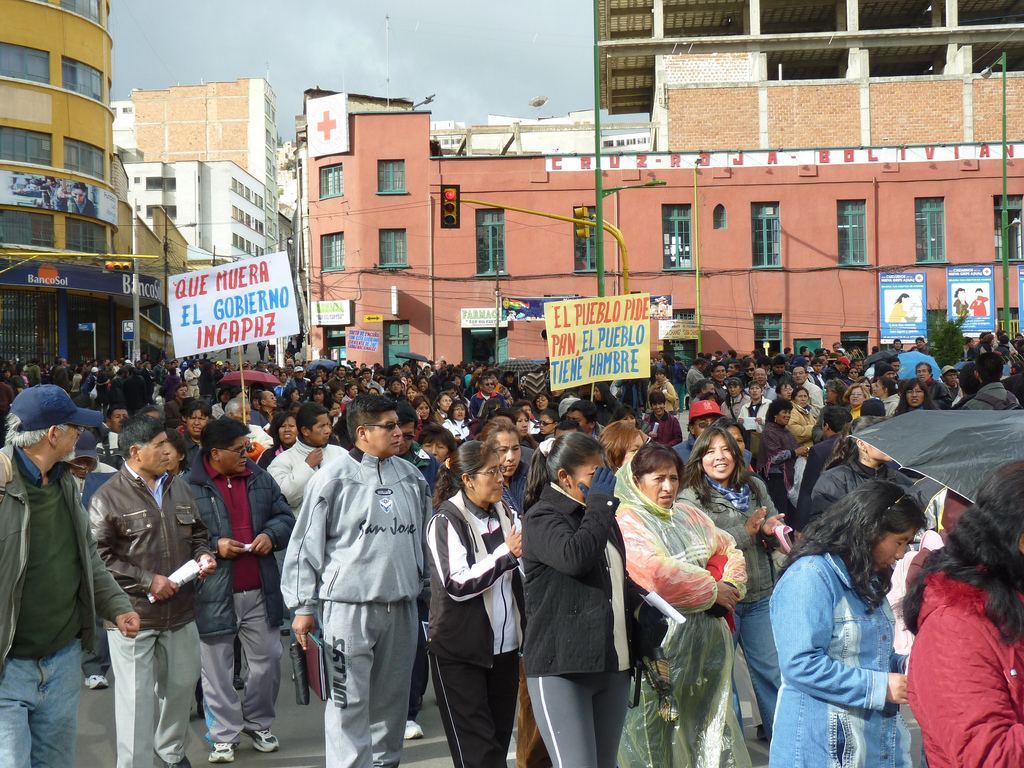
A second march on the 18th, led by the more radical teachers’ unions of La Paz department brought an harsher indictment of the Evo Morales-led government. Placards, chants and speakers labelled the government “incapable” and committed to neoliberal policies like the gasolinazo. Once again the slogans of seven years ago rang in streets, and a working-class crowd was calling for the indigenous peasant union leader who is president to resign and make way for “a government born of struggle in the streets.” Such a government, radical unionists claim, could guarantee larger wage increases for workers by expropriating transnational corporations in extractive industries and redistributing their wealth to enlarge workers’ salaries.

Health care workers and teachers rally in La Paz, February 18: Signs read "Death to the incapable government" and "The people ask for bread; the people are hungry"

It is not so much that this rhetoric is new as that it has migrated from the pamphlets of the radicals at sides of the march to the main stage. Like a stopped clock that is right twice a day, those who are always skeptical that the government has sold out the public, and turned against the grassroots are now in sync with at least a large portion of the popular mood. And they can speak to broadly shared concerns about the cost of living, the subcontracting of work, and the lack of sufficient investment in the industries that provide employment and public revenues to Bolivia.

Five years of MAS rule, and two years since its decisive victory over right-wing resistance to the project of a new, plurinational constitution have allowed a lot of tensions, mistrusts, and frustrations to accumulate within the party’s diverse grassroots base.  Movements that always knew how to mobilize on their own have frequently been in the streets in the past years. Unfortunately, the first response of the MAS government has often been to accuse those who mobilize of being aligned with, misled by, or even “infiltrated” by the right-wing opposition. If anything, it now seems that independent protest and even independent opposition has been made more likely by these accusations.

The US-Bolivia Relationship

Last week, Bolivia hosted a conference of defense ministers from all the countries in the Americas. This became front-page news here mainly because of the speech by President Evo Morales and proposals put forward by Bolivia. It also seems to have attracted at least a little attention in the United States.

US Defense Secretary Robert Gates came to Bolivia with the public agenda of discouraging Bolivia-Iran economic cooperation. He was actually surprisingly diplomatic in his complaints, saying from the outset that Bolivia has the right to have relationships with whomever it chose, but cautioning that Iranian interest in Bolivia’s untapped uranium and joined Bolivia-Iran plans for civilian nuclear plants will be closely monitored.

During the summit, Evo’s opening speech criticized the United States’ history of intervention in Latin American democracies. He claimed that popular democracies are “three and one” in resisting attempted coups backed by the United States. The three are Venezuela (2002), Bolivia (2008), and Ecuador (2010); with the one being Honduras (2009). In fact, they are two inaccuracies in this score: the recent police revolt in Ecuador did not have any apparent American backing, as President Rafael Correa has said publicly; and Evo, like many other observers, leaves out Haiti (2004), the only case in which Americans had an on-the-ground role. The real score is a less optimistic two for the democracies, two for the United States-backed coups against them.

Nevertheless, what has gathered media attention is not Evo’s accuracy, but his audacity in making such a comment in front of a senior American official. The Heritage Foundation responded by saying that, “Morales demonstrated in his speech a quantity of venom, a lack of restraint, and complete disrespect for the U.S. that befits a bully and tyrant.” Heritage joins several right-wing congress members and urging more hostile relations between the United States and Bolivia.

It is difficult to imagine exactly what that would mean since the two countries have had not had ambassador-level relations since 2008, when Bolivia expelled the US ambassador for coordinating Bolivia’s right-wing opposition at a time when it was seizing and burning government buildings and taking over gas infrastructure. After the Obama election, both countries have expressed a desire for renewed relations and cooperation, but the Bolivian proposal for a treaty of mutual respect has languished inside the United States State Department. While in August of this year, the countries announced “90% agreement” on the treaty, there is then no action since. Now that members of the new Republican House majority are making angry noises about Bolivia, it will be even more difficult for the Obama administration to make headway on mending the relationship.

I’ve been meaning to write a bit of background about the US-Bolivian relationship, and the realistic and unrealistic fears of the Morales administration about US intervention. The threat is real; no one who pursues an independent policy as a Latin American president can ignore what happened to Salvador Allende (Chile, ousted by a US-backed coup in 1973); Maurice Bishop (Grenada, invaded by the US in 1983); and Jean-Bertrand Aristide (ousted by CIA-paid Army officials in 1991); and what nearly happened to Hugo Chavez in 2002. However, the rhetoric of foreign interference often gets carried over into domestic politics. A quick summary might be: Just because they are out to get you doesn’t mean you’re not paranoid; and, Just because you’re paranoid doesn’t mean they aren’t out to get you. However, since nearly 1,300 documents on just what the US Embassy has been doing in Bolivia are being released by Wikileaks beginning this week, I’ll suspend judgment on just who is paranoid until I read the documents.

Potosí isolated by 12-day regional protest

[There is, as of today, rising hope for negotiations to begin between the Government and Potosinos (and for three-way dialogue with Oruro on the border issue to take place as well) soon. More on that soon. This post comes as written yesterday. Also, I added a little bit on Pablo Solón’s comments on Democracy Now at the end.]

A department-wide general strike in Potosí department, Bolivia’s traditional mining center, has entered its thirteenth day today, with no clear end in sight. The strike is now taking three major forms: a comprehensive blockade of transport in and out of the department, a general closure of businesses by both their workers and owners, and a growing hunger strike reported at more than 500 people on Sunday. The mobilization was backed by a remarkable show of unity on last Tuesday, August 3, when some 100,000 people marched in the city of Potosí in support of the effort. The number is phenomenal relative to the city’s population of 160,000, and even the department’s of some 700,000.

The systematic isolation of the department has made it impossible for me to visit the protests, once it became clear (with the march) just how significant this event is. Hundreds of trucks and buses are lined up at the various entrances to the department. As of Sunday, the Governor of Chuquisaca was mobilizing food and supplies to people stranded on the border.

Potosinos in protest are coordinated by the Civic Committee of Potosí, a coordinating committee of major institutions. Other key actors include the community of Coroma (part of which is in territory also claimed by a neighboring community in the department of Oruro), the Federation of Cooperative Miners, and since the massive march, major politicians including Governor Félix Gonzales (MAS). Gonzales and four Potosino members of the Plurinational Legislative Assembly (formerly, the National Congress) are at the head of the hunger strike.

Compared to the mobilization, the demands are quite modest:

  1. Delimitation of the inter-departmental border between Quillacas (Oruro) and Coromo (Potosí), which centers around control over limestone resources in the area
  2. Installation of a cement plant in the Coroma region, using those resources
  3. Reactivation of the metallurgy plant in Karachipampa, currently suspended due to a legal conflict among two companies
  4. Preservation of the Cerro Rico, the massive mining mountain just outside the city of Potosí, whose structural future is in jeopardy after five centuries of mining
  5. Construction of an international airport for Potosí as soon as possible
  6. Completion of delayed highway projects

The protests seemed to have expanded as rapidly as they did because in the first week the national government insisted, primarily through its Minister of Autonomy Carlos Romero, that they were a purely partisan effort in defense of Potosí Mayor René Joaquino (see ). This added to a sense of indignation at being ignored by a MAS government to which they have supplied an overwhelming vote for the past five years. Their sense of being slighted has rebounded into the chant (heard at a solidarity march of Potosinos here, as well) of “Potosí Federal,” a call for devolving power to the region. (This is clearly not a demand of the mobilization, however, and it’s unclear how such a demand would differ from the departmental autonomy approved by referendum in December, and soon to be delimited by a Statute of Autonomy.) Comcipo leader Celestino Condori emphasized a new sense of unity on the day of the march, “We’d like to demonstrate to the government that in Potosí, there is unity, among Moors and Christians; everyone is changing their polleras [traditional indigenous women’s dress] to put on the red and white which are the colors of the Potosino flag.” In action, this is taking the form of a wide variety of hunger strike pickets led by different organizations, and since the weekend, spreading to other cities in Bolivia.

Currently, the impasse blocking negotiations concerns where and how they might take place. As with movements across the continent (and using good strategic sense), the Potosí movement has demanded to negotiate at their place of strength, while the pressure of mobilization is on. On the other hand, the Morales government is insisting that discussion of border must occur in neutral territory and that no negotiations can take place without an intermediate truce that suspends mechanisms of pressure. On the question of territory, they are backed up by concerns that Oruro might mobilize as well if discussions began on non-neutral ground. Oruro’s civil society placed themselves in a “state of emergency,” preparing to mobilize last weekend.

In a broader sense, this mobilization is one of a growing number of signs that MAS allies (and members, such as the governor) are moving to pressure the national government over particular demands, making Evo Morales’ second administration a period of serious conflict, though of a very different kind than the years of confrontation with the right-wing of the media luna. It also is an early sign that the new autonomy in the western departments will come with genuine political independence on the part of regional leaders.

Incompetent English-language coverage: As a side note, this central political story in the last week here in Bolivia is being described to the English-speaking world by reporters who can only be described as myopically focused on the lives of wealthy foreign tourists and stunningly ignorant of local realities. Local realities such as the front page stories of every single national newspaper. Associated Press, I’m talking about you. Here, in its entirety is Saturday’s AP story on the Potosí situation:

Protest traps tourists in Bolivian highland city

(AP) – 1 day ago

LA PAZ, Bolivia — A protest by Bolivian miners has trapped more than 100 mostly European tourists in the southern Bolivia mining city of Potosi for more than a week.

The protesters piled rocks on the runway of the Potosi airport Friday to prevent a plane from landing to pick up some of the foreign tourists.

The miners have also blocked roads into the area for 10 days.

Also trapped are about 500 Bolivians, and local media say the blockade is beginning to cause food shortages in the city of 200,000 people.

The miners have a series of grievances with the government, including a demand to reactivate mines that officials ordered closed and to settle land disputes. (“Protest traps tourists in Bolivian highland city,” The Associated Press)

I’ve highlighted in red things that are basically wrong, or reflect the listening-to-other media’s-stories as reporting that seems to have gone into this story, filed from La Paz. As noted above, cooperative miners are one of many groups that have folded into the department-wide protest. There are substantial reports of Bolivians being stranded, but descriptions of around five hundred people refer to people on vehicles waiting to get in to the region. “The area” is actually the Department of Potosí, which has one “land dispute” on the table, its border with Oruro. The only mine under discussion in the demands is the Cerro Rico, whose structural instability could result in the closure of mining, under a review currently underway and encouraged by UNESCO, which maintains the mountain (as well as the city) on its World Heritage list. For details of the actual airport incident, which did involve miners, you can see this article in Spanish. For consolation on the ability of English reporters to competently discuss life in Bolivia, see this piece from Agence France Presse: Protesters seize Bolivia airfield, seal off Potosi.

Pablo Solón on Democracy Now: Potosí got a sliver of further US media coverage today with the mention of the protest made by Amy Goodman while interviewing Bolivian Ambassador to the United Nations Pablo Solón. Amy’s question got to the heart of the protest: “The demonstrators are calling for more investment by the Bolivian government in the lithium-rich area.” And Solón basically dodged her question by talking about borders and not development commitment. It’s hard not to be sympathetic with him having to explain this issue alongside the other awesome work he’s doing, which the interview does a good job of describing.

CMPCC: Root Causes of Climate Change are Capitalism and Culture

Big conference, bigger questions

Tuesday at the CMPCC was the first day of truly massive events, besides the 17 (+1) Working Groups (Mesas de Trabajo) which themselves reached up to 500 people each. Yesterday morning was devoted exclusively to a massive opening ceremony held at Tiquipaya’s stadium. The New Bolivia has a combination of faces: the grassroots movements gathered in a stadium face, the indigenous tradition face, and the we’re running the state face. All three were on display in the pageantry of yesterday morning: dozens of banners and hundreds of wiphalas (indigenous flag of the Andes whose rainbow colors symbolize inclusion) marked the first side; the ceremony was inaugurated with requests for permission from Mother Earth and Father Cosmos; and Evo’s entrance began with a massive salute from hundreds of red-coated soldiers.

The content of the speeches was more interesting (Evo’s personal content was extended and rambling, but had its good moments which are already beginning to be overshadowed by tactless and factless comments about male sexuality and European baldness), and led into the afternoon session on “The Root Causes of Climate Change.”

The morning speeches were marked first by representatives of five continents (no one from Australia or Antarctica) addressing the summit: Faith Gemill (a Gwich’in from Alaska) spoke about a shared need to decolonize indigenous peoples; a member of the European Parliament’s left-green alliance said that the summit has allies on the European left willing to challenge the Copenhagen Accord; Nnimmo Bassey of Friends of the Earth-Nigeria/International called for an end to fossil fuels (“Keep the oil in the soil, the coal in the hole, and the tar sands in the lands”) and a rejection of false solutions; Suma Dutra argued that more than 90% of her native India has not been part of the new fossil-fuel-dependent economy and that this majority is waking up to the issue; and Eveldina Mazioli (Brazil) spoke to the systemic change towards small-scale agriculture advocated by Via Campesina, one of the world’s largest and most dynamic transnational alliances.

This brought us to Evo, who addressed with props differences between the capitalist and indigenous way of life. What I found striking was the personal animus involved on the part of people wanting show they are “better than” indigenous people, by using commodities. Contrasting a ceramic, fancy china, and plastic plates, Evo pointed out that capitalism/consumerism encouraged people to leave behind the plates that return to being earth when they break, in favor of modern versions that contaminate the world around them.

The massively attended afternoon session on “Root causes of Climate Change” kept its focus more exclusively on capitalism, with activists, a sociologist, an ethicist, and a vice president all framing the issue. Real aspects of capitalism are driving factors in the global ecological crisis: the quest for expansion, relentless incorporation of resources into the economy, an inability to settle for sufficiency, the promotion of consumerism as an economic strategy, treating environmental costs as externalities, and on and on.

Of course, however reasonable it is to put capitalism at the center of the ecological crisis, doing so raises more questions than it answers. Let me put this another way for people who aren’t as skeptical of capitalism as I am: suppose we accept that the dynamics of capitalism are provoking a crisis in the liveability of the planet; and that those same dynamics make any kind of solutions extremely difficult. What other questions does that raise?

First, what kind of economic and social systems might substitute for endless growth? How will they provide incentives for a “people-centered economy”? Unlike when I was growing up, the other possible are less unified, but far more diverse. The plural left here in Bolivia is one example of the kind of diversified solutions: nationally direct industries function alongside communal indigenous economies, and small and massive cooperatives. What is not capitalism is many things.

Second, how in the world does the political groundswell needed for real transformations get built? Third, what alternatives? (This is the easy one, actually: There’s a ton of movement, planning, and visioning work done on this question.)

Fourth, and most complicated, given that capitalism isn’t going anywhere in most of the world for at least a few decades, how much inside-capitalism response to the climate crisis is necessary? This may be the hardest question, since capitalism and its critics will have to work together to solve one of the most difficult technical and social problems ever, even as the critics remain skeptical that an end to the crisis is possible through such cooperation.

Beyond our economic system (as if that were a small matter), I think we have to ask real questions about the other issues raised by our five continental representatives.

Culture: We are talking about a real ethical transformation, built atop many cultures that have got used to relentless consuming more as a chief measure of personal status. And we’re also talking about internalizing all the consequences of our decisions for other people and the planet in our economic and social choices. What in the world will that look like.

Colonialism: The power states exercise over indigenous peoples, and that a powerful few countries exercise over the rest ends up being a key factor in climate change. The oil and mining industries operate through inequality between regions of production and consumption. Simply put, the kind of people who drive SUVs wouldn’t put a conventional oil pit in their backyard to do so. Instead they rely on less fortunate communities to supply the fuel, and pay the price. The one nice thing about this arrangement is that confronting it creates a virtuous cycle. To the degree that drillsite and fence line communities demand respect or gain in power, the whole system gets an incentive to switch to green ways of being. The difficult part is that very real systems of power have to be challenged in the process.

False solutions: In the short term, there are both real and false solutions to climate change. Some things will in fact slow, and one day reverse, the increase in carbon dioxide in the atmosphere. Others won’t. How do we tell the difference? And how do we stop the false solutions from being implemented? This is extremely important in a “flexible” climate change regime like the one that exists since the Kyoto Protocol: any country can pay another to implement a cheaper false solution, and avoid real emissions cuts in return.

Finally, in writing this I feel torn geographically. Half of these questions may seem un-askable in the United States. They are daily matters of discussion in movements here. And from the looks of the conference not just here. The thing about the global climate crisis is that it makes asking difficult questions a necessity. Since the 1990s, the small island states of the world have regarded these kinds of global discussion as life or death matters, because they are: they might be literally underwater without comprehensive solutions. In recent years, much of Africa (facing desertification and major food production loss) and countries like the low-lying, very-dense Bangladesh (not as low-lying or dense as the Netherlands, but money works wonders) have been added to the list. In circumstances like these, you must move very quickly along a chain of logic like this: “If capitalism is the problem, what might be the solution.” Or along a different chain of logic: “If the global economy can’t feed over one billion people, what good is it?” Part of seeing this week’s conference for what it is, is to recognize that thousands of people from movements across the global South, and some of the North as well, are here asking themselves just these kinds of questions. It may be a while before such questions seem reasonable to North Americans, and longer before they seem practical. This post hopes to make that possible.

Exit Polls: Evo Morales & MAS win 62%, Absolute Senate majority

Bolivia’s television networks are reporting an overwhelming MAS victory in today’s elections, based on exit polls at “the mouth of the voting urns.” While the victory was not in much doubt, reports indicate that the MAS won a higher than expected 62-63% to Manfred Reyes Villa/PPB’s 23-24% (figures vary among the Red ATB, Unitel, and Los Tiempos). The MAS victory is reported to extend to 6 departments including Tarija (traditionally a part of the right-leaning Media Luna) and Chuquisaca (where MAS lost departmental elections, but won two national referenda in the last eighteen months). The television network Unitel is projecting that MAS will win 25 of the 36 seats in the Bolivian Senate, giving it an absolute and unblockable majority.

I may play at live blogging this over the next day…

14:40 PST Manfred Reyes Villa (PPB-CN), the leading opposition candidate has just made his first reaction. Reyes Villa is the former governor of Cochabamba, a post he was recalled from by referendum in August 2008. Speaking in Santa Cruz, he tried to reconfigure the national map to that of the height of the right-wing opposition, by noting that if Chuquisaca and Tarija, which joined the solidly pro-MAS departments in voting for Morales and the MAS today, were added to the remaining parts of the Media Luna, the overall five-province vote is projected to show a PPB-CN majority. This is an extreme and hard to justify geographic stretch.

14:50 PST ERBOL, a community radio network is passing on the ATB exit poll results, broken down by province. These shows a close vote in Santa Cruz and Pando in which the PPB-CN leads the MAS, but the margin is within the likely (but unstated) margin of error of the polls.