Bolivia in Price Crisis (part I)

Eighteen months ago, when I was applying for funds to conduct research in Bolivia, one of the criticisms I had to respond to was this: How do you know that mass protest events will be going on while you’re there? In the end, I resorted to putting a table of recent events of large-scale space-claiming protests in my two focus cities in my proposal to make this point: there has not been a 12-month period without such protests since last century.

And here we are again.

On the day after Christmas, the Vice President (then acting president since Bolivian law requires that the office must always be filled by someone physically in the country) announced that the Bolivian government would remove all subsidies on fuel: primarily gasoline and diesel, and let the prices float to international levels. Fuel prices went up 70-80% overnight. This was not the first time that such a drastic move has happened in Bolivia, but it was the first time that the popular movement-linked MAS government had taken the step. In fact, the MAS had led major protests against exactly the same move less than a decade ago.

The politics of subsidies in general and the gasolinazo in particular are fascinating, and fully getting the arguments requires putting aside everything that Westerners are taught about prices, markets, and subsidies, but that’s a whole other post (several pages of which are in my notebook waiting to be typed into an article).

In any case, the social movements that brought the MAS to power, including Evo Morales’ coca grower base, did not hesitate to mobilize against the gasolinazo. (And the transport sector quickly moved to double fares.) Despite some pressure on their leadership, the Neighborhood Councils, Factor Workers, labor confederation, and others mobilized mass protests. The scene in El Alto in particular, especially on December 29 and 30, brought back collective memories of the mobilizations that toppled presidents in 2003 and 2005, even though the numbers were not yet as great. Evo and Álvaro reversed course, and returned fuel prices to their former levels.

However, the price hike genie was out of the bottle. While some in the government promised the gasolinazo was over, others have made it clear that the prices will be raised in smaller doses over the coming year. Several weekends in January and February, there has been panic buying in La Paz over rumors of an imminent price hike.

More pressingly, this year’s extremely late rainy season (normally beginning around November 1, it didn’t really kick in until the New Year) and other factors have led to a national sugar shortage, grain price hikes, and a squeeze on the milk producing industry. The national government’s response was first to use its agricultural production support company, Emapa, to supply sugar directly at low prices to the cities, in an attempt to push the price down. However, Emapa itself abruptly raised prices in late January, and the government has been embarrassed by former ministers and senators illegally wholesaling government sugar out of their homes. Finally this month, the transport sector has moved to increase urban transit fares in a half dozen cities, and began charging the new fares without official approval.

The economic situation has brought multiple sectors into the streets, although without unified demands. Buyers and sellers of the same product are both mobilizing. Ideologies conflict as well: some are demanding the enforcement of the free-market principals of Supreme Decree 21060, while more are calling for it to be revoked. Shopkeepers demand that Emapa be abolished, while neighborhood councils in Oruro demand that it distribute basic goods directly to neighborhood suppliers. And in Cochabamba, drivers demanding higher fares and factory workers and neighborhood council marchers who oppose them have each attacked the property of the other side.

On February 18, the national worker confederation known as the COB (Bolivian Worker’s Central) carried out a 24-hour strike. And when Bolivians strike, they march. That included a 10,000+ worker march down the main highway from El Alto to La Paz. The COB is demanding either wages or wage increases in line with a study it performed on the cost of basic goods in the country. However, this analysis showed that the baseline cost of living is 8,300 Bolivianos per month for a family, about $1200. This is above and beyond the typical Bolivian’s earnings, leading the government to disqualify the study as anything more than a pipe dream for workers.

A second march on the 18th, led by the more radical teachers’ unions of La Paz department brought an harsher indictment of the Evo Morales-led government. Placards, chants and speakers labelled the government “incapable” and committed to neoliberal policies like the gasolinazo. Once again the slogans of seven years ago rang in streets, and a working-class crowd was calling for the indigenous peasant union leader who is president to resign and make way for “a government born of struggle in the streets.” Such a government, radical unionists claim, could guarantee larger wage increases for workers by expropriating transnational corporations in extractive industries and redistributing their wealth to enlarge workers’ salaries.
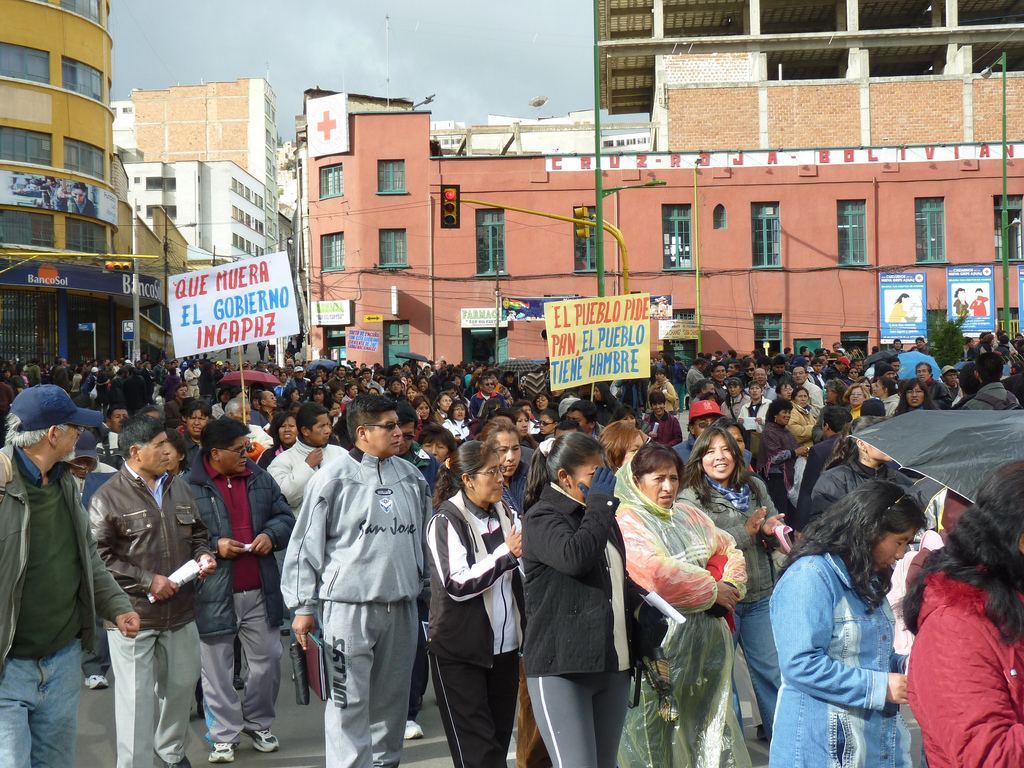
Health care workers and teachers rally in La Paz, February 18: Signs read "Death to the incapable government" and "The people ask for bread; the people are hungry"

It is not so much that this rhetoric is new as that it has migrated from the pamphlets of the radicals at sides of the march to the main stage. Like a stopped clock that is right twice a day, those who are always skeptical that the government has sold out the public, and turned against the grassroots are now in sync with at least a large portion of the popular mood. And they can speak to broadly shared concerns about the cost of living, the subcontracting of work, and the lack of sufficient investment in the industries that provide employment and public revenues to Bolivia.

Five years of MAS rule, and two years since its decisive victory over right-wing resistance to the project of a new, plurinational constitution have allowed a lot of tensions, mistrusts, and frustrations to accumulate within the party’s diverse grassroots base.  Movements that always knew how to mobilize on their own have frequently been in the streets in the past years. Unfortunately, the first response of the MAS government has often been to accuse those who mobilize of being aligned with, misled by, or even “infiltrated” by the right-wing opposition. If anything, it now seems that independent protest and even independent opposition has been made more likely by these accusations.

From Bolivia to Egypt: Overcoming Death and Fear

As I alternate between interviewing Bolivians about the process of mass collective action that overthrew two neoliberal governments in 2003 and 2005, and watching the unfolding uprising in Egypt by the Internet, I’m doing my best to learn from both situations. For now, here’s one bit of writing describing Bolivia’s 2003 Gas War that seems especially relevant to events in Egypt in 2011:

Hay ocasiones en que la muerte y el miedo son los puntos infranqueables que detienen una insurgencia social frente a las murallas del gobierno. Por eso el Estado necesita monopolizar la coerción legítima pues ésta, que encarna el posible uso de la violencia y muerte en contra de la sociedad, es la garantía última y final de todo orden político constituido. Sin embargo, hay momentos en que la muerte cataliza el ímpetu de la sublevación, en que la muerte es la seña que permite unificar colectividades distanciadas dando pie a un tipo de hermandad extendida en el dolor y el luto. En ese momento la muerte es derrotada por la vitalidad de una sublevación de voluntades sociales llamada insurrección.

There are occasions when death and fear are the insuperable obstacles that stand in the way of a social insurgency outside the walls of government power. For this reason, the State needs to monopolize legitimate coercion, which embodies the possible use of violence and death against the society, since this is the last and final guarantee of every constituted political order.

Nevertheless, there are moments in which death [instead] catalyzes the impetus of the uprising, in which death is the sign under which formerly distant collectivities can unify, giving rise to a sort of extended bortherhood of pain and mourning. In that moment, death is defeated by the vitality of the uprising of social wills that is called insurrection.

—Álvaro García Linera, “La sublevación indígena popular en Bolivia
[The Indigenous Popular Uprising in Bolivia],” 2004

Bolivia’s Literate Political Culture

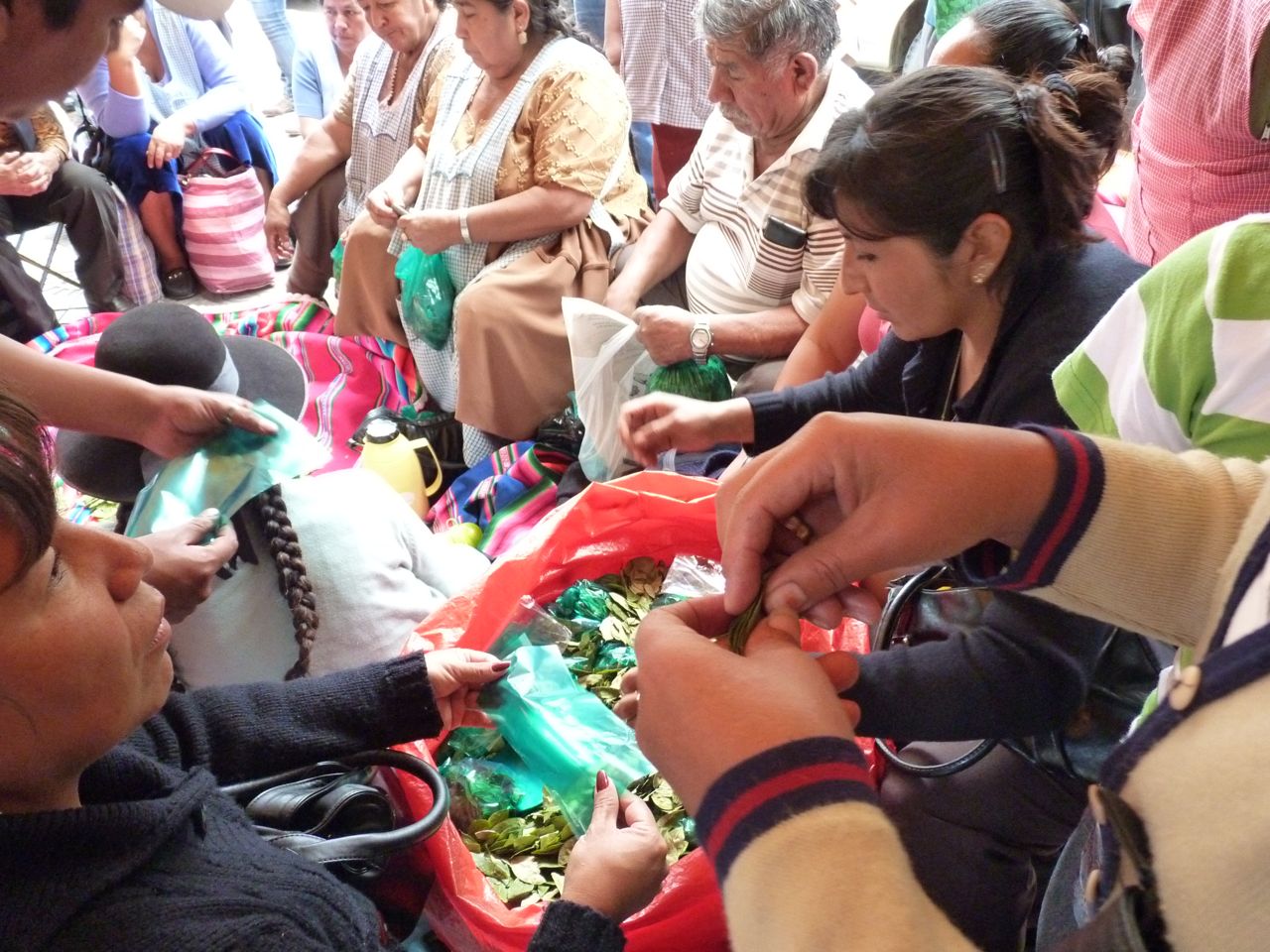
While sitting in the midst of the massive coca chew-in in Cochabamba’s central square, the overwhelming mass of people was cris-crossed by two types of vendors: sellers of cloths on which to dry coca leaves, and a ubiquitous Bolivian sight, the hawkers of copies of new laws recently passed by the Plurinational Legislative Assembly. The hot seller of the day was last year’s Law 045, the Law Against Racism and All Forms of Discrimination.

Bolivian laws are a widely circulated commodity. Newspapers, both broadsheet and tabloid, publish copies of both draft laws and their final versions as free supplements. Wednesday’s Los Tiempos had the draft statute of autonomy for Cochabamba Department stuck in alongside the sports and fashion sections. On the streets of downtown La Paz, Cochabamba, or Potosí, you can buy bound versions of all the major laws in Bolivia—the laws on criminal procedure, the labor code, and indigenous legal process, for instance—at all the main newsstands. Just by attending social movement conferences, I’ve accumulated three bound copies of the 2009 Constitution.

And that Constitution is surely the most cited text at Bolivian political rallies. You can count on the text of the constitution being referenced (though rarely directly quoted) when a series of political speakers lines up. Always referred by its formal name, the [New] Political Constitution of the State, it is a touchstone of legitimacy for protesters. It comes up as much as the so-called October Agenda, the combined political demands embodied in the 2003 Gas War, the first protests to topple a neoliberal government.

So, it was most surprising to read how America’s diplomats think about Bolivia’s political literacy, as revealed by the Wikileaks release of cables:

Although the opposition is making a mighty effort across the country to rally against the constitution, the forces of inertia seem to be conspiring against them, particularly in the form of a largely uneducated rural base in the Altiplano. Leading daily La Razon interviewed several community leaders from the Altiplano, and their supporters, and reported on January 18 that neither the leaders nor the supporters had read the Constitution.  Instead, the repeated message was that rural communities would take their marching orders from the MAS, and vote for the constitution. … In the countryside, the number of those reading the constitution is much lower.  Post suspects disinterest, blind faith in Evo Morales’ political project, and illiteracy, despite the Cuban literacy program, all play a role. (Cable 09LAPAZ96)

While the length of the new Constitution—literally hundreds of articles—no doubt limited the number of people who read it through, it’s clear that American diplomats have yet to clue in on Bolivia’s grassroots political culture. No one who has sat through a campesino rally, or the well-attended presentations on technical details of pensions or gas production, or who even sat with coca chewers ready and willing to buy the new anti-racism law, could look down so easily on alleged popular ignorance.

Attendees at World People's Conference on Climate Change—25,000 Bolivians and 9,000 foreigners—snap up a free newspaper

International Day of Action in Defense of Coca Chewing Underway

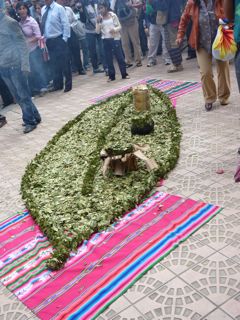
Massive coca leaf made out of coca leaves
On the plaza, a giant coca leaf made out of coca leaves

Coca growers from the Chapare (Cochabamba Department) and the Yungas (La Paz Department)—Bolivia’s two coca-growing regions—have travelled to Bolivia’s nine departmental capitals today to publicly chew the traditional leaf and to support the Bolivian government campaign to end the UN prohibition on coca chewing. Coca leaves are a traditional crop in the Andes and are both chewed in the mouth and boiled into a tea called mate de coca. Both forms are valued for their medicinal properties and cultural role in Andean culture, particularly the protection they offer against altitude sickness, fatigue, and upset stomachs. Bolivia’s demand that a 1961 UN drugs convention be amended has attracted broad support, including from the Union of South American Nations (UNASUR) and Africa, and several countries that had expressed doubts about the move have been won over. However, the United States—a major cocaine-consuming country and the main international sponsor of Bolivia’s once-heavily-militarized war on drugs—and Sweden continue to block the move. The deadline for changing their position is January 31.

Events in Cochabamba are still underway, but here is an early preview of the gathering in the city’s main square, the Plaza 14 de Septiembre.


bagging and sorting coca leaves
Vendors from the May 27 Association bag coca leaves to give away
Marchers with coca plants
Two women from the Six Federations of the Tropics of Cochabamba march with young coca plants and bags of coca leaves
TV journalist interviews Leonilda Zurita, president of Coca Growers' Women's Federation

A more complete set of photos from today’s protest is online at flickr.

Bolivia’s anti-racism law at the center of face-off with corporate press

Since August, one issue has generated more headlines here in Bolivia than any other: The Law Against Racism and All Forms of Discrimination, which was debated and passed by the Plurinational Legislative Assembly (aka, the parliament) in late September.

The remarkably short Law 045 is the Bolivian equivalent of more than a generation of civil rights law in the United States. It bans discrimination by public officials and private businessmen, criminalizes verbal and physical aggressions, charters educational efforts on discrimination, creates a national commission on issues of discrimination, and imposes sanctions on the media for circulating “racist ideas.” The scope of the law is broad, including discrimination on the basis of race, ethnicity, religion, language, age, sexual orientation, disability, and pregnancy, among other statuses. A such, it is parallel to American laws from the 1948 integration of the Armed Forces to the 1965 Civil Rights Act to the yet-to-be-passed Employment Non-Discrimination.

So, it would not be shocking if wide range of controversies had emerged over the manifold implications of the law. But this has not occurred. One single controversy, however, has risen to national prominence.

Two articles of the proposed legislation, Articles 16 and 23, have been roundly criticized by the mainstream, privately-owned press. Article 16 makes publications subject to economic fines and even closure for circulating racist ideas. And Article 23 removes any special immunity for members of the press from prosecution under the law. The mainstream press has characterized the articles as the rebirth of a 1980s proposal for prior press censorship, known as the Ley de Mordaza (the Jaws Law, for its ability to crush the press). They led marches across the country as the law was being considered, and coordinated a nationwide protest by in which newspaper covers all read only: “Without freedom of expression, there is no democracy.”

As an (US) American, of course, these provisions are shocking. Our Voltaire (“I detest what you have to say but will defend to the death your right to say it”)-to-American Civil Liberties Union tradition of free speech is, however, a globally extremely tolerant position. (I’ve written before about how our notion of the freedom of the press is, on the other hand, a highly restricted vision of public access to the media, essentially limited by press ownership.) Following the nightmares of World War II, the global human rights regime initiated by the Universal Declaration of Human Rights drew the line on free expression at racism and incitement to war, which it said should be prohibited. International conventions follow these lines by banning “racist incitement.” Germany bans Nazi parties, advocacy of and apology for genocide, and rallies by the racist right. Several other Latin American countries have restrictions on racist media which include prison terms, unlike the Bolivian law. Both the OAS president and the UN human rights representative who have visited in recent weeks have emphasized that the law is appropriate, although the line between racist incitement and free expression must be scrupulously drawn. They’ve also urged the private press to end their boycott of the rule-making process on the legislation.

Strangely, however, the American standard is irrelevant to the debate here. In three months, I have not heard or read a single defense of free *speech* as opposed to free *press* on these issues. No one is suggesting that criminalizing calling someone an “Indio de mierda” (“shitty Indian”) to their face is inappropriate. (Doing so in the United States would of course ignite a national firestorm over “thought police” and be overturned in short order by any competent Federal Court.) There has been a great deal of concern about whether the a TV station filming and disseminating that act would be liable to prosecution (the government regulations proposed on the issue now make it clear that such reporting of others’ speech will not be subject to sanction).

Aside from marches, the press and many media workers’ unions have used a one-day strike, hunger strikes in Santa Cruz, and an immense petition campaign to oppose the law, which sailed through the MAS-controlled parliament. On November 26, they submitted a sample selection of signatures to Vice President Álvaro García Linera. The press claims to have gathered one million signatures, although they are still being sent to a single place to be verified, and the eight books they handed over only come to some 32 thousand. Which brings us to the current impasse: while the new Constitution permits citizen initiatives as part Bolivian democracy, there is no enabling legislation yet to regulate the process. The press is depending on the moral weight of its gathered signatures (one million is a substantial portion of Bolivia’s 10.6 million inhabitants) to kickstart the initiative process. So far, the government seems resistant. And so, a policy controversy seems about to cross over to a crisis of democracy.

Meanwhile, the mainstream press is not the only voice on this issue. During the debate, a book was published on racism by the press over the last century in Bolivia. This racism runs up through the media’s overt collaboration with (really, rallying for) attacks on indigenous protesters in Cochabamba in January 2007 and Sucre in 2006, 2007, and 2008. The cocalero movement has declared itself on alert in defense of the law, and marched here in Cochabamba. And a stream of “alternative media” which includes indigenous radio producers, radical working-class publications, and (strangely given the name) workers in the government-owned media, has taken a distinct position calling for professional standards and arguing that racism and free expression are fundamentally different. They’ve also used the anti-racism law as an opportunity to argue for systematic coverage of indigenous issues and use of indigenous languages in the media.

For me, this storyline is a fascinating instance of public debate in the process of rights-making, an opportunity to see the shape of the Bolivian legislating process (very little of which takes place inside the walls of the Legislative Assembly), and another turn in the kaleidoscope of political alliances here in Bolivia. It’s also forcing me to reconsider (although not yet change) my ideas of what free expression is. I’ve conducted some interesting brief interviews with the alternative press on this, and hope to delve more as the story develops.

What’s behind the Potosí regional strike?

As the department-wide strike in Potosí continues to edge into the international press (primarily through its effect on tourists and now upon mining companies that operate in the region), I want to give more of the background on the strike and its demands, so it’s at least understandable why people are blockading and hunger striking there.

“It can be summed up in one single thing: in misery. … We are fighting for a hill that as of yet is not a factory, just a hill; it’s raw material. For the dream that some time we, that the families that live there, might have something. They are places forgotten by the hand of God: they don’t have water. They are using up the water in the wells. There is no electricity. It is misery.”
Saúl Juarez, Potosino hunger striker in Cochabamba

If you are from North America, this use of misery might be unfamiliar to you, but it is common in the language of Latin America. We must first organize, then-Haitian president Jean Bertrand Aristide once said, to move from misery to poverty. Here in the hemisphere’s second-poorest country (after Haiti), Potosí is the poorest of nine departments. The rate of extreme poverty, which is falling nationwide, is still 66.7%; meaning that two-thirds of Potosinos cannot afford to buy their family’s basic necessities. Of every 1000 live births there, 101 children will die before their fifth birthday. Both of these figures are the highest in Bolivia; in the case of child mortality, the second place departments—La Paz and Chuquisaca—see 63 deaths per 1000 children. It is for this reason that Potosinos have spread to the rest of the country in search of better opportunities.

“We can say that we are fighting for the reactivation of the productive apparatus of Potosí.”
Claudia López, Potosino hunger striker in Cochabamba

Most of the demands advanced by the Potosí mobilization are focused on specific industrial or economic projects, which in the eyes of protesters, have languished for the lack of state interest. The boundary dispute with Oruro centers around two hills that contain limestone, a key ingredient for cement, and a second demand is for a cement plant to earn money and create jobs from that resource. Likewise, Potosinos are calling for the activation of a metallurgy plant and for the creation of an international airport to connect Uyuni and its phenomenal salt flats to international tourists.

Potosí, of course, is not poor for the simple lack of investment from the outside. It has never simply languished in the absence of foreign interest. Instead, it was once the largest the city in the Western world precisely because of the rich attraction its mineral wealth held for the Spanish state and its investors. Immense wealth was symbolized by the Cerro Rico which sits above the city, or simply by the phrase “it’s worth a Potosí.” Every Bolivian, rich or poor, left or right, knows how Bolivian wealth enriched Spain, and through it Europe. And every Bolivian understands that to take part in that wealth requires doing more than extracting minerals from the ground and shipping them out of the country.

More recently, Potosí was hit hard by the shock-therapy program of neoliberal economic restructuring that began in 1985. At the time, the miners who worked for COMIBOL—the national mining company that took over the mines run by three wealthy tin barons in 1952—were the strongest social movement in the country. The government of Paz Estenssoro aimed to break this power, and essentially shut down the government-run mining sector to do so, laying off tens of thousands of workers. Those miners who did not resettle elsewhere in the country became the backbone of the cooperative mining sector, a collection of small scale mining projects that engage in uncoordinated mining of the Cerro Rico, and other mountains like it, in search of rich veins of minerals. Decades of such drilling have brought the Cerro to the brink of structural collapse, posing the threat that the hill—recognized as a World Heritage Site by UNESCO—could become a ruin.

“They all come to promise and promise, and to say this and that could be done. The [current] government has done the same: it has promised. But after five years of their rule, of creating new laws and a new constitution, of re-electing them, there is nothing. … So, we want dates; we want concrete responses of when and how; we want specific studies; we want operational plans that establish dates for the processes that are going to happen.”
Claudia López

If one had to choose a symbol of the capacity for delay in pursuing development projects in Bolivia, it might well be Karachipampa, the metallurgical plant that the mobilization is demanding to be activated. This lead and silver smelter was built between 1985 and 1988. It has never operated.

Several years ago, in 2005, the Canadian firm Atlas Precious Metals Inc. entered a shared-risk agreement to invest in the plant. You can see on their web page an optimistic assessment of the plant’s production capacity. As of April, only 20% of the firm’s promised investment had been realized (article in Spanish). Currently, Atlas and COMIBOL are in a legal dispute in which Atlas demands its $12 million investment be repaid, and COMIBOL seeks compensation for the value of the plant, which remains unused. In a letter to the government (es), the Potosinista Civic Committee washes its hands of the whole dispute and demands:

The only thing the Potosí people want is to see, in an immediate manner, the effective functioning of the Karachipampa Plant, whether it is with the [foreign] company or through state intervention.

Beyond all these details, the strongest emotion visible here is simple, exhausted, impatience. Whether the timeline is 21 years for the plant, or 5 years for the MAS government, or three generations for the border dispute (more on that when I can provide a fuller background, or transcribe more of my interview with a Coroma resident), those who have thrown themselves into this protest have run out of patience. Against the experience of delay, they have enacted tactics based on urgency: extended blockades, hunger strikes, and so on. So far, Potosinos themselves, beginning with the hunger strikers have borne most of the costs of these urgent tactics themselves, or imposed them on the surrounding communities. However, they are increasingly enacting or talking about tactics that will cost companies operating in the region substantial losses on a daily basis.

Potosí isolated by 12-day regional protest

[There is, as of today, rising hope for negotiations to begin between the Government and Potosinos (and for three-way dialogue with Oruro on the border issue to take place as well) soon. More on that soon. This post comes as written yesterday. Also, I added a little bit on Pablo Solón’s comments on Democracy Now at the end.]

A department-wide general strike in Potosí department, Bolivia’s traditional mining center, has entered its thirteenth day today, with no clear end in sight. The strike is now taking three major forms: a comprehensive blockade of transport in and out of the department, a general closure of businesses by both their workers and owners, and a growing hunger strike reported at more than 500 people on Sunday. The mobilization was backed by a remarkable show of unity on last Tuesday, August 3, when some 100,000 people marched in the city of Potosí in support of the effort. The number is phenomenal relative to the city’s population of 160,000, and even the department’s of some 700,000.

The systematic isolation of the department has made it impossible for me to visit the protests, once it became clear (with the march) just how significant this event is. Hundreds of trucks and buses are lined up at the various entrances to the department. As of Sunday, the Governor of Chuquisaca was mobilizing food and supplies to people stranded on the border.

Potosinos in protest are coordinated by the Civic Committee of Potosí, a coordinating committee of major institutions. Other key actors include the community of Coroma (part of which is in territory also claimed by a neighboring community in the department of Oruro), the Federation of Cooperative Miners, and since the massive march, major politicians including Governor Félix Gonzales (MAS). Gonzales and four Potosino members of the Plurinational Legislative Assembly (formerly, the National Congress) are at the head of the hunger strike.

Compared to the mobilization, the demands are quite modest:

  1. Delimitation of the inter-departmental border between Quillacas (Oruro) and Coromo (Potosí), which centers around control over limestone resources in the area
  2. Installation of a cement plant in the Coroma region, using those resources
  3. Reactivation of the metallurgy plant in Karachipampa, currently suspended due to a legal conflict among two companies
  4. Preservation of the Cerro Rico, the massive mining mountain just outside the city of Potosí, whose structural future is in jeopardy after five centuries of mining
  5. Construction of an international airport for Potosí as soon as possible
  6. Completion of delayed highway projects

The protests seemed to have expanded as rapidly as they did because in the first week the national government insisted, primarily through its Minister of Autonomy Carlos Romero, that they were a purely partisan effort in defense of Potosí Mayor René Joaquino (see ). This added to a sense of indignation at being ignored by a MAS government to which they have supplied an overwhelming vote for the past five years. Their sense of being slighted has rebounded into the chant (heard at a solidarity march of Potosinos here, as well) of “Potosí Federal,” a call for devolving power to the region. (This is clearly not a demand of the mobilization, however, and it’s unclear how such a demand would differ from the departmental autonomy approved by referendum in December, and soon to be delimited by a Statute of Autonomy.) Comcipo leader Celestino Condori emphasized a new sense of unity on the day of the march, “We’d like to demonstrate to the government that in Potosí, there is unity, among Moors and Christians; everyone is changing their polleras [traditional indigenous women’s dress] to put on the red and white which are the colors of the Potosino flag.” In action, this is taking the form of a wide variety of hunger strike pickets led by different organizations, and since the weekend, spreading to other cities in Bolivia.

Currently, the impasse blocking negotiations concerns where and how they might take place. As with movements across the continent (and using good strategic sense), the Potosí movement has demanded to negotiate at their place of strength, while the pressure of mobilization is on. On the other hand, the Morales government is insisting that discussion of border must occur in neutral territory and that no negotiations can take place without an intermediate truce that suspends mechanisms of pressure. On the question of territory, they are backed up by concerns that Oruro might mobilize as well if discussions began on non-neutral ground. Oruro’s civil society placed themselves in a “state of emergency,” preparing to mobilize last weekend.

In a broader sense, this mobilization is one of a growing number of signs that MAS allies (and members, such as the governor) are moving to pressure the national government over particular demands, making Evo Morales’ second administration a period of serious conflict, though of a very different kind than the years of confrontation with the right-wing of the media luna. It also is an early sign that the new autonomy in the western departments will come with genuine political independence on the part of regional leaders.

Incompetent English-language coverage: As a side note, this central political story in the last week here in Bolivia is being described to the English-speaking world by reporters who can only be described as myopically focused on the lives of wealthy foreign tourists and stunningly ignorant of local realities. Local realities such as the front page stories of every single national newspaper. Associated Press, I’m talking about you. Here, in its entirety is Saturday’s AP story on the Potosí situation:

Protest traps tourists in Bolivian highland city

(AP) – 1 day ago

LA PAZ, Bolivia — A protest by Bolivian miners has trapped more than 100 mostly European tourists in the southern Bolivia mining city of Potosi for more than a week.

The protesters piled rocks on the runway of the Potosi airport Friday to prevent a plane from landing to pick up some of the foreign tourists.

The miners have also blocked roads into the area for 10 days.

Also trapped are about 500 Bolivians, and local media say the blockade is beginning to cause food shortages in the city of 200,000 people.

The miners have a series of grievances with the government, including a demand to reactivate mines that officials ordered closed and to settle land disputes. (“Protest traps tourists in Bolivian highland city,” The Associated Press)

I’ve highlighted in red things that are basically wrong, or reflect the listening-to-other media’s-stories as reporting that seems to have gone into this story, filed from La Paz. As noted above, cooperative miners are one of many groups that have folded into the department-wide protest. There are substantial reports of Bolivians being stranded, but descriptions of around five hundred people refer to people on vehicles waiting to get in to the region. “The area” is actually the Department of Potosí, which has one “land dispute” on the table, its border with Oruro. The only mine under discussion in the demands is the Cerro Rico, whose structural instability could result in the closure of mining, under a review currently underway and encouraged by UNESCO, which maintains the mountain (as well as the city) on its World Heritage list. For details of the actual airport incident, which did involve miners, you can see this article in Spanish. For consolation on the ability of English reporters to competently discuss life in Bolivia, see this piece from Agence France Presse: Protesters seize Bolivia airfield, seal off Potosi.

Pablo Solón on Democracy Now: Potosí got a sliver of further US media coverage today with the mention of the protest made by Amy Goodman while interviewing Bolivian Ambassador to the United Nations Pablo Solón. Amy’s question got to the heart of the protest: “The demonstrators are calling for more investment by the Bolivian government in the lithium-rich area.” And Solón basically dodged her question by talking about borders and not development commitment. It’s hard not to be sympathetic with him having to explain this issue alongside the other awesome work he’s doing, which the interview does a good job of describing.

Pando Massacre trial underway: 314 witnesses named by the prosecution

The Prosecutor’s Office has tendered its list of witnesses (article in Spanish) in the trial of twenty-five officials and right-wing activists for the 2008 massacre in and around El Porvenir, Pando. The witness list includes 314 people, reflecting an extensive investigation of the day’s deadly events. The key defendant in the trial is Leopoldo Fernández, then Prefect of Pando, who is accused of coordinating the massacre of at least 19 campesino protesters on September 11, 2008. Fernández was removed from office shortly thereafter and has remained in prison for the past 20 months. During last year’s presidential elections, the right-wing Progress Plan for Bolivia slate nominated him as their Vice Presidential candidate.

Some background: The large massacre of MAS-aligned campesinos occurred on September 11, 2008, the deadliest political violence in Bolivia since 2003. The confrontations of that day are the subject of a recent documentary by César Brie, the playwright and director who produced the documentary about the May 2008 public humiliation of peasant activists in Sucre. Brie’s documentary, Morir en Pando (To Die in Pando), broadly confirms the investigation by UNASUR, South America’s equivalent of the European Union. I saw it in its depressing length during my first week here. As the media luna governors mounted their most serious challenge to national power, local campesinos (and in Santa Cruz, slum dwellers) mobilized against them. Two contingents of campesinos were marching to Pando’s capital by way of Cobija on that fateful day. Right-wing civicos (there is no good translation for this “civic movement”) attempted to block both marches, threatening the use of deadly force. A complex series of confronations, during which Brie argues a civico was brought down by “friendly fire” gave way to an all out assault by civicos on the peasant protesters. At least twenty were killed; and angry right-wing crowds outside the hospital in Pando’s capital Cobija attempted to assault wounded campesinos receiving treatment. Some were evacuated to La Paz for their own safety, and many had their injuries downgraded and misrepresented in their eventual autopsies.

This dire event was in several ways a turning point for the 2008 political crisis. The MAS government, which had been pursuing an apparent strategy of falling back in the face of right-wing violence, cancelling presidential visits for example when right-wing protesters threatened to disrupt them, made its first major show of force. Pando’s Prefect (the new, post-2010, title is Governor) Leopoldo Fernandez was linked to the civic movement and the violence, a state of emergency was declared, and Fernandez was arrested.

Stunning political turnaround: Despite the clear depth of the right-wing movement in Pando, the department broke from the so-called media luna block of four eastern departments in this past April’s regional elections. Both the new governor of Pando, Luis Flores, and the new mayor of its capital Cobija, Ana Lucía Reis, represent the indigenous-popular Movement towards Socialism, Bolivia’s governing party.

Dignidad y dinero: Ecuador, Bolivia reject US pressure on climate

The central aim of any climate summit is not to save itself and accept any outcome, but to come to an agreement that will save humanity.” — Pablo Solon, Bolivia’s climate negotiator

In the days before this week’s conference, and while a global preparatory negotiations were being held on climate change in Bonn, this news came:

The US State Department is denying climate change assistance to countries opposing the Copenhagen accord, it emerged today.  The new policy, first reported by The Washington Post, suggests the Obama administration is ready to play hardball, using aid as well as diplomacy, to bring developing countries into conformity with its efforts to reach an international deal to tackle global warming.  The Post reported today that Bolivia and Ecuador would now be denied aid after both countries opposed the accord. (Guardian)

This came as a shot across the bow of other developing countries who are caught between environmental principles and economic realities.

These pressures are quite serious. A leading daily newspaper in Cochabamba, Los Tiempos, ran an op-ed yesterday that circled around the movie Avatar, a story of indigenous resistance to extractive industry. It was a blunt caution to the Bolivian government under the headline “Truths that hurt“:

If Bolivia were to act in a more diplomatic way, it could have a great opportunity in the carob market, and this could even be a part of the new economic base of the country. … With the poverty of people, they cannot make speeches which at the moment of settling accounts will amount to no more than that. Bolivia could play its cards in a different way, avoiding the politicization of an issue in which its vote matters very little. The rest is for the movies and for science fiction.

Of course, Bolivia is making just such speeches and hosting a massive civil society gathering on climate change. And it’s clear from the compendium of speeches all of us participants were given by the Foreign Affairs Ministry that this didn’t start yesterday. Instead, Bolivia has been playing a diplomatic role on behalf of the world’s hundreds of millions of indigenous people: pushing for the passage of the UN Declaration on the Rights of Indigenous Peoples, calling for the Rights of Earth to be globally recognized, and connecting with environmental and indigenous delegates in the Copenhagen summit. It would represent a major reversal of rhetoric and a betrayal of the government’s indigenous base to turn back under pressure.

It’s also true that for many countries, the outcome of climate negotiations is the primary issue. The overall targets agreed to, and the effectiveness of the measure worked out determines how severe climate change will ultimately be. As long as negotiations are open, their resistance can push climate agreements to be more serious. Agreeing to take money from a mechanism

But there is something else at stake. To abandon a political initiative under this kind of pressure, is effectively to admit that the hemisphere’s great power  determines your policy. As Bolivian climate negotiator Pablo Solon put it, “We are a country with dignity and sovereignty and will maintain our position.” To do otherwise would be to admit that the country’s principles come with a price tag.

At yesterday’s Root Causes panel, Ecuador’s Ambassador to the UN, María Fernanda Espinosa Garcés, took this one step further.

Last week, the United States suspended Ecuador from$2.5 million in assistance in its climate change agenda because Ecuador did not adhere to the Copenhagen Accord. It was a punishment that the United States carried out upon Ecuador for not adhering to that Accord that was not an Accord. It was a spurious document made by just a few, without consulting all the governments and all the peoples of the world. Ecuador is not going to accept these forms of extortion. In return, the president of Ecuador and the people of Ecuador have said to the United States with all seriousness that Ecuador offers the United States $2.5 million if the US would sign the Kyoto Protocol. [applause] And we say it seriously. If the United States signs the Kyoto Protocol, we will transfer $2.5 million in cooperation to that country  to help them in their process of technological conversion that will so help the planet.

The offer stands.