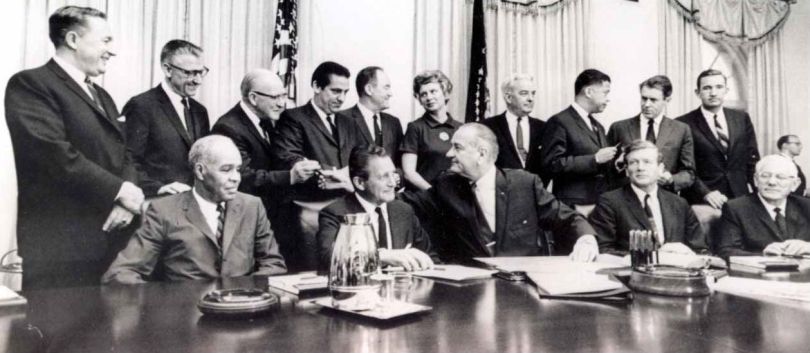
Following the 1967 wave of urban uprisings in Black communities, President Lyndon Johnson established the National Advisory Commission on Civil Disorders to investigate “What happened? Why did it happen? What can be done to prevent it from happening again and again?” As part of the relatively small field of social science on rioting, it is best known for its alarming statement that “Our nation is moving toward two societies, one black, one white—separate and unequal,” a dire prospect for a country that had dismantled the legal doctrine of “separate but equal” just a dozen years before.
Less often quoted is the Commission’s in-depth study of the nature and process of rioting. Altogether, Malcolm McLaughlin records in a recent book (Long, Hot Summer of 1967: Urban Rebellion in America), in the first nine months of 1967, “almost 170 cities in 34 states and the District of Columbia had experienced an uprising of some sort, and almost 40 communities had more than one. Few corners of urban America were left untouched.” In its effort to document and understand the riots, Kerner Commission reached the following conclusions, many of which seem very descriptive of the past year’s flashpoints of unrest from Ferguson, Missouri to Baltimore, Maryland.
The “typical” riot did not take place. The disorders of 1967 were unusual, irregular, complex and unpredictable social processes. Like most human events, they did not unfold in an orderly sequence. However, an analysis of our survey information leads to some conclusions about the riot process.
In general:
The civil disorders of 1967 involved Negroes acting against local symbols of white American society, authority and property in Negro neighborhoods—rather than against white persons.Read More »



 Carwil without Borders