Peru convicts Walter Aduviri, acquits seventeen others in Aymarazo verdict [Guest Post]

This guest post is by Kellie Cavagnaro (website|Twitter: @KellieCavagnaro), a Vanderbilt graduate student in Anthropology who is conducting fieldwork in the Puno region of Peru.

As of Thursday afternoon, the fates of eighteen indigenous activists who were indicted for their leadership in the 2011 anti-mining protests in Puno region, Peru, have been decided. Sixteen men and one woman of the Aymara Nation have been acquitted today for their involvement in organizing and leading a region-wide uprising—known as El Aymarazo—against the Santa Ana silver mining project (Wikipedia) owned by Vancouver-based Bear Creek Mining. Only the movement’s widely-recognized leader, Walter Aduviri, stands convicted on a count of inspiring destruction of state and corporate property. (All 18 defendants were acquitted of the charge of extortion.)  He left court in high spirits nonetheless, surrounded by loyal supporters who marched behind him through the urban center of Puno, the capital city of the region.

Video: Aduviri leaving Puno’s Palacio de Justicia at nightfall amid wide support from Quechua and Aymara activists

Aduviri faces the likelihood of seven years in prison and a fine of two million Peruvian Nuevo Soles (about $575,000 USD). His final sentencing is scheduled for July 18th, 2017, but today’s provisional sentencing carries heavy consequences for the political future of this region’s indigenous citizens.  As a result of the court’s decision, Aduviri, who held political ambitions for 2018 regional governance in Puno, may lose his lands and campaign financing in attempt to pay the exorbitant fees, and be ineligible for public service once his sentence is finalized. Aduviri runs on a stringently anti-mining campaign platform, and his political symbol, a blue gotita (droplet) of water with a winking face, is painted along myriad houses and community buildings all along the highway tracing the southern shores of Titicaca.

The politically-charged consequences of these financial sanctions have incensed many of Aduviri’s Aymara and Quechua supporters, who demonstrated en masse, braving the cold and waving wiphala flags in support of “Hermano Walter”. Discussion and planning is already underway for a new wave of Aymara protests, road blocks, and regional strikes, though citizens are awaiting the final sentencing in a few weeks. Just after the decision was announced, I raced north across the city the recording studio at Pachamama Radio with Aymara communicator and women’s rights activist Rosa Palomino. She and her communications team broadcasted their weekly Aymara language news and culture show, Wiñay Pankara (Always Blooming), with a focus on the day’s legal proceedings. On the air were Palomino and her associates from the Union of Aymara Women of Abya Yala, or UMA, and invited guest Lucio Ramos, a local yatiri, or Aymara spiritual leader and educator, who encouraged listeners to take charge of their indigenous communities’ bienestar (wellbeing) and “train-up” to be indigenous sociologists, anthropologists, and community reporters. Central to the program’s discussion was the theme of representation; from the state’s refusal to address collective land rights issues, to the mainstream media’s avoidance of indigenous rights violations and neglect of Aymara perspectives on illegal land concessions and corporate manipulation of local governors.

The proposed Santa Ana mine at the center of today’s conflict is located in the Aymara village of Huacullani, an Andean community of the altiplano, the arid high-altitude plain that traverses the Peru-Bolivia border along the shores of Lake Titicaca. Back in 2011, the conflict over unwanted mining infiltration at Huacullani ignited the El Aymarazo uprising, which quickly spread to protests and demonstrations against various extraction projects throughout the region, all of which were operating against the United Nations’  ILO 169, which guarantees indigenous communities the right to free, prior, and informed consent on all extraction and development projects on their territories. It remains to be seen if a second wave of El Aymarazo will retain the same strength in numbers as the 2011 movement that successfully halted state and municipal roadways, and shut down the center of Puno for days on end. But after Thursday’s momentous court decision, across the radio fields of the altiplano, cries for a new “Quechuazo y Aymarazo” echoed into the night.

— Kellie Cavagnaro

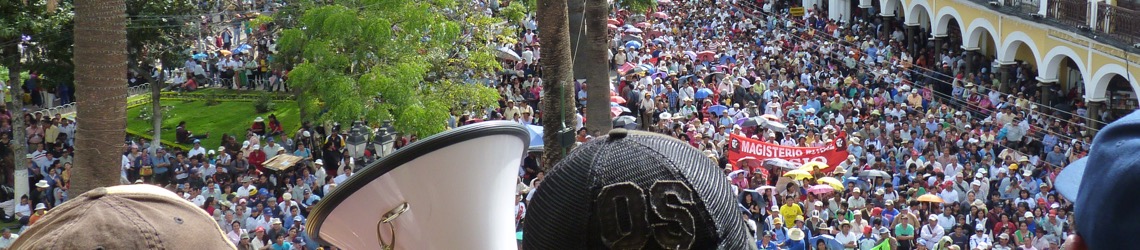
Photo above headline: Palacio de Justicia surrounded by Aymara and Quechua activists waving the Andean wiphala. (photo by: Kellie Cavagnaro)

[2014] CONAMAQ in crisis: Pro-government faction seizes headquarters by force

This post was originally written in January 2014, and went unpublished while I was on parental leave with my first child. I’m posting it now to make it available for others to reference.

The highland indigenous movement CONAMAQ entered a profound organizational crisis in December over the organization’s relationship to the Evo Morales government. The group, whose full name means the National Council of Ayllus and Markas of Qullasuyu, represents over a dozen highland indigenous communities dedicated to restoring self-governance through traditional community structures. It diverged politically with the government in 2011 over the right to exercise free, prior, and informed consent over projects in indigenous territories and its participation in the Eighth National Indigenous March in defense of the Isiboro-Sécure National Park and Indigenous Territory (TIPNIS). Soon after the march, CONAMAQ withdrew from the government-aligned Pact of Unity. In the past year, it has made preparations to run an independent slate in the 2014 parliamentary elections.

A faction of pro-government leaders within CONAMAQ, led by Hilarion Mamani of Chichas waged a campaign for new leadership of the organization, which included six attempts to occupy its headquarters. In December, Mamani’s faction and the existing leadership held separate gatherings of the Jach’a T’antachawi, a large gathering that is the organization’s highest authority. Late on December 10, after the pro-government gathering elected Hilarion Mamani, a crowd of his supporters burst into the organization’s La Paz headquarters and beat three CONAMAQ leaders and a member of the Permanent Assembly for Human Rights. Bolivian police took control of the building for the next month, while supporters of the existing leadership maintained a vigil outside the building. Hilarion Mamani’s supporters attacked that vigil and took control of the headquarters on January 14. Both the Defensoria del Pueblo and the UN’s human rights office in Bolivia issued statements of concern following the violent takeover; the UN particularly criticized the failure of the police to safeguard the vigil from physical attack.

The Jach’a T’antachawi aligned with the incumbent leadership elected Freddy Bernabé as the new head of the organization on December 12 and 13. The regional indigenous confederation of the Andes (CAOI) and the Amazon Basin (COICA) recognize him as the leader of CONAMAQ. The government-aligned Pact of Unity, which also include the CIDOB faction led by Melva Hurtado, views Hilarion Mamani as CONAMAQ’s leader. The newspaper Pagina Siete and community radio network Erbol report that grassroots leaders in most of the organization’s base back Bernabe.

For Hilarion Mamani, the split is a repudiation of the incumbent leadership’s political alliances, including with CIDOB, the Green Party, and “free thinking” dissidents within the MAS. Conversely, the incumbent leaders have denounced his actions as nothing more than government interference in the organization. The government claims to distance itself from an “internal” conflict in the organization, but state media immediately recognized Hilarion Mamani as its leader and Vice Minister Alfredo Rada has blamed the split on the government’s critics in the movement. Dissident MAS legislator Rebeca Delgado denounced government interference, citing documentation of Rada’s Vice Ministry paying the logistical expenses for Mamani’s election (see also this signed budget posted online). Since his election, Mamani’s faction has vowed to mobilize for Evo Morales’ re-election as president.

Post-script: CONAMAQ’s headquarters before and after the takeover by the pro-government faction, as tweeted by a Bolivia journalist.


State of the TIPNIS highway, 7 years into its controversial construction

Since documenting the state of construction of the Villa Tunari–San Ignacio de Moxos highway is purely factual work based on references, I’ve been doing on Wikipedia for years. Here’s the latest update:

Screen Shot 2017-07-05 at 3.52.38 PM

Villa Tunari–San Ignacio de Moxos highway on Wikipedia

Update 1: Despite the legal prohibition on Segment II, TIPNIS community members have recently shared photographic evidence (taken on July 17, 2017) that the government is actively building bridges inside of the Territory that would become part of the highway.

TIPNIS-Unauthorized Construction-July17 170998

Update 2: After the passage of Law 266, construction of the highway appears to have accelerated. This is happening despite provisions in the law which require the elaboration of  transportation plan for TIPNIS and consultation with residents.

Pablo Solón squares off with Bolivian government over El Chepete/El Bala megadam

Pablo Solón Romero was the most important face of the Plurinational State’s environmental and human rights diplomacy from 2006 to 2011. Last week, he became the latest critic of that same government to suddenly face criminal charges. On Friday, June 30, authorities delivered Solón a subpoena in a case against him and journalist Rafael Archondo. The pair had been designated Bolivia’s permanent and alternate representative to the United Nations. Now, they each face two charges of corruption for Archondo’s succession to the role after Solón resigned. The government alleges that Solón’s letter presenting Archondo to the United Nations constituted an unlawful usurpation of the President’s power to designate ambassadors.

For Solón, the investigation is an act of retribution.

In a statement released Monday, he declared:

The news wasn’t a surprise. Due to our critical analysis of the El Bala and El Chepete hydroelectric megadams, various friends had warned me that they would search underneath the stones to find something to accuse me of, to intimidate me, and to make me shut up. […]

I won’t refer at this time to the supposed crimes that we are accused of, since I will refute every one of them in a formal and public manner when I go to declare before the Prosecutor’s Office.

What I can say is that we will continue to think and we will continue to speak. Wherever we find ourselves, we will not renounce our ability to criticize and to state our opinion. It is most lamentable that rather than refute us with arguments, they seek to frighten us with this kind of accusations.

La noticia no fue una sorpresa. A raíz de nuestro análisis crítico de las mega hidroeléctricas de El Bala y el Chepete, varios amigos y amigas me habían advertido que buscarían debajo las piedras para acusarme de algo, intimidarme y hacerme callar.

En esta oportunidad no me referiré a los supuestos delitos de los cuáles se nos acusa ya que de manera formal y pública refutaré cada uno de ellos el día que vaya a declarar a la fiscalía.

Lo que si puedo decir es que seguiremos pensando y seguiremos hablando. Donde quiera que nos encontremos no renunciaremos a nuestra capacidad de criticar y decir lo que opinamos. Es muy lamentable que en vez de refutarnos con argumentos busquen amedrentarnos a través de este tipo de acusaciones. 

Pablo Solon
Pablo Solón speaking in March 2017

Pablo Solón, a Bolivian with a long history of radical and progressive activism, served first as its ambassador to UNASUR and later to the United Nations (Wikipedia biography|2010 Democracy Now interview). When the Bolivian government attacked the 2011 indigenous march in defense of the Isiboro Sécure National Park and Indigenous Territory (TIPNIS), Solón was one of several government officials to speak out, urging President Evo Morales to reconsider the proposed highway through the territory, a position he amplified once he stepped out of public service in 2012. After several years at the head of Focus on the Global South, Solón returned to working on Bolivian environmental issues at the La Paz-based Solón Foundation. Now, he has put his expertise to use challenging the government’s drive to build massive energy infrastructure projects in the Bolivian Amazon.

Read More »

Bolivian Ombudsman sues to prevent doctors from going on strike


Taking one more step in the Bolivian government’s slide away from socialism, the Defensor del Pueblo (Human Rights Ombudsman) has successfully petitioned a court to limit the right of Bolivian workers to go on strike. The workers in question are doctors affiliated with the Colegio Médico, who carried out a two-day work stoppage in protest of a government decree turning medicine into “free affiliation” profession, analogous to anti-union right-to-work laws in the United States.

Defensor David Tezanos Pinto filed the suit in the name of the right of the public to health, but the move cuts against the grain of strong pro-labor elements of Bolivian political culture, some of which date back to 1936. The right to strike was reaffirmed in the 2009 Constitution, and the court ruling that resulted is equivocal on the appropriate balance between that right and the public interest in access to medical services. The ruling stipulates “the Colegio Médico’s obligation to guarantee the right to health in normal conditions for all uses of the public health service when they exercise their ight to strike | El deber garantizar el derecho a la salud en condiciones de normalidad en todos los usuarios del servicio de salud público por parte del colegio médico a tiempo de ejercitar su derecho a la huelga.”

After the ruling,  Tezanos threatened further lawsuits against future protests on May 30, suggesting that transit drivers on strike and protesters using road blockades could be targeted. Blockade of highways are a central form of protest in the Andes, and many other places across Latin America. The current government owes its existence to extensive social unrest using blockades from the 1980s onward in the Chapare and from 2000 to 2005 across Bolivia. More recently, Tezanos has stepped back from his earlier threats, stating on Twitter that “The Constitution protects health services, limiting medical strikes, guaranteeing the right to strike in other sectors.”

Tezanos is the first Defensor appointed from within the Movement Towards Socialism party, which has governed since 2006. Under Bolivia’s previous political turbulence, the long term of the Defensor and the fractiousness of the National Congress has kept this important role somewhat independent of the ruling party. This lawsuit is the latest action leading some Bolivian’s to question whether that independence will continue under Tezanos’ leadership. For Inter-Union Pact leader José Luis Álvarez, the latest action “criminalizes the strike and social protest.”

This week, the Departmental Workers Center has stepped up a campaign to demand Tezanos renounce his action and back the right to strike. An alliance of workers, doctors, neighborhood councils, rural irrigation users, and others is preparing a march on the matter for June 26.

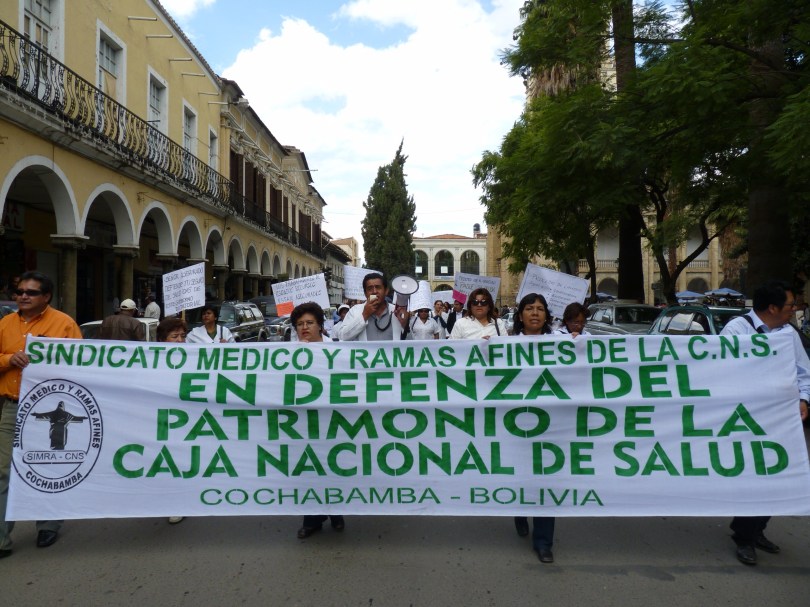
Image: Bolivian medical workers on strike in Cochabamba, April 2011.


At the Inter-American Commission Human Rights…

I’m spending this week in Washington, DC, attending sessions of the Inter-American Commission on Human Rights. I’m here as a researcher on socio-environmental conflicts and a teacher; six of my students in a Human Rights of Indigenous Peoples class are here with me to see how the human rights they are learning about are claimed in practice. The Inter-American human rights system, which includes the Commission and the Inter-American Court on Human Rights, has become a critical node in the mesh of institutions that are transforming indigenous rights from a general aspiration to a formal international norm.

International law institutions are viewed by most United States citizens with well-earned skepticism. The US government has played an ironic role in helping to structure such institutions, but then refusing to acknowledge any outside legal commitment or monitoring structure as having authority over its actions. US Ambassador to the United Nations Jeane Kirkpatrick famously called social and cultural rights “a letter to Santa Claus” and Senate ratifications of major human rights treaties have included statements insisting they may not be invoked in civil litigation. Outside the superpower, however, these institutions tend to be regarded with greater respect and states dutifully send senior officials to be questioned and directed by members of the Inter-American Commission. On Friday, for example, Commissioner Macaulay insisted that a Minister from Panama not leave the room without first scheduling the next meeting with a community who brought its land claims case before the IACHR.

Indigenous Rights at UN:OAS.002Both the Commission and the Court are bodies of the Organization of American States, the regional association of Western Hemisphere countries founded in 1948 in response to the Roosevelt Administration’s call for a “League of Nations of the Americas.” US leadership initially positioned the OAS as anti-communist and drove Cuba’s suspension from the organization from 1962 to 2009. The Commission began in 1959 and the Court opened in 1979. While the softer of the two institutions, the Commission has the power to impose binding “precautionary measures,” ordering states to protect vulnerable individuals or avoid taking irreversible actions. The Commission also acts as an investigative arm of the system and makes recommendations to states, and sends cases to the Court for adjudication when the states don’t comply. The Court acts as a kind of continental Supreme Court overseeing the human rights of people in twenty-four countries that have ratified the American Convention on Human Rights (those countries indicated by all colors except purple and gray in this map).

My students have been reading Richard Price’s Rainforest Warriors: Human Rights on Trial, a detailed ethnographic account of the how the Saramaka people brought their rights claims before the Inter-American Commission and Inter-American Court in a landmark case. The Court’s eventual decision in Saramaka v. Suriname concluded (1) Afro-descendant peoples in the Americas living traditionally and distinctly from national societies have the same rights as indigenous peoples; (2) Both kinds of traditional peoples have rights to property in their traditional territories, and the resources they have traditionally used; (3) projects that seize this property or threaten the physical or cultural survival of traditional peoples can only be carried forward with their free, prior, and informed consent.

Four years ago, I attended the session on the Isiboro-Sécure National Park and Indigenous Territory at the Commission. You can read my report on that hearing here. More recently, in December 2016, three Sioux peoples brought the issue of the Dakota Access Pipeline to the IACHR. The hearing is archived as an online video (en and es, according the language of the speaker), just as all hearings this week are available from the Commission.

Women of TIPNIS reject government’s new push for a highway through their territory

“We, the indigenous women and the communities categorically and overwhelmingly reject, before the government of the Plurinational State and its operatives, the construction of the TIPNIS highway, the [proposed] abrogation of Law 180, and the deceitful acts, the bribes, for their threat to human life, and [for the resulting] permanent colonization and despoiling of three indigenous nations.”

“Las mujeres indígenas y comunidades rechazamos de forma categórica y contundente ante el gobierno del Estado Plurinacional y sus operadores la construcción de la carretera al Tipnis, la abrogación de la Ley 180 y acto mentiroso, prebendas, por atentar contra la vida humana, la colonización permanente y el despojo de tres naciones indígenas” (Source: Los Tiempos)

This was the reaction of Marqueza Teco, president of the organization of women of the Isiboro-Sécure National Park and Indigenous Territory (TIPNIS) to the recently announced draft law that would repeal Law 180 and authorize the building of a highway across their lands. Read More »

Bolivian government and opposition coalitions to march on referendum anniversary

A year has passed since Bolivian voters denied President Evo Morales a chance at re-election in the February 21, 2016, referendum. The vote marked the first national defeat for Morales’ Movement Towards Socialism (MAS) party in a decade (although local election results have been mixed before). Prior to that vote, critics of the government from the left (on indigenous rights, unkept development promises, corruption, or the centralization of power) had ultimately aligned against the conservative elite. But by holding a referendum that could curtail Morales’ power without replacing him entirely, the MAS generated a de facto alliance between its left and right opponents. (A similar phenomenon contributed to the unprecedented number of blank and spoiled ballots in the 2011 Judicial Elections.)

Despite the 51.3%–48.7% defeat, the MAS has plunged ahead with a national effort to re-elect Morales, offering four strategies to legalize him running for a fourth term:

  1. Convene a constitutional referendum by collecting signatures through citizen initiative.
  2. Re-convene a constitutional referendum through the Plurinational Legislative Assembly
  3. Seek a judgement from the Plurinational Constitutional Tribunal declaring that the president’s term limit is an unconstitutional violation of the public’s right to freely choose their leader.
  4. Have Morales resign six months before the 2019 election to make himself eligible to run again.

Unsurprisingly, these proposals have not gone over well with either left critics or right-wing opponents of the government. With the February 21 referendum as a rallying symbol, organizations in both milieux as well as voters on social media have organized mobilizations “in defense of the vote.” You can get a sense of the tenor of these calls here:

  • afiche_no
    Independent left ‘Bolivia Voted No’ image demands: Respect the citizens’ vote.

    A coalition of left grassroots signatories, including the movements behind the TIPNIS campaign, Potosí regional strikes, Guaraní protests at Takova Mora, and many other organizations put forward this document: Let’s remember why we voted no!

  • Pre-February 21 mobilizations have included this protest in La Paz on February 1.
  • On February 21, mass meetings called cabildos have been called for major plazas in departmental capitals across the country.

Conversely, the government and its close movement allies have been preparing their own counter-mobilizations to occur on the same day (or the previous night).

bolivia_21f_dia_de_la_mentira
Pro-MAS image asks “What happened on February 21? A series of media attacks against Evo Morales.”

These mobilizations will have the slogan, February 21: Day of the Lie. This lie is mainly the false claim by President Morales’ young ex-lover Gabriela Zapata that she and the president had a son together, and (after the referendum) her procuring of a five-year-old boy to claim he was the president’s daughter. The scandal combined sex, paternity, and the whiff of trafficking in government influence: Zapata became the legal representative of Chinese corporation CAMC in Bolivia despite her youth and lack of qualifications. Zapata has been imprisoned since early last year, held on a rotating set of charges including influence peddling, kidnapping (of the presumed child), and fraud. Since their unexpected defeat, the MAS has focused attention on the story, which broke in early February 2016, as the factor that swung voters against them. On Sunday night, February 19, 2017, in a broadcast interview from jail, Zapata put forward the improbable claim that MAS political operative Wálter Chávez and long-time center-right opponent Samuel Doría Medina had invented the story of the child in 2005 to be deployed against Morales at some future date. (Former MAS official Amanda Dávila, Wálter Chávez, and Doría Medina have denied the claim.)

Bolivian politics has been marked by competing mobilizations in favor of and opposed to the government since at least 2004. Demonstrating a capacity to mobilize in large numbers is regarded as a marker of political legitimacy.

Numerous detentions go beyond letter of Muslim Travel Ban Executive Order

We’re seeing a lot of legally ungrounded detentions and expulsions of international travelers in and around Donald Trump’s Executive Order 13769 imposing a travel ban on residents of seven Muslim countries. Here’s a brief list:

  • Prior to the January 27 Executive Order, multiple valid visas were abruptly canceled by the Department of Homeland Security, The Intercept reports: “Valid visa holders were suddenly being prevented from re-entering the country after taking trips abroad … The impacted individuals whose files the official reviewed included a young mother of a U.S. citizen child and students at some of the nation’s top universities who had been publicly recognized for their outstanding achievement. These students had already undergone rigorous U.S. government vetting before being admitted to the country, and had only traveled abroad briefly over their winter break.”
    These cancellations were imposed suddenly and the surprised visa holders were punished, the official is quoted as saying, “More disturbing, in some cases the individuals were allowed to board flights for the United States not knowing their visas had been terminated. They were only informed when they attempted to use their visas to seek admission and were denied. Even though they were ignorant of the termination, they were still charged with violating U.S. immigration law and given a five-year ban to future admission.”
  • The pattern of border officials threatening visa holders with punishment for violating immigration law continued on Saturday, January 28, as the Order began to be implemented upon people who had begun their journeys before it even existed. Cleveland Clinic medical intern Suha Abushamma, an MD from Sudan, was told she faced deportation and five-year ban from the United States unless she signed a document relinquishing her H-1B visa, according multiple press reports. UAE national and doctor Amer Al Homssi likewise had his visa cancelled upon arrival to O’Hare; the United Arab Emirates is not on the travel ban list. Al Homssi’s exclusion was reversed on February 1 as his lawyers appeared in court to press his case. Coerced departures were common at JFK as of Sunday, according to Becca Heller of the International Refugee Assistance Project, “Rogue customs and Border Patrol agents continue to try to get people on to planes. A lot of people have been handcuffed, a lot of people who don’t speak English are being coerced into taking involuntary departures.”
  • Court orders enjoining enforcement of the travel ban have been ignored by the government.
    • Abushamma’s removal came after Judge Ann Donnelly’s stay and the judge’s insistence that “nobody is to be removed in this class [i.e., those covered by the class action suit], okay?”
    • Four Democratic members of Congress were unable to compel authorities at Dulles Airport to comply with the court order on January 28.
  • Extended questioning of arrivals continued on Monday, January 30 at O’Hare airport despite court orders, with the Chicago Tribune reporting that 40 to 50 people were detained for hours.
  • Mohammad Abu Khadra, a sixteen-year-old Jordanian visa holder who sometimes lives with his family in Katy, Texas, has been detained since his January 28 arrival at Houston Intercontinental airport. (Jordan isn’t on the travel ban list.) On January 30, he was transferred to an Office of Refugee Resettlement facility in Chicago. He was first able to speak with his lawyers on February 1, and they now expect him to be detained for up to a month. He “is allowed to talk to his family twice a week for 10 minutes on the phone now that he’s been processed” according to his immigration attorney. There have been intimations in the press that he may be detained now because of a mismatch between his tourist visa and his taking English classes at a Texas high school. Khadra was released to his family on Febuary 13; his future visa status is unresolved. Representative Shirley Jackson Lee held a press conference advocating him upon his release. [Updated February 13]

In short, the Department of Homeland Security is coloring outside of the lines of the Executive Order, in the direction of a general process of arbitrary detention of foreign Muslims. Unfortunately, I fear I may be updating this list for some time to come.

Bolivia’s current water crisis is the tip of a melting iceberg

The Bolivian government has declared a “national emergency” as water shortages grip five of the country’s nine departments, and severe rationing has been imposed on La Paz–El Alto, the two-city metropolis that is the seat of government and center of highland life in the country. (Coverage: Guardian 1 | 2| photos; La Razón 1)

As La Razón reports:

It all began in an inopportune manner on November 7, when a rumor unsettled the residents of La Paz: water was getting scare. One day later, the Public Water and Sanitation Company (Empresa Pública Social de Agua y Saneamiento; EPSAS) began to apply a rationing plan that would grow harsher and harsher until this Sunday regular 72 hour cutoff of water supply were set, with just three hours of running water for 94 neighborhoods in the city.

In many cases the schedule was not kept, provoking neighborhood complaints, and now long lines of residents in the affected neighborhoods await the few tanker trucks that are available in the city.

In the last few hours, the supply plan has spread to other neighboroods in La Paz and El Alto.

Todo comenzó intempestivamente el 7 de noviembre, cuando el rumor de que el agua escaseaba en La Paz inquietó a sus habitantes. Un día después, la Empresa Pública Social de Agua y Saneamiento (EPSAS) comenzó a aplicar un plan de racionamiento que se endureció progresivamente al punto de fijar este domingo cortes de servicio de 72 horas con solo tres para la dotación de agua en 94 barrios de la urbe.

En muchos casos, el cronograma no se cumplió lo que provocó la queja de los vecinos, que ahora hacen largas colas en los barrios afectados a la espera de los pocos camiones cisterna que hay disponibles en la urbe.

En las últimas horas el plan de suministro también se ajustó en otros barrios de La Paz y de la ciudad de El Alto.

The crisis combines a periodic drought, which last hit Bolivia this hard 25 years ago, and the worsening effects of climate change. The 1980s drought set off the explosive urbanization from the Altiplano into La Paz’s twin city El Alto and spurred migration to the Chapare, soon to become a coca growing center and the home base of current president Evo Morales.

Climate change is the slower, but more inexorable threat. As a World Bank report, Turn down the heat: Confronting the new climate normal, observed:

Major population centers, such as Bogota and Quito, rely on páramo water as a significant supply source. The melting of the Andean glaciers, increasingly unpredictable seasonal rainfall patterns, and the overuse of underground reserves are affecting the urban centers of the highlands (e.g., La Paz, El Alto, and Cusco), which rely to some extent on glacial melt for dry season water supplies and are already facing dire shortages. The arid coastal plain of Peru faces similar challenges. Water shortage has become a huge risk and a source of tension in Lima, which is dependent on water from the Andes. (v. 2, p. 92–94)

screen-shot-2016-12-05-at-9-48-44-amThe high altitude of the Andes Mountains has allowed significant glaciers to exist for thousands of years, even in the warm Holocene epoch when human civilization flourished. As we enter the Anthropocene, however, industrial changes to the atmosphere are likely to clear nearly all permanent ice cover from the tropics of South America. Glaciers are now declining at 3%/year throughout the region (see graph, right from p. 57 of the World Bank report).

Even optimistic scenarios for climate action leave little hope for tropical Andean glaciers. Between 66  and 94% of the ice mass from Venezuela to Bolivia is expected to be gone by 2100, provided that global warming is limited to 2C. A 4C warming would complete eliminate tropical glaciers, and leave just half of the Patagonia ice in Argentina and Chile by 2100 (p. 58–59).In the coming decades, glacial meltwater may temporarily offset some water crises, if supplies are managed effectively and kept clean.

Climate scientists have recently offered stark warnings to the Bolivian government on the threat of climate change to generate flash floods and to imperil water supplies.

The Bolivian government seems to have been caught off guard by the current crisis, however. Research documenting new mining concessions on the ice of La Paz’s iconic Mount Illimani has touched off public alarm and official denials. (Additionally, the venerable Cochabamba-based research group CEDIB has suffered online harassment in the wake of its revelations).

In the long run, however, the Altiplano capital’s vital resources are in question. As climate scientist Simon Cook asks, “Most glaciers will be gone or much diminished by the end of the century – so where will the water come from in the dry season?” Bolivia’s recent and long-term history has been marked by massive internal migration among its regions. The last of these has quadrupled the size of La Paz–El Alto metropolis. It remains to be seen whether the twenty-first century climate migrations that are likely in the region will come in the form of sudden tragic crises or a collectively managed transition to sustainable living. This month has offered cautionary rather than hopeful signs.

Photo above: The dried-up reservoir of the Ajuan Khota dam near La Paz. By David Mercado-Reuters.