Bolivian police break up epic road blockade in Achacachi

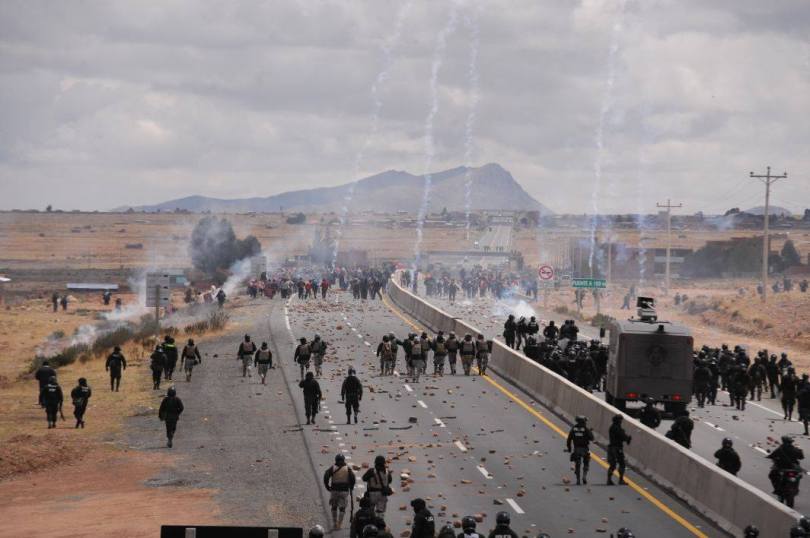
Early on Sunday morning, September 17, over sixteen hundred Bolivian police massed in the high desert plateau east of Lake Titicaca. Perhaps the largest police mobilization under the presidency of Evo Morales, these forces gathered to interrupt an extraordinary local protest that had blockaded roads and interrupted travel by road in the region for an unprecedented 26 days. The operation used its overwhelming numbers, police vehicles, and a substantial amount of tear gas to break up the Achacachi blockade. Over forty-five people were arrested, twenty-one of whom are being held without bail in Patacamaya and San Pedro prisons. The intervention looks to be a decisive turn in the municipality’s protests, which have been ongoing throughout 2017.

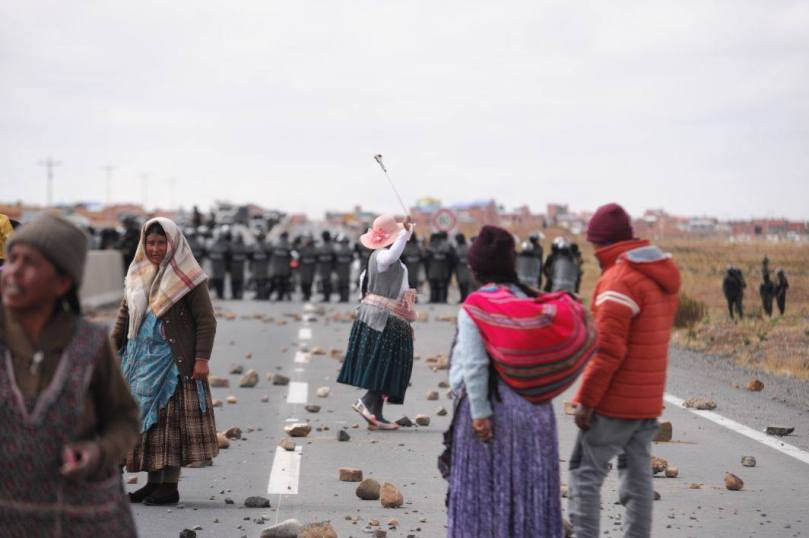
Woman with an Aymara-style slingshot faces off with dozens of riot police during their September 17 blockade clearing operation. This photo (and photo above) by Javier Alejandro Mamani (APG). See Gallery at Rimay Pampa.

The protesters, who have numbered in the thousands, are backing a demand that Édgar Ramos (of the governing MAS-IPSP party) step down as mayor of Achacachi municipality over allegations of corruption. That demand prompted protests in February, in which anti-Ramos demonstrators damaged the mayor’s property and his organizational allies in Achacachi city. In response, Ramos’ rural allies looted the city’s commercial district. In July, the national government advanced an investigation of the anti-Ramos forces, notably Achacachi Neighborhood Federation (Federación de Juntas Vecinales; Fejuve) leader Esnor Condori, but not of pro-Ramos forces. Reversing an earlier decisions to grant house arrest, a judge jailed Condori and two urban teachers affiliated with the movement, Pastor Salas and Gonzalo Laime, in San Pedro. The day after they were jailed, August 22, the blockade began.

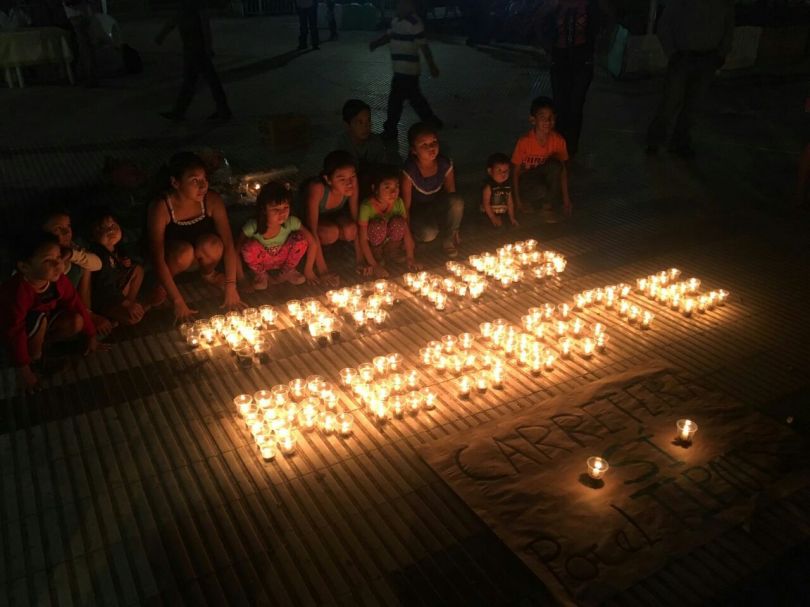
In a remarkable month of mobilization, the mostly urban Achacachi protesters who began the blockade (in so far as a town of nine thousand people is considered urban on the Altiplano) both maintained steady control over regional roadways and built a surprising network of alliances. They were joined in protest by Felipe Quispe, the famed, but retired leader of the national peasant confederation CSUTCB, who is a native of Achacachi Municipality. They signed a pact of mutual support with TIPNIS community leaders still reeling from the August law that permits development in their territory. And on August 28, a march of Achacachi women descended from the Altiplano and El Alto to stand before the San Pedro Prison. Their signs read:

Damn those who defend corrupt mayors with their power.
Jail for this looter
Evo, listen: Your mayor is corrupt
“Malditos aquellos que con su poder defiende a alcaldes corruptos”,
“Cárcel para este saqueador”
“Evo escucha, tu alcalde es un corrupto”

The Achacachi women stayed in the capital of La Paz, staging regular demonstrations and setting up a sit-in blockade in front of the Ministry of Justice. Their mobilization seems to have built more surprising ties to parts of the Paceño population, while the highland traditionalist organization CONAMAQ Orgánica, regional labor federation COD-La Paz, and the traditionally radical teacher’s union all offered their support.

On Friday, September 15, these groups combined to hold a cabildo—a mass public meeting that can issue statements or coordinate protests—in the Plaza San Francisco, the traditional heart of grassroots protest in Bolivia, four blocks below the presidential palace in La Paz.

The cabildo termed itself “Achacachi Somos Todos” (We are all Achacachi) and managed to generalize the demands of the local movement, related to the mayor and the detained protest leaders, into “an Agenda that comes from the Aymara people to the whole country.” The six points of departure raised and approved in the cabildo include (1) the struggle against corruption, (2) the struggle against the politicization of the criminal justice system, (3) the right to dissidence and critique, (4) respect for individual and collective rights, (5) critical debate about the vision for Bolivia’s development based on local demands and perspectives, and (6) rejection of the instrumentalizing of indigenous peoples for political ends.

Achacachi municipality, particularly the smaller town of Warisata and the many Aymara rural communities that make up most of its population, was the point of ignition for the 2003 Gas War, and a key part of the rural mobilizations that preceded it. At that time, a thousand marchers from the Altiplano led by Felipe Quispe implanted themselves in the overwhelmingly indigenous city of El Alto (just above La Paz on the edge of the Altiplano plateau) and became an articulating force for collaborative protest. Today, Achacachi Municipality is divided along partisan lines (which are partially town/village lines), but its mobilization again seems to be bringing other movements together. It is very much an alliance of outsiders, those grassroots social forces that have had the harshest break-ups with the national government. But the process of connection among them should be watched closely as the Achacachi movement regroups from Sunday morning’s police intervention.

Broad Legitimacy for Road Blockades as Protest Tactic in Bolivia

Road blockades are a frequent form of protest in Bolivia, at many different scales. A small demonstration may claim a single roadway, or a coordinated effort can deliberately paralyze transport across an entire region. Sometimes small protests in just the right place can lead to big consequences. Bolivia is one of the most highly mobilized countries in the world in terms of protest: In a 2012 national survey by LAPOP (the Latin American Public Opinion Project), just under 17% of 2,999 people polled said they had taken part in a protest in the last 12 months. The 508 who said yes were asked if they had blockaded a road or other public space, and 229 confirmed that they had. In other words, one out of every 13 adult Bolivians polled had taken part in a road blockade. Asked in the same year whether they approved of different kinds of political action, Bolivians rated blockading a bit lower than simply demonstrating, but ahead of creating a political party.

In 2002 and 2004, LAPOP asked Bolivians a more incisive question about road blockades:

“Sometimes there are protests that provoke difficulties because the streets are closed. In those cases, what should the government do? A veces hay protestas que provocan dificultades porque se cierran las calles. En esos casos, ¿qué debe hacer el gobierno?

The result was overwhelming: Large majorities (76.48% in 2002; 71.89% in 2004) chose “Negotiate with the protesters although this may take days or weeks, affecting the economy of the country” over “Order the police to open the roads.” (Negociar con los manifestantes aunque esto pueda tardar días o semanas, afectando la economía del país vs. Mandar a la policía para abrir los caminos).

Add to this the fact that the ruling political party, the Movement Towards Socialism–Political Instrument for the Sovereignty of the People emerged from the Chapare cocalero movement, which frequently used blockades as a protest tool. And that it came to power in 2005 on a wave of unrest that was powered by blockades and sparked into national revolt in Achacachi. And that road blockades were also a frequent tool of the grassroots left in the 2006–09 struggle against a separatist right-wing movement in the east of the country.

Accordingly, the Morales government has often approached blockades with tolerance on the ground. It’s the exceptional application of intensive force to break up a blockade that attracts well-deserved attention: the 2010 police raid on the Caranavi blockade demanding a citrus plant, the 2016 effort to break up blockades by the cooperative miners federation, and this week’s operation in Achacachi. The first two efforts had deadly consequences: two townspeople were killed in Caranavi, and five miners and one Vice Minister died in last years confrontations. While the current operation caused no fatalities, it represents an important break point between the government and a movement that had been a solid part of its broad grassroots base until now.


Ignoring new TIPNIS law, Bolivian government restarts roadway construction

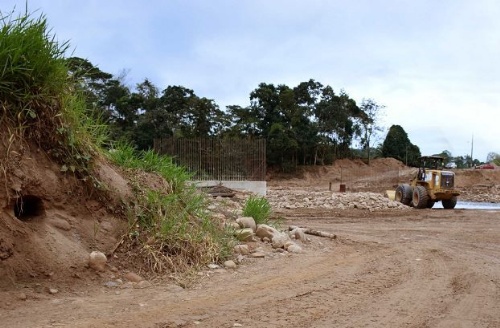
Bolivian newspaper Página Siete has published photos of the ongoing construction of the Villa Tunari–San Ignacio de Moxos highway inside of the Isiboro Sécure National Park and Indigenous Territory. The current active construction continues work that began before the enacting of Law 266, which ends special protections for the territory, on August 13. The prior activity, revealed by indigenous residents was clearly in violation of Law 180 of 2011, which the new law repealed.

However, Law 266 also placed some legal limits on road building (see the full text of Law 266 (es)). Officially termed the Law of Protection, and Integral and Sustainable Development of the Isiboro Sécure National Park and Indigenous Territory (TIPNIS), it requires:

Article 9 … Integration and Articulation Activities [i.e., transportation infrastructure], which improve, establish, or maintain rights of indigenous peoples such as freedom of movement, whether through the opening of neighborhood roads, highways, systems of river navigation, or of aerial transportation, etc. shall be designed in a participatory manner with the indigenous peoples …

The law also establishes a planning process for development and integration:

A timeframe of 180 days is established for the elaboration of a Protection Plan for TIPNIS, the Integral Plan for Transportation in TIPNIS, and the Development Agenda for the Indigenous Peoples of TIPNIS to Live Well, in accordance with the results of the Consultation. Insofar as those documents are approved, the instruments of planning and management of TIPNIS shall be applicable, so long as they don’t contradict that which is established in this law, and in agreements resulting from the Consultation.

Right now, of course there is no Integral Plan for Transportation in TIPNIS, nor has any highway been designed in a participatory manner. Whether before or after the passage of the new law, the Bolivian government shows no sign of following the legal limits on its road building in TIPNIS.

Bolivian Senate approves law to de-protect TIPNIS amid protests across the country

The Bolivian Senate has approved Law 266, which allows for the construction of highways and exploitation of resources within the Isiboro Sécure National Park and Indigenous Territory (TIPNIS). Their vote came less than six hours after the law was brought to the Senate. In so doing, they set the stage for Bolivian President Evo Morales to abrogate Law 180 of 2011, legislation won by the Eighth National Indigenous March of the same year which declares TIPNIS to be an “intangible zone” and prohibits any highways from crossing it. The government has already secretly contracted with two contractors to build the controversial Segment II of the Villa Tunari–San Ignacio de Moxos highway, and journalists and residents have confirmed the presence of building equipment and construction parts inside the park.

Protests occurred throughout the last week in La Paz, Trinidad, Santa Cruz, San Ignacio de Moxos, and Cochabamba, organized by the Confederation of Indigenous Peoples of Bolivia, the Fundación Solón—led by former UN Ambassador Pablo Solón–, environmentalists, feminists, and indigenous solidarity activists. Protests continue today in La Paz, coinciding with the scheduled opening of the Senate session; with vigils in Santa Cruz de la Sierra and Trinidad (Beni Department), and in Cochabamba. Activists will gather for a “direct action” demonstration in Cochabamba at 7 pm local time.

Read More »

As he ordered attack on indigenous march, Bolivian Vice Minister saw raid as a fight to industrialize the country

Nearly six years ago, members of the Bolivian Army and National Police carried out a raid on some six hundred indigenous marchers at Chaparina. In a startlingly frank conversation addressing members of the National Police, Vice Minister of Police and the Interior Regime Marcos Farfán described the next day’s raid as a battle to preserve the government’s economic program and political future. (A video recording of his conversation was leaked to the press, and published this week by the Fundación Solón as part of an article by Pablo Solón). The Eighth National Indigenous March had as its first demand the defense of Isiboro-Sécure National Park and Indigenous Territory (TIPNIS), and put forward a general right of indigenous communities to say no to destructive projects within their territories.

On September 25, police mounted an attack on the indigenous marchers, beating and teargassing them, seeking out and arresting prominent leaders, and leaving behind a chaotic scene of injury, flight, and fear. Marchers, including prominent leaders, were grabbed, tackled, and handcuffed in front of network television cameras. Between 70 and 280 were injured in the assault, including Celso Padilla (president of the Guaraní People’s Assembly), hospitalized with multiple hematomas. Hundreds of marchers were taken on buses overnight in a frustrated attempt to return them by land or airplane to the starting point of the march. The raid at Chaparina was the breaking point for the lowland Confederation of Indigenous Peoples of Bolivia’s alliance with the government.

While the motives of the raid have long been evident, this forthright statement crystalizes the government’s motives in carrying it out. It will appear in any future historical account of when and how the Evo Morales government shifted from a rhetorical embrace of indigenous rights to a committed advocate of putting extractive industrial development first.

One must have a global, integrated vision of the matter, although it can be reduced to just the operation that we will carry forward tomorrow, it has to do with overall issues in terms of what our Constitution and program [of government] have proposed, which is rooted in industrializing, highways, hydroelectric dams, electricity, and energy.

But they [the indigenous marchers, presumably] are with their program attempting to avoid that going forward. They have their own political objectives behind it. The less able this government is to fulfill its programs, the fewer possibilities it will have in the future to gain votes.

Because if we don’t produce, if we don’t create industries, if we don’t build highways, if we don’t diversify our production, if we don’t transform our gas into other products, if we don’t generate added value from our raw materials, this government will fail. Everything will be ruined. This is the bottom-line objective that it [the march] has, to say that they were with Evo and his lovely proposals, but he didn’t carry them out. And he didn’t carry them out because of these kind of elements who put up hindrances and obstacles against carrying out that which is the job of nobody else in the country [but us]. A country in which we have been reduced to backwardness, to economic dependence, and to political dependence over years and years and years.

What we need to do is consolidate our sovereignty as a nation. To be sovereign, we must be productive, rich as a nation, and to be rich we need to produce and industrialize our country.

Thank you for listening to me. It doesn’t have much to do with the matter [at hand], but I believe it’s important to clarify those elements that have to do with all Bolivians, police officers or not, with the whole country. But it is within this framework that we, lamentably, are entering into carrying out this operation… Tomorrow, we will be working.

“Hay que tener una visión global, integral del tema, aunque se reduzca al operativo que vamos a llevar mañana adelante, pero tiene que ver con temas de fondo en relación a lo que establece nuestra Constitución Política y el programa por supuesto que se ha planteado, que radica en industrializar, carreteras, hidroeléctricas, electricidad, energía.

Pero están con este programa tratando de evitar que se lleve adelante. Tienen sus objetivos políticos ahí atrás. (Mientras) menos pueda dar cumplimiento a sus programas este gobierno, menos posibilidades va tener en el futuro de ganar más votos.

Porque si no producimos, no creamos industrias, no construimos carreteras, no diversificamos la producción, no transformamos nuestro gas en otro elemento, no generamos valor agregado a nuestro producto, este gobierno va a fracasar. Todo se viene al tacho. Este es el objetivo de fondo que se tiene, para decir estuvo el Evo con sus lindas propuestas pero no las cumplió. No las cumplió porque hay este tipo de elementos que ponen trabas y obstáculos para que se pueda dar cumplimiento a eso que no es en función de nadie mas que del país. Un país que hemos estado reducidos al atraso, a la dependencia económica, a la dependencia política durante años y años y años.

Lo que necesitamos es consolidar nuestra soberanía como nación. Para ser soberanos tenemos que ser productivos, ricos como nación, para ser ricos tenemos que producir e industrializar nuestro país.

Gracias por escucharme no tenía mucho que ver con el tema pero creo que es importante aclarar estos elementos que tienen que ver con todos los bolivianos, policías no policías, con todo el país. Pero en ese marco es que estamos, lamentablemente, entrando a realizar este operativo… Mañana vamos a estar trabajando”.

Within 48 hours, Marcos Farfán resigned his post as Vice Minister, reportedly to facilitate a public inquiry into the raid. A report leaked in 2013 revealed that prosecutors found that the raid was carried out in accordance with the chain of command. Interior Minister Sacha Llorenti, who was involved in the decision, was reappointed to serve as Bolivia’s Ambassador to the United Nations. In April 2015, prosecutors relieved Farfán, Llorenti, and other senior officials of criminal responsibility for Chaparina. Six officials then indicted have yet to face trial.

What’s wrong with the 2012 TIPNIS consultation?

At the core of the current legislative push to reverse the 2011 special protection law for the Isiboro-Sécure National Park and Indigenous Territory is the 2012 government-run consultation process. Government advocates and the sponsors of the legislation, Patricia Chávez and Romona Moye, repeatedly claim:

It’s the request of the people, the community members, their corregidores [a traditional leadership post] and leaders, through the prior consultation carried out within the territory itself. We have exercised our right to be consulted as Bolivians and as indigenous people who inhabit the region.

“Es el pedido del pueblo, comunarios, los corregidores y dirigentes, a través de la consulta previa desarrollada en el mismo territorio; nosotros hemos ejercido nuestro derecho a ser consultados como bolivianos e indígenas que habitamos esa región”

When proponents of the law have talked about how the law, the highway, and the revocation of the protective law have been discussed among the communities of TIPNIS, they are referring only to one and only one thing, the 2012 consultation. While there are real disagreements about it, all signs indicate that the consultation process was fundamentally flawed.Read More »

Emergency protests as Bolivian legislature considers bill to allow TIPNIS highway (live-blogging)

This morning, Thursday August 3, the Chamber of Deputies of Bolivia’s Plurinational Legislative Assembly is considering a bill that would authorize the country’s most controversial infrastructure project, the Cochabamba–Beni highway, to be built through the Isiboro-Sécure National Park and Indigenous Territory.

Ramona Moye and Patricia Chávez, two MAS-affiliated Deputies in the Plurinational Legislative Assembly, introduced the legislation on July 3, and it recently passed out of committee, and will be considered today. The bill, called the “Ley de Protección, desarrollo integral y sustentable del Territorio Indígena Parque Nacional Isiboro Sécure – Tipnis” (Law for the Protection, Integral and Sustainable Development of the Isiboro-Sécure National Park and Indigenous Territory) would repeal and replace Law 180, the 2011 law that protects the territory, declares it an “intangible zone,” and prohibits any highway project from passing through it. That law was the fruit of the a national march led by the Confederation of Indigenous Peoples of Bolivia and a wave of nationwide support of the cause of protecting the territory.

Where can I get a quick overview of the TIPNIS conflict?

If you understand Spanish, watch this documentary:

Other overviews in English are in Emily Achtenberg’s article Contested Development: The Geopolitics of Bolivia’s TIPNIS Conflict (2012), and Rob Key’s documentary The Dividing Line – TIPNIS and Bolivia’s Road (2013). An up-close look of the arduous path of resisting the highway comes is offered by this recent Mongabay profile of Fernando Vargas (in Spanish), the former President of the Subcentral TIPNIS.

What is the current state of construction of the highway?

The original funder of the highway, Brazil’s National Bank for Economic and Social Development, withdrew all funds from the project in 2012. Since then, the Bolivian government has funded the northern and southern segments of the project, located north of the park and inside the colonized Polygon 7 at the south end. Both of these segments have been troubled by delays and adverse construction conditions, but the southern Segment I was opened in 2016.

Screen Shot 2017-07-05 at 3.52.38 PM Despite the legal prohibition on Segment II, TIPNIS community members have recently shared photographic evidence that the government is actively building bridges inside of the Territory that would become part of the highway.

TIPNIS-Unauthorized Construction-July17 170998

Emergency Protests in Defense of TIPNIS

On Wednesday, August 2, activists in La Paz marched and set up an encampment (plantón) in Plaza Camacho opposing the new law. Here is a half-hour video of their demonstration. Present in the video are Fabián Gil and Marqueza Teco from the Subcentral TIPNIS and a representative of CONAMAQ Orgánico.  Press coverage: Página Siete.

A protest is being held on Thursday, August 3 in Cochabamba.

Resources for following the controversy:

Live coverage today

  • The press service Agencia Nacional Fides is covering the debate live on Twitter: Follow @noticiasfides
  • The government line within the Plurinational Legislative Assembly is being live tweeted at @Diputados_Bol
  • Twitter hashtags: TIPNIS, #TIPNISenEmergencia

Tense session in the Assembly

Fides reports Fides reports that security has prevented three opponents of the highway from entering the chamber during debate: Rafael Quispe, former head of CONAMAQ and currently an alternate deputy in the Assembly; Senator Edwin Rodríguez, head of the UD delegation; and Fernando Vargas, leader of the 2011 March and former President of the Subcentral TIPNIS. Vargas was later admitted into the gallery.

Inside the session, one opposition tactic was deputies wearing masking tape over their mouths to recall the police use of the same tape on captured members of the pro-TIPNIS march in September 2011. Another was protest signs within the session.

The debate included extended statements from MAS-IPSP deputies Patricia Chávez and Ramona Moye (indigenous seats, Cochabamba), Gabriel Montaño (Santa Cruz), Juana Quispe (Chimoré in the Chapare), and Emilio Vilche (alternate deputy and an affiliate of CONISUR). The official Twitter feed of the Chamber of Deputies (@Diputados_Bol) broadcast these statements but not those of opponents of the legislation. Opposition deputy Shirley Franco (UD) complained about a lack of parity in participation, but Montaño counted 16 opposition speeches, which she claimed lasted over 4 hours out of 11 hours of debate so far.

In the end, the Chamber of Deputies approved both the overall bill and the detailed text as presented.

Even before this approval, the Senate’s Committee on Land, Territory, Natural Resources and Environment put the legislation on its agenda (see image to the right). Minutes later, a vote in that committee resulted in a tie vote. A rapid-fire consideration of the bill is well underway. Late in the evening, Senate President José Alberto “Gringo” Gonzalez stated publicly that the chamber as whole will take up the bill next Tuesday morning, August 8, at 11am.
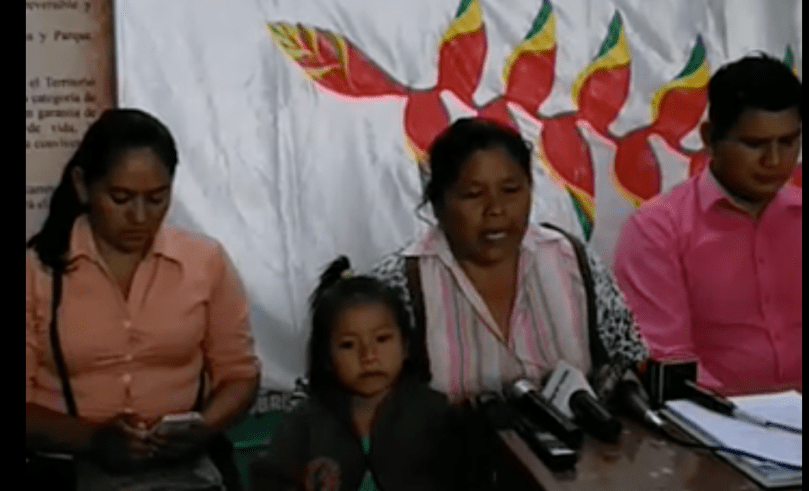


Video: TIPNIS leaders speak out against law that threatens their territory

Screen Shot 2017-08-05 at 6.35.29 AM

Press conference featuring leaders of the Subcentral TIPNIS
Conferencia de prensa dirigentes de la Subcentral TIPNIS

Marqueza Teco, President of the Subcentral of Women of TIPNIS
Fabián Gil, President of the Subcentral TIPNIS (elevated from Vice President by community resolution repudiating Domingo Nogales’ role in supporting the proposed law)

Available as Facebook live video segments: 1 | 2 (es)

Departmental Civic Committees: Build highway outside of TIPNIS

An assembly of Bolivia’s departmental Civic Committees has called on the government of Evo Morales to re-route a controversial highway to the east of the Isiboro-Sécure National Park and Indigenous Territory (TIPNIS). In their joint statement issued on July 20, the establishment organizations write,  “We categorically reject the Villa Tunari-San Ignacio de Moxo highway project for destroying TIPNIS and propose that the connecting of Beni and Cochabamba should be [instead] articulated along a Villa Tunari–Camiaco–Loreta–Trinidad route. Rechazamos categóricamente el proyecto carretero Villa Tunari-San Ignacio de Moxos por destruir el Parque Nacional y Territorio Indígena Isiboro Sécure (TIPNIS) y proponemos que la articulación entre Beni y Cochabamba sea: Villa Tunari-Camiaco-Loreto-Trinidad.” This alternative route is one of several that has long been ignored as the Morales government pressed to build a highway northwards out of the coca-growing Chapare and directly through the national park, inhabited by Mojeño-Trinitario, Tsimané, and Yuracaré communities who have campaigned against it for over a decade. I last reported on these option in 2012, when the Isiboro Sécure Defense campaign estimated that the route (number 2 on the map below) would be 250km in length, about 50km shorter than the project underway.

Map of four options to the Cochabamba-Beni highway through TIPNIS

Bolivia’s civic committees are coalitions of mainstream organizations, equivalent to an amalgam of a Chamber of Commerce, assembly of government officials, church leadership, and charitable organizations. While in the 1960s and 1970s, they played a key role as an independent voice for civil society amid Bolivia’s military dictatorship, they emerged as a right-wing counterweight to the Morales government in 2005. The right-wing civic movement encompassed committees in the eastern and central provinces, while civic committees in Potosí, La Paz, and Oruro have tilted leftwards. (Oruro and Potosí civic committees have organized important protests making regional demands of the national government.) This week’s report of a joint statement represents an important new voice in the ongoing conflict. It builds upon an alliance of indigenous and center-right project skeptics that backed Carmelo Lens in the 2015 governor’s race in Beni department. As can be seen below, civic committees from Cochabamba, El Alto, Tarija, Oruro, Pando, Camiri, and Chuquisaca, issued the statement, in cooperation with TIPNIS leaders Fabian Gil, Marqueza Teco, and Fernando Vargas.

Images of the resolution provided by Lelponi Maria Alba Guillén de Vargas.

Documentary offers local perspective on TIPNIS conflict: “The rivers are our road.”

If you’re new to the re-emerging conflict over the Isiboro-Sécure National Park and Indigenous Territory (TIPNIS), or if you simply want a visual look at the lush environment that is being fought over, there is no better place (for Spanish-speakers) to start than the 2016 documentary El camino es el río [The River is the Road]. Beautifully shot in the TIPNIS communities of Nueva Lacea and Puerto San Lorenzo, it is also co-narrated by Marquesa Teco, the President of the Women’s Subcentral of TIPNIS and one of the most important voices within the territory in 2017.

The name of the documentary says a lot. For proponents of running the Villa Tunari–San Ignacio de Moxos highway through TIPNIS, connecting the territory to outside markets offers the promise of development. However, as the documentary shows, these promises run counter to the actual needs of longtime Tsimané, Yuracaré, and Mojeño-Trinitario residents, whose communities are linked by rivers that generally flow from east to west.

“We the Yuracarés and the Trinitarios are people who live on the rivers, we make our communities by their banks,” Silverio Muiba, a Mojeño-Trinitario resident of Santíssima Trinidad observed to Sarela Paz a generation ago. “On the other hand, the Quechuas always live were there is a road: where the road runs out, so do the collas [highland indigenous people].”[1] The different needs of Quechua- and Aymara-speaking cocaleros, who have steadily turned the forests of TIPNIS into new plots for growing coca connect readily to the highway. Their livelihoods are built around a cash crop that serves distant markets.

Should the highway be built, it will literally pass by (and far away from) most indigenous communities. They will feel its effects in the increased deforestation of the interior of the park without ever receiving transportation benefits.

CEDIB-Carretera, Comunidades
Graphic by CEDIB illustrates how few indigenous communities (magenta dots) are connected to the proposed (dark grey) highway. source

[1] Sarela Paz Patiño, “El Limite Yuracaré,” Facetas, July 24, 1994, sec. Datos e Análisis, http://www.bibvirtual.ucb.edu.bo/etnias/digital/106000425.pdf.

Image above: still from El camino es el río.

Legislation and office occupation are latest moves in seven-year fight over TIPNIS

The saga of Bolivia’s most controversial road project, the Villa Tunari–San Ignacio de Moxos highway through the Isiboro-Sécure National Park and Indigenous Territory (TIPNIS), took a long-anticipated turn this month. As I observed in 2013:

The 2012 events of the TIPNIS conflict have added manylayers of complexity to the story, but the essential government stance is simple. Where once it said the highway would be built “whether the indigenous like it or not,” since November 2011, the message [now] is that the highway will be built precisely because the indigenous like it. (Bjork-James 2013:278)

On July 3, Ramona Moye and Patricia Chávez, two MAS-affiliated Deputies in the Plurinational Legislative Assembly, introduced legislation that would open the territory to a highway that is projected to leave it mostly deforested within fifteen years of completion. The text of the law had been circulated to TIPNIS communities in February and March of this year. The legislative assembly event was headlined by Domingo Nogales, who was elected presidente of the Subcentral TIPNIS in December; Diego Roca, President of Conisur; and Carlos Fabricano. In their press communiqué announcing the event (cached here), the MAS claimed the draft law was “their draft law, which was worked out in consensus with the communities that make up the reserve su anteproyecto de ley, el mismo que fue trabajado en consenso con las comunidades que conforman la reserva ubicada entre Cochabamba y Beni.

Prior and subsequent events belie that description. Ramona Moye and Carlos Fabricano, who are married, have been publicly repudiated by indigenous community members within for their involvement in the 2012 pro-highway march and affiliation with the pro-road MAS party. In April 2015, Moye had her visit to TIPNIS disrupted by a traditional leader and a young community member who allegedly stole her outboard motor to prevent her from campaigning for Beni gubernatorial candidate Alex Ferrier. Moye complained to the press: “How is it that I can’t enter my territory? … they prohibit me, and take away my motor, and threaten that I’ll never be able to return there again. Cómo pues yo no voy a poder entrar a mi territorio, si he nacido allá, si soy de allá, soy una indígena de allá y que ellos me prohíban y que me quiten el motor así con robo y amenazas porque eso fue lo que ellos me hicieron a mí, me amenazaron que nunca más podía volver a allá (a Nueva Lacea), por lo tanto me hicieron un robo.” The Subcentral Sécure has been divided into factions led by Carlos Fabricano and Emilio Noza since at least 2012; Fabricano’s wing took over the organization’s office in Trinidad, Beni in 2014.

Since the December 2016 gathering of affiliates of the Subcentral TIPNIS, the new leader of the Women’s Subcentral, Marqueza Teco, has taken the lead in opposing the highway project, while the newly elected male leader Domingo Nogales Morales has had a lower profile in the press. In April, the women’s organization reportedly occupied the office of the Subcentral Sécure within the park.

The early July announcement has prompted new reactions from opponents of the highway through TIPNIS. Fernando Vargas, past president of the Subcentral TIPNIS has spoken out against the legislation (video|La Razón) Then, on July 12, representatives of at least ten indigenous communities and the Women’s Subcentral occupied the Subcentral TIPNIS and publicly de-recognized Domingo Nogales as their leader (video|Los Tiempos). “He is no longer president of TIPNIS because he committed such a serious crime within the territory and its communities; therefore, they have elevated the vice president of the subcentral [Fabian Rocha] to president of the Subcentral TIPNIS | Ya no es presidente del Tipnis por haber cometido un delito tan grave dentro del territorio y las comunidades, por lo cual le suben al vicepresidente como presidente de la subcentral del Tipnis,” Emilio Noza told reporters by phone.

Such changes of leadership in Bolivian organizations are often precursors to mobilization. In this case, they match calls by both Fernando Vargas and Marcial Fabricano (a founder of the Subcentral TIPNIS and former president of the Confederation of Indigenous Peoples of Bolivia) to reorganize the indigenous movement. As we enter the seventh year of the controversy, the TIPNIS highway continues to be a flashpoint for indigenous and environmental mobilization in Bolivia.

Image: Women’s Subcentral of TIPNIS President Marqueza Teco at indigenous territories summit in May 2017.

[2014] CONAMAQ in crisis: Pro-government faction seizes headquarters by force

This post was originally written in January 2014, and went unpublished while I was on parental leave with my first child. I’m posting it now to make it available for others to reference.

The highland indigenous movement CONAMAQ entered a profound organizational crisis in December over the organization’s relationship to the Evo Morales government. The group, whose full name means the National Council of Ayllus and Markas of Qullasuyu, represents over a dozen highland indigenous communities dedicated to restoring self-governance through traditional community structures. It diverged politically with the government in 2011 over the right to exercise free, prior, and informed consent over projects in indigenous territories and its participation in the Eighth National Indigenous March in defense of the Isiboro-Sécure National Park and Indigenous Territory (TIPNIS). Soon after the march, CONAMAQ withdrew from the government-aligned Pact of Unity. In the past year, it has made preparations to run an independent slate in the 2014 parliamentary elections.

A faction of pro-government leaders within CONAMAQ, led by Hilarion Mamani of Chichas waged a campaign for new leadership of the organization, which included six attempts to occupy its headquarters. In December, Mamani’s faction and the existing leadership held separate gatherings of the Jach’a T’antachawi, a large gathering that is the organization’s highest authority. Late on December 10, after the pro-government gathering elected Hilarion Mamani, a crowd of his supporters burst into the organization’s La Paz headquarters and beat three CONAMAQ leaders and a member of the Permanent Assembly for Human Rights. Bolivian police took control of the building for the next month, while supporters of the existing leadership maintained a vigil outside the building. Hilarion Mamani’s supporters attacked that vigil and took control of the headquarters on January 14. Both the Defensoria del Pueblo and the UN’s human rights office in Bolivia issued statements of concern following the violent takeover; the UN particularly criticized the failure of the police to safeguard the vigil from physical attack.

The Jach’a T’antachawi aligned with the incumbent leadership elected Freddy Bernabé as the new head of the organization on December 12 and 13. The regional indigenous confederation of the Andes (CAOI) and the Amazon Basin (COICA) recognize him as the leader of CONAMAQ. The government-aligned Pact of Unity, which also include the CIDOB faction led by Melva Hurtado, views Hilarion Mamani as CONAMAQ’s leader. The newspaper Pagina Siete and community radio network Erbol report that grassroots leaders in most of the organization’s base back Bernabe.

For Hilarion Mamani, the split is a repudiation of the incumbent leadership’s political alliances, including with CIDOB, the Green Party, and “free thinking” dissidents within the MAS. Conversely, the incumbent leaders have denounced his actions as nothing more than government interference in the organization. The government claims to distance itself from an “internal” conflict in the organization, but state media immediately recognized Hilarion Mamani as its leader and Vice Minister Alfredo Rada has blamed the split on the government’s critics in the movement. Dissident MAS legislator Rebeca Delgado denounced government interference, citing documentation of Rada’s Vice Ministry paying the logistical expenses for Mamani’s election (see also this signed budget posted online). Since his election, Mamani’s faction has vowed to mobilize for Evo Morales’ re-election as president.

Post-script: CONAMAQ’s headquarters before and after the takeover by the pro-government faction, as tweeted by a Bolivia journalist.