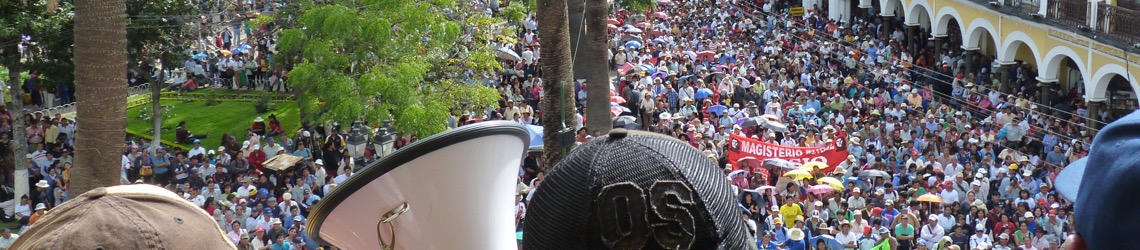
The wave of anti-mining protests in the Puno Region of Peru reached day 50 today. Yesterday, June 24, was a particularly dramatic day, however: the Peruvian government announced that it will annul the mining concession for the proposed Santa Ana silver mine in Huacullani District, near the Bolivian border southeast of Puno; other protesters took over the Manco Capac airport in Juliaca, north of Puno, only to be shot with live ammunition by police. These were both very important events in the seven-week-long protests. But they were also the two kinds of events that the English-language press steps in to cover: economic loss to Western corporations and deadly violence. If it bleeds, it leads is a key phrase for journalism, but if it bites the bottom line, it makes the business pages is just as important.
Unfortunately, the coincidence of these two newsworthy events led a string of English-language outlets to treat one as causing the other. In fact, there is quite a bit of separation: the Santa Ana mine was the lead issue for the primarily Natural Resources Defense Front of the Southern Zone of Puno (Frente de Defensa de los Recursos Naturales de la Zona Sur de Puno), which joined forces with National Confederation of Peruvian Communities Affeted by Mining (Spanish: Confederación Nacional de Comunidades del Perú Afectadas por la Minería; Conami). The Defense Front, a predominantly Aymara organization, is based near the border and had organized an earlier regional general strike against the Santa Ana Mine in April. It joined forces with the largely Quechua Conami for a larger regional protest from May 7 to June 1. When protests resumed after the victory of Ollanta Humala, new forces got involved, many but not all also concerned with mining elsewhere in the Puno Region. These include protests in Carabaya province [the Puno region has 13 provinces, divided in 107 districts] against mining concessions and the Inambari hydroelectric power plant; protests in Melgar, Juli, and Sandia over local mines; and Azángaro (whose capital is Juliaca) demanding decontamination of the Ramis river from pollution caused by small-scale mining. Outside of the Defense Front, most peasants in these regions are Quechua-speakers, not Aymaras.
The story is the strike wave, which has rippled across the region. And the other surprising story is the willingness of the government to deal openly with the strikers: even in May, substantial concessions were granted to the protests (including a 12-month delay in the Santa Ana mine and a regional commission to study all mining in southern Puno Region). The possibilities of protest and the limits of resource extraction are being rewritten in Peru. However, it didn’t bleed, so it didn’t lead. Indeed, for English-reading outsiders, it didn’t even get covered. Blame this on editors and the priorities of understaffed media organizations.
However, when things got interesting for the newswires, they assigned the story, apparently to reporters far from the scene. And the results juxtaposed the shootings in Juliaca and the victory in Chuquito Province in ways that distort the truth:
- Associated Press, “Peru cancels mine after 6 killed in clash” somehow fails to mention the demands of protesters in Juliaca, and gives the false impression that the clash led to the concession.
- Agence France-Presse, “Peru halts Canada mining operations amid protests“: “Peru suspended a Canadian company’s mining project in the south of the country on Saturday following intense negotiations in the wake of deadly protests by mostly indigenous anti-mining activists, authorities said.” “In the wake of” is fuzzy talk for afterwards without committing to a connection. In fact, the negotiations preceded the deadly violence, with a commitment to annul the Santa Ana mine being made verbally to the Defense Front on Wednesday and Thursday, with confirmation on Saturday. As discussed above, anti-mining protesters in Juliaca have other demands. Later in the article, “Protests have since spread to the provinces of Azangaro, Melgar and now the city of Juliaca.” Juliaca is the capital of Azangaro, and protests occurred there in late May, as well as early June. Nonetheless, AFP did some homework; this is spot on: “They then expanded to include opposition to other area mines, and now include opposition to the Inambari project, an ambitious plan to damn several Andean rivers and build what would become one of the largest hydroelectric power plants in South America.”
- Voice of America, “3 Killed in Peru Airport Clash“: Contributes one fact: the result of a hospital phone call to Juliaca (“A doctor said the three people killed died from gunshot wounds Friday at Manco Capac airport in the city of Juliaca in Puno state.”), but mis-identifies the protesters as Aymara Indians—0.28% of Azángaro Province is Aymara. The hospital workers, through no fault of their own, understated the death toll by half.
Reporting like this is far less effective than paying translators to read the local press (Los Andes in Puno has been among the most comprehensive; see their chronology) and fact-check one against the other. If you’re reporting on these issues, I’d really like to know your process and point you in the direction of reliable background information. Seriously, where are you and what do you read?
Credit where credit is due: Reuters got the story right, noting “On Friday, hours before the deadly clash at the airport, Garcia’s cabinet revoked the license of Canadian mining firm Bear Creek in a bid to persuade locals residents to end protests that have dragged on for more than a month.”
p.s. A look at the same problem in Bolivia ten months ago: Potosí isolated by 12-day regional strike.