USAID and Counter-Insurgency: Five Decades Old

The State Department (@StateDept) reminds us that the United States Agency for International Development has it’s 50th anniversary today. Somehow, the United States had the bright idea to place its international aid agency within the national security apparutus right from the start. John F. Kennedy and his top global policy planners saw USAID, the Alliance for Progress in Latin America, and other friendlier faces of the US government as working hand-in-glove with the planners of military maneuvers, trainers of military and para-military forces, and plotters of coups.

Not only was Kennedy into such soft power–hard power collaboration, but he was personally fascinated by counter-insurgency (a word that would later become so common, it lost its hyphen). John F. Kennedy, a man with a political halo is most American circles, brought about the Green Berets and the Special Warfare School at Fort Bragg, North Carolina. In March 1961, just as US AID was getting its commission publicly, a committee of the National Security Council (later the Special Group – Counter Insurgency) was commissioned to report on “U.S. Strategy To Deal With Wars of National Liberation,” as put in the title of the report they issued in December.

This report did not remain in a file, but instead drove new concepts like “counter-insurgency” and “internal defense” into the heart of US foreign policy for a generation. In Latin America, where I am now, “internal defense” became “internal security” or the “national security state,” the key American vision for reorienting Latin American militaries towards a new enemy: internal leftist parties and social movements.

Here’s a breakdown of the worldview behind this (all quotes are from the Overseas Internal Defense Policy written for the National Security Council in 1962; I swear no critic of the government was involved in making any of this up!):

  1. Communism was the global enemy, but the most serious losses to it had come in China, Vietnam, Cuba, and Algeria, where local leftists were almost entirely responsible. This is called internal agression.
  2. “Communists often infiltrate nationalist and reform movements.” So they might be a problem too.
  3. Everyone’s a target: “The vital sectors within modernizing societies include the rural sector; the labor front; students and youth organizations; the intelligentsia; the educational systems; internal communications and informational media; the military and police; religious groups; the civil bureaucracy; the various middle-class elites; ethnic minorities; and the political parties, sometimes including a legal communist party but invariably an illegal communist apparatus operating underground or through various fronts.”
  4. This matters to the USA because (1) We like freedom; (2) For military reasons, “strategic areas and the manpower and natural resources of developing nations” must not fall under communist control; (3) For economic reasons, “resources and markets of the less developed world [must] remain available to us.”
  5. The USA can get involved everywhere: to “immunize” countries where there is no insurgency, to “defeat the threat” where “subversive insurgency is latent or incipient,” and to train countries for and get involved in fights against insurgents.
  6. We need to get local governments to sign on to this policy. “To persuade these leaders to act in the interests of their society is often a complex and subtle task. … It is therefore essential that U.S. Country Teams know where the points of strength and vulnerability lie. This done, they can determine how to strengthen those elements which most effectively support U.S. objectives.”
  7. The US is okay with revolution: “The U.S. does not wish to assume a stance against revolution, per se, as an historical means of change. … A change brought about through force by noncommunist elements may be preferable to prolonged deterioration of governmental effectiveness or to a continuation of a situation where increasing discontent and repression interact, thus building toward a more dangerous climax.”
  8. However, the US will act against any revolution still in its early stages: “Where subversive insurgency is latent or incipient, U.S. strategy will be directed toward its elimination, lest it provide a communist foothold and escalate into active insurgency.”
  9. All hands on deck! “Anticipating, preventing and defeating communist-directed insurgency requires a blend of civil and military capabilities and actions”

Okay, so what does this have to do with USAID? Well, guess who was on the Special Group – Counter Insurgency:

  • Military Representative of the President, Chairman
  • The Attorney General
  • Deputy Under Secretary of State for Political Affairs
  • Deputy Secretary of Defense
  • Chairman, Joint Chiefs of Staff
  • Director of Central Intelligence
  • Special Assistant to the President for National Security Affairs
  • Administrator, [US]AID
  • Director, USIA

Further, the AID has a strategic role in “immunizing” countries against uprisings, in making the existing social order more palatable, and in training militaries and paramilitaries. Or as the NSC put it:

Where subversive insurgency is virtually non-existent, or incipient (PHASE I), the objective is to support the development of an adequate counter-insurgency capability in indigenous military forces through the Military Assistance Program, and to complement the nation-building programs of AID with military civic action.* The same means, in collaboration with AID and CIA, will be employed to develop a similar capability in indigenous para-military forces.

*[From the glossary]: The use of preponderantly indigenous military forces on projects useful to the local population at all levels in such fields as education, training, public works, agriculture, transportation, communications, health, sanitation and others contributing to economic and social development, which would also serve to improve the standing of the military forces with the population.

And just in case you’re thinking that USAID-Counterinsurgency cooperation is so fifty years ago, here’s a quote from the US Government Counterinsurgency Guide of January 2009:

“The large numbers of foreign service nationals that make up the professional cadre of field staff provide a unique understanding of the local situation, while the range of sectors and levels of activity allow USAID great operational flexibility and agility to both implement and track the effectiveness of COIN operations.” (Appendix: US Government Roles in COIN [Counterinsurgency], p. 51)

So, happy birthday, USAID! And remember, if anyone confuses you with an organized attempt to thwart radical social change, it’s just because they’ve figured out your mission statement.

Bibliographic note: The Overseas Internal Defense Policy is just one of many declassified documents now freely available. Many subsequent implementation decisions on counter-insurgency issues are part of the Presidential Decision Directives archive by the Federation of American Scientists.
International Day of Action in Defense of Coca Chewing Underway

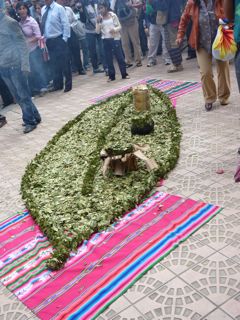
Massive coca leaf made out of coca leaves
On the plaza, a giant coca leaf made out of coca leaves

Coca growers from the Chapare (Cochabamba Department) and the Yungas (La Paz Department)—Bolivia’s two coca-growing regions—have travelled to Bolivia’s nine departmental capitals today to publicly chew the traditional leaf and to support the Bolivian government campaign to end the UN prohibition on coca chewing. Coca leaves are a traditional crop in the Andes and are both chewed in the mouth and boiled into a tea called mate de coca. Both forms are valued for their medicinal properties and cultural role in Andean culture, particularly the protection they offer against altitude sickness, fatigue, and upset stomachs. Bolivia’s demand that a 1961 UN drugs convention be amended has attracted broad support, including from the Union of South American Nations (UNASUR) and Africa, and several countries that had expressed doubts about the move have been won over. However, the United States—a major cocaine-consuming country and the main international sponsor of Bolivia’s once-heavily-militarized war on drugs—and Sweden continue to block the move. The deadline for changing their position is January 31.

Events in Cochabamba are still underway, but here is an early preview of the gathering in the city’s main square, the Plaza 14 de Septiembre.


bagging and sorting coca leaves
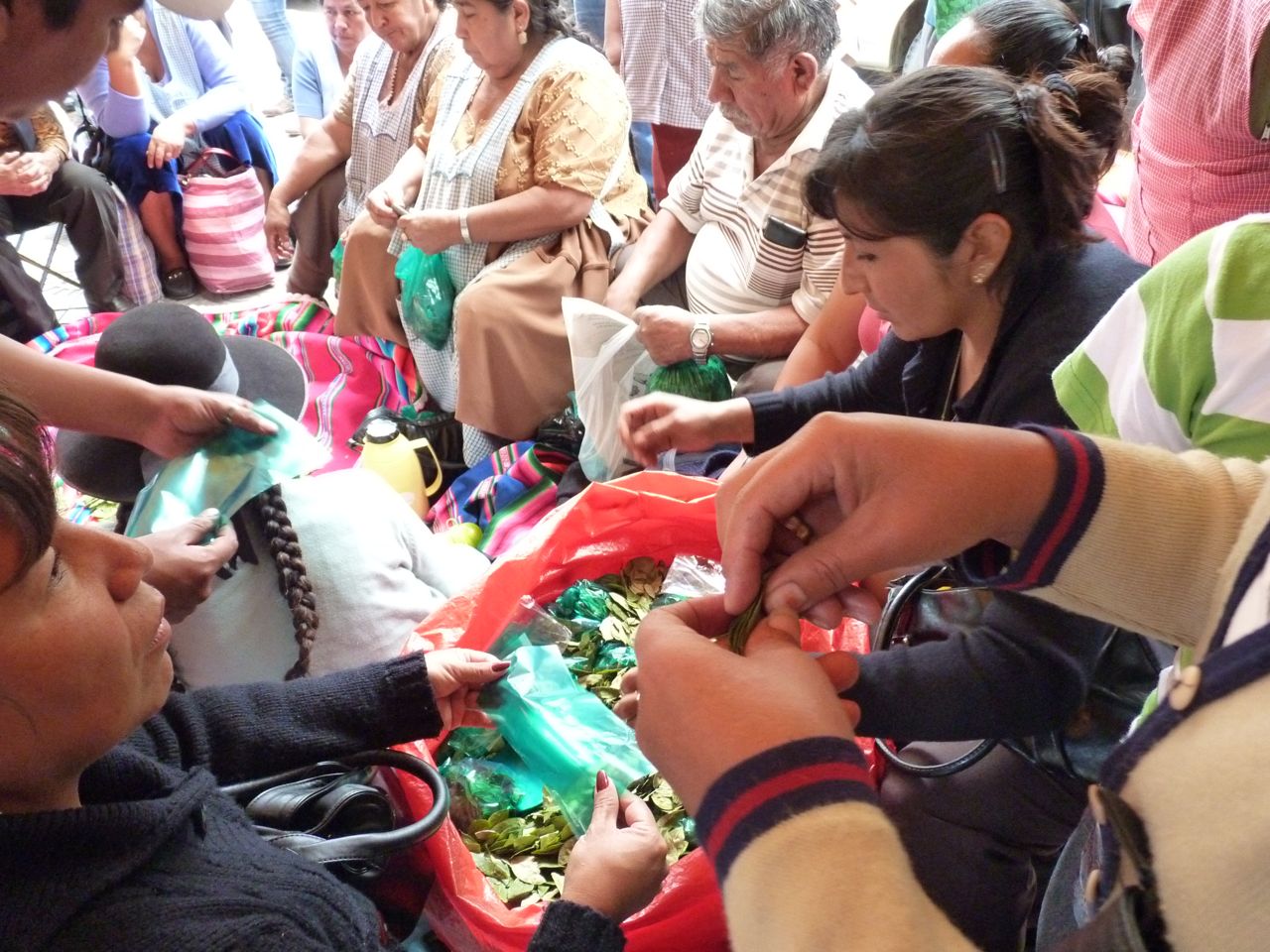
Vendors from the May 27 Association bag coca leaves to give away
Marchers with coca plants
Two women from the Six Federations of the Tropics of Cochabamba march with young coca plants and bags of coca leaves
TV journalist interviews Leonilda Zurita, president of Coca Growers' Women's Federation

A more complete set of photos from today’s protest is online at flickr.

Local road blockade challenges Egyptian election fraud

On Sunday, Egypt held parliamentary elections which are widely known to be neither free nor fair (denunciation by the Carnegie Endowment for international peace). The elections were a demonstration of the government’s plans in advance of the 2011 elections, when long-time president Hosni Mubarak may make way for his son to rise as a successor. Unlike the media frenzy over the selection of Kim Jong-Il’s son to receive a special title, little mainstream outrage has been directed at Mubarak’s machinations. Egypt remains under its third decade of emergency rule (which ban demonstrations and some opposition parties), and is the largest non-democratic recipient of United States’ foreign aid by far. It’s also the largest undemocratic country in the Middle East, helped to remain so by our tax dollars, and military and diplomatic support. It’s the clearest sign that the alleged US policy to support democracy in the region is a joke.

In the absence of outside support, people in Egypt have made a number of challenges to this situation. One of the latest was the mid-day peaceful uprising on Sunday by residents of Balteem and Hamoul against voter fraud. Their actions were in defense of independent candidate Hamdeen Sabahy (profile). Since 1995, three of Sabahy’s voters have been killed by Egyptian riot police, while he won office in 2000 and 2005.

Blogger Baheyya has an hour-by-hour account of local resistance (h/t to The Arabist). Here are some highlights:

8:30 am. Sabahy’s representatives rush to photocopy the new certification papers required to gain access to polling stations. Early that morning at 12:30 am, Sabahy’s campaign was dumbfounded to learn of sudden new regulations for the papers, requiring that they be stamped from police precincts rather than notary publics as had been announced earlier. Certain that this is an 11th hour rule manipulation to bar Sabahy’s agents from accessing polling stations, campaign workers spend all night driving to police stations to get the necessary stamps.

9:10 am. The first reports of foul play trickle in. Candidate agents from 12 polling stations phone in that they have been kicked out of polling stations, and one says her certification papers were ripped up despite having the necessary police stamp.

1:00 pm. Sabahy’s representatives sent to Hamoul and agents of other candidates who are sympathetic to Sabahy begin to phone in reports of ballot-stuffing in favor of Abdel Ghaffar in villages surrounding Hamoul.

1:50 pm. Balteem’s main streets are lined with men congregating and sitting on the sidewalks, expressions somber and nerves frayed. A procession of cars and pickup trucks loaded with youth speed past in the direction of the highway. “They’re blockading the highway!” Spontaneously, Balteem and Borg youth decide to blockade the highway to protest what is now a certain sense of election rigging. The news travels like wildfire and some cars change route and head for the highway rather than Sabahy’s house. Frantic calls to campaign cars instructs them to make sure no women are headed to the highway, in anticipation of violence between protestors and riot police.

2-4 pm. Town youth blockade the highway with burning tires and clumps of tree branches and wooden sticks. Highway traffic comes to a standstill, with freight trucks backed up as far as the eye can see. A campaign worker says to no one in particular, “Didn’t I say that this morning was the quiet before the storm?”

4 pm. Townspeople converge on Sabahy’s courtyard and the candidate comes out to speak, standing on a pick-up truck. Livid, fiery youth and men climb on the pick-up truck and demand revenge. Sabahy struggles to control the crowd’s emotions, saying he’d rather withdraw and give up his seat than join this scandalously handpicked parliament. A fully veiled woman in black climbs on the truck and pulls the microphone from his hand, screaming, “Don’t you dare withdraw, Sabahy! Don’t you dare withdraw!”

The crowd chants, “Balteem boxes won’t leave! Balteem boxes won’t leave!” By law, counting stations for the entire district are located in Hamoul but since Hamoul was experiencing rigging, residents feared their ballots would be destroyed or disappeared en route to the counting station.

Ultimately, these efforts appear not to have saved the day. Instead it was the threat of further government violence that won. Al Ahram reported at 4:35 pm, “Police armored vehicles have stormed Balteem, in Kafr El-Sheikh, firing tear gas and live ammunition into the air.” Later, Sabahy himself convinced his supporters to stand down (again, the full day is here):

7:00 pm. Sabahy comes out and is immediately mobbed by the crowd, lifting him on their shoulders and giving him a hero’s welcome. He gives a rousing speech in which he denounces the government and several Amn al-Dawla officers by name for fixing the elections in Hamoul, and reiterates his position of withdrawing from the elections. The crowd presses him to authorize and lead a peaceful protest march to the police station to protest the rigging, but Sabahy fears security forces’ violent response and does not want injuries and casualties among his supporters, as in the past. The back-and-forth goes on for an hour that feels like an eternity, but in the end Sabahy prevails and the people are dejected, though none take matters into their own hands as some did that afternoon.

Somewhat obnoxiously, a government spokesman claimed, “The [governing] party’s careful selection of its candidates was a factor in defeating big opposition names such as Hamdeen Sabahi.” Sabahy withdrew from the race, and made these comments later: “The rigging proves that the [governing] NDP wants no opposition in parliament. With the new parliament, we will see increased restrictions on freedom of expression, including new restrictions on the media.” Whatever the wisdom of backing down (and no one should be too eager to second guess such moves when lives are at stake), residents’ willingness to take their anger to the streets are remarkable under so much pressure.

p.s. Apparently, Egyptian President Hosni Mubarak would like another dictatorship in Iraq, according to advice he gave to US officials (Thanks, Wikileaks).

Dignidad y dinero: Ecuador, Bolivia reject US pressure on climate

The central aim of any climate summit is not to save itself and accept any outcome, but to come to an agreement that will save humanity.” — Pablo Solon, Bolivia’s climate negotiator

In the days before this week’s conference, and while a global preparatory negotiations were being held on climate change in Bonn, this news came:

The US State Department is denying climate change assistance to countries opposing the Copenhagen accord, it emerged today.  The new policy, first reported by The Washington Post, suggests the Obama administration is ready to play hardball, using aid as well as diplomacy, to bring developing countries into conformity with its efforts to reach an international deal to tackle global warming.  The Post reported today that Bolivia and Ecuador would now be denied aid after both countries opposed the accord. (Guardian)

This came as a shot across the bow of other developing countries who are caught between environmental principles and economic realities.

These pressures are quite serious. A leading daily newspaper in Cochabamba, Los Tiempos, ran an op-ed yesterday that circled around the movie Avatar, a story of indigenous resistance to extractive industry. It was a blunt caution to the Bolivian government under the headline “Truths that hurt“:

If Bolivia were to act in a more diplomatic way, it could have a great opportunity in the carob market, and this could even be a part of the new economic base of the country. … With the poverty of people, they cannot make speeches which at the moment of settling accounts will amount to no more than that. Bolivia could play its cards in a different way, avoiding the politicization of an issue in which its vote matters very little. The rest is for the movies and for science fiction.

Of course, Bolivia is making just such speeches and hosting a massive civil society gathering on climate change. And it’s clear from the compendium of speeches all of us participants were given by the Foreign Affairs Ministry that this didn’t start yesterday. Instead, Bolivia has been playing a diplomatic role on behalf of the world’s hundreds of millions of indigenous people: pushing for the passage of the UN Declaration on the Rights of Indigenous Peoples, calling for the Rights of Earth to be globally recognized, and connecting with environmental and indigenous delegates in the Copenhagen summit. It would represent a major reversal of rhetoric and a betrayal of the government’s indigenous base to turn back under pressure.

It’s also true that for many countries, the outcome of climate negotiations is the primary issue. The overall targets agreed to, and the effectiveness of the measure worked out determines how severe climate change will ultimately be. As long as negotiations are open, their resistance can push climate agreements to be more serious. Agreeing to take money from a mechanism

But there is something else at stake. To abandon a political initiative under this kind of pressure, is effectively to admit that the hemisphere’s great power  determines your policy. As Bolivian climate negotiator Pablo Solon put it, “We are a country with dignity and sovereignty and will maintain our position.” To do otherwise would be to admit that the country’s principles come with a price tag.

At yesterday’s Root Causes panel, Ecuador’s Ambassador to the UN, María Fernanda Espinosa Garcés, took this one step further.

Last week, the United States suspended Ecuador from$2.5 million in assistance in its climate change agenda because Ecuador did not adhere to the Copenhagen Accord. It was a punishment that the United States carried out upon Ecuador for not adhering to that Accord that was not an Accord. It was a spurious document made by just a few, without consulting all the governments and all the peoples of the world. Ecuador is not going to accept these forms of extortion. In return, the president of Ecuador and the people of Ecuador have said to the United States with all seriousness that Ecuador offers the United States $2.5 million if the US would sign the Kyoto Protocol. [applause] And we say it seriously. If the United States signs the Kyoto Protocol, we will transfer $2.5 million in cooperation to that country  to help them in their process of technological conversion that will so help the planet.

The offer stands.

U.S. torture of detainee reaching the reckoning stage…

After a U-turn by President Obama, it would seem we (yes, I sometimes use the U.S. we) have reached the point of actually contemplating criminal responsibility for systematically authorizing torture of “War on Terror” detainees. It would seem that once again the flawed-but-awesome Freedom of Information Act, the American Civil Liberties Union, and the bizarre nature of the state, which must both record everything and make up completely implausible justifications along the way, all deserve part of the credit. The camel’s-back-breaking straw seems to be this footnote in the May 30, 2005 memo:

The CIA used the waterboard “at least 83 times during August 2002” in the interrogation of Zubaydah. IG Report at 90, and 183 times during March 2003 in the interrogation of K[halid] S[haikh] M[ohammed], see id. at 91. (May 30, 2005 memo available from the ACLU)

More details are available from the blogger who first publicized it, Marcy Wheeler of emptywheel.

As the paper trail is taken out from under a Bush administration coverup, we’re going to have to rewrite the entire narrative. In the process, we seem to be undergoing a moral transformation as well. As British reporter Phillippe Sands narrates it:

With a wide-ranging Spanish criminal investigation into torture at Guantánamo threatening to embarrass the US, Barack Obama decided to declassify legal memos sent under the Bush administration in the hope the country would move on. The opposite has happened. Ever more documents set out in meticulous detail the full extent of the cruelty: who was abused by whom, how they did it and what was done. The truth has been revealed in stark detail, from the number of times waterboarding was used to the legal deliberations that led to it. By Tuesday, President Obama had raised the possibility of US war crimes trials and far-reaching inquiries, developments that were unthinkable a month ago. (The Observer)

I’m not as hopeful that we’re really at a turning point on torture, as revealed by the unimpressive and unmoving poll results this week.

Currently, nearly half say the use of torture [“in order to gain important information”] is often (15%) or sometimes (34%) justified; about the same proportion believes that the torture of suspected terrorists is rarely (22%) or never (25%) justified.

However, public exposure of the realities of Guantanamo, Bagram, the CIA Black Sites, and Clinton-initiated extraordinary rendition, can only be useful in transforming Americans into the morally aware creatures we have the capacity to be. [Homework assignment in that direction: listen to Maher Arar, the Canadian computer programmer “we” rendered to Syria describe his detention, torture, and its effect on his life. The compare “cramped confinement” as authorized in the 2002 and 2005 memos.] We might emerge with a bit less fear of the rest of the world and a lot less confidence in our (and our government’s) righteousness.  If only the moral transformation would extend to the torture in our regular prisons and immigration detention centers…

The Gaza War: Time for Introspection…

The December-January war in Gaza came and went too fast for people in the United States who weren’t already convinced to come to a moral reckoning with what was being done in our name, and with the money and weapons we provided. Unlike the Iraq war, advertised for over a year before, this one took place in the shadow of a U.S. national election campaign that was generally unconcerned with Israel and Palestine.

But there should be no mistake for United States residents that this war was ours. The United States government was nearly unique in providing unqualified support to the Israeli assualt, which left over 1300 people dead. Near-unanimous votes in both houses of the U.S. Congress backed the Israeli position, nearly word for word. The unprecedented demand that the Palestinian side renounce violence per se as a condition of negotiations was included in that endorsement. The new president, Barack Obama, maintained a strategic silence but made clear that “Israel’s security” is “sacrosanct” in the campaign.

The depth of this support cannot be pinned entirely on the pro-Israel lobby, athough its operation is a part of the way Washington works, with clear parallels to the Indonesia lobby that maintained a flow of arms during more than two decades of the occupation of East Timor. But US support is also an issue of popular mentality, of the minds and perspectives in our community. It combines Christianity and Fundamentalist apocalyptic viewpoints with a common self-perception of our societies as divinely blessed cities on a hill in a hostile wilderness. This perspective is the ideology that was needed by our shared histories as a settler colonial states, reinforced over the past forty years by anti-Arab racism. It’s about resonance, a shared politics that makes it possible to endorse one another’s crimes. Smart analyses of these political affinities has come from both right (see Walter Russell Mead writing in Foreign Affairs last summer) and left (see chapter 4 of Retort collectives’ Afflicted Powers).

Somehow these ideological limitations seem to distort American perceptions more than Israeli ones when it comes to Israeli actions. No doubt this combines real and legitimate guilt and remorse over antisemitism (though rarely does that come with a real self-examination about antisemitism in American history) with the World War II-centered story of American nationalism. The fact that defeating Nazi antisemitism is at the center of the last war most Americans can be proud of has made many reluctant to criticize the Jewish state that emerged in the years that followed.

But not keeping our eyes open gets us into big trouble. Fortunately, the Israeli media some times offers an up-close view that is sadly lacking in our own. So too, of course, do the Arab and international media. Right now, the Gaza war is being examined in a big way. Take a look…

Change will come from us, when and where it comes…

It’s 19° here in DC this morning, where I will be joining some six or seven digit number of people outside for the inauguration. Washington is an old hometown to me, but it does have a different feel when it’s claimed as a front yard by people from across the country. Walking around last night, I saw more people on the street than I ever have, black folks selling “I was there” sweatshirts, and other black folks dressed to the nines out partying, a big time reception or three in different night spots, people dressed to be dropped off in limos (and clearly used to that too) walking through the cold because of the security perimeter, and a cleared out and brightly lit Pennsylvania Ave. surrounded by security fencing but nonetheless open to the public.

And in the past month, I’ve seen a disastrous war, bought, paid for, armed, and endorsed by my country but carried out in Gaza. I’ve called my black, Democratic Congressman from Brooklyn, Ed Towns, only to hear the exact Israeli line from his legislative aide, calling the deadliest assault in Palestine in three decades an act of “self defense.” Now over 1300 people are dead, and 50,000 are homeless.

I’ve also seen on video a black man shot in the back in Oakland, while waiting to be cuffed by BART police. And Oakland was my city, and New Year’s is my holiday in the Bay, and I had helped break up a fight earlier in the week, so I can sure imagine being swept up when the cops arrived. Oscar Grant could have been me.

These causes for despair can be healed, but it will be us, our actions that heal them by standing up and challenging injustice. I’m proud of so many people for standing up to these two in recent weeks (on Gaza | on Oscar Grant). They are what I have to celebrate today.

A couple months ago, I signed on to a call for a Bloc to be present at today’s inauguration called “Celebrate People’s History, Build Popular Power.” Given today’s mega-concert like feel, it might not be the action with the greatest impact. But I’m grateful for a way to set myself a bit apart today, to say the words “We are the ones we’ve been waiting for,” in a way that can never be the same as listening to the same words. To make the future we want, we all need to produce rather than consume our politics. See you in the streets, celebrating and fighting.

Laidoff Green Economy Workers Occupy Factory in Chicago

[Yes, more of an overview update is coming soon; there’s been big news in the past two months. The bailout has morphed into something bigger, with both interesting and scandalous implications (some times at the same time); we have a new president; anti-authoritarians have some interesting things to think through around grassroots political campaigning, public works projects and an economic crisis, etc. Plus, Thai mass direct action just brought down a government. But everything starts somewhere, so let’s start with a new kind of protest..]

In Chicago, the economic crisis hit the road in the form of worker suddenly cut off from their jobs at Republic Windows and Doors (company website here). Republic’s (apparently one and only) factory closed Friday, three days after its 260 workers were notified. Standard notice is sixty days. Severance and unused vacation for the workers have not been paid. In response:

Members of the United Electrical, Radio and Machine Workers, which represents 260 workers at the company’s Goose Island plant, have taken shifts at a sit-in at the plant, 1333 N. Hickory Ave., since Friday. (Chicago Tribune)

Scores of workers laid off from a factory here that makes windows and doors have refused to leave, deciding to stage a “peaceful occupation” of the plant around the clock this weekend as they demand pay they say is owed them.

[…]

The workers, many of whom were sitting on fold-up chairs on the factory floor Saturday afternoon, said they would not leave.

“They’re staying because the fact is that these workers feel they have nothing to lose at this point,” said Leah Fried, an organizer for the United Electrical, Radio and Machine Workers of America Local 1110, who said groups of 30 were occupying the plant in shifts. “Telling them they have three days before they are out on the street, penniless, is outrageous.” (NYT)

Clearly, this is the face of the overall downturn: we saw 533,000 lost jobs in November, bringing the total ot 1.9 million in the current recession. It’s also the front end of the bailout: Bank of America, backed up by our bailout, is Republic Windows and Doors’ creditor, and is accused by workers of not releasing the funds for the company to meet its obligations. Bank of America, by the way now includes ABN AMRO North America, FleetBoston, LaSalle Bank, NationsBank, predatory lender Countrywide Financial, Merrill Lynch, credit card giant MBNA. As of July, after taking on Countrywide, the company controlled between 20 to 25 percent of the home loan market. As Jobs with Justice reminds us, “Bank of America has received $25 billion in bailout funds, ostensibly in order to extend credit to companies that need it.”

You can back up their protest with letters to Bank of America here.