Recent political violence in Bolivia is happening between social movements, not against them

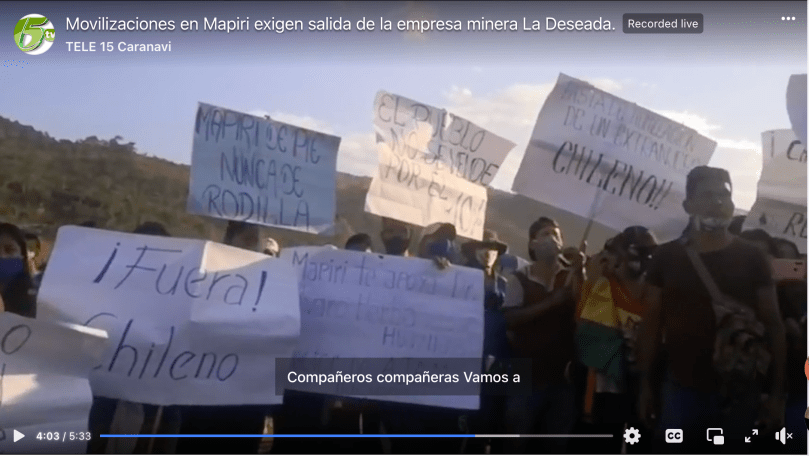
This review of lethal political conflict in Bolivia is cross-posted from the Ultimate Consequences research project website, where I’ll be archiving my commentary and analysis on political violence in the country. Featured photo above shows protesters against the La Deseada mine in Mapiri, in Larecaja Province, where mining conflict have claimed five lives in recent years.

Eleven people have died in social movement-related violence in Bolivia since the beginning of 2023, ten of them the victims of violence carried out by other social groups. These conflicts pitted rural community members against miners, as well as disputes within the same profession, be it mining cooperatives, urban transit drivers, or rival claimants to rural land. Only one death, in January 2023, was caused by security forces, who fired a projectile into the eye of a bystander during raucous protests over the arrest of right-wing governor Luis Fernando Camacho.

In addition, the government of Luis Arce attributed four deaths from medical causes to the side effects of pro-Evo Morales blockades in January 2024. (Per our codebook, we record such collateral consequences but exclude them from other analysis.) For more details on these events, visit Ultimate Consequences’s interactive directory (Spanish version) of all deaths recorded in the dataset. Type “Arce” into the search bar for presidents to just see events during the Arce administration.

Deadly protest events, January 2023–August 2024
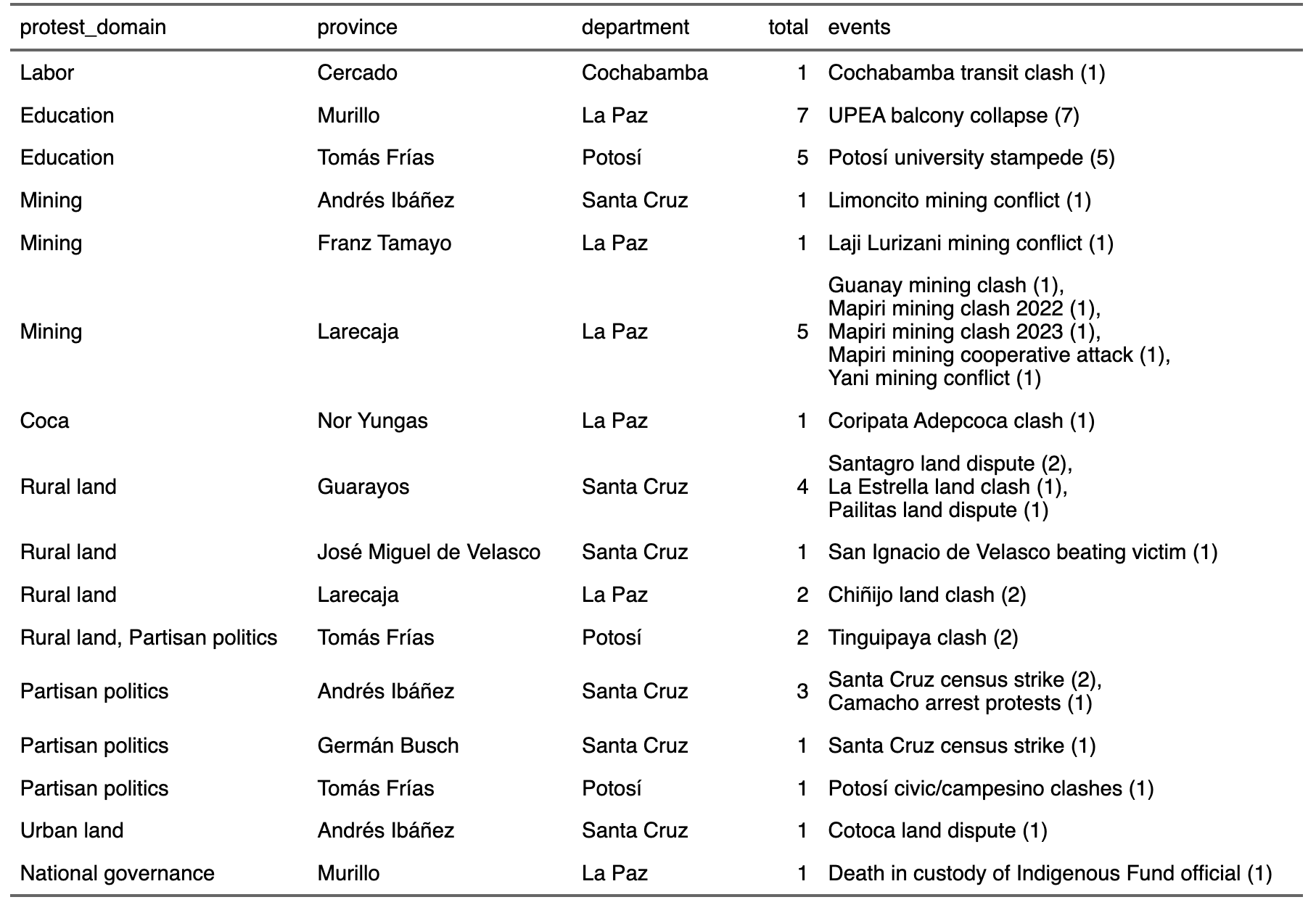
The recent events are as follows:

Camacho arrest protests: The December 28 arrest of Santa Cruz’s governor (and ex-presidential candidate) Luis Fernando Camacho touched off immediate protests in Santa Cruz de la Sierra, the regional capital. Following a one-day airport takeover, members of Camacho’s Civic Movement alternated between daytime blockades and nighttime property destruction. On New Year’s Day, police fired a projectile—likely a tear-gas canister—into the eye of Edwin Chávez Durán. The man enduring no fewer than seven surgeries over the next two weeks before succumbing to a heart attack on January 13.

Mapiri mining clash: Amid negotiations upon the filing of mining permits for a mine site located on the Merque river, confrontations began between prospective miners at the site and community members. The mining firm, Minera La Deseada, is described as Chilean, and the workers involed as arriving outsiders, some or all from Caranavi, according to the OTB of Mapiri, led by Ruddy Salcedo. Salcedo describes a Chilean business owner as present at the start of the confrontation, urging them to begin work by force. Community members occupied the disputed site, waiting for police to arrive. In the ensuing confrontation, stones, dynamite, and firearms were used, wounding ten people and killing Jhilmer Cuele Sompero. Community struggles challenging the La Deseada Mine have been ongoing for years; a 2020 mobilization shows leaders describing a five year struggle up to that point. In 2020, they were demanding the enforcement of a ruling by the national mining authority AJAM.

Limoncito mining conflict: On March 1, police accompanied an inspection visit by AJAM to document the stone-mining operation of the Dracruz company, in Limoncito, El Torno municipality. The delegation was confronted by mine workers who launched rockets and otherwise attacked the inspectors and police. Amid a retreat, Sub-Lieutenant Ronald Choque Mamani suffered a cardio-pulmonary arrest and collapsed to the ground. (Initial reports of bullet wounds to the officer proved unfounded.) He could not be revived. Five men were taken into custody for investigation by the FELCC and prosecutors. Subsequent inspection on March 10 revealed an unpermitted mining operation extending over 16 hectares of municipal land. Police then took both heavy equipment and documentation from the company. Local residents had complained of the operation, and have an ongoing campaign against other illegal mining operations.

Santagro rural land dispute: In El Puente municipality of Santa Cruz, conflict flared up between members of the Intercultural farmer federation, who established settlements there in December 2023, and the employees of the Santagro soy producing company, which works on the land. The armed confrontation on March 30 claimed the lives of two men, Francisco Morales and Jorge Pérez.

Cotoca land dispute: During a confrontation between established residents and squatters in Cotoca, Herland Salinas Añez was stabbed multiple times, first by a machete and then by a short blade knife (arma blanca) and killed. Several others suffered machete and bullet wounds during the confrontation. Witness reports describe the confrontation as continuing over several days. Police arrested 25 to 33 people, whom they investigated for the illegal land occupation. Per a more detailed report, the housing takeover was sudden and carried out by a group arriving in a van, making the squatters the attackers.

Laji Lurizani mining conflict: Wilmer Chambi Salcedo, 25, was shot and died while in an ambulance transporting him from Apolo to La Paz. He was one of four wounded in a conflict in the Santa Rosa community in the Laja sector of Apolo on September 13, 2023. The violence resulted from a conflict between illegal miners and community members in the protected Parque Nacional y Área Natural de Manejo Integrado Madidi (PN-ANMI Madidi). On September 15, the Autoridad Jurisdiccional Administrativa Minera (AJAM) reaffirmed that no mining rights were granted anywhere in the protected area. The same day, police arrived in the conflict zone and took control of the Laji Lurizani community. Bitza Delgado, the wife of the deceased Wilmer Chambi Salcedo, demanded that the authorities move to find those responsible for his death.

The death marked a continued worsening of violence due to mining conflicts in the Apolo region of northern La Paz. Illegal and informal mining thrives in the region. On September 18, community members of Laji Lurizani arrived in La Paz’s Plaza Murilo to protest the activities of illegal miners and their backers, and the absence of the state. Residents testified and presented photographic evidence of how illegal miners force them under threat of violence to allow them to do what they want in the area.

Pailitas land dispute: A week of armed confrontation between interculturales and peasants disputing land rights in the Forest Reserve of the Ascensión de Guarayos province resulted in the death of the intercultural Félix Ribera Bellido (23) of San Julían and the injury of 14 others. The death occurred early on the morning of December 2, when a conflict erupted between the communities of Pailitas and Santa María (in the Los Londras area). On December 6, the leader of the interculturales of San Julían, Tito Rokas, threatened the death of landowners in the province, claiming they were responsible for the violence. President Luis Arce announced that the violence would not be tolerated and summoned an emergency meeting of ministers to analyze the land conflict and propose structural solutions. The director of the National institute of Agrarian Reform (INRA) emphasized however that the lands being fought over were in fact property of the state, as all of the properties lie withing the Gurayos Forest Reserve. The Bolivian Ombudsman’s Office condemned the violence and called upon all actors to lower the temperature and to find peaceful solutions to the conflict. On January 16, 2024, Heber Sixto Canaza Sacaca (47), one of the leaders of the San Julían syndicate, was charged with homicide, for his role in inciting the violence on December 2, and for land trafficking, due to his promise to deliver properties in the municipality to intercultural groups. He was apprehended and taken into custody on January 15 and transferred to Santa Cruz by the FELCC. Sixto Canza had also been previously involved in another armed conflict in the Las Londras area in 2021, during which a group of journalists, police, and businessmen were kidnapped and tortured.

Cochabamba transit clash: A taxi driver suffered blunt force trauma while being attacked by drivers of a rival union of drivers disputing their line. One report indicates he and his brother were dragged out of their vehicle and held in another, possibly suffering the wound when jumping out of the vehicle. A doctor described blunt trauma inflicted by a large stone.

Guanay mining clash: Conflict among miners resulted in two injuries (both with metal shrapnel) and the trauma-induced heart attack of Mauricio Soliz Miranda.

Yani mining conflict: National Police intervened in the Yani community of Sorata municipality where two groups of cooperative miners were in open confrontation. This confrontation included injuries from firearms suffered inside the mine the night of July 25. Sent to accompany officials from AJAM and to de-escalate the conflict, the police were confronted by members of one side of the dispute. Reportedly, the miners threw rocks and dynamite at the arriving police, and set the hill on fire. Caught in the flames, two police officers suffered severe burns to 70% and 80% of their bodies respectively. One of those burned, Fabricio Reynoso Gutiérrez, succumbed to his injuries in a La Paz hospital. Altogether, four police were hospitalized. Two alleged perpetrators were arrested and held in preventative detention. One party to the dispute was the Cooperativa Minera “Señor de Mayo”, seemingly the side complaining of illegal occupation of their stake, while the other side (per a social media post circulated by Señor de Mayo) is known as Hijos de Ingenio. The latter allege further violence by Hijos de Ingenio, including a shooting on the following day.

Past annual reviews of political violence on Carwil without Borders: 2022 | 2021 | 2019 crisis | 2012. More tagged Lethal Conflict

Arrest of Luis Fernando Camacho prompts fiery new Santa Cruz protest wave

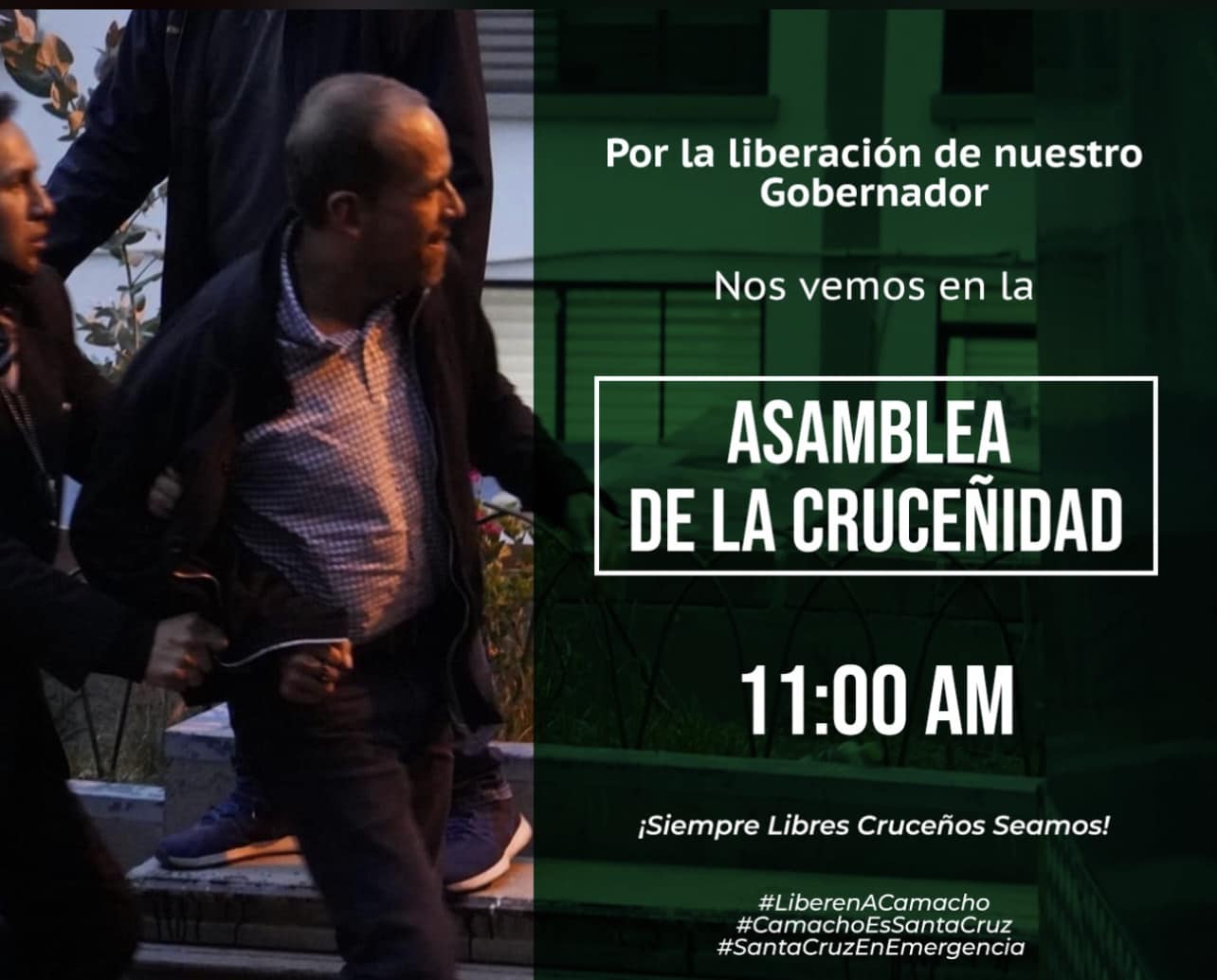
Luis Fernando Camacho, governor of Santa Cruz department and regional leader in 2019 protests against Evo Morales, was arrested on December 28, 2022, as a suspect in the Golpe de Estado I (Coup d’état I) investigation. Camacho, whose public statements suggest that he and his father coordinated with the military and police prior to Evo Morales’ ouster, has been named as a suspect as well as convened to testify in the inquiry. The formal charge against Camacho is “terrorism,” though its specifics are more akin to insurrection against elected authorities. Camacho was sentenced to four months of preventative detention, during which time prosecutors promise to deepen their investigation of the nexus among Camacho’s Civic movement, the incipient Áñez government, police mutineers, and military conspirators in November 2019. (For today, I’m not blogging my thoughts on the legality, strategic wisdom, or ethics of this arrest.)

Camacho’s arrest was widely expected. He was known to be the subject of at least eight criminal investigations. As it turned out, the arrest order had been issued on October 31. Three days before, he had issued a video publicly challenging Justice Minister Iván Lima:

Ministro, usted que encabeza esto, que está buscando incriminarme con casos de violencia, no sea cobarde: si quiere, deténgame, deténgame, venga, deténgame
Minister, it is you who are at the head of this, who are seeking to incriminate me in cases of violence. Don’t be a coward: if you want, detain me, detain me, come here and detain me. [my translation]

Molina, Fernando. “Detenido el gobernador boliviano de Santa Cruz, Luis Fernando Camacho, por la crisis que llevó al derrocamiento de Evo Morales.” El País, December 28, 2022.

Almost immediately, the arrest itself kicked off a new wave of protests in Santa Cruz department, headed by the department‘s civic movement. Camacho previously headed the Comité Cívico Pro-Santa Cruz in 2019 and was Vice President of the Unión Juvenil Cruceñista in 2002–2004. These institutions, joined by the public voice of governor Camacho since his April 2021 election, have engaged in waves of protest challenging the MAS–IPSP governments of Evo Morales (2006-2019) and Luis Arce (2020–). While demands have varied widely—rejection of the constitutional assembly and departmental (2006–08), rejection of judicial elections (2012), of penal code reforms, of alleged electoral fraud (2019), an anti-money laundering law (2020), and a census delay (2021), the mechanisms of regional protests have been relatively stable.

Like other regions, Santa Cruz goes on strike through road blockades and a city-wide work stoppage. And during the 2006-09 political standoff and since 2019, these tactics were enhanced by peaceful or forcible takeovers of national state institutions, as well as direct physical attacks on institutions associated with the governing MAS-IPSP party, such as labor unions and Indigenous organizations, and attacks upon so-called “traitors” to the region, which is to say local MAS-IPSP politicians.

While used only sparsely between 2009 and 2019, arson has been an important tactic for the Santa Cruz Civic movement during the so-called catastrophic stalemate of 2006 to 2009, during the October–November 2019 political crisis, and in protests since Luis Arce’s October 2020 election. (I detail the broader use of arson in the 2019 crisis and the catastrophic stalemate in a forthcoming article in the Bolivia Studies Journal.)

Immediate Responses to Camacho’s Arrest

A crowd of civilians on the tarmac of Viru Viru International Airport

The first responses by the Civic Movement to their leader‘s arrest were attempts to prevent his transport out of the region. Protesters flooded into the terminals and runways at Viru Viru International Airport and El Trompillo Airport. Per El País (of Madrid):

A group of hundreds of the governor’s sympathizers, led by regional authorities and [parliamentary] deputies, headed to the Viru Viru airport in Santa Cruz. There, they overwhelmed and beat security personnel, invaded the runway, entered some of the airplanes waiting to take off, and obliged the passengers to disembark, to prevent Camacho from being taken from Santa Cruz. They didn’t find him. Despite this, they decided to paralyze the airport after [Camacho’s] detention.

Molina, Fernando. “Detenido el gobernador boliviano de Santa Cruz, Luis Fernando Camacho, por la crisis que llevó al derrocamiento de Evo Morales.” El País, December 28, 2022

Among the elected officials present was Paola Aguirre, who reportedly vowed, “No sale ni un avión de este aeropuerto [Not one plane will leave this airport.” Aguirre posted a 33-minute video to her Facebook page beginning with her atop a boarding staircase to an airplane, including an impromptu press conference on the tarmac, live questioning of the airport director about whether Camacho had boarded a BOA flight (at 15m50), and vows that any damage or inconvenience caused to the airport is the responsibility of the national government who ordered Camacho’s arrest (at 30m50).

Flights from Viru Viru resumed on December 29. Airport officials reported 5,000 travelers were affected, with 350,000 Bs (~ $50,000) in material damages and 900,000 Bs. ($130,000) in accommodations purchased for inconvenienced passengers.

The New Daily Protest Cycle

With Camacho successfully removed from the department, the protest mood turned to rage.

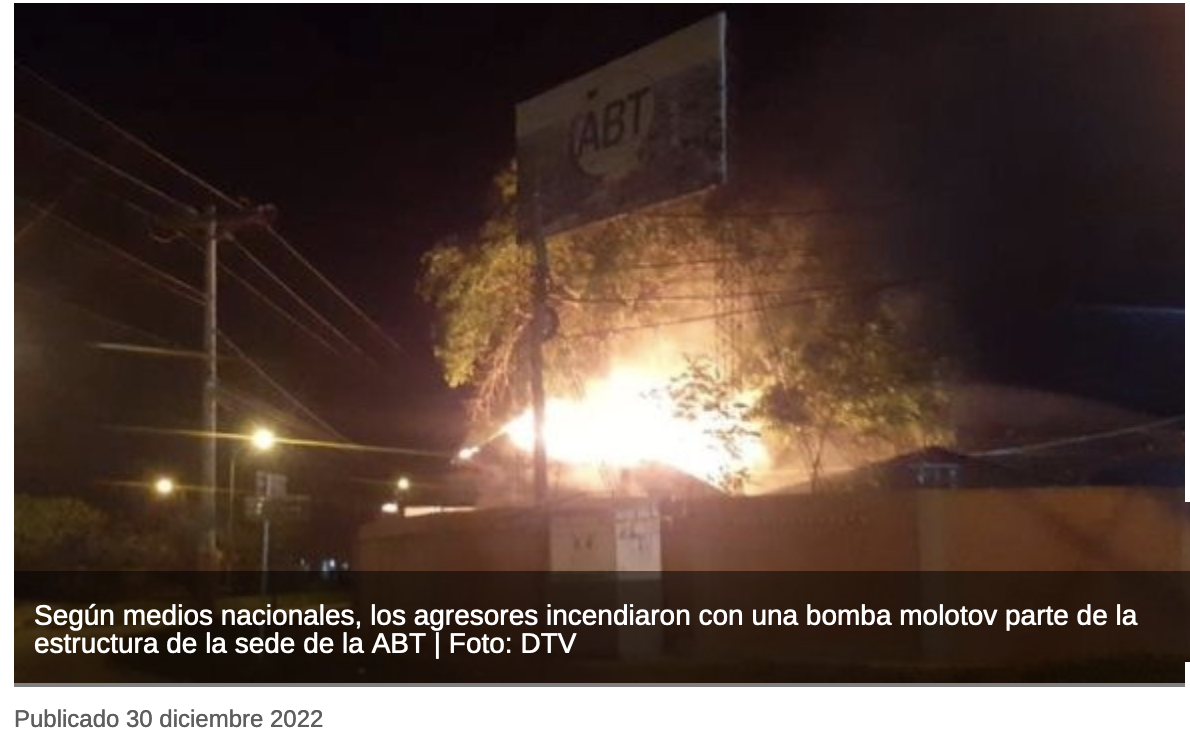
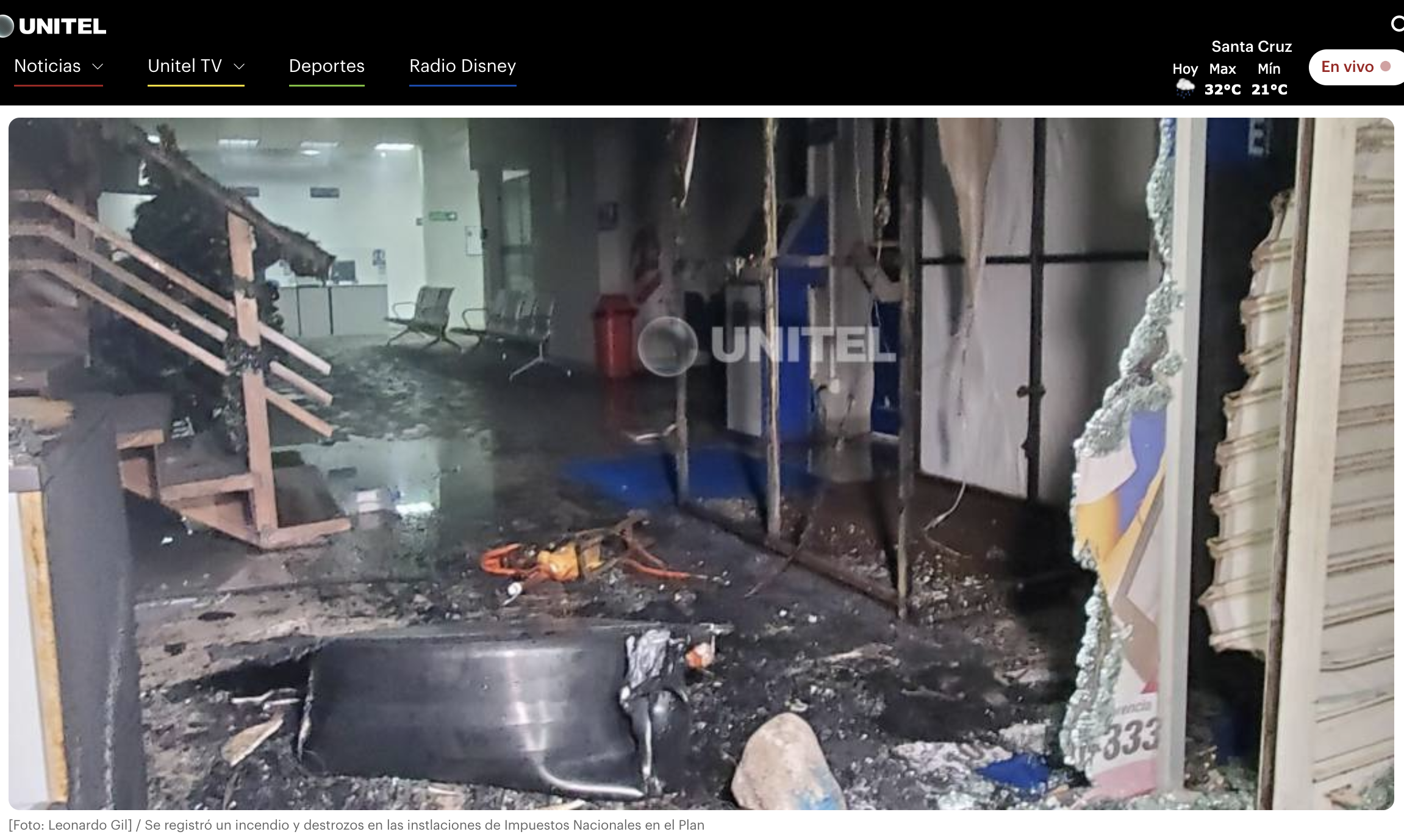
Pro-Civic Movment newspaper El Deber reported a “night of fury” that consumed three buildings: the prosecutor’s office, a drug control office that has been used for negotiations w/ the national government, and the home of Minister of Public Works Edgar Montaño.

In its public pronouncement, the Cruceño civic movement called for road blockades to begin at midnight (December 28/29) and the takeover of public institutions, both key tactics in past protests, including the 36-day strike in October–November of 2022. It, along with former centrist presidential candidate Carlos Mesa, qualified the arrest as a “kidnapping” and the act of a “dictatorial” national government. It has convened mass gatherings to mount a new regional mobilization until Camacho is freed.

What is apparent after three nights is that this new wave of mobilization has a daily cycle with a daytime phase focused on blockades and calmer occupations held at/in front of national institutions and a nighttime phase of confrontations with police during which protesters attempt to seize and burn the same class of institutions.

Here are daytime actions, as photographed by the Unión Juvenil Cruceñista:

And night-time attacks on the same class of public institutions, sometimes literally the same ones (like the ABT, the Administration of Forests and Lands) pictured in peaceful protests.

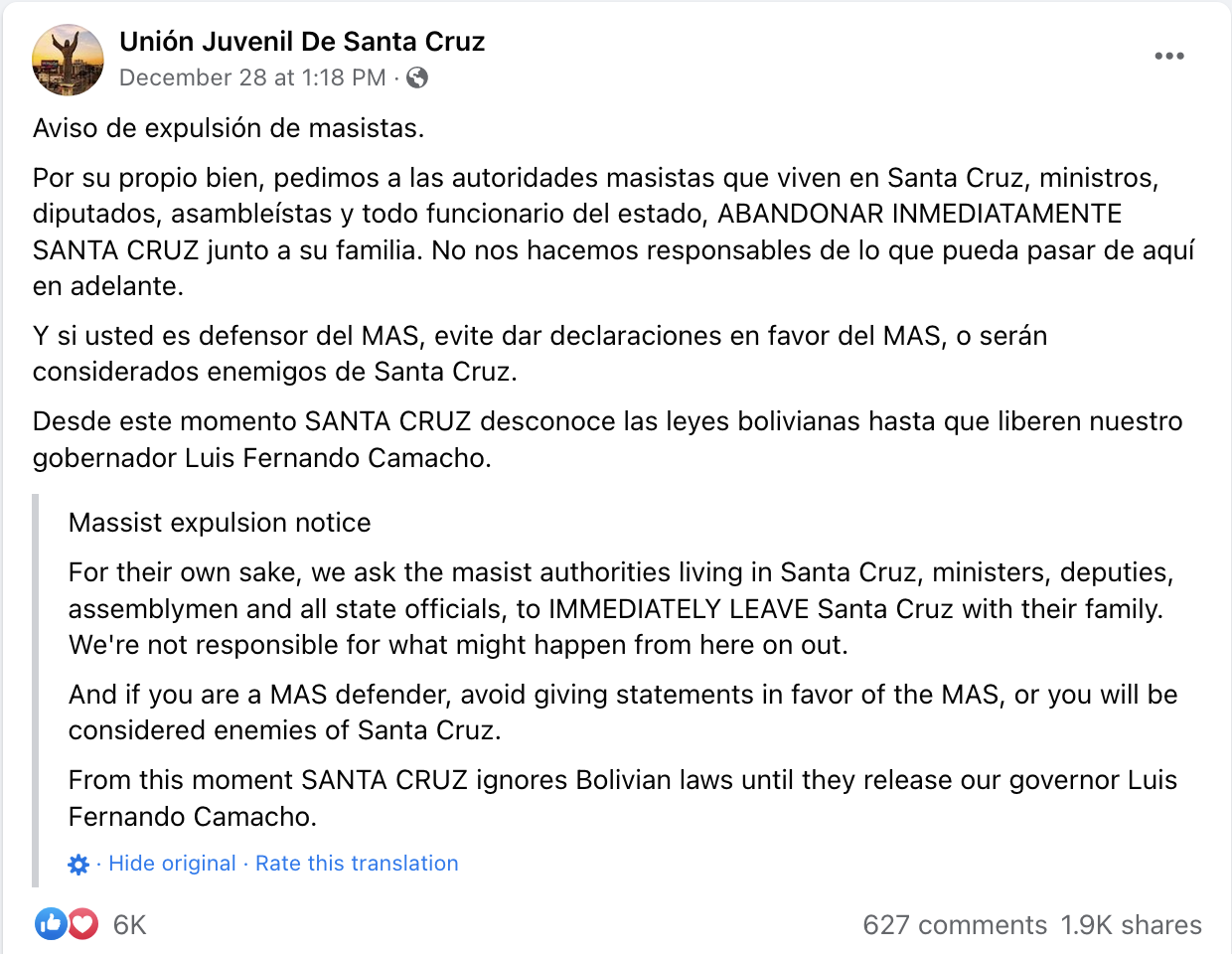
The logic of these actions is twofold: first, a public repudiation of the legitimacy of the national government and second, the assertion that only MASistas work in such instutions and they are “traitors to the region.” A widely shared “order of expulsion” posted by a non-official(?) UJC account urged MAS supporters to leave Santa Cruz. It was “shared” over a thousand times and widely reposted beyond that.

The formal leadership of the Cruceño organizations has been careful to label the arsons as the work of “infiltrators” in their ranks or so-called “self-inflicted attacks” by MAS-led institutions. The claim that a small number of closeted pro-government arsonists are hiding themselves nightly in anti-government crowds who only want to fight the cops is, to say the least, not especially credible. The will and capability of the Santa Cruz civic movement to carry out both crude and sophisticated arson attacks was demonstrated amply in the October 2019 burnings of electoral offices in protest over alleged voter fraud, and numerous attacks during the 2006-09 political crisis.

What is the actual relationship between the daytime pronouncements of the Comité Pro-Sana Cruz and the Unión Juvenil Cruceñista, and the nighttime actions of arson? Is there a real split over tactics, or merely an effort to deny responsibility for arson and insurrection, which might be distasteful to potential foreign allies?

Here’s how Camacho-aligned congressional deputy Paola Aguirre answers that question:

La ciudadanía cruceña, como en su momento lo dijen, no tiene patrones. Ellos se han autoconvocados desde el momento en que se enteraron que el gobernador Camacho estaba siendo secuestrado por el regimen del President Luis Arce. Y han tomado acciones por iniciativa propia. El Comité Cívico Pro-Santa Cruz prácticamente el día de ayer [29 de diciembre] ya la ha dijo a la ciudadanía, ‘ya, tomen ustedes las determinaciones que consideren convenientes.’

Este paro de 24 horas definitivamente es una de las menores medidas que se va tomar. Santa Cruz está convulsionada y no va a volver a la normalidad en cuánto no se restituya la libertad del Gobernador Luis Fernando Camacho. Por que no se trata de encarcelar a Camacho, se trata de encarcelar el voto popular de cientos, miles, y millones de Cruceños que han decido elegir a Camacho como Gobernador.

Translation: “The Santa Cruz citizenry does not, as is sometimes said, have bosses. They have convened themselves from the moment they knew that Governor Camacho was being kidnapped by the regime of President Luis Arce. And they have taken actions of their own initiative. The Pro-Santa Cruz Civic Committee practically said to the citizenry yesterday, ‘Alright, you take the determinations that you find convenient.’
“This 24-hour strike is definitely one of the smallest measures that will be taken. Santa Cruz has been convulsed and normality will not return so long as the freedom of Governor Luis Fernando Camacho is not restored. Beacuse they are not just trying to imprison Camacho, but they are trying to imprison the popular vote of hundreds, thousands, and millions of Cruceños who have decided to elect Camacho as our Governor.”

Paola Aguirre, interview with Radio Fides, 30 December 2022. At 7m30 in video posted on her Facebook page.

What is clear is that, today, the daytime organizations are now mobilizing for the freedom of protesters imprisoned for confrontation and arson.

And that the night-time factions are promising a New Years’ Eve of escalated confrontation, and inviting Cruceños to equip and prepare themselves for confrontation, starting at 10pm tonight.
A Facebook invite from Unión Juvenil Santa Cruz (not the official account of the UJC), reads, "Gran Bienvenida del 2023 / Recibamos este nuevo año a los pies del cristo / Desde los 22 horas / Entrada: Vinagre, mascara antigas, agua, balde, bicarbonato, palos, piedras, escudos, pinturas, petardos, etc. / Te esperamos!"

"Great Welcome to 2023 / Let's receive this new year at the feet of the Christ [the Redemeer statue] / From 10pm onwards / Entry fee: Vinegar, gas mask, water, bicarbonate, sticks, stones, shields, paint, rockets, etc! We're waiting for you!"

How the Arce/Choquehuanca ticket reclaimed the pre-2016 Morales majority

On October 18, 2020, Bolivia’s Movement Towards Socialism–Political Instrument for the Sovereignty of the People (MAS-IPSP) party roared back into a majority at the ballot box, winning a solid 55.11% of the vote and nearly doubling its nearest rival, Carlos Mesa’s Citizen Community (CC)’s 28.83%. The presidential ticket of Luis Arce Catacora and David Choquehuanca easily surpassed the simple-majority threshold for avoiding a runoff vote, and had an ample 26.28% margin of victory. Their victory came just 364 days after the disappointing performance of Evo Morales, who garnered 47.08% with a 10.57% margin over Mesa. It is all the more impressive since Arce and Choquehuanca campaigned without the benefits of incumbency and under the cloud of political persecution imposed by the temporary government of far-right interim president Jeanine Áñez.

This post takes a quantitative look at which parties gained and lost votes between these two elections and how the MAS-IPSP majority has evolved in size and geography since 2005. In the past year, the most consequential shift was missed by the headlines: the collapse in support for third-party candidate Chi Hyun Chung. I will also consider what these shifts reveal about Evo Morales’ second-round chances in 2019 (much better than expected), and Carlos Mesa’s fateful decision not to negotiate a prompt second round. A year ago, I looked at where and how Evo Morales lost his majority in 2016 and 2019; in the final section, I extend that analysis and see where Arce and Choquehuanca gained back supporters.

I draw on a statistical analysis of votes shifts by Diego Aliaga and colleagues, municipality-level vote analysis by Arián Laguna, citing and sometimes questioning their conclusions, and vote data from the Plurinational Election Organ (2019|2020). The analysis from 2019 to 2020 is simplified by the fact that nearly equal numbers of valid votes were cast in the two elections, meaning that we can work with raw vote counts as well as vote shares.

Read More »

Bolivia’s 2020 presidential candidates: A very quick guide

Party/
Alliance
Presidential CandidateVice Presidential Candidate
MAS-IPSPLuis Arce Catacora undefinedundefined
finance minister, 2005–19
David Choquehuancaundefinedundefined
foreign minister, 2005–17
CCCarlos Mesa Gisbertundefinedundefined
president, 2003–05
Gustavo Pedraza Méridaundefinedundefined
planning minister, 2004-05
FPVChi Hyun Chungundefinedundefined
doctor, Baptist pastor
Leopoldo Chui
lawyer, El Alto prosecutor
Juntos
Jeanine Áñezundefinedundefined
interim president
Samuel Doria Medinaundefinedundefined
planning minister, 1991–93
CreemosLuis Fernando Camachoundefinedundefined
Santa Cruz civic movement
Marco Antonio Pumariundefinedundefined
Potosí civic movement
Libre 21Jorge Tuto Quirogaundefinedundefined
president, 2001–02
Tomasa Yarhuiundefinedundefined
rural affairs minister, 2001–02
PAN-BOLFeliciano Mamani
Cooperative Miners Federation
Ruth Nina
police spouses association
ADN
Withdrawn.
Ismael Schabibundefined
Navy admiral
Remberto Siles
Army general

Today, February 3 was the deadline for Bolivian parties to submit their candidate lists for the May 3 general election, which replaces the annulled October 2019 vote. Here is a summary of the parties, their political situation, and their candidates.

Read More »