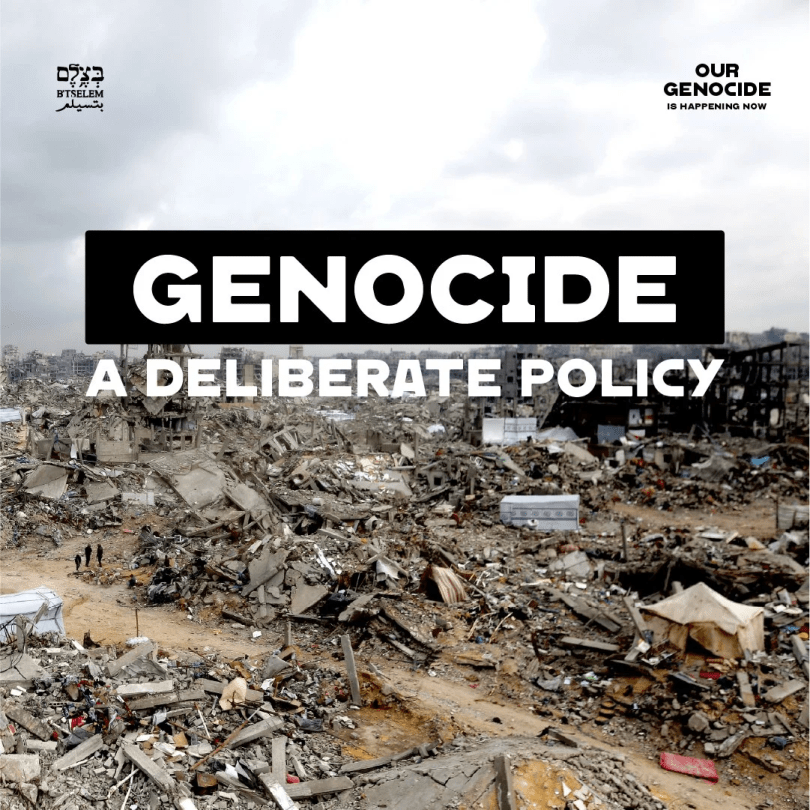
"Genocide: A Deliberate Policy." Cover of a report by B'Tselem, with title over a destroyed urban landscape.

Israel 2025: Some acknowledge “Our Genocide,” while most endorse escalation

If you’ve taken a step back from the endless stream of video-documented destruction in Gaza, something even Israel-aligned political voices have been compelled to describe as “a wall of carnage,” perhaps it is time to re-engage with the political realities of the society that has waged war (at high and lower intensity) on the occupied territories of the Gaza Strip and West Bank for the last twenty-seven months. If so, let me recommend four videos and one podcast episode to catch up with Israeli politics, seventy-thousand violent deaths into the current period.

Israeli human rights groups: “Our Genocide”

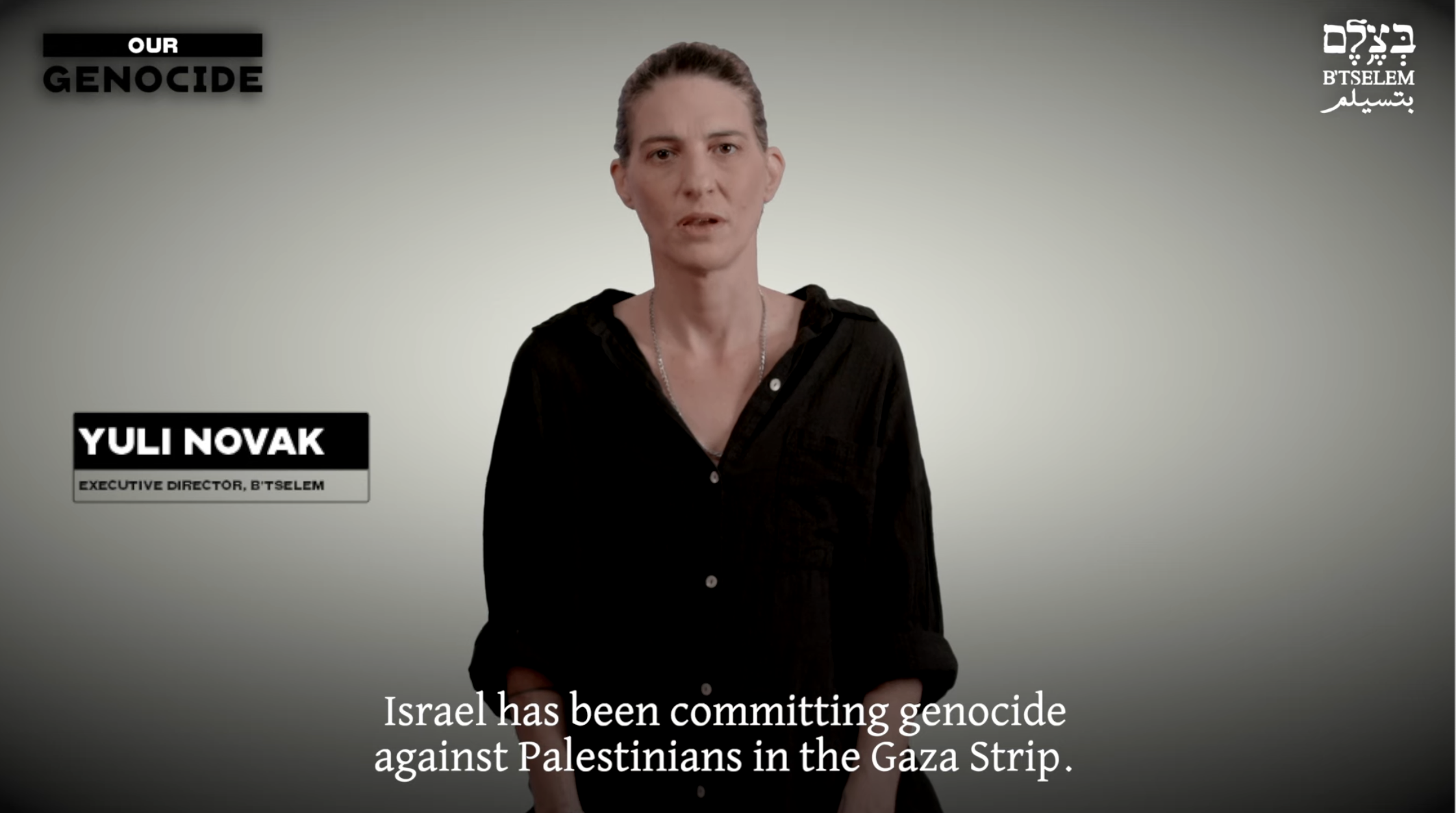
In July, the Israeli human rights organization B’Tselem issued a report concluding that Israeli policy had taken a decisive turn from a destructive military occupation to “coordinated, deliberate action to destroy Palestinian society in the Gaza Strip.” Checking each of the elements of the crime of genocide, they enumerate actions including:

“an intensive military campaign in the Gaza Strip that includes mass killing, both in direct attacks and through creating catastrophic conditions that increase the massive death toll; serious bodily or mental harm; large-scale destruction of infrastructure and living environments; destruction of the social fabric, including Palestinian educational institutions and cultural sites; mass arrests and abuse of Palestinians in Israeli prisons, which have effectively become torture camps; mass forced displacement, and making the ethnic cleansing of Gaza one of the official war goals; and an assault on Palestinian identity through the deliberate destruction of refugee camps and attempts to undermine the United Nations Relief and Works Agency for Palestine Refugees (UNRWA)”

B’Tselem was joined by Physicians for Human Rights Israel in denouncing the genocide in Gaza. Their conclusions came after many similar conclusions by Amnesty International, Human Rights Watch, United Nations human rights experts, and genocide, scholars, but they represent a crucial bridgehead in to Israeli Jewish society. (B’Tselem is a non-sectarian institution that includes Jewish Israelis, Palestinian citizens of Israel, and Palestinians from the Occupied Territories.) Their perspective very much remains a minority position in Israel, where a June 2025 poll found that 87% of the ruling coalition supporters, 67% of moderate voters, and even 30% of supporters of the left-wing opposition all agreed that there are “no innocents” in Gaza. (More recent polling confirms this.) Political supporters of equality between Palestinians and Israelis continue to navigate difficult strategic questions about how to represent themselves and enlarge their numbers.

In Jerusalem and Tel Aviv: Denial of Palestinian suffering

Guardian reporter Matthew Cassel’s three-part series “Along the Green Line” serves to illustrate the hardening line in Israeli society. Partisans of Israeli victory increasingly see the notion of Palestinian territory itself as a thing of the past. The first episode show such Israelis’ point of view including their ambitions to expel Palestinians and replace the Al-Aqsa mosque. Meanwhile Palestinians continue to narrate their historical presence.

In a separate video, Cassel meets with Israelis on the streets of Tel Aviv and asks them about the understanding of the war, in light of the reports of genocide. After meeting with B’Tselem, he finds many Israelis who hold tight to the notion that mass casualties in Gaza are a staged deception, a product of “Gazawood” film-making rather than grim reality. Even at an anti-Netanyahu demonstration, Cassel asks “why there is little mention of the Palestinian victims of this war in Gaza?” and manages to find just one person willing to prioritize Palestinian suffering.

Fifty miles south in the Israeli communities of the so-called ”Gaza envelope” there is little more sympathy for Gazans, but far less denial. A resident of a border town shows Cassel the remaining destruction from the three-day invasion of his town of Kfar Aza by Hamas in October 2023, leading to the deaths of 80 Israelis (including 19 taken hostage and 24 members of the security forces). A resident who leads tours of the wreckage for visiting Israelis speaks frankly about 50,000 Palestinian deaths as a possible recompense for the 1,200 Israelis killed in the attacks, and acceptable measure to deter future Palestinian violence. He narrates the violence as an almost clinical measure: “Clean it out and then bring in something good.” Meanwhile across the Green Line, Malak, a young Gazan woman fears that her journalism could lead to the deaths of her already-displaced family.

The West Bank: “The threshold of despair”

NPR radio show This American Life devoted an August 2025 episode to “The Other Territory,” the West Bank. In its opening it quotes from a plan drawn up by Bezalel Smotrich, now overseer of the occupied territory as Minister of Finance and a defense official. In this document from before his appointment, Smotrich wrote, “The point will come when [Palestinian] frustration will cross the threshold of despair and will lead to acceptance and understanding that their cause stands no chance. It simply isn’t going to happen.” The episode is in essence a chronicle of the forms that despair takes, both outside and inside Israeli prisons. This, of course, continues regardless of the partial ceasefire in Gaza. For those of us whose governments back this process, it is essential listening.

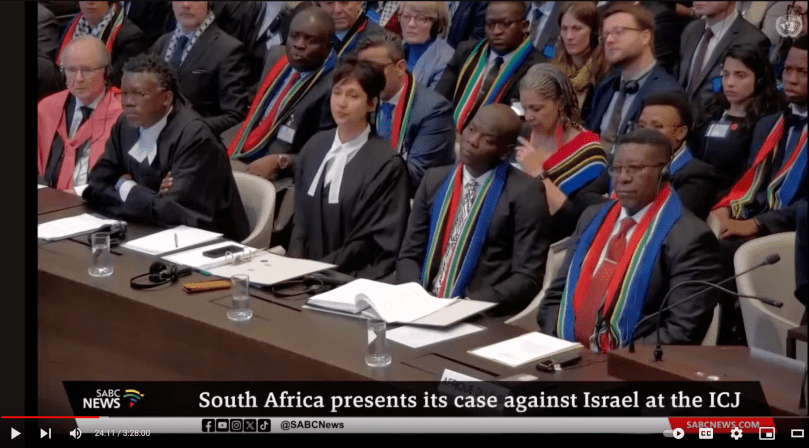
Five formally dressed lawyers sit at a long brown wood table at the International Court of Justice. They are South Africa's delegation, each dressed in black suits: three men have dark African skin, one lighter skin woman in the middle, and one European-descent man on the left. Two of them, and many people seated behind them wear long cloths with the colors of the post-Apartheid South African flag. A South African Broadcast Corporation news chyron at the bottom reads: "South Africa presents its case against Israel at the ICJ"

Gratitude for South Africans at the ICJ

South Africa’s existence as the country it is now is the result of a remarkable global collective struggle that many US residents played a part in. This struggle was only in small measure a legal one, but it built on the ways democracy, anti-racism, and equality of all nations were built into the global legal architecture since 1945. Apartheid was overcome in part by UN institutions deeming apartheid itself a crime.

Perhaps some day, decades from now, Palestinians and Israelis will sit side-by-side and advocate for the rights of others (whether as representatives of two states or one), and will remember their own troubled history and how they overcame it by ending violence and ensuring equal rights for all. If so, it too will be in part because voices worldwide could not abide the violent present, and used every means they could, including courts and diplomacy, boycotts and arms embargoes to chart another path..

The scale and pace of death in Israel–Gaza war are staggering

This is not just another turn in the Israeli–Palestinian conflict.

The extraordinary attacks by Hamas on October 7 and the thirty-one days of bombardment and invasion by the Israeli military that followed have led to a loss of life on an historic scale in Israel and Palestine, respectively.

Researching and accounting for lethal political violence is a major part of my work, and I find myself staggered by this extraordinary and extraordinarily public burst of violence. Like climate scientists during this year’s record-breaking summer, I find myself frantically sharing statistics and re-posting and pointing out this is not normal. Not even against recent trends. That this is the threshold of something worse than what we’ve known.

That’s what I’m doing and feeling with these numbers coming out of Gaza. (And about October 7 in Israel, though it will be months before Hamas could credibly repeat that day of atrocity, while Israeli air strikes happen every day, and a prolonged occupation promises even worse.)

Making this graph is my attempt to show how this isn’t normal. To grapple with the historic significance of this moment. To not feel alone in seeing it.

Read More »

Three Palestinian photographers, three Israeli killings

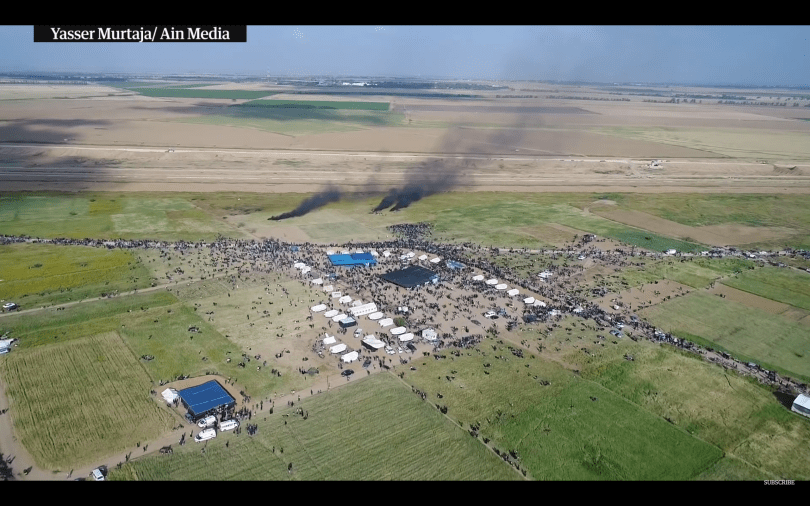
In 2012, photographer and videographer Roshdi Sarraj (Twitter|Instagram) co-founded Ain Media with Yaser Murtaja (Instagram). Both used up-close and drone-mounted cameras to document the life of the everyday life, wartime suffering, and protest movements of Gaza. I became aware of Murtaja and Ain Media’s remarkable work through his last piece, documentary coverage of The Great March of Return, celebrated on this blog as the world’s most daring protest. In footage shot for an envisioned documentary, Murtaja captured the collective organizing, on-site medical care, patient journalism, and defiant risk-taking that made the protest possible.

And he was killed for that journalism, shot by an Israeli sniper beside his collaborator Roshdi Sarraj.

It was Sarraj who narrated Murtaja’s last moments to the world:

Read More »

The Palestinian protest camps in Gaza are world’s most daring protest

Today is the long-planned climactic day of the Great March of Return, a Palestinian protest on the fenceline of the Gaza Strip. On March 30, Palestinians set up five protest camps a half-kilometer from the Israeli military. These camps are themselves a form of mass protest, reminding the world that two-thirds of Gazans are refugees from towns, villages, and farms within Israeli territory. The protest’s chief demand is the Right of Return, their ability to freely return to their homes and/or to re-establish the communities they have maintained in exile for the past 70 years. Protesters are also demanding an end to the eleven-year blockade of Gaza, imposed in 2007, which has crippled the territory economically. The camps have been the staging grounds for weekly demonstrations, in which ten to thirty thousand protesters rally while at first hundreds, and more recently thousands of protesters have advanced into the unilaterally declared buffer zone along the fence. During these protests, unarmed Palestinians have thrown stones and flaming bottles towards the fence, and used a variety of tools to dismantle part of the wall that keeps them caged and isolated from the rest of the world.

Marchers, journalists, protesters engaged in confrontation and those who have peacefully approached the fence have all been subjected to an unprecedent barrage of violent force on the part of the Israeli military, who are positioned in towers and earthen embankments on their side of the fence. Israeli snipers have shot over 2,500 people and as of today, killed over fifty Palestinians. Yet week after week they keep coming.

The Great Return March in Gaza continues to be the most daring tactical encounter between protesters and security forces on the planet.

If you’ve seen the film Gandhi, you know the scene where people line up and risk beatings to defend their strike. Journalistic coverage of this march on the Dharasana Salt Works was a devastating proof the moral bankruptcy of British Rule in India. I’ve long said this could not be repeated when the opponent has deadly weapons. The Gaza protests have proven me wrong.

The Gaza protesters are unarmed militants, not satyagrahis. They are not arriving empty-handed but with stones in their hands. But they have injured no one on the Israeli side. They are deploying unequal means: inflicting symbolic damage while suffering brutal and deadly violence. And their response to that violence is not to switch to the deadlier means at their disposal (guns and rockets), but to keep coming back.

This is the dynamic of the Soweto Uprising, a turning point in the anti-apartheid struggle in South Africa. Unequal violence proved morally unsustainable for the regime, ultimately isolating it from its support system in the United States and Europe. The dynamic on the side of Israel and its backers remains unknown; will shooting thousands of essentially defenseless civilians provoke a moral reckoning? That choice is up to us.

You probably haven’t seen this protest from the inside. To do so, see the last footage captured by Yaser Murtaja, who was killed by Israeli gunfire in April. It offers a flash of insight into what the ongoing Gaza protests entail. Watch it.

After the break, four things you need to know about the protests…

Read More »

Who was on the Gaza flotilla? An Israeli Jew and the IHH speak in harmony

The two most compelling comments on the flotilla tragedy I’ve read came from very different sources. One is an Israeli Jew, Udi Adoni, writing on the Israeli online news service Ynetnews. The other is from IHH, the Turkish aid group that sponsored the MV Mavi Marmara, the ship that saw at least nine of its passengers shot dead. At a time when the Israeli state is eagerly telling the world that flotilla, and especially IHH, is Hamas, Iran, al-Qaeda and terrorists; and that the passengers who fought back were a terrorist ambush, the coincidence of these two voices is striking, and critical to hear. (everything that follows is their words0

Udi Adoni,A view from the Left”: It is not true that among the participants of the flotilla there are proponents of peace and proponents of war. Its beauty lies in the seemingly impossible coalition of contrasts of men and women, homosexuals and clergymen, Muslims and Jews, Christians and communists, anarchists and Hanin Zoabi and Dror Feiler. They all agreed to unite for an unarmed action. They all decided to act for freedom without a fight.

IHH press conference (I’m fairly sure the speaker is Bülent Yıldırım, its president, but it’s not indicated on the page), June 4: Our group was made up of all sorts of people, including leftists, rightists, liberals, conservatives, atheists, muslims, christians, jews, buddhists…Ours was a civil and pacifist initiative created by conscientious, civilian, unarmed people who carried with them nothing but humanitarian aid.

And we set sail to prove to the people of Gaza, who have been under a siege for years which is not unlike an imprisonment in a castle, that human kindness has not yet died.

Keeping our faith in the spirit of civil power, our Freedom Flotilla did not take any orders or any kind of support from any government during its organization. Our power came solely from the conscience of humanity and the courage of our rightfulness. We wanted to be a source of invigoration for the people of Gaza on whom many states turn a blind eye.

Adoni: But I was afraid to stand on board a ship that carries food and hope to Gaza, and to find myself confronting the men of the corps which I had served loyally 30 years ago. Looking back, it is a pity I did not join. I am asked, “Surely you would not have beaten IDF soldiers?” True. I suppose that I would have tied myself to a post and screamed with fear and faith. However, the question is not at all how I would have behaved but whether one has the right to self-defense against maritime terror applied by a state.

IHH: Ours was self-defense. And self defense is legitimate. It has always been legitimate in all systems of law and throughout history.  I am a lawyer. I should know this better than anyone. However, we did not defend ourselves with firearms against these terrorists that attacked us with firearms, we did not have such means anyway

Adoni: There were no firearms on board the ship. There were no suicide bombers. On the practical level, opposing worlds, united against the occupation and for the people of Gaza, to a struggle which was not supposed to bring death…but life.

IHH: Now some people are asking, “Why did you go there?”

We did, because we are humans. We went out there because we are humans. The conscience of humanity has not yet died, this we wanted to prove to humanity itself. For this, we went out there.

We went and we will go again.

Turkish Journalist Cevdet Kılıçlar apparently murdered on Gaza flotilla

Update, June 5: The International Federation of Journalists is calling for an inquiry into Cevdet Kılıçlar’s killing and the shooting of Indonesian cameraman Sura Fachrizaz. The investigation would also consider the treatment of all journalists on the flotilla and the confiscation of their pictures, cameras, and computers.

Update: IHH (the German acronym is the circulating one) has posted a photo album of Cevdet Kılıçlar (it appears to be pictures of him, rather than by him, but I don’t read Turkish) to its Facebook page. I’ve included his picture below now.

Original post: Onboard the Mavi Marmara, the largest ship of the Gaza Freedom Flotilla, at least nine passengers were killed. Witness reports and forensic evidence now suggest that at least one of those killed was documenting the raid and not participating the clashes between Israeli commandos and passengers that came along with it. Turkish journalist Cevdet Kılıçlar was shot in the forehead at close range, the bullet ripping away the back of his skull. Kevin Ovenden, a British activist onboard and eyewitness, has stated that Kılıçlar was filming at the time and has his camera held to his eye.

Kılıçlar worked for the Taraf, and Selam and Milli newspapers in Turkey. For the flotilla, he was employed by boat organizer, the Human Rights and Freedoms (İHH) Humanitarian Help Foundation, as part of its press staff. He was one of sixty journalists on the flotilla.

Relatives mourn over Cevdet's coffin Photo:Bulent Kilic/AFP

Cevdet Kılıçlar was 38. He leaves behind a grieving widow, Derya, and two children. He was also a gifted photographer, as you can see from his flickr page from a recent trip to Baku, Azerbaijan.

I draw three things from this sad news. First, the tragedy in Gaza has crossed the “it could have be me” threshhold, and I am sadder and more angry than before because of it. Second, the manner of this death as described by Ovenden, can be nothing other than murder. Third, the complete Israeli seizure of photographic evidence from those onboard is an even more serious than before; the grounds for a complete, independent, international investigation lie in part in what the Israelis have taken and may choose to destroy.

Cevdet Kılıçlar, c. 1972-2010

Sources for this story: Erol Önderoğlu and Tolga Korkut, “Journalists Returned from Israel – İHH Employee Dead.” Mehmet Nedim Aslan, “Israeli commandos killed journalist as he photographed their crime.”

Free Gaza flotilla: Accusation on bulletproof vests a dangerous distortion

As you probably know, Israel’s May 31 raid on the Free Gaza Movement’s flotilla of aid-bearing ships has occasioned a torrent of justifications, short video clip releases, and arguments. On the Israeli side, this began before the nine to nineteen dead activists bodies were yet cold. The narrative, remarkably, made the unarmed activists aboard the ships into a lynch mob and a terrorist ambush. In short, the Israeli government has been extremely eager to make the story fit a standard narrative in the region, one of treacherous asymmetrical warfare.

Those looking for the other side of the story had to wait out detentions and deportations, but eyewitness accounts are increasingly circulating. Both the anti-blockade activists and third-party journalists have had their ability to tell the story severely crimped by the Israeli seizure of film, memory cards, cameras, computers and other personal effects of those onboard.

The Israeli search has resulted in a remarkable remix of the goods they claim were onboard the ships, most visible in this photoset released by the Ministry of Foreign Affairs. And here is I where I can offer my humble contribution to correcting propaganda. A well-circulated story right now involves this contention:

Israeli officers later displayed slingshots, knives and truncheons they said were found on the ship as evidence of organized resistance. Defense officials also say some activists had military-style gear such as bulletproof vests and night-vision goggles and carried large sums of cash. (AP)

The AP is simply reporting their claim, but is also giving the Israeli government the sole opportunity to create a narrative from various objects onboard. Let’s consider a very serious alternative story. Observe the following Israeli government photo:

Note, by the way, the clean, unruffled, un-shot-at state of the vests. Now read this from the International Committee of the Red Cross in 2002:

No one is more keenly aware of the risks taken by ambulance personnel than Mohammed El Hessi, a 26-year-old Palestine Red Crescent (PRCS) paramedic who was called to the scene of a gunboat attack on a security post north of Gaza City on the night of 7 March. Mohammed, who responded to the call along with three of his colleagues, would be dead today had it not been for the bullet-proof vest he was wearing. Such vests have been supplied to the PRCS by the ICRC, with the knowledge of the Israeli authorities. Mohammed suffered serious shrapnel wounds as his team attempted to retrieve two bodies. A piece of metal was subsequently found embedded in the ceramic back-plate of his vest. A second PRCS ambulance team came to the rescue and managed to evacuate the dead and wounded after more than an hour. Mohammed was rushed to a hospital in Gaza, and his life is now out of danger. During the same rescue operation, a member of an ambulance team from the local medical services was killed.

“Without a doubt, the bullet-proof vest saved his life,” said Dr Fayez Jibril, head of the PRCS’s emergency medical service in Gaza, as he examined Mohammed’s bloodstained vest the following morning. “This is where the shrapnel lodged. If it had pierced his body, it would have gone straight to his heart.”

Who needs bulletproof vests in Gaza? No doubt people like paramedic Mohammed El Hessi. Why should we think that this vest was meant for him? Reading on in the same 2002 story:

Respect for medical personnel, ambulances and medical facilities bearing the protective red cross and red crescent emblems is compulsory under international humanitarian law. Any violation of this rule puts the safety of all medical and humanitarian workers in jeopardy. (Full article from the ICRC)

Oh, you mean these emblems? Compare them to the ones on the vest.

No matter how much the Israeli government might wish it had faced a commando team onboard the Gaza-bound flotilla, it didn’t. But it’s willing to weave a web of lies to make you think that it did. Hopefully, we can be a little less trusting of this kind of propaganda, and a little more concerned for lives like Mohammed El Hessi, the paramedic whose life was saved by a bulletproof vest with a red crescent.

IDF kills 30-year-old nonviolent protester in Bil’in

The weapon used against Tristan Anderson, a high velocity tear gas round, has once again proved deadly on the West Bank. This time, on Friday, occupying Israeli soldiers attacked demonstrators, including Bassem Abu Rahme. According to demonstrators’ reports, “He participated in the weekly protest and was standing in the other side of the wall, and was shouting at the soldiers “we are in a nonviolent protest, there are kids and internationals” he couldn’t continue his scrim and was shot. He was transferred to Ramallah governmental hospital, but he was dead. The funeral will be tomorrow in the village of Bilin at 1:00 pm.”

The relative position of soldiers and protesters is clear from this photo: a recently wounded Bassem is in fluorescent yellow.

April 17, 2009: IDF fatally shoots Palestinian protester. Photo by Lazar Simeonov

This was the predictable consequence of the flagrant repurposing of “less lethal” or “non-lethal” munitions to maim and kill at close range. See reporting by Israeli human rights group B’Tselem.

The Gaza War: Time for Introspection…

The December-January war in Gaza came and went too fast for people in the United States who weren’t already convinced to come to a moral reckoning with what was being done in our name, and with the money and weapons we provided. Unlike the Iraq war, advertised for over a year before, this one took place in the shadow of a U.S. national election campaign that was generally unconcerned with Israel and Palestine.

But there should be no mistake for United States residents that this war was ours. The United States government was nearly unique in providing unqualified support to the Israeli assualt, which left over 1300 people dead. Near-unanimous votes in both houses of the U.S. Congress backed the Israeli position, nearly word for word. The unprecedented demand that the Palestinian side renounce violence per se as a condition of negotiations was included in that endorsement. The new president, Barack Obama, maintained a strategic silence but made clear that “Israel’s security” is “sacrosanct” in the campaign.

The depth of this support cannot be pinned entirely on the pro-Israel lobby, athough its operation is a part of the way Washington works, with clear parallels to the Indonesia lobby that maintained a flow of arms during more than two decades of the occupation of East Timor. But US support is also an issue of popular mentality, of the minds and perspectives in our community. It combines Christianity and Fundamentalist apocalyptic viewpoints with a common self-perception of our societies as divinely blessed cities on a hill in a hostile wilderness. This perspective is the ideology that was needed by our shared histories as a settler colonial states, reinforced over the past forty years by anti-Arab racism. It’s about resonance, a shared politics that makes it possible to endorse one another’s crimes. Smart analyses of these political affinities has come from both right (see Walter Russell Mead writing in Foreign Affairs last summer) and left (see chapter 4 of Retort collectives’ Afflicted Powers).

Somehow these ideological limitations seem to distort American perceptions more than Israeli ones when it comes to Israeli actions. No doubt this combines real and legitimate guilt and remorse over antisemitism (though rarely does that come with a real self-examination about antisemitism in American history) with the World War II-centered story of American nationalism. The fact that defeating Nazi antisemitism is at the center of the last war most Americans can be proud of has made many reluctant to criticize the Jewish state that emerged in the years that followed.

But not keeping our eyes open gets us into big trouble. Fortunately, the Israeli media some times offers an up-close view that is sadly lacking in our own. So too, of course, do the Arab and international media. Right now, the Gaza war is being examined in a big way. Take a look…