Translated: UNASUR Declaration in Emergency Session following the diversion of Evo Morales’ plane in Europe

The following is my translation of the official statement by the UNASUR leaders made yesterday, in response to the diversion of Bolivian President Evo Morales’s airplane during his return from Moscow to La Paz, Bolivia.

Cochabamba Declaration — July 4, 2013

Before the situation to which the President of the Plurinational State of Bolivia, Evo Morales, was submitted by the governments of France, Portugal, Italy, and Spain, we [declare and] denounce to the international community and the various multilateral organizations the following:

The flagrant violation of International Treaties that govern peaceful coexistence, solidarity, and cooperation among states, which constitutes an extraordinary, unfriendly, and hostile act, forming an illicit act that affects the freedom of transit and movement of of a Head of State and his official delegation.

The abuse and neocolonial practices that still subsist on our planet in the twenty-first century.

The absence of transparency with regard to the political decisions that impeding the aerial transit of the Bolivian presidential plane and of the country’s president.

The offense suffered by President Evo Morales, which did not only offend the Bolivian people, but rather all of our nations.

The illegal practices of espionage that put at risk the rights of citizens and the friendly coexistence between nations.

Given these denunciations, we are convinced that the process of building a Greater Homeland [of South America], to which we are committed, should be consolidated based on upon the full respect for the sovereignty and independence of our peoples, with the interference of the world’s hegemonic centers, overcoming the old practices through which some sought to impose [a system of] first-class and second-class nations.

The Heads of State and of Government of countries of the Union of South American Nations UNASUR, gathered in Cochabamba, Bolivia on July 4, 2013,

1. Declare that the unacceptable restriction of the liberty of President Evo Morales Ayma, turning him into a virtual hostage, constitutes a violation of the rights not just of the Bolivian people, but rather of all the countries and peoples of Latin America, and sets a dangerous precedent with regard to effective international law.

2. Reject these actions that clearly violate the basic norms and principles of international law, such as the inviolability of Heads of State.

3. Demand that the governments of France, Portugal, Italy, and Spain explain the basis for the decision to deny overflight acess to their airspace to the presidential aircraft of the Plurinational State of Bolivia.

4. Equally demand that the governments of France, Portugal, Italy, and Spain offer public apologies in relation to the grave matters that have occurred.

5. Stand behind the Denunciation presented by the Plurinational State of Bolivia before the Office of the UN High Commissioner for Human Rights for the grave violation of human rights and concrete danger to life to which President Evo Morales Ayma was subjected. Equally, we back the right of the Plurinational State of Bolivia to carry out all actions it considers necessary before competent Tribunals and [other] instances [of law].

6. Agree to form a Follow-Up Committee, assigning our Chancellors [i.e., Foreign Ministers] the task of carrying out the necessary actions to clarify the facts.

Finally, in the spirit of the principles established in the Founding Treaty of UNASUR [the Union of South American Nations], we exhort the full body of Chiefs of State of the Union to stand by this Declaration. Equally, we call on the United Nations, and regional organizations that have not yet done so, to speak out on this unjustifiable and arbitrary act.

Cochabamba, July 4, 2013

Spanish after the jump

Read More »

Bolivia’s Unexpected Blockade: Oruro on strike over “Evo Morales Airport”

Today is the third day of highway blockades in the Department of Oruro, the culmination of what is already 29 days of pressure backed the department’s Civic Committee and its labor federation (the Central Obrera Departamental of Oruro; COD). The form and schedule of the strike follows the standard Bolivian pattern: participants declared themselves on alert to press their demands, and have held 24-hour, 48-hour, and 72-hour general strikes before proceeding to an indefinite period of pressure, which began on Monday. Road blockades are common means of ramping up pressure in the country, and in fact Oruro’s blockades coincide with blockades by peasants in La Paz department, neighborhood organizations in El Alto, and a municipal organization pursuing a border dispute outside the city of Cochabamba.

However, the topic of Oruro’s mobilization is quite unusual. Over four weeks of protests have been waged on what is a symbolic issue: the naming of the newly expanded airport (the expansion and new routes require it to be redesignated as an international airport). The pre-established name, Juan Mendoza Airport honored an aviation pioneer from the department. But on February 7, the region’s parliament chose to honor a different native son, President Evo Morales Ayma, by re-naming the airport after him. Surprise and discontent about the sudden renaming accompanied the airport’s re-opening the next day. The first strikes on the issue took place on February 27 and 28, endorsed by both the COD and the Civic Committee. Unions of miners (notably from the famous mines in Huanuni) and the ever-strident teachers have been vocal participants.

The conflict is particularly surprising given the strong and consistent backing from the region for President Morales and his Movement Towards Socialism (MAS-IPSP) political party. The department gave 79.46% of its votes to the MAS-IPSP in the 2009 general elections, and all but one of its representatives in the Plurinational Legislative Assembly belong to the party. Evo Morales migrated with his family out of Oruro to the Chapare valley region in Cochabamba, but he is a highly respected native son. During the 2010 regional strike by Potosí, Oruro’s Civic Committee was one of the counterweights to a mobilization that was highly critical of the president.

Criticisms from the Civic Committee had already begun by last December, when the national government kicked off construction a museum of the “democratic and cultural revolution” in Morales’ hometown, the village of Orinoca, Oruro. Then, Civic Committee President Sonia Saavedra questioned the  priorities for investment from national government funds:

We need projects that are truly icons for tourist development. I don’t deny the value of the museum that will be built in Orinoca, but we also would like to see that the things that are really necessary to be built are built. What should be more at hand is to ensure that people of the country and from abroad come and see the richness of our department. “Necesitamos proyectos que realmente sean íconos de desarrollo turismo, no desvaloro el museo que se va construir en Orinoca, pero también quisiéramos que se construyan los que realmente van a ser necesarios y están más a la mano para que venga gente del interior y exterior del país para que vean la riqueza de nuestro departamento”

Saavedra urged funds for the Museum in Oruro commemorating the city’s world-famous festival, and suggested that water and irrigation were more important priorities for Orinoca than a stadium with 8,000 seats for a town of 2,000 people.

The past month’s discontent has been met by a series of accusations from the departmental government, who have variously accused “a press bought by the right,” conspiratorial actors intending to produce a coup, and other figures as standing “behind” the campaign. However, many mobilization are attempted in Bolivia, while only a few reach this scale. To gain this level of adherence requires a real willingness of people to stay away from work and join in mass efforts at pressure. However surprising, there is little doubt that this willingness is genuine. Moreover, the region’s political leanings are not in doubt. Rejecting the accusations of right-wing ties, Orureño journalists issued a statement declaring:

We journalists have never been from the right, to the contrary we have always been of the left, but from the humble left, wich fights for justice and equality among all, for seriousness and responsibility; on the other hand, the supposed leftists are taking on the poses of the right: self-important, irrational, and unwilling to dialogue. “Los periodistas nunca hemos sido de derecha, más por el contrario, siempre hemos sido de izquierda, pero de la izquierda humilde, que lucha por la justicia, la igualdad entre todos, la seriedad y la responsabilidad; en cambio, los supuestos izquierdistas están asumiendo poses de la derecha, soberbios, irracionales y faltos de diálogo”

More recently, Saavedra rejected the renaming in this way: “It’s a servile act by the [departmental] Assembly members who want to erase the history of Oruro. Juan Mendoza was the first Bolivian pilot born in this land.” “Es una actitud servil de los asambleístas que quieren borrar la historia de Oruro. Juan Mendoza fue el primer piloto boliviano nacido en esta tierra.”

So the current strike can best be understood as an act of resistance to the symbolic centralization of power, and the beginnings of a personality cult emerging around the president. That this resistance is coming from his own home region reflects the critical and diverse currents that make up Bolivian political culture.

The president himself has tried to remain aloof from the conflict, noting that he had never asked for any public works to bear his name and urging Orureños to work out the conflict among themselves. However, as the conflict enters a second month, national officials have begun to disqualify participants in the protest, repeating local accusations, and suggesting that the preference for Mendoza over Morales has an anti-indigenous, racial component. The Observatorio on Racism reacted skeptically on twitter.

Several proposals have been floated to resolve the conflict, including referring the matter to the Constitutional Tribunal (there are legal restrictions on naming works after living people), naming the airport Juan Mendoza and the terminal after Evo Morales, and simply calling the place Oruro International Airport. Today, however, the strike goes on.

Update: The strike was successful and the government agreed to repeal the re-naming law by March 22, 2013. The airport opened with neither Mendoza nor Morales’s name upon it in 2014, generating an angry reaction from Sonia Saavedra. As of March 2016, the legally approved name of Juan Mendoza still had not been placed on airport signage. The airport sees 32 flight per week. However, its future is clouded by on-the-ground problems: keeping birds and animals off the runways and the nearby presence of a municipal dump. Aviation officials have given the airport until the end of 2017 to resolve these issues or face cancellation of all flights.

Bolivia’s new Mother Earth Law to sideline indigenous rights

Bolivia, the country that became synonymous with indigenous and environmental rights on the global diplomatic stage, is about to approve a Mother Earth Law that lacks the blessing of the country’s leading indigenous organizations and undermines indigenous communities’ rights to prior consultation. Thursday (August 23), the National Council of Ayllus and Markas of Qollasuyu (CONAMAQ) publicly walked out of the Chamber of Deputies’ drafting session on the “Framework Law on Mother Earth and Integral Development for Living Well” (Ley Marco de la Madre Tierra y Desarrollo Integral para Vivir Bien).  CONAMAQ Spokesman David Crispin explained the walk out: “We in CONAMAQ dave decided to withdraw from the drafting because we do not want to be complicit, alongside the Plurinational Assembly, in building a Law of Integral Development that will damage the Pachamama/Mother Earth. nosotros del CONAMAQ hemos decidido retirarnos del tratamiento porque no queremos ser cómplices, juntamente con la Asamblea Plurinacional, en construir una Ley de Desarrollo Integral que va dañar a la Pachamama” The government had already broken off contact with the Confederation of Indigenous Peoples of Bolivia (CIDOB) and the government-backed alternate leadership of the organization does not appear to be involved in the drafting process.

Readers of the English-language press may be thoroughly confused at this point. Doesn’t Bolivia already have a Mother Earth law, the strongest in the world? Many in the international environmental community know that Bolivia that introduced the concept of the Rights of Mother Earth to the world, hosted a global conference on Climate Change and the Rights of Mother Earth [past coverage: 1|2|3] in April 2010, and passed the Law on the Rights of Mother Earth [Wikipedia] in December 2010.

What is less widely known is that the law that was passed was only a rough statement of principles—a declaratory “short law”—with no legal force behind it. Even the short law featured just 10 of the 12 principles worked out by the grassroots organizations in Bolivia’s Pact of Unity: right of indigenous people’s to freely consent to or reject megaprojects on their lands was cut at the last minute. In April 2011, Senator Julio Salazar (MAS) who is in charge of the law’s progress, declared, “Our indigenous brothers cannot block taking advantage of natural resources.”

Bus ad at Cochabamba Climate Summit'
“We, the peoples, are the voice of Mother Earth” reads a bus placard at the Cochabamba eco-summit, sponsored by the state-owned gas company YPFB.

Salazar’s position, embraced by the Evo Morales government as a whole, has been influential over the past two years. As highlighted by the TIPNIS controversy, the Bolivian government has prioritized national economic development over local indigenous choices; publicly vowed to ignore local opposition to transport, hydrocarbon, and mining projects; and backtracked from guarantees of indigenous rights to free, prior, and informed consent regarding projects on their territories. Alongside other left governments in the region, these policies tie continued mining, drilling, and pumping of natural resources to greater social spending, a combination called “neo-extractivism.” The transformation of the Law on the Rights of Mother Earth into a Law on Mother Earth and Integral Development reflects all of these trends.

The draft law (complete text), already fully approved by the Bolivian Senate, declares a governmental obligation to “Promote the industrialization of the components of Mother Earth,” while surrounding this objective with extensive promises about respecting the rights and development of indigenous nations and peoples, safety monitoring, clean technologies, and so on. In short, “Integral Development” in the proposed Bolivian law is about conditioning industrial extraction on environmental compliance (the environmental policy framework embraced throughout the West, from the Clean Air Act to the World Bank), not about rethinking the extractive model.

In a letter to Rebecca Delgado, the President of Chamber of Deputies, CONAMAQ argues:

The draft only keeps “Living Well as an alternative civilizational horizon to capitalism” and “Equilibrium with Mother Earth” by way of proclamation (i.e., propaganda). The Draft Law does not propose a change in the structural basis of the capitalist system, nor reconfiguration of the nation-state.

El proyecto solo conserva el “Vivir Bien como horizonte civilizatorio alternativo al Capitalismo” y el “Equilibrio con la Madre Tierra” de manera enunciativa (propaganda). El Proyecto de ley no propone un cambio de las bases estructurales del sistema Capitalista, ni una reconfiguración del Estado nación.

In CONAMAQ’s analysis, “‘Integral Development’ is introduced as a framework of processes and rights” that conflict with one another. The rights of Mother Earth, rights of indigenous peoples, rights of peasants, right to development, and the right to escape from poverty are all intermixed. CONAMAQ argues the law “incorporates the ‘right to development and the right to esacape from poverty’ so as to justify a developmentalist, extractive, and industrializing vision. [Incorpora el “derecho al desarrollo y el derecho a salir de la pobreza” para justificar un visión desarrollista, extractiva e industrializadora]” In my analysis (and here I’ll put my environmental policy degree on the line), combining these rights into a single mix will allow future Bolivian governments to decide on which right gets prioritized. Under the aegis of “integral development,” governments can decide to value oil revenues spent on antipoverty programs over an indigenous people’s rights to refuse drilling on their territory. (And the public statements of the Morales government make it clear they have every intent to make just that choice.)

The proposed law is also weaker than its well-known (but inoperative) predecessor on three key points:

  • Legally enforceable rights of the Earth and “life systems” — These rights are first the responsibility of the government itself, although “affected persons and collectivities” may intervene in court as well. However, these rights are limited to “the framework of Integral Development for Living Well,” limiting any ecological rights independent of the overall economic plan. In cases where a government agency and a private entity both step in to defend these rights, the case will be consolidated, perhaps making it difficult for independent critics to gain the ear of the courts. (It’s worth noting that the  original law was weaker than realized. The concept “life systems” that include human societies and ecosystems in a single interwoven package sounds intellectually innovative, but makes ecosystem protection much more complicated than a straightforward law like the US’s Endangered Species Act.)
  • Mother Earth Defender’s Office unspecified — Both the new law and the December 2010 call for the creation of a Defensoría de la Madre Tierra, equivalent in rank to the Human Rights Defender’s Office (Defensoría del Pueblo, often called the Human Rights Ombudsman). However, other than a one-year deadline, no specifics are included in the new law.
  • Indigenous free, prior, and informed consent— As expected, the new law does not explicitly recognize indigenous communities’ right to approve or reject projects on their territories, as required by the UN Declaration on the Rights of Indigenous Peoples, which Bolivia incorporated into its national laws. The term ”free, prior, and informed consultation” does appear in a subordinate clause:“Generation of the necessary conditions for the use and appropriation of the components of Mother Earth in the framework of sustainable life systems which integrally develop the social, ecological, cultural and economic aspects of the Bolivian people, taking into account the knowledge of each indigenous, native, peasant, intercultural, and Afro-Bolivian nation and people, in the framework of free, prior, and informed consultation. Generación de condiciones necesarias para el uso y aprovechamiento de los componentes de la Madre Tierra en el marco de sistemas de vida sustentables que desarrollen integralmente los aspectos sociales, ecológicos, culturales y económicos del pueblo boliviano tomando en cuenta los saberes y conocimientos de cada nación y pueblo indígena originario campesino, comunidad intercultural y afro boliviana, en el marco de la consulta previa, libre e informada.

This verbiage makes indigenous consultation into just another phase of the approval process for “using and appropriating Mother Earth.” The protections for indigenous rights and the idea of a new relationship with the Earth and its ecosystems have been shelved for now in the Bolivian legislature.

Bolivian government bypasses local organizations, misrepresents facts in “agreement” on TIPNIS consultation

On July 3, as participants in the Ninth National Indigenous March remained camped outside the Vice Presidency, the Bolivian government flew a set of 45 residents in the Isiboro Sécure National Park and Indigenous Territory (TIPNIS) to La Paz. Once there, they met with a group of government ministers on live television. The government accepted these 45 people as representatives of TIPNIS and signed an agreement with them authorizing a consultation process for July 29 to September 2 to approve the segment of the Villa Tunari–San Ignacio de Moxos highway that passes through TIPNIS. According to the government, these 45 people are Corregidores (a community-level office common among indigenous peoples of the region) conveying the assent of their communities. (Some coverage of the event: La Razón)

TIPNIS representatives rejected the proposed process of consultation in a March 2012 summit of Corregidores and have repeatedly stated their opposition to the construction of the road. The Subcentral TIPNIS, which holds collective title to the indigenous territory, the Confederation of Indigenous Peoples of Bolivia (CIDOB) and many other observers (like Pablo Solón), have criticized the proposed consultation as deeply flawed. Many TIPNIS community members and CIDOB members walked 62 days to La Paz as part of the march to oppose the consultation, and they reacted with outrage to the agreement’s announcement. Meanwhile, CONISUR, a separate organization in the region that represents indigenous communities overrun and now intertwined with coca-growing settlers, has been openly advocating for the road and the new consultation process.

As with the recent maneuvers within CIDOB, which have created a parallel leadership vying for control of the organization, the orchestration of this new “agreement” raises major questions about government interference in the internal workings of grassroots organizations, and about the government’s commitment to make the process of informed consent both free and fair.

Alongside these questions of principle, however, are more troubling questions about who this group of TIPNIS community members are, which communities they represent, and how the government of Evo Morales won their assent to the consultation. While the specific facts of the matter are in sharp dispute, multiple accounts undermine the credibility of the government narrative around this agreement.

  •  The signatories include 18 representatives of CONISUR communities, located outside of the collective title that makes up the indigenous territory. Seven CONISUR communities were recognized as part of the Isiboro-Sécure National Park before, but had their titles divided into individual plots, leaving them outside of the Indigenous Territory. These 18 representatives seem to represent between 11 and 13 communities. (This point is made by Subcentral TIPNIS President Fernando Vargas here.) The government seems ready to treat 13 Conisur communities as part of the consultation, despite the dissent of its own Agrarian Reform Institute (the body charged with land titling in Bolivia). Source: Erbol.
  • Fernando Vargas also testified that only about 20 of the 45 community members are in fact Corregidores recognized by their own communities, while others are merely hand-picked community members selected by the government.
  • Those Corregidores signing in the agreement may have included both titulares (officeholders) and auxiliares or suplentes (alternates), most likely from the same communities. By the count of Benigno Noza, a Corregidor opposed to the road, there were just 18 officeholders among the group authorizing the consultation.

For these three reasons, government representations that “45 of the 63 communities” signed on to the consultation are lies, intended to deceive the media and the public about the situation in TIPNIS. The signers neither represent 45 communities, nor all they all from the 63 recognized communities within the collective title of the park, a number which excludes the CONISUR and coca-grower communities in Polygon 7, where farmers hold individual titles.

  • Adolfo Moye, past president of the Subcentral TIPNIS has also raised grave questions about the way the meeting was organized. Basing his account on family connections (his father-in-law was one of the 45), Moye reported: “The government met them in San Pablo, it was a gathering place from which to transport them. Supposedly, the corregidores had to hand in their [local development] project proposals to the Vice-Ministry of the Environment, but once they there, it became know that they would have to travel to La Paz. But there was resistance, so then the deceptions began with the [threat] of losing their projects and their outboard motors. [El gobierno los reunió en San Pablo, fue un lugar de concentración para llevárselos. Supuestamente los corregidores tenían que entregar proyectos a una comisión del Viceministerio de Medioambiente, pero cuando se encontraron ahí se enteraron que tenían que trasladarse a La Paz. Pero hubo una resistencia, entonces comenzó los chantajes con la pérdida de los proyectos y los motores fuera de borda.]” Later, according to Moye’s account, the government provided its meeting of leaders with alcohol and flew them to La Paz. Moye also claimed that isolation and deception were used to gain support of these community members.

While I cannot verify the details of these claims, it seems obvious that repeating the Morales government’s claim about “45 communities” is taking part in an intentional deception.

It is also clear that the consultation agreement was not representative, and bypassed the local democratic process in TIPNIS. Let me quote Xavier Albó, a Jesuit, intellectual, and anthropologist who worked closely with indigenous movements and the Morales government in crafting Bolivia’s plurinational constitution, on this issue:

It is not evident to me whether the denunciation of Fernando Vargas, that just 18 or 20 of the 45 who signed the agreement with the government are genuine, is true or not. But, having watched on television that entire mediatic ceremony, and all that occurred in the following days, it is clear to methat we are still very far from fulfilling those minimal conditions that would render constitutional this (prior, or justified-after-the-fact) consultation. When Evo and his ministers travel time and again through TIPNIS, laden with gifts (perhaps suitable for [their] development even without a highway) but deliberately avoid speaking as equals with the leaders on the march, and rather denigrate them, what is left of the “good faith” which is necessary for any agreement?  [No me consta si la denuncia de Fernando Vargas de que apenas 18 o 20 de los 45 que firmaron el acta con el gobierno son corregidores genuinos es o no real. Pero, habiendo visto por Tv toda aquella ceremonia mediática, y todo lo ocurrido en los días siguientes, sí me queda claro que estamos aún muy lejos de que se cumplan las condiciones mínimas que harían constitucional una consulta previa o de saneamiento posterior. Cuando Evo y sus ministros viajan una y otra vez por el TIPNIS, llenos de regalos (tal vez idóneos para un desarrollo incluso sin carretera) pero deliberadamente evitan hablar de igual a igual con esos dirigentes marchistas y más bien los denigran, ¿en qué queda la “buena fe” indispensable para cualquier concertación?] (“¿Consulta o cooptación en el TIPNIS?”)

Divides, Smoke, and Mirrors: The new chaotic scene around TIPNIS and CIDOB

  • Please forgive the past three months of quiet on this blog. My April and May were filled with organizing around May Day and the Free University in New York City. June saw a succession of alternately joyous and traumatic personal events. Through it all, I’ve been microblogging at @CarwilJ on Twitter; so please turn there for updates.
  • On two of this blog’s central fixations, Bolivian indigenous movements and contentious protests, this months have been anything but silent in the real world. It would be futile to try to summarize the past 90 days, but you might want to turn to these excellent English-language sources: Andean Information Network on the May protest wave (1 | 2) and on the police protests-turned-mutiny: May 30 | June 25. A compilation of coverage of the Ninth Indigenous March and the TIPNIS conflict is at Dario Kenner’s Bolivia Diary. The blog’s own articles on TIPNIS often provide a great deal of depth.

If there is one defining new aspect of Bolivian political protest in Evo Morales’ second term (since January 2010), it has been counter-mobilization. With the political right thoroughly defeated, many tensions emerged within the grand coalition of social movements that lent their votes and their marching feet to defend the government for the previous four years. When these groups took to the streets (or, as often happens, took over and shut down the streets) with demands that were unpalatable the government, one way for the Morales administration to resist has been to mobilize other sectors in return. Counter-mobilization within the grassroots is sometimes successful, and sometimes only delays negotiations and concession, but it always comes with a price, damaging previous alliances and increasing distrust among former allies.

Since last October’s Eighth National Indigenous March won a law prohibiting construction of the locally-opposed Villa Tunari–San Ignacio de Moxos Highway through the Isiboro–Sécure National Park and Indigenous Territory, the Morales government has shifted counter-mobilization into high gear on this issue. From December to February, the organization CONISUR—consisting of the now vastly outnumbered indigenous residents of Polygon 7, an area of TIPNIS colonized for coca—led its own march for the highway. Morales conceded to this march a new consultation process, which the Subcentral TIPNIS opposes. In the process, it became clear that CONISUR communities are themselves engaged in coca growing on private plots of land; the organization affiliated itself with the Six Federations of coca growers and was expelled from the lowland indigenous confederation CIDOB.

In March, local TIPNIS organizations rejected the “prior” consultation and began preparations with CIDOB and the highland traditionalist movement CONAMAQ for a Ninth National Indigenous March, in defense of TIPNIS and advancing other indigenous demands. The government began conceding local demands to regional indigenous organizations in April in a bid to lessen support for the march. Indigenous solidarity and the need to advance local agendas for territory, rights, and material support have been put at odds during this process. Still, of the eleven or twelve regionals that signed agreements, just five distanced themselves from the march (count per Emily Achtenberg) and some of their prominent leaders marched anyway.

Since the march began, however, divisions within the CIDOB umbrella have deepened into an institutional crisis. Led most visibly by Rosendo Alpiri, president of Central de Pueblos Étnicos de Santa Cruz (CPESC, the regional organization for Santa Cruz department), leaders who stayed at home during the march have begun a contest for power over CIDOB. In early June, nine regional leaders met and officially suspended CIDOB President Adolfo Chávez. Chávez deemed the meeting illegitimate and CIDOB Vice President Nelly Romero accused the government of intervening in CIDOB’s affairs.

This week, with over 1200 CIDOB and CONAMAQ marchers still encamped in La Paz, the pro-government CIDOB dissidents have begun a Grand National Assembly of Indigenous Peoples (GANPI), a congress that is traditionally the highest decisionmaking body in the organization. The Asssembly of the Guaraní People and the Indigenous Organization of Chiquitanos are both boycotting the gathering. Early signs indicate that the Assembly will fully adopt the government agenda: reintegrate CONISUR and its leader Gumercindo Pradel into the organization, and (one presumes) accept the government’s proposal for consultation in TIPNIS. Meanwhile, Adolfo Chávez and the camped marchers also continue to act as CIDOB. (Mass marches are a longstanding CIDOB tradition, and involve creating a self-organizing community that essentially represents the organization for the period of the march.) Chávez himself returned to Santa Cruz this week and (according to Santa Cruz daily El Día) is currently occupying his own headquarters along with a group of followers. Rosendo Alpiri pledges to install the new leadership in the headquarters and has invited President Morales to attend.

So, as of this week there will be a “new CIDOB” and an old one. Right on cue, the Morales government has demanded that the new CIDOB as well as CONISUR be present in any new negotiations with TIPNIS leaders. The government invitation to dialogue now extends to TIPNIS leader Fernando Vargas and Ninth March leader Bertha Bejarano, both of whom have voiced outrage at the recent maneuvers within CIDOB. As Bejarano puts it: The new Grand National Assembly of Indigenous Peoples “is not organic [i.e., representative of the organization] and is a response to the government’s intention to create parallel organizatins and disregard the organic structure of the principal indigenous organization in the country, for entirely political reasons: seeking to construct a highway through TIPNIS and destroy the largest ecological reserve in the country [es inorgánico  y responde a la intención gubernamental de crear organizaciones paralelas y desconocer la estructura orgánica de la principal organización indígena del país para fines enteramente políticos que buscan construir una carretera por el Tipnis y destruir la mayor reserva ecológica del país].”

It’s one thing to deploy a strategy of countermobilization when two groups have very different interests around an issue. For example, it’s no surprise that coca growers who hope to expand their plots into the Isiboro-Securé National Park and Indigenous Territory along the highly disputed Villa Tunari–San Ignacio de Moxos Highway have marched in support of it.  It’s something very different when countermobilization takes the form of attempting to split, or even break up organizations, bringing down any leader who challenges the government line. When governments stop taking seriously the independence of social movement organizations and instead demand that movement leaders toe the government line, you no longer have what Bolivian Vice President Álvaro García Linera promised would be “a government of social movements.” Instead, you have a corporatist system, a return to the days when presidents like Hugo Banzer headed the national peasant organization and essentially negotiated with themselves.

The tactics for outside control of grassroots organizations are such a big issue that protections against them are written into international indigenous rights standards. The right to “free, prior, and informed consent” by indigenous peoples over projects and  policies that affect them and their territories requires that indigenous peoples’ own freely chosen institutions be the vehicle for that consent. To waver from this requirement, to “persuade” with large gifts, to station troops within communities, or to implant leaders chosen from outside, invalidates the “free”-ness of any consultation process. (Those of us who have been involved in indigenous solidarity for a long time have seen this strategy deployed by governments hostile to indigenous rights and resource extraction companies seeking local cover for their projects. For a detailed example, it’s worth reading about how oil giant ARCO helped to create the indigenous organization DICIP when it grew tired of being criticized by the Organization of Indigenous Peoples of Pastaza, OPIP, in Suzana Sawyer’s book Crude Chronicles.) Unfortunately, tragically, the Evo Morales government, which has long identified with indigenous peoples, is now deploying every one of these tactics in the TIPNIS conflict.

The deadly Yapacaní mayor’s office clash in perspective

In Bolivia’s highly mobilized and turbulent political climate, mayors have been pushed out not just by a formal indictment, but also by social pressure from their constituents. Such mobilizations led at least 9 mayors to step down themselves or be replaced by city councils as between April 2010 and December 2011. However, in two major cases, the national government has appealed to the courts to defend its own mayors from removal by their councils. The cities involved were Sucre, where interim mayor Veronica Berríos was pushed aside for peasant leader and councilman José Santos Romero in January 2011, and Yapacaní, Santa Cruz, where the council suspended David Carvajal for the second time in December 2011. Both of these cases involved local MAS councilmembers backing popular pressure for MAS mayors to resign. In effect, the national MAS is standing by its embattled mayors and against its own base. In terms of procedure, the national MAS is rejecting mass mobilization to topple leaders in favor of revocation referendums, which are only possible halfway through a five-year term.

In Sucre, the Guarantees Tribunal of Chuquisaca’s Superior Court of Justice restored Berríos to the post of Interim Mayor after just 17 days. However, local officials remained frustrated with the national party (as represented by Minister Wilfredo Chávez). Neither MAS nor Berríos was able to mount the kind of dramatically successful administration that could win over moderate voters for the MAS in time for December elections. When two parties in the city’s highly fractious right-wing formed an alliance last month, they won a solid plurality and ended the MAS’ hold on the Mayor’s chair.

Last week’s events in Yapacaní reprised this story, but with a tragic and fatal ending. National officials again stood by the controversial suspended mayor, David Carvajal. Again, their defense was successful in court, but resented at the grassroots level. In Yapacaní, there is no right-wing to speak of, and peasant movements predominate in the municipality. (Instead, a division between primarily rice-growing agrarian colonists and coca growers expanding from the neighboring Chapare region seem to have taken on a political dimension.)

The national government clearly expected resistance to returning David Carvajal to the Yapacaní city hall, and deployed at least 450 National Police to make that possible. The Inter-institutional Committee of Yapacaní, which had earlier organized road blockades demanding Carvajal’s resignation, organized to block his return. Clashes left three protesters dead, two from gunshot wounds: Abel Rocha (age 27) and Michael Sosa (23). Eliseo Rojas (22) was reportedly electrocuted during a crowd attack on the police barracks.

Important questions have been raised about the circumstances of these men’s deaths, including in this article by the Andean Information Network. As in at least two other incidents of protester deaths (a Movimiento Sin Techo land occupation in La Guardia, Santa Cruz in April 2010; and a regional blockade in Caranavi in May 2010), the national government claims to have prohibited the use of firearms by police, but commanders on the scene deployed them anyway. Police Commander Lily Cortez is alleged by eyewitnesses to have fired some of the fatal shots.

In another time or another country, the protesters’ aggressiveness might be enough reason for mainstream commentators to ignore such issues. But in the turbulent world of Bolivian protest, allowing things to turn deadly raises questions of good governance. The center-left Página Siete, for example, editorialized:

The terrible events of Yapacaní could have been avoided. Not in the final hours, but rather before. The City Council accepted the exit of Carvajal and nominated a replacement, also of the MAS. It was at that moment that the governing party could have acted, advising Carvajal to renounce his position definitively so that new elections could be called.

If the relevant minister, Wilfredo Chávez, was obliged to send at least 600 police troops, it was because he knew the gravity of the matter. It was logical that violence would be unleashed again, as had already occurred at the end of last year. Therefore, Minister Chávez was conscious of the explosiveness of the situation. If he himself gave the order to send no less than half-a-thousand police, it was because he feared a popular reaction against the departed mayor. Thus, he acted with the knowledge that the situation could get out of control. And today we must lament four more deaths from political repression in the history of our country.

Los terribles sucesos de Yapacaní podrían haberse evitado. No en las últimas horas, sino antes. … El Concejo Municipal aceptó la salida de Carvajal y nombró en su lugar a un reemplazante, también del MAS. En ese momento es que el oficialismo podría haber actuado en primera instancia, aconsejándole a Carvajal renunciar a su cargo definitivamente para llamar a nuevas elecciones.

Si el ministro del área, Wilfredo Chávez, estuvo obligado a enviar a por lo menos 600 efectivos policiales es porque sabía de la gravedad del asunto. Era lógico que la violencia se iba a desencadenar nuevamente, como ya ocurrió a fines del año pasado. Por lo tanto, el ministro Chávez tenía conocimiento sobre lo explosivo de la situación. Si él mismo dio la orden de enviar nada menos que medio millar de policías es porque temía una reacción popular contra el alcalde saliente. Por lo tanto, actuó a sabiendas de que la situación podría descontrolarse. Y hoy debemos lamentar otras cuatro muertes por represión política en la historia del país.

Similarly, Franklin Garvizu, who represents Yapacaní in the Plurinational Legislative Assembly, voiced his frustration with the government for failing to deal with Carvajal’s corruption or to seek a negotiated solution. Garvizu  visited three ministers—Carlos Romero (Presidency), Claudia Peña (Autonomies), and Wilfredo Chávez (Government/Interior)—seeking a delay to the return of the mayor. “It was requested that they generate a space for concord. There was a judicial resolution, certainly, but there had to be a moment to apply it, and that moment was not immediately through police [force].” (Audio recording by Los Tiempos) “They have not listened, they haven’t had the capacity to convene a meeting to seek an alternative solution. The attitude of the ministers is what makes it understood that they have not let the true facts of the matter reach President Evo Morales. No han escuchado, no han tenido la capacidad de convocar a una reunión, para buscar una solución alternativa. La actitud de los ministros es lo que hace entender que no han hecho conocer sobre los verdaderos hechos al presidente Evo Morales.” (El Día)

The night of the deadly clashes David Carvajal pledged to resign, and he has followed through with that pledge. Councilman and fellow MASista Zenobio Meneses has taken the mayor’s chair in Yapacaní. However, the national government’s handling of the situation illustrates the dangers of excessive partisanship and will surely call into question its commitment to a “zero corruption” standard for local officials.

Update: For more on the aftermath, you can read this article “Yapacaní, solo quedan cenizas [Yapacaní, only ashes remain].” By late February 2012, the investigation into the calshes at Yapacaní had stalled, largely because both local political factions are MAS affiliates with little interest in embarrassing the national government. Nonetheless, there was an early-March blockade demanding an investigation. Lily Cortez was promoted to the rank of general in the Bolivian police in 2013, and became its National Director of Planning in December 2013.

MAS campaign to reverse agreement, build highway through TIPNIS reaches legislature today

The campaign by Evo Morales’ Movement towards Socialism (MAS) party to resume construction of a controversial new highway (background: 1 2 3 wikipedia) through the protected Isiboro Securé National Park and Indigenous Territory enters a critical phase today. While a pro-highway march has just reached Caracollo (Oruro), a six-day march away from the capital, the Bolivian Plurinational Legislative Assembly will take up consideration of the march’s demands today. The march, officially led by CONISUR, an organization of indigenous people living in the southern, colonized zone of TIPNIS, has had open support of the MAS from the start. Its legitimacy has also been called into question by the national indigenous confederation CIDOB and a wide swath of Bolivian media from the right to the independent left, including the community radio network Erbol.

Erbol has an informative run-down today of the “five MAS strategies to achieve the construction of the TIPNIS highway” since it signed an agreement with the Subcentral TIPNIS, CIDOB, and CONAMAQ to shelve the project in October. These strategies are:

  • A December 9 rally in Cochabamba in support of construction, organized by the Governor’s office of Cochabamba. Work hours throughout the department were adjusted to assure attendance, and government officials spoke out about being obliged to attend.
  • The CONISUR march, begun December 19/20 at Isinuta, on the edge of TIPNIS.
  • The December 16 suspension of Beni governor Ernesto Suarez Sattori, indicted for governmental financial irregularities. Suarez had been the most prominent official in the region to criticize the project and showed a willingness to support alternate routes for the road. His successor, Haisen Ribera Leigue, is a right-wing legislator who has since been disavowed by his party for joining the MAS vote to suspend Suarez. Ribera has joined the call to annul the law protecting TIPNIS, and build the road.
  • The Plurinational Encounter to Deepen the Change, a three-part “consultation with civil society” on the part of the Bolivian executive branch, included the highway in its agenda for Cochabamba and Beni. The meeting was boycotted by the indigenous federations CIDOB and CONAMAQ as part of the fracturing of the Pact of Unity (wikipedia).
  • The effort to annul the law in the legislature, which will begin today. Eleven legislators who met with the CONISUR marchers will make their report today, after which relevant legislation will be gestated in committee. The MAS Cochabamba delegation has already pledged to support reversing the protection of TIPNIS. Senate President René Martínez claims to have a 2/3 majority in support of the iniciative, a claim that others contest in light of indigenous and Without Fear Movement legislators withdrawing from the MAS delegation.
  • Plus (not cited by Erbol): The government continues to stall on its agreement with the CIDOB and Subcentral TIPNIS to put forward official regulations for the law protecting the territory.

While no vote is expected today, the engagement of the Plurinational Legislative Assembly on the issue of reversing the protection of TIPNIS marks a culminating moment in the MAS strategy to go ahead with the road. The government continues to ignore alternate routes for connecting Cochabamba and Beni that fall outside of the indigenous territory and national park, and continues to make winning this fight a political priority. The time for environmental and indigenous rights supporters to turn their attention back to this issue is now.

About Conisur, organization of TIPNIS indigenous in the colonized areas

Update: More on the Conisur communities and coca added, based on new reporting from Erbol; see below.

The long-promised counter-march from Isiboro Sécure National Park and Indigenous Territory (TIPNIS), this time in support of the Villa Tunari–San Ignacio de Moxos highway (Wikipedia) began last Tuesday, December 20. Around 300 initial marchers began the journey from Isinuta, on the edge of the park. Reinforced by hundreds more, the marchers should reach Cochabamba tomorrow, and expect to proceed onwards to La Paz. The countermarch is headed by the members of the Indigenous Council of the South (Consejo Indígena del Sur, or Conisur), a local organization of indigenous people inside TIPNIS, but living in the southernmost part of the the territory, entirely in the department of Cochabamba.

The march is understandably surrounded with controversy, and according to the opposition-leaning/center-right Los Tiempos, a lack of public enthusiasm. But rather than attempting to dismiss this countermarch, I write here to explain it.

To understand this (counter)march, it is helpful to understand the organizational structure of TIPNIS indigenous peoples. The oldest and broadest organization in the territory is the Subcentral TIPNIS (indigenous organizations over large regions of the country are called Centrals and this is a smaller portion of a region). The Subcentral TIPNIS was founded in 1988 and received the land title to TIPNIS from Evo Morales in 2009. It pertains to the Central de Pueblos Étnicos Mojeños del Beni. The Subcentral Securé includes nearly all communities on the Securé river itself, and belongs to the Consejo de Pueblos Indígenas del Beni.

Communities in TIPNIS, Conisur highlighted
Map of communities in TIPNIS. Orange arrows signal communities affiliated with Conisur. Purple arrows signal other communities mentioned in pro-highway mobilizations.

Conisur includes most but not all communities in the southernmost part of the territory. The Indigenous and Community Conserved Areas (ICCA) database estimates Conisur’s population at 915 people and lists 14 Conisur communities: Limo del Isiboro, Santa Fe, San Juan del Isiboro, San Juan de Dios, San Benito, Sanandita, Secejsama, Fátima, San Antonio, Mercedes de Lojojota, San Juan de la Angosta, Carmen Nueva Esperanza, San Jorgito, and Puerto Pancho. Conisur affilialtes with the Coordinadora de los Pueblos del Trópico de Cochabamba (CPITCO); [La Razón reports 20 communities]. By comparison, estimates for the indigenous population of TIPNIS as a whole are around 12,500 in 64 communities. CPITCO’s website acknowledges, “CONISUR is an organization basically created and supported by the Cochabamba Prefecture, which serves it as a mechanism for channeling aid to the communities of the south and through this to defend its sovereignty over the area. [CONISUR es una organización básicamente creado y apoyado por la Prefectura de Cochabamba a la cual le sirve como mecanismo para canalizar ayuda a las comunidades del sur y de este modo defender su soberanía sobre el área.]” (The Prefecture—now the Gobernaciónor Governorate—is especially interested because the Cochabamba-Beni border inside TIPNIS is not officially demarcated.)

Map illustrating TIPNIS TCO and Polygon 7
This map shows Polygon 7, the main colonized area, in white at the bottom of TIPNIS.

The communities in Conisur are principally located inside Polygon 7, the region around Isinuta which been colonized since 1970 by outside settlers, principally coca growers. The Polygon is separated from TIPNIS by the Linea Roja (Red Line) which is meant to prevent the advance of further settlement into the park, but in practice has repeatedly been moved to allow just such settlement. Bolivia’s Fundación Tierra estimates that some 20,000 agricultural settlers live in the 100,000-hectare Polygon 7, swamping the local indigenous population whose territory they have largely deforested.

All three of the parent organizations of the TIPNIS indigenous organizations are members of CIDOB. And all three organizations joined in the May 2010 meeting of indigenous residents condemning the Villa Tunari–San Ignacio de Moxos highway. However, political opportunities, local relationships with cocaleros, and divergent economic needs have driven Conisur apart from the residents in the rest of the Isiboro Securé National Park and Indigenous Territory.

Politically, as regular readers of this blog are well aware, the highway has become a major priority of the MAS-IPSP party. MAS-IPSP has controlled the departmental government since the 2008 revocation referendum. The party began its meteoric rise in eastern Cochabamba specifically the Chapare province whose capital is Villa Tunari. Governor Edmundo Novillo has made no secret of his support for the highway, and he plays a key role in its promotion committee. Since June, numerous MAS officials including Novillo, President Evo Morales, and Vice President Álvaro García Linera have been frequent visitors to the Conisur-aligned area of TIPNIS. They’re visits have served to rally support for the highway and to put an indigenous face on a project that is being pursued in contravention of the principle of indigenous consultation.

Map of TIPNIS deforestation, 2007
Map of deforestation in TIPNIS as of 2007. Red indicates the deforested area.

Four decades of cocalero settlement have created a variety of relations between them and the indigenous inhabitants of Polygon 7. Fundación Tierra documents intermarriage and indigenous participation in the coca growers’ unions’ standard-sized plots for growing coca. However, according to press visits (like this one by La Razón), relations are not equitable. Instead, indigenous people are often dependent, landless laborers in their own land, earning around 20 Bolivianos (a bit less than US$3) to harvest a coca plot or selling their fish or wild meat to colonists for around 300 Bolivianos (~US$40) a month. Some told the newspaper the cocaleros prevent them from joining in coca planting. Others earn income by authorizing the cutting of timber, and the elimination of the forest on which their lives once depended.

Unlike those living in the intact sections of the park, the indigenous in the colonized areas have already moved from a way of living interdependent with the ecosystems of the park to one that is integrated with the national economy. Right now, they are living at the bottom of the heap in the cash economy, relying on income from the growers of the regions’ key cash crop. This goes a long way to explain why they see a shared economic interest with the coca growers in the road. They also could see both educational and economic benefits from the expansion of formal schooling in their communities. While schools do not have to follow the roads, in practice the Conisur communities are being registered for schools right now. With this registration comes the Juancito Pinto school attendance bonus, 200 Bs paid to parents per student. This new payment may have furthered aligned their interests with the departmental government and thereby the road.

Added, 2 Jan: Further reporting on indigenous coca planting comes from the Cochabamba center-left daily Opinión and the community radio network Erbol. Opinión describes three levels of involvement by indigenous residents: labor in colonists’ coca harvesting, small-scale unofficial coca planting, and membership in coca growers’ unions. Coca is a good cash crop option for those who are enmeshed in the cash economy, but disconnected from the road network: the light coca leaves can be dried, packed up, and carried to larger settlements for sale. However, only union members can sell their leaves in large, official markets, which are controlled by the union federations. Opinión profiled in particular the community of San Antonio as a coca-growing Yuracaré indigenous community. Erbol has now published quotes from an interview “four months ago” with Conisur leader Gumercindo Pradel, confirming that “five to seven” Conisur communities grow coca: “There are five to seven communities that are dedicated to planting coca and which are affiliated with the Federation of the Tropic [one of the Six Federations of cocaleros]. [Son cinco a siete comunidades que se dedican a la siembra de la coca y que están afiliadas a la Federación del Trópico.]” Since the march began, however, Pradel has insisted that Conisur communities are not coca cultivators. // end update //

Across the world, indigenous rights struggles over development projects often see the fostering or exacerbating of internal divisions by those actors who promote the project. This makes the current counter-mobilization in TIPNIS familiar, even if few expected such a divisive move from the indigenous-identified government of Evo Morales. International and Bolivian standards around free, prior, and informed consent by indigenous have a provision to avoid this problem: an insistence that the pre-existing and recognized structures of governance be the basis of indigenous consultation. While the schismatic history of TIPNIS indigenous organizations complicates this picture, the Morales government clearly recognized the Subcentral TIPNIS as the local authority over the National Park and Indigenous Territory. By changing course when the Subcentral spoke out against its highway project, the MAS government is following in the footsteps of the divide-and-conquer strategies by governments and corporations it once condemned.

TIPNIS road construction finally suspended (over money)

Nearly two months after the cross-country Eighth Grand National Indigenous March won a law prohibiting any highway project through the Isiboro Securé National Park and Indigenous Territory (TIPNIS), construction of the project has finally been suspended, but not stopped. The Brazilian contractor OAS has laid off 80 of its 800 workers, and pulled back its work camps, machinery, and work teams from areas of active construction, reports today’s Los Tiempos (Cochabamba). The layoffs were reported earlier in the Brazilian newspaper Valor (secondary coverage from the Erbol community radio network). Update: OAS now reports that it is laying off 411 additional workers, leaving just 300 on staff “for continuity” of its operations. The worker’s union reports even larger layoffs: 350 on December 14 and another 350 on December 15. (source: “Despido masivo en OAS; la ABC no halla motivos,” Los Tiempos, 15 December). Evo Morales criticized the move and the company. Further Update (January 7): The Brazilian ambassador to Brazil, Marcel Biato confirms a “slowdown” in work, but attributes it to the rainy season, rather than any monetary dispute. The ambassador mediated in the Decemeber impasse between OAS and the Bolivian government, and claims to have resolved it. [Opinión puts it this way: Biato, que había interpuesto sus buenos oficios para superar el impasse, dijo que aquello ya no es tal. ] Biato states that he expects the Bolivian government to renegotiate Segment II, but reiterates there is “no hurry” to do so.

The immediate cause of the paralysis in new work is a dispute between OAS and the Bolivian government over financing. While most of the funds (US$322 million)  for the project are being provided by the Brazilian state development bank BNDES, the Bolivian government share had been set at US$190 million. However, the Bolivian government is now offering just US$143 million, although the reasons for this are unclear.

Workers on the project have offered the Bolivian government a 48-hour deadline to resolve the issue or face mobilizations.

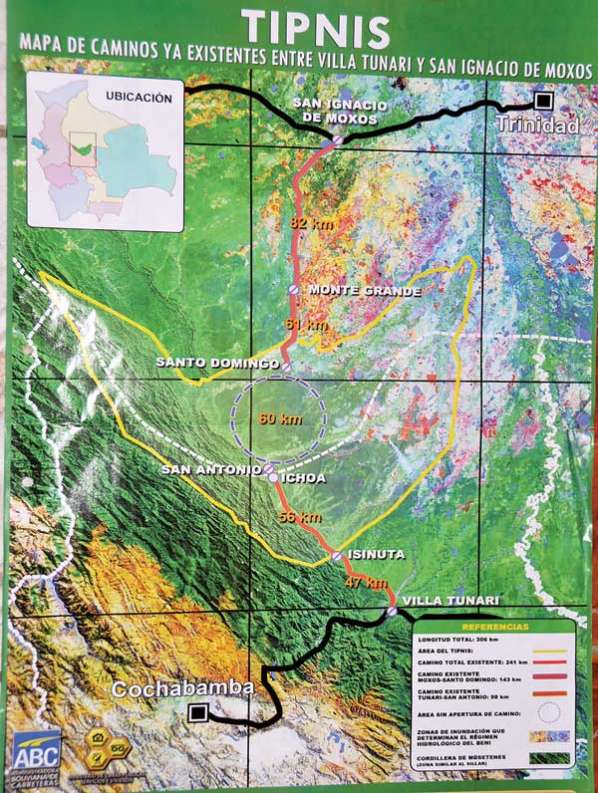
Map of Cochabamba-Beni highway and TIPNIS
A map from the Bolivian Highway Administration illustrating the road project from Villa Tunari to San Ignacio de Moxos. The boundaries of TIPNIS appear in yellow. Segment I ends at Insinuta, while Segment III begins at Montegrande.

The Bolivian Highway Administration (ABC) claims to be working within the mandate of Law 180 protecting TIPNIS, but has doesn’t seem to have worked out that the current route of Segments I and III essentially require a cross-TIPNIS connection. ABC official, however, have deferred the issue to Cochabamba Governor Edmundo Novillo (of the ruling MAS party) and the highway booster committee.

Engineers: Alternatives Exist

Meanwhile, the Beni Inter-Institutional Committee and the Cochabamba Association of Emeritus Engineers have worked out alternate routes. The Cochabamban engineers proposed 270- to 300-km routes east of the park or a 749-km route northwest of Cochabamba to Trinidad in Beni. They estimate a cost savings over the current project, but realizing that cost savings requires stopping construction. The Beni group came up with an additional route passing immediately west of TIPNIS.

Political conflict continues

Despite the existence of alternatives, the debate over the future of the highway continues to be a political one. The national government, the MAS party in Cochabamba, and a quasi-independent organization of indigenous in the colonized zone of TIPNIS called Conisur continue to be the heart of the pro-road effort. President Evo Morales and Vice President Álvaro García Linera continue to vocally advocate for construction on the original route. The Bolivian government is pursuing parallel, but opposed tracks on the issue: authorizing regulations protecting the park on one hand and organizing a civil society campaign to overturn these decisions.

Some members of the Villa Tunari–San Ignacio de Mojos Highway Booster Committee, however, have expressed flexibility on the route. And several prominent Bolivian grassroots forces have distanced themselves from the campaign for the road, notably the national colonizer federation (the Union Federation of Intercultural Communities of Bolivia) and peasant union founder Genaro Flores.

This week, the Pact of Unity split deepened into two separate meetings on Bolivia’s future agenda. The 1st Plurinational Forum to Deepen the Change met at Cochabamba’s Casa Campestre while CIDOB and CONAMAQ organized their own summit in Santa Cruz. Despite the best efforts of the road-through-TIPNIS campaigners, it seems that the issue will be left for regional Sub-forums to Deepen the Change. The indigenous gathering has reaffirmed defense of territorial rights, including a highway-free TIPNIS as the top of its agenda.

A divided Pact of Unity lashes out on TIPNIS, continues to press its agenda

A truncated version of Bolivia’s most prominent grassroots alliance, the Pact of Unity (wikipedia background), met last week in Sucre. The indigenous-campesino Pact has had various versions but generally (since 2006) consists of five nationwide organizations: the campesino federation CSUTCB, the campesino women’s federation known as the Bartolina Sisas, the agrarian colonist federation CSCIB, the lowland indigenous CIDOB, and the highland indigenous traditionalists in CONAMAQ.

Since the divide over the August–October CIDOB-CONAMAQ march in defense of Isiboro Sécure, however, disunity has prevailed. The November 17 to 19 meeting, which hosted President Evo Morales, had just three national participants, the three campesino organizations (or “the triplets”) while CIDOB and CONAMAQ stayed away. (Some Moxeños and representatives of Conisur, an organization of indigenous residents in the colonized area of TIPNIS attended.)

Early reports show no signs of rapprochement on the the TIPNIS issue from the Pact; instead they took an even harder line than the Morales administration by supporting the highway and urging indictments against a human rights activist who repeated the widespread (but unsubstantiated) reports of deaths during the September 25 raid on CIDOB’s march. However, the Pact of Unity continues to have its own agenda independent of the government it supports, and the multifaceted  demands emerging from this week’s gathering serve to illustrate that fact.

Signature Agenda: The Pact of Unity is responsible for major legislation re-envisioning agriculture and environmental policy. These initiatives remain in their early stages. The Law on the Rights of Mother Earth (wikipedia), a general environmental law has become world famous, but its full, operative version has yet to pass the Plurinational Legislative Assembly. On the other hand, the Law of the Productive, Communitarian, and Agricultural Revolution, a plan for massive investment in the agrarian sector, passed in July, but major implementation challenges are ahead.

On both fronts, the Pact has been a combative force and at times a harsh critic of government. With the presence of CIDOB and CONAMAQ, the June meeting of the Pact critiqued “resistances to change, deviations and political errors” within the government, manifesting in “a nationalist bloc within the government that does not want give up the Nation-State, and does not want to build the  communitarian and autonomy-based Plurinational State.” That same meeting placed the Mother Earth and Productive Revolution laws as the foundation for rewriting of Bolivian policy around all types of interaction with the environment, including new laws on consultation, mining, forestry, water, and food sovereignty.

Social control over the state: In the Pact’s June 2011 vision, social movement organizations, indigenous nations, and grassroots communities must watch over the process of change. This week they agreed to form a Supreme Mixed [that is, multi-organization] Council on Monitoring and Social Control to watch over and meet with government Ministers on a monthly basis. This represents the most institutionalized high-level step so far proposed for social movement involvement with governance, although it is unclear whether Morales will accept it. Previously, Morales traditionally held annual (and sometimes quarterly) meetings between Ministers and allied social movements, but broke the tradition before the 2010 gasolinazo.

Critique of Ministers: The La Paz delegation pressed a call for ministerial resignations. In the past the La Paz campesino federation has singled out a few ministers, notably Nemesia Achacolla, for such requests. This time, their delegation called on the entire cabinet to resign. The Pact as a whole kept this to a vague statement referring to ministers “not working for the process of change.”

Gasolinazo: Eleven months after the MAS government’s politically disastrous abandonment of fuel subsidies (quickly reversed by protests), the Pact remain unable to reach consensus on the issue. For now, however, they’re asking the administration to hold off on any new price hikes until the economy approves. Morales acquiesced, while declaring subsidies “a cancer for the country’s economy” which one day the public will ask him to eliminate. No one should hold their breath.

TIPNIS: The Pact embraced a finger-pointing strategy consistent that the movement in defense of the park  and indigenous territory is an attack on the grassroots “process of change” underway in Bolivia. Accordingly, they called for lawsuits against the media; prominent activists (Alejandro Almaraz, Lino Villca, Rafael Quispe were named); and the president of the Permanent Assembly of Human Rights. The three activists were blamed for “instigating violence and confrontation among social movements.” Without naming names, the Pact also resolved to expel “all the traitors to the process of change without regard to office or hierarchical rank.” They also now support building the Villa Tunari – San Ignacio de Moxos highway, and the northern highway from La Paz to Pando.

In short, while the TIPNIS issue continues to be divisive, the peasant wing of the Pact of Unity are far from pro-government yes men (and yes women) on other issues. The common agenda they share with their absent counterparts continues to occupy their time and may lead to friction with the Morales government. The future of an alternative development model based on Vivir Bien, long demanded by the Pact of Unity and long promised by Evo Morales, remains undecided. The Pact’s legislative agenda, and tangible actions on extraction projects will be decisive on these issues.