Pablo Solón Romero was the most important face of the Plurinational State’s environmental and human rights diplomacy from 2006 to 2011. Last week, he became the latest critic of that same government to suddenly face criminal charges. On Friday, June 30, authorities delivered Solón a subpoena in a case against him and journalist Rafael Archondo. The pair had been designated Bolivia’s permanent and alternate representative to the United Nations. Now, they each face two charges of corruption for Archondo’s succession to the role after Solón resigned. The government alleges that Solón’s letter presenting Archondo to the United Nations constituted an unlawful usurpation of the President’s power to designate ambassadors.
For Solón, the investigation is an act of retribution.
In a statement released Monday, he declared:
The news wasn’t a surprise. Due to our critical analysis of the El Bala and El Chepete hydroelectric megadams, various friends had warned me that they would search underneath the stones to find something to accuse me of, to intimidate me, and to make me shut up. […]
I won’t refer at this time to the supposed crimes that we are accused of, since I will refute every one of them in a formal and public manner when I go to declare before the Prosecutor’s Office.
What I can say is that we will continue to think and we will continue to speak. Wherever we find ourselves, we will not renounce our ability to criticize and to state our opinion. It is most lamentable that rather than refute us with arguments, they seek to frighten us with this kind of accusations.
La noticia no fue una sorpresa. A raíz de nuestro análisis crítico de las mega hidroeléctricas de El Bala y el Chepete, varios amigos y amigas me habían advertido que buscarían debajo las piedras para acusarme de algo, intimidarme y hacerme callar.
…
En esta oportunidad no me referiré a los supuestos delitos de los cuáles se nos acusa ya que de manera formal y pública refutaré cada uno de ellos el día que vaya a declarar a la fiscalía.
Lo que si puedo decir es que seguiremos pensando y seguiremos hablando. Donde quiera que nos encontremos no renunciaremos a nuestra capacidad de criticar y decir lo que opinamos. Es muy lamentable que en vez de refutarnos con argumentos busquen amedrentarnos a través de este tipo de acusaciones.
Pablo Solón speaking in March 2017
Pablo Solón, a Bolivian with a long history of radical and progressive activism, served first as its ambassador to UNASUR and later to the United Nations (Wikipedia biography|2010 Democracy Nowinterview). When the Bolivian government attacked the 2011 indigenous march in defense of the Isiboro Sécure National Park and Indigenous Territory (TIPNIS), Solón was one of several government officials to speak out, urging President Evo Morales to reconsider the proposed highway through the territory, a position he amplified once he stepped out of public service in 2012. After several years at the head of Focus on the Global South, Solón returned to working on Bolivian environmental issues at the La Paz-based Solón Foundation. Now, he has put his expertise to use challenging the government’s drive to build massive energy infrastructure projects in the Bolivian Amazon.
A year has passed since Bolivian voters denied President Evo Morales a chance at re-election in the February 21, 2016, referendum. The vote marked the first national defeat for Morales’ Movement Towards Socialism (MAS) party in a decade (although local election results have been mixed before). Prior to that vote, critics of the government from the left (on indigenous rights, unkept development promises, corruption, or the centralization of power) had ultimately aligned against the conservative elite. But by holding a referendum that could curtail Morales’ power without replacing him entirely, the MAS generated a de facto alliance between its left and right opponents. (A similar phenomenon contributed to the unprecedented number of blank and spoiled ballots in the 2011 Judicial Elections.)
Despite the 51.3%–48.7% defeat, the MAS has plunged ahead with a national effort to re-elect Morales, offering four strategies to legalize him running for a fourth term:
Convene a constitutional referendum by collecting signatures through citizen initiative.
Re-convene a constitutional referendum through the Plurinational Legislative Assembly
Seek a judgement from the Plurinational Constitutional Tribunal declaring that the president’s term limit is an unconstitutional violation of the public’s right to freely choose their leader.
Have Morales resign six months before the 2019 election to make himself eligible to run again.
Unsurprisingly, these proposals have not gone over well with either left critics or right-wing opponents of the government. With the February 21 referendum as a rallying symbol, organizations in both milieux as well as voters on social media have organized mobilizations “in defense of the vote.” You can get a sense of the tenor of these calls here:
Independent left ‘Bolivia Voted No’ image demands: Respect the citizens’ vote.
A coalition of left grassroots signatories, including the movements behind the TIPNIS campaign, Potosí regional strikes, Guaraní protests at Takova Mora, and many other organizations put forward this document: Let’s remember why we voted no!
On February 21, mass meetings called cabildos have been called for major plazas in departmental capitals across the country.
Conversely, the government and its close movement allies have been preparing their own counter-mobilizations to occur on the same day (or the previous night).
In Cochabamba, the MAS is promising to mobilize “45,000 coca growers, 20,000 transit drivers, 500 rural teachers, and thousands of campesinos” onto the central plaza.
Pro-MAS image asks “What happened on February 21? A series of media attacks against Evo Morales.”
These mobilizations will have the slogan, February 21: Day of the Lie. This lie is mainly the false claim by President Morales’ young ex-lover Gabriela Zapata that she and the president had a son together, and (after the referendum) her procuring of a five-year-old boy to claim he was the president’s daughter. The scandal combined sex, paternity, and the whiff of trafficking in government influence: Zapata became the legal representative of Chinese corporation CAMC in Bolivia despite her youth and lack of qualifications. Zapata has been imprisoned since early last year, held on a rotating set of charges including influence peddling, kidnapping (of the presumed child), and fraud. Since their unexpected defeat, the MAS has focused attention on the story, which broke in early February 2016, as the factor that swung voters against them. On Sunday night, February 19, 2017, in a broadcast interview from jail, Zapata put forward the improbable claim that MAS political operative Wálter Chávez and long-time center-right opponent Samuel Doría Medina had invented the story of the child in 2005 to be deployed against Morales at some future date. (Former MAS official Amanda Dávila, Wálter Chávez, and Doría Medina have denied the claim.)
Bolivian politics has been marked by competing mobilizations in favor of and opposed to the government since at least 2004. Demonstrating a capacity to mobilize in large numbers is regarded as a marker of political legitimacy.
As previewed on this blog, Bolivians went to the polls on February 21 to decide on whether the 2009 Constitution should be amended to allow Evo Morales to run for a fourth term in 2020. There was strong participation, with 84.45% of registered voters going to the polls (a stronger showing than the 2015 regional election, but below the turnout in the last national vote). The result was a narrow but convincing defeat for Morales and the MAS party: 51.30% of voters rejected the constitutional change. (Final results)
Here are five quick things to take away from this result.
This vote on Evo Morales getting a fourth term wasn’t to some extent a referendum on Evo Morales, but it was not a referendum on leftism, indigeneity, or standing up to neoliberalism. Evo’s personal image took a major hit with the revelation of his affair with Gabriela Zapata, a young law student in 2006 and 2007 who later became a well-paid representative of CAMC, a major government contractor. This scandalous revelation brought a whiff of corruption to the president in the final week of campaigning. Meanwhile, a deadly arson apparently set by pro-government protesters in the El Alto city hall undermined the standing of the governing Movement Towards Socialism party.
Despite these winds, public perception of Evo Morales remained fairly positive. Polls showed his approval at 58%, far ahead of the support level for term extension. So, a significant fraction of the public supports him in his third term, but refuses to grant him a fourth. A narrative, transplanted from Venezuela, of collapsing support for a leftist goverment simply does not apply to the Bolivian referendum.
The NO campaign on the referendum united left and indigenous critics of the government, advocates of rotating leadership, and right-wing opposition. This kind of tacit alliance has never fully coalesced before, although it appeared to some extent in the successful, if ineffectual, calls for blank or null ballots in the 2012 judicial elections. It also is highly unlikely for these forces to come together again in national elections. Nonetheless, the referendum did prompt a number of left dissidents to step forward as possible participants in 2019 elections. It remains to be seen which of their political projects will endure, win ballot access, and compete in that contest.
The MAS and the YES campaign have lost Potosí. While all four of the western capital cities—La Paz, Oruro, Cochabamba, and Potosí —voted agaist the referendum, the poor and left-identified city of Potosí did so overwhelmingly. Over 85% of Potosinos refused to back another term for Morales. The department was once a MAS stronghold and has no significant right-wing presence, but its capital has spearheaded major protest campaigns in 2010 and 2015 demanding greater investment and new jobs. Serious disenchantment with the national government has set in.
The MAS has a major challenge in candidate selection for 2019. It simply hasn’t been cultivating middle-level leaders to become national figures. There are certainly high-level party loyalists, like Silvia Lazarte, and a few long-time cabinet members, including David Choquehuanca, but no obvious successor to Evo. Meanwhile, numerous prominent MAS members of the past have gone from rising stars, to despised free thinkers (libre pensantes), to ex-members of the party. Still, Bolivia’s presidential runoff system and demographic composition makes it very difficult for a right-wing or anti-indigenous candidate to win. The interesting question is whether a left outsider could make it into that second round.
“It’s not possible for so much time to be lost in the so-called consultations, that is the great weakness of our State, [our] people, and now obviously we will modify some of the rules with the sole objective of accelerating investment and obtaining more natural resources and that will benefit the Bolivian people.”
The Bolivian government of Evo Morales is enthusiastically celebrating two new finds of petroleum and gas this month, at the Boquerón-Norte well in the east and in the Lliquimuni block in the Bolivian Amazon. These findings come just as new presidential decrees have opened parks and environmentally protected areas to oil and gas drilling. You can get a flavor of the government’s excitement by seeing some of its image production around these finds.
First is this wordless video produced by Petroandina (the Bolivian-Venezuelan consortium of state-run oil companies) celebrating the construction of the test well LQC-X1, which began operation last December. Preliminary results presented this week place this block as the place where large-scale oil drilling could come to the northern Bolivian Amazon. The soundtrack befits a cinematic drama, and the intent is clearly to make drilling for oil into a national heroic endeavor.Read More »
Bolivian President Evo Morales has renewed his efforts to build a controversial highway through the heart of the Isiboro Sécure National Park and Indigenous Territory (TIPNIS), a forested park that is home to over 12,000 indigenous people. The central segment of the highway would bisect the territory and accelerate already high rates of deforestation. Protests spearheaded by the Confederation of Indigenous Peoples of Bolivia (CIDOB) in 2011 and 2012 postponed its construction, while funding by the Brazilian Development Bank (BNDES) was withdrawn. The Bolivian government had previously said it would tackle extreme poverty in the territory before mounting any new effort to build the highway.
On June 4, however, President Morales told an audience in his home base of Villa Tunari, Cochabamba, that the project “will be realized.” His remarks followed on earlier statements leading up to the April regional elections and a May runoff that put the highway back on the official agenda. Now, with an overwhelming victory for Morales’ MAS party in Cochabamba and a very narrow win in the Beni runoff, the national government seems committed to restarting the project. In the president’s words,
On the subject of integration, good voices come from the new governors of Beni [Alex Ferrier] and Cochabamba [Iván Canelas]. The Villa Tunari – San Ignacio de Moxos, comrades, will be realized.Read More »
First of all we would like to emphasize that those who sign this letter consider themselves to be friends of the Bolivian people. We applaud what your government has done over the years for the welfare of the people of Bolivia, for the recovery of control over your natural resources as well as for social justice and the redistribution of wealth. We also support the strong stance you and your government have taken on the protection of the environment, with the institution of the Day of Mother Earth and the acts against the exploitation of food resources for purposes other than the nourishment of the people. Moreover, we have been fighting for years, in our countries and internationally, against military and civilian nuclear energy.
In this light, as friends, we have been surprised by the announcement of your government’s plans to start the process of building a nuclear plant in Bolivia.
We believe this to be a move in the wrong direction and we wish to explain why in the following few points. We also hope that this debate can be continued with the participation of the entire Bolivian society. We therefore welcome positions different from ours and are always available to participate in an open discussion with further contributions.
1) That for nuclear energy is a choice without return, and no visible end! No one knows precisely what it costs to dismantle a nuclear power plant, but it is likely to be comparable to the cost of constructing one; no durable solution for the disposal of radioactive wastes has yet been found. These wastes constitute a heavy legacy that is expensive to store and remains deadly for thousands of years.
While facing an election next year, Bolivian President Evo Morales is thinking about his legacy. As the strong front-runner in national politics, his governing party, the Movement Towards Socialism—Political Instrument for the Sovereignty of the Peoples, feels confident it will be in power for a long time to come. This self-confidence is driving the drafting of a 2025 Patriotic Agenda. Alongside the formal process, the president has spoken off the cuff of his desires for the future. And like any dreams, they provide an insight into the mind and orientation of the dreamer. In his oratory, Morales long seemed to equally embrace two visions: sovereignty through claiming natural resources for the nation and reorientation of society towards ecological harmony with Mother Earth. Now, however, he has discarded the Pachamama-centered rethinking of exploitation and dreams of technologies long criticized for their environmental destructiveness.
At the end of October, Morales declared nuclear power to be a long-term goal of the Bolivian state. Speaking at a government-organized summit called Hydrocarbon Sovereignty by 2025, he revealed that he had asked the governments of Argentina and France for assistance in launching a Bolivian nuclear power program. “We are going to advance, dear students,* we are not far off, we have the raw materials. It is a political decision that has to be made. [Vamos a avanzar queridos estudiantes, no estamos lejos, tenemos materia prima (el óxido de uranio es la principal materia prima utilizada en los procesos radioactivos), es una decisión política que hay que tomar.]” Soon after, he called it a dream: “Bolivia has all the conditions to exploit this form of energy, there are raw materials and studies, and I want you to know that alongside our brother Vice President, I am already dreaming of having atomic energy, and we are not so far from it. [Bolivia tiene todas las condiciones para explotar esa energía, hay materia prima, hay estudios y quiero que sepan que con nuestro hermano vicepresidente ya soñamos contar con energía nuclear atómica y no estamos tan lejos.]” (El País) By the middle of November, Morales had convened thirty scientists to sketch out a Nuclear Energy Commission.Read More »
Honor Brabazon and Jeffery Webber have just released a new research article on the state of agrarian reform in Bolivia under the government of Evo Morales. The paper, available as a pre-print from the Journal of Agrarian Change, offers a disconcerting look at the state of land redistribution six years after Morales signed a law promising community-led “redirection of the Agrarian Revolution.” The paper is compelling because it puts the experiences and views of the Bolivian Landless Peasants’ Movement (MST; the same initials as its better-known Brazilian counterpart) alongside hard data on the redistribution of land produced by the La Paz-based research unit Centro de Estudios para el Desarollo Laboral y Agrario (CEDLA).
I’ve previously covered the most dramatic shift in Bolivian land tenure on this blog, the dramatic reordering of large swaths of land into “Native Community Lands,” (TCOs) collectively controlled indigenous territories throughout the country that now constitute nearly a fifth of the country. The same process of clarification of land title was promised to yield a revolution in the prospects of landless and near-landless peasants. The data presented and translated by Brabazon and Webber shows that promise was not to be.
The story of land reform in Bolivia has long been a regional one. The sweeping 1953 Land Reform Decree was the product of rural uprisings across the Altiplano and the central Valleys which left the vast eastern lowlands essentially untouched. There, a relatively small number of landowners built vast export-oriented monocultural plantations over the next five decades. Both the predominantly lowland MST and Evo Morales spoke of these large holdings as ”latifundio,” oversized properties that deserve to be redistributed for the common good. However, land reform requires one of two causes to take away land from its owner. Either the field is used for illegal labor exploitation, or it is failing to fulfill its “economic and social function.” The latter term essentially applies to fields left in disuse for long periods. As it turned out, neither cause applies to the agribusinesses of the east:
the types and delimitations of latifundio designated for expropriation by the MAS government through the LRCRA and official policy documents are not those that predominate in the structure of the Bolivian agrarian economy; therefore, the large capitalist landowners who obtain rent from the land, along with the agrarian capitalist enterprises that obtain their profits through the exploitation of their salaried workforce, have not and will not be affected by the ‘agrarian revolution’. (19)
A small number of farms have been expropriated ”due to the presence of bonded labour, semi-slavery, slavery or other illegal labour practices,” but just 54,734 hectares. Another 855,823 hectares owned by medium- and large-propertyholders were incorporated into TCOs. But when the government speaks of “land redistribution,” it pulls out far larger numbers. As Brabazon and Webber point out, “the overwhelming bulk of these redistributed lands were transfers from various forms of state-owned lands (tierras fiscales) to TCOs” or even the re-categorization from one form of collective ownership to another. Meanwhile, “one-third of the [national] territory will remain in the hands of the medium and large agro-industrial firms.”
Brabazon and Webber provide a sobering conclusion: “The same social class that ruled over agricultural production in 2005 continues to rule today in 2012” (21).
In honor of #NewResearchThursday / #NRTh, one attempt to increase the content to signal ratio on social media.
The United States Air Force has a drone base in Niger from which it flied unmanned aircraft into Mali to provide military intelligence for the French military involved in Mali’s civil war. The United States State Department orchestrated the denial of European countries’ airspace to the presidential plane of Evo Morales on July 2.
These are now former secrets, documented in the mainstream press of the United States. Neither lasted very long. Surely the Malian rebels saw drones flying above them and guessed the US military was taking sides against them. And even more surely, Evo Morales knew that the US was behind his plane’s emergency diversion to Vienna. Yet these acts were classified; the US role in blocking the Bolivian presidential plane was publicly denied. What can we learn about United States state secrecy from them?
This is a time of highly controversial disclosures of government secrets. It’s also a time of unprecedented classification of government documents as secret: a US government audit found 3,507,782 people hold security clearance to access Confidential/Secret documents, and 1,409,969 hold Top Secret security clearances as of October 2012. In Fiscal Year 2012, the US government classified 95,180,243 documents, declaring 23 million of them top secret (ISOO annual report). The government spends $8 to $12 billion per year on keeping these documents secret.
Within this mountain of so-called secrets live millions of banal pieces of data: personnel files of agency employees, details of weapons systems, operational details of military deployments. While it’s reasonable to debate how much of this material truly needs to be secured in this way, that’s not the material people are willing to risk their freedom to bring to the world. Instead, the real state secrets are government actions that are carried out covertly. Recently whistleblowers have shown us that the military kept records of killed civilians in the Iraq War, that the US illegally spies on diplomats at the United Nations, that the United Kingdom violated the Land Mine Ban treaty, that the US could document massive government corruption in Tunisia (helping to spark revolt there) and that the NSA spied on the electronic communication of people around the world [some of these revelations are described here]. Every day, diligent work by journalists exposes other secrets to the people whose governments try to keep them.
The drone base in Niger is an example of quasi-secrecy. About 100 Air Force troops deployed in February and set up a base. On February 22, the Washington Post described the operation, which was mentioned in a vaguely worded letter to Congress under the War Powers Act. While the paper reported on the troops, their mission and even the type of drones used, it had to resort to anonymous sources to provide these details. It also noted “Obama did not explicitly reveal the drone base in his letter to Congress.” The President of Niger has been more forthcoming, providing the basis for further reporting in March. Even in February, the Malian rebels targeted by these aircraft were already well aware of the US aircraft, “The Associated Press reported finding an al-Qaeda document in Timbuktu, Mali, that listed 22 tips for avoiding drones.”
The only ones left in the dark by this policy of secrecy are the people of the United States. When the press asks questions about drones, US officials try to avoid the word, and give pseudo-answers like this one: “What the President indicated is we’re going to continue to provide the support that we’ve been investing in this operation. And what we’ve provided is, for instance, logistical support and other types of backing for those nations that are putting peacekeepers into Mali” (Deputy National Security Advisor for Strategic Communications Ben Rhodes, June 27). For four years, the Obama administration directed its press secretary to talk like this: “When I went through the process of becoming press secretary, one of the first things they told me was, ‘You’re not even to acknowledge the drone program. You’re not even to discuss that it exists'” (Robert Gibbs). In effect, the United States is supplying targeting information for a war in Mali, and actually killing people in half a dozen other countries, but refusing to talk about it.
The case of the Morales plane diversion went beyond secrecy to lies. Days before the operation, President Obama responded to a question explicitly raising this possibility: “Mr. President, will you use U.S. military assets to in any way intercept Mr. Snowden should he at some point in the future leave Russia to try to find safe passage in another country?” The President’s answer was unequivocal: “No, I’m not going to be scrambling jets to get a 29-year-old hacker” (transcript). On July 2, Bolivian President Evo Morales’ plane was denied entry into French, Spanish, and Italian airspace and its landing to refuel in Portugal was cancelled. As reflected by the emergency gathering of the Union of South American Nations in response, this was a major violation of diplomatic protocol. It rapidly became clear that the diversion was the use of state power (backed by the possibility of force—i.e., the scrambling of jets) in an attempt to intercept Mr. Snowden.
From the beginning, the Bolivian government identified the United States as the evident cause of the incident. With Morales still on the ground in the Vienna airport, Defense Minister Ruben Saavedra stated:
“This was orchestrated, rigged, by the US Department of State which has provoked this situation utilizing certain European countries, under the suspicion that Mr. Snowden was onboard the presidential plane.”
“Esto fue orquestado, amañado por el departamento de Estado de Estados Unidos, que utilizando algunos países europeos ha provocado esta situación, con la sospecha de que en el avión presidencial estuviera el señor Snowden.” (EFE, 2 July)
This narrative is not only the most plausible one, it is backed up by Austrian press reports that the country’s Foreign Office received a late-night call from US Ambassador Ambassador William Eacho alerting them to Snowden’s presence on President Morales’ plane. It is also suggested by the Spanish Foreign Minister José Manuel García-Margallo’s statement that “They told us that [Snowden] was onboard,” and further describing the source of the communication as a diplomatic secret.
Meanwhile, the US State Department was busy issuing a cascade of non-statements.
July 3: At the State Department, a spokeswoman, Jennifer Psaki, declined to say whether American authorities had asked other countries to deny airspace to the Bolivian plane. “I would point you to them to describe why they made decisions if they made decisions,” Ms. Psaki told reporters. (NYTimes)
July 8: Journalist: And just to follow up, does – is there any more information on where the original information or the leak came from that Snowden was on that plane? Does the U.S. have any more idea –MS. PSAKI: I don’t have anything for you on that, no. (State Department briefing)
July 9:QUESTION: Earlier today at the OAS, a French diplomat – a very young French diplomat, I might say —
MS. PSAKI: Mm-hmm.
QUESTION: — said that the French Government had, in fact, revoked permission for President Morales’ plane to go, but he said that it was a technical error based on a misunderstanding. Do you and the United States have any idea what that technical error – that technical reason that was based on a misunderstanding or an incorrect assumption might have been?
In an interview with Spanish-language CNN, Congresswoman Ileana Ros-Lehtinen* (R-FL) was more direct in admitting US responsibility:
And so, for us, there was a great concern that these countries could give him sanctuary. Therefore, the United States sent that quite severe, quite direct message to—this time it was to Evo Morales, it could have been to other people. We are saying to all countries in a very open manner that this man [has] felonies against him. That he should come to the United States if he is a man of honor…
Así que para nosotros, este gran preocupación que estos países le pudieran dar santuario. Por eso los Estados Unidos envió esa mensaje bien duro, bien directo a … en esta vez fue a Evo Morales, hubiera sido a otras personas. Le estamos diciendo a todos los países de una manera bien abiertamente que este señor [tiene] felonías americanas en su contra. Que venga a los Estados Unidos si es un hombre de valor… (CNN Video posted by Ros-Lehtinen’s office [at 7:30])
So, Bolivia knew of US involvement. Other countries knew of US involvement. A senior legislator claims that the act was designed to send a message of the position of the US government. But the US government formally claims to have no idea how this action happened. The only possible target for these denials is the US public. We are meant to pretend that our government was not involved in this international incident, that such involvement is a product of Evo Morales’ paranoia rather than an obvious and widely discussed pattern of US behavior. (And so, the New York Times will continue to publish sentences full of hypotheticals like this one: “Latin American leaders condemn refusal to let plane carrying Bolivia’s Pres Evo Morales fly over European nations because of what Bolivian officials say were suspicions that Edward J Snowden was on board.”) Given the standards of American journalism, we—and we alone—will have to wait for an actual leaked document from the State Department before our press takes seriously what the rest of the world confidently knows.
Like these two examples, many state secrets are not about protecting complex operations or securing the lives of operatives. They are about keeping the public out of decisionmaking. They are about reducing accountability. They are about subverting democracy. Alongside making a mockery of such basic principles, they make dangerous, unpopular, and/or immoral behavior by government officials easier.
Fortunately, part of that dynamic is beginning to weaken.
Government without Secrecy
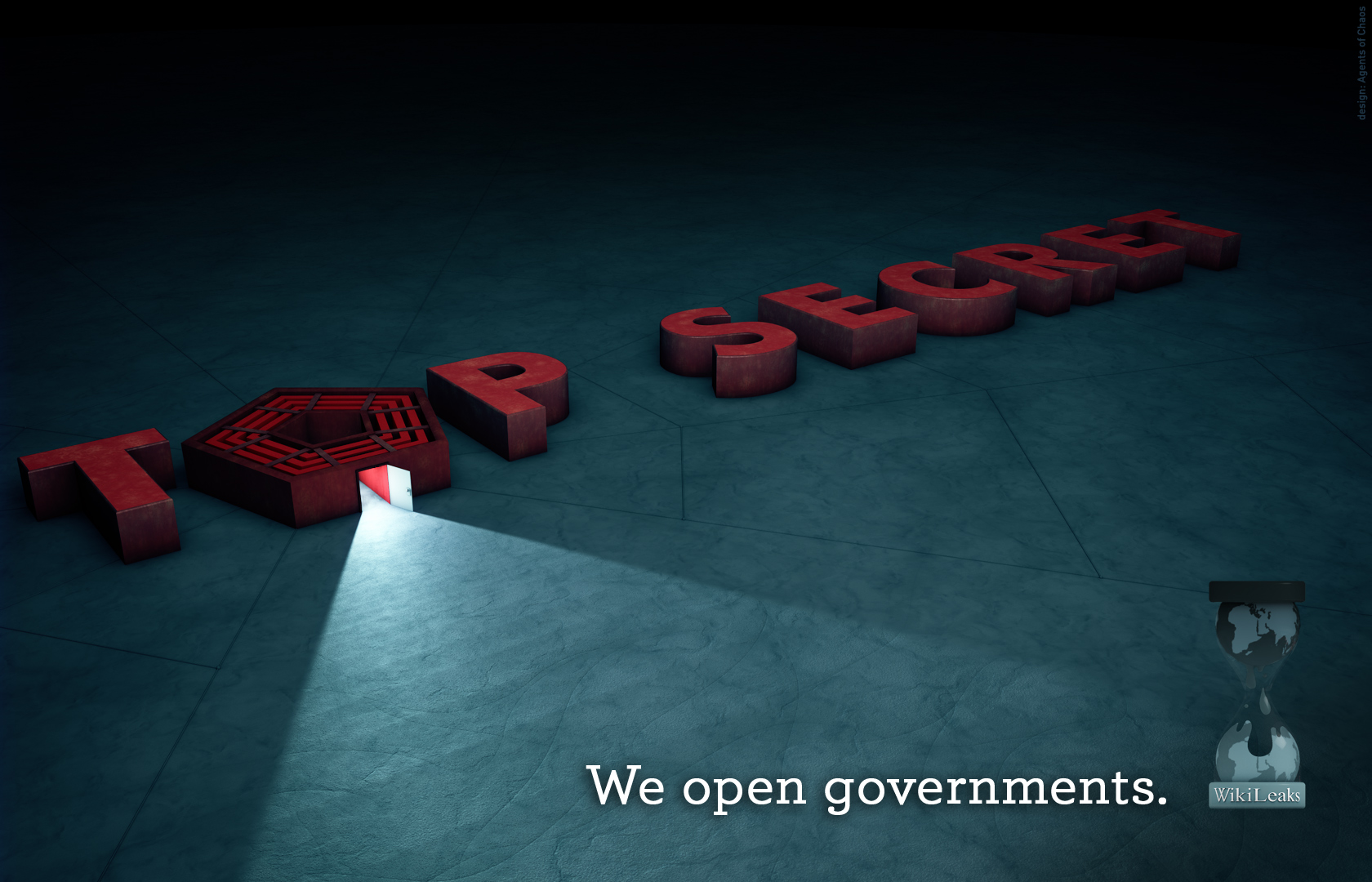
“We Open Governments”
The publication of logs of the Iraq War and diplomatic cables by Wikileaks has raised the prospect of the US government being denied the prerogative of secret wars, secret foreign policies, secret decisions, and secret outcomes. The Snowden disclosures and the avalanche of additional investigative reporting that has followed in their wake have done the same for the surveillance state. (It’s worth noting that every single one of these disclosures have exposed wars, policies and outcomes, rather than the operational security that enables them to be carried out.) Snowden, Bradley Manning, Thomas Drake, and William Binney are all examples of government officials who allowed their conscience to override the classification of information.
In a discussion on Talking Points Memo, a reader (“MB”) suggests that these disclosures are just the beginning of a tidal wave. MB points to a post-Cold War generational value shift “toward a greater emphasis on issues that assumed global cooperation, such as environmentalism and humanitarianism, and … significant value on cross-cultural exchange.” Polling data backs this up: “Just 32% of Millennials believe the U.S. is the greatest country in the world” compared with 48 to 64 percent of older generations. On foreign policy, Millennials value listening to allies more, favor diplomacy over military force more strongly, believe that excessive military force causes more terrorism, and believe it is morally acceptable to refuse to fight in a war you don’t believe in—all by 2-to-1 margins. MB observes:
The national security apparatus is designed to defend itself against Cold War threats: agents who commit espionage in the service of a foreign power for ideological reasons, or for personal gain. It seems that it is not at all prepared to defend itself against espionage committed for personal, ethical reasons, done at one’s own detriment. It may not ever be possible to do so. On some level, this line of business requires that all those involved completely accept the utility and purpose of the mission, and accept that international relations are a zero-sum game. Otherwise, anyone could walk out of their office with a thumb drive and publish the contents online.
What does the world with thousands of thumb drives look like? (Other than a half-dozen presidents of Obama’s generation ordering international manhunts to track them down.) In evaluating the impact, value, and morality of these disclosures, our focus should be on the incentives created by transparency on war, foreign policy, and surveillance. How do diplomats, warriors, and spies change their behavior when they know their deeds will be exposed? (Especially when those disclosures are more likely when the acts are morally objectionable.) There are grounds for hope that “opened governments” will be more cautious and less destructive because they have more reason to fear public awareness of their actions.
* Ros-Lehtinen is former chair and a continuing member of House Committee on Foreign Affairs, and thereby has clearance to be briefed on this kind of diplomatic activity.





 Carwil without Borders