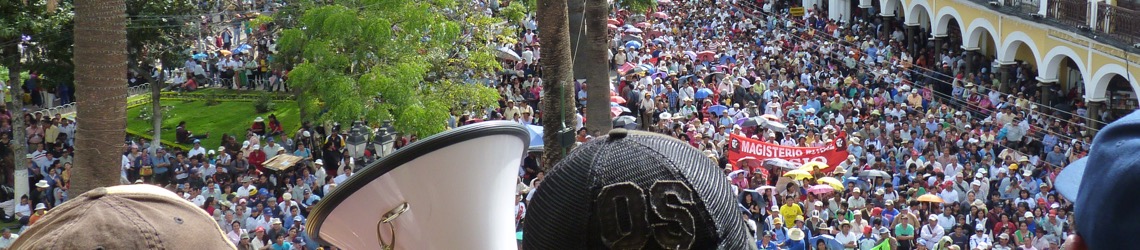
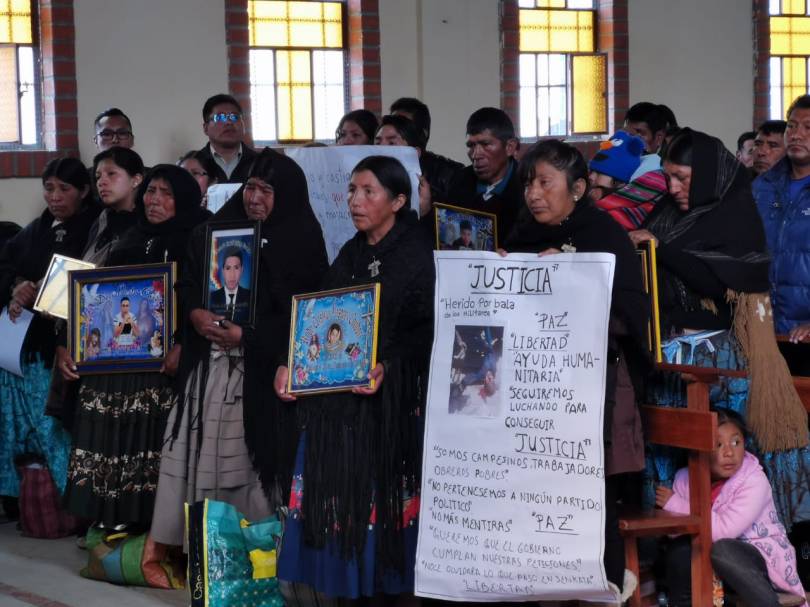
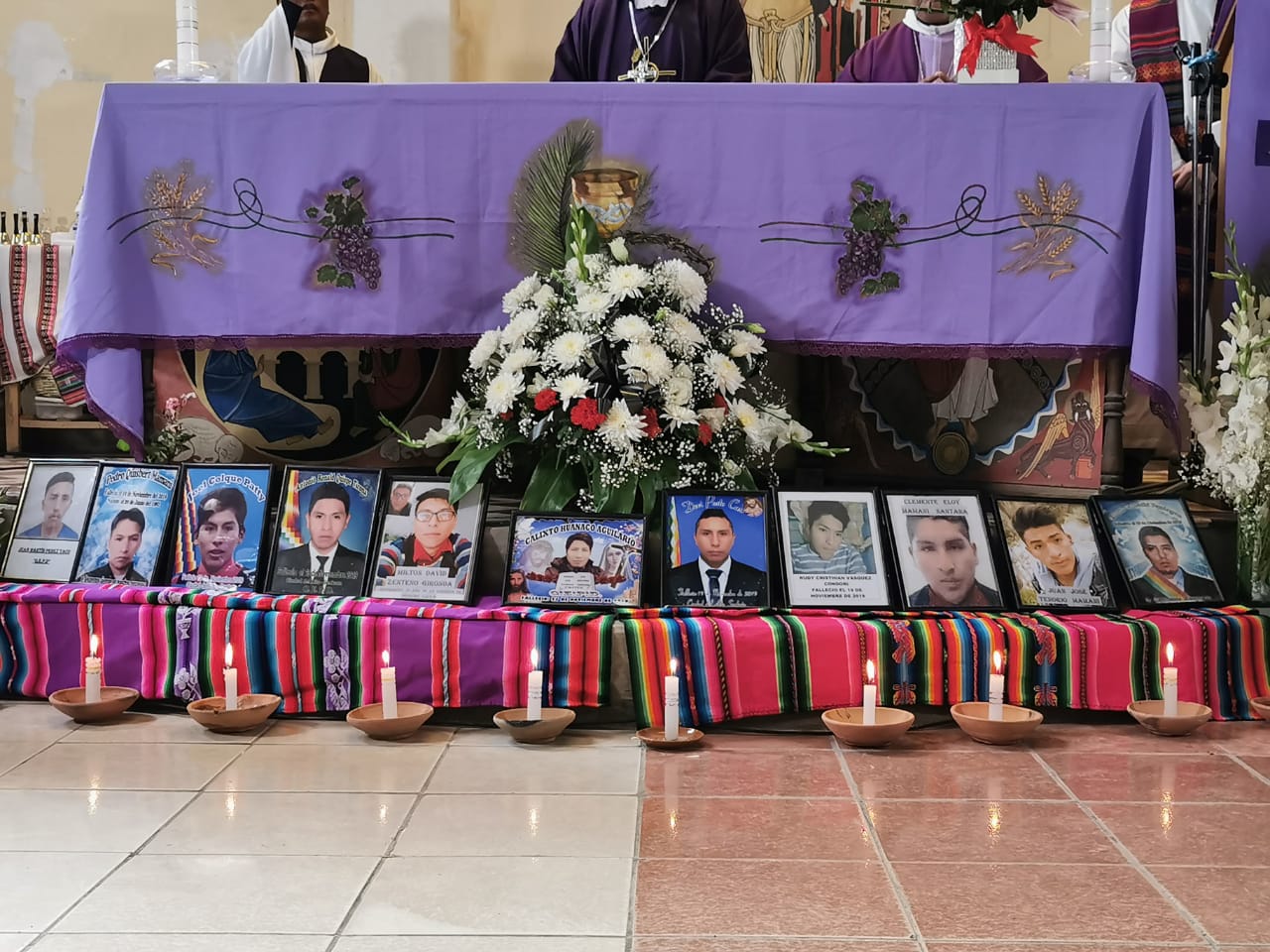
The Plurinational Legislative Assembly of Bolivia took its sessions to the largely indigenous city of El Alto yesterday in honor of the anniversary of the founding of Bolivia’s second most populous city. Relations between the city and the hard-right interim government of President Jeanine Áñez are still shadowed by the massacre of protesters and bystanders on November 19, 2019, shortly after she took power. (Prior coverage of the Senkata masscre.) During the anniversary procession, mourners marched with a black flag in remembrance of those killed.
A couple dozen Senkata residents, largely family members of those killed protested the lack of accountability for the Senkata massacre by attempting to block the Bolivian Senate’s special session in their part of El Alto. In response, the Bolivian police teargassed them, as the statement from the Defensoría del Pueblo below details. This was the second time that security forces have tear gassed the family members of Senkata massacre victims; the first time was in a politicized funeral march just days after the attack.
Meanwhile, news has broke of the death of an eleventh victim of state repression at Senkata. Emilio Fernández of Loayza province died of his wounds on Wednesday morning.
Statement from the Defensoría del Pueblo
The original statement was posted on the Defensoría website; my translation follows.
Today, [Bolivia’s] Human Rights Ombudsman Office condemns the indiscriminate use of force by agents of the Bolivian Police, who gassed the family members of the victims of the Senkata massacre, which occurred November of last year, and affected a hundred children in the [nearby] July 25 School.
The incidents occurred in the morning, when the Bolivian Senatae attempted to hold a session in the social headquarters of the July 25 neighborhood in the Senkata are of the city of El Alto, in honor of the the anniversary of the municipality. Then, some two dozen family members of last November’s massacre and neighbors of that zone posted themselves outside to call for “trial and punishment for those responsible” for the ten deaths in November.
The union office, inside which the legislators gathered, was surrounded by police troops, before whom the family members [of the Senkata massacre victims] displayed signs pleading for justice. “Justice and Punishment or those responsible for the Senkata massacre. Justice for Ruy Cristina Vásquez,” read one of the signs. Amid their cries, the family members approached the uniformed police to call out for justice for their dead.
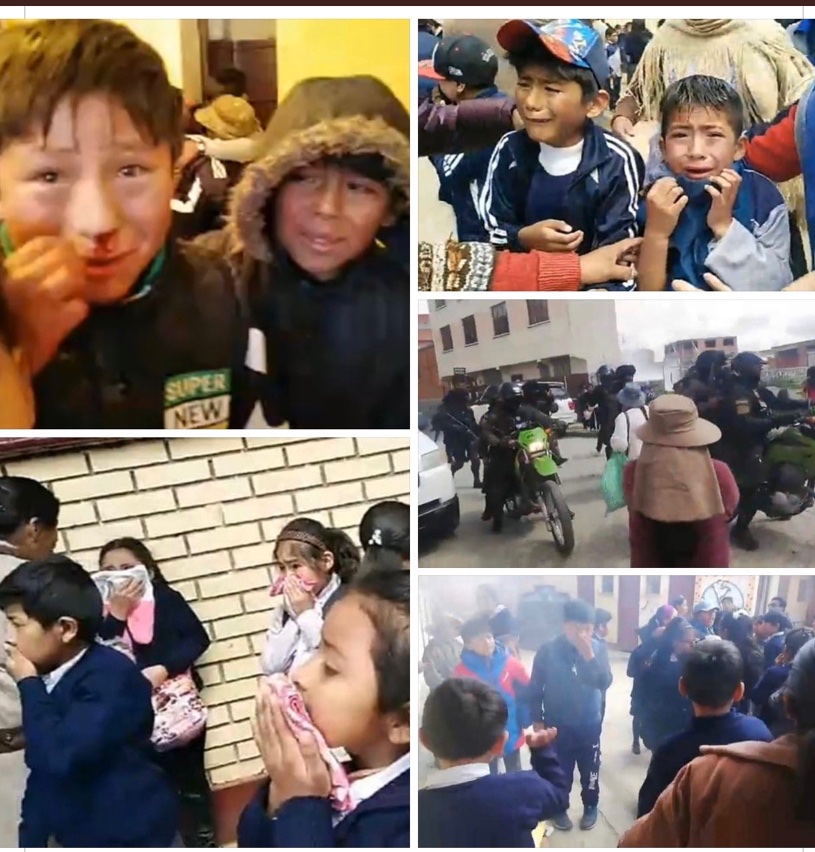
The response of the police was tear gas, which they launched upon the demonstrators and which reached the July 25 School, located across from the union headquarters. A hundred children were affected and had to be evacuated amid their cries and even bleeding, because it could be seen that one of them broke out bleeding from their nose. The docents of the school had to set a fire in the patio to dissipate the gas that had penetrated throughout the installation. According to the report from RTP, the troops launched the chemical agents to protect the evacuation of the senators, partisans of the government, who had decided to suspend their session.
The Human Rights Ombudsman Office condemns this indiscriminate use of force and reminds the Ministry of Government and the Bolivian Police that their actions must be within the framework of the [2009] Constitution and the national and international norms for the protection and guarantee of individual and collective rights.
Additionally, it noted that the Inter-American Commission for Human Rights (IACHR) has established that police operatives should have an operational plan that contemplates special attention and safeguard for children and adolescents, among other vulnerable groups. From the perspective of the Office, in this case the security forces did not act in accordance with this recommendation.
The Human Rights Ombudsman Office reiterates to political parties, citizen groups, political and social leaders, as well as to the government its exhortation to guarantee the peaceful carrying out of celebrations of the anniversary of the city of El Alto, as well as the current electoral process.


 This last issue is the subject of Choqueyapu: Un río enfermo que nos alimenta (Choqueyapu: A sick river that feeds us). Bolivian newspaper Página Siete has re-released one of its most important investigative pieces of 2017 in an online comic-book format. The narrative follows a drop of glacial meltwater as it travels past industrial sites, through the city center, and out to the vegetable and fruit-growing fields that lie downstream of the city. There, farmer Eugenia Mamani explains how her downstream community has adapted: “In the early morning the clean water comes” (because polluting industries and the slaughterhouse aren’t operating). “We irrigate from 3am onwards; during the day it comes in dirty and we no longer use it. We have to make sacrifices [to make] our products.”
 The high altitude of the Andes Mountains has allowed significant glaciers to exist for thousands of years, even in the warm Holocene epoch when human civilization flourished. As we enter the Anthropocene, however, industrial changes to the atmosphere are likely to clear nearly all permanent ice cover from the tropics of South America. Glaciers are now declining at 3%/year throughout the region (see graph, right from p. 57 of the World Bank report).
 Carwil without Borders