CMPCC: Root Causes of Climate Change are Capitalism and Culture

Big conference, bigger questions

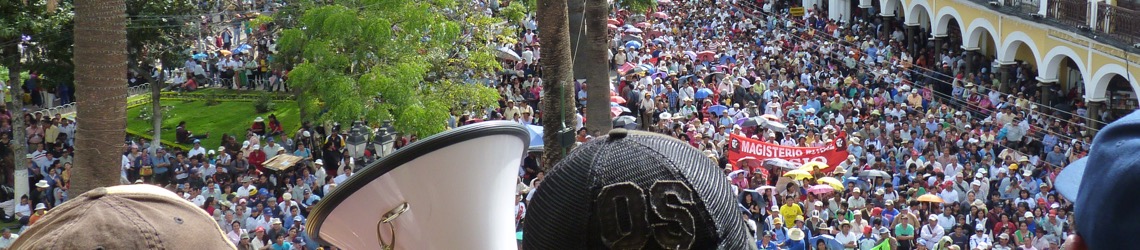
Tuesday at the CMPCC was the first day of truly massive events, besides the 17 (+1) Working Groups (Mesas de Trabajo) which themselves reached up to 500 people each. Yesterday morning was devoted exclusively to a massive opening ceremony held at Tiquipaya’s stadium. The New Bolivia has a combination of faces: the grassroots movements gathered in a stadium face, the indigenous tradition face, and the we’re running the state face. All three were on display in the pageantry of yesterday morning: dozens of banners and hundreds of wiphalas (indigenous flag of the Andes whose rainbow colors symbolize inclusion) marked the first side; the ceremony was inaugurated with requests for permission from Mother Earth and Father Cosmos; and Evo’s entrance began with a massive salute from hundreds of red-coated soldiers.

The content of the speeches was more interesting (Evo’s personal content was extended and rambling, but had its good moments which are already beginning to be overshadowed by tactless and factless comments about male sexuality and European baldness), and led into the afternoon session on “The Root Causes of Climate Change.”

The morning speeches were marked first by representatives of five continents (no one from Australia or Antarctica) addressing the summit: Faith Gemill (a Gwich’in from Alaska) spoke about a shared need to decolonize indigenous peoples; a member of the European Parliament’s left-green alliance said that the summit has allies on the European left willing to challenge the Copenhagen Accord; Nnimmo Bassey of Friends of the Earth-Nigeria/International called for an end to fossil fuels (“Keep the oil in the soil, the coal in the hole, and the tar sands in the lands”) and a rejection of false solutions; Suma Dutra argued that more than 90% of her native India has not been part of the new fossil-fuel-dependent economy and that this majority is waking up to the issue; and Eveldina Mazioli (Brazil) spoke to the systemic change towards small-scale agriculture advocated by Via Campesina, one of the world’s largest and most dynamic transnational alliances.

This brought us to Evo, who addressed with props differences between the capitalist and indigenous way of life. What I found striking was the personal animus involved on the part of people wanting show they are “better than” indigenous people, by using commodities. Contrasting a ceramic, fancy china, and plastic plates, Evo pointed out that capitalism/consumerism encouraged people to leave behind the plates that return to being earth when they break, in favor of modern versions that contaminate the world around them.

The massively attended afternoon session on “Root causes of Climate Change” kept its focus more exclusively on capitalism, with activists, a sociologist, an ethicist, and a vice president all framing the issue. Real aspects of capitalism are driving factors in the global ecological crisis: the quest for expansion, relentless incorporation of resources into the economy, an inability to settle for sufficiency, the promotion of consumerism as an economic strategy, treating environmental costs as externalities, and on and on.

Of course, however reasonable it is to put capitalism at the center of the ecological crisis, doing so raises more questions than it answers. Let me put this another way for people who aren’t as skeptical of capitalism as I am: suppose we accept that the dynamics of capitalism are provoking a crisis in the liveability of the planet; and that those same dynamics make any kind of solutions extremely difficult. What other questions does that raise?

First, what kind of economic and social systems might substitute for endless growth? How will they provide incentives for a “people-centered economy”? Unlike when I was growing up, the other possible are less unified, but far more diverse. The plural left here in Bolivia is one example of the kind of diversified solutions: nationally direct industries function alongside communal indigenous economies, and small and massive cooperatives. What is not capitalism is many things.

Second, how in the world does the political groundswell needed for real transformations get built? Third, what alternatives? (This is the easy one, actually: There’s a ton of movement, planning, and visioning work done on this question.)

Fourth, and most complicated, given that capitalism isn’t going anywhere in most of the world for at least a few decades, how much inside-capitalism response to the climate crisis is necessary? This may be the hardest question, since capitalism and its critics will have to work together to solve one of the most difficult technical and social problems ever, even as the critics remain skeptical that an end to the crisis is possible through such cooperation.

Beyond our economic system (as if that were a small matter), I think we have to ask real questions about the other issues raised by our five continental representatives.

Culture: We are talking about a real ethical transformation, built atop many cultures that have got used to relentless consuming more as a chief measure of personal status. And we’re also talking about internalizing all the consequences of our decisions for other people and the planet in our economic and social choices. What in the world will that look like.

Colonialism: The power states exercise over indigenous peoples, and that a powerful few countries exercise over the rest ends up being a key factor in climate change. The oil and mining industries operate through inequality between regions of production and consumption. Simply put, the kind of people who drive SUVs wouldn’t put a conventional oil pit in their backyard to do so. Instead they rely on less fortunate communities to supply the fuel, and pay the price. The one nice thing about this arrangement is that confronting it creates a virtuous cycle. To the degree that drillsite and fence line communities demand respect or gain in power, the whole system gets an incentive to switch to green ways of being. The difficult part is that very real systems of power have to be challenged in the process.

False solutions: In the short term, there are both real and false solutions to climate change. Some things will in fact slow, and one day reverse, the increase in carbon dioxide in the atmosphere. Others won’t. How do we tell the difference? And how do we stop the false solutions from being implemented? This is extremely important in a “flexible” climate change regime like the one that exists since the Kyoto Protocol: any country can pay another to implement a cheaper false solution, and avoid real emissions cuts in return.

Finally, in writing this I feel torn geographically. Half of these questions may seem un-askable in the United States. They are daily matters of discussion in movements here. And from the looks of the conference not just here. The thing about the global climate crisis is that it makes asking difficult questions a necessity. Since the 1990s, the small island states of the world have regarded these kinds of global discussion as life or death matters, because they are: they might be literally underwater without comprehensive solutions. In recent years, much of Africa (facing desertification and major food production loss) and countries like the low-lying, very-dense Bangladesh (not as low-lying or dense as the Netherlands, but money works wonders) have been added to the list. In circumstances like these, you must move very quickly along a chain of logic like this: “If capitalism is the problem, what might be the solution.” Or along a different chain of logic: “If the global economy can’t feed over one billion people, what good is it?” Part of seeing this week’s conference for what it is, is to recognize that thousands of people from movements across the global South, and some of the North as well, are here asking themselves just these kinds of questions. It may be a while before such questions seem reasonable to North Americans, and longer before they seem practical. This post hopes to make that possible.
Cochabamba’s water system since the Water War: DIY blooms, Public utility stalls

Cochabamba’s Water War in 2000 was the beginning of a long and upward climbing story of the country’s resistance to neoliberal policies. That story joins the defense of the right to grow coca leaves by farmers nearby in the Chapare and near La Paz in the Yungas, resistance to the privatization and export of Bolivia’s gas resources, demands for greater indigenous self-governance, and calls to rewrite the constitution. The forms of pressure pioneered or revived in the Water War played a key role in all of them.

But what became of the water? Bechtel’s demands for international arbitration after it was kicked out of Cochabamba dragged on from 2002 to 2006, when it was the first such international case to be withdrawn under popular pressure. Cochabambinos got a public water system, managed by a municipal company called SEMAPA. And Bolivia’s new constitution proclaims water as a human right.

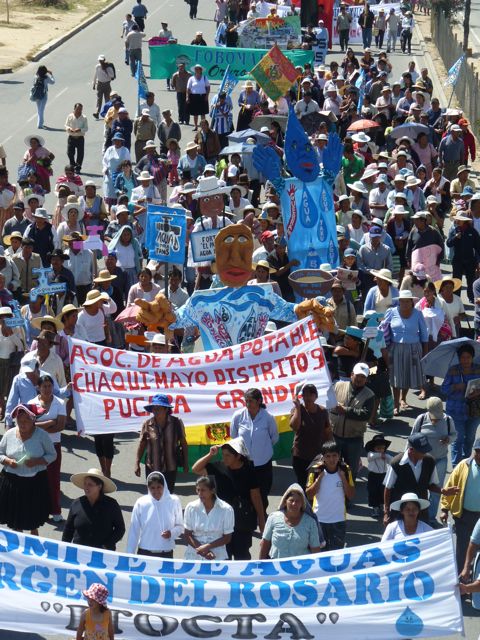
Yet, on the ground, things are more complicated. The first, critical thing to understand is the massive role of neighborhood water associations play in supplying water here. The municipal water service only provides water to about half the city’s burgeoning population, mostly in the central area and the wealthy northern zone. In  the massive Zona Sur, few people have direct water connections. Instead, neighbors have organized themselves into associations to build their own tanks, pumps, wells, and cisterns that supply water locally. Nearly all these systems have some kind of holding tanks and distribution pipes, but not all have their own water sources. Those that don’t rely on outside water to be trucked in, and then distributed.

Much of this week’s Water Fair was an opportunity for these groups to network and also to showcase their operations. Three sides of a soccer field were surrounded by tents that hosted each of these associations, most with their own scale models of their neighborhood and the self-financed apparatuses that supplies its water. A great deal of ingenuity is going into repurposing automotive motors to run pumps, to finding water sources and maintaining wells, to keeping the neighborhood organized.

And it was these organizations members that blockaded the southern entrances to Cochabamba in 1999 and 2000 when they were threatened with privatization. (The concession owned by the Franco-American corporation Aguas de Tunari included the infrastructure created by numerous water committees.) Their members went from building and maintaining pipes or paying into a local cooperative to fighting in the streets to maintain what they built. And, most surely thought, to reclaim an accountable, publicly-owned water utility that would provide for all.

SEMAPA has fulfilled its half of that dream. The company has been plagued by mismanagement, failure to invest in major expansion, and internal corruption. Thursday night, a panel on SEMAPA since the Water War was primarily an opportunity for former directors, a former community board member, engineers, and investigative journalists to describe what has gone wrong. It was, to be fair, also a remarkable opportunity of the kind of transparency that a utility that was won by the public is subject to: the managers offered a level of internal detail that would be shockingly frank in the United States. But coverage of the city remains around 50%, while the company only bills about half the water it supplies, with much of the remainder clandestinely siphoned by industrial users or received without payment by parts of the municipality.

Nowadays, when the water committee members dream of the future, they do so outside of SEMAPA. There is an association of the committees called ASICA-SUR, engaged in running trucks with water to supply the source-less committees, maintaining water quality standards, facilitating new committees, and planning for universal access. Cochabamba uses more water than flows in its own valley, and an Italian-backed project is under construction to supply water from the Misicuni River. When that water is coming, ASICA-SUR would like its own direct connection, outside SEMAPA.

The idea of a universal public service, accountable to all, is not necessarily just a dream. But it has proved elusive here in Cochabamba. Small-scale alternatives based on community involvement have been a real, viable alternative, and the way that much of the Zona Sur receives its water. The bottom-up organization of ASICA-SUR has found a secure foundation in local groups that require the direct involvement of neighbors. Without economies of scale and piped connections, however, they do so at a higher price that other Cochabambinos, and that is when they don’t rely on trucks to move their water or private middlemen to supply it. Large-scale decisions remain to be made, and large infrastructure is a major part of the city’s water future. Meanwhile, the pollution of underground water sources is putting some of the community-based water systems at serious risk, particularly around the unregulated municipal dump Kara Kara. In the end, the Water War has to be fought again and again, in local organizations, in planning discussion, and in pressure on the streets.

Thursday’s march celebrates Water War, kicks off International Water Fair

Many here in Cochabamba are celebrating the tenth anniversary of the Water War, a series of protests against the newly-privatized water utility and its French and American owners in 2000. Back then, privatization was taken on faith as an all-purpose solution by Bolivia’s national government. Rate payers, who saw 40 to 200% hikes in their bills, and water supply committees that coordinate local water systems (which the new corporation claimed as its own) disagreed, strongly. Sectoral protests found a new form, a cross-movement coordinadora that brought them together, and caught fire. Two major confrontations in February and then April 2000 saw protesters take over the central streets of Bolivia’s third largest city. In Bolivia, the Water War came towards the beginning of a series of massive mobilizations that redefined politics. It was the first globally visible reversal of neoliberal policies imposed by the IMF and World Bank (the package of such policies, including privatization and “fast money” or easily reversible foreign investment, was called the Washington Consensus).

Thousands march in Cochabamba ten years after Water War

So, on Wednesday a march was held to celebrate the anniversary and to inaugurate a three-day conference on water rights activism globally. At the Factory Worker’s Union complex, speakers from four continents talked about the inspiration that the water war provided for their movements, doing such things as mobilizing against the privatization of municipal water systems in Italy, advancing a national referendum on public water in Uruguay, and protecting irreplaceable (in human lifetimes) aquifers from bottled water manufacturers in Maine.

More photos from Wednesday are on flickr here.

Exit Polls: Evo Morales & MAS win 62%, Absolute Senate majority

Bolivia’s television networks are reporting an overwhelming MAS victory in today’s elections, based on exit polls at “the mouth of the voting urns.” While the victory was not in much doubt, reports indicate that the MAS won a higher than expected 62-63% to Manfred Reyes Villa/PPB’s 23-24% (figures vary among the Red ATB, Unitel, and Los Tiempos). The MAS victory is reported to extend to 6 departments including Tarija (traditionally a part of the right-leaning Media Luna) and Chuquisaca (where MAS lost departmental elections, but won two national referenda in the last eighteen months). The television network Unitel is projecting that MAS will win 25 of the 36 seats in the Bolivian Senate, giving it an absolute and unblockable majority.

I may play at live blogging this over the next day…

14:40 PST Manfred Reyes Villa (PPB-CN), the leading opposition candidate has just made his first reaction. Reyes Villa is the former governor of Cochabamba, a post he was recalled from by referendum in August 2008. Speaking in Santa Cruz, he tried to reconfigure the national map to that of the height of the right-wing opposition, by noting that if Chuquisaca and Tarija, which joined the solidly pro-MAS departments in voting for Morales and the MAS today, were added to the remaining parts of the Media Luna, the overall five-province vote is projected to show a PPB-CN majority. This is an extreme and hard to justify geographic stretch.

14:50 PST ERBOL, a community radio network is passing on the ATB exit poll results, broken down by province. These shows a close vote in Santa Cruz and Pando in which the PPB-CN leads the MAS, but the margin is within the likely (but unstated) margin of error of the polls.

Bolivia to hold elections tomorrow

2009 has been a very different year for Bolivia than 2008, marked more by elections than by the intense street confrontations of late last year. The new Bolivian Constitution was sent to the polls in January 2009 after the referendum was approved under the influence of a march of more than 100,000 people to surround the Bolivian parliament in late 2008.

Now, eleven months later, general elections are being held tomorrow to elect the president, parliament and departmental governors. The MAS (Movement Towards Socialism) ticket of Evo Morales and Álvaro García Linera is polling well ahead, and is expected to receive a majority of votes. Their closest rival, led by recalled Cochabamba governor Manfred Reyes Villa, is polling around 24%.

The poll will be marked by two innovations: a “biometric” (fingerprints, signature, photo) identification system, demanded by the opposition to prevent alleged voter fraud; and the participants of Bolivians outside the country’s borders, including the United States. The biometric system raised a lot of questions, starting with: could it be implemented for the entire population? Six months ago, at the Bolivian Studies Association in Sucre, I heard several talks about the many rural residents who lack a formal identification card, and the costs (and occasional benefits) of being invisible to the state, such as inelegibility for formal land ownership and government service. Four months later, after a 76-day registration marathon (in which everyone had to re-register to the new standards), the largest electorate ever (es) was certified with 4,997,172 voters.

International monitors (such as those from Carter Center) are following closely, and it will be “the most heavily monitored election” in Bolivian history. Despite some recent street confrontations, the Organization of American States’ head obsever expects the elections to be “calm, peaceful, and transparent” (es).

Looking forward to next year, and my long trip to Bolivia, I’m keeping a close watch on tomorrow’s elections, comparing this year to last year, and imagining the consequences for the year to come. I’ll keep you posted.

Sucre/Chuquisaca election roundup

In the big news, definitely the headline: ACI candidate Savina Cuellar defeats MAS candidate Walter Valda. The final vote: 51.5% to 41.2%, far closer than the initial margin that reached the early national and international press. As expected, Sucre went for her heavily (67,38% to 26,57%), but the mostly rural provinces backed Valda in a big way. Final details en español.

So on to the experiences of the day. First the “act of good government” made for a silent city for much of the day: no vehicles on the streets except for the occasional motorbike and those cars granted a permit by electoral officials. Certain Bolivian election norms are better than the American ones: a period of reflection with no advertising before the vote, free transport for elderly voters, and an election held on a day when no one has to work. And with no one having to work, all the shops and restaurants were closed, save a small few servicing visiting gringos (which means all folks from the global North in Bolivia) and internet cafes connecting the less resourced reporters with the ‘Net.

As early reports from the city’s ballot boxes came in, Savina’s supporters gathered in the main square and rallied. Some of their chants reflected the months before, notably “Sucre de pie, Evo de rodillas! [Sucre on the march, Evo on his knees!]” Others talked of becoming the national capital and winning autonomy for the department.

Chatting with MAS election observers (each party is entitled to a representative in each precinct), it’s clear there was a legitimate ACI victory, although it was clouded by extra “observers” for the ACI in some precincts who belong to confrontation groups (read, street fighters).

The story of May 24 remains untold in Sucre’s mainstream media despite at least two attempts to show Cesar Brie’s documentary on TV. Both were interrupted by covert means–once the cable
company switched off the local channel showing it, and the other time, (and no, I’m not making this up), unknown parties pushed eucalyptus trees into the power lines that feed local broadcast transmitters.

If in the atmosphere of Sucre I’ve felt very partisan in my descriptions of what’s going on, which is quite frighteningly hostile to open organizing by the MAS, the left, etc., my personal feelings there were in fact very liberal. In the older sense of the word. While I know that the different performance of the parties contending for government will make a big difference to many in the department, probably a difference of life or death to those who depend on public services (Cesar Brie told me that infant mortality has been halved in the past few years), I couldn’t stop focusing on the absence of the ability organize openly, to do things like open an office.

I’m trying to collate all my thoughts on/experiences of the election, its national significance, and some photos. So stay tuned.

Saturday: Eve of Chuquisaca’s Election; Clandestine campaigning in Sucre

[Saturday, June 28] Walther Valda, the candidate for prefect from Evo Morales’ party, the MAS (Movement towards Socialism), in Sunday’s election in the Department of Chuquisaca, has been forced to run a largely word-of-mouth campaign in the city of Sucre. No campaign headquarters can announce itself in the all the usual ways you might expect.

So, as candidate Valdas described in yesterday’s paper, the campaign has gone underground, rooted itself in word of mouth campaigning and going door-to-door. Walking around one sees wheatpasted posters and graffiti for both candidates, but only the ACI has flags flying from windows. Those flying flags of the MAS, I was told last night, have faced attacks on their property and their person. This is an election in which one side has to campaign clandestinely.

This is not just a matter of excess precaution, or a careful reaction to the one day of violence on May 24. In fact, each of the two days before that, horrible violence was visited on supporters of the MAS as
they respectively opened a campaign office and held a fundraiser at a prominent officials home. The election is being held in the first place because the former prefect, David Sanchez, survived having his home looted and burned, and fled to Peru. A leading member of the party was attacked downtown.

Things are entirely different, of course, outside the city, although there’s no sign of similar violence in the reverse direction. The ACI-supporting paper quoted thier candidate, Savina Cuellar, as complaining about an incident in which several drunken MAS supporters in an outlying town stole stacks of posters from an office and burned them in the streeet. The perpetrators turned themselves in.

I had a long talk with one Valda supporter, who radiated seriousness but also optimism. He views the urban support for the ACI as a matter primarily of misinformation, and had all the conviction of a canvasser that reaching people directly will sway the outcome.

Some English reporting on May 24…

A book on women in Bolivian social movements co-written by Alison Spedding, that I’ve been carrying with me for the last week or so incisively observed (in its opening literature review) that texts on the 2000 to 2003 period written by women tend to describe the specific impact of events on people involved, while those by men tended to assimilate events to their political argument. Unlike Cesar Brie’s documentary, these articles seem to follow the latter trend. Still, I wanted readers to have something other than my description to go by.


Wednesday: Anti-racism on the march, at least for a day, in Sucre

Monday night, I went to the well known scholars group Comuna on their biweekly meeting/event in La Paz. Instead of the usual talk though, they were hosting a video screening of a new documentary (by Cesar Brie–his poorly translated take on the events) rushed to production on the events of late May in Sucre…

To take a step back, the rapid advance of a largely indigenous grassroots left in Bolivia has been met by a polarizing of the politics here. Region (the highland west/center vs. the lowland east “the Media Luna”), race (native vs. mestizo-white), and divisions that capture both (Kolla vs. Camba) have been key dividing lines that are suddenly more visible. This is in part a reaction to the biggest line crossing of all, the presence of an indigenous peasant union leader, Evo Morales, in the presidency, but it goes beyond that.

In the east, particularly Santa Cruz, the white opposition has cottoned on to a long-running aspiration to autonomy for the department (think state in the US or province in Canada; provinces here are smaller divisions). This separatism has a youth wing, whose focus goes beyond separation to attacking and intimidating indigenous leaders and offices of the MAS party in national government. This wing, often with broader collaboration from the white opposition parties, have been threatening and carrying violence to disrupt what might otherwise be run-of-the-mill state functions involving Morales. This has reached the point where the President has been avoiding certain cities because regional governments are not guaranteeing his security.

So, back to the video. On May 24 in Sucre, Evo was set to preside over the awarding of ambulances to each province across the department of Chuquisaca, whose capital is Sucre. Right-wing youth and the anti-Morales mayor’s Inter-insitutional Committee urged Evo not to come, and threatened a confrontation. With local leaders from the countryside already on their way in, Evo backed down from attending. The rightists turned on the indigenous leaders, attacking with sticks and rocks. Several dozen fled to a house on the outskirts of town, only to be surrounded there.

They were escorted forcibly from there to Sucre’s main square, where a spectacle of public humiliation unfolded over the afternoon. Stripped to their underwear, forced to kneel, they had to endure insults, punches, and watch as their banners and the indigenous flag (or wiphala) was burned. The spectacle, captured by the mainstream media, continued for quite a long time.

In the judgment of the documentarian, the withdrawal of national police on the day happened because of a strategic decision to face and reveal what the rightists would do, rather than to confront them with force. If so, the price involved was paid by the indigenous leaders, whose pained after-the-fact interviews formed a key part of the documentary.

It was a hard film to watch, and left me in a pretty pensive mood Monday night. I had known that one in a series of racist outrages had happened in Sucre in May, and that the Women’s Summit would feature a public act dis-agression (desagravio) to repudiate it. But this was the first I had seen what was actually involved.

The whole situation strongly evokes what I’ve heard of the (US) Southern response to the Civil Rights Movement. How on front lawns, in jails, and with gunshots, the ugliest parts of a history of racism were revived to terrorize people organizing for equality.

As it happened, today’s desagravio was a complete success. Leaving from the ministadium where the summit is happening, a march of over 1,000 people traversed all over Sucre, including the plaza where local leaders were humiliated. As women filed through Sucre’s streets, wiphala and Bolivian flags in hand, shouting slogans for unity and against racism, scores of people came out in the streets: a few hostile but calmed by our numbers, and many visibly relieved and excited to have the march there–applauding as the march went past.

Campesinas on the streets of Sucre

The act was a defiance of fear. For me, a little, and for the movement a great deal. It’s hoped that it can change the dynamic in the streets and in this department. The section I marched with had a frequent chant: “Viva la esperanza. Basta de racismo. [Long live hope. Enough of racism.]” For now, I just want to convey that it happened, and happened in peace and providing some inspiration.

Indigenous, Feminist and Campesina Women March through Sucre

Delayed blogging: Settling in

[June 12] It snowed yesterday in El Alto. Not what I expected when I took the microbus (read: minivan with signs) up to the University there. Verdict: winter is real.

The event that the snow and bad directions made me miss was held again down here in La Paz around dinner time… A professor and a Vice-Minister of Justice talking about redefining policies of criminalization in a plurinational society. The first talk was very provocative–lots about how criminal law (and incarceration) are a last resort for resolving conflict, and we need to think first about the mechanisms creating for mediating conflict. Also, a question I’ve never heard asked before in such a forum: how do we solve the problem of those in prison always, under any type of government, consisting almost entirely of the poor.

There’s a lot of through-the-looking-glass style experiences of ideas you’d never expect to come out of an official’s mouth.

And then there’s the altitude (which has slowed me down, but hasn’t thrown me for a loop yet), the sudden lack of daylight hours, and being in a very different city. But I’m well, and housed for the next week or so here in La Paz (two floors above the crazily beautiful but excessively spacious place I looked at a couple days ago).