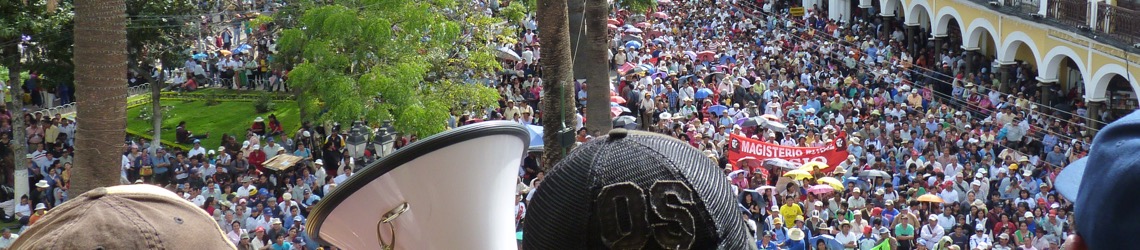
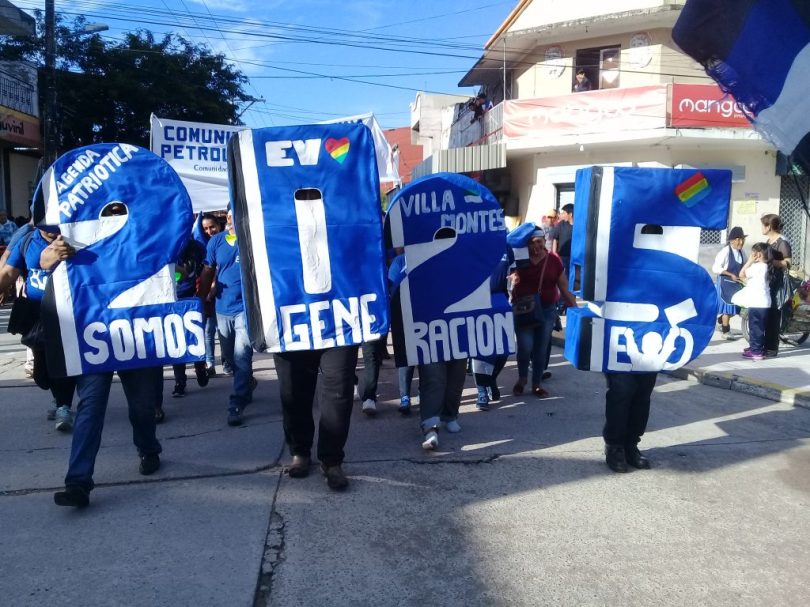
Members of Generación Evo march in Yacuiba in support of his 2025 candidacy.

Evo Morales faces criminal investigation over sexual relationship with teenage girl

Five years after his ouster from office, former president Evo Morales is suddenly facing a serious investigation into his apparent sexual relationship with a minor at the height of this presidency in 2015–16. The allegations cover the illegal and coercive nature of the relationship as well as allegations that the girl’s parents traded sexual access to their daughter for political favors from Morales. The fact of Morales’ sexual act appears to be proven by the subsequent birth of a child in February 2016, on whose birth certificate (revised in 2018) Morales’ name appears as father.

However,  the underlying charge of estupro (roughly, but not exactly equivalent to statutory rape) cannot be prosecuted without the participation of the alleged victim in the prosecution. The criminal investigation therefore rests on the link between the then-57-year-old president’s coercive sex with a fifteen-year-old and public corruption. Per the prosecutors’ document seeking Evo Morales’ arrest:

The teenager had been enrolled by her parents in the Generation Evo youth group “with the sole purpose of being able to climb politically and obtain lucrative benefits, that is, to get what they wanted in exchange for their minor daughter, among them to obtain privileged positions, economic stability and political benefits, being this in such a way that by convincing, pressure practically forced the teenager to maintain a carnal access with … Evo Morales Ayma”. (“¿Cuáles son los detalles del escándalo en la denuncia contra Evo Morales?”, Opinion, October 3, 2024 )

Prosecutors allege that the parents were repaid with multiple benefits from the Morales administration, including a failed nomination of the victim’s mother to be a regional legislative candidate. 

The investigation of the case by Bolivian prosecutors was first prompted by a complaint from the Vice Minister of Transparency Guido Melgar, just three weeks before the end of Jeanine Áñez’s interim government. The recent prosecution concerns the same victim, but with new charges—sex trafficking and corruption—that can be considered without her filing a complaint. Restrained from progressing for years, and challenged by Morales as politically motivated persecution under both the presidencies of Jeanine Áñez and Luis Arce, the case has finally convened the former president to testify on October 10.

And he, in turn, has convened his political allies to resist the prosecution in the streets.

A history of allegations surrounding Morales

These new allegations, as so often is the case in sexual scandals, have a history. In February 2016, Carlos Valverde revealed that Evo Morales had a 2007 affair with Gabriela Zapata, then an 18-year-old lobbyist for a Chinese firm seeking contracts with the government. The affair proved embarrassing for Morales, then seeking a mandate for re-election, but was soon overshadowed by the woman’s evident deceit about having a child with Morales. Zapata was eventually convicted on other influence-trafficking charges, though Morales’ complaint against her for psychological abuse (regarding the alleged child) failed.

Following Morales’ forcible ouster in 2019, the president fled in to exile in Mexico and Argentina. The interim government that followed pursued investigations of his relations with underage girls, eventually arresting Noemi Meneses, who was 19 at the time, and seizing her phone. Prosecutors leaked extensive transcripts of her text messages with Morales dating back several years. A March 2020 profile piece on Morales by John Lee Anderson (among other things, one of Che Guevara’s biographers) described an unnamed young woman in Morales’ entourage-in-exile,  suggesting a relationship he wanted kept out of the press. 

As we spoke, I became aware that a young woman was listening to us from a chair a dozen feet away. She had straight dark hair in pigtails, and she was dressed in jeans and a black T-shirt, with the word “LOVE” in sparkly white letters. She and Morales occasionally exchanged glances and smiled. At one point, Morales interrupted our conversation to tell my photographer not to take pictures of the woman. Later, as Morales posed for photographs, she asked me to take her portrait using her phone. She stood with her back to the garden wall, giggling playfully at Morales, who was posing a few feet away.

Anderson later identified her as Noemi, writing on Twitter, “Why do you think I mentioned her? Anyone will realize that I included her exactly because her youth caught my attention, although I never knew her age, so I could not affirm that which I didn’t know.”

It was at this time that Guido Melgar first raised the question of a second victim in Yacuiba, the girl about whom Morales is currently expected to testify.

New allegations regarding Morales in exile

This week, a new witness has stepped forward, both confirming that Noemi Meneses was resident with Morales in Argentina, and alleging that the pattern of trading sexual access to children for political favors from Morales continued during 2020.

These explosive allegations come from Angelica Ponce, formerly a national leader of the Confederación Nacional de Mujeres Interculturales de Bolivia, the women’s organization of agrarian colonist communities. Ponce campaigned in 2019 for Evo Morales’ re-election. She took a role in 2021 in the Arce government as head of the Autoridad Plurinacional de la Madre Tierra, an environmental agency. In 2022, Ponce publicly broke with Evo Morales, accusing him of everyday sexism on his return from exile. Her public critiques quickly led to her expulsion from the Intercultural women’s federation.

Speaking to the press on October 14, Ponce recalled her visits as a leader to Evo Morales’ residence-in-exile in Argentina, including with representatives of victims of the Senkata and Sacaba massacres.

It’s important to recognize that Evo Morales, yes, was living with minors in Argentina. I am a witness to that, so I think it’s important to denounce before the international community that a person of this measure is threatening the stability of Bolivia. … He was with Noemi and with three minors. … I went with the injured of Senkata and Sacaba, and he didn’t even want to receive me with the injured people. He would rather still be with the girls, with the minors.

And if we can speak of it—the former organizational leaders, the former officials, those of us who passed through there—Evo publicly said: all of those who needed public works done would give him a girl. And so, no one can stay silent any more. God is going to see us, God is going to judge us, brothers and sisters. This man has been a damaging guy, who has made a very lamentable misdeed to rape girls, and who needs to pay in prison.

I, as a former executive leader, I have seen how Evo Morales would take the girls from events delivering public works. [My translation from Angelica Ponce, entrevista, “‘Estuvo viviendo en su mansión con menores’“]

MAS leadership disavowed Evo’s behavior in 2020

By 2020, the question of Evo Morales’ sexual relations with underage girls became both a matter of criminal investigation and political responsibility for the party, appearing in multiple statements by MAS leaders, including future vice president David Choquehuanca, who addressed the issue in a September 2020 interview:

With regard to the denunciations against Morales for statutory rape [estupro], he said that, if there is proof, Morales will have to submit to justice and he said he does not know how many children the former president had during his government.

“I think that he [Evo Morales] has more than the two [children he publicly recognizes], it is possible that he has not recognized them. … I don’t know how many women he will have had [during his term].I cannot say ‘so many women’, but that there have been some. I have said there there is machismo, and that we have to struggle against it.” said [Choquehuanca] in an interview with Radio Deseo.  (https://www.lostiempos.com/actualidad/pais/20200925/futuro-evo-exministros-ponen-aprietos-arce-choquehuanca.)

Likewise, Chamber of Deputies President Sergio Choque Siñani speaking shortly after Luis Arce’s election victory said, “Perhaps [Evo Morales] will return to the country, but he will have to return to take on his own defense with respect to the legal charges that have been openened against him by this interim government, and also by private individuals. The ex-president will have to come and assume his defense, and well defend himself, right, in accordance with what the constitution asks.” “Tal vez retorne al país, pero él tiene que retornar a asumir defensa respeto a los proceso proceso que han aperturado — esta gestión transitoria, denuncias también de personas. Todo ello el expresidente tendrá que venir a asumir defensa, y bueno defenderse, no, de acuerdo al que reza también la constitución.

These statements were part of a broader effort by the MAS-IPSP leaders to turn the page on Evo Morales, both to win the election and to establish a “MAS 2.0” government with its own identity. These efforts would be complicated, however, by Morales’ national and global celebrity status and by his continuing position as leader of the party during the course of the election. Ultimately this led to a formal break in 2023, with Morales and Arce leading two different organizations each claiming to be the rightful Movement Towards Socialism party.

Criminal investigation intersects with Morales’ renewed effort to run for president

Now, with less than a year until the next presidential election (on August 17, 2025), Evo Morales’ faction is pressing for both the MAS-IPSP ballot line and for an end to the charges against Morales, which it terms “judicial persecution.” On both these matters, the ex-president finds himself at odds with the current Arce government, as well as the theoretically independent judicial and electoral branches. The Supreme Electoral Tribunal de-recognized Morales’ faction in October and November 2023. Morales was ruled ineligible to run for the presidency by the Plurinational Constitutional Tribunal in December 2023. The Evista faction faced off with the government in a January 2024 blockade campaign that focused on judicial elections.

Evo’s threatened arrest for failing to testify on October 10 has now been rolled in to his faction’s latest round of mobilization. Backed by factions of the coca growers, intercultural, and peasant unions, these blockades began Monday, October 14 in three points in Cochabamba, with a threat to escalated to nationwide road blockades by the following Monday. Blockaders put forward ten demands: four calling for the roll back of Supreme Decrees issued by President Arce, one calling for a 44-km highway project, one related to fuel supply and prices of goods, two opposing judicial persecution of Evo Morales and his allies, and one demanding his presidential candidacy be recognized.

By the weekend, the blockades had expanded across Cochabamba department and reached isolated locations in Santa Cruz and La Paz. They have isolated Cochabamba from other cities and begun to impact the fuel supply in La Paz and El Alto. But they were limited in scope and number (reaching no more than 24 sites) compared to past mobilizations on behalf of the party, reflecting the concentration of Morales’ base in eastern rural Cochabamba.

It remains to be seen how many rural farmers are willing to mobilize in defense of Evo Morales’ political future, how seriously this mobilization will advance other demands, and how many voters will emerge alienated or disgusted by the charges weighing against the ex-president.

Lead image: Members of the Generación Evo youth organization march in Yacuiba in support of his 2025 candidacy. Evo is alleged to have used Generación Evo coercively as a source of underage sexual partners.

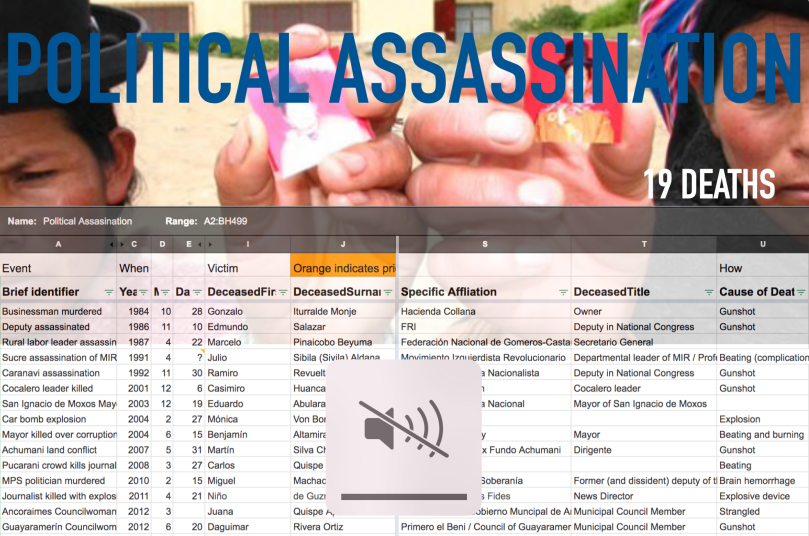
Fifteen Bolivians were killed in social movement conflicts in 2022

Violent death cast a shadow over multiple social movements in Bolivia during the third calendar year of President Luis Arce. Deliberate killings came in clashes over land, mining, and the planned census, claiming eight lives, while tear gas detonated in a student meeting led to a stampede in which five were killed. A government bureaucrat who exposed a major corruption scandal died of years of mistreatment in prison. A motorcyclist was killed by a wire strung as part of a road blockade. And a brutal stabbing killed another participant in road blockades. Altogether, fifteen Bolivians lost their lives in or around Bolivia’s often charged movement conflicts.

The deadly events were as follows:

  • La Estrella land clash, March 19: Intercultural farmers had moved on March 12 to occupy lands on the “La Estrella” ranch, owned by Jacob Ostreicher and subject to claims of money laundering in a 2011 case that attracted international attention. These land occupiers were attacked on March 19 by armed people, either farmworkers or hired attackers presumibly sponsored by in-country landowner Claudia Liliana Rodríguez. (Ostreicher remains in exile.) The attackers confronted the Intercultural squatters around 22:00, shooting rockets and firing firearms. Franklin Delgadillo, son of Intercultural leader Ricardo Delgadillo, was shot and killed. The Interculturales maintained a multiday blockade demanding justice afterwards. Police arrested at least nine people for the killing in March 2022.
  • Death of imprisoned Indigenous Fund official, April 19: Marco Antonio Aramayo, the former director of Bolivia’s Fondo Indígena, died in custody following seven years of detention under an abusive avalanche of investigations in a scandal he himself brought to light. The Fondo Indígena, which Aramayo headed from 2013 to 2015, was intended to provide independent funding to indigenous communities for development and self-representation. Aramayo denounced in 2016 that the Fund was instead used by Minister Nemesia Achacolla as a slush fund during an election year.
    While many have been accused of corrupt acts, Aramayo has borne the highest weight of prosecutions (over 250 investigations begun); he was convicted and sentenced to 5 years in 2017. ITEI, a Bolivian organization that supports victims of torture and state violence, issued a statement: Aramayo’s “death is the tragic conclusion of a series of violations of [his] fundamental rights,” “which affect [him] and also affect people deprived of liberty in general.” According to the ITEI, which has provided medical and psychological attention to him since 2017, police and penal authorities tortured Aramayo physically with beatings and stress positions; biologically by depriving him of food, water, or medicine; psychologically with threats, extortion, insults, and humiliation. Aramayo was repeatedly required to travel to attend new cases across the country, with the final one filed two weeks before his death. Exhausted from his ordeal, Aramayo died of multiple organ failure, aggravated by diabetes and hypertension.
    While police announced an investigation into his death, his legal representative denounced that no actions had been taken three weeks later.
  • Potosí university stampede, May 9: A nightmarish stampede ensued at Potosí’s Tomás Frías University after a tear gas grenade was set off during an indoor meeting to convene university federation elections. Some five thousand students were reportedly in the coliseum. Many were injured in the rush to flee, including four who were killed that day and one more who died on June 15. Reportedly two of the dead were mothers who leave behind children. Six were sent to intensive care. Between 71 and 83 were wounded. The tragedy was apparently amplified by the locking of the main exit doors.
    Bolivian student politics operates in close coordination with national political parities and is often highly contentious. The tragedy also put attention on student leaders who maintain student status over decades and accumulate patronage and power in on-campus political organization.Four students, at least two of them involved in student politics, have been arrested in connection with the gas release and its deadly consequences. The Minister of Justice names Manfred Flores Canaza as the “principal and material author” of the crime.
  • Tinguipaya clash, May 15: Two men died in fratricidal violence in the town of Tinguipaya, Potosí. The brawl between differently organized Indigenous people—ayllus vs. campesinos—followed a visit by Vice President Choquehuanca and involved stones, sticks, slingshots, and rockets. Ironically, Choquehuanca’s speech, marking the opening of a political training school, had called for cross-cultural unity and fearless speech. The cause of the conflict remains totally disputed: national MAS-IPSP official attributed it to a local land conflict, while some local figures and opposition politicians blamed internal partisan disputes within the MAS-IPSP linked to the local mayor. Police attempting to investigate the incident had difficulty entering the area in the following days.
  • Chiñijo land clash, June 23: On June 23 a confrontation over land ownership in the community of Tamiplaya Tolapampa in Chiñijo, Sorata resulted in the beating deaths of two local campesinos and injury to an additional five. A group of 60 land-grabbers, hired and led by Gabriel Callisaya Toledo, Mario Luque, and Genaro Quito attacked the community in attempt to take their land, intimidating them with dynamite, dogs, and firearms. The General Secretary of Chiñijo, Susana Silva, claimed that Sorata police refused to provide assistance or to remove the bodies of the victims and only arrived at the on the 26th. Communities members protested by taking the victims’ bodies to Sorata in a protest march in order to demand justice. The community members possessed a resolution from the National Institue of Agrarian Reform (INRA) that recognized their right to the property and instructed the police to forcefully evict unlawful occupants.
  • Mapiri mining cooperatives clash, June 24: A group of expelled members of the Hijos de Pueblo gold mining cooperative attacked the cooperative in the community of Charobamba, Mapiri, in an attempt to regain leadership. A local teacher, Faustino Nestor Maqui Chambi, was killed when he was hit in the head by a stone, causing him to fall from his boat and drown. Police arrested 7 or 8 of the agressors, but their convoy was attacked in Aguada while transporting the arrested persons to La Paz and one the arrestees escaped.
  • Santa Cruz census strike, deaths on October 22, November 9 and 10: The Santa Cruz Civic Movement mounted a 36-day department-wide strike in protest of the delay of the Census to 2024, and demanding it be held in 2023. Clash between supporters of Santa Cruz general strike and those attempting to open blockades. During an October 22 clash on the Amistad bridge that connects Santa Cruz with Brazil, a municipal employee of Arroyo Concepción, Julio Pablo Taborga, suffered injuries from blows to his head. He was transported to a hospital in Puerto Quijarro where his death was recorded early the next morning. According to Taborga’s wife, he was demonstrating against the blockade when supporters of the strike arrived with dynamite and homemade bombs and began to beat him. Video of the confrontation appeared to show victim succumbing to tear gas rather than a beating. The Santa Cruz Civic Committee released a statement blaming the MAS for the conflict.
    Eduardo Arancibia Barrancos was killed in the early morning of November 9 while driving a motorcycle to work. He attempted to drive through a blockade point in the Tres Lagunas neigborhood of Santa Cruz. He did not notice that a coaxial cable was stretched across the road between two poles. This cable cut through his upper neck as he drove, causing his death. Police arested five men who were maintaining the blockade point.
    Overning on November 11, a group of four or five people attacked two men who were maintaining a blockade in the Barrio Latino of the Los Lotes zone of Santa Cruz. The attackers assaulted Jairo Montero, 21, and José Eduardo Sosa, 28, with knives, leaving Montero hospitalized with criticall injuries and Eduardo Sosa dead. The Sosa’s heart was reportedly cut out of his chest by the attackers. Two of the attackers were arrested on November 15.
Read More »

Introducing Ultimate Consequences: A digital archive on lethal conflict in Bolivia, 1982–present (video)

Introducing Ultimate Consequences, presented as video-on-demand at AAA 2022.

This presentation introduces Ultimate Consequences, a quantitative and qualitative database, unique in its depth and completeness of coverage, of all conflict deaths in Bolivia since October 1982, a period of largely elected governments and political dynamism. The country’s 1977–82 return to democracy, 1985 general strikes, 2000–2005 antineoliberal protest wave, and its political crises in 2006–2008 and 2019–2020 each exemplify the ability of mass disruptive protest to remake national politics. The database enables comparative analysis across twelve presidential administrations, four episodes where protesters successfully sought the end of a presidential term, and 192 protest events in 17 domains of conflict. Due to the number of lethal events in the study period, the dataset is both large enough for quantitative research that analyzes patterns and small enough for qualitative, journalistic, and historical examination of the individual deaths involved. To serve these multiple purposes, we are coding information such as individuals’ relation to a specific social movement, protest campaign, cause of death, responsible parties, and location, and writing detailed narrative descriptions about major events. The presentation introduces the open data format of the database and the R-based tools to explore it.

The project draws on journalistic, advocacy, and scholarly sources to comprehensively document all deaths in political conflict, including those not readily categorizable as human rights violations. The project also seeks to ask more intimate, and cultural, questions about the role of risk, violence, sacrifice, and loss in transformative social change. As the database reveals, Bolivian protest can involve intense risk, privation, self-sacrifice, and either enduring or inflicting violence. Bolivian social movement traditions include proclamations of fearlessness and vows to carry on their struggles “until the ultimate consequences,” that is, to persist in collective measures and to refuse to be deterred by deadly state violence. These movements invoke a history of indigenous uprisings, labor militancy, and state massacres in narrating their own histories.

The dataset offers a grounded view on such questions as: What practices and political choices result in some presidencies being far less violent than others? What is the relative importance of different forms of political violence, from repression of protest to guerrilla movements to fratricidal disputes among movements? Which movements have succeeded despite deadly repression? This presentation introduces a new tool for social scientists, oral historians, and human rights advocates to use in answering these and other questions.

The death of Bolivian mining leader Orlando Gutiérrez was accidental, investigators conclude.

The death of Bolivian mining leader Orlando Gutiérrez Luna remained a matter of dispute for a full year after his untimely death in October 2020, shortly after the electoral victory of Luis Arce and David Choquehuanca. While estranged from the inner circle of Evo Morales, Gutiérrez headed the pivotal miner’s union, Federación Sindical de Trabajadores Mineros de Bolivia (FSTMB), and campaigned hard for Arce and Choquehuanca. He also feared for his life and warned his wife not to accompany him on his final journey to La Paz. From such murky circumstances seems to have sprung the notion that he may have been the victim of foul play. His widow, Karen Calle, was the leading proponent of suspicions of an attack.

Gutiérrez’s death became a matter of public concern, both in Bolivia and for the international left, after a denunciation issued on social media by the FSTMB on October 23, 2020. (Detailed in previous coverage here) The statement, which has since been disavowed by the FSTMB leadership, spoke of “hired killers” and “street thugs” who “assassinated” Gutiérrez. In the wake of some three dozen deaths in 2019, this claim set off concern and more than a few sympathetic denunciations far beyond Bolivia’s borders.

Within Bolivia, however, conflicting evidence was easier to hear. Three friends of the deceased labor leader reported that he fell on stairs in his home when they were with him, causing his fatal injuries. This explanation matched that given by the clinic that cared for him. Karen Calle, too, heard Gutiérrez himself offer this explanation to the medics who cared for him. but felt sure her husband was concealing the real cause out of fear. Bolivian social movement, union, and political leaders, who initially reacted with shock and anger, shifted from calling for “justice” for Orlando Gutiérrez to “clarification” of the circumstances of his death.

And still, that clarification was slow to arrive.

In March 2021, prosecutors declined to treat the matter as a homicide. Their statement said, “While there is testimony from witnesses, there is no place or date of the events, nor an original cause of his death.” However, they did not attempt to clarify the cause of death.

Then in August 2021, a detailed investigation was restarted.

While a final report is still pending, Bolivian prosecutors have now told the independent news network Erbol the results, which confirm that writing on the wall since late 2020: Gutiérrez died of an accidental fall. Other conclusions:

  • Gutiérrez fell in a private residence after an evening out drinking.
  • Both criminal investigation and spatial reconstructions found the fall was accidental.
  • An autopsy found that he died of lesions to his upper nerve centers, cerebral hemorrhage, and cranioencephal trauma.
  • Gutiérrez also suffered from post-COVID pulmonary fibrosis and caridomegaly.
  • The Departmental Health Service audited Gutiérrez’s care during a prolonged clinic.

Hopefully the conclusions can put to rest the concerns of a grieving and fearful widow, concerned members of Bolivian movements, and activists worldwide who feared—for healthy reasons, but without sound evidence—that Gutiérrez was the victim of unknown agents of the Bolivian right wing.

One dead as urban opposition battles pro-MAS campesinos in Potosí

Young pro-MAS protester Basilio Titi Tipolo has been identified as the first fatal casualty in renewed partisan confrontations in Bolivia. Titi died amid the yesterday’s most intense street clashes, in the city of Potosí, where the Potosí Civic Committee (Comcipo) was leading the second day of a nationwide strike. In Potosí, as in several other major cities of Bolivia, striking opposition protesters mounted road blockades in protest of Law 1386, an anti-money laundering statute that shopkeepers claim will lead to abusive investigations of their books. But the issue primarily serves as a lightning rod for the civic opposition, which previously led October–November 2019 protests that culminated in the overthrow of President Evo Morales, to coordinate a nationwide challenge to what they call the “authoritarian” rule of Luis Arce, who was elected in October 2020.

During Tuesday’s protests, multiple efforts were on a collision course in urban Potosí:

  • The Potosí Civic movement intended to paralyze economic life through blockades as part of a national strike.
  • Campesinos arrived in town as opponents of the strike and as supporters of President Luis Arce.
  • Bolivia’s National Police were taking a more-hostile-than-usual approach to the blockades, assailed by Arce’s government as economically damaging.
  • The Departmental government, led by Jhonny Mamani (MAS-IPSP), was preparing to hold an honorary parliamentary session on Wednesday to commemorate the department’s anniversary.
  • On Tuesday morning, Comcipo announced that it would not allow President Luis Arce and Vice President David Choquehuanca to attend the anniversary festivities.
  • Once in town, campesinos rallied around and damaged the headquarters of Comcipo.
  • The Potosí Civic movement mounted a sustained effort to push campesinos out of the central Plaza 10 de Noviembre, eventually achieving this objective.

Security forces and pro-government and opposition protesters were thus pursuing objectives that led to confrontation. Unarmed street battles are not rare in Bolivian political life, but most often involve one group of demonstrators and security forces. Tuesday saw clashes between all three groups, as well as prolonged violent attacks upon individuals isolated in crowds of their political opponents. A pall of confusion and self-interested statements hangs over many of the details of yesterday’s events, but some facts are gradually becoming clear.

Potosí’s mayor reports that fifty people were treated in hospitals in clinics following the confrontations, two remain in intensive care, and one protester died. The deceased protester is Basilio Titi Tipolo, a young man just shy of his 22nd birthday. Basilio had residential ties in Surichata and Potosí, where he had worked as a miner. His body lay in state in the Potosí Peasant Confederación headquarters, where he was mourned by his Quechua-speaking mother.

The Defensoría del Pueblo has taken charge of compiling information on Basilio Titi’s death. Defensora Nadia Cruz stated that he died in the context of the confrontations, that he reportedly fell in attempt to reach safety, and that the medical cause of his death was broncoaspiración—the entry of food or other obstruction into the lungs causing suffocation. Separate accounts have been offered by Comcipo and the national government.

Comcipo issued this comment: “We know that a person has died, a 25-year old who had choked on their coca, surely while running away. There were no signs of violence, and I regret very much that there was a death on the side of our campesino brothers.” Further comments alleged that the campesinos were given alcohol, money, and chile pepper (that is, meals) to cajole them into protests. This is a statement so full of hostility and stereotypes that (1) any sincerity to the claimed lament of the death rings hollow; (2) it’s hard to take the claim that the death was accidental rather than caused by violence at face value.

Comcipo was also at pains to declare that Titi was physically unharmed, placing him among the handful of Bolivians who have fled violent confrontations to their deaths over the years.

Álvaro Terrazas, a vice minister of health, presented a more sinister narrative. He alleged that violent groups blocked the passage of an ambulance carrying Titi and that “the lack of medical attention has led to the death of one person.” Terrazas claims that the forensic medical report established that Titi suffered multiple traumatic injuries, including hematomas from the blows that were struck upon him in the street. He did not cast doubt on the medical cause of death, but rather argued that someone who lost consciousness could suffer broncoaspiración from something as mall as a bit of bread. Terrazas also accused blockaders of throwing dirt to attack the ambulance carrying Titi.

Read More »

Note from the field: Bolivia redefines its history [2010]

I’m reposting this fieldwork newsletter account that I wrote in 2010 because it feels relevant to current conversations about narrating American history.

Imagine for a moment the following scenario:

There’s a formal diplomatic function between the United States and France, in which the visiting French president is honoring a hero of the Franco-American effort during the American Revolutionary War. Military and civil honors are being accorded to Thomas Jefferson, say, or the Marquis de Lafayette.* The French President is there, before a special session of the United States Congress. Picture the well of the House, the assembled guests, the audience of Americans watching on video screens on the streets outside the Capitol. The first to speak, on behalf of the United States Government is Joe Biden. He strides to the podium, welcomes the French President, and begins a speech. He remembers the revolutionary era as a period of liberation for the American continent, a key point in a still unfinished process. Then he says we must think of the revolutionary period as two distinct struggles for independence and self determination: the American Revolution we all know, extending through the War of 1812; and the struggles Native Americans fought against invasion during the same decades. He says we must remember as American heroes Tecumseh as well as Jefferson, Blackhawk as much as Lafayette. For good measure, he adds Nat Turner to the list. The Age of Liberation we celebrate as the birth of our nation, he argues, will only be fulfilled when Native peoples have self governance and Blacks have ended oppression and racism against them.

I’m sure I can imagine this scene. You can too; hopefully, you just have. But those words out of the mouth of our current President or Vice President probably seem impossible. At least, I’m confident I won’t hear them. And I’m confident that if I did hear them, I would break into tears with the unexpected justice of the situation.

I mention this scenario not just because it represents a good goal, or underscores the place of talking about history in righting historic wrongs. I mention it most of all because changing the national context, it is exactly what I witnessed on the 26th of March in Sucre. The figure in question was not Thomas Jefferson or Lafayette, but Juana Azurduy de Padilla, a mestiza military commander in the wars against the Spanish from 1809 to 1825. Born in the town of Chuquisaca (now named Sucre after her contemporary military and political leader), she fought for the independence of both Argentina and Bolivia in a war in which she saw four of her sons and her husband die. It was also a war during which she gave birth to a daughter. Azurduy is embraced by nationalists and pro-indigenous activists, as an Argentine and a Bolivian, as a woman and as a soldier.

The speech was given not by Joe Biden, of course, but by Bolivian Vice President Álvaro García Linera. Before becoming Vice President, he was a partisan of a guerrilla movement of the 1980s and 90s, a professor of sociology, and a moving force within a leftist theory collective in La Paz called Comuna.

It is one thing to sit in a graduate classroom and learn about the extended history of South America’s Age of Revolution, to learn how the indigenous revolts of the 1770s and 1780s presaged the independence wars of the early 19th century. It is a different and altogether remarkable thing to watch a country’s national leadership embrace that narrative as a way of understanding its past. One of the better aspects of fieldwork has been the opportunity to do both.

* Military commander and diplomat Lafayette was in fact given honorary American citizenship in 2002. I won’t ask you to imagine the above scenario with Dick Cheney playing the role of García Linera.

Arturo Murillo began corruption scheme in first week of Áñez regime

On May 21 and 22, the United States government arrested Arturo Carlos Murillo Prijic, the former minister of government under the interim government of Jeanine Áñez, his chief of staff Sergio Rodrigo Mendez Mendizabal, and three of Murillo’s long-time associates. These include Murillo’s childhood friend Luis Berkman Littman, his son Bryan Samuel Berkman, and Argentine lawyer Philip Lichtenfield. The men are charged with money laundering and corrupt practices surrounding the Áñez government’s purchase of riot control munitions.

Based on the facts laid out in the indictment (Murillo is “Co-Conspirator 1”), confirmed by prior document releases in Bolivia since June 2020, this scheme is best understood not as an arms company bribing Murillo and Mendez to secure a contract, but rather the joint effort by the men involved to interpose the Berkmans’ shell company, Bravo Tactical Solutions, into an existing arms supply arrangement between a Brazilian arms manufacturer and the Bolivian government. This was done at a substantial mark-up, generating between $2 and $3 million, some $600 thousand of which were recycled back to Mendez, Murillo, and an unnamed Ministry of Defense official.

Since the public indictment provides a detailed timeline, we now know that this corrupt scheme originated in the first week of the Áñez government, before the government was even recognized by opponents, while blood was still on the ground from the Sacaba massacre, and before the second mass killing at Senkata.

I think about this crisis moment all the time; I’ve studied it intensely to understand who did what when, how hardline officials came in with guns blazing, killing more with the police and military in ten days than Bolivian security forces had killed in the past decade of policing protests. What I had not imagined, however, was that this first week was also a time for them to think about profiteering.

Arturo Murillo’s dramatic week

The week of November 10th through 16th, 2019, was a momentous one for Bolivia and for conservative hardliner Arturo Murillo.

Read More »

Spatialities of Andean Extractivism (video/talk at AAG 2021)

As part of an extended panel on the Corporation on at the American Association of Geographers meeting, I presented the following talk on Concession blocks, spiraling pits, and wily start-ups: Spatialities of Andean extractivism (AAG members only). The talk is a deep dive in the technologies and policies that connect open-pit mining w/ speculative capital, built around Sumitomo Corporation’s San Cristobal mine in Potosí, Bolivia and Bear Creek Mining’s failed Santa Ana silver mine project in Puno, Peru (prior coverage here: 1|2).

A breakdown of the observations on corporate structure is in this Twitter thread. You can watch a video of the full talk here. I’m preparing to submit an article-length version of the investigation soon.

Read More »

NACLA/NYU panel on the Bolivian election and challenges to come — 17 November 2020

The North American Congress on Latin America and New York University Center for Latin American and Caribbean Studies hosted me on a panel on the 2020 Bolivian elections and the challenges that await the MAS-IPSP government, on Tuesday, November 17. The video is online here.

Bolivia’s Electoral Victory: What Challenges Lie Ahead For MAS?

Read More »

President Luis Arce’s economic model (and its limits)

Luis Arce Catacora, the economic architect of the Movement Towards Socialism during Evo Morales’ fourteen-year presidency, will take power today as Bolivia’s sixty-seventh president. Arce and incoming Vice President] David Choquehuanca were two of the longest-serving ministers in Evo’s cabinet (both from 2006 to 2017) and they stood at the core, respectively, of the party’s socialist and plurinational projects during those years.

When the Morales government came to power, it was haunted by the spectre of economic failure under the last center-left government, the 1982 to 1985 UDP government of Hernán Siles Zuazo. Morales turned to Arce, an economist who had worked in the Bolivian Central Bank since 1987, to lead his economic policy. Arce faced an incredible challenge: to thread the needle between popular demands for redistribution and an international credit market wary of leftist populism.

The markets were already trembling: Morales was already a bogeyman of demagogic populism. He was vilified by American diplomats for the coca leaf’s connection to narcotics and stereotyped domestically as an uninformed peasant ignorant of diplomatic protocol and economic realities. Moreover, Morales proposed a “21st century socialism” as his economic project. Everything that was an anathema to neoliberal technocrats seemed to be packaged together.

And yet, the new Morales government was far from ignorant of global economic or political realities. It still needed foreign credit, still lived in a hemisphere politically and militarily dominated by the United States, and still sought international investment. The spectre of dangerous populism, and the historical shadow of the 1982–86 hyperinflation, threatened all of those relationships. The Bolivian government could not afford to be downgraded in international bond markets, isolated like a new Cuba, or spurned by transnational corporate investors. And so, the government sent clear signals to global powers about just what its brand of populism would entail.

One unlikely emissary was Vice President Álvaro García Linera, a Marxist intellectual and former guerrilla, who spoke at the Washington-based Center for Strategic and International Studies in 2006. “We are not,” the Vice President pledged, “a populist government with easily opened pockets and cheap promises.” He highlighted the government’s “austerity” with its officials, who would no longer put money in offshore accounts (unlike their notoriously corrupt predecessors), and its “responsible management of macroeconomics.” This was Arce’s portfolio.

Read More »