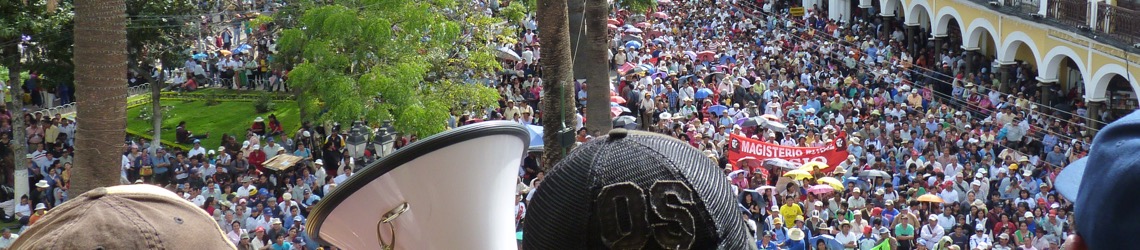
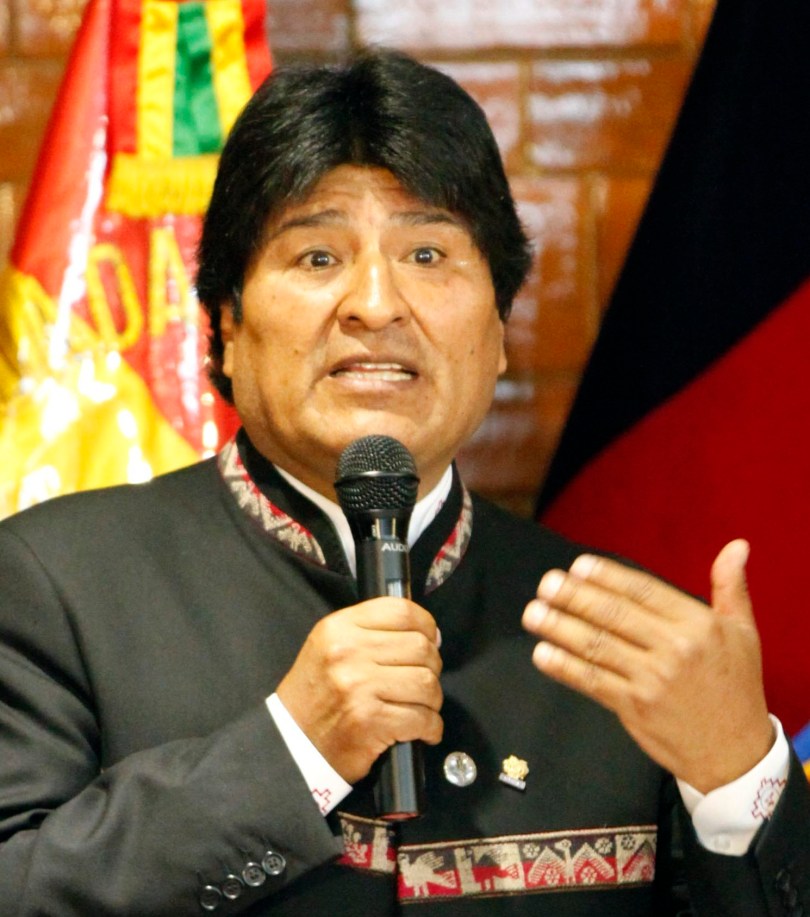
Evo Morales’ bid for a fourth term as Bolivia’s president will be put to the test when voters go to the polls on Sunday, October 20. All signs point to the most competitive presidential contest since 2002, when the future president narrowly lost to Gonzalo Sánchez de Lozada, the architect of neoliberalism in Bolivia. After grassroots protests ousted Sánchez de Lozada in 2003 and his historian-turned-Vice-President in 2005, Evo Morales swept to power with a decisive majority in a December 2005 special election. Since then, Morales’ Movement Towards Socialism–Political Instrument for the Sovereignty of the Peoples (MAS-IPSP) has dominated national and municipal politics in the country, and never dipped below 48% support on a national ballot.
Morales is now the longest serving president in Bolivian history, but polls, past electoral results, and an extraordinary series of pre-election protests point to his extraordinary vulnerability this time around. Even though Morales retains a solid base and a significant lead in the polls, he may not clear the threshold for a first round victory, and could face a competitive runoff with Carlos Mesa a month later.
To understand the uncertainty in the election, you must first know the ground rules of the vote. Under the 2009 Constitution, presidents are elected by popular vote. In the initial round of voting, a candidate who receives over 50% of the votes cast (for a candidate), or who receives 40% and holds a 10% advantage over the 2nd place finisher is elected president. Otherwise, the top two finishers face off in a new head-to-head vote. Current polls agree that Morales and Mesa will finish first and second, respectively, but differ as to whether a runoff will be triggered.
Bolivian public opinion polls vary widely in quality and consistency. Historically, some have concentrated their samples in the more accessible urban corridors and underestimated the MAS-IPSP vote, which once had overwhelming rural strength. This year, however, a research team at the Universidad Mayor de San Andrés (La Paz’s famed public university) produced a poll with an extraordinarily large and geographically representative sample called Tu Voto Cuenta (“Your Vote Counts”). Their most recent results are shown here:
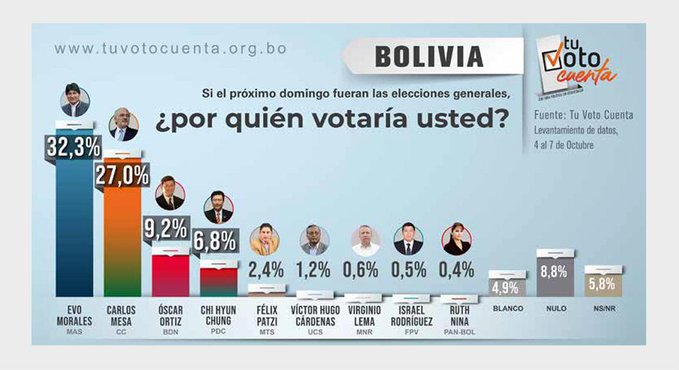
If accurate, Morales’ 32.3-27.0 margin would neither clear the 40% threshold nor the 10% minimum difference, even after excluding blank, null, and unsure votes as the electoral authorities will do in their calculations. Another poll by CiesMori shows a wider lead, 36.2-26.9. Discarding the neutral votes, this puts Morales just above the numbers needed to avoid a runoff.
Read More »



































 Carwil without Borders