I returned this week from nearly a full year researching mass protest in Bolivia. As luck would have it, 2010 has seen protests in greater numbers (67 per month!) than any year since 1971 , when the Center for Studies of Economic and Social Reality (Centro de Estudios de la Realidad Económica y Social) began keeping records on the subject. And based on both a comparative look at Bolivian history and pure population growth, it’s safe to extend that title to the most protests in a single year since the beginning of the 19th century, or even Bolivia’s history as an independent country.
Unlike 2003 and 2005, Bolivian protests did not mount into an overarching national wave capable of toppling a sitting government. However, many of the forces involved in those years are showing increasing independence from President Evo Morales and the Movement towards Socialism (MAS) party. Morales was ratified by a 64% majority in the December 2009 presidential elections and his party won the mayor’s office in nearly two-thirds of the country’s 337 municipalities in the April 2010 elections. However, this year many of the voters who backed the MAS in national fights showed their willingness to take to the streets to denounce its policies. Meanwhile, the MAS itself mobilized its base in a spectacular welcome to a global summit of climate change activists and against a 2011 workers’ strike.
Here, then, are the one election and ten mass mobilizations that defined the past year.
The worst active anti-union law in the United States was not Scott Walker’s recently passed assault on collective bargaining by state employees, but a law that makes many of the most powerful ways for workers to fight back against such a law illegal: the 1947 Taft-Hartley Act (wikipedia). That law makes many practical collective responses used by unions around the world illegal acts (technically “unfair labor practices”) in the United States. Nearly all of these are recognized as part of the fundamental right of freedom of organizing, recognized by international conventions to which the United States is a signatory. Among these actions are:
Jurisdictional strikes—A strike to demand that work be performed by members of the union
Wildcat strikes—Strikes called from the workplace floor, for new demands or in direct response to events
Solidarity strikes—A strike by one workplace in solidarity with a strike at another
Political strikes—Strikes in support of demands that extend beyond a single workplace, such as the minimum wage, overtime rights, or national health care
Secondary boycotts—The refusal of workers at one company to handle goods from another company during a strike there
Secondary picketing—Picketing (say be striking workers at one workplace) intended to get workers at a second shop to engage in a secondary boycott
If you haven’t worked for union or gone out on strike, you probably have never heard this list, and the first items that are illegal probably sound like basic elements of free speech. Harry Truman, whose veto of the Act was overriden, would agree with you. He called the law a “dangerous intrusion on free speech.”
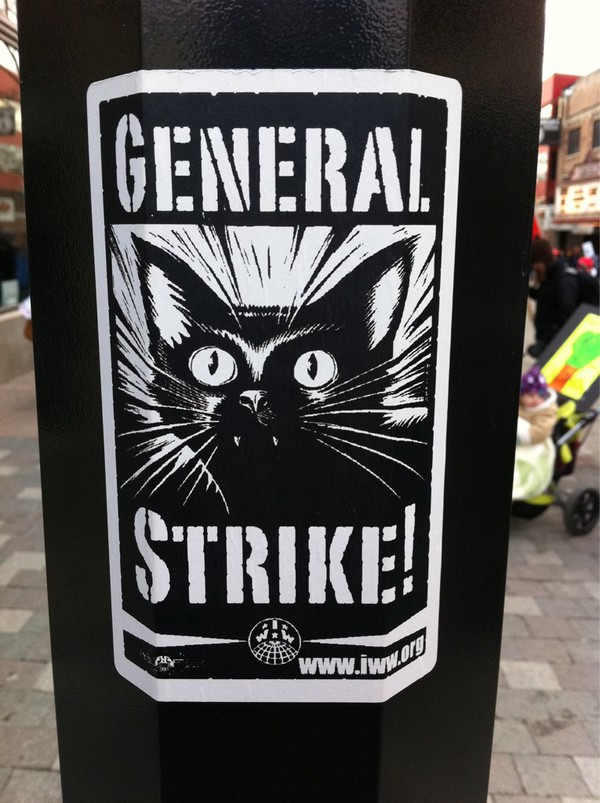
Today, as union members, people who believe in the right of workers to represent themselves, and people who hope for a better life for themselves and their communities debate how to respond to Scott Walker’s union-busting bill in Wisconsin, far too many effective forms of nonviolent collective action require formally breaking the law. Increasing numbers of union activists have brought up the general strike, a coordinated work stoppage by multiple unions, and ideally the public at large, as a means of exerting pressure. General strikes are in fact ideal ways for workers to press demands on a government: Spanish and Italian workers have repeatedly pressed for wage increases through general strikes; Bolivians have used general strikes for a broad range of goals; the French used them to oppose raising the retirement age; and most of Western Europe established the worker protections they enjoy under threat of general strikes. It is indeed an exciting time now in Wisconsin because this extremely powerful tool is being broadly considered. However, incorporated unions have to consider the legal risks in not just calling a general strike, but in taking steps beyond wearing a common color in solidarity (one of the other proposals being planned right now). Meanwhile, right-wing opponents are covering this debate under the headline, “Socialists, Unions Plotting Illegal Strike in Wisconsin.”
We should remember that illegal does not mean immoral, or wrong-headed. Like the right to bargain collectively, the right to strike and the right to strike together to press common demands are basic forms of democracy; they are rights that everyone has, as even our government has recognized at the international level. Rolling back laws that turn rights into crimes should be on our agenda, whether those laws are from 2011 or 1947.
The State Department (@StateDept) reminds us that the United States Agency for International Development has it’s 50th anniversary today. Somehow, the United States had the bright idea to place its international aid agency within the national security apparutus right from the start. John F. Kennedy and his top global policy planners saw USAID, the Alliance for Progress in Latin America, and other friendlier faces of the US government as working hand-in-glove with the planners of military maneuvers, trainers of military and para-military forces, and plotters of coups.
Not only was Kennedy into such soft power–hard power collaboration, but he was personally fascinated by counter-insurgency (a word that would later become so common, it lost its hyphen). John F. Kennedy, a man with a political halo is most American circles, brought about the Green Berets and the Special Warfare School at Fort Bragg, North Carolina. In March 1961, just as US AID was getting its commission publicly, a committee of the National Security Council (later the Special Group – Counter Insurgency) was commissioned to report on “U.S. Strategy To Deal With Wars of National Liberation,” as put in the title of the report they issued in December.
This report did not remain in a file, but instead drove new concepts like “counter-insurgency” and “internal defense” into the heart of US foreign policy for a generation. In Latin America, where I am now, “internal defense” became “internal security” or the “national security state,” the key American vision for reorienting Latin American militaries towards a new enemy: internal leftist parties and social movements.
Here’s a breakdown of the worldview behind this (all quotes are from the Overseas Internal Defense Policy written for the National Security Council in 1962; I swear no critic of the government was involved in making any of this up!):
Communism was the global enemy, but the most serious losses to it had come in China, Vietnam, Cuba, and Algeria, where local leftists were almost entirely responsible. This is called internal agression.
“Communists often infiltrate nationalist and reform movements.” So they might be a problem too.
Everyone’s a target: “The vital sectors within modernizing societies include the rural sector; the labor front; students and youth organizations; the intelligentsia; the educational systems; internal communications and informational media; the military and police; religious groups; the civil bureaucracy; the various middle-class elites; ethnic minorities; and the political parties, sometimes including a legal communist party but invariably an illegal communist apparatus operating underground or through various fronts.”
This matters to the USA because (1) We like freedom; (2) For military reasons, “strategic areas and the manpower and natural resources of developing nations” must not fall under communist control; (3) For economic reasons, “resources and markets of the less developed world [must] remain available to us.”
The USA can get involved everywhere: to “immunize” countries where there is no insurgency, to “defeat the threat” where “subversive insurgency is latent or incipient,” and to train countries for and get involved in fights against insurgents.
We need to get local governments to sign on to this policy. “To persuade these leaders to act in the interests of their society is often a complex and subtle task. … It is therefore essential that U.S. Country Teams know where the points of strength and vulnerability lie. This done, they can determine how to strengthen those elements which most effectively support U.S. objectives.”
The US is okay with revolution: “The U.S. does not wish to assume a stance against revolution, per se, as an historical means of change. … A change brought about through force by noncommunist elements may be preferable to prolonged deterioration of governmental effectiveness or to a continuation of a situation where increasing discontent and repression interact, thus building toward a more dangerous climax.”
However, the US will act against any revolution still in its early stages: “Where subversive insurgency is latent or incipient, U.S. strategy will be directed toward its elimination, lest it provide a communist foothold and escalate into active insurgency.”
All hands on deck! “Anticipating, preventing and defeating communist-directed insurgency requires a blend of civil and military capabilities and actions”
Okay, so what does this have to do with USAID? Well, guess who was on the Special Group – Counter Insurgency:
Military Representative of the President, Chairman
The Attorney General
Deputy Under Secretary of State for Political Affairs
Deputy Secretary of Defense
Chairman, Joint Chiefs of Staff
Director of Central Intelligence
Special Assistant to the President for National Security Affairs
Administrator, [US]AID
Director, USIA
Further, the AID has a strategic role in “immunizing” countries against uprisings, in making the existing social order more palatable, and in training militaries and paramilitaries. Or as the NSC put it:
Where subversive insurgency is virtually non-existent, or incipient (PHASE I), the objective is to support the development of an adequate counter-insurgency capability in indigenous military forces through the Military Assistance Program, and to complement the nation-building programs of AID with military civic action.* The same means, in collaboration with AID and CIA, will be employed to develop a similar capability in indigenous para-military forces.
*[From the glossary]: The use of preponderantly indigenous military forces on projects useful to the local population at all levels in such fields as education, training, public works, agriculture, transportation, communications, health, sanitation and others contributing to economic and social development, which would also serve to improve the standing of the military forces with the population.
And just in case you’re thinking that USAID-Counterinsurgency cooperation is so fifty years ago, here’s a quote from the US Government Counterinsurgency Guide of January 2009:
“The large numbers of foreign service nationals that make up the professional cadre of field staff provide a unique understanding of the local situation, while the range of sectors and levels of activity allow USAID great operational flexibility and agility to both implement and track the effectiveness of COIN operations.” (Appendix: US Government Roles in COIN [Counterinsurgency], p. 51)
So, happy birthday, USAID! And remember, if anyone confuses you with an organized attempt to thwart radical social change, it’s just because they’ve figured out your mission statement.
Bibliographic note: The Overseas Internal Defense Policy is just one of many declassified documents now freely available. Many subsequent implementation decisions on counter-insurgency issues are part of the Presidential Decision Directives archive by the Federation of American Scientists.
Eighteen months ago, when I was applying for funds to conduct research in Bolivia, one of the criticisms I had to respond to was this: How do you know that mass protest events will be going on while you’re there? In the end, I resorted to putting a table of recent events of large-scale space-claiming protests in my two focus cities in my proposal to make this point: there has not been a 12-month period without such protests since last century.
And here we are again.
On the day after Christmas, the Vice President (then acting president since Bolivian law requires that the office must always be filled by someone physically in the country) announced that the Bolivian government would remove all subsidies on fuel: primarily gasoline and diesel, and let the prices float to international levels. Fuel prices went up 70-80% overnight. This was not the first time that such a drastic move has happened in Bolivia, but it was the first time that the popular movement-linked MAS government had taken the step. In fact, the MAS had led major protests against exactly the same move less than a decade ago.
The politics of subsidies in general and the gasolinazo in particular are fascinating, and fully getting the arguments requires putting aside everything that Westerners are taught about prices, markets, and subsidies, but that’s a whole other post (several pages of which are in my notebook waiting to be typed into an article).
In any case, the social movements that brought the MAS to power, including Evo Morales’ coca grower base, did not hesitate to mobilize against the gasolinazo. (And the transport sector quickly moved to double fares.) Despite some pressure on their leadership, the Neighborhood Councils, Factor Workers, labor confederation, and others mobilized mass protests. The scene in El Alto in particular, especially on December 29 and 30, brought back collective memories of the mobilizations that toppled presidents in 2003 and 2005, even though the numbers were not yet as great. Evo and Álvaro reversed course, and returned fuel prices to their former levels.
However, the price hike genie was out of the bottle. While some in the government promised the gasolinazo was over, others have made it clear that the prices will be raised in smaller doses over the coming year. Several weekends in January and February, there has been panic buying in La Paz over rumors of an imminent price hike.
More pressingly, this year’s extremely late rainy season (normally beginning around November 1, it didn’t really kick in until the New Year) and other factors have led to a national sugar shortage, grain price hikes, and a squeeze on the milk producing industry. The national government’s response was first to use its agricultural production support company, Emapa, to supply sugar directly at low prices to the cities, in an attempt to push the price down. However, Emapa itself abruptly raised prices in late January, and the government has been embarrassed by former ministers and senators illegally wholesaling government sugar out of their homes. Finally this month, the transport sector has moved to increase urban transit fares in a half dozen cities, and began charging the new fares without official approval.
The economic situation has brought multiple sectors into the streets, although without unified demands. Buyers and sellers of the same product are both mobilizing. Ideologies conflict as well: some are demanding the enforcement of the free-market principals of Supreme Decree 21060, while more are calling for it to be revoked. Shopkeepers demand that Emapa be abolished, while neighborhood councils in Oruro demand that it distribute basic goods directly to neighborhood suppliers. And in Cochabamba, drivers demanding higher fares and factory workers and neighborhood council marchers who oppose them have each attacked the property of the other side.
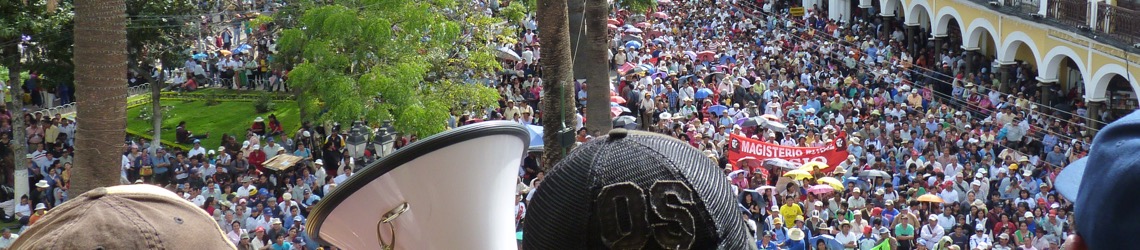
On February 18, the national worker confederation known as the COB (Bolivian Worker’s Central) carried out a 24-hour strike. And when Bolivians strike, they march. That included a 10,000+ worker march down the main highway from El Alto to La Paz. The COB is demanding either wages or wage increases in line with a study it performed on the cost of basic goods in the country. However, this analysis showed that the baseline cost of living is 8,300 Bolivianos per month for a family, about $1200. This is above and beyond the typical Bolivian’s earnings, leading the government to disqualify the study as anything more than a pipe dream for workers.
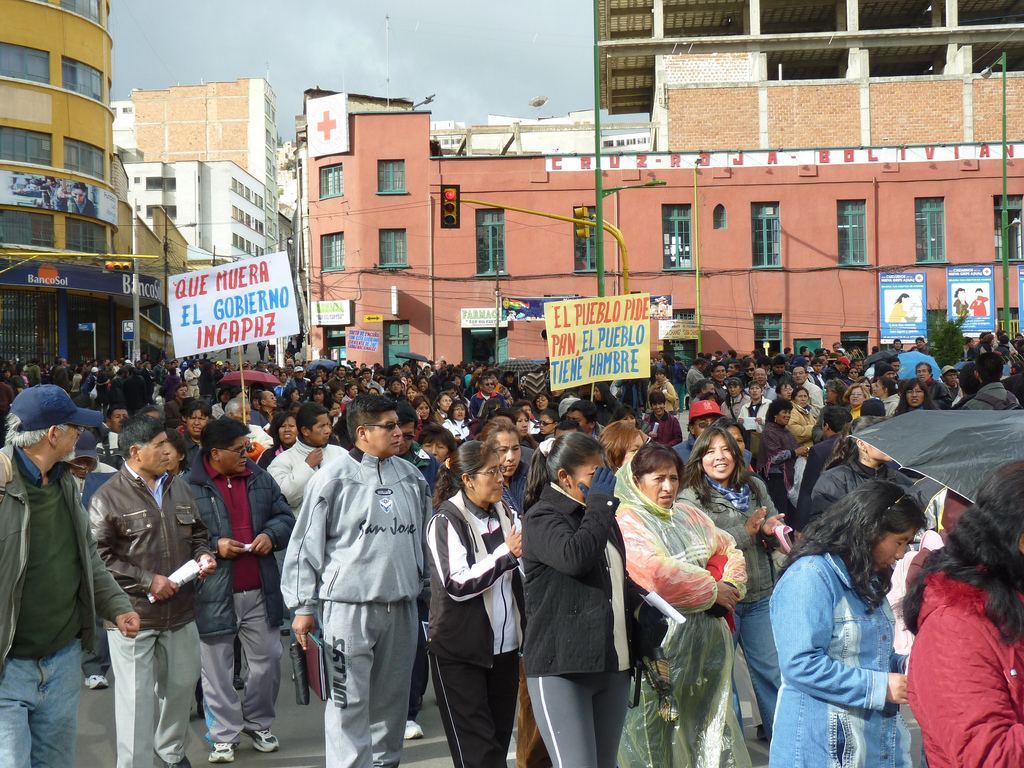
A second march on the 18th, led by the more radical teachers’ unions of La Paz department brought an harsher indictment of the Evo Morales-led government. Placards, chants and speakers labelled the government “incapable” and committed to neoliberal policies like the gasolinazo. Once again the slogans of seven years ago rang in streets, and a working-class crowd was calling for the indigenous peasant union leader who is president to resign and make way for “a government born of struggle in the streets.” Such a government, radical unionists claim, could guarantee larger wage increases for workers by expropriating transnational corporations in extractive industries and redistributing their wealth to enlarge workers’ salaries.
Health care workers and teachers rally in La Paz, February 18: Signs read "Death to the incapable government" and "The people ask for bread; the people are hungry"
It is not so much that this rhetoric is new as that it has migrated from the pamphlets of the radicals at sides of the march to the main stage. Like a stopped clock that is right twice a day, those who are always skeptical that the government has sold out the public, and turned against the grassroots are now in sync with at least a large portion of the popular mood. And they can speak to broadly shared concerns about the cost of living, the subcontracting of work, and the lack of sufficient investment in the industries that provide employment and public revenues to Bolivia.
Five years of MAS rule, and two years since its decisive victory over right-wing resistance to the project of a new, plurinational constitution have allowed a lot of tensions, mistrusts, and frustrations to accumulate within the party’s diverse grassroots base. Movements that always knew how to mobilize on their own have frequently been in the streets in the past years. Unfortunately, the first response of the MAS government has often been to accuse those who mobilize of being aligned with, misled by, or even “infiltrated” by the right-wing opposition. If anything, it now seems that independent protest and even independent opposition has been made more likely by these accusations.
As we cheer on Egypt’s anti-regime uprising, we should also be learning as much as possible how it worked. Some things, of course, are only important in a society that has lived under decades of emergency rule. But most, I think, apply just about everywhere. Since we’ve seen government spying and storm trooper-style riot cops deployed in just about every country, it’s great when we can learn things that stop them.
Here are some of my favorites so far.
Open source protesting: Making its round in Egypt during the last days of January was a brilliant little pamphlet called “How to Protest Intelligently.” This easily reproducible, forwardable, xeroxable pamphlet brought together an open-ended set of tactics and strategies and widely distributed them. San Francisco bikers will be familiar with the well-distributed xeroxes that circulate at Critical Mass (some mockingly call this form of leadership “xerocracy”), but its relatively rare that protesters aim for mass distribution of their plans to the rest of society. When enough people are fed up, but might remain inactive without a plan, this can be strikingly effective.
By the way, open source is a metaphor here, that has relatively little to do with actual computers. It seems that e-mail and pdfs did actually help in Egypt, but mimeographs, printing presses, fax machines, or copiers would have functioned just as well in another era. (Non-blog-oriented hat-tip to the European collectives circulating open source windmill designs to put renewable energy into grassroots hands.)
You can read nine pages of the pamphlet at Indybay (the San Francisco Bay Independent Media Center), one of my favorite open media institutions.
Advice on gathering and mobilizing from “How to Protest Intelligently”
Gather where you is, Converge on where you ain’t:* One piece of simple advice from the pamphlet is this universally applicable tactical plan. Apparently, it actually happened this way. Ahdaf Soueif, for example, reports:
This is the scene that took place in every district of every city in Egypt today. The one I saw: we started off as about 20 activists, after Friday prayers in a small mosque in the interior of the popular Cairo district of Imbaba. “The people – demand – the fall of this regime!” Again and again the call went out. We started to walk: “Your security. Your police –killed our brothers in Suez.”
The numbers grew. Every balcony was full of people: women smiling, waving, dangling babies to the tune of the chants: “Bread! Freedom! Social justice!” Old women called: “God give you victory.”
For more than an hour the protest wound through the narrow lanes. Kids ran alongside. A woman picking through garbage and loading scraps into plastic bags paused and raised her hand in a salute. By the time we wound on to a flyover to head for downtown we were easily 3,000 people. (“An eyewitness account of the Egypt protests,” Guardian, January 28)
* “If you can’t organize where you is, you can’t organize where you ain’t” — received Saul Alinsky-style wisdom
Missing step, How to Defend a Public Plaza from Cops and Mobs of Hired Thugs: Seriously, I’m curious. And a lot of experience has been generated.
How to make demands from a giant crowd: Now that Tahrir Square has proclaimed itself an “autonomous republic,” and demands are flying from every corner of Egyptian society, not to mention every foreign government, the crowds whose effort has made change possible are trying to articulate their demands. Here’s how:
In Tahrir, the square that has become the focal point for the nationwide struggle against Mubarak’s three-decade dictatorship, groups of protesters have been debating what their precise goals should be in the face of their president’s continuing refusal to stand down.
The Guardian has learned that delegates from these mini-gatherings then come together to discuss the prevailing mood, before potential demands are read out over the square’s makeshift speaker system. The adoption of each proposal is based on the proportion of cheers or boos it receives from the crowd at large.
Delegates have arrived in Tahrir from other parts of the country that have declared themselves liberated from Mubarak’s rule, including the major cities of Alexandria and Suez, and are also providing input into the decisions.
“When the government shut down the web, politics moved on to the street, and that’s where it has stayed,” said one youth involved in the process. “It’s impossible to construct a perfect decision-making mechanism in such a fast-moving environment, but this is as democratic as we can possibly be.” (“Cairo’s biggest protest yet demands Mubarak’s immediate departure,” Guardian, February 5)
As I alternate between interviewing Bolivians about the process of mass collective action that overthrew two neoliberal governments in 2003 and 2005, and watching the unfolding uprising in Egypt by the Internet, I’m doing my best to learn from both situations. For now, here’s one bit of writing describing Bolivia’s 2003 Gas War that seems especially relevant to events in Egypt in 2011:
Hay ocasiones en que la muerte y el miedo son los puntos infranqueables que detienen una insurgencia social frente a las murallas del gobierno. Por eso el Estado necesita monopolizar la coerción legítima pues ésta, que encarna el posible uso de la violencia y muerte en contra de la sociedad, es la garantía última y final de todo orden político constituido. Sin embargo, hay momentos en que la muerte cataliza el ímpetu de la sublevación, en que la muerte es la seña que permite unificar colectividades distanciadas dando pie a un tipo de hermandad extendida en el dolor y el luto. En ese momento la muerte es derrotada por la vitalidad de una sublevación de voluntades sociales llamada insurrección.
There are occasions when death and fear are the insuperable obstacles that stand in the way of a social insurgency outside the walls of government power. For this reason, the State needs to monopolize legitimate coercion, which embodies the possible use of violence and death against the society, since this is the last and final guarantee of every constituted political order.
Nevertheless, there are moments in which death [instead] catalyzes the impetus of the uprising, in which death is the sign under which formerly distant collectivities can unify, giving rise to a sort of extended bortherhood of pain and mourning. In that moment, death is defeated by the vitality of the uprising of social wills that is called insurrection.
—Álvaro García Linera, “La sublevación indígena popular en Bolivia
[The Indigenous Popular Uprising in Bolivia],” 2004
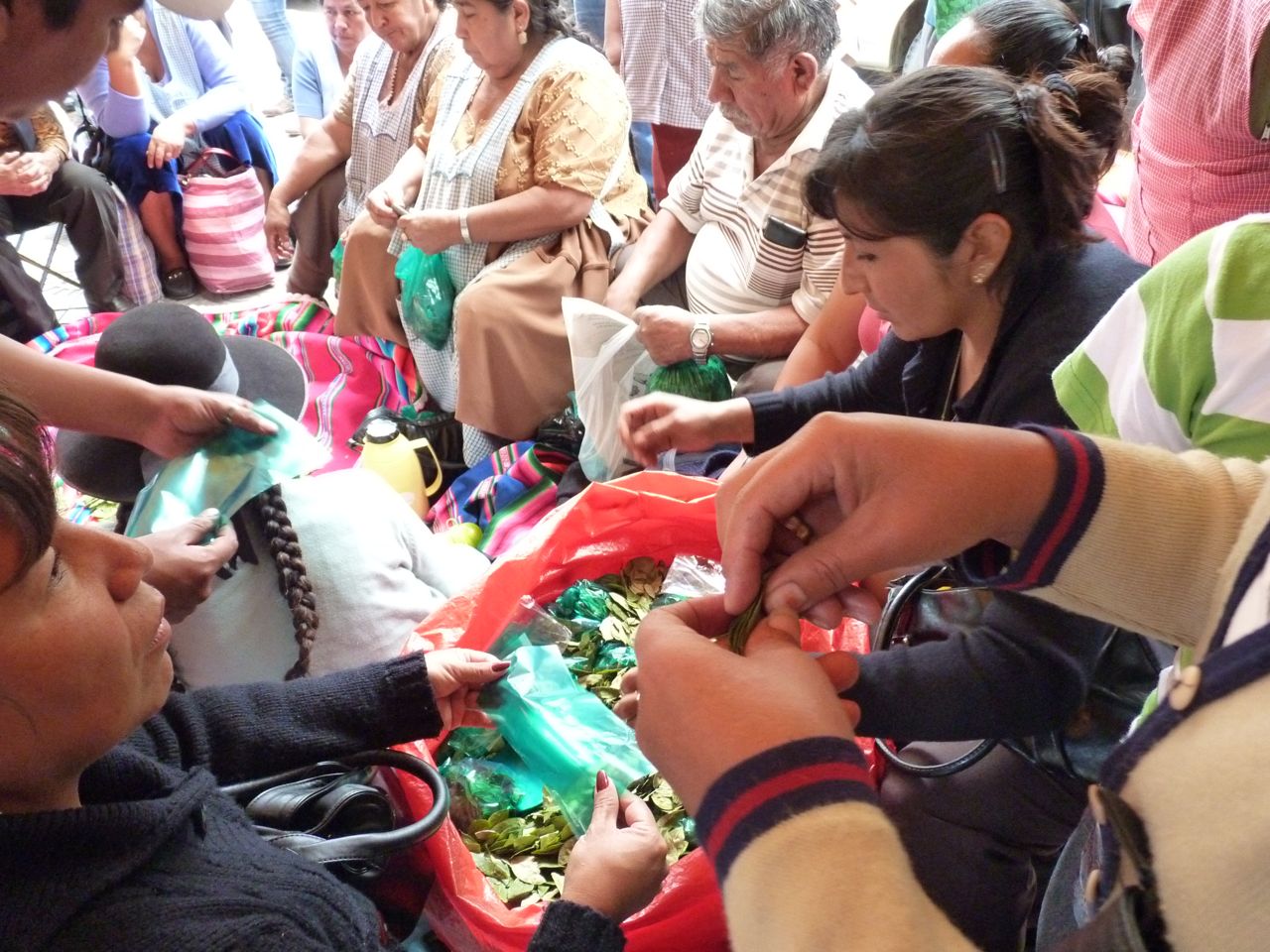
While sitting in the midst of the massive coca chew-in in Cochabamba’s central square, the overwhelming mass of people was cris-crossed by two types of vendors: sellers of cloths on which to dry coca leaves, and a ubiquitous Bolivian sight, the hawkers of copies of new laws recently passed by the Plurinational Legislative Assembly. The hot seller of the day was last year’s Law 045, the Law Against Racism and All Forms of Discrimination.
Bolivian laws are a widely circulated commodity. Newspapers, both broadsheet and tabloid, publish copies of both draft laws and their final versions as free supplements. Wednesday’s Los Tiempos had the draft statute of autonomy for Cochabamba Department stuck in alongside the sports and fashion sections. On the streets of downtown La Paz, Cochabamba, or Potosí, you can buy bound versions of all the major laws in Bolivia—the laws on criminal procedure, the labor code, and indigenous legal process, for instance—at all the main newsstands. Just by attending social movement conferences, I’ve accumulated three bound copies of the 2009 Constitution.
And that Constitution is surely the most cited text at Bolivian political rallies. You can count on the text of the constitution being referenced (though rarely directly quoted) when a series of political speakers lines up. Always referred by its formal name, the [New] Political Constitution of the State, it is a touchstone of legitimacy for protesters. It comes up as much as the so-called October Agenda, the combined political demands embodied in the 2003 Gas War, the first protests to topple a neoliberal government.
So, it was most surprising to read how America’s diplomats think about Bolivia’s political literacy, as revealed by the Wikileaks release of cables:
Although the opposition is making a mighty effort across the country to rally against the constitution, the forces of inertia seem to be conspiring against them, particularly in the form of a largely uneducated rural base in the Altiplano. Leading daily La Razon interviewed several community leaders from the Altiplano, and their supporters, and reported on January 18 that neither the leaders nor the supporters had read the Constitution. Instead, the repeated message was that rural communities would take their marching orders from the MAS, and vote for the constitution. … In the countryside, the number of those reading the constitution is much lower. Post suspects disinterest, blind faith in Evo Morales’ political project, and illiteracy, despite the Cuban literacy program, all play a role. (Cable 09LAPAZ96)
While the length of the new Constitution—literally hundreds of articles—no doubt limited the number of people who read it through, it’s clear that American diplomats have yet to clue in on Bolivia’s grassroots political culture. No one who has sat through a campesino rally, or the well-attended presentations on technical details of pensions or gas production, or who even sat with coca chewers ready and willing to buy the new anti-racism law, could look down so easily on alleged popular ignorance.
Attendees at World People's Conference on Climate Change—25,000 Bolivians and 9,000 foreigners—snap up a free newspaper
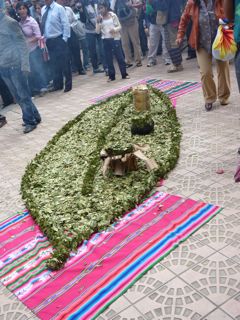
On the plaza, a giant coca leaf made out of coca leaves
Coca growers from the Chapare (Cochabamba Department) and the Yungas (La Paz Department)—Bolivia’s two coca-growing regions—have travelled to Bolivia’s nine departmental capitals today to publicly chew the traditional leaf and to support the Bolivian government campaign to end the UN prohibition on coca chewing. Coca leaves are a traditional crop in the Andes and are both chewed in the mouth and boiled into a tea called mate de coca. Both forms are valued for their medicinal properties and cultural role in Andean culture, particularly the protection they offer against altitude sickness, fatigue, and upset stomachs. Bolivia’s demand that a 1961 UN drugs convention be amended has attracted broad support, including from the Union of South American Nations (UNASUR) and Africa, and several countries that had expressed doubts about the move have been won over. However, the United States—a major cocaine-consuming country and the main international sponsor of Bolivia’s once-heavily-militarized war on drugs—and Sweden continue to block the move. The deadline for changing their position is January 31.
Events in Cochabamba are still underway, but here is an early preview of the gathering in the city’s main square, the Plaza 14 de Septiembre.
Vendors from the May 27 Association bag coca leaves to give awayTwo women from the Six Federations of the Tropics of Cochabamba march with young coca plants and bags of coca leavesTV journalist interviews Leonilda Zurita, president of Coca Growers' Women's Federation
A more complete set of photos from today’s protest is online at flickr.
Self-censorship may not be the most pernicious form of censorship out there, but it certainly can reorient one’s perspective on what really is happening in the world. It’s strange enough to interact with people without a shared vision of what is actually happening in the world. Even stranger is to watch people deliberately repress their own knowledge in the service of a political agenda, whether that’s misinforming the public about global warming, “protecting” secrets that have already been released, or sustaining a deceptive narrative of the Great Recession.
One
Democracy Now! has obtained the text of a memo that’s been sent to employees at USAID. This is to thousands of employees, about reading the recently released WikiLeaks documents, and it comes from the Department of State. They have also warned their own employees. This memo reads, quote, “Any classified information that may have been unlawfully disclosed and released on the Wikileaks web site was not ‘declassified’ by an appopriate authority and therefore requires continued classification and protection as such from government personnel… Accessing the Wikileaks web site from any computer may be viewed as a violation of the SF-312 agreement… Any discussions concerning the legitimacy of any documents or whether or not they are classified must be conducted within controlled access areas (overseas) or within restricted areas (USAID/Washington)… The documents should not be viewed, downloaded, or stored on your USAID unclassified network computer or home computer; they should not be printed or retransmitted in any fashion.” That was the memo that went out to thousands of employees at USAID. The State Department has warned all their employees, you are not to access WikiLeaks, not only at the State Department, which they’ve blocked, by the way, WikiLeaks, but even on your home computers. Even if you’ve written a cable yourself, one of these cables that are in the trove of the documents, you cannot put your name in to see if that is one of the cables that has been released. (Democracy Now!)
Two Media Matters exposed the following memo from Fox News managing editor Bill Sammon: “…we should refrain from asserting that the planet has warmed (or cooled) in any given period without IMMEDIATELY pointing out that such theories are based upon data that critics have called into question. It is not our place as journalists to assert such notions as facts, especially as this debate intensifies.” To quote Media Matters,
“Contrary to Sammon’s email, the increase in global temperatures over the last half-century is an established fact. As the National Climatic Data Center explains, the warming trend ‘is apparent in all of the independent methods of calculating global temperature change’ and “is also confirmed by other independent observations.'”
(Further outrage from the über-centrist National Wildlife Federation)
Three
The bipartisan Financial Crisis Inquiry Commission was established by law to “examine the causes, domestic and global, of the current financial and economic crisis in the United States.” …
It’s a straightforward story, but a story that the Republican members of the commission don’t want told. Literally.
Last week, reports Shahien Nasiripour of The Huffington Post, all four Republicans on the commission voted to exclude the following terms from the report: “deregulation,” “shadow banking,” “interconnection,” and, yes, “Wall Street.”
When Democratic members refused to go along with this insistence that the story of Hamlet be told without the prince, the Republicans went ahead and issued their own report, which did, indeed, avoid using any of the banned terms.
That report is all of nine pages long, with few facts and hardly any numbers. Beyond that, it tells a story that has been widely and repeatedly debunked — without responding at all to the debunkers. (“Wall Street Whitewash,” by Paul Krugman)
It’s been said that, Everyone’s entitled to their own opinions; but everyone is not entitled to their own facts. Someone tell Fox News, the State Department, the Library of Congress, and the Financial Crisis Commission.
Tommy: Yea, its an Irish ship. Fabrizio: It’s English…no? Tommy: No, it was built in Ireland. Fifteen thousand Irishmen built this ship. Solid as a rock. (Titanic)
These lines rolled off the tongues of actors in James Cameron’s 1994 film, showing just how accessible a mentality that’s critical of capitalism (who owns the things a society makes anyway?), of ethnic bias (who are you calling a second class citizen?), and of xenophobia (among white countries, at least) is to Americans today. The RMS Titanic was in fact built in Belfast by Irish workers. Workers and third-class passengers, often Irish, numbered disproportionately among the dead in the ship’s maiden voyage sinking.
Flash forward a century from the Titanic, and we can see that the luxurious extreme of modern life is still often made possible by the hard work of second-class non-citizens. Case in point, the winning bid (official website) to host the 2022 World Cup, Qatar.
Qatar is an absolute monarchy, ruled by an Emir and a 35-member Consultative Council, currently appointed. Elections for the Council were promised for 2007, 2008, 2010, and are now promised for 2013, although municipal elections have already been held. Qatar is proposing to build or upgrade twelve stadiums, each with a capacity of 40,000 or more for the 2022 World Cup.
Or rather, Qatar is proposing that foreign workers build or upgrade twelve stadiums. As of 2008, most everyone in Qatar was a foreigner: 1,305,428 people, making up 86.5% of the population, and rising. A year earlier, 92.5% of workers in Qatar were foreign nationals, including 72,765 domestic service workers (International Labour Organization, International labour migration and employment in the Arab region). Population estimates for Qatari citizens alone vary widely, although 180,000 in 2006 is one estimate. Those with citizenship could not fill the stadium seats to be built for the World Cup.
Throughout the region’s tiny monarchies, grouped in the US-allied Gulf Cooperation Council, citizenship coexists with a temporary rotating underclass of workers, who lack the right to organize and do not receive the social benefits they make possible. Their hardworking stays in the region are organized through the Kefala or sponsorship system (some times called Kafeel, the word for sponsor). Sponsored workers have their residence rights strictly conditioned on the approval of their employers. This results in illegal abuses such as “working and living conditions, irregular payment of wages and, in extreme cases, retention of travel documents. Foreign workers are more often than not forced to accept these circumstances having incurred the costs of finding jobs and travelling.” Or as the Guardian puts it less diplomatically:
Workers arrive in the country heavily indebted, having borrowed from moneylenders or mortgaged their land to finance inflated travel and visa costs. Their passports are immediately and customarily confiscated and they are typically forced to sign a revised contract that pays them a significantly lower rate than was originally agreed.
…
The results are depressingly familiar: unpaid wages, inhumane living conditions, unsafe working conditions and suicides.Qatar, one of the wealthiest countries in the world, has been referred to as a “death trap for hundreds of thousands of construction workers” from some of the poorest countries in the world. Female domestic workers, meanwhile, are not covered by national labour law – an omission which, as Amnesty International rightly pointed out, “allows employers to exploit, enslave, abuse, assault and injure their domestic workers with virtual impunity”. There is a strong argument for saying that in the worst cases of abuse, the treatment of migrant workers constitutes slavery in international law.
The ILO is forced to make extremely minimal demands for the labor rights of migrants, such as its recent calls for Kuwait and the United Arab Emirates to reform the sponsorship system, institute a minimum wage, and allow unions to form. (A theoretical right to unionize was established in 2005, but only applies to worksites with 100 or more Qatari nationals. The AFL-CIO’s Solidarity Center reports no unions have yet formed; more from them here.)
Like the Titanic, the World Cup is the ultimate in luxury. It will be up to a global public to decide whether it can stomach a worldwide party built by rights-free labor. For now, at least, we can stop saying that Qatar is hosting a World Cup, and start saying that Indians, Pakistanis, Filipinos, Bangladeshis, Egyptians, and Yemenis are making possible a celebration of sport most of them could never afford to attend.
* Yes, the title is not technically accurate: I know Qatar is in Asia. However there is no short, identifiable word for the vast region that provides migrants to the Middle East monarchies. Maybe they’re should be. Also, I know that more than 1.3 million people (the current number of foreigners present) will have cycled through Qatar during the run-up to its World Cup bid. Sadly, details are hard to come by. Labor history is disadvantaged from the start under conditions of large-scale exploitation.




 Carwil without Borders