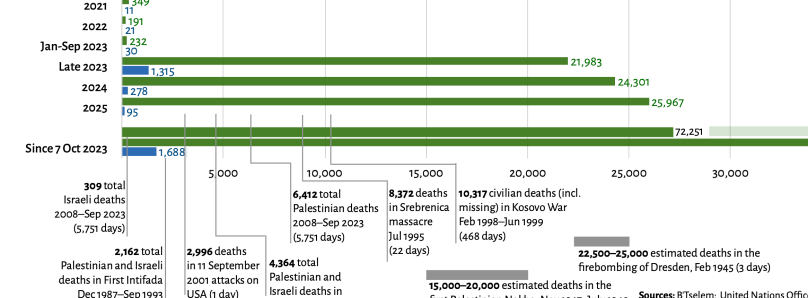
Close up view of 2021-2025 deaths showing remarkable disparities.

Deaths in the Israeli-Palestinian conflict through 2025: Staggeringly large and unbalanced

Gaza’s death toll remains the most staggering data point about the
Israeli war that brought it about. Month after month, the Gaza health
ministry continued to compile both total numbers of those violently
killed and lists of the names of the dead.

It remains among the most extraordinary human acts I have come into
contact with, from the day I first held the scores of pages of names,
identity numbers, and ages in my hands, to the searches I made
among the compiled birth dates for my own and those of my children.

Every two weeks, United Nations Office of Coordination for Humanitarian
Affairs in the Occupied Palestinian Territories has added new details of
individual violent acts and new totals of destruction. Recently, I
brought this biggest picture back up-to-date, at least through the
end of 2025.

The calendar year of 2025 was deadlier than that of 2024, and both
exceeded the toll of the devastating last three months of 2023.

As the Palestinian population of Gaza increasingly lived in tents
and makeshift dwellings, the genocide wore on.
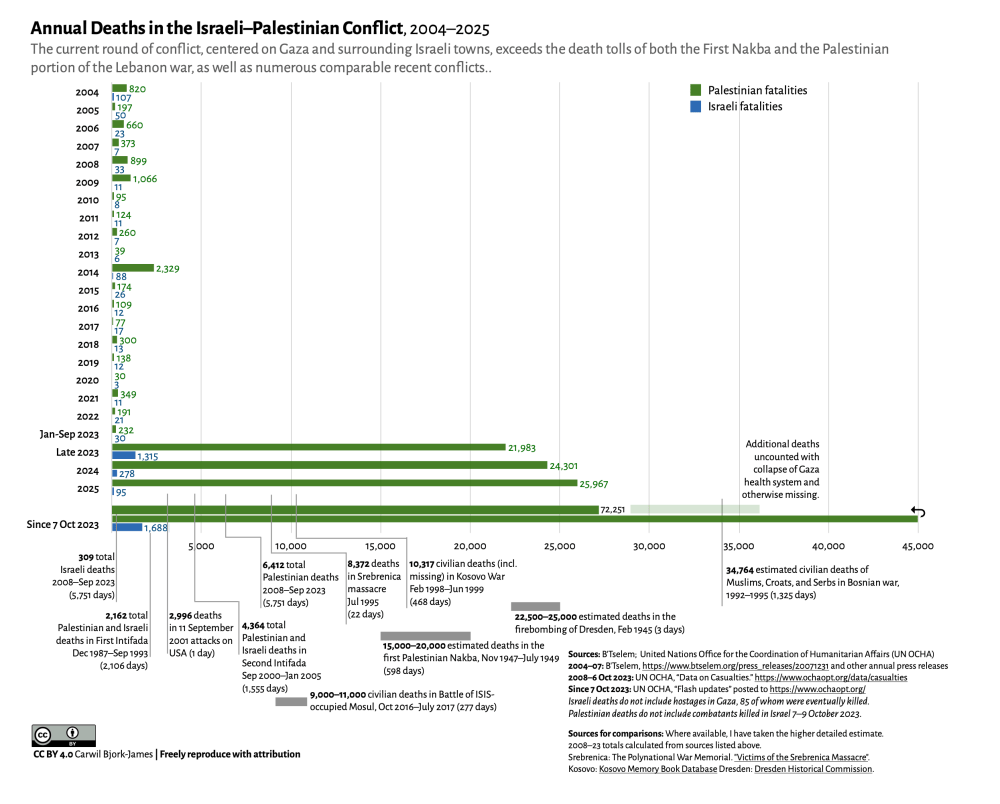
The comparisons I made about the first eleven months now apply with equal force to each of three years of violence. Palestine’s loss in each year exceeds…

  • Israeli losses on October 7 (1139 including, 373 security forces, 36 children) by a factor of 36 to one.
  • 2,162 total Palestinian and Israeli deaths in First Intifada Dec 1987–Sep 1993 (2,106 days)
  • 2,996 deaths in 11 September 2001 attacks on USA (1 day)
  • 4,364 total Palestinian and Israeli deaths in Second Intifada Sep 2000–Jan 2005 (1,555 days)
  • 6,412 total Palestinian deaths 2008–Sep 2023 (5,751 days)
  • 8,372 deaths in the genocidal Srebrenica massacre, Jul 1995 (22 days)

… combined.

By all measures but territorial loss and villages destroyed, but including deaths, deaths of children, number of people displaced, and number of homes and building destroyed, this assault is far larger than the first Nakba. During those 598 days, Palestine suffered 15,000 to 20,000 estimated deaths. We now stand at twice that toll. Upwards of 1.9 million Palestinians have been expelled from their homes, over twice as many as during the event Palestinians have remembered as their greatest tragedy.

Download: Annual Deaths in the Israeli–Palestinian Conflict as a PDF.
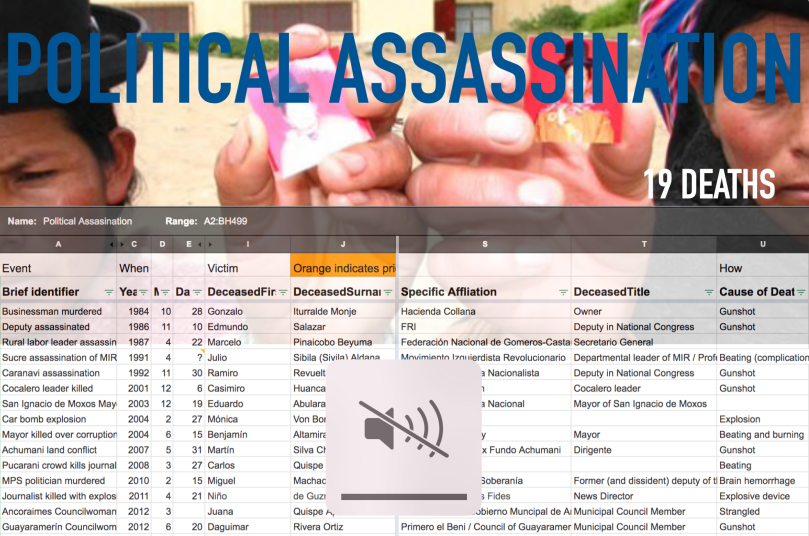
Introducing Ultimate Consequences: A digital archive on lethal conflict in Bolivia, 1982–present (video)

Introducing Ultimate Consequences, presented as video-on-demand at AAA 2022.

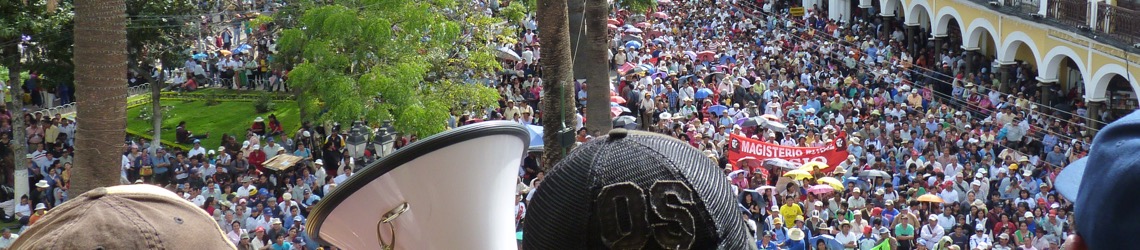
This presentation introduces Ultimate Consequences, a quantitative and qualitative database, unique in its depth and completeness of coverage, of all conflict deaths in Bolivia since October 1982, a period of largely elected governments and political dynamism. The country’s 1977–82 return to democracy, 1985 general strikes, 2000–2005 antineoliberal protest wave, and its political crises in 2006–2008 and 2019–2020 each exemplify the ability of mass disruptive protest to remake national politics. The database enables comparative analysis across twelve presidential administrations, four episodes where protesters successfully sought the end of a presidential term, and 192 protest events in 17 domains of conflict. Due to the number of lethal events in the study period, the dataset is both large enough for quantitative research that analyzes patterns and small enough for qualitative, journalistic, and historical examination of the individual deaths involved. To serve these multiple purposes, we are coding information such as individuals’ relation to a specific social movement, protest campaign, cause of death, responsible parties, and location, and writing detailed narrative descriptions about major events. The presentation introduces the open data format of the database and the R-based tools to explore it.

The project draws on journalistic, advocacy, and scholarly sources to comprehensively document all deaths in political conflict, including those not readily categorizable as human rights violations. The project also seeks to ask more intimate, and cultural, questions about the role of risk, violence, sacrifice, and loss in transformative social change. As the database reveals, Bolivian protest can involve intense risk, privation, self-sacrifice, and either enduring or inflicting violence. Bolivian social movement traditions include proclamations of fearlessness and vows to carry on their struggles “until the ultimate consequences,” that is, to persist in collective measures and to refuse to be deterred by deadly state violence. These movements invoke a history of indigenous uprisings, labor militancy, and state massacres in narrating their own histories.

The dataset offers a grounded view on such questions as: What practices and political choices result in some presidencies being far less violent than others? What is the relative importance of different forms of political violence, from repression of protest to guerrilla movements to fratricidal disputes among movements? Which movements have succeeded despite deadly repression? This presentation introduces a new tool for social scientists, oral historians, and human rights advocates to use in answering these and other questions.

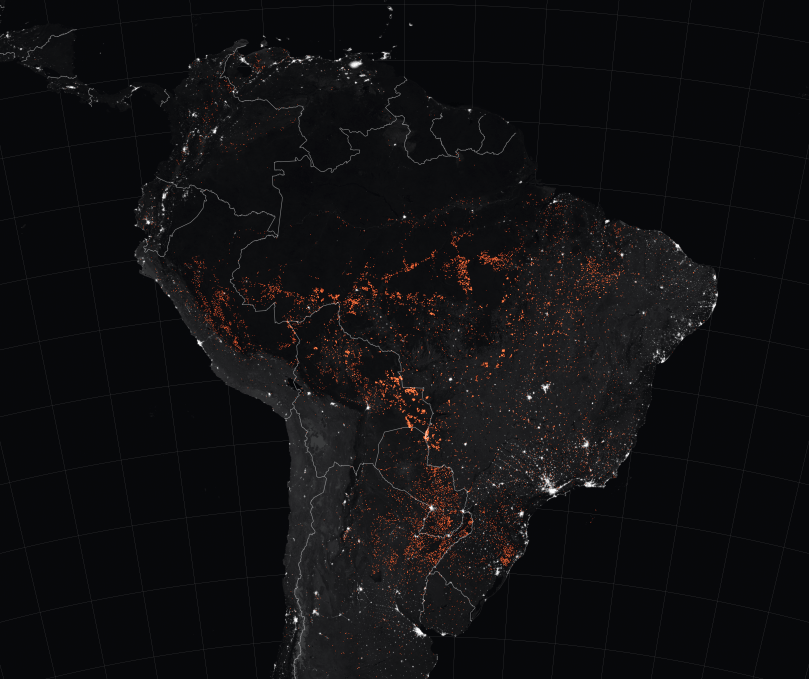
Fires rage in Brazilian Amazon, Bolivian Chiquitanía, Paraguayan Pantanal

This image from NASA offers a panorama of the fires raging across South America during the week of August 15 – 22, 2019. World attention has turned to the Amazon rainforest fires in Brazil, where ultra-right President Jair Bolsonaro has drastically cut back environmental enforcement. This week, there has been needed attention brought to Bolivia’s rapidly expanding fires, primarily in the Chiquitano dry forest. Claire Wordley offers a solid primer on the situation in English.

As of August 22, the Bolivian government reported that 744,000 hectares of the country were affected by the blazes, and by Saturday, August 24, the regional government of Santa Cruz raised that estimate to over one million hectares. These are parallel crises, caused by independently set fires. A key driver of the fires in both countries is the deliberate clearing of forest land for agricultural production, which has been prioritized by left-wing government of Evo Morales as well as the right-wing government of Bolsonaro.

Read More »