Cochabamba hosts the world…

Like what is soon to be thousands and thousands of people, I’m now in Cochabamba, Bolivia. Cbba is Bolivia’s third-largest metropolis, and fourth-largest city (both of the twins, La Paz and El Alto, are larger along with Santa Cruz). If you’ve heard of Cochabamba before, it’s probably because of the April 2000 Water War. In celebration of that event’s tenth anniversary, water activists are gathering in the 3rd International Water Fair from this past Thursday until Sunday (website). And Bolivia, which played a pivotal role in the December Copenhagen Climate Summit is hosting a global gathering to re-plant the global effort to confront damaging climate change, the World Conference on Climate Change and the Rights of Mother Earth (website), Monday through Thursday in the Cochabamba suburb of Tiquipaya. So far, there are over 14,000 registrations online for the conference, with representatives of over 60 governments and over 100 countries making the trip.

Since I’ve been passionately involved in climate change issues, but am actually focusing on other matters here in Bolivia, I’ll be channeling this week direct to you here, as well as doing my best with 140 characters at a time via twitter: @CarwilJ. Stay tuned.

As Bolivia votes, a closer look…

Bolivia’s elections are prompting the mainstream press to run a series of profile pieces, such as these: “In Bolivia, a Force for Change Endures,” New York Times; “Bolivia’s Morales favored to win re-election,” Reuters.

There has also been some hyperventilating led by the Heritage Foundation’s claim that “U.S. Should Reject Illegitimate Election Process in Bolivia.” Heritage goes so far as to advocate, “The Obama Administration should … refuse to recognize the new government Morales forms, and call for Bolivia’s expulsion from the Organization of American States (OAS).”

Leaving the election’s legitimacy to the ample contingent of observers, and noting that Heritage writers have managed to trump up Senate President Oscar Ortiz’s statement with uninformed exaggerations throughout the piece, let’s turn to Heritage’s alternate universe account of the first Morales term:

Not only have Morales’s economic policies weakened and further impoverished the already destitute poor of Bolivia, but his win in the December 6 election will empower him to further persecute what little remains of a democratic alternative.

Many of Morales supporters are indigenous Bolivians from the western highlands who have been mired in poverty for generations. Improving these indigenous people’s living conditions is certainly a laudable goal, but Morales’s methodology for realizing such improvement — statist policies and totalitarian control — has been disastrous.

As it turns out, Bolivia’s economic performance is the subject of a newly released report (announcement|pdf|flash)  by the Center for Economic and Policy Research (home of Dean Baker, the economist most vocal about the housing crisis before it became headline news). In it we find:

Bolivia’s economic growth in the last four years has been higher than at any time in the last 30 years, averaging 4.9 percent annually since the current administration took office in 2006. Projected GDP growth for 2009 is the highest in the hemisphere. It is worth noting that Bolivia’s growth for 2009 follows its peak growth rate in 2008. As discussed in more detail below, Bolivia’s 2009 growth is all the more remarkable in view of the size and number of negative shocks to the economy. These included falling remittances, declining foreign investment, the United States’ revocation of trade preferences, declining export prices and markets for part of the year and other impacts of the global recession.

In short, Bolivia has ducked the Great Recession’s global impact, something achieved by only a handful of countries. How? Largely by its partial nationalizations of natural resource extraction industries, paying down external debt (including to the World Bank and IMF, with the help of debt cancellation), accumulating currency reserves, and spending them in a stimulus that is relatively larger than ours in the United States. Where has that money gone? Partly to public investment and infrastructure, and partly directly to the poor:

In the last three years the government has begun several programs targeted at the poorest Bolivians. These include payments to poor families to increase school enrollment; an expansion of public pensions to relive extreme poverty among the elderly; and most recently, payments for uninsured mothers to expand prenatal and post-natal care, to reduce infant and child mortality.

More official sources concur in the economic success, notably the International Monetary Fund: “The International Monetary Fund said in October that Bolivia is likely to post Latin America’s strongest economic growth this year at 2.8 percent” (source: Reuters; see also Bolivia’s Gross Domestic Product over time).

Five years ago, Bolivia’s national politics revolved around the future of its national gas resources. Today, none of the candidates is even suggesting a reversal of the partial nationalization that movements demanded and the Morales government has carried out.

Further background on the elections is available from: the Cochabamba-based Democracy Center (1|2|3); Upside Down World (1); Andean Information Network (1|2); InterPress Service (1); Bolivia Transition Project (“Pre-election analysis”).

Love for Tristan, Solidarity for Ni’lin Against the Wall

This past Friday afternoon, my friend and comrade Tristan Anderson was shot in the forehead by Israeli occupation forces at a demonstration against the wall they are building across the West Bank. The International Solidarity Movement reports,

Another resident from Ni’lin was shot in the leg with live ammunition. Four Ni’lin residents have been killed during demonstrations against the confiscation of their land.

Ahmed Mousa (10) was shot in the forehead with live ammunition on 29th July 2008.  The following day, Yousef Amira (17) was shot twice with rubber-coated steel bullets, leaving him brain dead.  He died a week later on 4 August 2008. Arafat Rateb Khawaje (22), was the third Ni’lin resident to be killed by Israeli forces.  He was shot in the back with live ammunition on 28 December 2008.  That same day, Mohammed Khawaje (20), was shot in the head with live ammunition, leaving him brain dead.  He died three days in a Ramallah hospital.

Residents in the village of Ni’lin have been demonstrating against the construction of the Apartheid Wall, deemed illegal by the International Court of Justice in 2004. Ni’lin will lose approximately 2500 dunums of agricultural land when the construction of the Wall is completed. Ni’lin was 57,000 dunums in 1948, reduced to 33,000 dunums in 1967, currently is 10,000 dunums and will be 7,500 dunums after the construction of the Wall.

The campaign against the construction of an apartheid wall across the West Bank is a crucial part of changing the dynamics of occupation in Palestine. The wall is the greatest manifestation of the policies of confiscating land, turning the occupation into annexation, and maintaining a logic of social separation between Jews and non-Jews in the occupied West Bank. It is also the key place where international law, solidarity from around the world, Palestinian civil society cooperation, and nonviolent direct action are being experimented with as tools for liberation. It does not surprise me, but does make me proud that Tristan placed himself in this crucial location.

Gabrielle Silverman, an activist, eyewitness and Tristan’s girlfriend, described the scene:

We were at a demonstration against the wall, against the Israeli apartheid wall in the West Bank village of Ni’lin, which is about twenty-six kilometers west of Ramallah. I was very close to him when he was shot. I was only a few feet away. The demonstration had been going for several hours. It was wrapping up; it was almost over. Most people had already gone home.

We were standing on some grass nearby a village mosque, and Tristan was taking pictures. He likes to take pictures and post them on Indymedia, sometimes under assumed names. And he was taking pictures, and he was shot in the head with the extended range tear gas canister. He fell to—nothing was happening immediately around us, by the way, I should mention. No one was throwing rocks around us. Nothing was happening. We were standing there.

He fell to the ground, and immediately medics from the Palestinian Red Crescent responded, came running over. And more people came running over. It was very clear that he was—that there was a seriously injured person on the ground. The medics are impossible to mistake. They wear neon uniforms. They have bright yellow stretchers. The medics were working on him, were getting him onto the stretcher, and as we’re doing so, the army continues to tear gas all around us. As we’re carrying him off on the stretcher, there’s tear gas falling, tear gas canister after tear gas canister falling at our feet.

Finally, we get him to the ambulance. The ambulance is very good. The Palestinian medics were excellent. And we get into the ambulance. We drive in the ambulance to the checkpoint at the beginning of town, and we are stopped there at the checkpoint for about fifteen minutes. For about fifteen minutes, the army, the Israeli army, refuses to let us through, even though we have a critically injured person in the ambulance. And the reason why is because under no circumstances are Palestinian ambulances ever allowed to enter Israel from the West Bank. And so, with Tristan being critically injured and getting worse and worse and worse and worse and falling deeper into this abyss, the soldiers are holding us up and waiting—we had to wait there for an Israeli ambulance to come from who knows where and then transfer him into that ambulance. All of this is taking precious time.

Finally, we drive to the hospital in Tel Aviv. I should add also, once the Israeli ambulance did finally show up, there was a soldier who stood in the doorway smirking and wouldn’t move and wouldn’t let the ambulance through until finally another international activist grabbed this soldier and we slammed the door shut, and then the ambulance was first able to start moving towards the hospital. When he got to the hospital, they started doing surgeries on him. (Democracy Now!, March 16)

Solidarity demonstrations have been held in London and San Francisco. A demonstration will be held in New York on Friday. It will be at the Israeli consulate, 800 2nd Ave, 4:00pm – 6:00pm. More than 4,000 people have joined “Solidarity with Tristan Anderson” on Facebook.

Tristan has been transferred to intensive care and his condition remains serious.

Tristan is unconscious, anesthetized and artificially respirated, has
sustained life-threatening injuries to his brain (as well as to his
right eye), and is expected to undergo several operations in the
coming days.

Politicians, Wobblies pile on to support Chicago workers; BoA caves

The Republic Windows and Doors factory occupation turned out to be the right action at the right time. It attracted solidarity from Jobs with Justice, congresspeople, President Elect Obama, and from the New York City IWW (Industrial Workers of the World, a longstanding union built on anarchist principles). The NYC solidarity action visited 3 Bank of America offices:

The net result…

The 240 workers who had occupied the factory since its abrupt closing Dec. 5 voted unanimously Wednesday night to accept a deal to pay them severance, vacation time, and temporary health care benefits. The $1.75 million agreement was negotiated over three days with the workers’ union, Republic owners and lender Bank of America.

Union negotiators were unable to obtain a commitment from the parties to reopen the Goose Island plant, said United Electrical Workers organizer Mark Meinster. So the union has decided to forge ahead to find someone new to run the plant, he said, using some of the money donated from around the world during the sit-in. (Chicago Tribune)

The settlement, happily coming on my birthday, includes the following:

The settlement totals $1.75million. It will provide the workers with:

– Eight weeks of pay [workers] are owed under the federal WARN Act;
– Two months of continued health coverage, and;
– Pay for all accrued and unused vacation.

JPMorgan Chase will provide $400,000 of the settlement, with the balance coming from Bank of America. Although the money will be provided as a loan to Republic Windows and Doors, it will go directly into a third-party fund whose sole purpose is to pay the workers what is owed them. In addition, the UE has started the “Window of Opportunity Fund” dedicated to re-opening the plant. (Jobs with Justice)

Of course, larger success will come (or not come) as these tactics are taken up across the country, as they change agenda and form of contest, and if they make workers (and, yes, that’s us) think of themselves as owning the economy instead of just working for it.

For now the threat alone may have an impact as well, as U.S. Rep. Luis Gutierrez (D-Ill.) put it, “This Republic Windows saga, I’m sure, is reverberating throughout boardrooms in America.”

Bitch, Ph.D. notes insightfully:

The last time American workers resisted mass layoffs this way, we ended up with a middle class.
And that’s change you can believe in.

Primer on the financial mess…

Okay. No one can claim that the vortex of disappearing money is not confusing. Those of us who spend our days buying mere things with services thrown in for a bonus, are bound to be confused by the array of ways in which money, currencies, debt are bought, repackaged and sold. Not to mention the ways in which the possibility of any of those “things” fluctuating in value is then remade into a commodity in and of itself.

So, I’m assembling here (stay tuned to this post) as much background as I can on how this happened…

First up, is This American Life‘s collaboration with NPR on The Giant Pool of Money, an hour-long radio documentary on how excess cash begat a housing boom, a mortgage collapse, and the credit crunch. Ignore the bit from early this summer when they speculate that everything will only get as bad as the 1970s. As Lehman Brother’s understated last dispatch declares:

This episode of financial crisis appears to be much deeper and more serious than we and most observers thought it likely to be. And it is by no means clear that it is over.

Smart and graph-heavy expert Doug Henwood of Left Business Observer gives his take in two parts (1|2) as the crisis evolves.

The New York Times, which has had to start a blog called Freakonomics (after a book, but imagine the great grey paper running that title in stabler times), offers summaries of the crisis by David Leonhardt, “Bubblenomics,” and John Steele Gordon, “Greed, Stupidity, Delusion — and Some More Greed.”

Just in: French Opposition end support for “Occupation” of Afghanistan

A major crack in the Euro-USAmerican consensus…

The Taleban are fast regaining territory and the allies are losing the support of the Afghan people because of poor American tactics, said Jean-Marc Ayrault, the Socialist parliamentary leader. “We do not accept this slide towards a war of occupation,” he told Parliament. “Our troops are manifestly lacking in equipment,” he added.

Public opinion was against Mr Sarkozy’s decision to send more combat troops last spring. Emotion over the August ambush has raised demands for an immediate pullout, an option now backed by more than 60 per cent of the public, polls show.

Soldiers’ families have been stirring passions with public attacks on the President and the military for sending young soldiers to their deaths. Wives of soldiers complained that they could not stand the strain of knowing that their men were in possible combat. “If he doesn’t phone by 8pm I start worrying myself sick,” said one. (more from the Times of London)

“Eco” Opponents of Immigration Really Concerned about Brown People, Not Green Issues

Writing in the SF Chronicle (“The changing face of America poses risks”), Californians for Population Stabilization cites recent Census projections on US racial demographics to expose his, the group’s and allegedly white America’s fears about losing control of the country.

the increasingly rapid erosion of the white population in America raises the stakes considerably no matter who wins the White House. The question transcends what the occupant of the Oval Office looks like and becomes whether whites are ready for the accelerating changes that will result in an America that no longer looks like them, sounds like them or necessarily embraces their cultural tastes.

The author, Mark Cromer is a “senior writing fellow” for CPS, a group spun off from Zero Population Growth, and descended from the efforts to use the Sierra Club to oppose immigration to the United States on ecological grounds. Perhaps the Earth isn’t exactly their top priority. With current projections showing the U.S. will no longer have a non-Hispanic white majority in my generation’s lifetime, Cromer is focused on so-called stability of racial divides:

In just over 300 of [3100 U.S. counties], ethnic minorities are now the majority population. The effect has often been the real-world elimination of hard-won racial balances, with traditional working and middle-class black and white communities effectively disappearing. In many places throughout Southern California, the white flight that marked the efforts at integration in the 1960s and early 1970s struck again in the 1990s, turning into a middle-class Anglo exodus from the state in the face of massive immigration from Mexico, helping create the first minority-majority state in the union.

In essence, he’s saying those whites who agreed to “tolerate” a certain level of black faces are not okay with black and brown people together outnumbering. The result he predicts is this…

This demographic upheaval has spawned another phenomena among the white middle class that has become iconic: the gated community.

Knowing the white folks in my own family who fled for the far suburbs when their neighborhood became “too ethnic,” I’m hesitant to dismiss this explanation. Such frankness on the anti-brown-immigrant, pro-white-flight side is very rare. But when it comes to policymaking, Cromer is calling for a racial compromise that means racial planning of immigration policy:

to begin any new round of negotiation on immigration reform with an understanding that any effort to legalize the status of millions of illegal immigrants will be matched with a commensurate reduction in legal immigration into the United States, spread out over years. This would go far in ameliorating the pervasive sense among whites that America is being overrun.

Read that again. More legalization of brown people must be offset less legal immigration of brown people. The presence of people of color feels like “America” is “being overrun.” Of course not all people have this racist perspective, but important thing is to compromise between other values and racism:

Failure to seize the opportunity to build a real national consensus – one that can only be obtained through what surely will be a hard-fought compromise – is to risk further alienating a white majority that will ultimately insist on having its voice heard on these issues, one way or the other.

The question is: do racist fears deserve a seat at the table in planning our cities and policing our borders, or should we act beyond racism and let our neighbors be whoever moves into the houses and apartments next door? Fortunately the answers will come with the free decisions and political lives of my generation. I want to ask my white peers whether this represents you, your friends, or your cousins. I’m really curious, and will strive not to be judgmental:

it’s not the end result that most white Americans probably find troubling today, but rather the factors that are fueling those projections [of a white non-majority], namely unrestrained immigration and the increasingly bitter sense that they’ve had little to no say about this matter.

Oh, and if this doesn’t represent you, consider dropping a line to the writer at Mrcromer@aol.com.

Dad makes the papers…

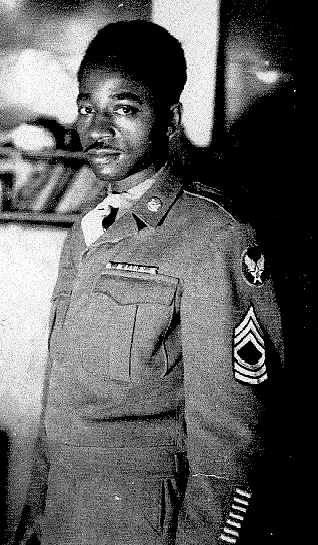
Frank JamesSo, my father has been spending a lot of the last five years remembering and retelling the story of his past, especially during World War II. The main result is a self-published memoir, Capers of a Medic, courtesy of some herculean typing and editing work by my mom. It’s been a real pleasure and an amazing gift to have access to this portion of his life. A couple weeks ago, he told his story in person to reporter who came by my parent’s house. The result appeared today in Cleveland’s Plain Dealer:

Many who fought and survived, in so many different ways, during World War II are gone now.

Some took their stories with them.

But not this one.

For every World War II GI who pulled a trigger, dropped a bomb or fired a shell, there were thousands of people making sure they could.

They were the support and supply troops who, as famed war correspondent Ernie Pyle noted, toiled “from day to day in a world full of insecurity, discomfort, homesickness and a dulled sense of danger.”

Among them were many of the 1 million black Americans who served during the war, including Frank James, 83, of Shaker Heights.

read more on Cleveland.com

Something you learn fast when you start to listen to black soldiers of this era, is the immensely two-sided nature of the war, the way they were forced to fight on two fronts at times, and to choke back their well-grounded outrage to racism at home at other times. There’s also a generational experience of being respected, through their ranks, through being seen as liberators, through encountering people not schooled in racism American-style, that a million black men, my father included, brought home. It stiffened his, and their, spine for the hard work ahead.

The book is available from me (for those who know me), or online at CapersofaMedic.com.

The First Amendment is So Eighteenth Century…

Once again the U.S.’s now right-shifted Supreme Court has reaffirmed the concept that limiting spending on political ads is limiting speech. They threw out campaign finance regulations that restricted corporations from funding issue-based ads that are parallel equivalents to giving money to candidates. As John Bonifaz of Voter Action puts it:

The court continues to equate money with speech in the political process. But beyond that, it gives First Amendment rights to corporations. And these artificial entities don’t have the same, obviously, qualities as you and I do as breathing human beings, and they should not be given those kind of First Amendment protections.

The fact is, is that we need to protect the electoral process and to protect our democracy. And we should not have big money corporate interests drown out the voices of ordinary citizens. The court does not weigh in any way whatsoever the First Amendment rights and the equal protection rights of voters, of people who do not have access to wealth, but yet under our Constitution and our promise of democracy have an equal right to participate. And that continues to be a problem with the court’s jurisprudence in this area.

In a way the ruling is no surprise, as the legal equation of money with speech is long standing in the U.S., and corporations have maintained the status of “people” with legal rights (except the right to die after a reasonable period, it would seem) since the 1880s. More importantly, the U.S. view of what exactly is free speech is stuck in the eighteenth century. That’s how you have the traditionally liberal ACLU supporting this strange entitlement for corporations. (See also Kaja Tretjak’s “Why U.S. Liberalism Must Change or Die“)

What do I mean by stuck in the eighteenth century. Take this snippet of the ruling:

The First Amendment requires us to err on the side of protecting political speech, rather than suppressing it. Where the First Amendment is implicated, the tie goes to the speaker, not the censor.

Now it’s easy enough to argue about whether buying television and radio ads is political speech, especially when it’s a kind of speech that 98% of us could never have, or whether protecting a kind of speech where a few people are massively louder than everyone else makes sense at all.

But I’m writing this from Mexico City, and that offers a bit of perspective. One of the prime issues in last year’s disputed presidential election is the intervention of private corporations into the election at all. And, they intervened quite massively by using fear-stoking political ads insisting the left-leaning PRD candidate, Andres Manuel Lopez Obrador was a “danger to Mexico” and threatening massive economic collapse should he win. An entire block of Reforma Avenue, a central thruway in the City which is now lined with a massive outdoor exhibition charging the winner with fraud, is devoted to this corporate intervention. Now in Mexico, corporate funding of candidates is just plain illegal, while in the U.S. it’s an industry (for all you ever wanted to know about that industry, ask the Center for Responsive Politics). Free speech is a shared concept in both countries, but it means something different.

Encoding the right of free speech and a free press, our First Amendment is a bit vague: “Congress shall make no law … abridging the freedom of speech, or of the press;”. That “make no law” clause meant that violations of free speech weren’t even subject to lawsuits until after the Supreme Court took the 14th Amendment (1866) to mean that rights were defensible. And it took decades of defiance of baton-wielding cops to guarantee regular practice of free assembly, something not really achieved until the unionization push of the 1930s. For the press, though, the no-interference nature of the 1st Amendment boils down to what A.J. Liebling said: “Freedom of the press belongs to those who own one.” So Eighteenth Century.

What do I mean by Valley Girl-style dissing the Constitution? I mean, get with the program. This press freedom for those who own one thing isn’t convincing anyone, in the same way that giving property owners only the vote is passe. And like a lot of things, if you zoom out from the U.S., you see a lot of people have different ideas. The biggest change is to think of rights as belonging to people (all of them, right) instead of restricting the government. So you have South Africa’s constitution:”Everyone has the right to freedom of expression, which includes ­1. freedom of the press and other media; 2. freedom to receive or impart information or ideas; 3. freedom of artistic creativity;” or even clearer the Universal Declaration of Human Rights: “Everyone has the right to freedom of opinion and expression; this right includes freedom to hold opinions without interference and to seek, receive and impart information and ideas through any media and regardless of frontiers.”

Whoa, “any media” for everyone. That’s going to take some work. Yeah, it’s time to move from our limited idea of freedom (the government leaves you the heck alone) to something which takes work, but is worth fighting for. Building our own media is as much a part of the free speech struggle as is suing for it. That takes all kinds of forms: When the Solidarity movement in Poland (look ’em up, ’cause they were once so rad) demanded a free right to publish, it’s demand was backed up by printing press workers taking over their shops to print & by the free use of pasted poster & graffiti if they weren’t going to be allowed on air. The May 1970 student takeover of Berkeley and the May 1968 revolt in France essentially turned universities into giant publication factories (all those xerox machines and paper), with Berkeley having public competitions among art students to design the best posters and students running from Berkeley and downtown Paris to outside and inside factories organizing blue collar folks to join them. Oaxacan women nonviolently invaded a TV station last summer when they were tired of being ignored, and when a long while later riot police chased them out, activists took over at least ten more broadcasters and opened their doors and their airwaves.

Less confrontationally, but just as effectively, zine publishers & internet folks have been spreading out “those who own one [a press, remember]” to the rest of us. Check out Electronic Frontier Foundation, which has been acting as the legal and legislative defense arm of that effort for the past couple decades.

Cue soundtrack: They Might Be Giants, “I should be allowed to think.”

Empathy

..means shared pain. Without it solidarity is impossible, and support is optional. With it, we on the trigger side of empire have a chance of uniting with the rest of humanity.

After several years of various activist stints against the Guantanamo Bay prison, I found that the group Outlandish had a song about it. Which led me to their moving piece “Try Not Cry.” Have a listen if you can, perhaps by checking out a home-made video here. Some of the lyrics:

Hmm, a little boy shot in the head / Just another kid sent out to get some bread / Not the first murder nor the last / Again and again a repetition of the past / Since the very first day same story / Young ones, old ones, some glory / How can it be, has the whole world turned blind? / Or is it just ’cause it’s only affecting my kind?!

I grew up with a kind of visceral affinity for kids throwing stones at tanks and riot police. South Africa, first of all. When an a form of oppression cuts you in two, it gets obvious. But Palestine too, where the first Intifada brought out those Mahmoud Darwish would call “the children of the stones,” shaming their elders with their refusal to accept their fate.

No matter how clearly I know that empire isn’t new, it still breaks my heart for my neighbors to be the ones driving the tanks now.

p.s. Also check out Outlandish’s video of Look Into My Eyes.