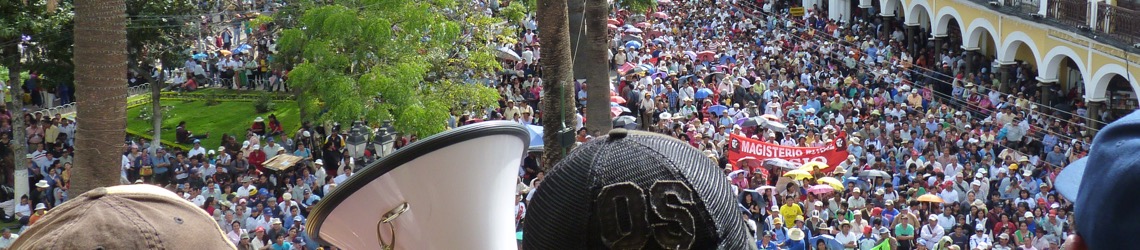
The most powerful forms of worker action, illegal in the USA

The worst active anti-union law in the United States was not Scott Walker’s recently passed assault on collective bargaining by state employees, but a law that makes many of the most powerful ways for workers to fight back against such a law illegal: the 1947 Taft-Hartley Act (wikipedia). That law makes many practical collective responses used by unions around the world illegal acts (technically “unfair labor practices”) in the United States. Nearly all of these are recognized as part of the fundamental right of freedom of organizing, recognized by international conventions to which the United States is a signatory. Among these actions are:

  • Jurisdictional strikes—A strike to demand that work be performed by members of the union
  • Wildcat strikes—Strikes called from the workplace floor, for new demands or in direct response to events
  • Solidarity strikes—A strike by one workplace in solidarity with a strike at another
  • Political strikes—Strikes in support of demands that extend beyond a single workplace, such as the minimum wage, overtime rights, or national health care
  • Secondary boycotts—The refusal of workers at one company to handle goods from another company during a strike there
  • Secondary picketing—Picketing (say be striking workers at one workplace) intended to get workers at a second shop to engage in a secondary boycott

If you haven’t worked for union or gone out on strike, you probably have never heard this list, and the first items that are illegal probably sound like basic elements of free speech. Harry Truman, whose veto of the Act was overriden, would agree with you. He called the law a “dangerous intrusion on free speech.”
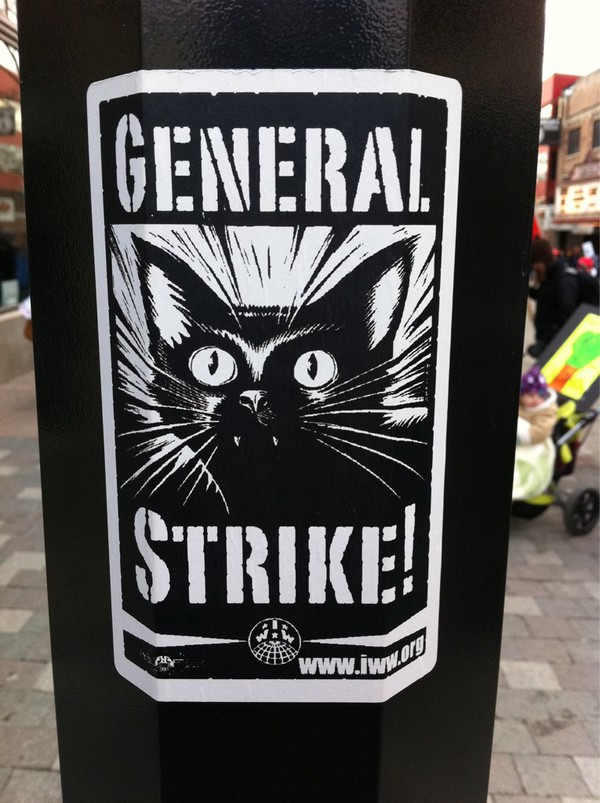
Today, as union members, people who believe in the right of workers to represent themselves, and people who hope for a better life for themselves and their communities debate how to respond to Scott Walker’s union-busting bill in Wisconsin, far too many effective forms of nonviolent collective action require formally breaking the law. Increasing numbers of union activists have brought up the general strike, a coordinated work stoppage by multiple unions, and ideally the public at large, as a means of exerting pressure. General strikes are in fact ideal ways for workers to press demands on a government: Spanish and Italian workers have repeatedly pressed for wage increases through general strikes; Bolivians have used general strikes for a broad range of goals; the French used them to oppose raising the retirement age; and most of Western Europe established the worker protections they enjoy under threat of general strikes. It is indeed an exciting time now in Wisconsin because this extremely powerful tool is being broadly considered. However, incorporated unions have to consider the legal risks in not just calling a general strike, but in taking steps beyond wearing a common color in solidarity (one of the other proposals being planned right now). Meanwhile, right-wing opponents are covering this debate under the headline, “Socialists, Unions Plotting Illegal Strike in Wisconsin.”

We should remember that illegal does not mean immoral, or wrong-headed. Like the right to bargain collectively, the right to strike and the right to strike together to press common demands are basic forms of democracy; they are rights that everyone has, as even our government has recognized at the international level. Rolling back laws that turn rights into crimes should be on our agenda, whether those laws are from 2011 or 1947.

USAID and Counter-Insurgency: Five Decades Old

The State Department (@StateDept) reminds us that the United States Agency for International Development has it’s 50th anniversary today. Somehow, the United States had the bright idea to place its international aid agency within the national security apparutus right from the start. John F. Kennedy and his top global policy planners saw USAID, the Alliance for Progress in Latin America, and other friendlier faces of the US government as working hand-in-glove with the planners of military maneuvers, trainers of military and para-military forces, and plotters of coups.

Not only was Kennedy into such soft power–hard power collaboration, but he was personally fascinated by counter-insurgency (a word that would later become so common, it lost its hyphen). John F. Kennedy, a man with a political halo is most American circles, brought about the Green Berets and the Special Warfare School at Fort Bragg, North Carolina. In March 1961, just as US AID was getting its commission publicly, a committee of the National Security Council (later the Special Group – Counter Insurgency) was commissioned to report on “U.S. Strategy To Deal With Wars of National Liberation,” as put in the title of the report they issued in December.

This report did not remain in a file, but instead drove new concepts like “counter-insurgency” and “internal defense” into the heart of US foreign policy for a generation. In Latin America, where I am now, “internal defense” became “internal security” or the “national security state,” the key American vision for reorienting Latin American militaries towards a new enemy: internal leftist parties and social movements.

Here’s a breakdown of the worldview behind this (all quotes are from the Overseas Internal Defense Policy written for the National Security Council in 1962; I swear no critic of the government was involved in making any of this up!):

  1. Communism was the global enemy, but the most serious losses to it had come in China, Vietnam, Cuba, and Algeria, where local leftists were almost entirely responsible. This is called internal agression.
  2. “Communists often infiltrate nationalist and reform movements.” So they might be a problem too.
  3. Everyone’s a target: “The vital sectors within modernizing societies include the rural sector; the labor front; students and youth organizations; the intelligentsia; the educational systems; internal communications and informational media; the military and police; religious groups; the civil bureaucracy; the various middle-class elites; ethnic minorities; and the political parties, sometimes including a legal communist party but invariably an illegal communist apparatus operating underground or through various fronts.”
  4. This matters to the USA because (1) We like freedom; (2) For military reasons, “strategic areas and the manpower and natural resources of developing nations” must not fall under communist control; (3) For economic reasons, “resources and markets of the less developed world [must] remain available to us.”
  5. The USA can get involved everywhere: to “immunize” countries where there is no insurgency, to “defeat the threat” where “subversive insurgency is latent or incipient,” and to train countries for and get involved in fights against insurgents.
  6. We need to get local governments to sign on to this policy. “To persuade these leaders to act in the interests of their society is often a complex and subtle task. … It is therefore essential that U.S. Country Teams know where the points of strength and vulnerability lie. This done, they can determine how to strengthen those elements which most effectively support U.S. objectives.”
  7. The US is okay with revolution: “The U.S. does not wish to assume a stance against revolution, per se, as an historical means of change. … A change brought about through force by noncommunist elements may be preferable to prolonged deterioration of governmental effectiveness or to a continuation of a situation where increasing discontent and repression interact, thus building toward a more dangerous climax.”
  8. However, the US will act against any revolution still in its early stages: “Where subversive insurgency is latent or incipient, U.S. strategy will be directed toward its elimination, lest it provide a communist foothold and escalate into active insurgency.”
  9. All hands on deck! “Anticipating, preventing and defeating communist-directed insurgency requires a blend of civil and military capabilities and actions”

Okay, so what does this have to do with USAID? Well, guess who was on the Special Group – Counter Insurgency:

  • Military Representative of the President, Chairman
  • The Attorney General
  • Deputy Under Secretary of State for Political Affairs
  • Deputy Secretary of Defense
  • Chairman, Joint Chiefs of Staff
  • Director of Central Intelligence
  • Special Assistant to the President for National Security Affairs
  • Administrator, [US]AID
  • Director, USIA

Further, the AID has a strategic role in “immunizing” countries against uprisings, in making the existing social order more palatable, and in training militaries and paramilitaries. Or as the NSC put it:

Where subversive insurgency is virtually non-existent, or incipient (PHASE I), the objective is to support the development of an adequate counter-insurgency capability in indigenous military forces through the Military Assistance Program, and to complement the nation-building programs of AID with military civic action.* The same means, in collaboration with AID and CIA, will be employed to develop a similar capability in indigenous para-military forces.

*[From the glossary]: The use of preponderantly indigenous military forces on projects useful to the local population at all levels in such fields as education, training, public works, agriculture, transportation, communications, health, sanitation and others contributing to economic and social development, which would also serve to improve the standing of the military forces with the population.

And just in case you’re thinking that USAID-Counterinsurgency cooperation is so fifty years ago, here’s a quote from the US Government Counterinsurgency Guide of January 2009:

“The large numbers of foreign service nationals that make up the professional cadre of field staff provide a unique understanding of the local situation, while the range of sectors and levels of activity allow USAID great operational flexibility and agility to both implement and track the effectiveness of COIN operations.” (Appendix: US Government Roles in COIN [Counterinsurgency], p. 51)

So, happy birthday, USAID! And remember, if anyone confuses you with an organized attempt to thwart radical social change, it’s just because they’ve figured out your mission statement.

Bibliographic note: The Overseas Internal Defense Policy is just one of many declassified documents now freely available. Many subsequent implementation decisions on counter-insurgency issues are part of the Presidential Decision Directives archive by the Federation of American Scientists.

From Bolivia to Egypt: Overcoming Death and Fear

As I alternate between interviewing Bolivians about the process of mass collective action that overthrew two neoliberal governments in 2003 and 2005, and watching the unfolding uprising in Egypt by the Internet, I’m doing my best to learn from both situations. For now, here’s one bit of writing describing Bolivia’s 2003 Gas War that seems especially relevant to events in Egypt in 2011:

Hay ocasiones en que la muerte y el miedo son los puntos infranqueables que detienen una insurgencia social frente a las murallas del gobierno. Por eso el Estado necesita monopolizar la coerción legítima pues ésta, que encarna el posible uso de la violencia y muerte en contra de la sociedad, es la garantía última y final de todo orden político constituido. Sin embargo, hay momentos en que la muerte cataliza el ímpetu de la sublevación, en que la muerte es la seña que permite unificar colectividades distanciadas dando pie a un tipo de hermandad extendida en el dolor y el luto. En ese momento la muerte es derrotada por la vitalidad de una sublevación de voluntades sociales llamada insurrección.

There are occasions when death and fear are the insuperable obstacles that stand in the way of a social insurgency outside the walls of government power. For this reason, the State needs to monopolize legitimate coercion, which embodies the possible use of violence and death against the society, since this is the last and final guarantee of every constituted political order.

Nevertheless, there are moments in which death [instead] catalyzes the impetus of the uprising, in which death is the sign under which formerly distant collectivities can unify, giving rise to a sort of extended bortherhood of pain and mourning. In that moment, death is defeated by the vitality of the uprising of social wills that is called insurrection.

—Álvaro García Linera, “La sublevación indígena popular en Bolivia
[The Indigenous Popular Uprising in Bolivia],” 2004

Denying Reality to Defend Power

Self-censorship may not be the most pernicious form of censorship out there, but it certainly can reorient one’s perspective on what really is happening in the world. It’s strange enough to interact with people without a shared vision of what is actually happening in the world. Even stranger is to watch people deliberately repress their own knowledge in the service of a political agenda, whether that’s misinforming the public about global warming, “protecting” secrets that have already been released, or sustaining a deceptive narrative of the Great Recession.

One

Democracy Now! has obtained the text of a memo that’s been sent to employees at USAID. This is to thousands of employees, about reading the recently released WikiLeaks documents, and it comes from the Department of State. They have also warned their own employees. This memo reads, quote, “Any classified information that may have been unlawfully disclosed and released on the Wikileaks web site was not ‘declassified’ by an appopriate authority and therefore requires continued classification and protection as such from government personnel… Accessing the Wikileaks web site from any computer may be viewed as a violation of the SF-312 agreement… Any discussions concerning the legitimacy of any documents or whether or not they are classified must be conducted within controlled access areas (overseas) or within restricted areas (USAID/Washington)… The documents should not be viewed, downloaded, or stored on your USAID unclassified network computer or home computer; they should not be printed or retransmitted in any fashion.” That was the memo that went out to thousands of employees at USAID. The State Department has warned all their employees, you are not to access WikiLeaks, not only at the State Department, which they’ve blocked, by the way, WikiLeaks, but even on your home computers. Even if you’ve written a cable yourself, one of these cables that are in the trove of the documents, you cannot put your name in to see if that is one of the cables that has been released. (Democracy Now!)

The Library of Congress followed suit in blocking Wikileaks, prompting a lively debate among librarians on information access.

Two Media Matters exposed the following memo from Fox News managing editor Bill Sammon: “…we should refrain from asserting that the planet has warmed (or cooled) in any given period without IMMEDIATELY pointing out that such theories are based upon data that critics have called into question. It is not our place as journalists to assert such notions as facts, especially as this debate intensifies.”  To quote Media Matters,

“Contrary to Sammon’s email, the increase in global temperatures over the last half-century is an established fact. As the National Climatic Data Center explains, the warming trend ‘is apparent in all of the independent methods of calculating global temperature change’ and “is also confirmed by other independent observations.'”

(Further outrage from the über-centrist National Wildlife Federation)

Three

The bipartisan Financial Crisis Inquiry Commission was established by law to “examine the causes, domestic and global, of the current financial and economic crisis in the United States.” …

It’s a straightforward story, but a story that the Republican members of the commission don’t want told. Literally.

Last week, reports Shahien Nasiripour of The Huffington Post, all four Republicans on the commission voted to exclude the following terms from the report: “deregulation,” “shadow banking,” “interconnection,” and, yes, “Wall Street.”

When Democratic members refused to go along with this insistence that the story of Hamlet be told without the prince, the Republicans went ahead and issued their own report, which did, indeed, avoid using any of the banned terms.

That report is all of nine pages long, with few facts and hardly any numbers. Beyond that, it tells a story that has been widely and repeatedly debunked — without responding at all to the debunkers. (“Wall Street Whitewash,” by Paul Krugman)

It’s been said that, Everyone’s entitled to their own opinions; but everyone is not entitled to their own facts. Someone tell Fox News, the State Department, the Library of Congress, and the Financial Crisis Commission.

U.S. torture of detainee reaching the reckoning stage…

After a U-turn by President Obama, it would seem we (yes, I sometimes use the U.S. we) have reached the point of actually contemplating criminal responsibility for systematically authorizing torture of “War on Terror” detainees. It would seem that once again the flawed-but-awesome Freedom of Information Act, the American Civil Liberties Union, and the bizarre nature of the state, which must both record everything and make up completely implausible justifications along the way, all deserve part of the credit. The camel’s-back-breaking straw seems to be this footnote in the May 30, 2005 memo:

The CIA used the waterboard “at least 83 times during August 2002” in the interrogation of Zubaydah. IG Report at 90, and 183 times during March 2003 in the interrogation of K[halid] S[haikh] M[ohammed], see id. at 91. (May 30, 2005 memo available from the ACLU)

More details are available from the blogger who first publicized it, Marcy Wheeler of emptywheel.

As the paper trail is taken out from under a Bush administration coverup, we’re going to have to rewrite the entire narrative. In the process, we seem to be undergoing a moral transformation as well. As British reporter Phillippe Sands narrates it:

With a wide-ranging Spanish criminal investigation into torture at Guantánamo threatening to embarrass the US, Barack Obama decided to declassify legal memos sent under the Bush administration in the hope the country would move on. The opposite has happened. Ever more documents set out in meticulous detail the full extent of the cruelty: who was abused by whom, how they did it and what was done. The truth has been revealed in stark detail, from the number of times waterboarding was used to the legal deliberations that led to it. By Tuesday, President Obama had raised the possibility of US war crimes trials and far-reaching inquiries, developments that were unthinkable a month ago. (The Observer)

I’m not as hopeful that we’re really at a turning point on torture, as revealed by the unimpressive and unmoving poll results this week.

Currently, nearly half say the use of torture [“in order to gain important information”] is often (15%) or sometimes (34%) justified; about the same proportion believes that the torture of suspected terrorists is rarely (22%) or never (25%) justified.

However, public exposure of the realities of Guantanamo, Bagram, the CIA Black Sites, and Clinton-initiated extraordinary rendition, can only be useful in transforming Americans into the morally aware creatures we have the capacity to be. [Homework assignment in that direction: listen to Maher Arar, the Canadian computer programmer “we” rendered to Syria describe his detention, torture, and its effect on his life. The compare “cramped confinement” as authorized in the 2002 and 2005 memos.] We might emerge with a bit less fear of the rest of the world and a lot less confidence in our (and our government’s) righteousness.  If only the moral transformation would extend to the torture in our regular prisons and immigration detention centers…

IDF kills 30-year-old nonviolent protester in Bil’in

The weapon used against Tristan Anderson, a high velocity tear gas round, has once again proved deadly on the West Bank. This time, on Friday, occupying Israeli soldiers attacked demonstrators, including Bassem Abu Rahme. According to demonstrators’ reports, “He participated in the weekly protest and was standing in the other side of the wall, and was shouting at the soldiers “we are in a nonviolent protest, there are kids and internationals” he couldn’t continue his scrim and was shot. He was transferred to Ramallah governmental hospital, but he was dead. The funeral will be tomorrow in the village of Bilin at 1:00 pm.”

The relative position of soldiers and protesters is clear from this photo: a recently wounded Bassem is in fluorescent yellow.

April 17, 2009: IDF fatally shoots Palestinian protester. Photo by Lazar Simeonov

This was the predictable consequence of the flagrant repurposing of “less lethal” or “non-lethal” munitions to maim and kill at close range. See reporting by Israeli human rights group B’Tselem.

The Gaza War: Time for Introspection…

The December-January war in Gaza came and went too fast for people in the United States who weren’t already convinced to come to a moral reckoning with what was being done in our name, and with the money and weapons we provided. Unlike the Iraq war, advertised for over a year before, this one took place in the shadow of a U.S. national election campaign that was generally unconcerned with Israel and Palestine.

But there should be no mistake for United States residents that this war was ours. The United States government was nearly unique in providing unqualified support to the Israeli assualt, which left over 1300 people dead. Near-unanimous votes in both houses of the U.S. Congress backed the Israeli position, nearly word for word. The unprecedented demand that the Palestinian side renounce violence per se as a condition of negotiations was included in that endorsement. The new president, Barack Obama, maintained a strategic silence but made clear that “Israel’s security” is “sacrosanct” in the campaign.

The depth of this support cannot be pinned entirely on the pro-Israel lobby, athough its operation is a part of the way Washington works, with clear parallels to the Indonesia lobby that maintained a flow of arms during more than two decades of the occupation of East Timor. But US support is also an issue of popular mentality, of the minds and perspectives in our community. It combines Christianity and Fundamentalist apocalyptic viewpoints with a common self-perception of our societies as divinely blessed cities on a hill in a hostile wilderness. This perspective is the ideology that was needed by our shared histories as a settler colonial states, reinforced over the past forty years by anti-Arab racism. It’s about resonance, a shared politics that makes it possible to endorse one another’s crimes. Smart analyses of these political affinities has come from both right (see Walter Russell Mead writing in Foreign Affairs last summer) and left (see chapter 4 of Retort collectives’ Afflicted Powers).

Somehow these ideological limitations seem to distort American perceptions more than Israeli ones when it comes to Israeli actions. No doubt this combines real and legitimate guilt and remorse over antisemitism (though rarely does that come with a real self-examination about antisemitism in American history) with the World War II-centered story of American nationalism. The fact that defeating Nazi antisemitism is at the center of the last war most Americans can be proud of has made many reluctant to criticize the Jewish state that emerged in the years that followed.

But not keeping our eyes open gets us into big trouble. Fortunately, the Israeli media some times offers an up-close view that is sadly lacking in our own. So too, of course, do the Arab and international media. Right now, the Gaza war is being examined in a big way. Take a look…

Trawling for terrorists… aggressive prosecution, racial profiling, one million names

For those of you as curious as I am how exactly the Justice Department has pursued its so-called terrorism cases (the sketchy Liberty City 7 case has been discussed here in the past), there’s now a fascinating look at one of the few “successful” prosecutions thus far: the Justice Department’s prosecution of the Detroit Sleeper Cell case. This American Life devoted an entire episode to Richard G. Convertino’s prosecution of four men of Middle Eastern descent for an alleged plot to attack Disneyland. Leaps of logic and imagining the worst appear to have combined with a zealous effort at prosecution. The case unraveled not due to any search for justice, but, it seems, due to internal Justice Department politics, which raise huge questions about public accountability. Reporter Petra Bartosiewicz’s The Best Terrorists We Could Find should make an interesting read when it comes out next year.

Meanwhile the FBI is proposing to let race and travel schedules tell them who is a terrorist, according to the Center for Constitutional Rights:

The proposed guidelines would give the domestic intelligence agency authority to investigate American citizens and residents without any evidence of criminal acts, relying instead on a “terrorist profile” that would include race, ethnicity and “travel to regions of the world known for terrorist activity” to spark an initial “national security investigation.”

These proposed guidelines would also allow, according to the reports, for FBI agents to ask “open-ended questions” about the activities of Muslim or Arab Americans, or investigate them if their jobs and backgrounds match other criteria considered to be “suspect.” Once this initial investigation stage was completed, a full investigation could be opened – allowing for wiretapping of phone calls or deep investigation of personal data – all guided merely by a “terrorist profile” that openly relies on race, ethnicity, religion and community connections.

Do something about it by pressuring Attorney General Mike Mukesey.

Also, the “terrorist watch list” is now over a million names. More on who’s on it from the ACLU.