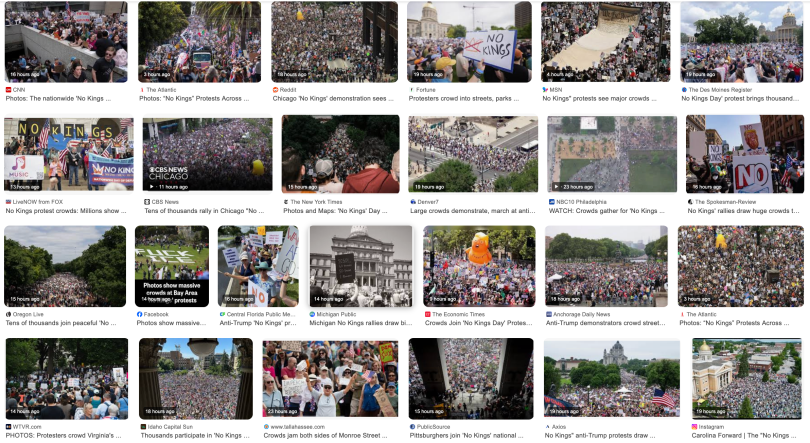
Grid of images of No Kings protests on June 14, 2025

No Kings protests were extraordinary. How exactly?

Americans, citizens and immigrants alike, protested on Saturday, June 14, in exceptional numbers as a wave of No Kings protests became the most widespread public repudiation of the second Donald Trump administration. These protests, which were undoubtedly energized by the standoff between Los Angeles-area communities and Federal troops, could mark a turning point from isolated protests to mass resistance.

Protests are called demonstrations for a reason. And these were displays of political strength for a movement that has a lot to prove: that it better represents the country than a president elected with a slim plurality in November 2020, that it is better able to capture public enthusiasm than an incipient fascist movement, and that it is undeterred by the state violence shown through military deployments, arrests of opposition leaders, and near-disappearances of a growing number of immigrants.

So what does success look like for a mass display of public will?

One simple metric is comparative: did a the anti-Trump movement out-organize and out-turnout their opponent. And here, the juxtaposition with Trump’s military parade — a celebration of the US Army’s 250th birthday on Trump’s 79th — will be unforgettable.

The King’s Parade vs No Kings Protest

News Eye (@newseye.bsky.social) 2025-06-14T22:36:16.034Z

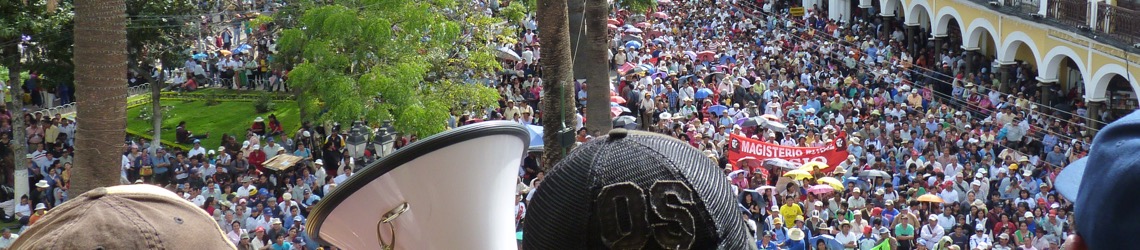
But in a larger sense, protesters make a political statement through crowds (and yes, through many other kinds of actions, but June 14 was largely a day for crowds). When they succeed, that message is “indisputable in its overwhelmingness,” as Argentina’s Colectivo Situaciones described the protests that brought down three presidents on December 19 and 20, 2001. Through some alchemy of place, time, presence, voice, and action, crowds constitute themselves into the “The Voice of the People.” And assert that they, and not their government, will decide the future.

I want to use this occasion to share how those of us who study mass protest try to conceptualize just how protests achieve that kind of political impact.

Read More »
Mistrial ruling text

Jurors, Rape, and #TheEmptyChair

  • Was an acquaintance or someone you know closely the victim of an unwanted sexual touching or assault?

In January 2015, jurors being impaneled for the rape trial of former Vanderbilt students Brandon Vandenburg and Corey Batey were asked this and similar questions. This turned out to be a pivotal issue because although the jury convicted both men of multiple counts of aggravated rape and sexual battery, the jury foreman’s impartiality was called into question based on his answer to this question. The foreman had had sex as a sixteen-year-old with an older man, who was prosecuted for statutory rape and did not mention this fact during jury selection. On June 23, Judge Monte Watkins found the juror ought to have disclosed his past and ruled that the juror’s “credibility had been tainted and brought a presumption of bias to the jury.” (His ruling did not imply that the juror intentionally withheld the facts or that he sought to influence the outcome.)

There’s experimental evidence that victims of a particular crime are more likely to convict defendants charged with that crime. This evidence backs up the common legal idea that such jurors must be probed for bias and may be removed by the defense. (On the other hand, withholding is very common practice: a study using follow-up interviews found that 25% of jurors in 31 trials were victims of a crime and 30% knew a law enforcement officer, but did not reveal these facts in voir dire.)

The sheer frequency of sexual assault and the stigma surrounding being its victim, however, raises a more complex problem. Being a survivor of sexual assault is very common: to take one data source, the CDC, 18.3% of US women and 1.7% of men report having been raped; between 5 and 6% of both men and women report having been sexually assaulted in some other way. If someone has just ten women they “know closely” there’s a 13% chance none of them have been raped. If someone knows twenty people, the chances of none of them being sexually assaulted are less than one in six. Even with these conservative ideas of people close to you, no conceivable jury would have fewer than two people saying yes.

With greater honesty (and bigger friend circles), the truth is there are only two answers to the jury question above:

  • Yes.
  • Yes, but they haven’t taken the initiative to tell me.

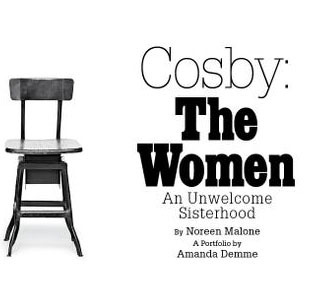
Empty chair next to title of NYMag article, "Cosby: The women. An unwelcome sisterhood."You certainly know someone who has survived rape. If you can answer “yes,” you probably know the emotional weight attached to the widespread impunity for rape. If you have to answer “yes, but…,” then it’s possible that this person is one of the many survivors who doesn’t come forward publicly. (There are plenty of good reasons.) New York Magazine recently symbolized the many “women who couldn’t come forward mostly (because) we, as a culture, wouldn’t believe them” with an empty chair. Social media has  made #TheEmptyChair a symbol of socially produced silence around rape and sexual assault.

But then again, maybe the problem is not just that “we, as a culture,” won’t believe them. Maybe its personal. And here’s the conundrum for jury selection. “Yes, but” isn’t a neutral category; it’s the sum of social and individual choices that mean no one came to you with one of our society’s most common traumas. One juror like that might be a coincidence. Twelve is a problem.