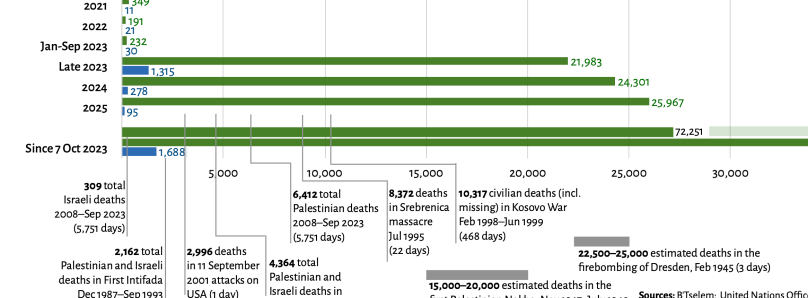
Close up view of 2021-2025 deaths showing remarkable disparities.

Deaths in the Israeli-Palestinian conflict through 2025: Staggeringly large and unbalanced

Gaza’s death toll remains the most staggering data point about the
Israeli war that brought it about. Month after month, the Gaza health
ministry continued to compile both total numbers of those violently
killed and lists of the names of the dead.

It remains among the most extraordinary human acts I have come into
contact with, from the day I first held the scores of pages of names,
identity numbers, and ages in my hands, to the searches I made
among the compiled birth dates for my own and those of my children.

Every two weeks, United Nations Office of Coordination for Humanitarian
Affairs in the Occupied Palestinian Territories has added new details of
individual violent acts and new totals of destruction. Recently, I
brought this biggest picture back up-to-date, at least through the
end of 2025.

The calendar year of 2025 was deadlier than that of 2024, and both
exceeded the toll of the devastating last three months of 2023.

As the Palestinian population of Gaza increasingly lived in tents
and makeshift dwellings, the genocide wore on.
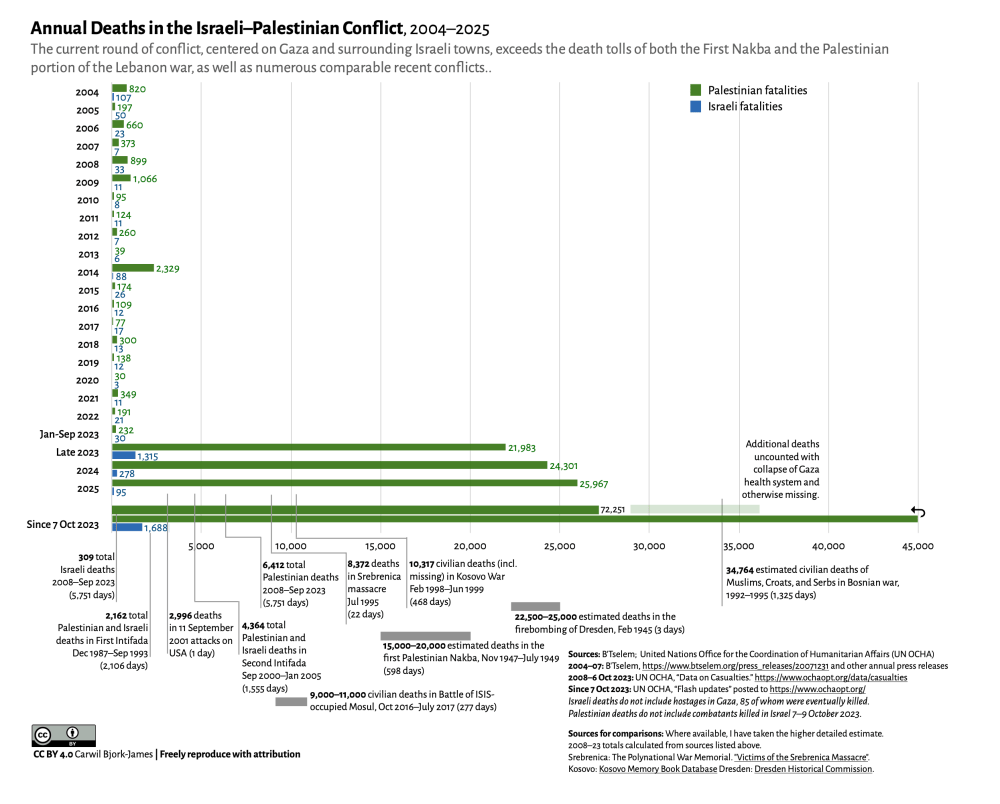
The comparisons I made about the first eleven months now apply with equal force to each of three years of violence. Palestine’s loss in each year exceeds…

  • Israeli losses on October 7 (1139 including, 373 security forces, 36 children) by a factor of 36 to one.
  • 2,162 total Palestinian and Israeli deaths in First Intifada Dec 1987–Sep 1993 (2,106 days)
  • 2,996 deaths in 11 September 2001 attacks on USA (1 day)
  • 4,364 total Palestinian and Israeli deaths in Second Intifada Sep 2000–Jan 2005 (1,555 days)
  • 6,412 total Palestinian deaths 2008–Sep 2023 (5,751 days)
  • 8,372 deaths in the genocidal Srebrenica massacre, Jul 1995 (22 days)

… combined.

By all measures but territorial loss and villages destroyed, but including deaths, deaths of children, number of people displaced, and number of homes and building destroyed, this assault is far larger than the first Nakba. During those 598 days, Palestine suffered 15,000 to 20,000 estimated deaths. We now stand at twice that toll. Upwards of 1.9 million Palestinians have been expelled from their homes, over twice as many as during the event Palestinians have remembered as their greatest tragedy.

Download: Annual Deaths in the Israeli–Palestinian Conflict as a PDF.
Manifesto of Mesa 18, the “rebel session” at the 2010 Tiquipaya Climate Summit

In April 2010, as the Bolivian government hosted the World Peoples’ Summit on Climate Change and the Rights of Mother Earth in Tiquipaya, movements within the country pressed for a forum to talk about these how the environment is treated within the country. The tens of thousands of summit attendees had their conversations structured around 17 working groups or “mesas” (literally, tables) on topics from ºthe root causes of climate change” to forests to the rights of Mother Earth. The Bolivian indigenous federations CONAMAQ and CIDOB proposed Mesa 18, an eighteenth working group on domestic environmental problems in Bolivia.

As the summit approached, they and the government got into a very public dispute with the over whether it would be included. Officially, the five Pact of Unity organizations—including CONAMAQ and CIDOB—were co-hosting the Summit, and they met to formally approve the structure of the meeting. Nonetheless, Evo Morales and the Foreign Ministry vetoed any discussion of “internal matters” in an official track. “I don’t know why we’re talking about Mesa 18,” Foreign Minister Choquehuanca blistered as the press questioned him about the issue.

In the end, Mesa 18 was held two blocks outside the gates of the Universidad de la Valle campus, separate and apart from the official sessions. CONAMAQ, four smaller indigenous organizations, one campesino federation, and the Landless Workers’ Movement joined environmentalists and academics to organize two days of sessions before an audience of hundreds of people. Dozens of community groups presented their experiences and concerns about the impacts of “the extractivist development model based on the export of hydrocarbons, hydroelectricity, mining, agribusiness, and lumber” (in the words of a Mesa 18 promotional flyer). These conversations took place in a room with simple concrete floors, a borrowed Brazilian restaurant. Many of the sessions were offered twice, first at the Water Fair commemorating the tenth anniversary of the Water War and again in Tiquipaya.

Called the “rebel” session by the press, Mesa 18 drew a spotlight on the “double talk” of the government, as critiqued by leaders like CONAMAQ’s Rafael Quispe: “This government speaks of respect for Mother Earth, but it simultaneously pollutes the land, and there are the cases of Corocoro, Mutún, the San Cristóbal [mining] company, and projects like Cachuela Esperanza [a planned hydroelectric dam], which also damage the Earth.” Like its official counterparts, Mesa 18 consisted of dozens of short presentations on environmental threats, projected on a screen. A small team compiled the issues presented and formulated a resolution on behalf of the gathering. They declared, “the development plans of these governments, including Bolivia’s, only reproduce the developmentalist schema of the past” and called instead for “the peoples to decide directly the destiny of their natural wealth in accord with their own organizational structures, their self-determination, their own norms and procedures, and their vision of the holistic management of their territories” (my translation, see text below). Outside Mesa 18, participants covered a brick wall with placards in preparation to march. Each detailed a different environmental crisis or contradiction. Unlike the official sessions up the road, these results were not included in the Tiquipaya People’s Accord that concluded the week, but the collective document advanced the same environmental critique, denouncing “mega-infrastructure projects … extractive projects, water privatization and militarized territories.” The massive scale of the summit had offered an opportunity for national visibility around the country’s growing series of socio-environmental conflicts.

Nine years have passed and Mesa 18’s concluding resolution, called the Final Manifesto of Table 18 in Defense of the Peoples and the Earth / Manifiesto Final de la Mesa 18 en Defensa de los Pueblos y la Tierra, has slipped off the internet. I post the complete version below for future reference. A PDF version of the Manifesto is available here.

Read More »

Your rights in New York

bag search on the subwayHaving people visit from out of town is a reminder of what inconveniences & impositions we get used to living in New York. Aside from the random convergence of police cars in downtown & midtown to practice, definitely one of the most unnerving is the randomly asserted right to search your “large backpacks and packages” on the subway. Somehow, the knowledge that this search is not exactly mandatory, courtesy of the Fourth Amendment (that whole “search and seizure” thing), and therefore can be refused, makes me feel better. So as a public service to New Yorkers, here’s what you can do if you’re not interested in your bag being searched:

If you choose to walk through a random search area and are stopped, you may refuse to be searched. In fact, Police Commissioner Raymond Kelly has said that you are free to “turn around and leave” any subway system where police are conducting random searches.…Calmly and clearly say “Officer, I do not consent to any searches. I’m going to exit the station.”Then immediately exit the station — and do not return through the same entrance.  

Thank Flex Your Rights’ Citizen’s Guide to Refusing New York Subway Searches for this information, and this handy (if somewhat alarming) flyer.More on how to expand your First Amendment rights in New York City soon…