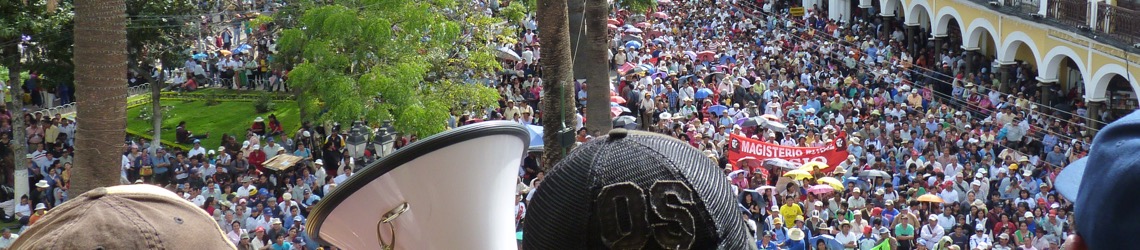
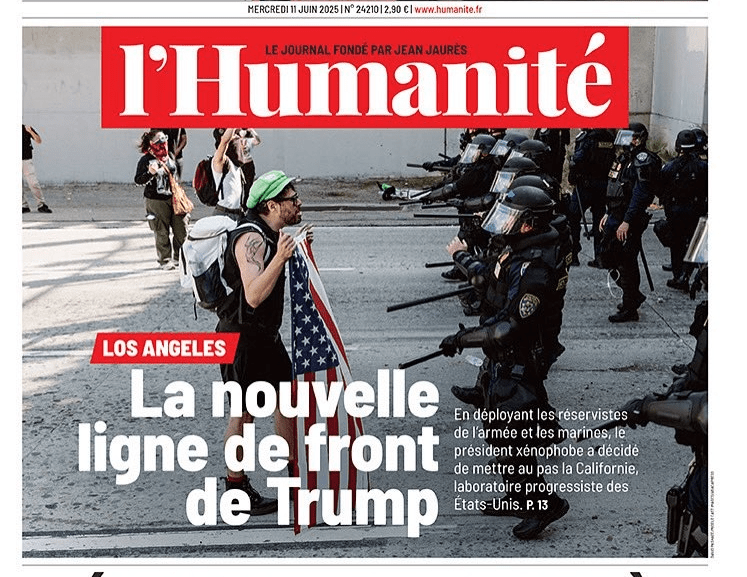
“The Whole World Is Watching.” It’s been decades since American protesters chanted this sentence at American police in an effort to deter violence and brutality. But it has perhaps never been more true than right now. The political drama of the USA in 2025 has the world riveted, and I as I walked through the modern train station in Potsdammer Platz, built where the Berlin Wall once stood, the face offs, a pillar at the bottom of stairway brought the confrontation between Federal troops and Los Angeles protesters to life in the middle of Germans daily commute.
And without a doubt, Los Angeles marks a dramatic new turn in the authoritarian rollout of the second Trump Administration. After months of high-consequence policy changes and comparatively isolated forms of protest, the situation is shifting towards an open confrontation and nationwide resistance. The Immigration and Customs Enforcement (ICE) raids on everyday Angelenos have prompted a public reaction by a community that doesn’t have the luxury of waiting until November 2026. And the president’s long-advertised desire to confront protesters with the United States military is finally being realized.
Both the roundup of ordinary civilians and the militarization of American cities push beyond existing expectations. They embody the threat of a different country, one where freedom is utterly denied to a millions and dramatically curtailed for the rest of us.
Everything I’ve said so far is, I think, obvious whether one is within range of the tear gas, across town, across the state, or across the ocean. But that’s not why I write this post. Instead I want to share a bit of perspective as someone who spent a decade puzzling through the sometimes deadly and sometimes transformative dance between protest and repression, including how Bolivians flipped the most heavy-handed domestic military deployment into the forced end of a presidency.
First and foremost, state crackdowns like Trump’s deployment of the National Guard and the Marines are exceptionally risky moves for rulers. The repressor imagines that such a show of force will rapidly bring about a scene of submission: arrested or injured opponents, a fearful majority of the population, and a quieter country. But the truth is, there’s no single outcome when an unarmed populace faces down an armed military. And nothing demonstrates a government’s weakness more powerfully than when even its deliberately trained soldiers can not obtain compliance with its orders.
Second, a crackdown in one place can kick up either mass demonstrations of repudiation or many sparks of daring rebellion across the country. Or both, which is what the invasion of Los Angeles has appeared to do this week. Spreading out protests when repression is concentrated is a winning tactical approach.
Sometime in the coming days or weeks, American protesters will make the turn from a solidarity movement with Los Angeles to a national mobilization in defense of freedom and democracy.
Third — and these may be the two ideas I most want to share widely because they is not common sense to many Americans — widespread confrontational protest and massive shows of popular opinion are both essential, and need not be in competition with one another. In Bolivia, in Argentina, in Thailand, in Ukraine, in Egypt, and in Chile, people who succeeded in national political turns did both of these things. As seen this week, acts of confrontational action can deter or delay the mass detention and deportation of our neighbors; they also can hold space in times of protest. On the other hand, acts of mass participation literally demonstrate that the public rejects a government and its policies. They create moments of collective purpose that strengthen their participants and remind allies elsewhere that they are not alone, and that we can win. (See below the line for how I described them working together in Cochabamba, Bolivia.)
This month, and especially this weekend, people primarily oriented around one or the other of these goals will likely be side-by-side in the street. Those who define themselves around what I’ve called “The Tactical Argument of our time” (whether nonviolent action can/is better at/is necessary for/could never/is counterproductive to bringing about revolutionary change), may be primarily worried about whether their preferred tactical approach is being permitted or blocked. My suggestion instead is to consider how much more powerful this movement could be if both flourished. And then to do the work of both helping people stay safe(r) as they speak, act, and resist.
Solidarity from Berlin.
p.s. Here’s how I described these two sides of successful uprisings in my research on Bolivia:
To win, the Coordinadora had to wield mass pressure, establish its legitimacy, gain a seat at the bargaining table, and convince the government to completely reverse the privatization. The moment of mass pressure involved blockades and other disruptive actions to win the annulling of the contract. The moment of legitimacy consisted in convening assemblies, cabildos, and an unofficial referendum or consulta popular to register public opposition to water policies. … While pressure and legitimacy represent two distinct moments of the mobilization, they worked in tandem, like two legs walking: Road blockades organized across the city and the surrounding region built up into an overwhelming civic strike, while marches flowed together into large-scale meetings called cabildos, often held in the central plaza. The civic strike was the cabildo’s operative arm, its means of exerting pressure; and the cabildo was the strike’s brains and voice, the only place from which it could claim sovereignty. Without either, the Coordinadora and the Water War it fought, would have amounted to nothing.




 Carwil without Borders