Recent political violence in Bolivia is happening between social movements, not against them

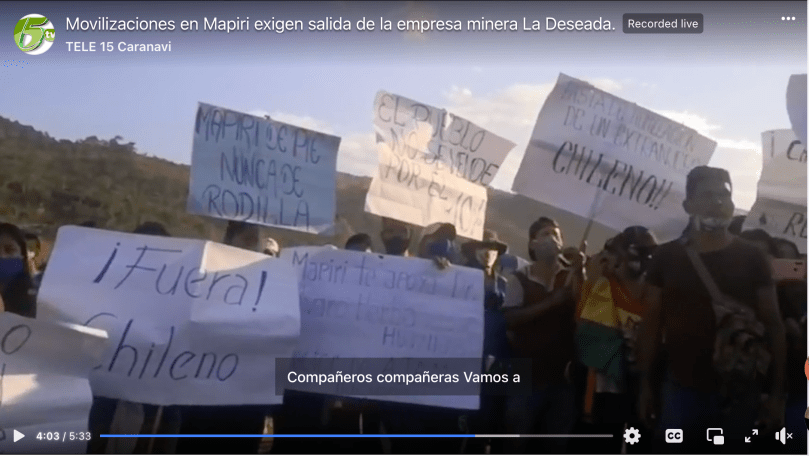
This review of lethal political conflict in Bolivia is cross-posted from the Ultimate Consequences research project website, where I’ll be archiving my commentary and analysis on political violence in the country. Featured photo above shows protesters against the La Deseada mine in Mapiri, in Larecaja Province, where mining conflict have claimed five lives in recent years.

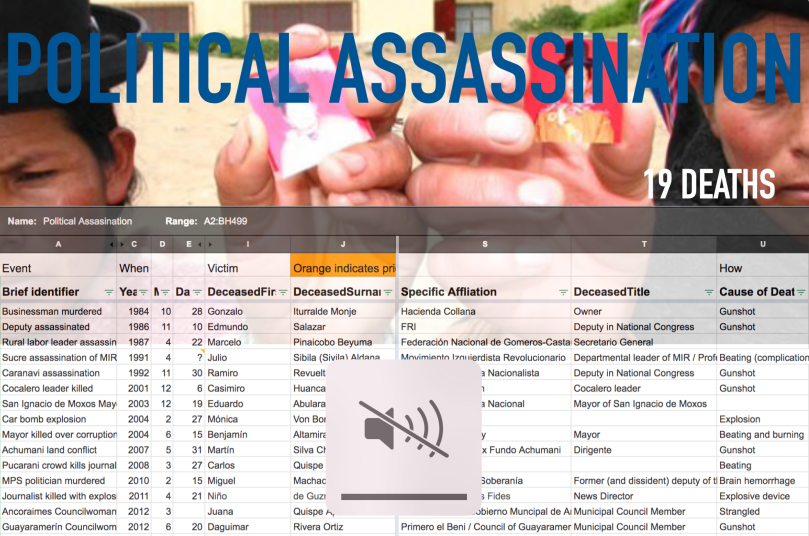
Eleven people have died in social movement-related violence in Bolivia since the beginning of 2023, ten of them the victims of violence carried out by other social groups. These conflicts pitted rural community members against miners, as well as disputes within the same profession, be it mining cooperatives, urban transit drivers, or rival claimants to rural land. Only one death, in January 2023, was caused by security forces, who fired a projectile into the eye of a bystander during raucous protests over the arrest of right-wing governor Luis Fernando Camacho.

In addition, the government of Luis Arce attributed four deaths from medical causes to the side effects of pro-Evo Morales blockades in January 2024. (Per our codebook, we record such collateral consequences but exclude them from other analysis.) For more details on these events, visit Ultimate Consequences’s interactive directory (Spanish version) of all deaths recorded in the dataset. Type “Arce” into the search bar for presidents to just see events during the Arce administration.

Deadly protest events, January 2023–August 2024
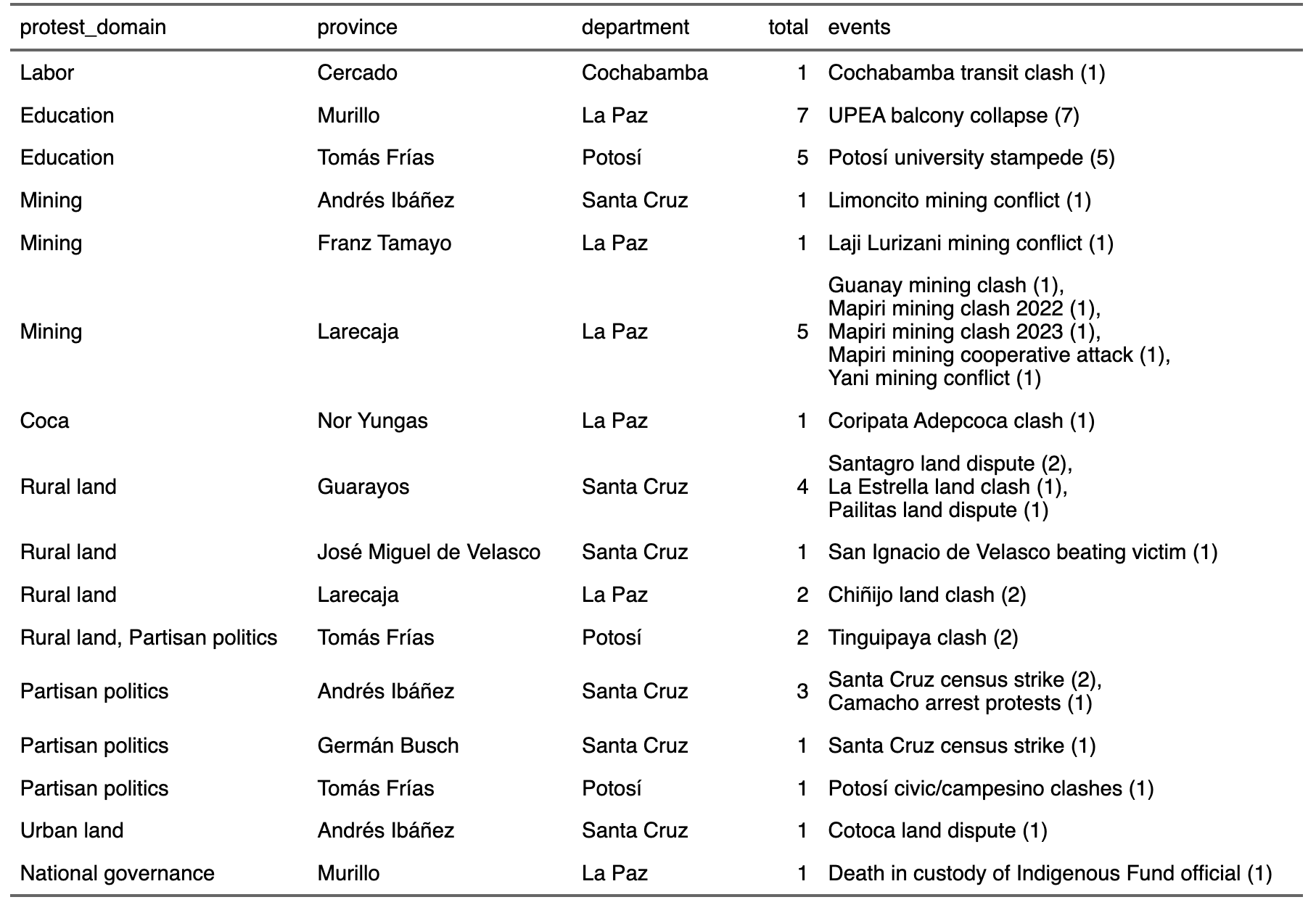
The recent events are as follows:

Camacho arrest protests: The December 28 arrest of Santa Cruz’s governor (and ex-presidential candidate) Luis Fernando Camacho touched off immediate protests in Santa Cruz de la Sierra, the regional capital. Following a one-day airport takeover, members of Camacho’s Civic Movement alternated between daytime blockades and nighttime property destruction. On New Year’s Day, police fired a projectile—likely a tear-gas canister—into the eye of Edwin Chávez Durán. The man enduring no fewer than seven surgeries over the next two weeks before succumbing to a heart attack on January 13.

Mapiri mining clash: Amid negotiations upon the filing of mining permits for a mine site located on the Merque river, confrontations began between prospective miners at the site and community members. The mining firm, Minera La Deseada, is described as Chilean, and the workers involed as arriving outsiders, some or all from Caranavi, according to the OTB of Mapiri, led by Ruddy Salcedo. Salcedo describes a Chilean business owner as present at the start of the confrontation, urging them to begin work by force. Community members occupied the disputed site, waiting for police to arrive. In the ensuing confrontation, stones, dynamite, and firearms were used, wounding ten people and killing Jhilmer Cuele Sompero. Community struggles challenging the La Deseada Mine have been ongoing for years; a 2020 mobilization shows leaders describing a five year struggle up to that point. In 2020, they were demanding the enforcement of a ruling by the national mining authority AJAM.

Limoncito mining conflict: On March 1, police accompanied an inspection visit by AJAM to document the stone-mining operation of the Dracruz company, in Limoncito, El Torno municipality. The delegation was confronted by mine workers who launched rockets and otherwise attacked the inspectors and police. Amid a retreat, Sub-Lieutenant Ronald Choque Mamani suffered a cardio-pulmonary arrest and collapsed to the ground. (Initial reports of bullet wounds to the officer proved unfounded.) He could not be revived. Five men were taken into custody for investigation by the FELCC and prosecutors. Subsequent inspection on March 10 revealed an unpermitted mining operation extending over 16 hectares of municipal land. Police then took both heavy equipment and documentation from the company. Local residents had complained of the operation, and have an ongoing campaign against other illegal mining operations.

Santagro rural land dispute: In El Puente municipality of Santa Cruz, conflict flared up between members of the Intercultural farmer federation, who established settlements there in December 2023, and the employees of the Santagro soy producing company, which works on the land. The armed confrontation on March 30 claimed the lives of two men, Francisco Morales and Jorge Pérez.

Cotoca land dispute: During a confrontation between established residents and squatters in Cotoca, Herland Salinas Añez was stabbed multiple times, first by a machete and then by a short blade knife (arma blanca) and killed. Several others suffered machete and bullet wounds during the confrontation. Witness reports describe the confrontation as continuing over several days. Police arrested 25 to 33 people, whom they investigated for the illegal land occupation. Per a more detailed report, the housing takeover was sudden and carried out by a group arriving in a van, making the squatters the attackers.

Laji Lurizani mining conflict: Wilmer Chambi Salcedo, 25, was shot and died while in an ambulance transporting him from Apolo to La Paz. He was one of four wounded in a conflict in the Santa Rosa community in the Laja sector of Apolo on September 13, 2023. The violence resulted from a conflict between illegal miners and community members in the protected Parque Nacional y Área Natural de Manejo Integrado Madidi (PN-ANMI Madidi). On September 15, the Autoridad Jurisdiccional Administrativa Minera (AJAM) reaffirmed that no mining rights were granted anywhere in the protected area. The same day, police arrived in the conflict zone and took control of the Laji Lurizani community. Bitza Delgado, the wife of the deceased Wilmer Chambi Salcedo, demanded that the authorities move to find those responsible for his death.

The death marked a continued worsening of violence due to mining conflicts in the Apolo region of northern La Paz. Illegal and informal mining thrives in the region. On September 18, community members of Laji Lurizani arrived in La Paz’s Plaza Murilo to protest the activities of illegal miners and their backers, and the absence of the state. Residents testified and presented photographic evidence of how illegal miners force them under threat of violence to allow them to do what they want in the area.

Pailitas land dispute: A week of armed confrontation between interculturales and peasants disputing land rights in the Forest Reserve of the Ascensión de Guarayos province resulted in the death of the intercultural Félix Ribera Bellido (23) of San Julían and the injury of 14 others. The death occurred early on the morning of December 2, when a conflict erupted between the communities of Pailitas and Santa María (in the Los Londras area). On December 6, the leader of the interculturales of San Julían, Tito Rokas, threatened the death of landowners in the province, claiming they were responsible for the violence. President Luis Arce announced that the violence would not be tolerated and summoned an emergency meeting of ministers to analyze the land conflict and propose structural solutions. The director of the National institute of Agrarian Reform (INRA) emphasized however that the lands being fought over were in fact property of the state, as all of the properties lie withing the Gurayos Forest Reserve. The Bolivian Ombudsman’s Office condemned the violence and called upon all actors to lower the temperature and to find peaceful solutions to the conflict. On January 16, 2024, Heber Sixto Canaza Sacaca (47), one of the leaders of the San Julían syndicate, was charged with homicide, for his role in inciting the violence on December 2, and for land trafficking, due to his promise to deliver properties in the municipality to intercultural groups. He was apprehended and taken into custody on January 15 and transferred to Santa Cruz by the FELCC. Sixto Canza had also been previously involved in another armed conflict in the Las Londras area in 2021, during which a group of journalists, police, and businessmen were kidnapped and tortured.

Cochabamba transit clash: A taxi driver suffered blunt force trauma while being attacked by drivers of a rival union of drivers disputing their line. One report indicates he and his brother were dragged out of their vehicle and held in another, possibly suffering the wound when jumping out of the vehicle. A doctor described blunt trauma inflicted by a large stone.

Guanay mining clash: Conflict among miners resulted in two injuries (both with metal shrapnel) and the trauma-induced heart attack of Mauricio Soliz Miranda.

Yani mining conflict: National Police intervened in the Yani community of Sorata municipality where two groups of cooperative miners were in open confrontation. This confrontation included injuries from firearms suffered inside the mine the night of July 25. Sent to accompany officials from AJAM and to de-escalate the conflict, the police were confronted by members of one side of the dispute. Reportedly, the miners threw rocks and dynamite at the arriving police, and set the hill on fire. Caught in the flames, two police officers suffered severe burns to 70% and 80% of their bodies respectively. One of those burned, Fabricio Reynoso Gutiérrez, succumbed to his injuries in a La Paz hospital. Altogether, four police were hospitalized. Two alleged perpetrators were arrested and held in preventative detention. One party to the dispute was the Cooperativa Minera “Señor de Mayo”, seemingly the side complaining of illegal occupation of their stake, while the other side (per a social media post circulated by Señor de Mayo) is known as Hijos de Ingenio. The latter allege further violence by Hijos de Ingenio, including a shooting on the following day.

Past annual reviews of political violence on Carwil without Borders: 2022 | 2021 | 2019 crisis | 2012. More tagged Lethal Conflict

The scale and pace of death in Israel–Gaza war are staggering

This is not just another turn in the Israeli–Palestinian conflict.

The extraordinary attacks by Hamas on October 7 and the thirty-one days of bombardment and invasion by the Israeli military that followed have led to a loss of life on an historic scale in Israel and Palestine, respectively.

Researching and accounting for lethal political violence is a major part of my work, and I find myself staggered by this extraordinary and extraordinarily public burst of violence. Like climate scientists during this year’s record-breaking summer, I find myself frantically sharing statistics and re-posting and pointing out this is not normal. Not even against recent trends. That this is the threshold of something worse than what we’ve known.

That’s what I’m doing and feeling with these numbers coming out of Gaza. (And about October 7 in Israel, though it will be months before Hamas could credibly repeat that day of atrocity, while Israeli air strikes happen every day, and a prolonged occupation promises even worse.)

Making this graph is my attempt to show how this isn’t normal. To grapple with the historic significance of this moment. To not feel alone in seeing it.

Read More »

Fifteen Bolivians were killed in social movement conflicts in 2022

Violent death cast a shadow over multiple social movements in Bolivia during the third calendar year of President Luis Arce. Deliberate killings came in clashes over land, mining, and the planned census, claiming eight lives, while tear gas detonated in a student meeting led to a stampede in which five were killed. A government bureaucrat who exposed a major corruption scandal died of years of mistreatment in prison. A motorcyclist was killed by a wire strung as part of a road blockade. And a brutal stabbing killed another participant in road blockades. Altogether, fifteen Bolivians lost their lives in or around Bolivia’s often charged movement conflicts.

The deadly events were as follows:

  • La Estrella land clash, March 19: Intercultural farmers had moved on March 12 to occupy lands on the “La Estrella” ranch, owned by Jacob Ostreicher and subject to claims of money laundering in a 2011 case that attracted international attention. These land occupiers were attacked on March 19 by armed people, either farmworkers or hired attackers presumibly sponsored by in-country landowner Claudia Liliana Rodríguez. (Ostreicher remains in exile.) The attackers confronted the Intercultural squatters around 22:00, shooting rockets and firing firearms. Franklin Delgadillo, son of Intercultural leader Ricardo Delgadillo, was shot and killed. The Interculturales maintained a multiday blockade demanding justice afterwards. Police arrested at least nine people for the killing in March 2022.
  • Death of imprisoned Indigenous Fund official, April 19: Marco Antonio Aramayo, the former director of Bolivia’s Fondo Indígena, died in custody following seven years of detention under an abusive avalanche of investigations in a scandal he himself brought to light. The Fondo Indígena, which Aramayo headed from 2013 to 2015, was intended to provide independent funding to indigenous communities for development and self-representation. Aramayo denounced in 2016 that the Fund was instead used by Minister Nemesia Achacolla as a slush fund during an election year.
    While many have been accused of corrupt acts, Aramayo has borne the highest weight of prosecutions (over 250 investigations begun); he was convicted and sentenced to 5 years in 2017. ITEI, a Bolivian organization that supports victims of torture and state violence, issued a statement: Aramayo’s “death is the tragic conclusion of a series of violations of [his] fundamental rights,” “which affect [him] and also affect people deprived of liberty in general.” According to the ITEI, which has provided medical and psychological attention to him since 2017, police and penal authorities tortured Aramayo physically with beatings and stress positions; biologically by depriving him of food, water, or medicine; psychologically with threats, extortion, insults, and humiliation. Aramayo was repeatedly required to travel to attend new cases across the country, with the final one filed two weeks before his death. Exhausted from his ordeal, Aramayo died of multiple organ failure, aggravated by diabetes and hypertension.
    While police announced an investigation into his death, his legal representative denounced that no actions had been taken three weeks later.
  • Potosí university stampede, May 9: A nightmarish stampede ensued at Potosí’s Tomás Frías University after a tear gas grenade was set off during an indoor meeting to convene university federation elections. Some five thousand students were reportedly in the coliseum. Many were injured in the rush to flee, including four who were killed that day and one more who died on June 15. Reportedly two of the dead were mothers who leave behind children. Six were sent to intensive care. Between 71 and 83 were wounded. The tragedy was apparently amplified by the locking of the main exit doors.
    Bolivian student politics operates in close coordination with national political parities and is often highly contentious. The tragedy also put attention on student leaders who maintain student status over decades and accumulate patronage and power in on-campus political organization.Four students, at least two of them involved in student politics, have been arrested in connection with the gas release and its deadly consequences. The Minister of Justice names Manfred Flores Canaza as the “principal and material author” of the crime.
  • Tinguipaya clash, May 15: Two men died in fratricidal violence in the town of Tinguipaya, Potosí. The brawl between differently organized Indigenous people—ayllus vs. campesinos—followed a visit by Vice President Choquehuanca and involved stones, sticks, slingshots, and rockets. Ironically, Choquehuanca’s speech, marking the opening of a political training school, had called for cross-cultural unity and fearless speech. The cause of the conflict remains totally disputed: national MAS-IPSP official attributed it to a local land conflict, while some local figures and opposition politicians blamed internal partisan disputes within the MAS-IPSP linked to the local mayor. Police attempting to investigate the incident had difficulty entering the area in the following days.
  • Chiñijo land clash, June 23: On June 23 a confrontation over land ownership in the community of Tamiplaya Tolapampa in Chiñijo, Sorata resulted in the beating deaths of two local campesinos and injury to an additional five. A group of 60 land-grabbers, hired and led by Gabriel Callisaya Toledo, Mario Luque, and Genaro Quito attacked the community in attempt to take their land, intimidating them with dynamite, dogs, and firearms. The General Secretary of Chiñijo, Susana Silva, claimed that Sorata police refused to provide assistance or to remove the bodies of the victims and only arrived at the on the 26th. Communities members protested by taking the victims’ bodies to Sorata in a protest march in order to demand justice. The community members possessed a resolution from the National Institue of Agrarian Reform (INRA) that recognized their right to the property and instructed the police to forcefully evict unlawful occupants.
  • Mapiri mining cooperatives clash, June 24: A group of expelled members of the Hijos de Pueblo gold mining cooperative attacked the cooperative in the community of Charobamba, Mapiri, in an attempt to regain leadership. A local teacher, Faustino Nestor Maqui Chambi, was killed when he was hit in the head by a stone, causing him to fall from his boat and drown. Police arrested 7 or 8 of the agressors, but their convoy was attacked in Aguada while transporting the arrested persons to La Paz and one the arrestees escaped.
  • Santa Cruz census strike, deaths on October 22, November 9 and 10: The Santa Cruz Civic Movement mounted a 36-day department-wide strike in protest of the delay of the Census to 2024, and demanding it be held in 2023. Clash between supporters of Santa Cruz general strike and those attempting to open blockades. During an October 22 clash on the Amistad bridge that connects Santa Cruz with Brazil, a municipal employee of Arroyo Concepción, Julio Pablo Taborga, suffered injuries from blows to his head. He was transported to a hospital in Puerto Quijarro where his death was recorded early the next morning. According to Taborga’s wife, he was demonstrating against the blockade when supporters of the strike arrived with dynamite and homemade bombs and began to beat him. Video of the confrontation appeared to show victim succumbing to tear gas rather than a beating. The Santa Cruz Civic Committee released a statement blaming the MAS for the conflict.
    Eduardo Arancibia Barrancos was killed in the early morning of November 9 while driving a motorcycle to work. He attempted to drive through a blockade point in the Tres Lagunas neigborhood of Santa Cruz. He did not notice that a coaxial cable was stretched across the road between two poles. This cable cut through his upper neck as he drove, causing his death. Police arested five men who were maintaining the blockade point.
    Overning on November 11, a group of four or five people attacked two men who were maintaining a blockade in the Barrio Latino of the Los Lotes zone of Santa Cruz. The attackers assaulted Jairo Montero, 21, and José Eduardo Sosa, 28, with knives, leaving Montero hospitalized with criticall injuries and Eduardo Sosa dead. The Sosa’s heart was reportedly cut out of his chest by the attackers. Two of the attackers were arrested on November 15.
Read More »

Introducing Ultimate Consequences: A digital archive on lethal conflict in Bolivia, 1982–present (video)

Introducing Ultimate Consequences, presented as video-on-demand at AAA 2022.

This presentation introduces Ultimate Consequences, a quantitative and qualitative database, unique in its depth and completeness of coverage, of all conflict deaths in Bolivia since October 1982, a period of largely elected governments and political dynamism. The country’s 1977–82 return to democracy, 1985 general strikes, 2000–2005 antineoliberal protest wave, and its political crises in 2006–2008 and 2019–2020 each exemplify the ability of mass disruptive protest to remake national politics. The database enables comparative analysis across twelve presidential administrations, four episodes where protesters successfully sought the end of a presidential term, and 192 protest events in 17 domains of conflict. Due to the number of lethal events in the study period, the dataset is both large enough for quantitative research that analyzes patterns and small enough for qualitative, journalistic, and historical examination of the individual deaths involved. To serve these multiple purposes, we are coding information such as individuals’ relation to a specific social movement, protest campaign, cause of death, responsible parties, and location, and writing detailed narrative descriptions about major events. The presentation introduces the open data format of the database and the R-based tools to explore it.

The project draws on journalistic, advocacy, and scholarly sources to comprehensively document all deaths in political conflict, including those not readily categorizable as human rights violations. The project also seeks to ask more intimate, and cultural, questions about the role of risk, violence, sacrifice, and loss in transformative social change. As the database reveals, Bolivian protest can involve intense risk, privation, self-sacrifice, and either enduring or inflicting violence. Bolivian social movement traditions include proclamations of fearlessness and vows to carry on their struggles “until the ultimate consequences,” that is, to persist in collective measures and to refuse to be deterred by deadly state violence. These movements invoke a history of indigenous uprisings, labor militancy, and state massacres in narrating their own histories.

The dataset offers a grounded view on such questions as: What practices and political choices result in some presidencies being far less violent than others? What is the relative importance of different forms of political violence, from repression of protest to guerrilla movements to fratricidal disputes among movements? Which movements have succeeded despite deadly repression? This presentation introduces a new tool for social scientists, oral historians, and human rights advocates to use in answering these and other questions.

The death of Bolivian mining leader Orlando Gutiérrez was accidental, investigators conclude.

The death of Bolivian mining leader Orlando Gutiérrez Luna remained a matter of dispute for a full year after his untimely death in October 2020, shortly after the electoral victory of Luis Arce and David Choquehuanca. While estranged from the inner circle of Evo Morales, Gutiérrez headed the pivotal miner’s union, Federación Sindical de Trabajadores Mineros de Bolivia (FSTMB), and campaigned hard for Arce and Choquehuanca. He also feared for his life and warned his wife not to accompany him on his final journey to La Paz. From such murky circumstances seems to have sprung the notion that he may have been the victim of foul play. His widow, Karen Calle, was the leading proponent of suspicions of an attack.

Gutiérrez’s death became a matter of public concern, both in Bolivia and for the international left, after a denunciation issued on social media by the FSTMB on October 23, 2020. (Detailed in previous coverage here) The statement, which has since been disavowed by the FSTMB leadership, spoke of “hired killers” and “street thugs” who “assassinated” Gutiérrez. In the wake of some three dozen deaths in 2019, this claim set off concern and more than a few sympathetic denunciations far beyond Bolivia’s borders.

Within Bolivia, however, conflicting evidence was easier to hear. Three friends of the deceased labor leader reported that he fell on stairs in his home when they were with him, causing his fatal injuries. This explanation matched that given by the clinic that cared for him. Karen Calle, too, heard Gutiérrez himself offer this explanation to the medics who cared for him. but felt sure her husband was concealing the real cause out of fear. Bolivian social movement, union, and political leaders, who initially reacted with shock and anger, shifted from calling for “justice” for Orlando Gutiérrez to “clarification” of the circumstances of his death.

And still, that clarification was slow to arrive.

In March 2021, prosecutors declined to treat the matter as a homicide. Their statement said, “While there is testimony from witnesses, there is no place or date of the events, nor an original cause of his death.” However, they did not attempt to clarify the cause of death.

Then in August 2021, a detailed investigation was restarted.

While a final report is still pending, Bolivian prosecutors have now told the independent news network Erbol the results, which confirm that writing on the wall since late 2020: Gutiérrez died of an accidental fall. Other conclusions:

  • Gutiérrez fell in a private residence after an evening out drinking.
  • Both criminal investigation and spatial reconstructions found the fall was accidental.
  • An autopsy found that he died of lesions to his upper nerve centers, cerebral hemorrhage, and cranioencephal trauma.
  • Gutiérrez also suffered from post-COVID pulmonary fibrosis and caridomegaly.
  • The Departmental Health Service audited Gutiérrez’s care during a prolonged clinic.

Hopefully the conclusions can put to rest the concerns of a grieving and fearful widow, concerned members of Bolivian movements, and activists worldwide who feared—for healthy reasons, but without sound evidence—that Gutiérrez was the victim of unknown agents of the Bolivian right wing.

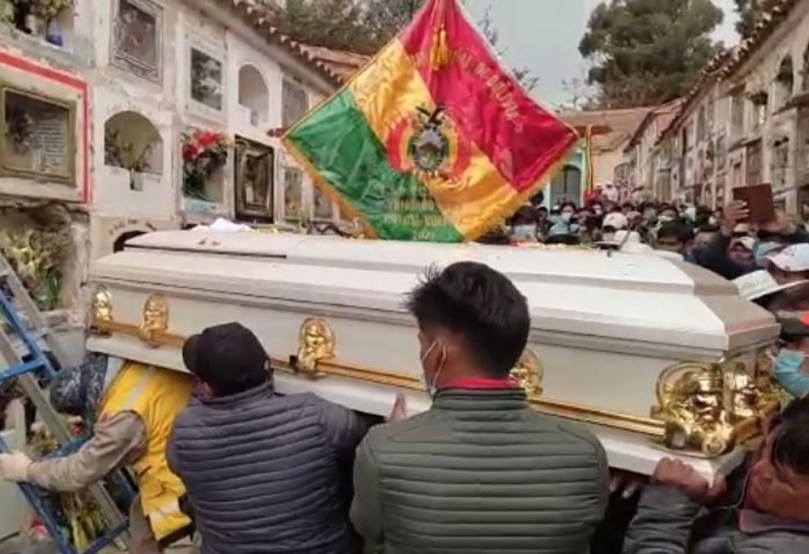
Several men carry the white coffin of Basilio Titi Topolo to a crypt.

Four deaths surrounded Bolivian political mobilizations in 2021. Responsibility for two remains in dispute.

Four Bolivians died in or around social movement conflicts in 2021. These were the first deaths since the deadly political crisis of 2019, when political violence claimed 38 lives, 29 or 30 of them killed by the security forces after the ouster of Evo Morales. In the year that followed, Bolivian politics centered on a single national struggle.

This year’s deaths came in four separate mobilizations, only one of them around a national issue.

  • Police Sergeant Miguel Ángel Quispe Nina — The ongoing conflict over leadership of Adepcoca, the La Paz Departmental Association of Coca Growers which split between pro- and anti-government factions, resurfaced in 2021 in a series of protests, unarmed street battles, building takeovers, and finally an electoral campaign. In July, this included an episode of armed violence.
    The pro-MAS faction led by Elena Flores convened a meeting of the organization in Coripata. The opposition factor led by Armin Lluta (since Franclin Gutierrez’s incarceration) blockaded a roadway leading to the town. Police came in to break up the blockade and police sergeant Miguel Ángel Quispe Nina was shot dead. Sub-lieutenant Reinaldo Quispe suffered a nonfatal gunshot to the head. Police and Flores blamed Lluta’s faction and alleged foreigners were involved. Afterwards, the government negotiated an agreement to hold leadership elections in the combined organization in September, but dissension and physical confrontations between the two sides continued. Five others died in the Adepcoca conflict in 2018 and 2019.
  • Chiquitano community leader Lino Peña Vaca (78) — One of many ongoing struggles over land between “Intercultural” highland migrant communities and Indigenous residents in Bolivia’s lowlands escalated in San Ignacio de Velasco, in Santa Cruz department. Chiquitano indigenous claims to the land in question stretch back twenty years. They sought title to the land from the National Land Reform Institute in 2016, but were given other lands in 2018, while the Interculturales had the land titled as Jerusalén III. A confrontation on the matter broke out on July 5, during which Lino Peña Vaca was severly injured, including with broken ribs and a broken nose. He was hospitalized eventually died of septic shock, severe pneumonia, and pulmonary fibrosis. However, his cause of death is disputed: his community, including leader Dino Franco assert that he died of complications of his injuries, while the death certificate indicates his respiratory maladies were due to COVID-19. Franco asserts that Peña Vaca’s COVID test was negative.
  • Indigenous marcher Rafael Rojas Abiyuna (63) — Rojas Abiyuna died of natural causes during the negotiation phase of a cross-Santa Cruz Indigenous march in defense of land and territory. At the time of his death from a heart attack in Santa Cruz de la Sierra in late October, the marchers had completed their trek and were unsuccessfully demanding negotiations with the Arce government.
  • Pro-MAS demonstrator Basilio Titi Topolo (21) — During the year’s most significant partisan mobilizations, opposition protesters mounted urban blockades in protest of Law 1386, an anti-money laundering statute that shopkeepers claimed will lead to abusive investigations of their books. In Potosí, as in several other cities, largely rural pro-MAS counterprotesters arrived to challenge these blockades in defense of the Arce government. Among the pro-MAS protesters was Basilio Titi Topolo, a miner of rural origin. He died while fleeing anti-MAS crowds, falling, and according to the official autopsy choking on a ball of coca lodged in his upper respiratory tract. The government alleged that violent anti-MAS groups blocked the passage of an ambulance carrying Titi and that “the lack of medical attention” led to his death. An unofficial autopsy pointed to other signs of trauma. Despite the rapid intervention of the Defensoría del Pueblo, the facts surrounding his death remain sharply disputed. Coverage on this blog: One dead as urban opposition battles pro-MAS campesinos in Potosí.
Read More »

“If you enter the city, I will hunt you.”: Sacaba massacre was preceded by open threat of military violence

On November 13, 2019—one after Jeanine Áñez was sworn as interim president of Bolivia—the highest police authority and highest-ranking peasant union leader of Cochabamba met in the Integral Police Station (EPI) of Huayllani, the neighborhood that would see the country’s deadliest massacre in sixteen years just two days later.

The Cochabamba peasant federation (Federación Sindical Única de Trabajadores Campesinos de Cochabamba; FSUTCC) had joined calls by the Movement Towards Socialism leader and coca grower Andrónico Rodríguez to mount a national march “against the coup d’ètat” and Áñez’s succession to president. Following in the footsteps of many prior mobilizations since the 1980s, the march would proceed from the coca-growing Chapare to Cochabamba and onto La Paz. The outlying town of Sacaba was the necessary first stop on that journey. FSUTCC leader Jhonny Pardo was in Huayllani to prepare the ground for this mobilization.

Colonel Jaime Edwin Zurita Trujillo, departmental commander of the Bolivian National Police, received Pardo and Nelson Cox, the departmental head of the Human Rights Ombudsman’s Office (Defensoría del Pueblo). Zurita had only recently taken command of the region’s police; National Police Commander Yuri Calderón installed him on November 8 in the wake of the nationwide police mutiny, which took a dramatic form in urban Cochabamba. Police officers in mutiny had demanded the removal of their prior commander Colonel Raúl Grandy. (Both Calderón and Zurita had received new commands in 2019 as part of anti-corruption house-cleaning in the police force. Calderón was later investigated by the Áñez government for his alleged loyalty to President Morales during the 2019 crisis, and by the Arce government for his role in the Sacaba massacre.)

After Morales‘ fall, Zurita had publicly embraced the Resistencia Juvenil Cochala, a right-wing motorcycle gang and called upon the it and self-organized citizens of Cochabamba to defend a police station in the city from pro-MAS opposition attacks. Zurita asked them to “organize brigades, organize barricades; we have information that people are coming towards the city from the Sacaba side and from the south… do not let them pass” (GIEI Report, p. 87). He also spoke out publicly to assure police officers in mutiny that he was on their side: ”[I would] say to the the comrades that I came to work … and that this is a moment for institutional cohesion. They should know that the Police chiefs are fully supporting all of the demands and that we are not going to leave them alone.” He offered to step down if it would be in the interest of police unity. “Of course” he supported the police mutiny, as did “absolutely all of the police command,” and he had nothing more in common with Cochabamba MAS leader Leonilda Zurita than their shared last name.

Read More »

One dead as urban opposition battles pro-MAS campesinos in Potosí

Young pro-MAS protester Basilio Titi Tipolo has been identified as the first fatal casualty in renewed partisan confrontations in Bolivia. Titi died amid the yesterday’s most intense street clashes, in the city of Potosí, where the Potosí Civic Committee (Comcipo) was leading the second day of a nationwide strike. In Potosí, as in several other major cities of Bolivia, striking opposition protesters mounted road blockades in protest of Law 1386, an anti-money laundering statute that shopkeepers claim will lead to abusive investigations of their books. But the issue primarily serves as a lightning rod for the civic opposition, which previously led October–November 2019 protests that culminated in the overthrow of President Evo Morales, to coordinate a nationwide challenge to what they call the “authoritarian” rule of Luis Arce, who was elected in October 2020.

During Tuesday’s protests, multiple efforts were on a collision course in urban Potosí:

  • The Potosí Civic movement intended to paralyze economic life through blockades as part of a national strike.
  • Campesinos arrived in town as opponents of the strike and as supporters of President Luis Arce.
  • Bolivia’s National Police were taking a more-hostile-than-usual approach to the blockades, assailed by Arce’s government as economically damaging.
  • The Departmental government, led by Jhonny Mamani (MAS-IPSP), was preparing to hold an honorary parliamentary session on Wednesday to commemorate the department’s anniversary.
  • On Tuesday morning, Comcipo announced that it would not allow President Luis Arce and Vice President David Choquehuanca to attend the anniversary festivities.
  • Once in town, campesinos rallied around and damaged the headquarters of Comcipo.
  • The Potosí Civic movement mounted a sustained effort to push campesinos out of the central Plaza 10 de Noviembre, eventually achieving this objective.

Security forces and pro-government and opposition protesters were thus pursuing objectives that led to confrontation. Unarmed street battles are not rare in Bolivian political life, but most often involve one group of demonstrators and security forces. Tuesday saw clashes between all three groups, as well as prolonged violent attacks upon individuals isolated in crowds of their political opponents. A pall of confusion and self-interested statements hangs over many of the details of yesterday’s events, but some facts are gradually becoming clear.

Potosí’s mayor reports that fifty people were treated in hospitals in clinics following the confrontations, two remain in intensive care, and one protester died. The deceased protester is Basilio Titi Tipolo, a young man just shy of his 22nd birthday. Basilio had residential ties in Surichata and Potosí, where he had worked as a miner. His body lay in state in the Potosí Peasant Confederación headquarters, where he was mourned by his Quechua-speaking mother.

The Defensoría del Pueblo has taken charge of compiling information on Basilio Titi’s death. Defensora Nadia Cruz stated that he died in the context of the confrontations, that he reportedly fell in attempt to reach safety, and that the medical cause of his death was broncoaspiración—the entry of food or other obstruction into the lungs causing suffocation. Separate accounts have been offered by Comcipo and the national government.

Comcipo issued this comment: “We know that a person has died, a 25-year old who had choked on their coca, surely while running away. There were no signs of violence, and I regret very much that there was a death on the side of our campesino brothers.” Further comments alleged that the campesinos were given alcohol, money, and chile pepper (that is, meals) to cajole them into protests. This is a statement so full of hostility and stereotypes that (1) any sincerity to the claimed lament of the death rings hollow; (2) it’s hard to take the claim that the death was accidental rather than caused by violence at face value.

Comcipo was also at pains to declare that Titi was physically unharmed, placing him among the handful of Bolivians who have fled violent confrontations to their deaths over the years.

Álvaro Terrazas, a vice minister of health, presented a more sinister narrative. He alleged that violent groups blocked the passage of an ambulance carrying Titi and that “the lack of medical attention has led to the death of one person.” Terrazas claims that the forensic medical report established that Titi suffered multiple traumatic injuries, including hematomas from the blows that were struck upon him in the street. He did not cast doubt on the medical cause of death, but rather argued that someone who lost consciousness could suffer broncoaspiración from something as mall as a bit of bread. Terrazas also accused blockaders of throwing dirt to attack the ambulance carrying Titi.

Read More »

Orlando Gutiérrez, mining union leader and MAS-IPSP rising star, dies after fatal post-election injury

Orlando Gutiérrez Luna, executive secretary of Bolivia’s celebrated miners’ union, the Federación Sindical de Trabajadores Mineros de Bolivia (FSTMB) has died after suffering a severe assault on October 21, shortly after the electoral victory of the Movement Towards Socialism (MAS-IPSP) party. A senior union leader, a potential MAS-IPSP senate candidate for La Paz (until his candidacy was refused) by electoral authorities, and reportedly the planned Minister of Mining under the incoming Arce government, Gutiérrez was the target of numerous death threats. During a time of protests against the MAS-IPSP election victory, Gutiérrez was badly beaten, though his family and comrades have not disclosed any major details of the attack.

The FSTMB responded to the attack with a statement saying:

“This grave attack, executed as a form of vengeance, perpetrated by the fascist right, by the so-called ‘pititas,’ [by] platforms, contracting ‘hired killers’ and ‘street thugs’ to assassinate the executive of the FSTMB for the mere act of speaking the truth; but, thanks to God, at this moment, despite this attempted homicide, he remains alive.” (FSTMB, 23 Oct 2020)

** The FSTMB leadership has distanced itself from this allegation; see update below **

Gutiérrez was treated at the Cemes clinic and visited by comrades. He reportedly suffered trauma to the parietal lobe of his brain.

His death was reported on October 28, but responsibility for it remains vague and unconfirmed. The Departmental Prosecutor of La Paz opened a homicide investigation later in the day. Reportedly, prior attempts to access him by investigators were rebuffed. The Defensoría del Pueblo has called for investigation and clarification of the circumstances of the attack on Gutiérrez.

Given the imminent transfer of power to a MAS-IPSP national government on November 8, the threats from political opponents against him, and the recent investigations of him for organizing pro-election blockades in July and August, it is perhaps not shocking that Gutiérrez’s comrades worked to delay an investigation. But the lack of any detailed narrative makes it impossible to verify their allegations of responsibility for his death.

Regardless of the circumstances of his death, the 36-year-old union leader is being remembered for his remarkable political leadership, his oratory on behalf of both the FSTMB union and the MAS-IPSP, and his calls for a time of peace following Bolivia’s traumatic last year.

Read More »

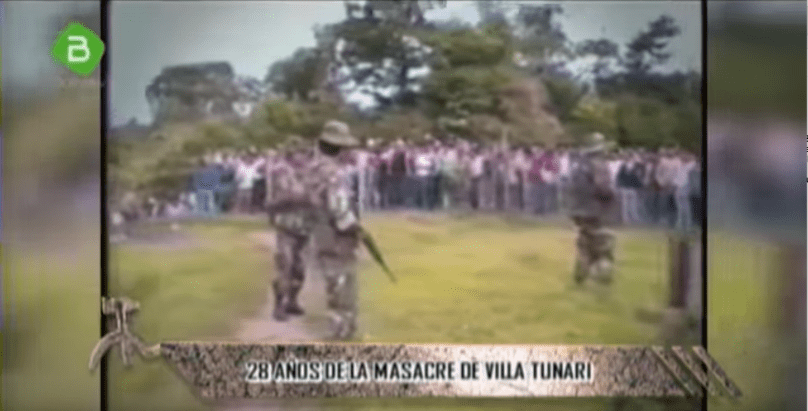
The 1988 Villa Tunari massacre, a dossier

In June 1988, Bolivia’s then-nascent Chapare coca grower’s union movement suffered its greatest single-day loss of life, the Villa Tunari Massacre. The killings came amid their campaign to oppose the passage of Ley 1008, which would eventually criminalize all coca growing in the Cochabamba valley region. The day forged the union and later political career of Evo Morales, Bolivia’s future president, and set Chapare coca growers and the US-backed Bolivian government on a deadly collision course that would claim scores of lives over the twenty-seven years that followed.

Despite the event’s importance, there have been precious few accounts in English. Jo Ann Kawell’s 1989 article in NACLA Report on the Americas is by the far the most complete I’ve found.

Read More »