The Interdisciplinary Group of Independent Experts for Bolivia, a five-person team of human rights experts named by the Inter-American Commission of Human Rights (IACHR), has been formally cleared to begin the work of investigating all human rights violations during Bolivia’s 2019 political crisis (prior coverage|Wikipedia) and expects to start work in the country on October 2, 2020. The Group was authorized by agreement between the Commission and the Bolivian government on December 2 of last year, following a dramatic visit by IACHR members to the country in the wake of the Sacaba and Senkata massacres. While the IACHR quickly appointed four members of the Group back in January, its work has yet to start and the interim government Jeanine Áñez has raised objections to both its membership and methods.
On April 28, however, the IACHR and the Foreign Ministry announced their agreement to a full investigation of last year’s often-violent events. The IACHR describes the Group as
[my English translation:] an international investigation mechanism on the acts of violence that occurred in the country … with guarantees of autonomy and independence, to secure the right to the truth and to duly identify those responsible for human rights violations.
un mecanismo de investigación internacional sobre los hechos de violencia ocurridos en el país, específicamente un Grupo Interdisciplinario de Expertos Independientes (GIEI), con garantías de autonomía e independencia, para asegurar el derecho a la verdad e identificar debidamente a los responsables de violaciones de los derechos humanos.
The agreement between the Bolivian state and the IACHR guarantees the Group the right to conduct an elaborate investigation with full access to the files and records of the government. Its designated powers are reminiscent of a truth commission:
An Argentine journalist’s final report denounced a coup; his beating later that night looks like murder
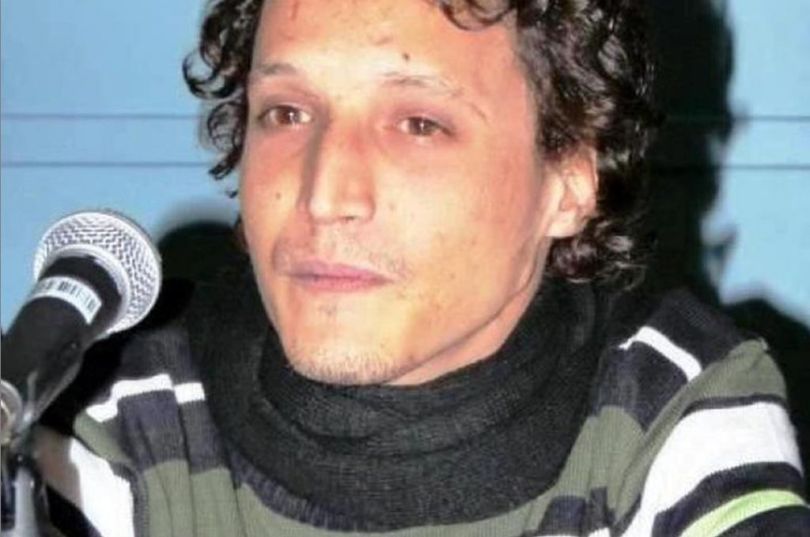
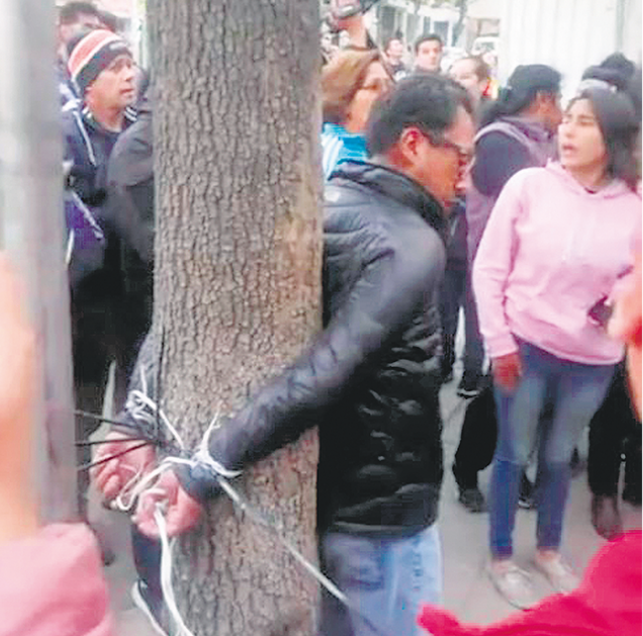
Sebastián Moro was a 40-year-old Argentine journalist working for Prensa Rural, a newspaper associated with the CSUTCB national peasants union that strongly supported the government of Evo Morales. On the morning of November 9, the Morales presidency was under siege, with a widespread police mutiny backing up nationwide protests of the October 20 election results. That morning, Sebastián Moro showed up to coordinate the next edition of Prensa Rural with his supervisor José Aramayo, who also coordinated the station Radio Comunidad out of the office of the CSUTCB in the Miraflores neighborhood of La Paz. By that night, angry civilian opponents of the Morales government had broken into the compound, beaten and tied up Aramayo and senior union leader Hugo López, and delivered them to a police station.
Photo: Jose Aramayo tied to a tree by anti-Morales protesters, November 9
From his apartment in the Sopocachi neighborhood, Moro filed a report for the Argentine newspaper Página12titled “Un golpe de estado en marcha en Bolivia [A coup d’etat is underway in Bolivia].” article mentioned the attack on Aramayo as part of long list of attacks by the civic movement:
Because of the [police and military’s self-imposed] confinement to barracks, on Saturady there were acts of vandalism and aggression upon government functionaries, journalists, and MAS party members in different parts of the country. Among numerous acts, the governor of Oruro’s house was burned, state workers at Bolivia TV and Radio Patria Nueva denounced they were kidnapped and denied their right to work by fighting groups of the opposition who surrounded their building, and the La Paz headquarters of the Peasant’s Confederation (CSUTCB) was invaded and attacked.
Producto de los acuartelamientos, el sábado hubo actos vandálicos y agresiones a funcionarios, periodistas y militantes del MAS en distintos puntos del país. Entre varios hechos, el gobernador de Oruro sufrió el incendio de su vivienda, trabajadores estatales del canal Bolivia TV y de Radio Patria Nueva denunciaron que fueron secuestrados y privados de su derecho al trabajo por grupos de choque de la oposición que cercaron el edificio, y la sede paceña de la Confederación Campesina (CSUTCB) fue invadida y atacada
By the next morning, Sebastián Moro was brutally beaten and in urgent need of medical treatment. Medical and media reports described multiple “bruises, abrasions, and scratches.” At the Clínica Rengel, he was diagnosed with an ischemic stroke, a condition which can be induced by trauma. He died around midnight on the morning of November 16.
The Bolivian government of interim president Jeanine Áñez has decreed a sweeping “total quarantine” for 14 days to prevent the spread of the novel coronavirus and halt a small, but significant outbreak of COVID-19 in the country. (Prior coverage of COVID-19 in Bolivia|Wikipedia) There are just 19 cases confirmed in Bolivia, with known community transmission in urban Oruro and the municipality of Porongo, both of which were already under local quarantine measures. Nonetheless, municipal and departmental authorities, legislators, and presidential candidates had all called for a total quarantine in the past few days. The fourteen-day emergency restrictions immediately prompted electoral authorities to postpone the highly anticipated general election, previously scheduled for May 3.
The quarantine measures mandate Bolivians to stay in their homes except for trips for work, groceries, and medical care; shorten the working and shopping day; and suspend public transport. It enters into force at 12am on Sunday, March 22, just hours after being announced. Bolivians are encouraged to provision themselves today, but markets will remain open for the mornings under the quarantine.
After Áñez decreed the national quarantine, Bolivia’s Supreme Electoral Tribunal (TSE) suspends electoral preparations for 14 days, calls on all parties to agree on a new date for general elections, previously set for May 3. In recent days, six political parties supported postponing elections, but the largest, but Evo Morales’ MAS-IPSP opposed any delay. Both calculation are in part political, since the MAS-IPSP is leading in the polls and the Bolivian political Right has failed to consolidate around a single candidate.
The Tribunal had little choice but to propose some delay since the proposed quarantine will interfere with pre-election preparations, even if it ends on schedule on April 5. The Tribunal’s statement s very clear in seeking consent from the legislative branch, led by a MAS-IPSP majority for a new election date. It also points out the central and troubling challenge: “to resist the threat of the pandemic and to also organize a clean and transparent electoral process, which will reflect precisely the will of the citizenry and will permit the formation of a legitimate government.”
It remains to be seen whether Áñez decision was necessary or precipitous, and whether the quarantine will further militarization and political divisions within the country or allow Bolivians to supplant them. The fractures opened up during the 2019 political crisis remain gaping, as does the absence of an elected government. There are clearly signs of both a cross-party willingness to cooperate against the coronavirus, as evidenced by recent agreements in El Alto and the Chapare, as well as clear signs of political opportunism. As with the rest of the world, much also depends on whether or not the coronavirus spreads out of control over the next two weeks.
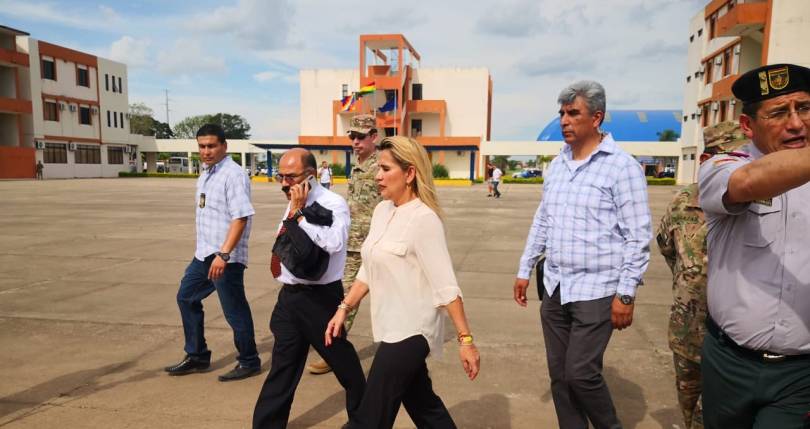
Top image: President Jeanine Áñez at the repurposed anti-imperialist military school, rapidly converted as a COVID-19 isolation site. From @JeanineAnez on Twitter.
It has been just seven days since the Bolivian Ministry of Health confirmed the first two case of the novel coronavirus disease, COVID-19, in the landlocked South American country, on Tuesday, March 10. The announcement, and the attempts of two patients to seek treatment in the lowland city of Santa Cruz de la Sierra set off a wave of panic in that metropolis, marked by (as best I know, globally unprecedented) protests by doctors, health workers, and neighbors seeking to deny treatment to the infected individuals. Cooler heads prevailed, and treatment sites were eventually proposed. Channeling the panic, several national legislators proposed criminal penalties for either blocking treatment or arriving and failing to quarantine.
Meanwhile, the small highland city of Oruro experienced community transmission of the virus, which now has seven cases (one of them is linked to travel from Italy). Oruro then led a wave of departments and localities in taking community-wide measures to prevent the spread of the virus. Oruro department’s “quarantine” measures are scheduled to last from March 16 to 31.
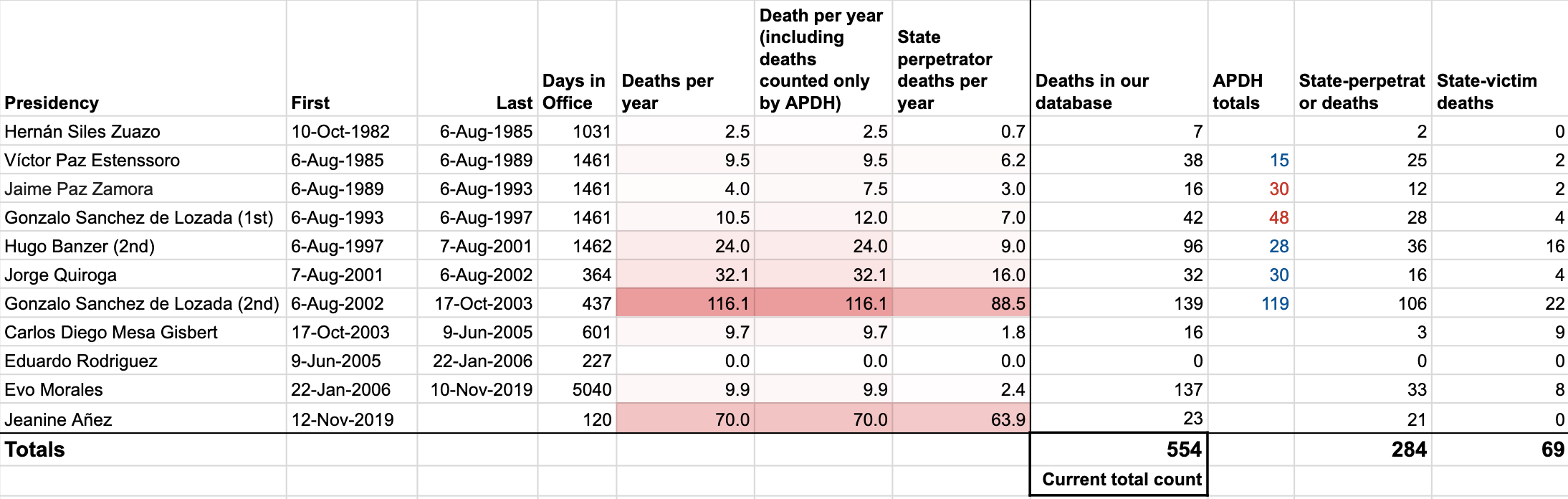
Evo Morales was the longest-serving president in Bolivia’s history, serving for nearly 14 years. His December 2005 election came in wake of a national uprising, the September–October 2003 Gas War, that claimed seventy-one lives in six weeks. It ended with a three-week protest movement over alleged electoral fraud in the October 20, 2019 election. Ultimately, thirty-six peopled died during the 2019 crisis, all but four of them after Morales resigned as president. A common theme in both these political transitions is loud public denunciation of the violence of the prior governments, specifically of Gonzalo Sánchez de Lozada, who governed for fourteen months in 2002 and 2003, and Evo Morales, who served over eleven times as long.
In this post, I offer an overview of political violence, including state repression, during the Morales years. This analysis is based on Ultimate Consequences, a database of people who have lost their lives in Bolivian social movement conflicts since 1982. I have been working to compile this information systematically since 2015. The data is compiled by myself and a research assistant based on multiple sources, including media reports, governmental, intergovernmental, and private human rights reports, and use of the research literature on political conflict. Unlike prior compilations by human rights organizations, however, this database includes a variety of qualitative variables designed to understand how and why the deaths occurred and what policies and patterns underpin them.
Altogether, 137 people[1] died in social movement-related events during the fourteen years of Morales’ presidency, the second highest total of any president during the democratic era, and a close runner-up to President Gonzalo Sánchez de Lozada’s fourteen-month death toll of 139. However, in nearly all other respects, the Morales years were quantitatively very different from Sánchez de Lozada, and more in line with the 1982–1999 period of limited violence in Bolivian political life.
The simplest way to see this is to look at the annual pace of deaths.
Table 1: Deaths by presidency in the post-1982 democratic era (excluding unconfirmed upper estimates and non-conflict-related accidents). The higher numbers of deaths found by the Permanent Assembly of Human Rights of Bolivia (APDH) in the 1989 to 1997 period may represent counting errors or deaths not yet included in the database.
Gonzalo Sánchez de Lozada’s second term stands out from all others (116 deaths per calendar year), only distantly followed by Jorge Quiroga’s one-year term (32/year) and Hugo Banzer’s 1997–2001 term (24–31/year). Evo Morales’ presidency had 9.9 deaths per year. Over the whole period since the restoration of democracy in October 1982, an average of 14.8 Bolivians per year have died in political conflicts, so Morales’ record is well below average.
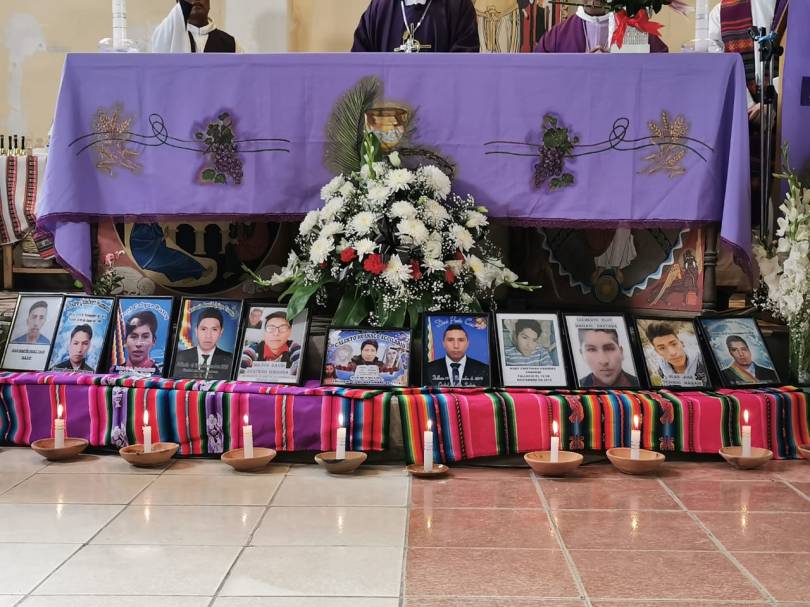
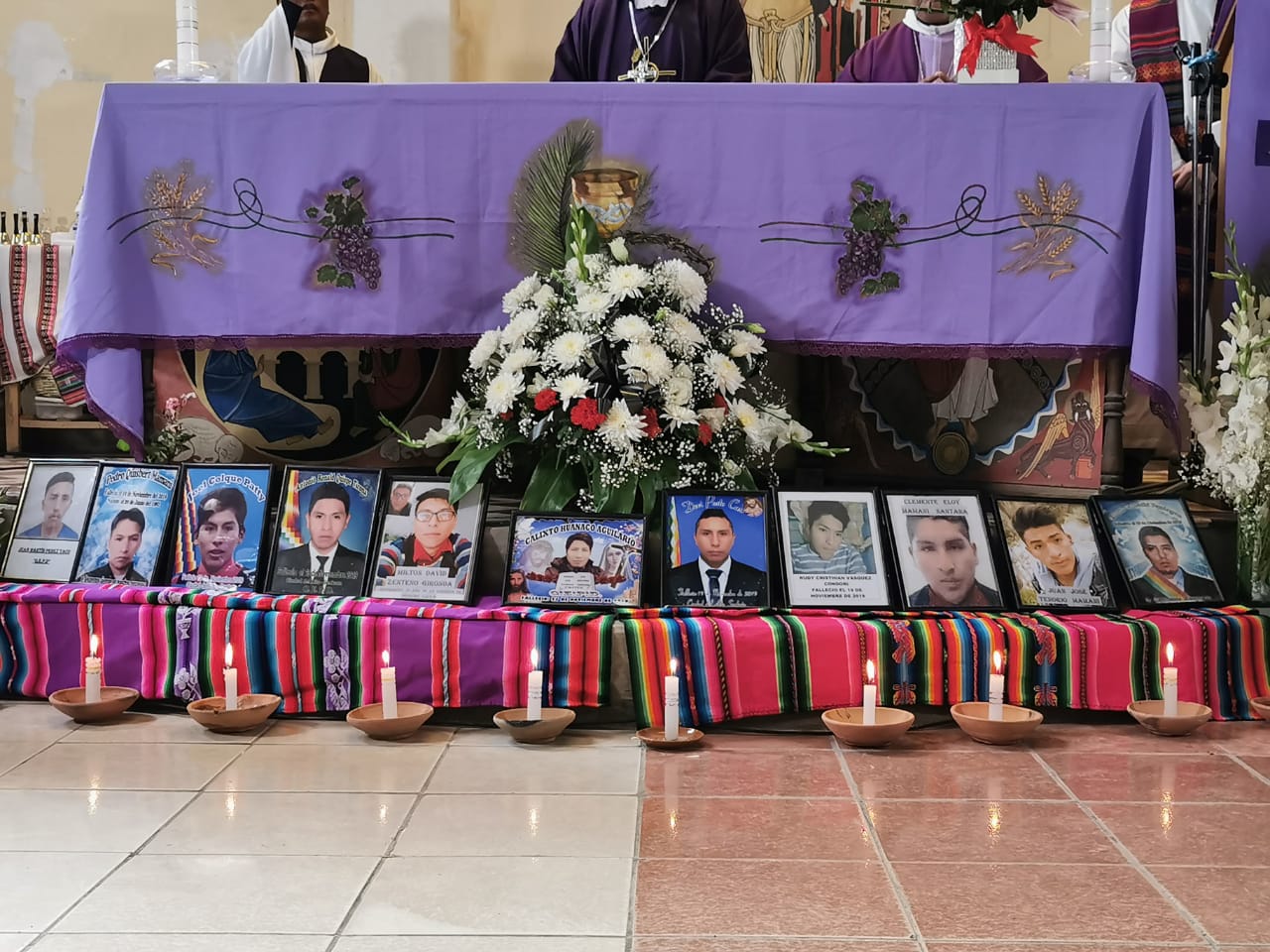
Emilio Fernández, a young man from Loayza province, became the eleventh known fatal victim of military and police repression of the blockade and protests at the Senkata gas installation in El Alto on November 19, 2019. (There have also been persistent and credible, if unverified, eyewitness reports of security forces removing the bodies of additional dead protesters from the scene at Senkata.) The Senkata massacre remains the deadliest event in Bolivian political conflict since 2008, and the deadliest act of state repression since the 2003 Gas War.
Another victim of the Senkata violence passes away, and now there are 11 deaths
David Inca, the representative of the Permanent Assembly of Human Rights of the city of El Alto, yesterday confirmed the death of an eleventh person after the violent events in Senkata in November 2019.
He said that he was aware that one of the injured had died on Wednesday morning [, March 4]. “He was one of the youth who was wounded and returned to his community in Loayza province. He was Emilio Fernández.”
Inca denounced that the wounded did not receive the required medical attention and surgical operations to recover from the damage they suffered after being injured by bullets. “There are other wounded who returned to their community without due attention. The transitional government threatened them that they would go to prison for supposed terrorism.”
The Plurinational Legislative Assembly of Bolivia took its sessions to the largely indigenous city of El Alto yesterday in honor of the anniversary of the founding of Bolivia’s second most populous city. Relations between the city and the hard-right interim government of President Jeanine Áñez are still shadowed by the massacre of protesters and bystanders on November 19, 2019, shortly after she took power. (Prior coverage of the Senkata masscre.) During the anniversary procession, mourners marched with a black flag in remembrance of those killed.
El desfile por el aniversario de la ciudad de El Alto fue con luto por las víctimas de la masacre de Senkata pic.twitter.com/OfePTRJGz9
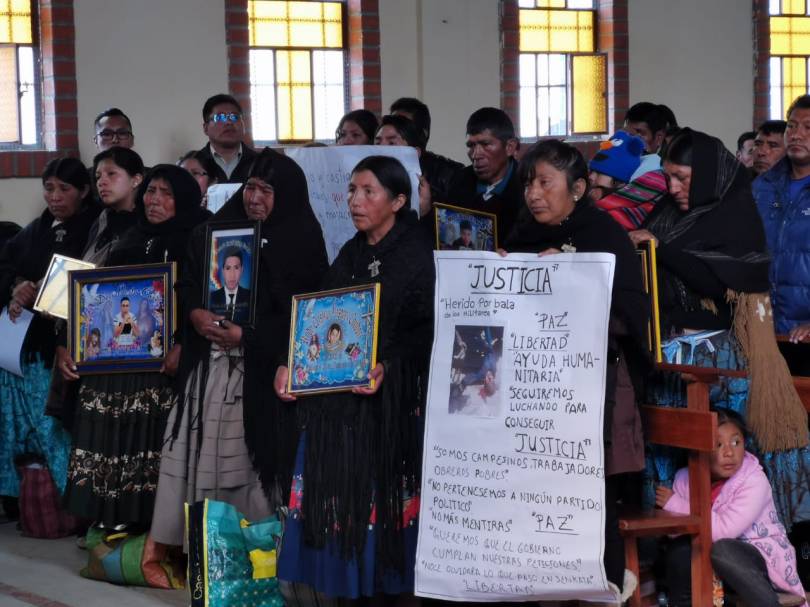
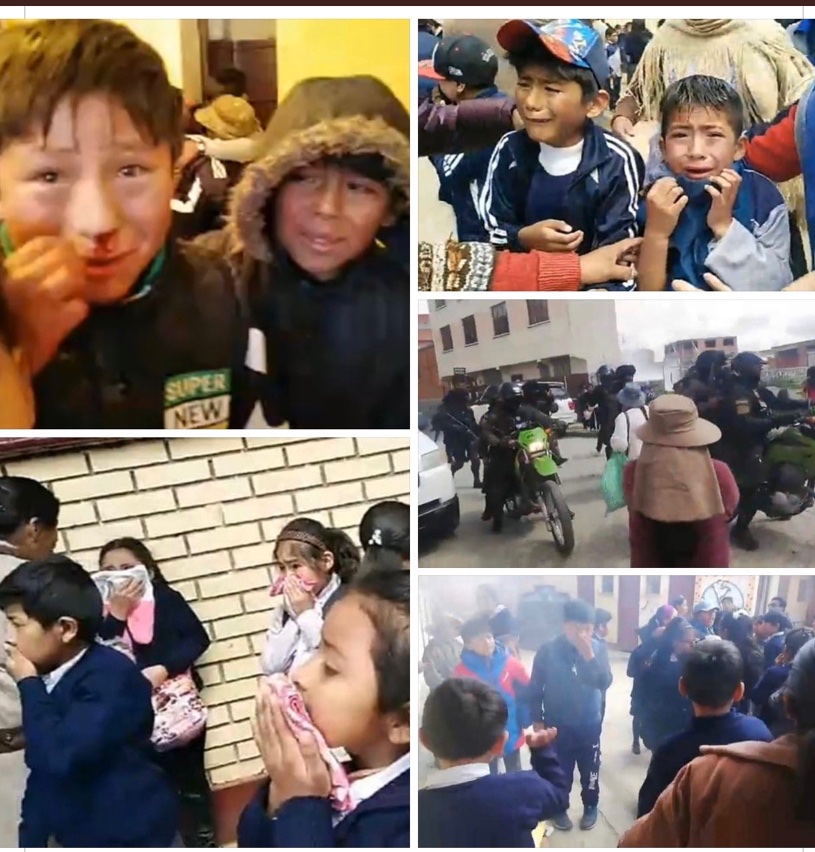
A couple dozen Senkata residents, largely family members of those killed protested the lack of accountability for the Senkata massacre by attempting to block the Bolivian Senate’s special session in their part of El Alto. In response, the Bolivian police teargassed them, as the statement from the Defensoría del Pueblo below details. This was the second time that security forces have tear gassed the family members of Senkata massacre victims; the first time was in a politicized funeral march just days after the attack.
Meanwhile, news has broke of the death of an eleventh victim of state repression at Senkata. Emilio Fernández of Loayza province died of his wounds on Wednesday morning.
Today, [Bolivia’s] Human Rights Ombudsman Office condemns the indiscriminate use of force by agents of the Bolivian Police, who gassed the family members of the victims of the Senkata massacre, which occurred November of last year, and affected a hundred children in the [nearby] July 25 School.
The incidents occurred in the morning, when the Bolivian Senatae attempted to hold a session in the social headquarters of the July 25 neighborhood in the Senkata are of the city of El Alto, in honor of the the anniversary of the municipality. Then, some two dozen family members of last November’s massacre and neighbors of that zone posted themselves outside to call for “trial and punishment for those responsible” for the ten deaths in November.
The union office, inside which the legislators gathered, was surrounded by police troops, before whom the family members [of the Senkata massacre victims] displayed signs pleading for justice. “Justice and Punishment or those responsible for the Senkata massacre. Justice for Ruy Cristina Vásquez,” read one of the signs. Amid their cries, the family members approached the uniformed police to call out for justice for their dead.
The response of the police was tear gas, which they launched upon the demonstrators and which reached the July 25 School, located across from the union headquarters. A hundred children were affected and had to be evacuated amid their cries and even bleeding, because it could be seen that one of them broke out bleeding from their nose. The docents of the school had to set a fire in the patio to dissipate the gas that had penetrated throughout the installation. According to the report from RTP, the troops launched the chemical agents to protect the evacuation of the senators, partisans of the government, who had decided to suspend their session.
The Human Rights Ombudsman Office condemns this indiscriminate use of force and reminds the Ministry of Government and the Bolivian Police that their actions must be within the framework of the [2009] Constitution and the national and international norms for the protection and guarantee of individual and collective rights.
Additionally, it noted that the Inter-American Commission for Human Rights (IACHR) has established that police operatives should have an operational plan that contemplates special attention and safeguard for children and adolescents, among other vulnerable groups. From the perspective of the Office, in this case the security forces did not act in accordance with this recommendation.
The Human Rights Ombudsman Office reiterates to political parties, citizen groups, political and social leaders, as well as to the government its exhortation to guarantee the peaceful carrying out of celebrations of the anniversary of the city of El Alto, as well as the current electoral process.
Departmental legislator Gustavo Torrico and Evo Morales’ legal representative Patricia Pamela Hermosa are the latest people arrested in the interim Bolivian government’s legally dubious effort to prosecute exiled president Evo Morales for the crimes of sedition and terrorism. Torrico, a member of the Departmental Legislative Assembly of La Paz, was arrested last night (February 6) and is expected to be charged with sedition for threatening comments he made in a late October radio interview. Hermosa, for her part, was arrested on February 2while bringing Morales’ identity documents into Bolivia in order to register him as a MAS-IPSP candidate for Senate. She seems to be under investigation due to telephone records indicating she spoke with Evo Morales in November after his overthrow on November 10. The government has also floated the possibility of subpoenaing Chapare cocalero leader and senate candidate Andrónico Rodríguez in the case.
These moves, on top of the active investigation of at least 592 Morales government officials for alleged financial irregularities, and the recent brief arrests and apparent physical mistreatment of two officials given safe passage out of the country, illustrate a scenario in which judicial actions is being used as an active mechanism of political persecution against members of Morales’ party. The “sedition and terrorism” case is the spearhead of that overall effort.
The UN Special Rapporteur on the Independence of Judges & Lawyers Diego García-Sayán has publicly called out the Áñez government: “I am concerned by the use of judicial and prosecutorial institutions for political persecution. The number of illegal detentions is growing. Today it was the turn of former minister Gustavo Torrico. I call for respect of the independence of institutions and for due process.”
#Bolivia: Me preocupa el uso de las instituciones judiciales y fiscales con fines de persecución política. Crece el número de detenciones ilegales. Hoy, fue el turno del ex-Ministro Gustavo Torrico. Llamo al respeto a la independencia de las instituciones y al debido proceso.
Today, February 3 was the deadline for Bolivian parties to submit their candidate lists for the May 3 general election, which replaces the annulled October 2019 vote. Here is a summary of the parties, their political situation, and their candidates.
With less than 48 hours remaining before an official deadline to finalize party alliances for the May 3 presidential ballot, two sudden surprises shifted the Bolivian political landscape. First, interim President Jeanine Áñez Chávez announced her own candidacy, reversing her emphatic promises upon assuming office. Áñez had been warning for weeks of the danger of splitting the anti-MAS vote and urging unity over partisanship. Now she will become one of at least ten candidates facing off against the MAS-IPSP candidate, former finance minister Luis Arce Catacora.
On January 10, for example, Áñez tweeted:
We Bolivians have fought for a single cause: to leave tyranny behind; that we have accomplished thanks to the patriotism of the youth, women, and men who went out onto the streets for a free Bolivia. To disperse the vote would be to devalue our struggle!
Tweet from Jeanine Añez Chavez (@JeanineAnez), January 10, 2020.
As late as January 19, the interim president was placing herself above partisan politics in her pleas for unity: “We hope that there will be the political maturity and openness within the political class to see the greater good. What may happen with me is what I am least concerned with, what does interest me is what could happen to Bolivia.” Of course, by then, the negotiations for her candidacy had already begun.
The Demócratas party (Twitter|Wikipedia entry)—formally the Social Democrat Movement, but composed of rightist regional parties and led by Rubén Costas of Santa Cruz —took up her candidacy as their own. Áñez had represented the party (competing as the “Unity Democrats” alliance) as a senator in the 2015-2020 term. Significantly, however, two more political forces have joined in backing her candidacy.
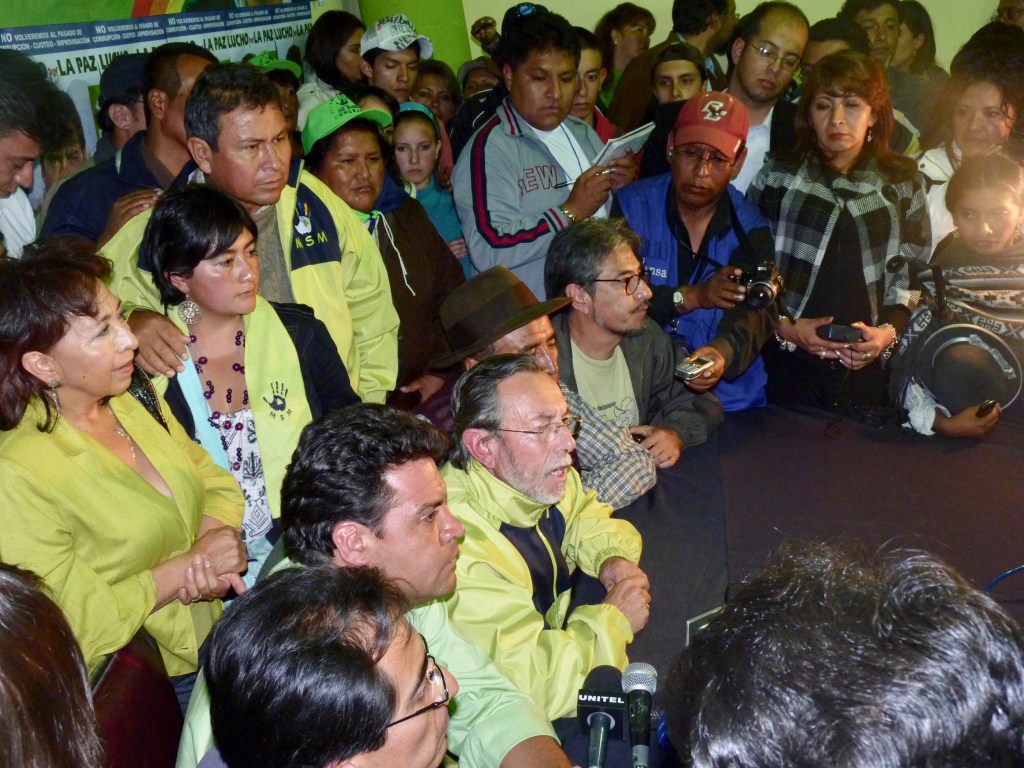
Luis “Lucho” Revilla and Juan del Granado at a press conference celebrating Revilla’s first election as mayor of La Paz, 4 April 2011. (photo: Carwil Bjork-James)
Luis “Lucho” Revilla has governed La Paz as mayor since 2010, a post he succeeded from his co-partisan and human rights lawyer Juan del Granado. The two had both represented the Without Fear Movement (Movimiento Sin Miedo; MSM), a center-left party that allied with Evo Morales’ MAS-IPSP in 2005, and offered support wtih criticism during the 2008 constitutional referendum. The party, always strongest in La Paz department, made a serious effort at recruiting disaffected MAS voters in the 2009 general and 2010 regional election. In 2014, however, it failed to reach the 3% threshold for keeping its legal status and was forced to reorganize in advance of the 2015 regional elections. Revilla’s urban progressive party allied with Felix Patzi’s indigenous socialist Third System Movement (Movimiento Tercer Sistema; MTS) to become the dominant political force in La Paz department: SOL.bo, a tech-oriented acronym for Sovereignty and Freedom (Soberanía y Libertad punto bo). Patzi, whose ideology proposes indigenous communities as the basis of a system beyond capitalism and state socialism, has been governor of La Paz for the last five years. Ever distrustful of Evo Morales’ governing party SOL.bo joined Carlos Mesa’s Citizen Community presidential coalition in 2019.
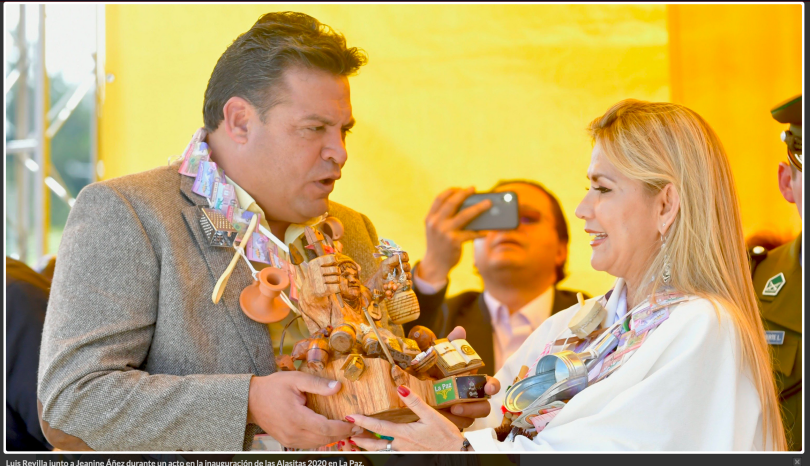
So it was a major surprise on January 24 when Revilla threw his support behind Jeanine Áñez, in an endorsement that coincided with the Alasitas festival in downtown La Paz. Widespread speculation implies that Revilla expects a Vice Presidential position in return for his endorsement, but the second spot on the ballot has not been announced yet, and Revilla is very loudly proclaiming that he didn’t trade his endorsement for a seat. Almost as loudly as Jeanine Áñez had proclaimed she wasn’t considering running for president.




 Carwil without Borders