dispatches across boundaries of states, and states of mind
Author: Carwil Bjork-James
Assistant Professor of Anthropology at Vanderbilt University. (My opinions are my own, and not my employer's.) Author of The Sovereigns Street: Making Revolution in Urban Bolivia (sovereignstreet.org). I conduct immersive and historical research on disruptive protest, grassroots autonomy, state violence, and indigenous collective rights in Bolivia.
Today, February 3 was the deadline for Bolivian parties to submit their candidate lists for the May 3 general election, which replaces the annulled October 2019 vote. Here is a summary of the parties, their political situation, and their candidates.
With less than 48 hours remaining before an official deadline to finalize party alliances for the May 3 presidential ballot, two sudden surprises shifted the Bolivian political landscape. First, interim President Jeanine Áñez Chávez announced her own candidacy, reversing her emphatic promises upon assuming office. Áñez had been warning for weeks of the danger of splitting the anti-MAS vote and urging unity over partisanship. Now she will become one of at least ten candidates facing off against the MAS-IPSP candidate, former finance minister Luis Arce Catacora.
On January 10, for example, Áñez tweeted:
We Bolivians have fought for a single cause: to leave tyranny behind; that we have accomplished thanks to the patriotism of the youth, women, and men who went out onto the streets for a free Bolivia. To disperse the vote would be to devalue our struggle!
Tweet from Jeanine Añez Chavez (@JeanineAnez), January 10, 2020.
As late as January 19, the interim president was placing herself above partisan politics in her pleas for unity: “We hope that there will be the political maturity and openness within the political class to see the greater good. What may happen with me is what I am least concerned with, what does interest me is what could happen to Bolivia.” Of course, by then, the negotiations for her candidacy had already begun.
The Demócratas party (Twitter|Wikipedia entry)—formally the Social Democrat Movement, but composed of rightist regional parties and led by Rubén Costas of Santa Cruz —took up her candidacy as their own. Áñez had represented the party (competing as the “Unity Democrats” alliance) as a senator in the 2015-2020 term. Significantly, however, two more political forces have joined in backing her candidacy.
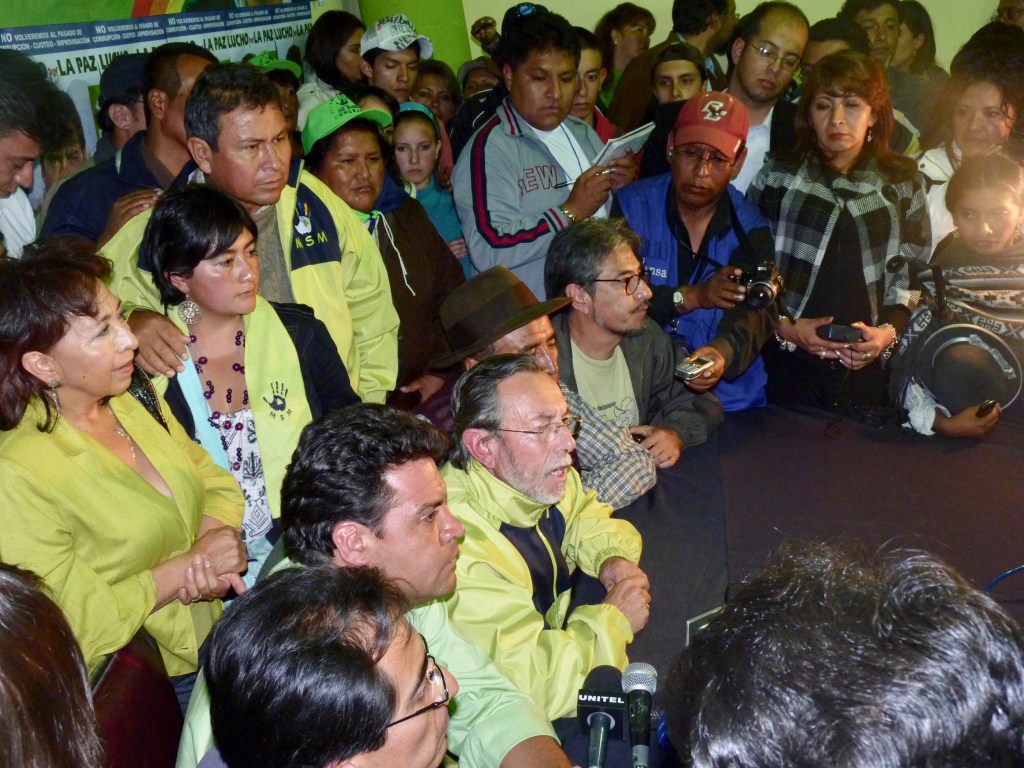
Luis “Lucho” Revilla and Juan del Granado at a press conference celebrating Revilla’s first election as mayor of La Paz, 4 April 2011. (photo: Carwil Bjork-James)
Luis “Lucho” Revilla has governed La Paz as mayor since 2010, a post he succeeded from his co-partisan and human rights lawyer Juan del Granado. The two had both represented the Without Fear Movement (Movimiento Sin Miedo; MSM), a center-left party that allied with Evo Morales’ MAS-IPSP in 2005, and offered support wtih criticism during the 2008 constitutional referendum. The party, always strongest in La Paz department, made a serious effort at recruiting disaffected MAS voters in the 2009 general and 2010 regional election. In 2014, however, it failed to reach the 3% threshold for keeping its legal status and was forced to reorganize in advance of the 2015 regional elections. Revilla’s urban progressive party allied with Felix Patzi’s indigenous socialist Third System Movement (Movimiento Tercer Sistema; MTS) to become the dominant political force in La Paz department: SOL.bo, a tech-oriented acronym for Sovereignty and Freedom (Soberanía y Libertad punto bo). Patzi, whose ideology proposes indigenous communities as the basis of a system beyond capitalism and state socialism, has been governor of La Paz for the last five years. Ever distrustful of Evo Morales’ governing party SOL.bo joined Carlos Mesa’s Citizen Community presidential coalition in 2019.
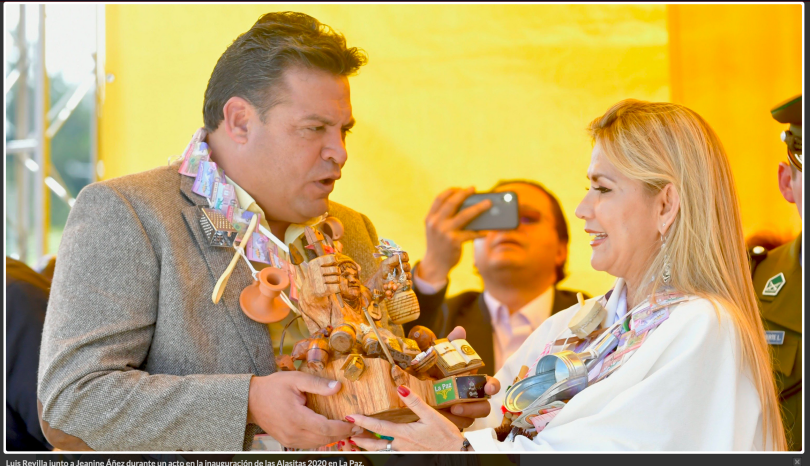
So it was a major surprise on January 24 when Revilla threw his support behind Jeanine Áñez, in an endorsement that coincided with the Alasitas festival in downtown La Paz. Widespread speculation implies that Revilla expects a Vice Presidential position in return for his endorsement, but the second spot on the ballot has not been announced yet, and Revilla is very loudly proclaiming that he didn’t trade his endorsement for a seat. Almost as loudly as Jeanine Áñez had proclaimed she wasn’t considering running for president.
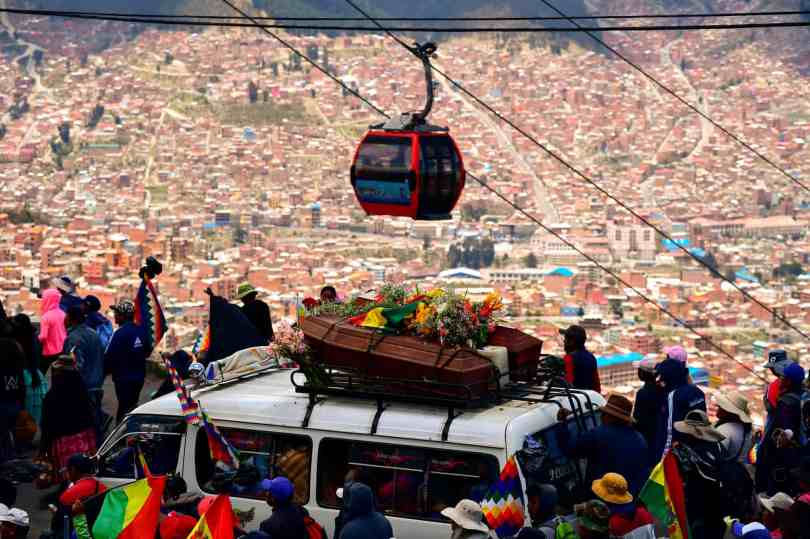
This article was published online by Guido Alejo. Thanks to an anonymous researcher’s translation work, I am sharing it here in English. While written just five days after the deadly day of military shootings that broke up protests in Senkata, a residential area on the edge of El Alto that is the site of La Paz department’s largest oil and gas supply depot. This essay provides the deepest look at the narrative put forward by the government of Jeanine Áñez to justify the killings of at least ten civilians, the deadliest act of state violence in Bolivia since 2003.
The most tragic event of El Alto’s recent history happened on November 19, the Senkata Massacre in which 9 Bolivian citizens died. The massacre was part of the post-electoral conflicts which led to the assumption of the presidency by Jeanine Áñez and the marches demanding her resignation. Many of these were led by remaining MAS leaders but the mobilised population didn’t necessarily support these interests.
There was a parallel symbolic struggle taking place, the construction of a discourse and story that hegemonizes the collective imagination and imposes itself over the fragments of another, subaltern story. Within this comes a strengthening discourse about the [subaltern] contender in the struggle: the sense of inferiorization of that contender, the trivialization of their reaction, the simplification of their being, their dehumanisation… Only in this way will the remainder of the population accept an oppressive imposition even at the cost of their own freedoms, in this way the death of the construed opponent will become tolerable, even desired. Consequently, the central government has claimed for itself moral superiority, the ownership of the absolute truth, and the legitimate use of force.
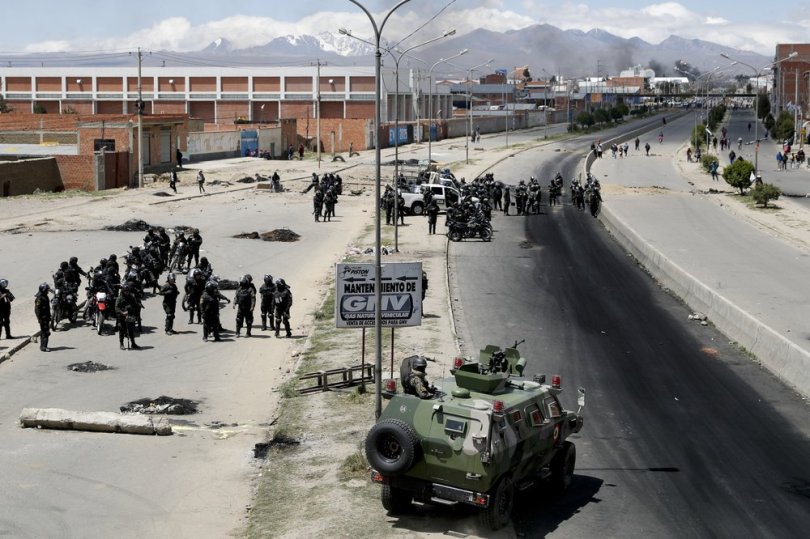
The Liquified Petroleum Gas plant in Senkata is a strategic location because it provisions the city of La Paz with fuel and gas for cooking. In the conflicts of the past few years, occupants of the area have blockaded the plant to put pressure on the state so that their demands be met. This time, the demand was the resignation of the current president and mayor and the annulment of Supreme Decree 4082 (exempting the military from criminal responsibility in “operations to restore order”). The blockade began on November 9, two days before the resignation of Evo Morales. Initially, the action was coordinated by MAS leaders. However, as the days passed, the MAS -upporting leadership of the FEJUVE was rejected and the movement became more heterogeneous and therefore cannot be catalogued as purely partisan.
The official version of the facts
The media environment was elaborated by the state [which saw] the ghosts of Cuban and Venezuelan interventionists, drug traffickers and illicit groups in the [geographic] center of the country (something which cannot be denied, but will it be relevant in the case of Senkata?), the profile of the blockading protester was categorised as “vandals, alcoholics and looters” and as a reason for the massacre, the profile of “terrorist” was coined as well. All this discourse is supported in a media account on the part of some television and radio stations alongside an intense social media campaign looking to show the protester as inferior.
Without a doubt, the post-electoral protests against President Evo Morales, his sudden resignation under pressure from both protesters and the military, and the unexpected succession of Jeanine Áñez (previously, second vice president of the Senate) are the most significant events of Bolivian political life in 2019. The hinge point of these events was the dramatic week stretching from November 8 to 15, during which the police and military joined protesters as central actors; significant transactions occurred behind closed doors; acts of violence and arson targeted politicians on all sides; uncertainty surrounded presidential succession; and finally, a remobilized military killed a shocking number of people in four dramatic days.
I want to offer here some detailed accounts of what happened during that pivotal week and lay out the crucial questions as to whether, when, and how the overthrow of Morales was planned.
Why did an inexperienced junior senator with no mandate get empowered to lead a disastrous coup, unleashing the deadliest month in 15 years in Bolivian politics? How did a military “suggestion” claiming to head off bloodshed so rapidly lead to operations against civilians that cost many more lives than had been lost in the previous three years (let alone the three weeks of protest since the election)? In short, to what extent was a unified planning process (what we might call a coup plot) at the heart of this political transition?
Put differently, do we understand Evo Morales’ overthrow, Jeanine Áñez’s succession, and the military shakeup that followed the result of:
The foresight and planning of a small circle of actors. Did someone in the civic movement set her up? Work out a deal with those in the military who craved a crackdown? There are real signs of premeditation, coordination, and alliances among political forces and people within the military who might have a crackdown as a goal.
A convergence of fearful choices that led to a disastrous transition. Did the military leadership believe a quick transition would de-escalate an increasingly deadly confrontation on November 10? Did multiple actors think confirming someone, any civilian at all, was preferable to prolonging interim military rule and nightly violence on November 12? The real consequences of fear, urgency, distrust, violence, and reactions to violence that led people to act without considering the worst-case scenario that could emerge.
Since plotting is necessarily a closed-door activity, we couldn’t fully know the answers to these questions on November 10 or 15. But since these are matters of public concern and the principal actors are talking to journalists, we are getting more and more details (all possibly filtered through self-justifications and political ambitions) about what exactly happened when. What follows is an evolving list of sources for those of us trying to understand what happened in detail.
November 7–9: Negotiating a Civic-Military alliance
During the week before the overthrow, anti-Morales protesters reached out the police and military for an alliance, and a police mutiny began on November 7 in Cochabamba and rapidly spread to other cities. On November 8, the Morales government publicly disavowed the use of the military to either attack the protest movement or quell the police mutiny. Defense Minister Javier Zavaleta declared that “Evo Morales and our government have given a strict order to the Armed Forces that under no circumstances … will there be any operation in the streets of any city,” while Government Minister said that deploying the military was totally ruled out. Armed Forces commander Williams Kaliman’s November 9 declaration that the Armed Forces would respect the constitution, maintain cohesion, and never confront the Bolivian people followed this overall line.
During these days, José Luis Camacho Parada, former head of the CEPB business federation and the father of Santa Cruz civic movement leader Luis Fernando Camacho, acted as a negotiator between that movement and the military. He contacted Fernando López Julio, a former officer who would become Áñez’s Defense Minister, to broker an agreement to keep the military out of the conflict, and it would appear, to consolidate a growing group of hardliners to back a post-Evo era.
Revealing the talks, Luis Fernando Camacho said López “got close with the military. For that reason, the person who when to speak with them and coordinate everything was Fernando López, the present Defense Minister And that is why he is the minister, to carry through with these commitments” (video). López himself has confirmed his role and stated that during the Morales presidency, the Ministers of Defense—all of them civilians—“never understood the Armed Forces, nor comprehended their needs.” He presents himself as “someone from their domain, and who will understand their needs and return to them their dignity” (Correo del Sur).
The night of November 10 saw chaotic property destruction by outraged Morales supporters in El Alto and La Paz. The police were increasingly overwhelmed by crowds whose principal target was police stations, many of which they burned and looted entirely. Two police were fatally wounded in these confrontations, one when his motorcycle crashed while attempting to evade marchers. Meanwhile, the military command resisted getting involved and Armed Forces commander and the head of the Air Force remained in contact with resigned president Evo Morales and Defense Minister Javier Zavaleta.
On the evening November 11, a faction of the military leadership pressured Armed Forces commander Williams Kaliman to send troops out. The generals who did so had become aware of “a rising (mutiny) among Army colonels which would seek to arrest the generals, take command, and put troops out in the street,” Página Siete reports. Apparently, even as Kaliman read the announcement of the deployment, the generals who threatened him were fearing their arrest for insubordination.
This initial wave of militarization led to between four and six deaths of protesters and bystanders. The Áñez government has since talked of prosecuting Kaliman for failure to fulfill his duties for not militarizing the country earlier.
A complex series of negotiations on presidential succession were brokered by the Catholic Church, the European Union, and others. Former president Tuto Quiroga emerged as the strategist behind the succession of Jeanine Áñez, previously the second vice president of the Senate. This position is not included in the brief section of the 2009 Constitution concerning the line of succession, but justification was found in a 2001 ruling on succession. Senate President Adriana Salvatierra and Chamber of Deputies President Víctor Borda had resigned their leadership posts on November 10.
In behind-the-scenes negotiations, Adriana Salvatierra represented the MAS-IPSP. According to Quiroga and four other parties involved (The New York Times reported), she exchanged permission for Evo Morales and his entourage to exit the country for a relatively uncontested succession. However, Salvatierra may have had personal interests at stake, namely the legal situation of her father who Hugo Salvatierra who is risking prosecution for a possibly corrupt tractor transaction during his time as Rural Development Minister early in the Morales government. Incoming Senate president Eva Copa revealed to the press that:
In her own voice in a meeting of our party delegation, she [Salvatierra] stated that she renounced the presidency, for she ought to have been the transitional president, because the only thing that she has is her father and mother, and that she could not assume the position because they might reactivate the tractors case against her father. That is the decision that she took, and that left us crippled and we have had to take responsible and mature decisions as partisans.
The New York Times reports that the succession agreement was worked out on November 11, but Salvatierra’s assent seemingly did not come on behalf of the larger MAS-IPSP delegation in the Plurinational Legislative Assembly. They did not attend sessions on the afternoon of November 12 meant to swear in Áñez as president. Instead of convening the Assembly to consider Morales’ resignation letter, Áñez invoked the former president’s “abandoning” his post by fleeing the country as the mechanism of succession. Through two successive parliamentary maneuvers, Añez first declared herself president of the Senate then took office as president on the basis of the unavailability of the president and vice president. MAS-IPSP legislators reasonably expected to be able to consider the resignation letters in their first session, and to elect a different senator to replace Salvatierra. There are conflicting accounts about whether they boycotted the session or stayed away out of fear for their own safety.
On the night of November 13, Jeanine Áñez presided over the elevation of a new set of officers to the military High Command, replacing the entire leadership. Handing over his office, outgoing commander Kaliman drew attention to “respect for [human] life” during his term and said, “The direction has been marked out; we leave you armed forces that are cohesive, disciplined, respected and admired by all Bolivians; an armed forces linked to the Bolivian Constitution. Only follow the trail of our work, improve what we have done with more effort, it is your turn to be the protagonists of our institution.” Was this a formality, or a warning of the danges of putting troops back into the streets to engage in crowd control?
Since 2015, I have been working systematically to compile a database of people who lost their lives in the course of Bolivian conflict, though I had been collecting detailed on a variety of deadly post-2000 events for years before that. Never before this year, however have I had the responsibility of adding so many new, present-day entries to database: at least 35 people died in the conflicts that followed the October 20 election and the November 10 overthrow of Evo Morales. November alone proved to be the bloodiest month in sixteen years, and the third deadliest month of the democratic era. And it is thanks to the database that I can make simple factual statements like those.
The database enumerates individual deaths in Bolivian political conflict since 1982, the end of military rule in the country. It is compiled by myself and a research assistant based on multiple sources, including media reports, governmental, intergovernmental, and private human rights reports, and use of the research literature on political conflict. The dataset now includes nearly all of the deaths identified by a Permanent Assembly of Human Rights-Bolivia (APDHB) study of deaths from 1988 to 2003, and a study of the coca conflict from 1982 to 2005 (Navarro Miranda 2006; Llorenti 2009; Salazar Ortuño 2008). Unlike prior compilations by human rights organizations, however, this database includes a variety of qualitative variables designed to understand how and why the deaths occurred and what policies and patterns underpin them.
I designed the database to both catalog the lethal consequences of participation in social movements and political activism, and to assess responsibility, accountability, and impunity for violent deaths. All deaths are significant as signs of the price that has been paid to seek social change. Some deaths are also significant as elements of repression or violence for which someone might ultimately be held accountable. Rather than begin by asking, “Is this death someone’s fault?,” we are coding each death according to multiple factors that enable us to extract different subsets of the overall database for different purposes. We estimate there were 550 to 580 deaths associated with Bolivian political conflict from October 1982 until the current crisis. As of October 2019, the project had identified 530 of these deaths, including those of 496 named individuals.
Through this process, I have become familiar with reading multiple and conflicting reports, evaluating official denials (we have created a data column for such denials), collecting narrative accounts, coding what we can based on the information, and signaling remaining questions. One thing that I have learned through this process is that making informed judgements, rather than marking all disputed facts with some kind of asterisk, is absolutely foundational to being able to do comparative work. It was with that experience that I spent time over the past month reading and processing reports of Bolivia’s deadly November.
This blog post presents Part I of this analysis, which describes the deadly events involved and explains some of my coding decisions in assessing responsibility for them. A second part will put the 2019 into comparative perspective against other periods covered by the database.
Who killed and who died in the 2019 crisis?
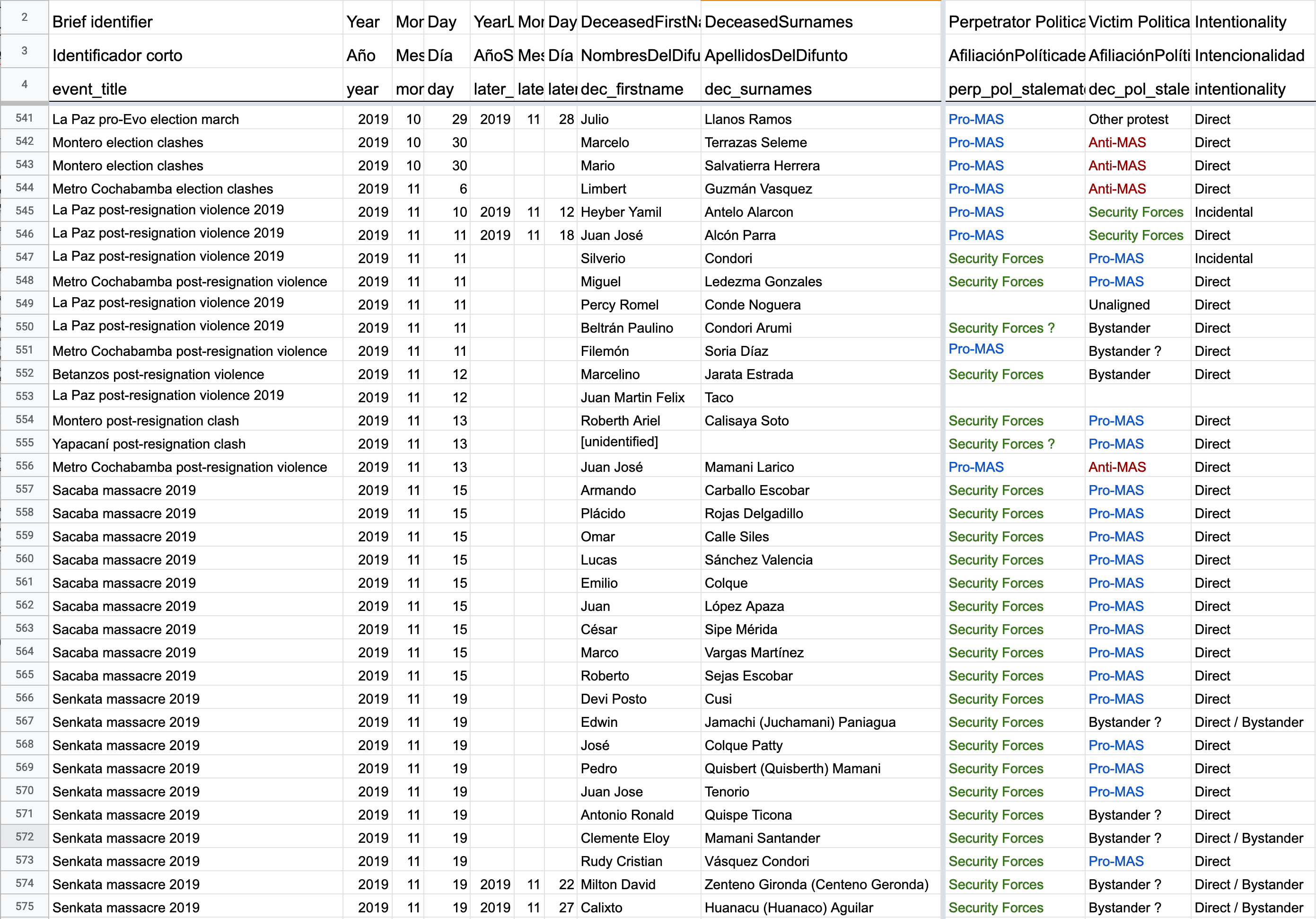
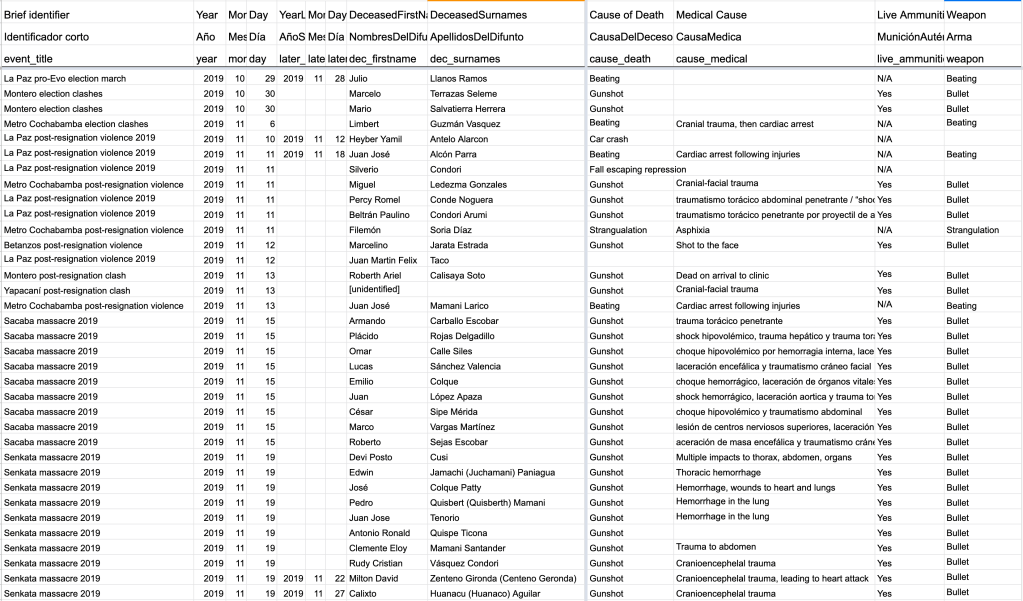
This table (click to expand) shows my initial analysis of the affiliations of the victims and perpetrators of violence and other deadly incidents during October and November. Overall, thirty-five people died in the conflict, including two people killed in their attempts to avoid violence against them.
Crisis deaths and affiliations of victims and perpetrators.Deaths during the crisis and their causes.
Below, I break down the events involved and describe what we know about who was responsible for and who suffered these deaths.
There has been relatively little in-depth journalistic coverage of the sequence of events at the blockaded Senkata refinery, which ended in the deadliest day in Bolivian political conflict since 2008. This report is a significant exception. The article was originally published as “Las 3 horas de terror que sufrieron en Senkata,” by Jorge Quispe, La Razón, December 2, 2019. The photos shown below accompanied the original article; their captions are also translated from the original article.
In October 2003, a convoy that would later be named as “the death caravan” outwitted the blockade at the Senkata plant. On Tuesday, November 19 [of this year], between 10:20 and 10:30am, [blockading] Alteños tried to prevent fifty tankers from exiting their cordon. The result was fatal.
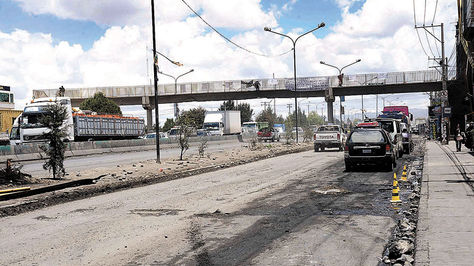
Pedestrian overpass from which soldiers had fired. Photo: Álvaro Valero
On Saturday, November 9, ten days before the 19th, the neighbors of District 8, which includes Senkata, were the first to follow the El Alto Neighborhood Council Federation’s instructions and blockade their main road, which leads to Oruro. Days later, the blockade was transferred to the hydrocarbon plant, which supplies natural gas, gasoline, and diesel to La Paz and El Alto.
That Tuesday morning, there were only a few neighbors taking part in the vigil at the gates of the Yacimientos Petrolíferos Fiscales Bolivianos (YPFB) installation, which is an hour’s walk away from the Ceja [the central market in El Alto], since (according to leader Juan Luis Chipana) a dialogue had begun to bring [the protesters] closer to the new government.
The majority of the people were at the Senkata Crossing, in the heart of the giant El Alto neighborhood, but at around 10:20, they could see in the distance a cloud of smoke near the plant. The news spread like wildfire. “The tankers are escaping!,” they shouted.
The protesters ran towards the plant, some fifteen minutes away from the Senkata Crossing, arrived there, and were received by a rain of tear gas fired by some fifty policemen. Some tried to set up and light bonfires, other looked for stones, and the boldest among them threw the gas canisters back. That was the first moment in this tense day.
After 11:15, the crowd surrounded the Senkata plant. And so began the second moment of that fatal day. Some of them threw stones at the windows and entry gates of the facility, but others, in groups of 20 or 30 people, appeared along the perimeter wall and began to push. That his how seven sections of that wall fell, the largest hole being 100 meters long, and the smallest some ten meters.
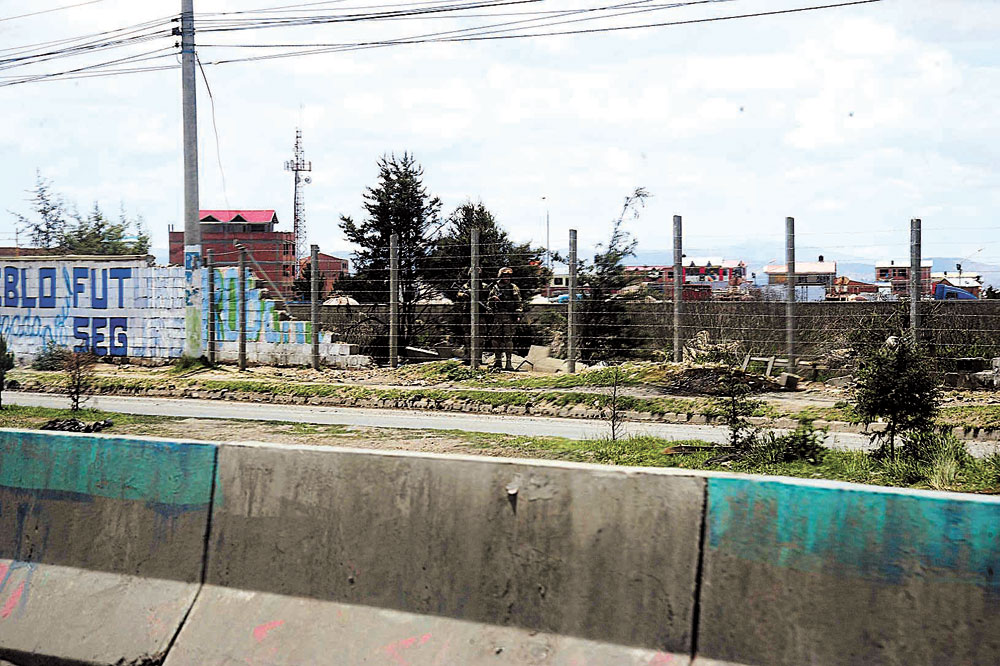
A segment of the pushed-over wall; the site remains guaraded today.
At that instant, according to family members [of those killed], witnesses, and David Inca, the representative of the Permanent Assembly of Human Rights of Bolivia (Asamblea Permanente de Derechos Humanos de Bolivia, APDHB), the shots began. “The people recounted that from behind the wall, they began to launch tear gas over it, the people appeared, and pushed and made the wall fall. That is when the military troops came out directly to shoot,” as the activist Inca described.
One of the first victims, according to the family member, was Edwin Jamachi. “He left the house to cash a check and passed by the [Senkata] plant where he was shot,” recounted his sister, who for fear of reprisals did not give her name. The loved ones of those killed, wounded, and detained are fearful, because they believe that they may be accused of sedition.
Shots. Between 11:00 and 12:00, according to his family members, Clemente Mamani also died.
“Clemente was shot near the rail (the old railway that passes by 50 meters from the plant). That happened after the tankers had gotten out, he wasn’t even blockading,” detailed another family member who requested anonymity.
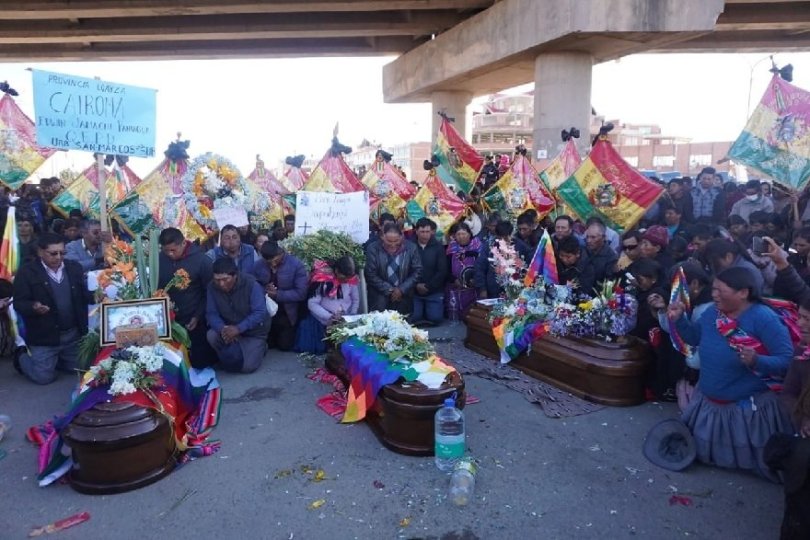
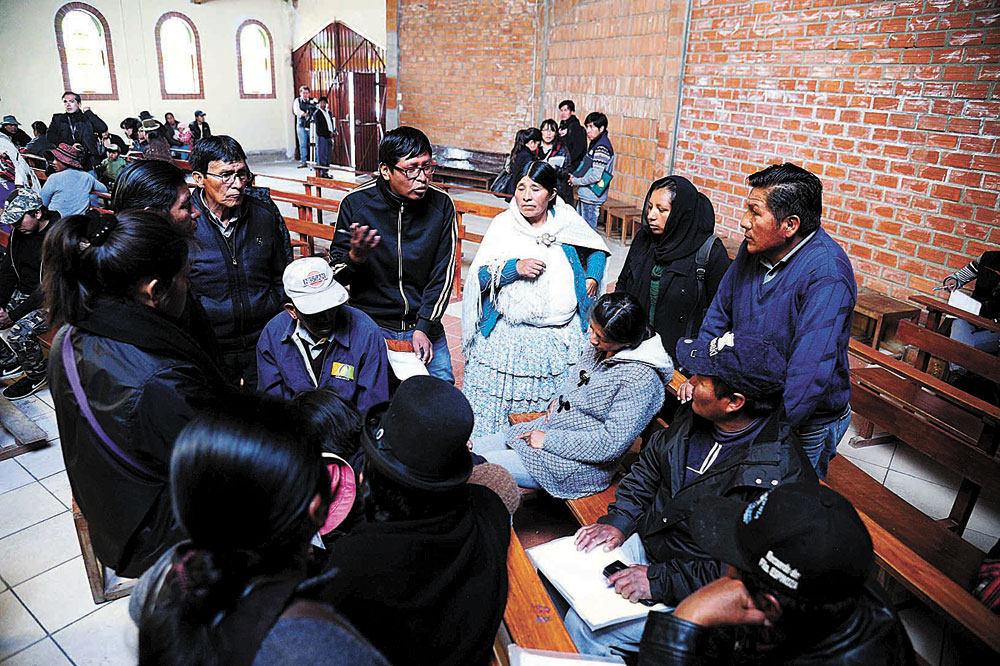
Families of the dead in the San Francisco parish church.
The people ran to the left, close to the old rail line; others to the right, towards the town of Achocalla, and many retreated towards the Senkata Crossing, where the blockade was born on November 9.
The third moment came between 12:00 and 1:30pm, according to the version related by Inca and the families of those wounded and killed. “The military troops came out of the plant towards the pedestrian bridge (in the center of Senkata) to carry out the work of dispersing [the crowd], advancing and firing gas canisters. Others fired their guns,” Inca denounced. According to the APDHB representative, there were 60 wounded and at least 11 killed (a girl died on Wednesday). Officially, there are ten known deaths.
“The helicopter that was flying over Senkata also fired gas,” affirms a family member of Juan José Tenorio, another of the victims that may have died near that pedestrian bridge. Others were wounded on the highway that leads to Vela Bridge. “A bullet passed through the arm and the right leg of my wife,” described a husband of one of those wounded. Some victims fell near the plant and others by the Senkata Crossing and the San Francisco de Asís parish. “My son Pedro Quisbert died near the church,” his mother said.
The long night of Tuesday, November 19, while five bodies were laid out under veils in the parish, Defense Minister Fernando López assured the public that not one shot was fired by the Armed Forces. … The Forensic Investigations Institute (Instituto de Investigaciones Forenses; IDIF) reported in La Paz that four of the dead in El Alto were wounded with 22mm and 9mm bullets. They ruled out [standard issue] military munitions.
On Tuesday November 26, Wilson Santamaría, the new Vice Minister of Citizen Security, said that after viewing the security cameras at Senkata, they identified the use of explosive by some blockaders and that some of them were not from El Alto.
The Inter-American Commission on Human Rights, which visited Bolivia November 22 to 25, has released a visually and emotionally arresting video that highlights the testimony of survivors of the Bolivian government’s massacres of protesters in the town of Sacaba and the El Alto neighborhood of Senkata. The video interweaves survivors’ pleas with crowd shouts for “justice” and does far more to humanize the participants in protests than nearly any coverage in the mainstream Bolivian press. (Click on “CC” for English subtitles, and on “vimeo” to see a larger version.)
The Commission’s report on its visit, currently available only in Spanish, includes extensive discussion of these two massacres. What follows is my translation of a relevant portion of their text:
Massacres and murders
In the context of the crisis, and as of November 27, the IACHR received news of 36 people who lost their lives in Bolivia. During its visit, the IACHR delegation received abundant information about two massacres committed in Sacaba and in Senkata, on November 15 and 19, respectively, in which at least 18 people lost their lives.
The Sacaba massacre occurred on November 15. The Commission received information from witnesses, according to which members of the Six Federations of the Tropic of Cochabamba arrived in a peaceful demonstration to the Sacaba municipality, demanding the return of Evo Morales to the government and recject the interim government. At the Huayllani bridge, located at kilometer 10 of the highway from Cochabamba, the combined forces of the Police and Armed Forces had established a security cordon. At the moment the demonstrators attempted to pass through, they were first contained and told verbally that the Human Rights Ombudsman’s Office (Defensoría del Pueblo) was on its way to mediate; nevertheless, according to information received, a few moments later the police and military agents would open fire against the civilian population gathered there, which they also would attack with tear gas, beatings, and kicks. In these acts, nine people were killed: Omar Calle, César Sipe, Juan López, Emilio Colque, Lucas Sánchez, Plácido Rojas Delgadillo, Armando Carvallo Escobar, Marco Vargas Martínez, and Roberto Sejas. Numerous people were wounded, including by bullets, who were received by various hospitals in Sacaba and Cochabamba.
The commission takes note of the existence of different versions of how these events unfolded. On one hand, some state authorities, including the Forensic Investigation Unit (Instituto de Investigaciones Forenses; IDIF) and the police command, have accused the demonstrators of having shot one another, proposing reasons such as the caliber of the bullets that were recovered from the bodies of the dead and wounded. On the other hand, the numerous testimonies received by the IACHR are consistent in indicating that the demonstrating people were unarmed, advanced peacefully by their own initiative, and were attacked with fire arms, teargas canisters, batons, and other weapons by the security forces, in a sudden and surprising manner. Security force helicopters participated in the operation, as even the Police Commander of Cochabamba testified before the IACHR.
The Senkata massacre occurred on November 19. According to information received, a group of partisans of the MAS carried out a blockade around the oil and gas plant of the Senkata sector, in El Alto. That morning, sixty container trucks of gasoline and natural gas were allowed to leave the plant, after which the demonstrators had knocked down one of the walls on the perimeter of the plant, at which time they were contained by the firearms of the combined forces of the Police and Army. In these acts, nine people were killed by gunshots: Devi Posto Cusi, Pedro Quisberth Mamani, Edwin Jamachi Paniagua, José Colque Patty, Juan José Tenorio Mamani, Antonio Ronald Quispe, Clemente Mamani Santander, Rudy Cristian Vásquez Condori, and Calixto Huanacu Aguilar. Among those who were killed are several people who do not seem to have participated in the blockade, but rather were simply passing through the zone on the way to their homes or workplaces. There were also numerous people wounded by gunshots, beatings, inhalation of gas, and other related causes, who were attended in various hospitals in El Alto. Just as in the Sacaba massacre, some public functionaries, both forensic and police, have questioned whether the bullets that killed these citizens had been shot by the regulation weapons of the security forces. With respect to that, according to public declarations and those made before the IACHR, insistently reiterated by the victims themselves, these people were publicly demonstrating without violence and were the object of repression by state agents using firearms. There have also been public denunciations of the disappearance over various lifeless bodies of people who had died in the the same massacre, which would have been taken by state agents so that no one would have word of these dead people. In particular, cases of [such disappearances] denounced before the IACHR include that of a peasant woman, and of a girl around 12 years old, among others. The victims of this massacre consistently signal that the number of those killed is much more than the nine that have been reported up to now.
The Inter-American Commission on Human Rights emphatically condemns the massacres of Sacaba and Senkata, in which [the perpetrators] incurred in grave violations of human rights. According to the Commission’s criteria, these acts can be characterized as massacres given the number of people who lost their lives in the same way, time, and place, and because they were committed against a specific group of people. In addition, the patterns of the wounds that have been recorded offer serious indications of practices of extrajudicial execution. The right to life, protected under the American Convention [on Human Rights], is inviolable, and due to its essential character is the precondition for the exercise of all other human rights. The organs of the Inter-American System [of Human Rights] have reiterated that the use of force by the state must be bound by the principles of exceptionality, legality, necessity, and proportionality. As well, the Bolivian state is reminded that lethal force many not be used merely to maintain or re-institute public order; only protection of life itself and physical integrity against imminent and real threats is a legitimate objective for the application of deadly force by state agents. In this sense, the IACHR urges the [Bolivian] state to immediately and urgently implement mechanisms to prohibit and effectively impede the use of lethal force as a control measure for public order in cases of public demonstrations. The Commission also reiterates that firearms and their munitions must be excluded from control operations of social protest, and that police or military functionaries that may enter into contact with a demonstration should not carry fire arms or other lethal weapons. Additionally, the Commission urges the state to rapidly carry out its international obligation to investigate, judge, and sanction those responsible for these criminal acts.
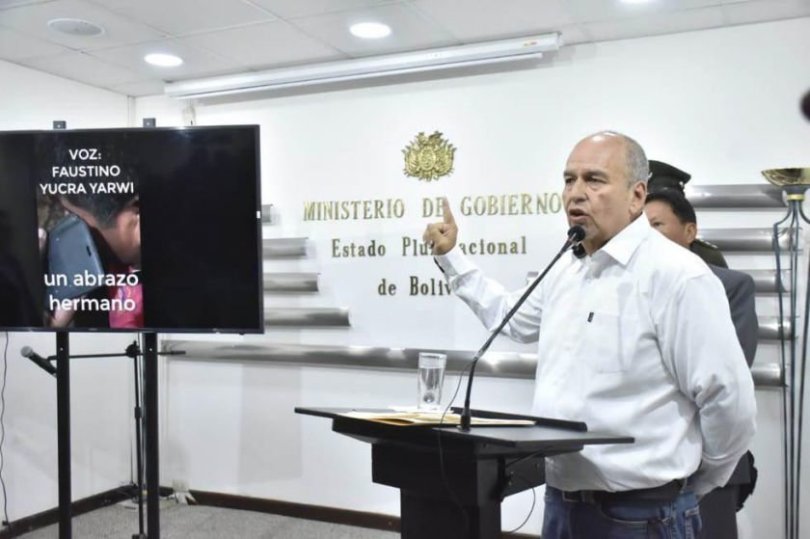
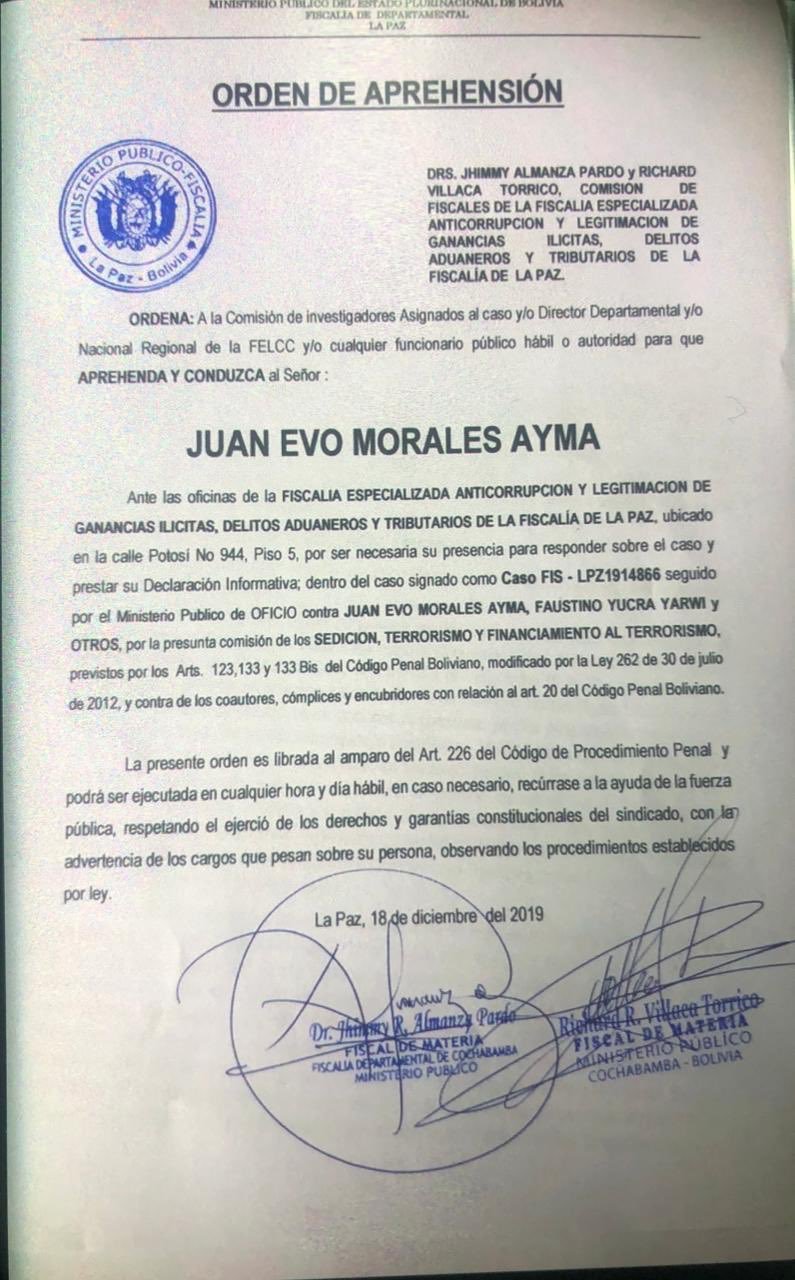
Today, December 18, the Bolivian government issued an arrest warrant against Evo Morales, charging him with sedition, terrorism, and financing terrorism, for his efforts to encourage and organize protests within the country after his November 10 ouster from the presidency of Bolivia. Specifically, the charges seem to stem from a single phone call between Morales and Faustino Yucra, the only named co-defendant in the arrest warrant and the initial investigative documents released in November (see below for details). The call was recorded in a cell phone video first revealed by Government Minister Arturo Murillo (photo above, by APG).
The December 18, 2019, arrest warrant for Evo Morales
The charges represent a dramatic, and extremely one-sided, redefinition of the basic contours of legality in Bolivia, where widespread mass protests frequently use road blockades as pressure tactics and demand the resignation of presidents, and where neither “sedition” nor “terrorism” have regularly been used as means to criminalize such political acts. Insofar as these charges are directed at Morales, three-times elected president and currently the “campaign chief” for his party in as-yet-unscheduled 2020 elections, they represent an attack on the country’s largest political party, the Movement Towards Socialism–Political Instrument for the Sovereignty of the Peoples. As signals of a new legal standard for protest, they represent a dramatic shift in the behavior of prosecutors that could criminalize common forms of protest. (Similar charges have been levied against demonstrators arrested in Sacaba and Senkata after their fellow demonstrators were massacred.) In both cases, the current government is overlooking the similar practices of the movement that challenged Morales for alleged electoral fraud in October and November, demonstrating a double standard that could compromise free and fair elections.
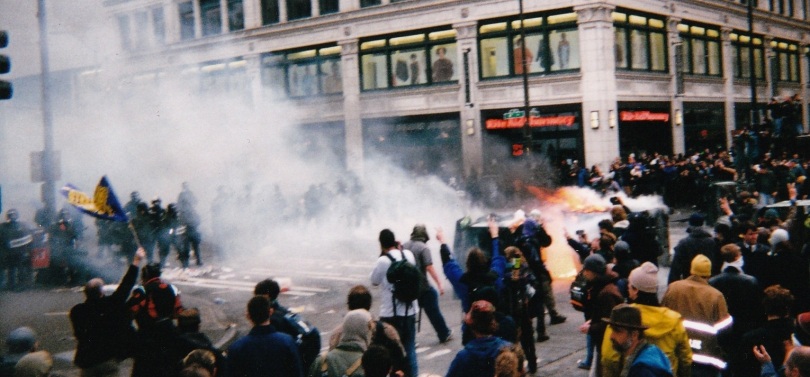
Twenty years ago today, I joined a massive direct action protest to stop the World Trade Organization from making neoliberal economic policy into a virtual treaty for most of humanity. In time, my involvement there drew me to the movements in Bolivia that challenged the same policies, and to a decade of work documenting their capacity to overthrow governments in South America. Here’s a bit of how I followed that path… The following is excerpted (with some small revisions) from my forthcoming book The Sovereign Street: Making Revolution in Urban Bolivia. Available in spring 2020 from University of Arizona Press.
You can get updates on the launch of The Sovereign Street: Making Revolution in Urban Bolivia, and a monthly digest of writing and photography on Bolivia, social movements, indigenous rights, protest tactics, and revolution from Carwil Bjork-James. Sign-up here.
I first encountered Bolivia’s remarkable political upheaval as part of the movement against corporate globalization. The nongovernmental organization that had just hired me, Project Underground, was one of dozens of international solidarity groups weaving bonds among community leaders from the global South, American union workers, environmental activists, and direct-action protesters, in preparation for the Ministerial Meeting of the World Trade Organization in Seattle. My first day on the job, I boarded a bus in Oakland, California, to bring about eighty environmental rights activists directly to the protest against the WTO.
Just before 7:00 a.m. on November 30, 1999, the N30 Global Day of Action, about two dozen of us formed three circles where Pike Street and Boren Avenue cross. In each circle, we linked arms through long tubular “lockboxes.” Sliding our arms into the tubes, and clipping our wrists to a concealed pin, we made circle a unit, breakable only at the risk of serious harm to the limbs concealed within. I got to know my coworkers while helping to occupy this intersection and thereby block the delegates from reaching the meeting. We shared the crossing with dozens of other protesters ready to link arms at a moment’s notice. Any delegates looking for a way into the Ministerial Meeting would have to push their way through us or another group of protesters ringing the Seattle Convention Center. By nightfall the first day of talks had been canceled, and Seattle’s mayor had declared a state of emergency. Surrounded by this display of North American resistance, long-skeptical delegates from the global South saw that U.S. and European negotiators lacked the support of their own people. Many African, Latin American, and Asian delegations then emerged as critics of the WTO’s plans for the seamless flow of capital and commodities, and the talks collapsed. The Direct Action Network, the coordinating body that orchestrated the blockades, mushroomed into a movement of tens of thousands of activists eager to converge upon summits of the powerful, including the World Petroleum Congress, Democratic and Republican political conventions, and the World Economic Forum. Seemingly overnight, challenges to the power and global reach of corporate capitalism became front-page news.
The collapse of the Ministerial Meeting led to cancellation of the Millennium Round of free-trade negotiations just as Bolivians were facing the real effects of corporate-designed trade and investment policies. The government had been aggressively seeking foreign buyers for public enterprises and utilities since 1993 and had found one for the municipal water company of Cochabamba in September 1999. The privatized company’s first water bills—some of them double or triple the previous rate—came out on December 1, 1999. Protests in downtown Cochabamba on that day coincided with the arrest of more than five hundred protesters—including me—in Seattle. By April three waves of mass protests had rocked Cochabamba and thrown out the foreign owners of Aguas del Tunari, restoring public ownership of the city’s water utility.
Following the forced resignation of Evo Morales last Sunday, El Alto has taken a unique path. The city of one million people maybe the most indigenous large city in the world: 76% Aymara and 9% Quechua in the lastest census. United in by the September and October 2003 protests, it ensured the downfall of Gonzalo Sánchez de Lozada, the last hardline Bolivian president to order deadly repression on a massive scale. Ever since, El Alto has a reputation for ethnic and working-class militancy. And yet this very militancy is often radically skeptical of political parties, prone to division, and adverse to being a pawn in others’ games.
And so, the city’s reaction to Morales’ overthrow has been complicated. Some angry crowds have circulated at night, targeting police installations, infrastructure, and other politically connected targets in self-proclaimed resistance to the coup. (An incendiary text by Ivan Apaza Calle, “They are not Evo supporters! They are Alteños, dammit!,” takes up this position.) As I’ve described on Twitter, these protest cut a wide swath of property destruction, especially on the first night of November 10. These attacks seemed destined to deepen divisions rather than unite Alteños in a common effort.
Last night, supporters of Evo Morales burned these public transit buses. They are Puma Katari cross-town buses built by the center-left government in La Paz and their name is a nod to indigenous revival.https://t.co/9VIUhMKFkZ
— Carwil Bjork-James | carwil.bsky.social (@CarwilBJ) November 11, 2019
Also burned last night: the El Alto city hall and the home of Mayor Soledad Chapetón. Chapetón is an Aymara woman who is with the opposition Unidad Nacional party. https://t.co/l0dCdfJpF9
— Carwil Bjork-James | carwil.bsky.social (@CarwilBJ) November 11, 2019
Other daytime protest events have mobilized “in defense of the wiphala,” but with more ambiguous views on President Morales himself. Judith Apaza wrote “So we can understand each other a bit…” from within this context.
A substantial but not overwhelmingly large cabildo of the mobilized, claiming to represent El Alto’s 14 districts and La Paz department’s 20 provinces met Saturday in El Alto. The gathering, which numbered in the low thousands, made a broad list of national and local demands, including the resignations of both Jeanine Añez and Soledad Chapetón.
The circulating crowds, property destruction and arson, have left other Alteños terrorized and there are many testimonial and interpersonal reports of neighborhoods dwelling in fear of overnight reprisals on them. For an example see, “El Alto overnight: Bolivia seems to be an animal that chases its tail.” This weekend, this perspective emerged into a public current of dissension from the stance of hardline mobilization. Alteños are divided between a pro-MAS-IPSP Federation of Neighborhood Councils (FEJUVE) and an opposition FEJUVE contestaria that organizes separately. Some of these divisions have already proved very costly in human lives, notably in the 2016 protest and arson at El Alto’s city hall, which killed six people.
La Razón reported Saturday:
Since that day [November 9], mobilizations with blockades began and there were actions by groups engaging in vandalism who burned almost all of the police stations.
In opposition, the alternate FEJUVE, led by Néstor Yujra, instructed [its constituents] to raise the wiphala in their homes and asked the neighbors to take actions to safeguard their homes, making it clear that the sector does not support any political party.
The lootings divided many neighborhoods. Hence, in many sectors, it was decided not to march or blockade.
The first to demonstrate their rejection [of the “citywide” blockade] were the neighbors of Villa Esperanza, who resolved not to participate in marches or blockades. They were followed in this determination by the Pacajes-Caluyo zone, whose inhabitants decided to go out and un-block the roadways. A similar decision was undertaken by the October 12 neighborhood. The Túpac Katari neighborhood, who de-recognized their [pro-blockade] leadership and Huayna Potosí zone (Porvenir sector) who rejected “being used by MAS partisans.”
Another sector resisting the mobilization by the FEJUVE leadership is District 3. There, barricades have been put up and every night there are vigils to safeguard the Integral Police Station, which is the only one that has not been burned down.
El Alteño newspaper ran the headline “El Alto closes week of protest divided” today. It also reports that neighbors pleading for peace marched with white flags on the city’s Avenida Cívica. Aside from these demobilization initatives, there are statements and manifestos like this feminist text rejecting the “fascism” of Jeanine Añez while refusing any partisan takeovers of grassroots organizations.
EL FASCISMO NO PASARÁ Nosotras, mujeres organizadas, paceñas, alteñas, feministas, hijas de mujeres indígenas, campesinas, obreras, urbanas, ante el avance fascista en Bolivia, más acuerpadas que nunca, de pie y presentes nos Pronunciamos #Bolivia, #LaPaz#ElAltopic.twitter.com/Fngqsw9rnH
Each region and city in Bolivia seems to have a different dynamic at the moment. Just as the national situation is reaching its bleakest moment yet, this pivotal city is working out its own longstanding divisions. It remains to be seen whether and how Alteños can claim the political initiative, and participate in an effective struggle to keep the gains they have won and reverse the damage currently being done.