dispatches across boundaries of states, and states of mind
Author: Carwil Bjork-James
Assistant Professor of Anthropology at Vanderbilt University. (My opinions are my own, and not my employer's.) Author of The Sovereigns Street: Making Revolution in Urban Bolivia (sovereignstreet.org). I conduct immersive and historical research on disruptive protest, grassroots autonomy, state violence, and indigenous collective rights in Bolivia.
The campaign by Evo Morales’ Movement towards Socialism (MAS) party to resume construction of a controversial new highway (background: 123wikipedia) through the protected Isiboro Securé National Park and Indigenous Territory enters a critical phase today. While a pro-highway march has just reached Caracollo (Oruro), a six-day march away from the capital, the Bolivian Plurinational Legislative Assembly will take up consideration of the march’s demands today. The march, officially led by CONISUR, an organization of indigenous people living in the southern, colonized zone of TIPNIS, has had open support of the MAS from the start. Its legitimacy has also been called into question by the national indigenous confederation CIDOB and a wide swath of Bolivian media from the right to the independent left, including the community radio network Erbol.
Erbol has an informative run-down today of the “five MAS strategies to achieve the construction of the TIPNIS highway” since it signed an agreement with the Subcentral TIPNIS, CIDOB, and CONAMAQ to shelve the project in October. These strategies are:
A December 9 rally in Cochabamba in support of construction, organized by the Governor’s office of Cochabamba. Work hours throughout the department were adjusted to assure attendance, and government officials spoke out about being obliged to attend.
The CONISUR march, begun December 19/20 at Isinuta, on the edge of TIPNIS.
The December 16 suspension of Beni governor Ernesto Suarez Sattori, indicted for governmental financial irregularities. Suarez had been the most prominent official in the region to criticize the project and showed a willingness to support alternate routes for the road. His successor, Haisen Ribera Leigue, is a right-wing legislator who has since been disavowed by his party for joining the MAS vote to suspend Suarez. Ribera has joined the call to annul the law protecting TIPNIS, and build the road.
The Plurinational Encounter to Deepen the Change, a three-part “consultation with civil society” on the part of the Bolivian executive branch, included the highway in its agenda for Cochabamba and Beni. The meeting was boycotted by the indigenous federations CIDOB and CONAMAQ as part of the fracturing of the Pact of Unity (wikipedia).
The effort to annul the law in the legislature, which will begin today. Eleven legislators who met with the CONISUR marchers will make their report today, after which relevant legislation will be gestated in committee. The MAS Cochabamba delegation has already pledged to support reversing the protection of TIPNIS. Senate President René Martínez claims to have a 2/3 majority in support of the iniciative, a claim that others contest in light of indigenous and Without Fear Movement legislators withdrawing from the MAS delegation.
Plus (not cited by Erbol): The government continues to stall on its agreement with the CIDOB and Subcentral TIPNIS to put forward official regulations for the law protecting the territory.
While no vote is expected today, the engagement of the Plurinational Legislative Assembly on the issue of reversing the protection of TIPNIS marks a culminating moment in the MAS strategy to go ahead with the road. The government continues to ignore alternate routes for connecting Cochabamba and Beni that fall outside of the indigenous territory and national park, and continues to make winning this fight a political priority. The time for environmental and indigenous rights supporters to turn their attention back to this issue is now.
Update: More on the Conisur communities and coca added, based on new reporting from Erbol; see below.
The long-promised counter-march from Isiboro Sécure National Park and Indigenous Territory (TIPNIS), this time in support of the Villa Tunari–San Ignacio de Moxos highway (Wikipedia) began last Tuesday, December 20. Around 300 initial marchers began the journey from Isinuta, on the edge of the park. Reinforced by hundreds more, the marchers should reach Cochabamba tomorrow, and expect to proceed onwards to La Paz. The countermarch is headed by the members of the Indigenous Council of the South (Consejo Indígena del Sur, or Conisur), a local organization of indigenous people inside TIPNIS, but living in the southernmost part of the the territory, entirely in the department of Cochabamba.
The march is understandably surrounded with controversy, and according to the opposition-leaning/center-right Los Tiempos, a lack of public enthusiasm. But rather than attempting to dismiss this countermarch, I write here to explain it.
To understand this (counter)march, it is helpful to understand the organizational structure of TIPNIS indigenous peoples. The oldest and broadest organization in the territory is the Subcentral TIPNIS (indigenous organizations over large regions of the country are called Centrals and this is a smaller portion of a region). The Subcentral TIPNIS was founded in 1988 and received the land title to TIPNIS from Evo Morales in 2009. It pertains to the Central de Pueblos Étnicos Mojeños del Beni. The Subcentral Securé includes nearly all communities on the Securé river itself, and belongs to the Consejo de Pueblos Indígenas del Beni.
Map of communities in TIPNIS. Orange arrows signal communities affiliated with Conisur. Purple arrows signal other communities mentioned in pro-highway mobilizations.
Conisur includes most but not all communities in the southernmost part of the territory. The Indigenous and Community Conserved Areas (ICCA) database estimates Conisur’s population at 915 people and lists 14 Conisur communities: Limo del Isiboro, Santa Fe, San Juan del Isiboro, San Juan de Dios, San Benito, Sanandita, Secejsama, Fátima, San Antonio, Mercedes de Lojojota, San Juan de la Angosta, Carmen Nueva Esperanza, San Jorgito, and Puerto Pancho. Conisur affilialtes with the Coordinadora de los Pueblos del Trópico de Cochabamba (CPITCO); [La Razón reports 20 communities]. By comparison, estimates for the indigenous population of TIPNIS as a whole are around 12,500 in 64 communities. CPITCO’s website acknowledges, “CONISUR is an organization basically created and supported by the Cochabamba Prefecture, which serves it as a mechanism for channeling aid to the communities of the south and through this to defend its sovereignty over the area. [CONISUR es una organización básicamente creado y apoyado por la Prefectura de Cochabamba a la cual le sirve como mecanismo para canalizar ayuda a las comunidades del sur y de este modo defender su soberanía sobre el área.]” (The Prefecture—now the Gobernaciónor Governorate—is especially interested because the Cochabamba-Beni border inside TIPNIS is not officially demarcated.)
This map shows Polygon 7, the main colonized area, in white at the bottom of TIPNIS.
The communities in Conisur are principally located inside Polygon 7, the region around Isinuta which been colonized since 1970 by outside settlers, principally coca growers. The Polygon is separated from TIPNIS by the Linea Roja (Red Line) which is meant to prevent the advance of further settlement into the park, but in practice has repeatedly been moved to allow just such settlement. Bolivia’s Fundación Tierra estimates that some 20,000 agricultural settlers live in the 100,000-hectare Polygon 7, swamping the local indigenous population whose territory they have largely deforested.
All three of the parent organizations of the TIPNIS indigenous organizations are members of CIDOB. And all three organizations joined in the May 2010 meeting of indigenous residents condemning the Villa Tunari–San Ignacio de Moxos highway. However, political opportunities, local relationships with cocaleros, and divergent economic needs have driven Conisur apart from the residents in the rest of the Isiboro Securé National Park and Indigenous Territory.
Politically, as regular readers of this blog are well aware, the highway has become a major priority of the MAS-IPSP party. MAS-IPSP has controlled the departmental government since the 2008 revocation referendum. The party began its meteoric rise in eastern Cochabamba specifically the Chapare province whose capital is Villa Tunari. Governor Edmundo Novillo has made no secret of his support for the highway, and he plays a key role in its promotion committee. Since June, numerous MAS officials including Novillo, President Evo Morales, and Vice President Álvaro García Linera have been frequent visitors to the Conisur-aligned area of TIPNIS. They’re visits have served to rally support for the highway and to put an indigenous face on a project that is being pursued in contravention of the principle of indigenous consultation.
Map of deforestation in TIPNIS as of 2007. Red indicates the deforested area.
Four decades of cocalero settlement have created a variety of relations between them and the indigenous inhabitants of Polygon 7. Fundación Tierra documents intermarriage and indigenous participation in the coca growers’ unions’ standard-sized plots for growing coca. However, according to press visits (like this one by La Razón), relations are not equitable. Instead, indigenous people are often dependent, landless laborers in their own land, earning around 20 Bolivianos (a bit less than US$3) to harvest a coca plot or selling their fish or wild meat to colonists for around 300 Bolivianos (~US$40) a month. Some told the newspaper the cocaleros prevent them from joining in coca planting. Others earn income by authorizing the cutting of timber, and the elimination of the forest on which their lives once depended.
Unlike those living in the intact sections of the park, the indigenous in the colonized areas have already moved from a way of living interdependent with the ecosystems of the park to one that is integrated with the national economy. Right now, they are living at the bottom of the heap in the cash economy, relying on income from the growers of the regions’ key cash crop. This goes a long way to explain why they see a shared economic interest with the coca growers in the road. They also could see both educational and economic benefits from the expansion of formal schooling in their communities. While schools do not have to follow the roads, in practice the Conisur communities are being registered for schools right now. With this registration comes the Juancito Pinto school attendance bonus, 200 Bs paid to parents per student. This new payment may have furthered aligned their interests with the departmental government and thereby the road.
Added, 2 Jan: Further reporting on indigenous coca planting comes from the Cochabamba center-left daily Opinión and the community radio network Erbol. Opinión describes three levels of involvement by indigenous residents: labor in colonists’ coca harvesting, small-scale unofficial coca planting, and membership in coca growers’ unions. Coca is a good cash crop option for those who are enmeshed in the cash economy, but disconnected from the road network: the light coca leaves can be dried, packed up, and carried to larger settlements for sale. However, only union members can sell their leaves in large, official markets, which are controlled by the union federations. Opinión profiled in particular the community of San Antonio as a coca-growing Yuracaré indigenous community. Erbol has now published quotes from an interview “four months ago” with Conisur leader Gumercindo Pradel, confirming that “five to seven” Conisur communities grow coca: “There are five to seven communities that are dedicated to planting coca and which are affiliated with the Federation of the Tropic [one of the Six Federations of cocaleros]. [Son cinco a siete comunidades que se dedican a la siembra de la coca y que están afiliadas a la Federación del Trópico.]” Since the march began, however, Pradel has insisted that Conisur communities are not coca cultivators. // end update //
Across the world, indigenous rights struggles over development projects often see the fostering or exacerbating of internal divisions by those actors who promote the project. This makes the current counter-mobilization in TIPNIS familiar, even if few expected such a divisive move from the indigenous-identified government of Evo Morales. International and Bolivian standards around free, prior, and informed consent by indigenous have a provision to avoid this problem: an insistence that the pre-existing and recognized structures of governance be the basis of indigenous consultation. While the schismatic history of TIPNIS indigenous organizations complicates this picture, the Morales government clearly recognized the Subcentral TIPNIS as the local authority over the National Park and Indigenous Territory. By changing course when the Subcentral spoke out against its highway project, the MAS government is following in the footsteps of the divide-and-conquer strategies by governments and corporations it once condemned.
Nearly two months after the cross-country Eighth Grand National Indigenous March won a law prohibiting any highway project through the Isiboro Securé National Park and Indigenous Territory (TIPNIS), construction of the project has finally been suspended, but not stopped. The Brazilian contractor OAS has laid off 80 of its 800 workers, and pulled back its work camps, machinery, and work teams from areas of active construction, reports today’s Los Tiempos (Cochabamba). The layoffs were reported earlier in the Brazilian newspaper Valor (secondary coverage from the Erbol community radio network). Update: OAS now reports that it is laying off 411 additional workers, leaving just 300 on staff “for continuity” of its operations. The worker’s union reports even larger layoffs: 350 on December 14 and another 350 on December 15. (source: “Despido masivo en OAS; la ABC no halla motivos,” Los Tiempos, 15 December). Evo Morales criticized the move and the company. Further Update (January 7): The Brazilian ambassador to Brazil, Marcel Biato confirms a “slowdown” in work, but attributes it to the rainy season, rather than any monetary dispute. The ambassador mediated in the Decemeber impasse between OAS and the Bolivian government, and claims to have resolved it. [Opinión puts it this way: Biato, que había interpuesto sus buenos oficios para superar el impasse, dijo que aquello ya no es tal. ] Biato states that he expects the Bolivian government to renegotiate Segment II, but reiterates there is “no hurry” to do so.
The immediate cause of the paralysis in new work is a dispute between OAS and the Bolivian government over financing. While most of the funds (US$322 million) for the project are being provided by the Brazilian state development bank BNDES, the Bolivian government share had been set at US$190 million. However, the Bolivian government is now offering just US$143 million, although the reasons for this are unclear.
Workers on the project have offered the Bolivian government a 48-hour deadline to resolve the issue or face mobilizations.
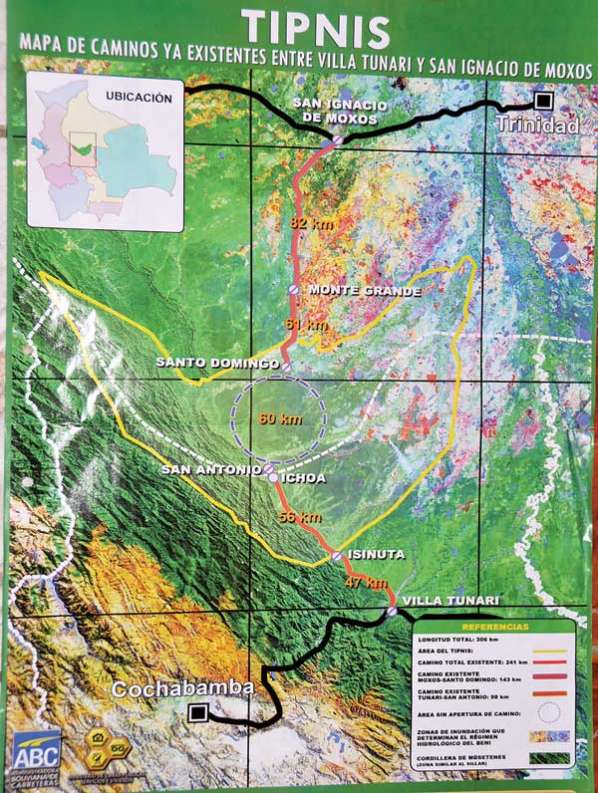
A map from the Bolivian Highway Administration illustrating the road project from Villa Tunari to San Ignacio de Moxos. The boundaries of TIPNIS appear in yellow. Segment I ends at Insinuta, while Segment III begins at Montegrande.
The Bolivian Highway Administration (ABC) claims to be working within the mandate of Law 180 protecting TIPNIS, but has doesn’t seem to have worked out that the current route of Segments I and III essentially require a cross-TIPNIS connection. ABC official, however, have deferred the issue to Cochabamba Governor Edmundo Novillo (of the ruling MAS party) and the highway booster committee.
Engineers: Alternatives Exist
Meanwhile, the Beni Inter-Institutional Committee and the Cochabamba Association of Emeritus Engineers have worked out alternate routes. The Cochabamban engineers proposed 270- to 300-km routes east of the park or a 749-km route northwest of Cochabamba to Trinidad in Beni. They estimate a cost savings over the current project, but realizing that cost savings requires stopping construction. The Beni group came up with an additional route passing immediately west of TIPNIS.
Political conflict continues
Despite the existence of alternatives, the debate over the future of the highway continues to be a political one. The national government, the MAS party in Cochabamba, and a quasi-independent organization of indigenous in the colonized zone of TIPNIS called Conisur continue to be the heart of the pro-road effort. President Evo Morales and Vice President Álvaro García Linera continue to vocally advocate for construction on the original route. The Bolivian government is pursuing parallel, but opposed tracks on the issue: authorizing regulations protecting the park on one hand and organizing a civil society campaign to overturn these decisions.
Some members of the Villa Tunari–San Ignacio de Mojos Highway Booster Committee, however, have expressed flexibility on the route. And several prominent Bolivian grassroots forces have distanced themselves from the campaign for the road, notably the national colonizer federation (the Union Federation of Intercultural Communities of Bolivia) and peasant union founder Genaro Flores.
This week, the Pact of Unity split deepened into two separate meetings on Bolivia’s future agenda. The 1st Plurinational Forum to Deepen the Change met at Cochabamba’s Casa Campestre while CIDOB and CONAMAQ organized their own summit in Santa Cruz. Despite the best efforts of the road-through-TIPNIS campaigners, it seems that the issue will be left for regional Sub-forums to Deepen the Change. The indigenous gathering has reaffirmed defense of territorial rights, including a highway-free TIPNIS as the top of its agenda.
A truncated version of Bolivia’s most prominent grassroots alliance, the Pact of Unity (wikipedia background), met last week in Sucre. The indigenous-campesino Pact has had various versions but generally (since 2006) consists of five nationwide organizations: the campesino federation CSUTCB, the campesino women’s federation known as the Bartolina Sisas, the agrarian colonist federation CSCIB, the lowland indigenous CIDOB, and the highland indigenous traditionalists in CONAMAQ.
Since the divide over the August–October CIDOB-CONAMAQ march in defense of Isiboro Sécure, however, disunity has prevailed. The November 17 to 19 meeting, which hosted President Evo Morales, had just three national participants, the three campesino organizations (or “the triplets”) while CIDOB and CONAMAQ stayed away. (Some Moxeños and representatives of Conisur, an organization of indigenous residents in the colonized area of TIPNIS attended.)
Earlyreports show no signs of rapprochement on the the TIPNIS issue from the Pact; instead they took an even harder line than the Morales administration by supporting the highway and urging indictments against a human rights activist who repeated the widespread (but unsubstantiated) reports of deaths during the September 25 raid on CIDOB’s march. However, the Pact of Unity continues to have its own agenda independent of the government it supports, and the multifaceted demands emerging from this week’s gathering serve to illustrate that fact.
Signature Agenda: The Pact of Unity is responsible for major legislation re-envisioning agriculture and environmental policy. These initiatives remain in their early stages. The Law on the Rights of Mother Earth (wikipedia), a general environmental law has become world famous, but its full, operative version has yet to pass the Plurinational Legislative Assembly. On the other hand, the Law of the Productive, Communitarian, and Agricultural Revolution, a plan for massive investment in the agrarian sector, passed in July, but major implementation challenges are ahead.
On both fronts, the Pact has been a combative force and at times a harsh critic of government. With the presence of CIDOB and CONAMAQ, the June meeting of the Pact critiqued “resistances to change, deviations and political errors” within the government, manifesting in “a nationalist bloc within the government that does not want give up the Nation-State, and does not want to build the communitarian and autonomy-based Plurinational State.” That same meeting placed the Mother Earth and Productive Revolution laws as the foundation for rewriting of Bolivian policy around all types of interaction with the environment, including new laws on consultation, mining, forestry, water, and food sovereignty.
Social control over the state: In the Pact’s June 2011 vision, social movement organizations, indigenous nations, and grassroots communities must watch over the process of change. This week they agreed to form a Supreme Mixed [that is, multi-organization] Council on Monitoring and Social Control to watch over and meet with government Ministers on a monthly basis. This represents the most institutionalized high-level step so far proposed for social movement involvement with governance, although it is unclear whether Morales will accept it. Previously, Morales traditionally held annual (and sometimes quarterly) meetings between Ministers and allied social movements, but broke the tradition before the 2010 gasolinazo.
Critique of Ministers: The La Paz delegation pressed a call for ministerial resignations. In the past the La Paz campesino federation has singled out a few ministers, notably Nemesia Achacolla, for such requests. This time, their delegation called on the entire cabinet to resign. The Pact as a whole kept this to a vague statement referring to ministers “not working for the process of change.”
Gasolinazo: Eleven months after the MAS government’s politically disastrous abandonment of fuel subsidies (quickly reversed by protests), the Pact remain unable to reach consensus on the issue. For now, however, they’re asking the administration to hold off on any new price hikes until the economy approves. Morales acquiesced, while declaring subsidies “a cancer for the country’s economy” which one day the public will ask him to eliminate. No one should hold their breath.
TIPNIS: The Pact embraced a finger-pointing strategy consistent that the movement in defense of the park and indigenous territory is an attack on the grassroots “process of change” underway in Bolivia. Accordingly, they called for lawsuits against the media; prominent activists (Alejandro Almaraz, Lino Villca, Rafael Quispe were named); and the president of the Permanent Assembly of Human Rights. The three activists were blamed for “instigating violence and confrontation among social movements.” Without naming names, the Pact also resolved to expel “all the traitors to the process of change without regard to office or hierarchical rank.” They also now support building the Villa Tunari – San Ignacio de Moxos highway, and the northern highway from La Paz to Pando.
In short, while the TIPNIS issue continues to be divisive, the peasant wing of the Pact of Unity are far from pro-government yes men (and yes women) on other issues. The common agenda they share with their absent counterparts continues to occupy their time and may lead to friction with the Morales government. The future of an alternative development model based on Vivir Bien, long demanded by the Pact of Unity and long promised by Evo Morales, remains undecided. The Pact’s legislative agenda, and tangible actions on extraction projects will be decisive on these issues.
Note: This is (hopefully) now a historical correction. This is assuming that the Morales government carries through its October 21 promise to prohibit any highway through TIPNIS. The misrepresentations of the Morales government on this issue (see below), however, suggest interested journalists and supporters of TIPNIS should stay tuned until the new legislation is finalized. Additionally, the Eighth Indigenous March has fifteen other points of demand, which are currently under negotiations with the Morales government. For comprehensive background on the issue see this briefing paper on the arrival of the march to La Paz (written October 16) and pastarticlesonthisblog. Happily, the English-language press has sent some impressiveon-the-groundjournalists who are covering this, alongside consistent bloggers like Dario Kenner. — CBJ, 21 October
Legislation passed by the Bolivian Chambers of Deputies and under consideration by the Bolivian Senate will not resolve the ongoing conflict over the proposed highway through Isiboro Sécure Indigenous Territory and National Park (TIPNIS). The indigenous communities of the territory, joined by the Confederation of Indigenous Peoples of Bolivia (CIDOB) and the highland National Confederation of Ayllus and Markas of Qollasuyu (CONAMAQ) have led a 59-day protest march in opposition to the proposed Villa Tunari–San Ignacio de Moxos highway, which would split the territory and accelerate already significant deforestation. The legislation, like prior government proposals, will not allow the indigenous people of the territory to freely choose the location or the absence of the road, as required by international standards. Nor will the law stop construction on the other two segments of the road, making the final segment a possible fait accompli.
Update, Thursday October 13: The executive branch has weighed in today. Evo Morales, speaking at the fulfillment an international business deal with a Chinese company, unequivocally said that the consultation will be non-binding, in the case of the highway and many other natural resources issues “of state concern.” As reported by the community radio network Erbol, Evo stated:
They ask that the consultation be binding, it’s impossible, that is non-negotiable. Prior consultations, consultations are always guaranteed by the Constitution and by international norms. We will always respect [consultation], but for a group of families to say to us, “Don’t do this,” would mean to paralyze our projects in the electrical and hydrocarbon sectors, and to paralyze our industries.
There are some matters that cannot be negotiated because it is a question of state, it is a question of the Bolivian people. [translation mine]
Nos piden que la consulta tenga carácter vinculante, (eso) es imposible, eso no se puede negociar, las consultas previas, las consultas siempre están garantizadas por la Constitución y por las normas internacionales, siempre vamos a respetar (la consulta), pero que un grupo de familias nos diga que no se haga (eso) significa paralizar todas nuestras obras en el sector eléctrico, en el sector hidrocarburífero, nuestras industrias.
Hay temas que no se pueden negociar porque es una cuestión de Estado, es del pueblo boliviano.
Evo Morales was not the executive official to weigh in today. Foreign Minister David Choquehuanca, widely regarded as the figure who urged Evo to retreat on the gasolinazo in December 2010, also spoke out.
Journalist: If they say they don’t want the highway, will that be accepted?
Choquehuanca: That’s it, that’s it. Otherwise, why are what are we doing the consulatation for?
Journalist: So, it will be binding?
Choquehuanca: It must be.
Morales’ statement came hours after Choquehuanca, and he continues to lead the government, so there is no doubt that Evo’s is the official position. However, Choquehuanca continues to be a crucial moral compass for the MAS government.
Note:This fact check is necessary in part because some English-language media (e.g., AFP) uncritically repeated the government’s spin that the road project has been stopped or suspended.
Government Proposal for Consultation Will Be Non-Binding
Legislators from the governing Movement towards Socialism (MAS) are currently advancing legislation on the TIPNIS conflict. While, some of them have claimed this legislation reflects the demands of the Eighth National Indigenous March, a delegation of MAS legislators failed to reach agreement with the marchers or indigenous deputies. On the night of October 8, after nine hours of debate, the Bolivian Chamber of Deputies passed the modified MAS proposal. It requires Senate approval and Presidential signing to become law. The modified MAS proposal does the following:
Suspends construction on Segment 2 pending “free, prior and informed consultation of the TIPNIS indigenous peoples, respecting their own norms and procedures in the framework of the Constitution,” ILO Convention 169, and the UN Declaration on the Rights of Indigenous Peoples.
Authorizes a study of alternatives for the Villa Tunari–San Ignacio de Moxos highway, with alternatives required to “guarantee the rights of indigenous peoples in their territory and the ecological equilibrium of TIPNIS.” (Relevant text appears here)
The indigenous march, and six indigenous deputies who represent lowland indigenous communities have raised several objections to this legislation (see after the jump). However, it has now come to light that the consultation process will not be binding; that is, the repeated indigenous opposition to the project, stated since 2003, may be ignored by the government under the law. Three MAS legislators—Deputy Ingrid Loreto (who helped to draft it), Deputy Emiliana Aiza, and Senator Rhina Aguirre—stated to the press (La Paz daily La Razón) that the legislated consultation does not require the government to carry out its results.
A binding process, rather than mere consultation, is the requirement of the UN Declaration on the Rights of Indigenous Peoples, which the government of Evo Morales incorporated into its national laws. Article 32 of the Declaration states in part, “States shall consult and cooperate in good faith with the indigenous peoples concerned through their own representative institutions in order to obtain their free and informed consent prior to the approval of any project affecting their lands or territories and other resources.” A recent letter from sixty-one organizations from five continents to President Evo Morales also urged, “We support a free and binding consultation process for the Villa Tunari–San Ignacio de Moxos highway and the right of the indigenous people of TIPNIS to say no to this development within the Territory and National Park.” Likewise, an online petition with nearly 500,000 signatures (from Avaaz) calls for a “binding and inclusive” consultation.
Construction continues on the highway
Meanwhile, construction continues on Segments 1 and 3 of the Villa Tunari–San Ignacio de Moxos highway. The Cochabamba daily Los Tiemposalso reports that a bridge from Isinuta (the endpoint of Segment 1) and Puerto Patiño, the first step in Segment 2 inside TIPNIS, is being prepared. The promise of Evo Morales, made in the wake of the September 25 police attack on the march, to suspend construction only applies to Segment 2. The same would be true of the suspension under the proposed legislation. However, as can be seen in the accompanying map, Segment 2 between Isinuta and Monte Grande would have to cross through TIPNIS if the other two segments are built as planned.
Map and other indigenous concerns about the law follow…
The 500-km (300-mile) indigenous march to preserve Isiboro-Sécure Indigenous Territory and National Park (TIPNIS) was held back for the week of September 20-25 by Bolivian police and a blockade set up by agrarian colonists loyal to the MAS government. Tensions rose as police turned back supplies for the march and indigenous women in the march compelled government negotiator David Choquehuanca to walk with the marchers through the police blockade on Saturday, September 24. Then, on Sunday, September 25, police launched a sudden and violent attack on the hundreds of marchers. The police use of tear gas, baton blows, zip ties and adhesive tape against an intergenerational cross-section of the indigenous movement, and direct targeting of its leadership sent shock waves through the political system. On Monday, three things were in rapid motion: the still-unconfirmed reports of deaths during the raid; some 300 marchers-turned-prisoners the government was attempting to fly out of the region; and a growing sense of outrage at the Evo Morales government for carrying out the attack. Rapidly organized protests by indigenous people and town-dwellers in Rurrenabaque compelled the police to release the arrested marchers before they could be flown out. Meanwhile, protests spread across the country and attracted support from all parts of the political spectrum, including the Defense Minister and figures who had been loyal allies of Morales.
Criticism of the Villa Tunari–San Ignacio de Moxos highway, planned to run through the ecological heart of TIPNIS, was reinforced by major voices this week, even as an international petition by Avaaz sped towards a half-million signature goal. Solidarity protests with TIPNIS were held in nine cities of Bolivia and across the department of Beni, where the raid occurred. On Wednesday, the national labor confederation held a general strike in solidarity with TIPNIS, among numerous other moves in support of the indigenous march.
Most dramatically, the hundreds of marchers bused by the police to Rurrenabaque have reunited with those dispersed during the raid. Together, they re-started the march at 7:00am on Saturday, October 1, less than a week after the raid. Their destination continues to be La Paz.
However, despite President Evo Morales’ apology for the raid, his government continues to support the proposed road. Government announcements that road construction is suspended remain unconfirmed on the ground, while we learned this week that construction of the road inside TIPNIS is well underway. Morales’ pre-raid Sunday morning proposal to hold a referendum on the highway for all residents of Cochabamba and Beni departments is not even close to “indigenous consultation,” much less “free, prior, and informed consent” by the indigenous communities directly affected by the route. Despite the upheavals of past week, Evo Morales and the MAS party remain committed to defeating opposition to this road project, and to avoiding a precedent for a local veto over infrastructure projects. To buttress this position, they are continuing to rally loyal supporters (primarily colono federations, but also some peasant unions) to upcoming marches in Cochabamba and La Paz departments. The possibility of direct confrontation between supporters and opponents of the road (or equivalently, critics of, and loyalists to Evo Morales), or further violent police action “to avoid confrontations” continues to loom large.
An international sign-on letter has been released in support of the Isiboro-Secure National Park and Indigenous Territory in the Bolivian Amazon and plains, currently threatened by a proposed highway that would cut the territory in two. The letter calls for the Bolivian government to recognize the right of indigenous people to freely accept or reject development projects, including the highway, and to negotiate in good faith with the cross-country indigenous march in its defense.
The signers—sixty-one environmental, human rights, indigenous, health, anti-privatization, and global justice organizations— hail from five continents and identify as supporters of Bolivian social movements and the Plurinational State of Bolivia’s proactive diplomacy on environmental and human rights issues. However, they warn: “the country’s pioneering work on all these issues
also comes with a great responsibility. Bolivia’s continued ability to press forward this vital agenda will be affected by its consistency and moral credibility on matters of human rights and environmental protection.”
The Eighth Grand Indigenous March, which set off from Trinidad in mid-October, has travelled half of its planned route to La Paz, but currently faces a blockade by some members of the Union Confederation of Intercultural Communities of Bolivia (formerly the Union Confederation of Colonizers, that is agricultural settlers on frontier lands). Both the blockaders and Bolivian police are currently preventing the advance of the march towards La Paz, as well as additional volunteers, food, medicine, and supplies sent from La Paz.
Note: I started writing this weeks ago, but wanted to share its content now, since plans are being laid for Monday and beyond. Ultimately, as a speaker said at yesterday’s opening rally: “Monday is a work day; and that’s when we have to get to work.”
There is Internet buzz and face-to-face planning going on around a September 17 occupation of Wall Street. With a pitch in the August Adbusters as a grain of sand, this proposal is crystallizing energy around a common action:
On September 17, we want to see 20,000 people flood into lower Manhattan, set up tents, kitchens, peaceful barricades and occupy Wall Street for a few months. Once there, we shall incessantly repeat one simple demand in a plurality of voices.
Internet forums have been setup, and in-person general assemblies are taking place in New York City (next one: August 9). The vision and politics behind the event reflect 20 years of Euro-American activism against corporate rule, but the plan and the courage are coming from the success at Tahrir Square. Or as Adbusters puts it:
A worldwide shift in revolutionary tactics is underway right now that bodes well for the future. The spirit of this fresh tactic, a fusion of Tahrir with the acampadas of Spain, is captured in this quote: The antiglobalization movement was the first step on the road. Back then our model was to attack the system like a pack of wolves. There was an alpha male, a wolf who led the pack, and those who followed behind. Now the model has evolved. Today we are one big swarm of people.
And at the center of this swarm are places for people to assembly, to debate plans, to envision their futures.
In the coming weeks, key preparations will help to decide the fate of this effort. Aside from enthusiasm, I want to offer some past experiences, all of them from the United States to help people who are making plans. The advice below is almost entirely about tactics, and not about old debates about which tactics are morally acceptable or politically enticing. Rather, this is to open a conversation about what works and doesn’t work on the ground for gathering, holding space, and taking over a place where hostile decisionmakers meet.
1. 2011 Capitol occupation in Madison, Wisconsin
I was a hemisphere away from this when it happened, but the basic structure has so much that could be replicated on Wall Street. Wisconsinites who followed this protest the whole way through should be hosted at least one night in the next six weeks in every community that plans to participate on September 17. One key idea:
Interplay of mass marches with more disruptive actions. Taking the Capitol inspired the whole state; bringing tens of thousands to the capitol justified the more confrontational action. Each effort should think about how it can best be a love letter to the other.
2. January 2002 World Economic Forum Protests in New York City
The buzz about #OCCUPYWALLSTREET that isn’t enthusiasm is basically about one thing: NYPD Lockdown. These protests, held four months after 9/11, saw the worst of times for mass deployments of cops and demonization of protesters. The key tool? Not some fancy weapon shooting rubber bullets or piercing sounds, but linkable security fences. NYPD circulated the idea that any legitimate protester needed to put him- or herself inside of a ring of these, or on street blocks enclosed by them at front or back. Then they arbitrarily closed protesters in and pushed them around using them. Options for resistance: It turns out these cages open with a good upward shove and are quite movable, if a crowd isn’t intimidated by the letters N,Y,P, and D in metal on the side.
Despite the clampdown, actions took place across the city. It turns out that Manhattan is a long island with lots of centers for corporate power stretched out along it. Police have to drive up and down it to get to your protest. Overly concentrating makes their life easier; a variety of locations makes your life easier. Also, pop-up actions in public places like forced security forces to play catch-up while locating their actions in view of the general public. Non-participating witnesses are a major deterrent.
“It should be noted that a large part of the success in policing the major demonstration on Saturday, Feb. 2, 2002, was due in part to the proactive arrest policy that was instituted at the start of the march at 59th Street and Fifth Avenue, and directed toward demonstrators who were obviously potential rioters.”
In another report, a police inspector praised the “staging of massive amounts” of armored vehicles, prisoner wagons and jail buses in the view of the demonstrators, writing that the sight “would cause them to be alarmed.”
Indeed, one of the documents — a draft report from the department’s Disorder Control Unit — proposed in blunt terms the resumption of a covert tactic that had been disavowed by the city and the federal government 30 years earlier. Under the heading of recommendations, the draft suggested, “Utilize undercover officers to distribute misinformation within the crowds.”
Extra reading: People with time may find useful information in these reportbacks on the tactical situation from the protesters’ perspective: 1.
3. March 2003 Financial District Shut-down in San Francisco
This large-scale mobilization paralyzed the city’s financial district on the first two days of the invasion of Iraq. In summary,
In San Francisco, the Bay Area Direct Action to Stop the War called for a next-day shutdown of the city’s financial district if the United States invaded Iraq. The well-publicized goals of the shutdown said in part, “We will impose real economic, social, and political costs and stop business as usual until the war stops…” (David Solnit and Aimee Allison, Army of None, p. 140)
Thousands of anti-war protesters poured into San Francisco on Thursday, fulfilling their promise to disrupt life in the city as they occupied intersections, blocked buildings and tried to shut down the Bay Bridge in protests that occasionally turned violent.Sirens wailed throughout downtown and helicopters whirred overhead most of the day as police in riot gear hustled to keep up with bands of demonstrators. Often they were unsuccessful, as small groups of protesters scurried into place in intersections or dodged around corners to elude police. (SF Chronicle, March 20, 2003)
Up to 1,400 had been arrested before the protests finally began to wind down after 11 p.m., and about 1,000 remained in custody. Most face citations for blocking traffic and failing to follow police orders, but at least 18 face felony charges.”This is the largest number of arrests we’ve made in one day and the largest demonstration in terms of disruption that I’ve seen,” said Assistant Police Chief Alex Fagan Sr., a 30-year department veteran. (SF Chronicle, March 21, 2003)
Tactics for organizing: David Solnit and Aimee Allison assign the success of this movement to four factors that make up what they call a “common-strategy framework”:
Clear What-and-Why Logic: Shut down the Financial District in order to impose a cost on war.
Broadly Publicized: Repeated lead-up actions and press conferences, street art, tens of thousands of fliers, a widely utilized Web site and broad community mobilizing made sure a huge portion of the Bay Area knew what was planned and why.
Mass Training and Mass Organization: A few thousand people received civil-disobedience trainings at schools, churches, and rallies, and well over a thousand people were directly involved in the organizing via affinity groups, working groups, and public meetings.
Decentralization: Many allied groups who had minimal contact with the initiating organization understood and supported the strategy, and participated in the action without coming to an organizing meeting or bothering to identify as part of the organizing nucleus, “Direct Action to Stop the War.”
From my experience in this mobilization, it’s clear that all of these things were crucial. But so too was the nature of the overall plan, traditions of taking the streets, methods of responding, and sheer numbers. And one more thing helped incredibly:
The civil disobedience pick and roll: Those of us who have gone through conventional nonviolence training usually learned to plan an action around arrests. Maybe not everyone gets arrested, but people who are willing to use that willingness to hold space, shut down an office, or simply make a point (recent example: the Tar Sands protests at the White House). Most normal people, on the other hand, tend to get out of arrestable situations while the getting is good. With an aggressive police force, this results in a very boring game of cat and mouse where people are swept all over town.
What San Franciscans accomplished in 2003, however, combined the best of both worlds. Committed activists, with our without lockdown equipment sat down in roadways, linked up across the fronts of corporate offices, and surged through semi-private spaces like lobbies and malls, in potentially arrestable actions. They took their places as if ready to get arrested, and they worked together with larger gathering crowds. But when the arrests came, nearly all of them melted back into the crowd. Meanwhile, the larger mass took advantage of the police concentration on one corner, including the really massive effort it takes to lock people up and cart them off to jail, to start taking over the next. Like the basketball move the pick and roll, this let people hold space in one place while setting up the next. It kept San Francisco protest rolling all day, while shutting down the financial district.
There’s much more experience to feed in, but all of this is a good start.