dispatches across boundaries of states, and states of mind
Author: Carwil Bjork-James
Assistant Professor of Anthropology at Vanderbilt University. (My opinions are my own, and not my employer's.) Author of The Sovereigns Street: Making Revolution in Urban Bolivia (sovereignstreet.org). I conduct immersive and historical research on disruptive protest, grassroots autonomy, state violence, and indigenous collective rights in Bolivia.
Peter Buffett’s “The Charitable-Industrial Complex” op-ed is notable because only rarely do wealthy people admit there’s something deeply morally wrong about accumulating wealth and the widespread existence of poverty:
As more lives and communities are destroyed by the system that creates vast amounts of wealth for the few, the more heroic it sounds to “give back.” It’s what I would call “conscience laundering” — feeling better about accumulating more than any one person could possibly need to live on by sprinkling a little around as an act of charity.
But this just keeps the existing structure of inequality in place. The rich sleep better at night, while others get just enough to keep the pot from boiling over. Nearly every time someone feels better by doing good, on the other side of the world (or street), someone else is further locked into a system that will not allow the true flourishing of his or her nature or the opportunity to live a joyful and fulfilled life.
While I’m happy to hear this critique and glad that it’s passed into the mainstream media so that elites are paying attention, I wish there was more of a direction here about where to go next.
What I like about it: Pointing out big problems: the classist misimpression that the wealthy know best about how to improve the lives of the poor, the idea that managerial and capitalist logic can easily be applied to problems that are essentially about public goods, the unwillingness of donors to give up control when they give their money, the notion that unconscionable gathering of wealth can be laundered by “giving back.”
What I worry about, especially among US-based radicals: The idea that simply abandoning or destroying these institutions or the flow of wealth they represent will solve things. This is why I’m resistant to naming this an “industrial complex”—something that must be destroyed.
The reality is that resources are wrongly distributed from the global South to a rich few every day, leaving behind both injustice and unmet needs. We can, and should, attack the injustice head-on, and fight the looting of the world by corporations and their corrupt associates in governments. But, we also need to build an infrastructure that provides public goods, like the eradication of polio, equitable titling of land, ambulances in rural communities, and emergency food assistance. The struggle is not to stop the institutions that distribute resources from northern donors to such ends, but to make them functional and to make them accountable to the people they serve.
Frankly, both liberals and radicals in the US are bad at putting their money where their heart is in challenging third world poverty. When I visited the Zapatistas, I saw desperately needed ambulances funded by Italian squatters. In Bolivia, left parties from Scandinavia run their own alternatives to the official aid system, while US Americans just complain about USAID without building alternatives. Indigenous and small farmer titles under agrarian reform there happened through official development assistance funds paired with a radical government.
Bottom line: change can cost money, and we need to think seriously about how to insist that it flows where its most needed.
The United States Air Force has a drone base in Niger from which it flied unmanned aircraft into Mali to provide military intelligence for the French military involved in Mali’s civil war. The United States State Department orchestrated the denial of European countries’ airspace to the presidential plane of Evo Morales on July 2.
These are now former secrets, documented in the mainstream press of the United States. Neither lasted very long. Surely the Malian rebels saw drones flying above them and guessed the US military was taking sides against them. And even more surely, Evo Morales knew that the US was behind his plane’s emergency diversion to Vienna. Yet these acts were classified; the US role in blocking the Bolivian presidential plane was publicly denied. What can we learn about United States state secrecy from them?
This is a time of highly controversial disclosures of government secrets. It’s also a time of unprecedented classification of government documents as secret: a US government audit found 3,507,782 people hold security clearance to access Confidential/Secret documents, and 1,409,969 hold Top Secret security clearances as of October 2012. In Fiscal Year 2012, the US government classified 95,180,243 documents, declaring 23 million of them top secret (ISOO annual report). The government spends $8 to $12 billion per year on keeping these documents secret.
Within this mountain of so-called secrets live millions of banal pieces of data: personnel files of agency employees, details of weapons systems, operational details of military deployments. While it’s reasonable to debate how much of this material truly needs to be secured in this way, that’s not the material people are willing to risk their freedom to bring to the world. Instead, the real state secrets are government actions that are carried out covertly. Recently whistleblowers have shown us that the military kept records of killed civilians in the Iraq War, that the US illegally spies on diplomats at the United Nations, that the United Kingdom violated the Land Mine Ban treaty, that the US could document massive government corruption in Tunisia (helping to spark revolt there) and that the NSA spied on the electronic communication of people around the world [some of these revelations are described here]. Every day, diligent work by journalists exposes other secrets to the people whose governments try to keep them.
The drone base in Niger is an example of quasi-secrecy. About 100 Air Force troops deployed in February and set up a base. On February 22, the Washington Post described the operation, which was mentioned in a vaguely worded letter to Congress under the War Powers Act. While the paper reported on the troops, their mission and even the type of drones used, it had to resort to anonymous sources to provide these details. It also noted “Obama did not explicitly reveal the drone base in his letter to Congress.” The President of Niger has been more forthcoming, providing the basis for further reporting in March. Even in February, the Malian rebels targeted by these aircraft were already well aware of the US aircraft, “The Associated Press reported finding an al-Qaeda document in Timbuktu, Mali, that listed 22 tips for avoiding drones.”
The only ones left in the dark by this policy of secrecy are the people of the United States. When the press asks questions about drones, US officials try to avoid the word, and give pseudo-answers like this one: “What the President indicated is we’re going to continue to provide the support that we’ve been investing in this operation. And what we’ve provided is, for instance, logistical support and other types of backing for those nations that are putting peacekeepers into Mali” (Deputy National Security Advisor for Strategic Communications Ben Rhodes, June 27). For four years, the Obama administration directed its press secretary to talk like this: “When I went through the process of becoming press secretary, one of the first things they told me was, ‘You’re not even to acknowledge the drone program. You’re not even to discuss that it exists'” (Robert Gibbs). In effect, the United States is supplying targeting information for a war in Mali, and actually killing people in half a dozen other countries, but refusing to talk about it.
The case of the Morales plane diversion went beyond secrecy to lies. Days before the operation, President Obama responded to a question explicitly raising this possibility: “Mr. President, will you use U.S. military assets to in any way intercept Mr. Snowden should he at some point in the future leave Russia to try to find safe passage in another country?” The President’s answer was unequivocal: “No, I’m not going to be scrambling jets to get a 29-year-old hacker” (transcript). On July 2, Bolivian President Evo Morales’ plane was denied entry into French, Spanish, and Italian airspace and its landing to refuel in Portugal was cancelled. As reflected by the emergency gathering of the Union of South American Nations in response, this was a major violation of diplomatic protocol. It rapidly became clear that the diversion was the use of state power (backed by the possibility of force—i.e., the scrambling of jets) in an attempt to intercept Mr. Snowden.
From the beginning, the Bolivian government identified the United States as the evident cause of the incident. With Morales still on the ground in the Vienna airport, Defense Minister Ruben Saavedra stated:
“This was orchestrated, rigged, by the US Department of State which has provoked this situation utilizing certain European countries, under the suspicion that Mr. Snowden was onboard the presidential plane.”
“Esto fue orquestado, amañado por el departamento de Estado de Estados Unidos, que utilizando algunos países europeos ha provocado esta situación, con la sospecha de que en el avión presidencial estuviera el señor Snowden.” (EFE, 2 July)
This narrative is not only the most plausible one, it is backed up by Austrian press reports that the country’s Foreign Office received a late-night call from US Ambassador Ambassador William Eacho alerting them to Snowden’s presence on President Morales’ plane. It is also suggested by the Spanish Foreign Minister José Manuel García-Margallo’s statement that “They told us that [Snowden] was onboard,” and further describing the source of the communication as a diplomatic secret.
Meanwhile, the US State Department was busy issuing a cascade of non-statements.
July 3: At the State Department, a spokeswoman, Jennifer Psaki, declined to say whether American authorities had asked other countries to deny airspace to the Bolivian plane. “I would point you to them to describe why they made decisions if they made decisions,” Ms. Psaki told reporters. (NYTimes)
July 8: Journalist: And just to follow up, does – is there any more information on where the original information or the leak came from that Snowden was on that plane? Does the U.S. have any more idea –MS. PSAKI: I don’t have anything for you on that, no. (State Department briefing)
July 9:QUESTION: Earlier today at the OAS, a French diplomat – a very young French diplomat, I might say —
MS. PSAKI: Mm-hmm.
QUESTION: — said that the French Government had, in fact, revoked permission for President Morales’ plane to go, but he said that it was a technical error based on a misunderstanding. Do you and the United States have any idea what that technical error – that technical reason that was based on a misunderstanding or an incorrect assumption might have been?
In an interview with Spanish-language CNN, Congresswoman Ileana Ros-Lehtinen* (R-FL) was more direct in admitting US responsibility:
And so, for us, there was a great concern that these countries could give him sanctuary. Therefore, the United States sent that quite severe, quite direct message to—this time it was to Evo Morales, it could have been to other people. We are saying to all countries in a very open manner that this man [has] felonies against him. That he should come to the United States if he is a man of honor…
Así que para nosotros, este gran preocupación que estos países le pudieran dar santuario. Por eso los Estados Unidos envió esa mensaje bien duro, bien directo a … en esta vez fue a Evo Morales, hubiera sido a otras personas. Le estamos diciendo a todos los países de una manera bien abiertamente que este señor [tiene] felonías americanas en su contra. Que venga a los Estados Unidos si es un hombre de valor… (CNN Video posted by Ros-Lehtinen’s office [at 7:30])
So, Bolivia knew of US involvement. Other countries knew of US involvement. A senior legislator claims that the act was designed to send a message of the position of the US government. But the US government formally claims to have no idea how this action happened. The only possible target for these denials is the US public. We are meant to pretend that our government was not involved in this international incident, that such involvement is a product of Evo Morales’ paranoia rather than an obvious and widely discussed pattern of US behavior. (And so, the New York Times will continue to publish sentences full of hypotheticals like this one: “Latin American leaders condemn refusal to let plane carrying Bolivia’s Pres Evo Morales fly over European nations because of what Bolivian officials say were suspicions that Edward J Snowden was on board.”) Given the standards of American journalism, we—and we alone—will have to wait for an actual leaked document from the State Department before our press takes seriously what the rest of the world confidently knows.
Like these two examples, many state secrets are not about protecting complex operations or securing the lives of operatives. They are about keeping the public out of decisionmaking. They are about reducing accountability. They are about subverting democracy. Alongside making a mockery of such basic principles, they make dangerous, unpopular, and/or immoral behavior by government officials easier.
Fortunately, part of that dynamic is beginning to weaken.
Government without Secrecy
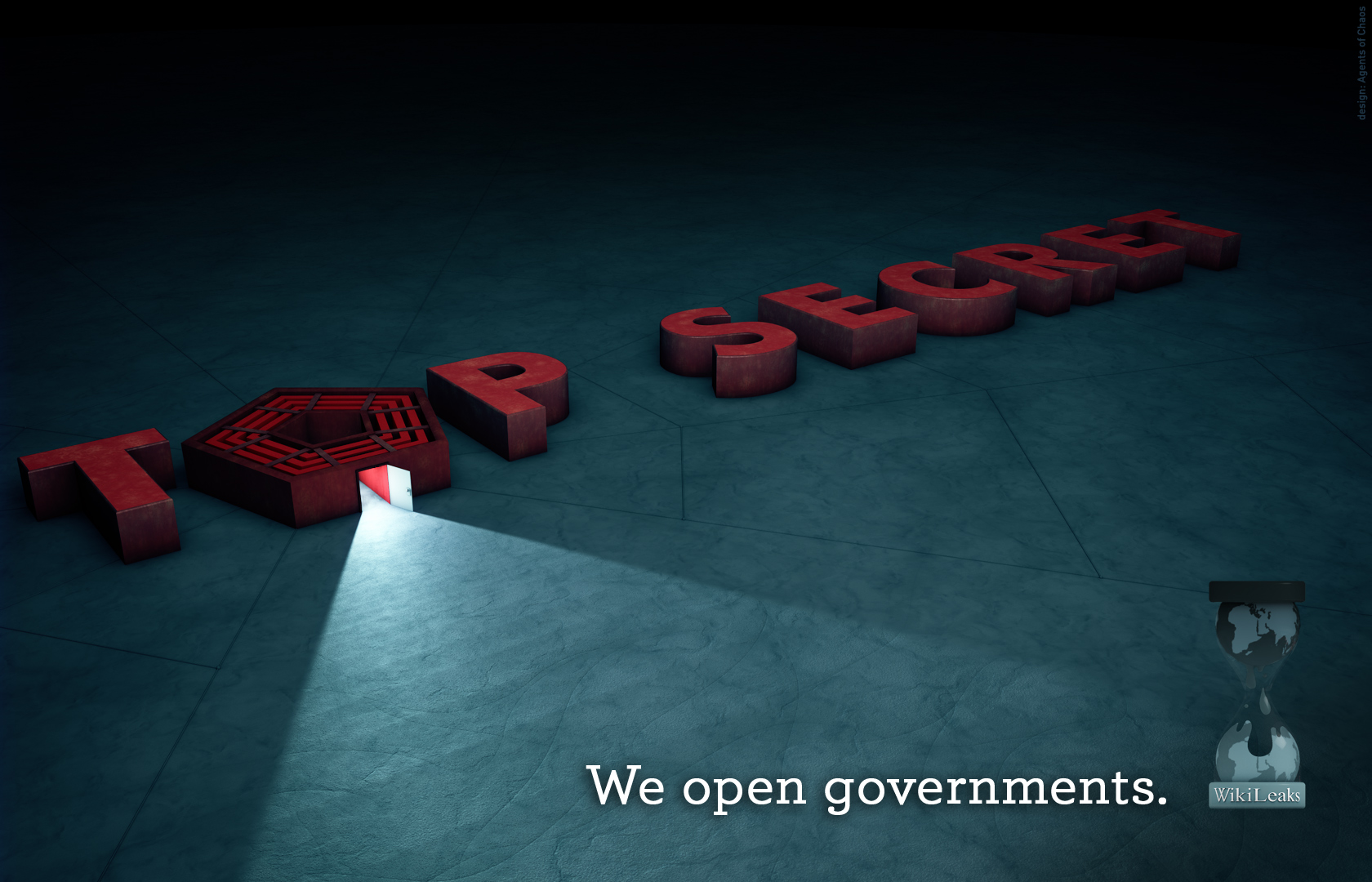
“We Open Governments”
The publication of logs of the Iraq War and diplomatic cables by Wikileaks has raised the prospect of the US government being denied the prerogative of secret wars, secret foreign policies, secret decisions, and secret outcomes. The Snowden disclosures and the avalanche of additional investigative reporting that has followed in their wake have done the same for the surveillance state. (It’s worth noting that every single one of these disclosures have exposed wars, policies and outcomes, rather than the operational security that enables them to be carried out.) Snowden, Bradley Manning, Thomas Drake, and William Binney are all examples of government officials who allowed their conscience to override the classification of information.
In a discussion on Talking Points Memo, a reader (“MB”) suggests that these disclosures are just the beginning of a tidal wave. MB points to a post-Cold War generational value shift “toward a greater emphasis on issues that assumed global cooperation, such as environmentalism and humanitarianism, and … significant value on cross-cultural exchange.” Polling data backs this up: “Just 32% of Millennials believe the U.S. is the greatest country in the world” compared with 48 to 64 percent of older generations. On foreign policy, Millennials value listening to allies more, favor diplomacy over military force more strongly, believe that excessive military force causes more terrorism, and believe it is morally acceptable to refuse to fight in a war you don’t believe in—all by 2-to-1 margins. MB observes:
The national security apparatus is designed to defend itself against Cold War threats: agents who commit espionage in the service of a foreign power for ideological reasons, or for personal gain. It seems that it is not at all prepared to defend itself against espionage committed for personal, ethical reasons, done at one’s own detriment. It may not ever be possible to do so. On some level, this line of business requires that all those involved completely accept the utility and purpose of the mission, and accept that international relations are a zero-sum game. Otherwise, anyone could walk out of their office with a thumb drive and publish the contents online.
What does the world with thousands of thumb drives look like? (Other than a half-dozen presidents of Obama’s generation ordering international manhunts to track them down.) In evaluating the impact, value, and morality of these disclosures, our focus should be on the incentives created by transparency on war, foreign policy, and surveillance. How do diplomats, warriors, and spies change their behavior when they know their deeds will be exposed? (Especially when those disclosures are more likely when the acts are morally objectionable.) There are grounds for hope that “opened governments” will be more cautious and less destructive because they have more reason to fear public awareness of their actions.
* Ros-Lehtinen is former chair and a continuing member of House Committee on Foreign Affairs, and thereby has clearance to be briefed on this kind of diplomatic activity.
The following is my translation of the official statement by the UNASUR leaders made yesterday, in response to the diversion of Bolivian President Evo Morales’s airplane during his return from Moscow to La Paz, Bolivia.
Cochabamba Declaration — July 4, 2013
Before the situation to which the President of the Plurinational State of Bolivia, Evo Morales, was submitted by the governments of France, Portugal, Italy, and Spain, we [declare and] denounce to the international community and the various multilateral organizations the following:
The flagrant violation of International Treaties that govern peaceful coexistence, solidarity, and cooperation among states, which constitutes an extraordinary, unfriendly, and hostile act, forming an illicit act that affects the freedom of transit and movement of of a Head of State and his official delegation.
The abuse and neocolonial practices that still subsist on our planet in the twenty-first century.
The absence of transparency with regard to the political decisions that impeding the aerial transit of the Bolivian presidential plane and of the country’s president.
The offense suffered by President Evo Morales, which did not only offend the Bolivian people, but rather all of our nations.
The illegal practices of espionage that put at risk the rights of citizens and the friendly coexistence between nations.
Given these denunciations, we are convinced that the process of building a Greater Homeland [of South America], to which we are committed, should be consolidated based on upon the full respect for the sovereignty and independence of our peoples, with the interference of the world’s hegemonic centers, overcoming the old practices through which some sought to impose [a system of] first-class and second-class nations.
The Heads of State and of Government of countries of the Union of South American Nations UNASUR, gathered in Cochabamba, Bolivia on July 4, 2013,
1. Declare that the unacceptable restriction of the liberty of President Evo Morales Ayma, turning him into a virtual hostage, constitutes a violation of the rights not just of the Bolivian people, but rather of all the countries and peoples of Latin America, and sets a dangerous precedent with regard to effective international law.
2. Reject these actions that clearly violate the basic norms and principles of international law, such as the inviolability of Heads of State.
3. Demand that the governments of France, Portugal, Italy, and Spain explain the basis for the decision to deny overflight acess to their airspace to the presidential aircraft of the Plurinational State of Bolivia.
4. Equally demand that the governments of France, Portugal, Italy, and Spain offer public apologies in relation to the grave matters that have occurred.
5. Stand behind the Denunciation presented by the Plurinational State of Bolivia before the Office of the UN High Commissioner for Human Rights for the grave violation of human rights and concrete danger to life to which President Evo Morales Ayma was subjected. Equally, we back the right of the Plurinational State of Bolivia to carry out all actions it considers necessary before competent Tribunals and [other] instances [of law].
6. Agree to form a Follow-Up Committee, assigning our Chancellors [i.e., Foreign Ministers] the task of carrying out the necessary actions to clarify the facts.
Finally, in the spirit of the principles established in the Founding Treaty of UNASUR [the Union of South American Nations], we exhort the full body of Chiefs of State of the Union to stand by this Declaration. Equally, we call on the United Nations, and regional organizations that have not yet done so, to speak out on this unjustifiable and arbitrary act.
Twenty-five years ago today, I brought a copy of the paper to a Fourth of July parade in Evanston, Illinois. I was 12, this was summer camp, and the news was not good. On July 3, 1988, the United States Navy shot down a civilian airliner. As Wikipedia now remembers the event:
Iran Air Flight 655 was an Iran Air flight from Tehran, Iran, to Dubai, United Arab Emirates, via Bandar Abbas, Iran. On 3 July 1988, at the end of the Iran–Iraq War, the aircraft serving the flight, an Airbus A300B2-203, was shot down by United States missiles fired by the United States Navy guided missile cruiserUSS Vincennes as it flew over the Strait of Hormuz. The aircraft, which had been flying in Iranian airspace over Iran’s territorial waters in the Persian Gulf on its usual flight path, was destroyed. All 290 onboard, including 66 children and 16 crew, perished.
As best I recall, there was not the slightest acknowledgment during the festivities of the attack on the commercial jet. President Reagan expressed “regret” on that July 3. No US president has ever apologized.
Before that time, I had innocently wondered why it was that the news habitually announced the death toll from lethal events overseas, followed by “including X Americans.” I remember my parents’ explanation being unsatisfying. On July 3, 1988, no Americans were killed.
Nor was a single soldier killed. Just civilians crossing to or from a neighboring country. While US ships operated in the waters between Iran and the United Arab Emirates, it was our government who notified theirs that “any approach to an American warship would be dangerous unless the intent was clearly peaceful.” I can only imagine the Airbus pilot’s—his name was Mohsen Rezaian—steely terror as he maintained course during the planned 28-minute flight that morning.
I remember little of the parade or even my feelings during it. What I would remember for years is four tween boys sitting on the grassy roof of the student center waiting for the fireworks to begin that night. As one kid closed his eyes, the other three of us “brainwashed” him, chanting the government slogans from George Orwell’s 1984: “War is peace. … Freedom is slavery. … Ignorance is strength.” We were at an age when play and reality were not fully distinct, when not a one of us had a basis to imagine what brainwashing would actually look like. Our play was more novice hypnotism than The Manchurian Candidate, but the twelve-year-old me (who had never heard of the Manchurian Candidate, but knew all about the prospect of dying in a nuclear war) wondered if it was working.
Our brainwashed friend improvised the part perfectly. Rousing himself, as if from a long sleep, he conveyed confusion and grogginess. His first words were tentative and out of sorts. He ventured slowly, “Daddy … daddy … Are nuclear weapons bad, daddy?” The fireworks must have began soon thereafter.
As it happened (as the news from the Gulf told our unlistening ears), our peace was war. The mourning we ought to have had was a celebration. Children—us—were properly disturbed by all of this; adults were impervious.
To be good American adults, we would be obliged to learn to feign a continuous innocence. To imagine that our missiles did not lead to their graves, that our government’s intentions were noble, that (US) American lives were more deserving of mourning.
In the end I could not make this transition.
A good US American could never compare July 3, 1988, to the bad downing of civilian jetliners that have so terrorized Americans and their allies in recent decades. Such terrorist acts are meant to be unforgivable, while there is endless time to analyze the thoughts and empathize with the fears of men like Captain William C. Rogers, the officer who gave the order to fire.
Perhaps he did not mean to shoot down a civilian jet. Perhaps he valued Iranian lives as much as his own family’s lives. In the end there was little need to inquire into his motives. He shot down one airplane. US government policy prolonged the Iran–Iraq War for years, providing arms and intelligence to both sides, led by Saddam Hussein and Ayatollah Ruhollah Khomeini. Iranians and Iraqis buried hundreds of thousands of young soldiers each, and over a hundred thousand civilians. The US goal was simple: “We wanted to avoid victory by both sides,” a senior State Department official told Seymour Hersh in 1992. Shooting down an airliner looks like terrorism. Planning for the pointless deaths of thousands upon thousands is terrorism.
There was a long gap between my disillusionment at twelve years old, and the college years I spent reading quotes like that from US officials and American papers. The disconnect between the image of American benevolence and five decades of history grew clearer with each thread I followed and pulled at. It would take nearly a decade of tracing, pulling, and following before I would stop being surprised, shocked, and sickened, rather than just saddened. Nearly a decade before I would start to assemble an understanding of the United States as an empire like any other. And by that time, through that process, it could no longer feel like mine.
In the first three months of 2013, two deeply disturbing crimes brought the problems of sexual and domestic violence to the forefront of public attention in Bolivia. Bolivian feminists have been denouncing these issues—and the general incapacity of the state and police to effectively respond to them—for years. In making their case they have cited facts and figures like the following, time after time:
While a 1996 law provides specialized institutions to receive denunciations of physical abuse, assault and violence, a climate of impunity often prevails. Of 442,056 cases brought to authorities from 2007 to 2011, just 27,133 even made it to prosecutors, and just 9.13% had resulted in guilty verdict or plea by mid-2012 (La Razón). Stated another way, just one of ever 178 complaints yielded a conviction. This builds upon the fact that justice is almost always delayed in the Bolivian justice system: of over 100,000 domestic violence cases begun in 2012, just 51 were closed by February 2013. Even when domestic violence escalates to murder, accountability does not increase; none of the 120 gender-related murders in 2012 have yet resulted in a conviction (Erbol).
(trigger warning: descriptions of sexual and physical violence, and one deeply offensive denial are included after the jump)
Marriage is a political binding spell. It obliges the state to not ask you to testify against one another, the boss who doesn’t respect your love to provide health care for your partner, the florist and the venue owner to treat you equally, the immigration inspector to see you as family. No love should be denied these powers.
And,
These protections should be spread far more widely. Collectivities of dissent should be spared grand juries. Health care should be for all, gay or straight; married or single; salaried, waged, or unemployed. Love in all its forms should be regarded as a blessing, celebrated by neighbors and friends, and honored by strangers. People should find their homes regardless of borders.
This week’s demands on marriage equality are just small asks compared to these. But they’re so easy to say yes to.
xo
I don’t usually repost my comments in the world of social media, but since a couple people asked… I live between a circle that has come to celebrate LGBT equality, with this week’s cases as a big symbol, and a circle where the priority of marriage for LGBT movements has longbeen rightly questioned. I hope this very short piece challenges people in the first circle to expand their demands and visions, and those in the second circle to embrace the limited but daring requests being put forward this week.
Last week, a group of scientists and development experts and the Colombian indigenous confederation each urged a fundamental rethinking of the priorities for planning “development”* in the twenty-first century. The technical experts published their perspective in a commentary in the prestigious journal Nature, “Sustainable development goals for people and planet,” while the National Indigenous Organization of Colombia published a report called Another Vision, Indigenous Peoples and the Millennium Development Goals. (coverage from Intercontinental Cry). Both texts are intervening in the global discussion on the next version of the Millennium Development Goals (MDGs). Outside of the United States (where this kind of international planning is treated as purely a foreign policy matter that won’t affect our future), the MDGs are taken as a general yardstick for directing aid and setting policy objectives, with goals like achieving universal access to primary school and eliminating extreme poverty that may change hundreds of millions of lives. Since I write from the USA, however, let’s pretend that this is just an intellectual discussion for how to think about the world. Even from that perspective, the scientists and the indigenous people raise some really important questions.
Bolivian indigenous leaders denounce human rights violations in Isiboro-Sécure case in Washington
(This blog post also appears at Amazon Watch’s Eye on the Amazon blog.)
Subcentral TIPNIS leader Fernando Vargas Mosua and Adolfo Chávez, president of the Confederation of Indigenous Peoples of Bolivia (CIDOB), addressed the Inter-American Commission on Human Rights (IACHR) on Friday, March 15. The hour-long hearing was the culmination of a weeklong trip aimed at putting the Isiboro Sécure situation on the hemispheric human rights agenda. The visit came in the third year of high-profile campaign to prevent the Bolivian government from building a highway through the Isiboro-Sécure National Park and Indigenous Territory (TIPNIS; past coverage).
Since their march to La Paz in 2011, residents of TIPNIS have experienced restricted freedom of movement. Military detachments, variously labeled an “environmental brigade,” an anti-narcotics measure, and part of “integrating the territory under state control,” restrict access and have hampered the activities of external organizations. Boat fuel, the essential ingredient of mobility on the rivers, has been tightly regulated as a “narcotics precursor.” Meanwhile the Bolivian government backed its own parallel leadership for CIDOB and assisted in evicting Adolfo Chávez and the rest of its elected officers from their headquarters in Santa Cruz. Domestic and Amazon Basin-wide indigenous organizations continue to recognize his leadership.
At the headquarters of the Organization of American States, the indigenous representatives offered a wide-ranging presentation concerning all of the events since the inauguration of the Villa Tunari–San Ignacio de Moxos highway project. Adolfo Chávez introduced his compatriot and to ask that indigenous and individual rights be protected by the IACHR. Fernando Vargas described the territory and the project and presented the struggle of his people as a defense of the territory, of their rights, and the natural environment. “We cannot be accomplices,” he said, “to the destruction of the environment and global warming.”
The leaders called the IACHR’s attention to a series of violations of the collective and individual rights of the sixty-four indigenous communities. Their community structures, including local traditional leaders called corregidores and the territorial organization Subcentral TIPNIS, have been bypassed by the government as decisions are made about the route for a Cochabamba-Beni highway. Police officers and military troops attacked and imprisoned hundreds of members of a pro-TIPNIS indigenous march on September 25, 2011. Despite formal complaints and the presentation of forensic reports on injuries to seventy protesters, the official investigation into abuses that day remains stalled.
At the conclusion of the 2011 march, the government capitulated and passed Law 180, designed to permanently protect the territory as an “intangible zone.” However, a December 2011 agreement between the government and the indigenous communities to implement the law was never put into effect. Instead, the government has unilaterally declared that “intangibility” means that nearly all economic activities – including eco-tourism, sustainable nut and cacao harvesting, and other projects previously approved – must be suspended until the communities accept the construction of the highway.
In 2012, the Bolivian government approved a Law 222 allowing for a community consultation on the future of the territory. However, the terms of this consultation were never coordinated with the local indigenous organization, despite an order from the Plurinational Constitutional Tribunal that the consultation would only be legal if agreed to. The government’s consultation went ahead despite multiple institutions complaining that it failed to meet the most basic of international standards. The “consultation” was accompanied by the public bestowing of gifts and development assistance that were explicitly conditioned on acceptance of the highway. Late last year, a joint survey team led by the Catholic Church and the Permanent Assembly for Human Rights, found that the consultation was neither free, nor informed, nor prior – the essential conditions of its legitimacy.
Fernando Vargas sought the Commission’s presence to clarify the facts, its intervention to maintain in force Law 180, and its determination that the Bolivian government’s obligations to protect the TIPNIS indigenous’ collective rights have not been met.
The Bolivian government brought a sizable delegation to the Commission, led by Minister of Government Carlos Romero. For its part, the Bolivian government’s presentation reviewed another version of the TIPNIS story that focused on who should represent the interests of the indigenous community. Most of its allotted time was given to pro-government indigenous leaders, Melva Hurtado, Pedro Vare, Carlos Fabricano, and Gumercindo Pradel. Respectively, they come from the parallel CIDOB leadership elected while the 2012 indigenous march was still in La Paz, a Beni indigenous organization, and communities on the Sécure River and in the colonized zone of TIPNIS who are affiliated with the coca grower’s movement. . The strategy of the government had two sides: bringing these allies to speak on one hand, and on the other hand treating their demands as totally independent of its campaign to promote the highway. In response, Adolfo Chávez offered another point of view by saying that these figure’s presence was the best illustration of the division among indigenous communities created by the government, and of the lack of respect it has for indigenous people’s own processes of self-government.
In his presentation, Minister Romero denied that any highway project yet exists in TIPNIS, continuing to claim that Segment Two of the highway is entirely independent of Segments One and Three. With the annulling of the government’s contract with the Brazilian construction firm OAS, he said, the project which had begun is now “merely a possible road” in the future. Therefore, he claimed, the 2012 consultation is now a “prior consultation” as required by international standards. He said the current government is more indigenous than any previous one, describing the representation of indigenous people in the national executive and legislature and the titling of Native Community Lands like TIPNIS.
With a session of just one hour, and the lengthy presentation by the government (finally cut short by the Commission), little time remained for questions from the dais. But two members of the commission offered some. What was the form of environmental impact statement generated before the consultation process? What were the norms that regulated that consultation? What was the specific evaluation offered by the indigenous of the likely environmental and social impact of a highway?
The Bolivian indigenous leaders brought with them abundant documentation ranging from their legal title to the territory to detailed community-by-community documentation of the flawed consultation process of the government. They extended an invitation to the Commission to visit the territory and to take a stand on the legality of government actions over the past two years. A full response from the Commission is expected in the months to come.
During their trip, the indigenous leaders also aired their concerns with the American Bar Association, American diplomatic officials, legislators in the House and Senate Human Rights caucuses, and Georgetown Law School.
Fernando Vargas, president of the Subcentral TIPNIS, speaks alongside Adolfo Chávez, president of the Confederation of Indigenous Peoples of Bolivia (CIDOB) in Washington, DC. The two leaders were on a five-day trip to draw attention to human rights violations in the Isiboro Sécure Indigenous Territory and National Park in Cochabamba and Beni departments of Bolivia.