“If you enter the city, I will hunt you.”: Sacaba massacre was preceded by open threat of military violence

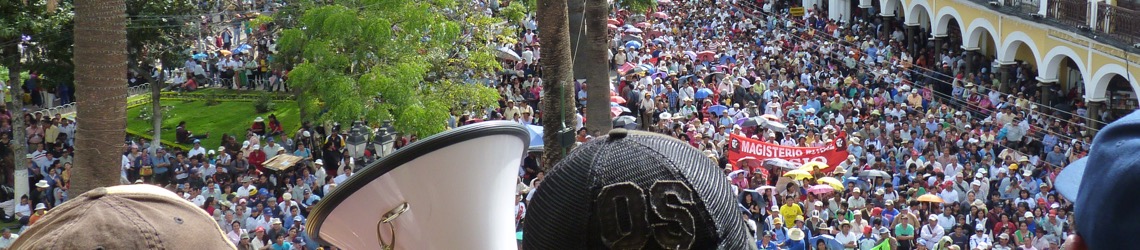
On November 13, 2019—one after Jeanine Áñez was sworn as interim president of Bolivia—the highest police authority and highest-ranking peasant union leader of Cochabamba met in the Integral Police Station (EPI) of Huayllani, the neighborhood that would see the country’s deadliest massacre in sixteen years just two days later.

The Cochabamba peasant federation (Federación Sindical Única de Trabajadores Campesinos de Cochabamba; FSUTCC) had joined calls by the Movement Towards Socialism leader and coca grower Andrónico Rodríguez to mount a national march “against the coup d’ètat” and Áñez’s succession to president. Following in the footsteps of many prior mobilizations since the 1980s, the march would proceed from the coca-growing Chapare to Cochabamba and onto La Paz. The outlying town of Sacaba was the necessary first stop on that journey. FSUTCC leader Jhonny Pardo was in Huayllani to prepare the ground for this mobilization.

Colonel Jaime Edwin Zurita Trujillo, departmental commander of the Bolivian National Police, received Pardo and Nelson Cox, the departmental head of the Human Rights Ombudsman’s Office (Defensoría del Pueblo). Zurita had only recently taken command of the region’s police; National Police Commander Yuri Calderón installed him on November 8 in the wake of the nationwide police mutiny, which took a dramatic form in urban Cochabamba. Police officers in mutiny had demanded the removal of their prior commander Colonel Raúl Grandy. (Both Calderón and Zurita had received new commands in 2019 as part of anti-corruption house-cleaning in the police force. Calderón was later investigated by the Áñez government for his alleged loyalty to President Morales during the 2019 crisis, and by the Arce government for his role in the Sacaba massacre.)

After Morales‘ fall, Zurita had publicly embraced the Resistencia Juvenil Cochala, a right-wing motorcycle gang and called upon the it and self-organized citizens of Cochabamba to defend a police station in the city from pro-MAS opposition attacks. Zurita asked them to “organize brigades, organize barricades; we have information that people are coming towards the city from the Sacaba side and from the south… do not let them pass” (GIEI Report, p. 87). He also spoke out publicly to assure police officers in mutiny that he was on their side: ”[I would] say to the the comrades that I came to work … and that this is a moment for institutional cohesion. They should know that the Police chiefs are fully supporting all of the demands and that we are not going to leave them alone.” He offered to step down if it would be in the interest of police unity. “Of course” he supported the police mutiny, as did “absolutely all of the police command,” and he had nothing more in common with Cochabamba MAS leader Leonilda Zurita than their shared last name.

Read More »

One dead as urban opposition battles pro-MAS campesinos in Potosí

Young pro-MAS protester Basilio Titi Tipolo has been identified as the first fatal casualty in renewed partisan confrontations in Bolivia. Titi died amid the yesterday’s most intense street clashes, in the city of Potosí, where the Potosí Civic Committee (Comcipo) was leading the second day of a nationwide strike. In Potosí, as in several other major cities of Bolivia, striking opposition protesters mounted road blockades in protest of Law 1386, an anti-money laundering statute that shopkeepers claim will lead to abusive investigations of their books. But the issue primarily serves as a lightning rod for the civic opposition, which previously led October–November 2019 protests that culminated in the overthrow of President Evo Morales, to coordinate a nationwide challenge to what they call the “authoritarian” rule of Luis Arce, who was elected in October 2020.

During Tuesday’s protests, multiple efforts were on a collision course in urban Potosí:

  • The Potosí Civic movement intended to paralyze economic life through blockades as part of a national strike.
  • Campesinos arrived in town as opponents of the strike and as supporters of President Luis Arce.
  • Bolivia’s National Police were taking a more-hostile-than-usual approach to the blockades, assailed by Arce’s government as economically damaging.
  • The Departmental government, led by Jhonny Mamani (MAS-IPSP), was preparing to hold an honorary parliamentary session on Wednesday to commemorate the department’s anniversary.
  • On Tuesday morning, Comcipo announced that it would not allow President Luis Arce and Vice President David Choquehuanca to attend the anniversary festivities.
  • Once in town, campesinos rallied around and damaged the headquarters of Comcipo.
  • The Potosí Civic movement mounted a sustained effort to push campesinos out of the central Plaza 10 de Noviembre, eventually achieving this objective.

Security forces and pro-government and opposition protesters were thus pursuing objectives that led to confrontation. Unarmed street battles are not rare in Bolivian political life, but most often involve one group of demonstrators and security forces. Tuesday saw clashes between all three groups, as well as prolonged violent attacks upon individuals isolated in crowds of their political opponents. A pall of confusion and self-interested statements hangs over many of the details of yesterday’s events, but some facts are gradually becoming clear.

Potosí’s mayor reports that fifty people were treated in hospitals in clinics following the confrontations, two remain in intensive care, and one protester died. The deceased protester is Basilio Titi Tipolo, a young man just shy of his 22nd birthday. Basilio had residential ties in Surichata and Potosí, where he had worked as a miner. His body lay in state in the Potosí Peasant Confederación headquarters, where he was mourned by his Quechua-speaking mother.

The Defensoría del Pueblo has taken charge of compiling information on Basilio Titi’s death. Defensora Nadia Cruz stated that he died in the context of the confrontations, that he reportedly fell in attempt to reach safety, and that the medical cause of his death was broncoaspiración—the entry of food or other obstruction into the lungs causing suffocation. Separate accounts have been offered by Comcipo and the national government.

Comcipo issued this comment: “We know that a person has died, a 25-year old who had choked on their coca, surely while running away. There were no signs of violence, and I regret very much that there was a death on the side of our campesino brothers.” Further comments alleged that the campesinos were given alcohol, money, and chile pepper (that is, meals) to cajole them into protests. This is a statement so full of hostility and stereotypes that (1) any sincerity to the claimed lament of the death rings hollow; (2) it’s hard to take the claim that the death was accidental rather than caused by violence at face value.

Comcipo was also at pains to declare that Titi was physically unharmed, placing him among the handful of Bolivians who have fled violent confrontations to their deaths over the years.

Álvaro Terrazas, a vice minister of health, presented a more sinister narrative. He alleged that violent groups blocked the passage of an ambulance carrying Titi and that “the lack of medical attention has led to the death of one person.” Terrazas claims that the forensic medical report established that Titi suffered multiple traumatic injuries, including hematomas from the blows that were struck upon him in the street. He did not cast doubt on the medical cause of death, but rather argued that someone who lost consciousness could suffer broncoaspiración from something as mall as a bit of bread. Terrazas also accused blockaders of throwing dirt to attack the ambulance carrying Titi.

Read More »