What’s at stake in the Paris climate talks

Addressing climate change is one of the most important collective decisions facing us as humans living in 2015. Based on decisions made in the next two weeks, the states of the world will either commit to restrain global climate change to under 2° Celsius above pre-industrial levels, or plan for modest reductions in pollution that still put us on track for 4°C of warming by 2100 (with greater increases beyond that).

Let’s assume you know the importance of this choice in theory, but maybe not in its details. Or even that you knew what the major risks of a 4°C warmer world back when the climate talks were held in Copenhagen, but haven’t updated your knowledge since then. Or that you know, and want something to share with those who don’t. Here are some places to get informed, in way that speaks to the immensity of the risks ahead, relatively fast…

  • Getting To Four Degrees: This hour-long  BBC radio drama puts a typical British family in a world warmed by 2°C and 4°C, while climate experts interrupt and discuss the details of what those world will look like. (original weblink dead; archived here)
  • Five possible scenarios for our future climate (The Guardian, 2009) — Degree by degree summaries of the world at 1°C through 5°C. Begins with our unavoidable future: Most of the world’s corals will die, including the Great Barrier Reef. Glaciers that provide crops for 50m people with fresh water begin to melt.
  • Turn Down the Heat — A series of reports from the Potsdam Institute and the World Bank spelling out the case for limiting warming to 2°C. Remember, the World Bank technocrats are people who have prioritized market-based growth and resource extraction, but they’re not afraid of the science on global warming. In this series, they’ve brought together detailed analyses of how much worse 4°C is than 2°C. If you’re doubting that controlling climate change matters, read about somewhere you love. Comes in three parts: A global summary released in 2012; and regional details for Sub-Saharan Africa, South East Asia and South Asia, and for Latin America and the Caribbean; the Middle East and North Africa; and Eastern Europe and Central Asia.
  • Professor Kevin Anderson on what’s under negotiation in Paris.
  • Understanding key positions of the Least Developed Countries in climate change negotiations: “Warming and associated risks will still be unevenly and unfairly distributed with a global average rise of 2°C, and temperature change will be highest in those regions where particularly vulnerable countries are located. A more ambitious ‘1.5°C pathway’ for limiting global average temperature increase is essential to minimise the risks to Least Developed Countries, Small Island Developing States, and Africa.”
  • The state of the carbon budget to reach 2°C (Washington Post, November 29).

And when you’re wondering how to feel about all this, read these for some company in the face of stark realities:

Bolivia’s climate pledge triples down on fossil fuels, megadams

Screen Shot 2015-11-30 at 1.01.55 PM

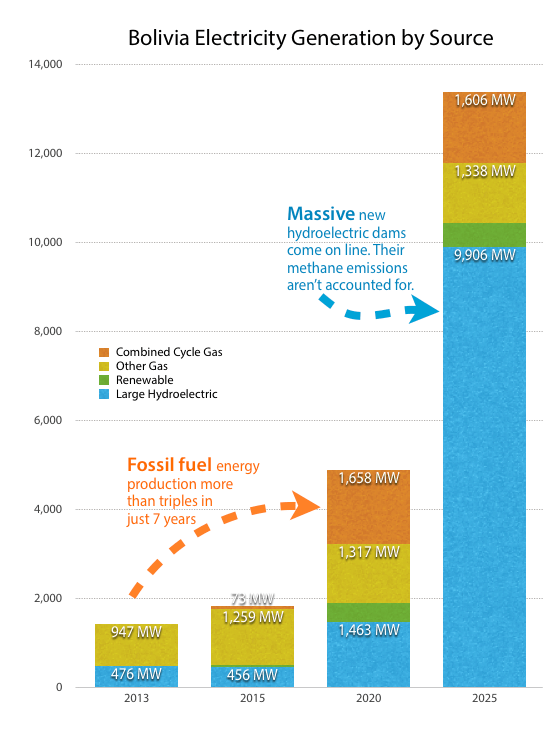
Last month, Bolivia submitted its pledge (English|Spanish) on addressing climate change to the UN FCCC, the body charged with overseeing global negotiations to prevent dangerous global warming. While much of the document is addressed towards global issues, the quantitative details show just how committed the Evo Morales government is to accelerated, and environmentally destructive, development.

The document follows  ambitious government announcements this year about expanding agribusiness, gas and oil exports, and electricity generation. I isolated the electricity numbers, with help filling in the details from this October 2015 report covering the Ministry of Energy and Hydrocarbons.

As you can see from the graph above, there are two big stories to be told about Bolivia’s electricity production plans. First, over the next five years, the country plans to massively expand its domestic burning of natural gas, more than tripling the 947 megawatts (MW) supplied by gas in 2013. Second, in a series of larger-scale projects, the country plans to bring 9,450 MW of hydroelectric power on line by 2025. This enormous expansion would require megadams at Rositas, El Bala, Miguillas, Río Grande, and Cachuela Esperanza (to name just a few of the sixteen proposed). These dams are likely to have severely damaging environmental consequences, particularly since some are located in fragile or protected natural areas. A third story is just as important: the government predicts that domestic power demand will only reach 3,000 MW in 2025, meaning that the vast bulk of the new electricity is intended for foreign consumers, mostly in Brazil and Argentina.

Bolivia’s climate pledge or Intended Nationally Determined Contribution manages to misrepresent this shift as a green move in two ways. First, it deals only in percentages: “Increased participation of renewable energy to 79% by 2030 from 39% in 2010.” In fact, the smaller percentage of nonrenewable energy reflects a massive increase. Second, it counts large-scale hydroelectricity as renewable and the carbon emissions numbers seems to treat these dams as zero emissions, despite the fact that entire biomass flooded by new dams is gradually converted into methane and released to the atmosphere.

Other unlikely claims are advanced in the area of land use change and forestry, including a unexplained promise to reduce illegal deforestation to zero, and to somehow reforest 4.5 million hectares of the country. These pledges coexist with a government plan to expand agricultural land by 10 million hectares over the coming decade, with the most coveted land for planting located squarely in the Amazon rainforest.

Noam Chomsky in his office, 1967

Liberal Imperialism, a classic definition

“Three years have passed since American intervention in a civil war in Vietnam was converted into a colonial war of the classic type. This was the decision of a liberal American administration. Like the earlier steps to enforce our will in Vietnam, it was taken with the support of leading political figures, intellectuals, and academic experts, many of whom now oppose the war because they do not believe that American repression can succeed in Vietnam and therefore urge, on pragmatic grounds, that we “take our stand” where the prospects are more hopeful. If the resistance in Vietnam were to collapse, if the situation were to revert to that of Thailand or Guatemala or Greece, where the forces of order, with our approval and assistance, are exercising a fair degree of control, then this opposition to the Vietnam war would also cease; in the words of one such spokesman, we might then ‘all be saluting the wisdom and statesmanship of the American government.’ If we are forced to liquidate this enterprise … the liberal ideologists will continue to urge that we organize and control as extensive a dominion as is feasible in what they take to be ‘our national interest’ and in the interest of the elements in other societies that we designate as fit to rule.

Noam Chomsky, Introduction to American Power and the New Mandarins, 1969.

The term liberal imperialism makes two distinctions: liberal imperialists are not radicals and are not always hawks. They accept exercising national power over other societies, whereas radical critics of war are simply against that goal, and the military mean of exercising it. Liberal imperialists make themselves against this or that war, precisely and only when the costs are too great, which boils down to when the resistance, abroad and at home, is too great. At the height of the Vietnam War, radical critic Noam Chomsky wrote a devastating moral challenge to the American public acceptance of their country’s power over others. He laments that his opposition to the war “ten or fifteen years too late” once American boots began to be on the ground in 1965, and not when the US military support began. He observes that “The war is simply an obscenity, a depraved act by weak and miserable men, including all of us, who have allowed it to go on and on with endless fury and destruction—all of us who would have remained silent had stability and order been secured.”