Twenty years ago today, I joined a massive direct action protest to stop the World Trade Organization from making neoliberal economic policy into a virtual treaty for most of humanity. In time, my involvement there drew me to the movements in Bolivia that challenged the same policies, and to a decade of work documenting their capacity to overthrow governments in South America. Here’s a bit of how I followed that path… The following is excerpted (with some small revisions) from my forthcoming book The Sovereign Street: Making Revolution in Urban Bolivia. Available in spring 2020 from University of Arizona Press.
You can get updates on the launch of The Sovereign Street: Making Revolution in Urban Bolivia, and a monthly digest of writing and photography on Bolivia, social movements, indigenous rights, protest tactics, and revolution from Carwil Bjork-James. Sign-up here.
I first encountered Bolivia’s remarkable political upheaval as part of the movement against corporate globalization. The nongovernmental organization that had just hired me, Project Underground, was one of dozens of international solidarity groups weaving bonds among community leaders from the global South, American union workers, environmental activists, and direct-action protesters, in preparation for the Ministerial Meeting of the World Trade Organization in Seattle. My first day on the job, I boarded a bus in Oakland, California, to bring about eighty environmental rights activists directly to the protest against the WTO.
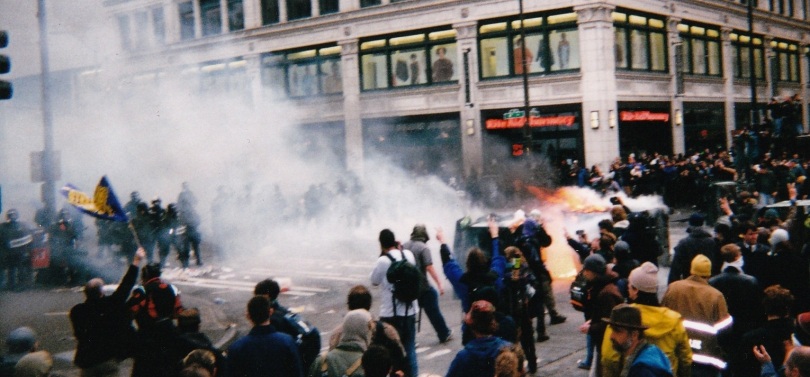
Just before 7:00 a.m. on November 30, 1999, the N30 Global Day of Action, about two dozen of us formed three circles where Pike Street and Boren Avenue cross. In each circle, we linked arms through long tubular “lockboxes.” Sliding our arms into the tubes, and clipping our wrists to a concealed pin, we made circle a unit, breakable only at the risk of serious harm to the limbs concealed within. I got to know my coworkers while helping to occupy this intersection and thereby block the delegates from reaching the meeting. We shared the crossing with dozens of other protesters ready to link arms at a moment’s notice. Any delegates looking for a way into the Ministerial Meeting would have to push their way through us or another group of protesters ringing the Seattle Convention Center. By nightfall the first day of talks had been canceled, and Seattle’s mayor had declared a state of emergency. Surrounded by this display of North American resistance, long-skeptical delegates from the global South saw that U.S. and European negotiators lacked the support of their own people. Many African, Latin American, and Asian delegations then emerged as critics of the WTO’s plans for the seamless flow of capital and commodities, and the talks collapsed. The Direct Action Network, the coordinating body that orchestrated the blockades, mushroomed into a movement of tens of thousands of activists eager to converge upon summits of the powerful, including the World Petroleum Congress, Democratic and Republican political conventions, and the World Economic Forum. Seemingly overnight, challenges to the power and global reach of corporate capitalism became front-page news.
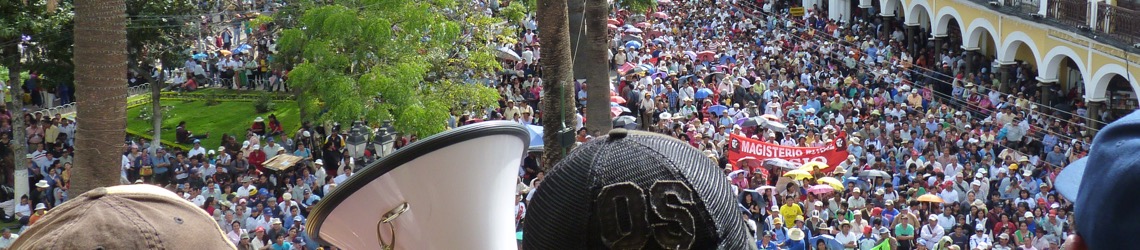
The collapse of the Ministerial Meeting led to cancellation of the Millennium Round of free-trade negotiations just as Bolivians were facing the real effects of corporate-designed trade and investment policies. The government had been aggressively seeking foreign buyers for public enterprises and utilities since 1993 and had found one for the municipal water company of Cochabamba in September 1999. The privatized company’s first water bills—some of them double or triple the previous rate—came out on December 1, 1999. Protests in downtown Cochabamba on that day coincided with the arrest of more than five hundred protesters—including me—in Seattle. By April three waves of mass protests had rocked Cochabamba and thrown out the foreign owners of Aguas del Tunari, restoring public ownership of the city’s water utility.
Read More »