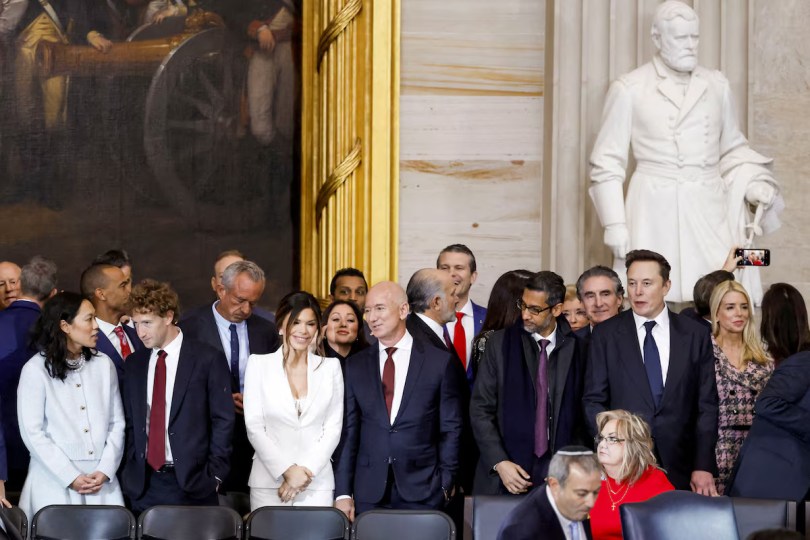
(L-R) Priscilla Chan, Meta CEO Mark Zuckerberg, Lauren Sanchez, businessman Jeff Bezos, Sundar Pichai, and businessman Elon Musk, among other dignitaries, attend Donald Trump's inauguration as the next President of the United States in the rotunda of the United States Capitol in Washington, DC, USA, 20 January 2025.

Prom for the US tech oligarchy

It was an inescapable image of the 2025 presidential inauguration: the joint appearance of Mark Zuckerberg (CEO, Meta), Priscilla Chan (co-CEO and operating leader of the Chan Zuckerberg Initiative, and Zuckerberg’s spouse), Jeff Bezos (founder, Amazon) Lauren Sanchez (Bezos’ fiancée and co-chair of the Bezos Earth Fund), Sundar Pichai (CEO, Alphabet/Google), Elon Musk (CEO, Tesla, SpaceX, and Twitter), Tim Cook (CEO, Apple), and Sam Altman (CEO, OpenAI). Upstaging governors and the incoming president’s cabinet, this roster of the giga-rich offered the blessing of the Silicon Valley to President Donald Trump and offered themselves as an on-stage symbol of what has been variously named the tech–industrial complex (by outgoing President Joe Biden), the Broligarchy (by Carole Cadwalladr among others), the attention economy (by Chris Hayes), and less recently surveillance capitalism (by Shoshana Zuboff).

If the inauguration served as something of a prom for tech oligarchs, it’s also a critical moment to think about how their power operates. It’s both quantitatively more extreme than prior rounds of monopoly capitalism, and tied to extraordinary ideas about future sources of wealth. As individuals, the founders and CEOs atop these corporate entities have way more power than even US corporate tradition usually provides.

The extraordinary personal concentration of dollars and power

First off, there’s a LOT of wealth in that one row: $653 billion among Chan, Zuckerberg, Bezos, and Musk

Google’s Pichai holds $1.3 billion, but he stands in the shadow of founders Larry Page and Sergey Brin, who have $266 billion together. The gap between Google founders Page and Brin, and current CEO Pichai highlight an staggering first-mover/founder advantage in many Silicon Valley firms, entrenching enormous wealth in early owners of these corporations. And these gaps are enabled by a corporate structure that provides founders with enormous voting power and disproportionate ownership of what eventually become large corporations.

Within the companies, they hold an extra level of voting power that exceeds even their share of the wealth.

One way that Google’s founders institutionalized their freedom was through an unusual structure of corporate governance that gave them absolute control over their company. Page and Brin were the first to introduce a dual-class share structure to the tech sector with Google’s 2004 public offering. The two would control the super-class “B” voting stock, shares that each carried ten votes, as compared to the “A” class of shares, which each carried only one vote. …
This arrangement inoculated Page and Brin from market and investor pressures, as Page wrote in the “Founder’s Letter” issued with the IPO: “In the transition to public ownership, we have set up a corporate structure that will make it harder for outside parties to take over or influence Google.… The main effect of this structure is likely to leave our team, especially Sergey and me, with increasingly significant control over the company’s decisions and fate, as Google shares change hands.” (Zuboff, Surveillance Capitalism)

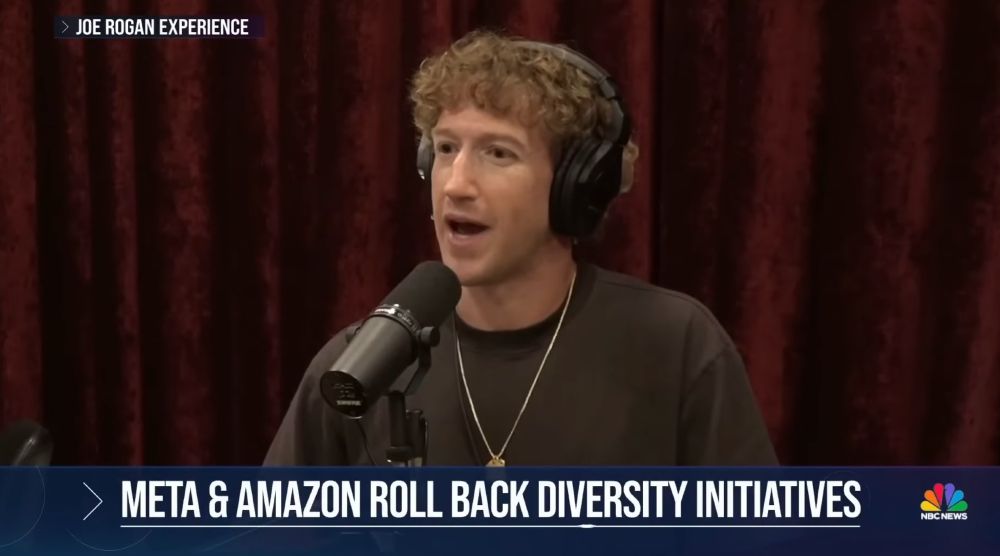
This makes actually-existing Google and Meta a lot closer in internal power dynamics to Elon Musk-owned Twitter than to Microsoft. Hence, this month’s turn-on-a-dime rejection of DEI and fact-checking by Mark Zuckerberg at Meta may reflect a kind of economic power unique to this sector, where founder-owners can exercise personal rule.

Outsized market values based on imagined future control

Despite the unusual internal structure, these are still publicly traded companies whose value is tied up in market expectations, and still massive employers whose functions depend on keeping their employees vaguely satisfied. In fact, tech firms with ties to the attention economy make up the majority the very largest companies by market capitalization—what shareholders estimate they are worth.

The five companies behind the presidential dais—Meta, Amazon, Alphabet/Google, Apple, and Tesla—weigh in at $11.16 trillion in market value. Adding in Microsoft (same sector, same inaugural donations, not on the dais) and NVIDIA and Broadcom (physical suppliers to this boom), we get a combined market capitalization of $19.21 trillion.
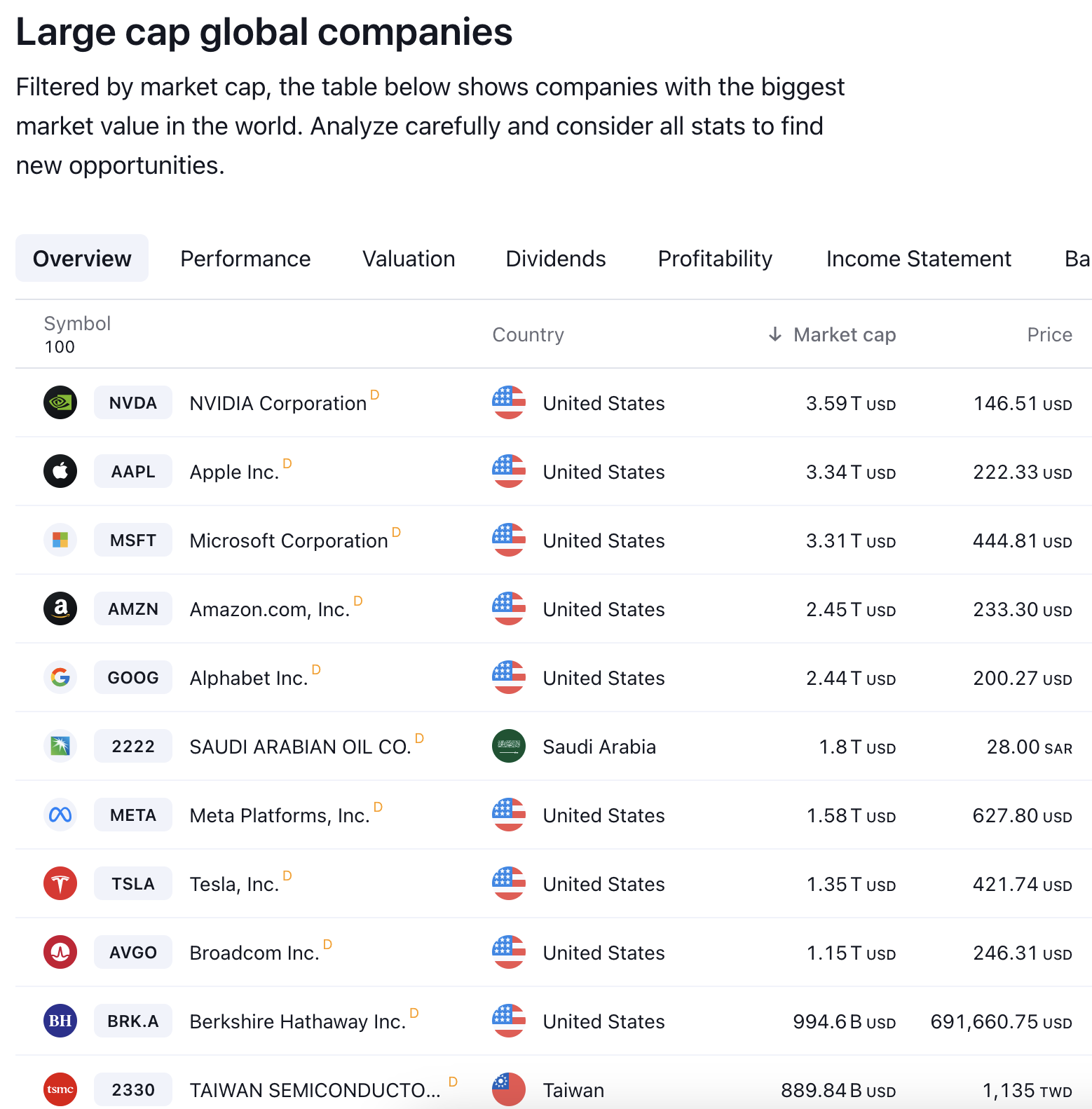
These corporations get a disproportionate amount of investor dollars, representing something approaching a quarter of the global stock equity market (estimated at $78 trillion in mid-2024). Needless to say they are a far smaller share of the global economy, whether measured in dollars of revenue or number of workers.

Collectively, stock markets imagine that these companies have not just their present revenue streams, but future control over larger and critical part of the global economy. Part of their monetary value is stories of future value, stories that may in part be fantastical. And their leaders’ personal wealth is heavily tied to just those stock market values: fundamentally they are fully invested in selling a narrative in which their products—advertising and marketing, behavioral prediction, digital infrastructure, and increasingly artificial intelligence will one day claim nearly all the value of the economy.

Tesla’s value in the stock market exceeds that of all other automakers put together, and is 114 times its earnings, while other carmakers (except Ferrari) run from 3x to 30x. Analysts estimate that over three-quarters of Tesla’s perceived value comes down to robotaxis and self-driving cars, technologies it has yet to deliver. Most of Musk’s wealth is from others’ bet that he has the secret key to the future.
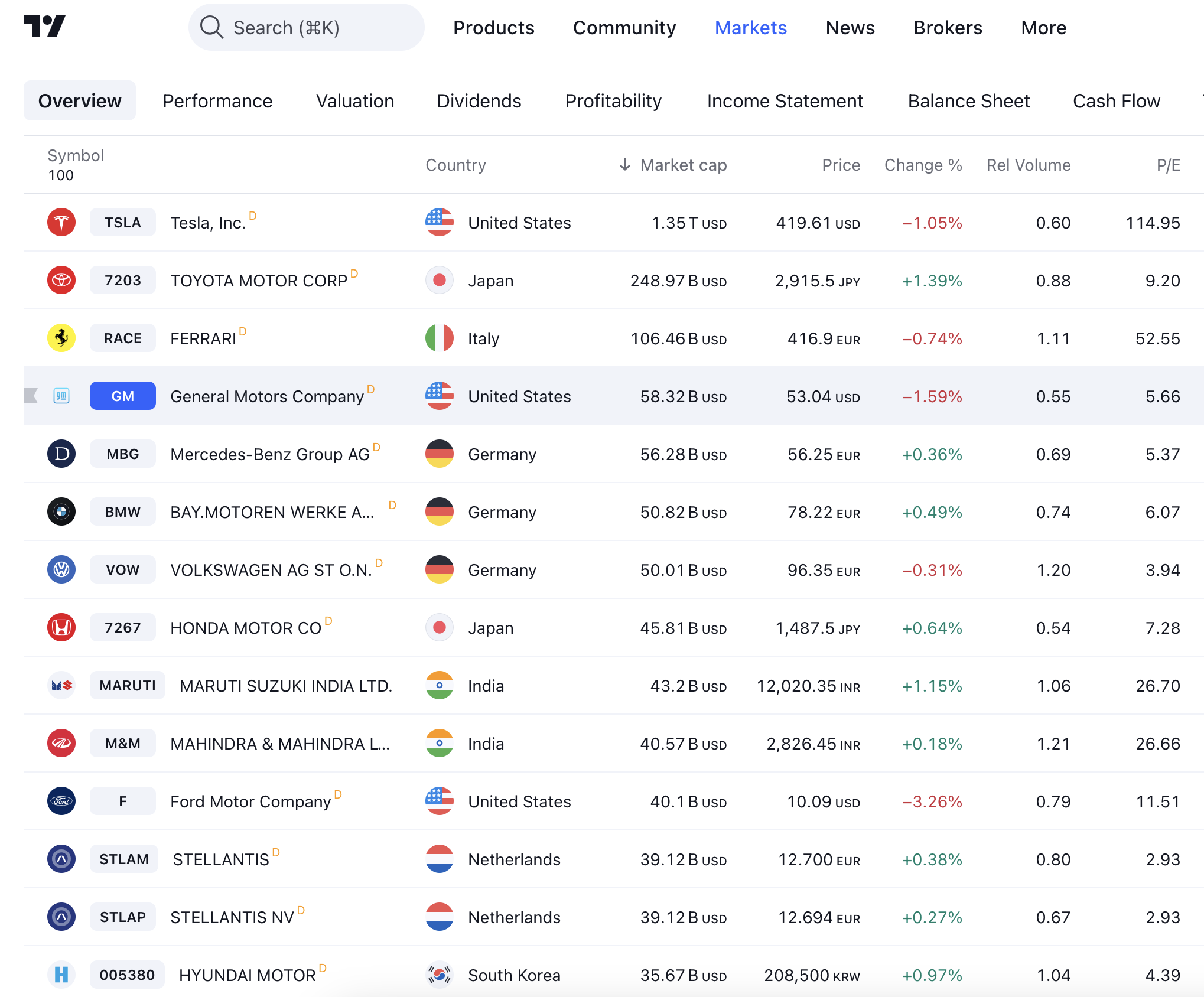
So aside from the usual asks around taxes, subsidies, and freedom from regulation, these oligarchs will be seeking a way for the US government to sustain the illusions and collective future fantasies that amplify their wealth.

Tactical Gems from the Egyptian Uprising

As we cheer on Egypt’s anti-regime uprising, we should also be learning as much as possible how it worked. Some things, of course, are only important in a society that has lived under decades of emergency rule. But most, I think,  apply just about everywhere. Since we’ve seen government spying and storm trooper-style riot cops deployed in just about every country, it’s great when we can learn things that stop them.

Here are some of my favorites so far.

Open source protesting: Making its round in Egypt during the last days of January was a brilliant little pamphlet called “How to Protest Intelligently.” This easily reproducible, forwardable, xeroxable pamphlet brought together an open-ended set of tactics and strategies and widely distributed them. San Francisco bikers will be familiar with the well-distributed xeroxes that circulate at Critical Mass (some mockingly call this form of leadership “xerocracy”), but its relatively rare that protesters aim for mass distribution of their plans to the rest of society. When enough people are fed up, but might remain inactive without a plan, this can be strikingly effective.

By the way, open source is a metaphor here, that has relatively little to do with actual computers. It seems that e-mail and pdfs did actually help in Egypt, but mimeographs, printing presses, fax machines, or copiers would have functioned just as well in another era. (Non-blog-oriented hat-tip to the European collectives circulating open source windmill designs to put renewable energy into grassroots hands.)

You can read nine pages of the pamphlet at Indybay (the San Francisco Bay Independent Media Center), one of my favorite open media institutions.

Advice on gathering and mobilizing from “How to Protest Intelligently”

Gather where you is, Converge on where you ain’t:* One piece of simple advice from the pamphlet is this universally applicable tactical plan. Apparently, it actually happened this way. Ahdaf Soueif, for example, reports:

This is the scene that took place in every district of every city in Egypt today. The one I saw: we started off as about 20 activists, after Friday prayers in a small mosque in the interior of the popular Cairo district of Imbaba. “The people – demand – the fall of this regime!” Again and again the call went out. We started to walk: “Your security. Your policekilled our brothers in Suez.”

The numbers grew. Every balcony was full of people: women smiling, waving, dangling babies to the tune of the chants: “Bread! Freedom! Social justice!” Old women called: “God give you victory.”

For more than an hour the protest wound through the narrow lanes. Kids ran alongside. A woman picking through garbage and loading scraps into plastic bags paused and raised her hand in a salute. By the time we wound on to a flyover to head for downtown we were easily 3,000 people. (“An eyewitness account of the Egypt protests,” Guardian, January 28)

* “If you can’t organize where you is, you can’t organize where you ain’t” — received Saul Alinsky-style wisdom

Missing step, How to Defend a Public Plaza from Cops and Mobs of Hired Thugs: Seriously, I’m curious. And a lot of experience has been generated.

How to make demands from a giant crowd: Now that Tahrir Square has proclaimed itself an “autonomous republic,” and demands are flying from every corner of Egyptian society, not to mention every foreign government, the crowds whose effort has made change possible are trying to articulate their demands. Here’s how:

In Tahrir, the square that has become the focal point for the nationwide struggle against Mubarak’s three-decade dictatorship, groups of protesters have been debating what their precise goals should be in the face of their president’s continuing refusal to stand down.

The Guardian has learned that delegates from these mini-gatherings then come together to discuss the prevailing mood, before potential demands are read out over the square’s makeshift speaker system. The adoption of each proposal is based on the proportion of cheers or boos it receives from the crowd at large.

Delegates have arrived in Tahrir from other parts of the country that have declared themselves liberated from Mubarak’s rule, including the major cities of Alexandria and Suez, and are also providing input into the decisions.

“When the government shut down the web, politics moved on to the street, and that’s where it has stayed,” said one youth involved in the process. “It’s impossible to construct a perfect decision-making mechanism in such a fast-moving environment, but this is as democratic as we can possibly be.” (“Cairo’s biggest protest yet demands Mubarak’s immediate departure,” Guardian, February 5)

Links: BP Oil spill in photos, maps

Smoke billows from controlled burns of spilled oil off the Louisiana coast in the Gulf of Mexico on June 13. (Sean Gartner/Reuters)

The Christian Science Monitor has published a gallery of fifty-five photos of the ongoing BP Deepwater Horizon oil spill’s various effects in the Gulf of Mexico. It’s dramatic and informative even if you’ve been following the spill as closely as I have. Many of the photos, like this one above, also provide a rare sense of the scale of the oil that’s been added to the environment, and the experiment in pollution that is being conducted right now.

Other spill resources:

  • New York Times’ Oil Spill Tracker interactive map—Note that the past seven days have seen a dramatic new landfall from Mississippi to Florida
  • SkyTruth (blog.skytruth.org) attempts to study oil pollution using satellite maps. The site’s early estimates have now been corroborated by the government’s scientific panel’s recent upward revisions in its estimate of the quantity of oil being released.
  • Treehugger.com’s Timeline of Unfortunate Events during the spill.

Sixty days into this disaster, I should have more to say, but there is a massive stream of commentary out there already. I would just add that: 1) The spill adds an entirely set of reasons to limit oil drilling, especially in remote areas, related to safety, disaster response, and local environmental impacts which is different from the climate and global warming issues that have driven the debate. 2) I witnessed some of the appallingly inadequate planning discussions (via public meetings of the Minerals Management Service) a decade ago. There are serious issues for long-term planning here. 3) Those of us thinking about strategies for addressing climate change should get much more serious now about large, but not global, energy policies—like drilling in the Gulf, or airport expansion, or every-increasing miles traveled by cars—instead of only fixating on overarching policy frameworks like carbon markets or taxes.