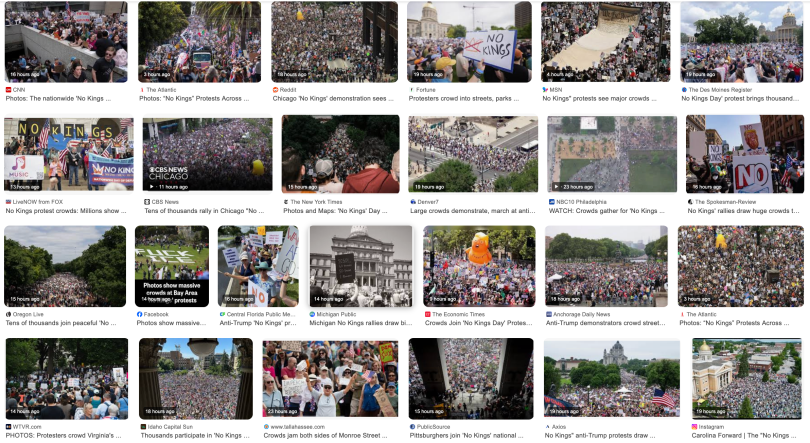
Grid of images of No Kings protests on June 14, 2025

No Kings protests were extraordinary. How exactly?

Americans, citizens and immigrants alike, protested on Saturday, June 14, in exceptional numbers as a wave of No Kings protests became the most widespread public repudiation of the second Donald Trump administration. These protests, which were undoubtedly energized by the standoff between Los Angeles-area communities and Federal troops, could mark a turning point from isolated protests to mass resistance.

Protests are called demonstrations for a reason. And these were displays of political strength for a movement that has a lot to prove: that it better represents the country than a president elected with a slim plurality in November 2020, that it is better able to capture public enthusiasm than an incipient fascist movement, and that it is undeterred by the state violence shown through military deployments, arrests of opposition leaders, and near-disappearances of a growing number of immigrants.

So what does success look like for a mass display of public will?

One simple metric is comparative: did a the anti-Trump movement out-organize and out-turnout their opponent. And here, the juxtaposition with Trump’s military parade — a celebration of the US Army’s 250th birthday on Trump’s 79th — will be unforgettable.

The King’s Parade vs No Kings Protest

News Eye (@newseye.bsky.social) 2025-06-14T22:36:16.034Z

But in a larger sense, protesters make a political statement through crowds (and yes, through many other kinds of actions, but June 14 was largely a day for crowds). When they succeed, that message is “indisputable in its overwhelmingness,” as Argentina’s Colectivo Situaciones described the protests that brought down three presidents on December 19 and 20, 2001. Through some alchemy of place, time, presence, voice, and action, crowds constitute themselves into the “The Voice of the People.” And assert that they, and not their government, will decide the future.

I want to use this occasion to share how those of us who study mass protest try to conceptualize just how protests achieve that kind of political impact.

Charles Tilly, who with various colleagues has probably done the most to examine the protest demonstration as political form, has a four-word summary of what protesters are actually demonstrating. And Tilly’s model is interesting in part because it situates demonstrations as just one form of collective political action (or “contentious politics”), alongside riots, strikes, revolutions, and among many other attempts at disruption or representation. Demonstrations are a social transaction where movements accept that a government system will persist, but where governments are moved to recalibrate their actions based on shifts in popular support and public mode. In that frame, Tilly et al. argue that protesters are engaged in displays of WUNC: worth, unity, numbers, and commitment.

  • Worth: Protesters present themselves as worthy of political participation, rather than exclusion from decisions about their own fate. This might be especially relevant for groups, from working-class laborers in the 19th century to women in the suffrage movements to minorities of various enfranchisement movements, who are formally excluded from participating in official politics. This is self-presentation as an argument that one deserves a place at the table.
  • Unity: Protesters come together and present a common voice. This may be the most basic element of what a common protest is, and everything from a speaker’s dais to roars of approval to marching side-by-side demonstrates this unity of purpose, both to participants themselves and to their audience.
  • Numbers: The size of a protest illustrates the larger capacity of a movement to catalyze political action, to show up again, and to influence democratic outcomes. When the 2006 immigrant protests promised, “Hoy marchamos, mañana votamos / Today we march, tomorrow we vote,” they were offering their quantitative weight to political actors that would accept their agenda.
  • Commitment: To a greater or lesser degree, protests demonstrate the willingness of participants to do hard things, to devote a share of their time to political action, and to make sacrifices for a cause. This is why long marches, gatherings in spite of rain or cold, and endurance of repressive violence—fire hoses, dogs, tear gas, projectile weapons—are so impactful. And why activists can create their own endurance tests—sit-ins, extended vigils, hunger strikes—to show others what they are willing to do.

What‘s great about this framework is that it doesn‘t just make sense of how movements have an impact, but also gives some sense of what goals organizers might have in choosing different protest forms.

But when I tried to understand the movements I have worked with, I came to feel that other dimensions were important as well. As I’ve written: “But what if grassroots movements see themselves not just as claimants before the state, but as a rival power to it? What if they claim a bit of sovereignty for themselves? The mobilized communities described here do use their unity and numbers to illustrate their claim to represent the public as a whole. To create the shared impression that “everyone” is part of a mobilization, however, they also highlight diversity among themselves and carry out geographically expansive protests. And they demonstrate effective practical sovereignty over urban spaces and persistence in the face of state violence.”

These are, I think, four new dimensions. A mobilization that claims sovereignty has worth, unity, numbers, and commitment, but is also diverse, widespread, irrepressible, and in control. What do these four adjectives mean?

  • Diverse: This includes and goes beyond the intersectional identities notion of diversity. Yes, it’s about including those oppressed, marginalized and excluded. It is those who were scorned claiming political voice. But also yes, it’s about joint action across lines of difference, showing people working together despite privilege and division. It is uniting to fight together. And yes again, it‘s about those sectors of society that have been pitted against each other finding common cause. It’s realized though unexpected juxtapositions: Teamsters and Turtles together at last, the office worker in a suit throwing back a tear-gas canister.
  • Widespread: Movements demonstrate their political significance by being ubiquitous: We are everywhere. At the height of their water privatization protests, Cochabambans moved to erect road blockades on every street they could find. And in the United States, we’ve seen a move since at least Occupy in 2011 to maximizing the number of protest locations. This was definitely a feature of the 2020 Black Lives Matter protests, possibly the most widespread protest mobilization in American history. Here in 2025, No Kings seems to have doubled down on this strategy, meaning that many metropolises could boast multiple urban and suburban protests on the same day: as many as fifty separate locations in the San Francisco Bay Area. Much of the celebratory sharing that happened yesterday was geographical, with images from places like Boise, Salt Lake City, or Hattiesburg (Mississippi) treated as mic drop moments.

Do you know how badly you have to screw up as a Republican to get this kind of turnout in IDAHO? #NOKINGS

Heather M. Collins🗽 (@heathersdesk.bsky.social) 2025-06-14T19:44:59.284Z

The last two elements of my list may just be at the horizon for the current protest wave in the USA, but they mark out where things could go as the protester–government standoff evolves.

  • Irrepressible: When a movement surges back in to the streets after repression, it showcases the limits of state power. This feeling is definitely significant right now, with these protests surging both in places where police and military violence was displayed over the past ten days, and showing up in new places in outraged reaction. Anyone who has been on the streets when police have backed down, or gave up their hold on even a block of the city to allow protesters to surge in, knows the electricity that goes through a crowd that has lost its fear and disempowerment. Finding ways to protest through, or in spite of, physical attempts to prevent you from doing so is a powerful political statement.
  • In control: Beyond that, lies the experience of protesters actually choosing what happens in the streets. Of public collective decisions on what happens next. This is why certain kinds of rallies and assemblies are uniquely empowering, because people choose on the spot what do, where to go, how to escalate, and whether to persist until their demands are one. The collective experience of direct action is its own unique form of self-empowerment.

The United States is a massive country with many cities, countless communities, and many, many places of gathering. It’s an exceptional challenge to walk forward through the different kinds of collective power sketched out here all at once. When face-to-face in one place we can get a sense of our potential, but we’ll need to find ways of keeping track of that across many settings.

Synthetic journalistic, movement media, and academic accounts can give us perspective, and I hope this outline of elements of power can help orient those accounts. Counting the number of locations, as being done by the Crowd Counting Consortium, is vital information. Yet summaries of crowd size and dispersion are useful, but also not enough. We need to thicken these accountings of where and how many with considerations of which alliances are emerging, which sectors of society are participating, and how daring and how contagious actions are. As well as what is working despite the kinds of force directed against it.

In the past, with thinner forms of communication and a greater reliance on centralized mass media, singular national protest gatherings may have been more important in building this shared sense of working together and achieving power. So did roving concentrated mobilizations, whether that was the trail from Birmingham to Freedom Rides to Selma to Chicago, or from Seattle to DC to Cancun to Miami. Now, in part because the adversary is more directly the national government, an Everything Everywhere strategy seems to be taking shape.
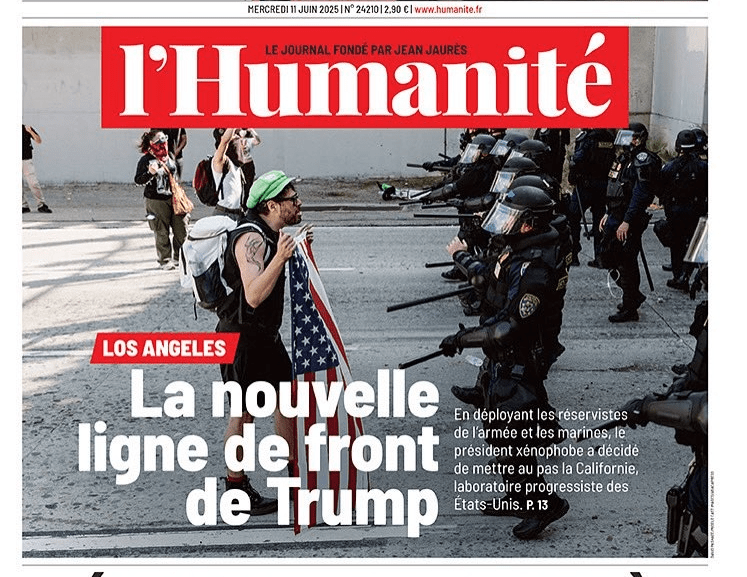
Front cover image from l'Humanité, a Paris newspaper. Shows a confrontation on a highway between black-clad soldiers and American civilians, one of them holding an American flag.

Resistance to Trump reaches its first turning point

“The Whole World Is Watching.” It’s been decades since American protesters chanted this sentence at American police in an effort to deter violence and brutality. But it has perhaps never been more true than right now. The political drama of the USA in 2025 has the world riveted, and I as I walked through the modern train station in Potsdammer Platz, built where the Berlin Wall once stood, the face offs, a pillar at the bottom of stairway brought the confrontation between Federal troops and Los Angeles protesters to life in the middle of Germans daily commute.

And without a doubt, Los Angeles marks a dramatic new turn in the authoritarian rollout of the second Trump Administration. After months of high-consequence policy changes and comparatively isolated forms of protest, the situation is shifting towards an open confrontation and nationwide resistance. The Immigration and Customs Enforcement (ICE) raids on everyday Angelenos have prompted a public reaction by a community that doesn’t have the luxury of waiting until November 2026. And the president’s long-advertised desire to confront protesters with the United States military is finally being realized.

Both the roundup of ordinary civilians and the militarization of American cities push beyond existing expectations. They embody the threat of a different country, one where freedom is utterly denied to a millions and dramatically curtailed for the rest of us.

Everything I’ve said so far is, I think, obvious whether one is within range of the tear gas, across town, across the state, or across the ocean. But that’s not why I write this post. Instead I want to share a bit of perspective as someone who spent a decade puzzling through the sometimes deadly and sometimes transformative dance between protest and repression, including how Bolivians flipped the most heavy-handed domestic military deployment into the forced end of a presidency.

First and foremost, state crackdowns like Trump’s deployment of the National Guard and the Marines are exceptionally risky moves for rulers. The repressor imagines that such a show of force will rapidly bring about a scene of submission: arrested or injured opponents, a fearful majority of the population, and a quieter country. But the truth is, there’s no single outcome when an unarmed populace faces down an armed military. And nothing demonstrates a government’s weakness more powerfully than when even its deliberately trained soldiers can not obtain compliance with its orders.

Second, a crackdown in one place can kick up either mass demonstrations of repudiation or many sparks of daring rebellion across the country. Or both, which is what the invasion of Los Angeles has appeared to do this week. Spreading out protests when repression is concentrated is a winning tactical approach.

Sometime in the coming days or weeks, American protesters will make the turn from a solidarity movement with Los Angeles to a national mobilization in defense of freedom and democracy.

Third — and these may be the two ideas I most want to share widely because they is not common sense to many Americans — widespread confrontational protest and massive shows of popular opinion are both essential, and need not be in competition with one another. In Bolivia, in Argentina, in Thailand, in Ukraine, in Egypt, and in Chile, people who succeeded in national political turns did both of these things. As seen this week, acts of confrontational action can deter or delay the mass detention and deportation of our neighbors; they also can hold space in times of protest. On the other hand, acts of mass participation literally demonstrate that the public rejects a government and its policies. They create moments of collective purpose that strengthen their participants and remind allies elsewhere that they are not alone, and that we can win. (See below the line for how I described them working together in Cochabamba, Bolivia.)

This month, and especially this weekend, people primarily oriented around one or the other of these goals will likely be side-by-side in the street. Those who define themselves around what I’ve called “The Tactical Argument of our time” (whether nonviolent action can/is better at/is necessary for/could never/is counterproductive to bringing about revolutionary change), may be primarily worried about whether their preferred tactical approach is being permitted or blocked. My suggestion instead is to consider how much more powerful this movement could be if both flourished. And then to do the work of both helping people stay safe(r) as they speak, act, and resist.

Solidarity from Berlin.


p.s. Here’s how I described these two sides of successful uprisings in my research on Bolivia:

To win, the Coordinadora had to wield mass pressure, establish its legitimacy, gain a seat at the bargaining table, and convince the government to completely reverse the privatization. The moment of mass pressure involved blockades and other disruptive actions to win the annulling of the contract. The moment of legitimacy consisted in convening assemblies, cabildos, and an unofficial referendum or consulta popular to register public opposition to water policies. … While pressure and legitimacy represent two distinct moments of the mobilization, they worked in tandem, like two legs walking: Road blockades organized across the city and the surrounding region built up into an overwhelming civic strike, while marches flowed together into large-scale meetings called cabildos, often held in the central plaza. The civic strike was the cabildo’s operative arm, its means of exerting pressure; and the cabildo was the strike’s brains and voice, the only place from which it could claim sovereignty. Without either, the Coordinadora and the Water War it fought, would have amounted to nothing.

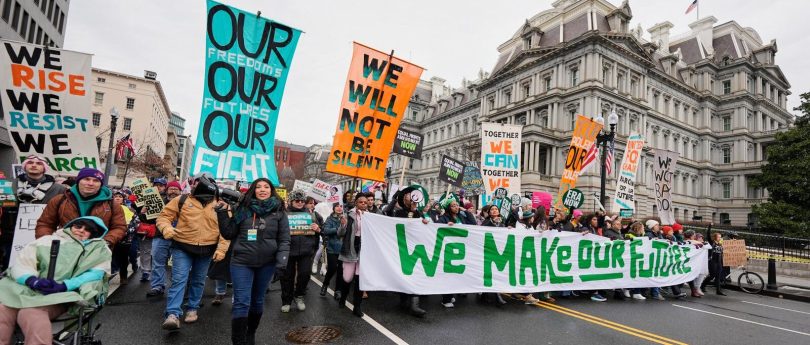
People's March, Saturday, Jan. 18, 2025, in Washington.(Mike Stewart | AP Photo/Mike Stewart)

Trump’s authoritarian turn is everyone’s problem

It’s May 2025, and it feels like every new conversation (in my circles? in the United States? far beyond that?) needs to start with an acknowledgement of the bleak bigger picture on the national and global stage. Like every How are you? could be personal, but could also be a How are you coping with these unfathomable times?

In my circles, a short phrase circulated in 2020–22: “Pandemic fine.” It was a way of addressing this uncertainty, this complication, this brokenness in brief, humane terms. With an unspoken subtext something like this: “My loved ones and I had a reasonably good day, though before bed I will be checking the charts that reveal that 2,592 of my countrymen have died yesterday of a disease that didn’t exist three years ago. And that reasonably good day was made as we navigate all the ways we know to live differently to make that number a bit smaller than it otherwise would be.”

Also in my circles, this attentiveness and yet also disconnect around the COVID pandemic was eventually displaced by the mounting horror of the Israeli genocide in Gaza. Which is something we didn’t have to plan our everyday behavior around. But which was present in our consciousness in a new and visceral way. The first live-streamed genocide brought us inches away from a tide of human suffering and calculated cruelty that was unimaginable. And while it felt like awareness of this new horror was uneven in the United States, the half or more of us who were aware could not look away. Our day-to-day lives coincided with both this atrocity, and with the broken promise of post–World War II life: “Never again.”

Less publicly, and I imagine among a smaller set of Americans than these last two, a dawning realization of the reality of massively disruptive climate change came up again and again in 2024. The city-shaking and sometimes city-shattering disasters that accompany the global rise in temperature knocked on more places I know in 2024, most memorably Asheville and Los Angeles. Those of us for whom climate is an area of expertise know the worst is still yet to come, and in the absence of rapid emissions reductions, the tempo and scale of these disasters will only rise. Among ourselves, we talk about the opposing demands for hope and clarity. and we mourn those places and lifeforms that can no longer be saved.

And for the United States, a further damaging shift came in with the Trump administration, and its dramatic efforts to take off the limits on repressive power; stigmatize and reverse efforts towards racial and gender inclusion; and dismantle a swath of institutions. We’ve see a former president who dreamed of being a dictator hire a phalanx of officials who are actually working to make him one. Moves from an authoritarian playbook are underway in the American state, even as crown jewels of that state — the Centers for Disease Control, PEPFAR, the National Endowment for the Arts , the list goes on — are cast aside. The White House directs a crackdown on the most vulnerable while also starting fights with pillars of its own power: the Ivy League, elite law firms, the Federal Bureau of Investigation.

Here there has been no silence. The details are too incredible, the variance with routine channels of action too extreme, the impacts too widespread for us to not bring these things up, just when we check in with each other. Public protests have popped up at a much faster pace this year than in 2017, with sustained regular demonstrating turning into a feature of the political landscape.

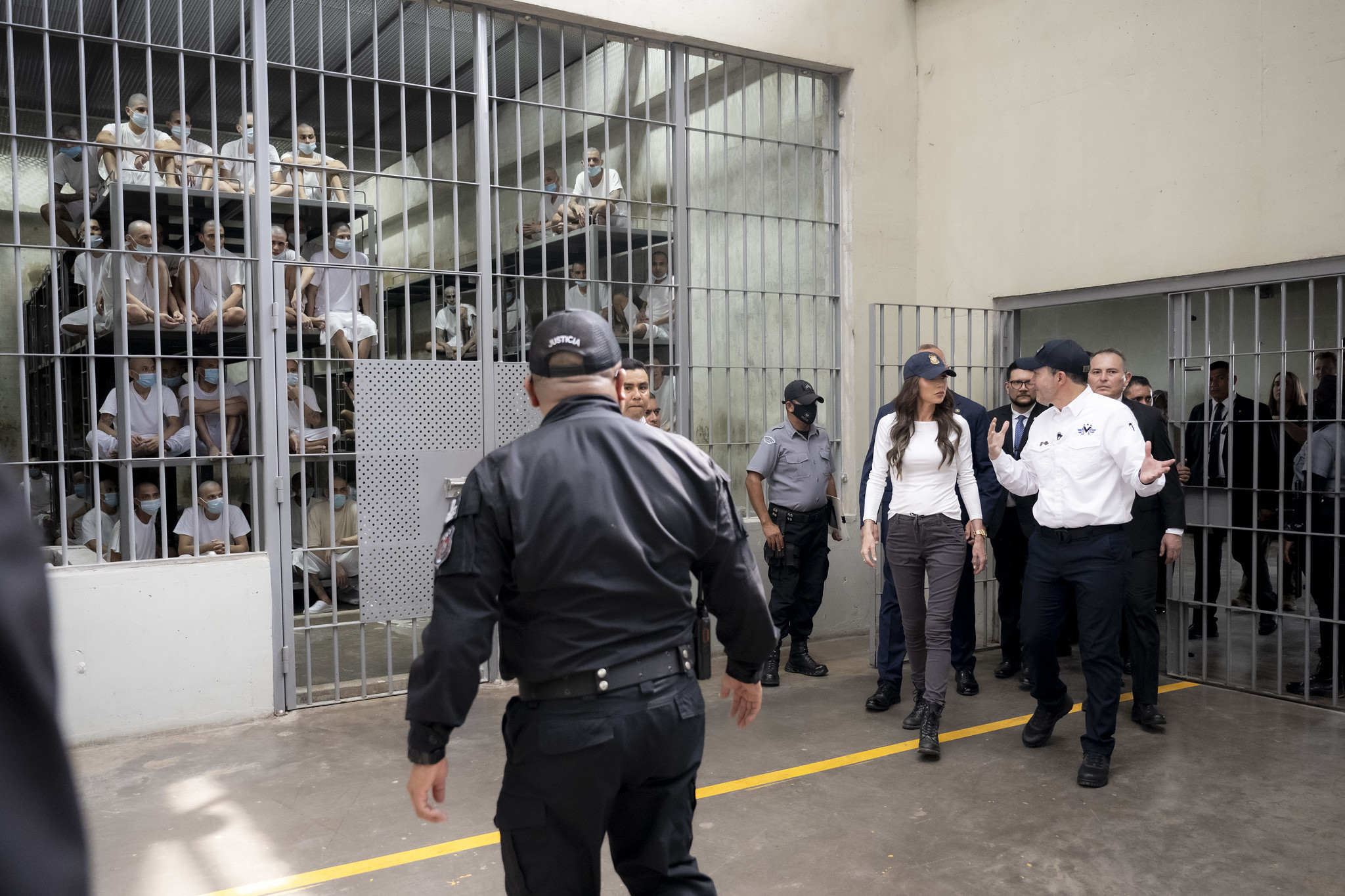
Department of Homeland Security (DHS) Secretary Kristi Noem receives a tour of the Terrorist Confinement Center CECOT with the Minister of Justice and Public Security Gustavo Villatoro in Tecoluca, El Salvador, March 26, 2025. (DHS photo by Tia Dufour)

But also, the warning signs of a more repressive turn are real and obvious: snatch squads targeting outspoken student activists; the use of immigration enforcement as political police; unaccountable detentions of lawfully arriving visitors; and the out-of-country imprisonments in El Salvador’s no-way-out prison CECOT. Again, those of us who have made our lives work studying such systems of power, as well as those who grew up living through authoritarian turns, are unified in seeing the dangers here.

Okay, so now what?

We’re up against a wildly ambitious White House intent on turning the US government into an authoritarian state, but also a White House that is doing so with self-weakening abandon. Starting from a bare plurality of voters, and the smallest possible majority in Congress, it is pursuing a maximalist agenda by largely ignoring the legislative process altogether. Its attacks on diversity, on queer rights, on opposition figures personally push otherwise moderate people into opposition. Its crudeness inspires more revulsion than it does participation. Trump’s absolutely Nixonian inability to treat powerful opponents differently than he does powerless ones continues to generate shock and outrage.

After a winter of cowardice, capitulation, and collaboration — with CBS, Columbia University, and the tech oligarchy as its most visible symbols — there’s a new balance of initiative. There will be battles in the courts, defiance from campuses, insubordination in federal offices and occasional bravery in state houses, and many, many reasons to get out in the streets.

Much of US activist practice is centered on raising awareness and visibility. But nothing could be more visible than the situation we confront. (We can retire the bumper stickers that say, “If you’re not outraged, you’re not paying attention.” Everyone is paying attention.) We’ll have to learn the forms of praxis that transform numbers into disruption, and disruption into power.

But I like our emerging coalition. And I like our chances.

Lead Photo: People’s March, Saturday, Jan. 18, 2025, in Washington.(Mike Stewart | AP Photo/Mike Stewart)

Inset Photo: Department of Homeland Security Secretary Kristi Noem receives a tour of the Terrorist Confinement Center CECOT with the Minister of Justice and Public Security Gustavo Villatoro in Tecoluca, El Salvador, March 26, 2025. (DHS photo by Tia Dufour)

Recent political violence in Bolivia is happening between social movements, not against them

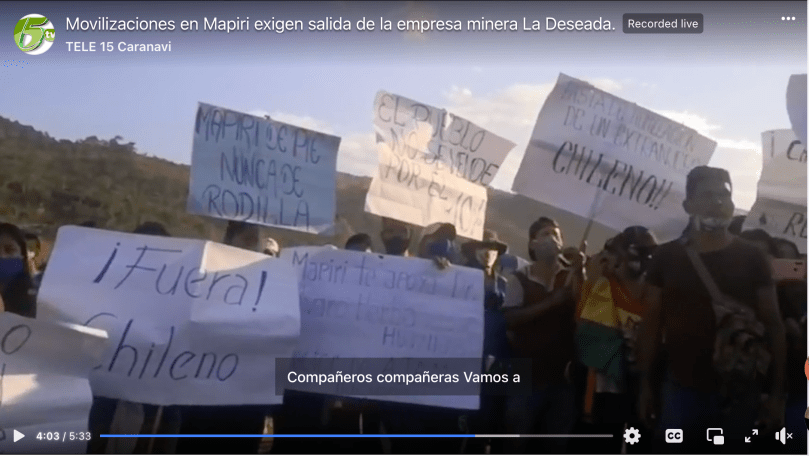
This review of lethal political conflict in Bolivia is cross-posted from the Ultimate Consequences research project website, where I’ll be archiving my commentary and analysis on political violence in the country. Featured photo above shows protesters against the La Deseada mine in Mapiri, in Larecaja Province, where mining conflict have claimed five lives in recent years.

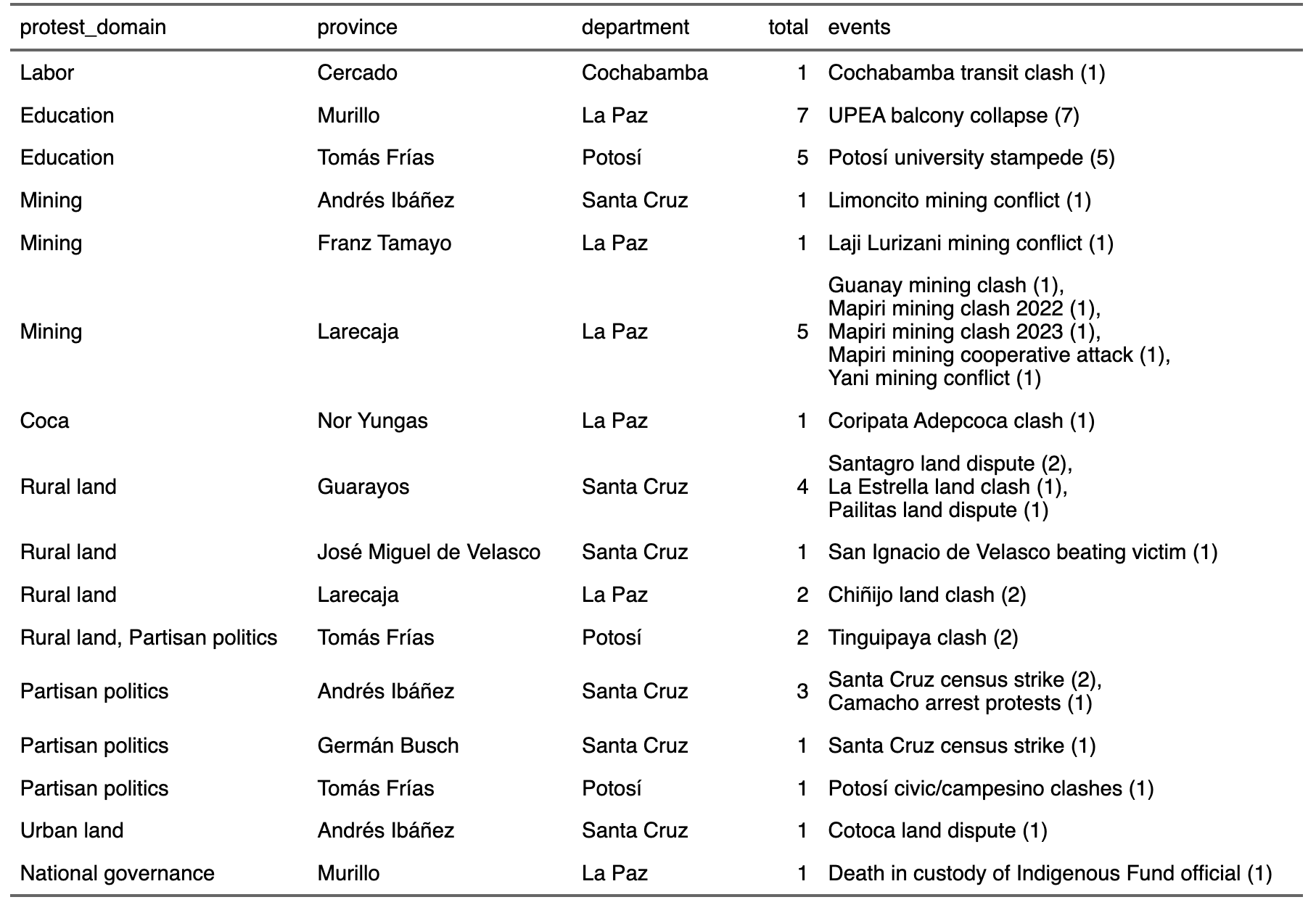
Eleven people have died in social movement-related violence in Bolivia since the beginning of 2023, ten of them the victims of violence carried out by other social groups. These conflicts pitted rural community members against miners, as well as disputes within the same profession, be it mining cooperatives, urban transit drivers, or rival claimants to rural land. Only one death, in January 2023, was caused by security forces, who fired a projectile into the eye of a bystander during raucous protests over the arrest of right-wing governor Luis Fernando Camacho.

In addition, the government of Luis Arce attributed four deaths from medical causes to the side effects of pro-Evo Morales blockades in January 2024. (Per our codebook, we record such collateral consequences but exclude them from other analysis.) For more details on these events, visit Ultimate Consequences’s interactive directory (Spanish version) of all deaths recorded in the dataset. Type “Arce” into the search bar for presidents to just see events during the Arce administration.

Deadly protest events, January 2023–August 2024

The recent events are as follows:

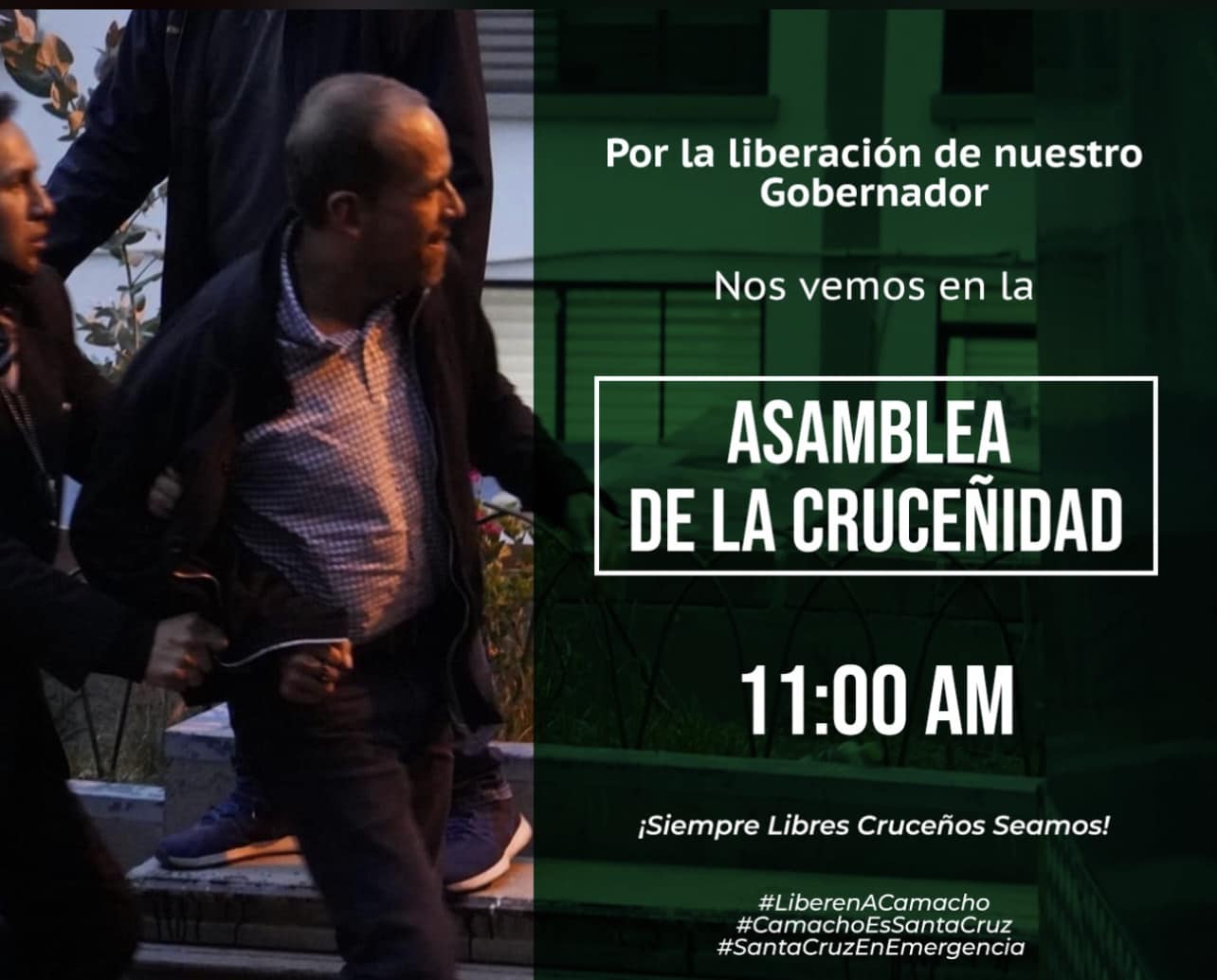
Camacho arrest protests: The December 28 arrest of Santa Cruz’s governor (and ex-presidential candidate) Luis Fernando Camacho touched off immediate protests in Santa Cruz de la Sierra, the regional capital. Following a one-day airport takeover, members of Camacho’s Civic Movement alternated between daytime blockades and nighttime property destruction. On New Year’s Day, police fired a projectile—likely a tear-gas canister—into the eye of Edwin Chávez Durán. The man enduring no fewer than seven surgeries over the next two weeks before succumbing to a heart attack on January 13.

Mapiri mining clash: Amid negotiations upon the filing of mining permits for a mine site located on the Merque river, confrontations began between prospective miners at the site and community members. The mining firm, Minera La Deseada, is described as Chilean, and the workers involed as arriving outsiders, some or all from Caranavi, according to the OTB of Mapiri, led by Ruddy Salcedo. Salcedo describes a Chilean business owner as present at the start of the confrontation, urging them to begin work by force. Community members occupied the disputed site, waiting for police to arrive. In the ensuing confrontation, stones, dynamite, and firearms were used, wounding ten people and killing Jhilmer Cuele Sompero. Community struggles challenging the La Deseada Mine have been ongoing for years; a 2020 mobilization shows leaders describing a five year struggle up to that point. In 2020, they were demanding the enforcement of a ruling by the national mining authority AJAM.

Limoncito mining conflict: On March 1, police accompanied an inspection visit by AJAM to document the stone-mining operation of the Dracruz company, in Limoncito, El Torno municipality. The delegation was confronted by mine workers who launched rockets and otherwise attacked the inspectors and police. Amid a retreat, Sub-Lieutenant Ronald Choque Mamani suffered a cardio-pulmonary arrest and collapsed to the ground. (Initial reports of bullet wounds to the officer proved unfounded.) He could not be revived. Five men were taken into custody for investigation by the FELCC and prosecutors. Subsequent inspection on March 10 revealed an unpermitted mining operation extending over 16 hectares of municipal land. Police then took both heavy equipment and documentation from the company. Local residents had complained of the operation, and have an ongoing campaign against other illegal mining operations.

Santagro rural land dispute: In El Puente municipality of Santa Cruz, conflict flared up between members of the Intercultural farmer federation, who established settlements there in December 2023, and the employees of the Santagro soy producing company, which works on the land. The armed confrontation on March 30 claimed the lives of two men, Francisco Morales and Jorge Pérez.

Cotoca land dispute: During a confrontation between established residents and squatters in Cotoca, Herland Salinas Añez was stabbed multiple times, first by a machete and then by a short blade knife (arma blanca) and killed. Several others suffered machete and bullet wounds during the confrontation. Witness reports describe the confrontation as continuing over several days. Police arrested 25 to 33 people, whom they investigated for the illegal land occupation. Per a more detailed report, the housing takeover was sudden and carried out by a group arriving in a van, making the squatters the attackers.

Laji Lurizani mining conflict: Wilmer Chambi Salcedo, 25, was shot and died while in an ambulance transporting him from Apolo to La Paz. He was one of four wounded in a conflict in the Santa Rosa community in the Laja sector of Apolo on September 13, 2023. The violence resulted from a conflict between illegal miners and community members in the protected Parque Nacional y Área Natural de Manejo Integrado Madidi (PN-ANMI Madidi). On September 15, the Autoridad Jurisdiccional Administrativa Minera (AJAM) reaffirmed that no mining rights were granted anywhere in the protected area. The same day, police arrived in the conflict zone and took control of the Laji Lurizani community. Bitza Delgado, the wife of the deceased Wilmer Chambi Salcedo, demanded that the authorities move to find those responsible for his death.

The death marked a continued worsening of violence due to mining conflicts in the Apolo region of northern La Paz. Illegal and informal mining thrives in the region. On September 18, community members of Laji Lurizani arrived in La Paz’s Plaza Murilo to protest the activities of illegal miners and their backers, and the absence of the state. Residents testified and presented photographic evidence of how illegal miners force them under threat of violence to allow them to do what they want in the area.

Pailitas land dispute: A week of armed confrontation between interculturales and peasants disputing land rights in the Forest Reserve of the Ascensión de Guarayos province resulted in the death of the intercultural Félix Ribera Bellido (23) of San Julían and the injury of 14 others. The death occurred early on the morning of December 2, when a conflict erupted between the communities of Pailitas and Santa María (in the Los Londras area). On December 6, the leader of the interculturales of San Julían, Tito Rokas, threatened the death of landowners in the province, claiming they were responsible for the violence. President Luis Arce announced that the violence would not be tolerated and summoned an emergency meeting of ministers to analyze the land conflict and propose structural solutions. The director of the National institute of Agrarian Reform (INRA) emphasized however that the lands being fought over were in fact property of the state, as all of the properties lie withing the Gurayos Forest Reserve. The Bolivian Ombudsman’s Office condemned the violence and called upon all actors to lower the temperature and to find peaceful solutions to the conflict. On January 16, 2024, Heber Sixto Canaza Sacaca (47), one of the leaders of the San Julían syndicate, was charged with homicide, for his role in inciting the violence on December 2, and for land trafficking, due to his promise to deliver properties in the municipality to intercultural groups. He was apprehended and taken into custody on January 15 and transferred to Santa Cruz by the FELCC. Sixto Canza had also been previously involved in another armed conflict in the Las Londras area in 2021, during which a group of journalists, police, and businessmen were kidnapped and tortured.

Cochabamba transit clash: A taxi driver suffered blunt force trauma while being attacked by drivers of a rival union of drivers disputing their line. One report indicates he and his brother were dragged out of their vehicle and held in another, possibly suffering the wound when jumping out of the vehicle. A doctor described blunt trauma inflicted by a large stone.

Guanay mining clash: Conflict among miners resulted in two injuries (both with metal shrapnel) and the trauma-induced heart attack of Mauricio Soliz Miranda.

Yani mining conflict: National Police intervened in the Yani community of Sorata municipality where two groups of cooperative miners were in open confrontation. This confrontation included injuries from firearms suffered inside the mine the night of July 25. Sent to accompany officials from AJAM and to de-escalate the conflict, the police were confronted by members of one side of the dispute. Reportedly, the miners threw rocks and dynamite at the arriving police, and set the hill on fire. Caught in the flames, two police officers suffered severe burns to 70% and 80% of their bodies respectively. One of those burned, Fabricio Reynoso Gutiérrez, succumbed to his injuries in a La Paz hospital. Altogether, four police were hospitalized. Two alleged perpetrators were arrested and held in preventative detention. One party to the dispute was the Cooperativa Minera “Señor de Mayo”, seemingly the side complaining of illegal occupation of their stake, while the other side (per a social media post circulated by Señor de Mayo) is known as Hijos de Ingenio. The latter allege further violence by Hijos de Ingenio, including a shooting on the following day.

Past annual reviews of political violence on Carwil without Borders: 2022 | 2021 | 2019 crisis | 2012. More tagged Lethal Conflict

Arrest of Luis Fernando Camacho prompts fiery new Santa Cruz protest wave

Luis Fernando Camacho, governor of Santa Cruz department and regional leader in 2019 protests against Evo Morales, was arrested on December 28, 2022, as a suspect in the Golpe de Estado I (Coup d’état I) investigation. Camacho, whose public statements suggest that he and his father coordinated with the military and police prior to Evo Morales’ ouster, has been named as a suspect as well as convened to testify in the inquiry. The formal charge against Camacho is “terrorism,” though its specifics are more akin to insurrection against elected authorities. Camacho was sentenced to four months of preventative detention, during which time prosecutors promise to deepen their investigation of the nexus among Camacho’s Civic movement, the incipient Áñez government, police mutineers, and military conspirators in November 2019. (For today, I’m not blogging my thoughts on the legality, strategic wisdom, or ethics of this arrest.)

Camacho’s arrest was widely expected. He was known to be the subject of at least eight criminal investigations. As it turned out, the arrest order had been issued on October 31. Three days before, he had issued a video publicly challenging Justice Minister Iván Lima:

Ministro, usted que encabeza esto, que está buscando incriminarme con casos de violencia, no sea cobarde: si quiere, deténgame, deténgame, venga, deténgame
Minister, it is you who are at the head of this, who are seeking to incriminate me in cases of violence. Don’t be a coward: if you want, detain me, detain me, come here and detain me. [my translation]

Molina, Fernando. “Detenido el gobernador boliviano de Santa Cruz, Luis Fernando Camacho, por la crisis que llevó al derrocamiento de Evo Morales.” El País, December 28, 2022.

Almost immediately, the arrest itself kicked off a new wave of protests in Santa Cruz department, headed by the department‘s civic movement. Camacho previously headed the Comité Cívico Pro-Santa Cruz in 2019 and was Vice President of the Unión Juvenil Cruceñista in 2002–2004. These institutions, joined by the public voice of governor Camacho since his April 2021 election, have engaged in waves of protest challenging the MAS–IPSP governments of Evo Morales (2006-2019) and Luis Arce (2020–). While demands have varied widely—rejection of the constitutional assembly and departmental (2006–08), rejection of judicial elections (2012), of penal code reforms, of alleged electoral fraud (2019), an anti-money laundering law (2020), and a census delay (2021), the mechanisms of regional protests have been relatively stable.

Like other regions, Santa Cruz goes on strike through road blockades and a city-wide work stoppage. And during the 2006-09 political standoff and since 2019, these tactics were enhanced by peaceful or forcible takeovers of national state institutions, as well as direct physical attacks on institutions associated with the governing MAS-IPSP party, such as labor unions and Indigenous organizations, and attacks upon so-called “traitors” to the region, which is to say local MAS-IPSP politicians.

While used only sparsely between 2009 and 2019, arson has been an important tactic for the Santa Cruz Civic movement during the so-called catastrophic stalemate of 2006 to 2009, during the October–November 2019 political crisis, and in protests since Luis Arce’s October 2020 election. (I detail the broader use of arson in the 2019 crisis and the catastrophic stalemate in a forthcoming article in the Bolivia Studies Journal.)

Immediate Responses to Camacho’s Arrest

A crowd of civilians on the tarmac of Viru Viru International Airport

The first responses by the Civic Movement to their leader‘s arrest were attempts to prevent his transport out of the region. Protesters flooded into the terminals and runways at Viru Viru International Airport and El Trompillo Airport. Per El País (of Madrid):

A group of hundreds of the governor’s sympathizers, led by regional authorities and [parliamentary] deputies, headed to the Viru Viru airport in Santa Cruz. There, they overwhelmed and beat security personnel, invaded the runway, entered some of the airplanes waiting to take off, and obliged the passengers to disembark, to prevent Camacho from being taken from Santa Cruz. They didn’t find him. Despite this, they decided to paralyze the airport after [Camacho’s] detention.

Molina, Fernando. “Detenido el gobernador boliviano de Santa Cruz, Luis Fernando Camacho, por la crisis que llevó al derrocamiento de Evo Morales.” El País, December 28, 2022

Among the elected officials present was Paola Aguirre, who reportedly vowed, “No sale ni un avión de este aeropuerto [Not one plane will leave this airport.” Aguirre posted a 33-minute video to her Facebook page beginning with her atop a boarding staircase to an airplane, including an impromptu press conference on the tarmac, live questioning of the airport director about whether Camacho had boarded a BOA flight (at 15m50), and vows that any damage or inconvenience caused to the airport is the responsibility of the national government who ordered Camacho’s arrest (at 30m50).

Flights from Viru Viru resumed on December 29. Airport officials reported 5,000 travelers were affected, with 350,000 Bs (~ $50,000) in material damages and 900,000 Bs. ($130,000) in accommodations purchased for inconvenienced passengers.

The New Daily Protest Cycle

With Camacho successfully removed from the department, the protest mood turned to rage.

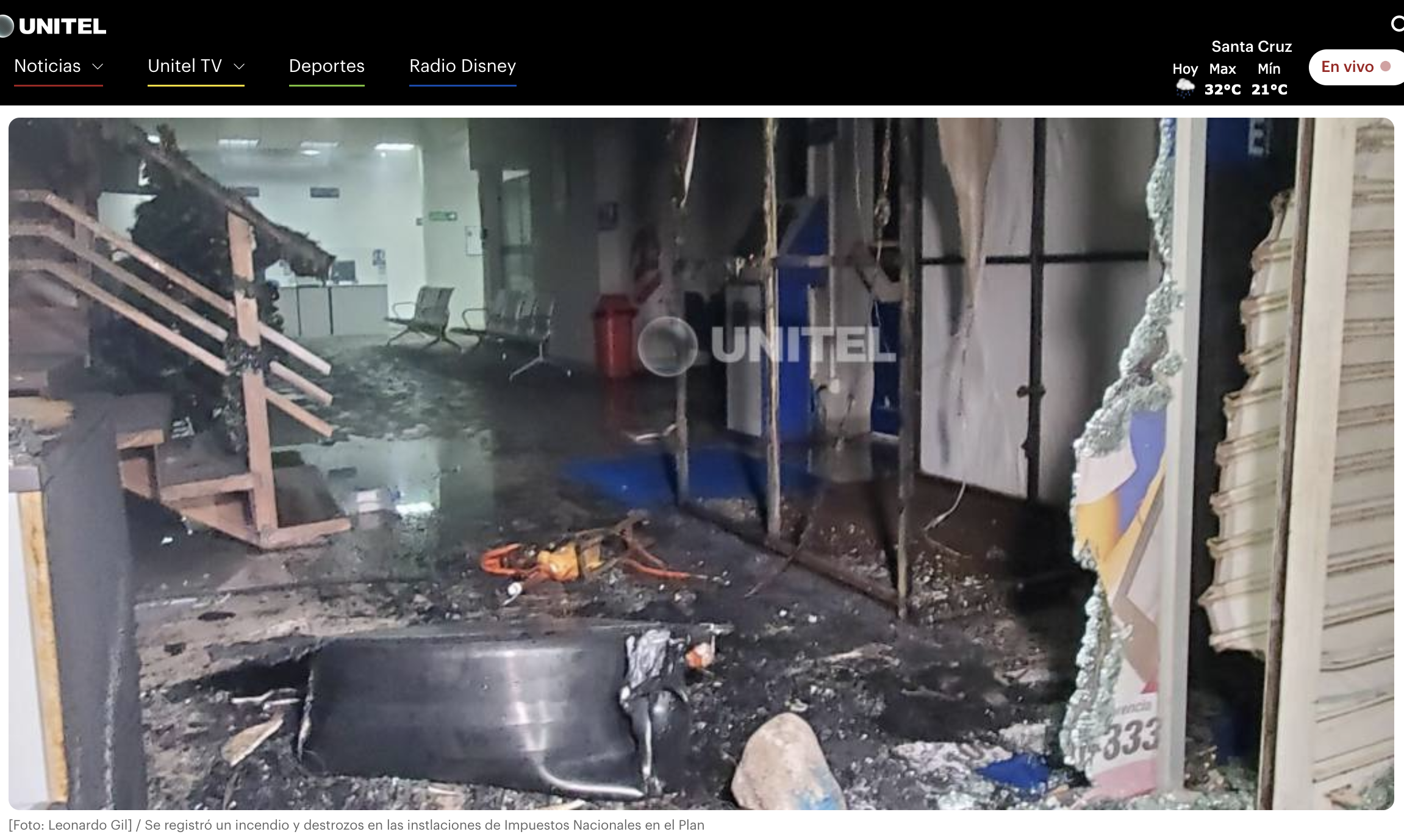
Pro-Civic Movment newspaper El Deber reported a “night of fury” that consumed three buildings: the prosecutor’s office, a drug control office that has been used for negotiations w/ the national government, and the home of Minister of Public Works Edgar Montaño.

In its public pronouncement, the Cruceño civic movement called for road blockades to begin at midnight (December 28/29) and the takeover of public institutions, both key tactics in past protests, including the 36-day strike in October–November of 2022. It, along with former centrist presidential candidate Carlos Mesa, qualified the arrest as a “kidnapping” and the act of a “dictatorial” national government. It has convened mass gatherings to mount a new regional mobilization until Camacho is freed.

What is apparent after three nights is that this new wave of mobilization has a daily cycle with a daytime phase focused on blockades and calmer occupations held at/in front of national institutions and a nighttime phase of confrontations with police during which protesters attempt to seize and burn the same class of institutions.

Here are daytime actions, as photographed by the Unión Juvenil Cruceñista:

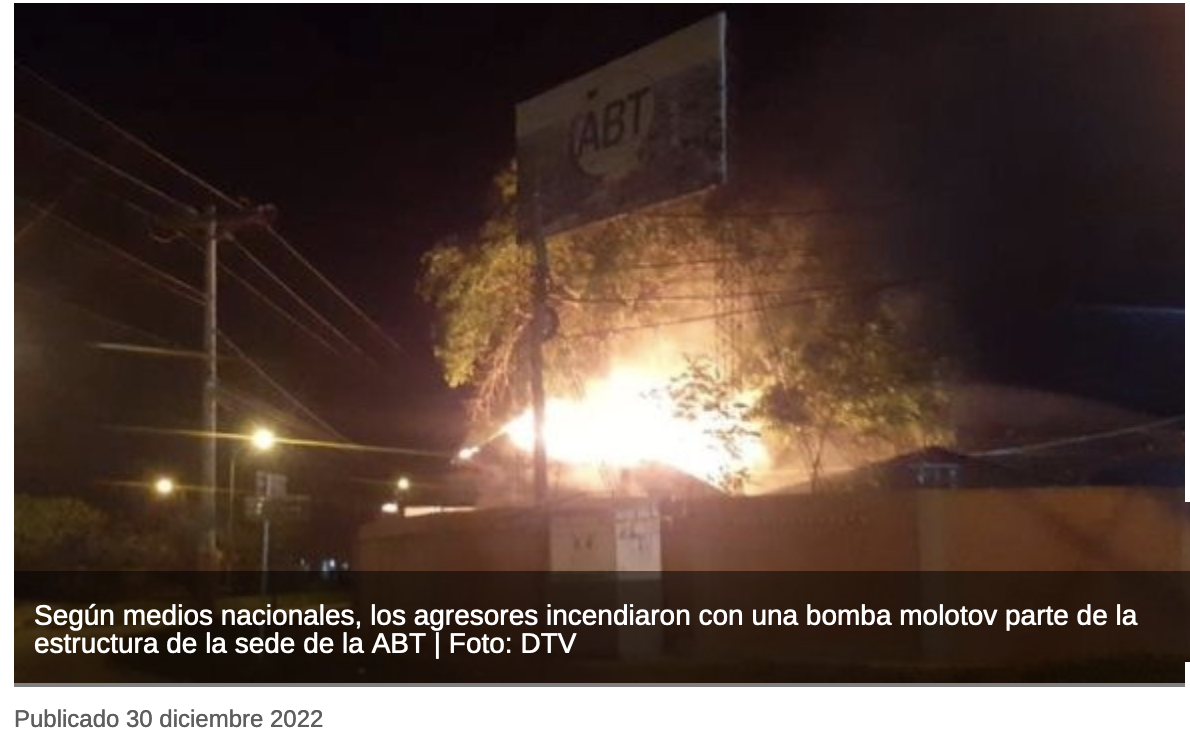
And night-time attacks on the same class of public institutions, sometimes literally the same ones (like the ABT, the Administration of Forests and Lands) pictured in peaceful protests.

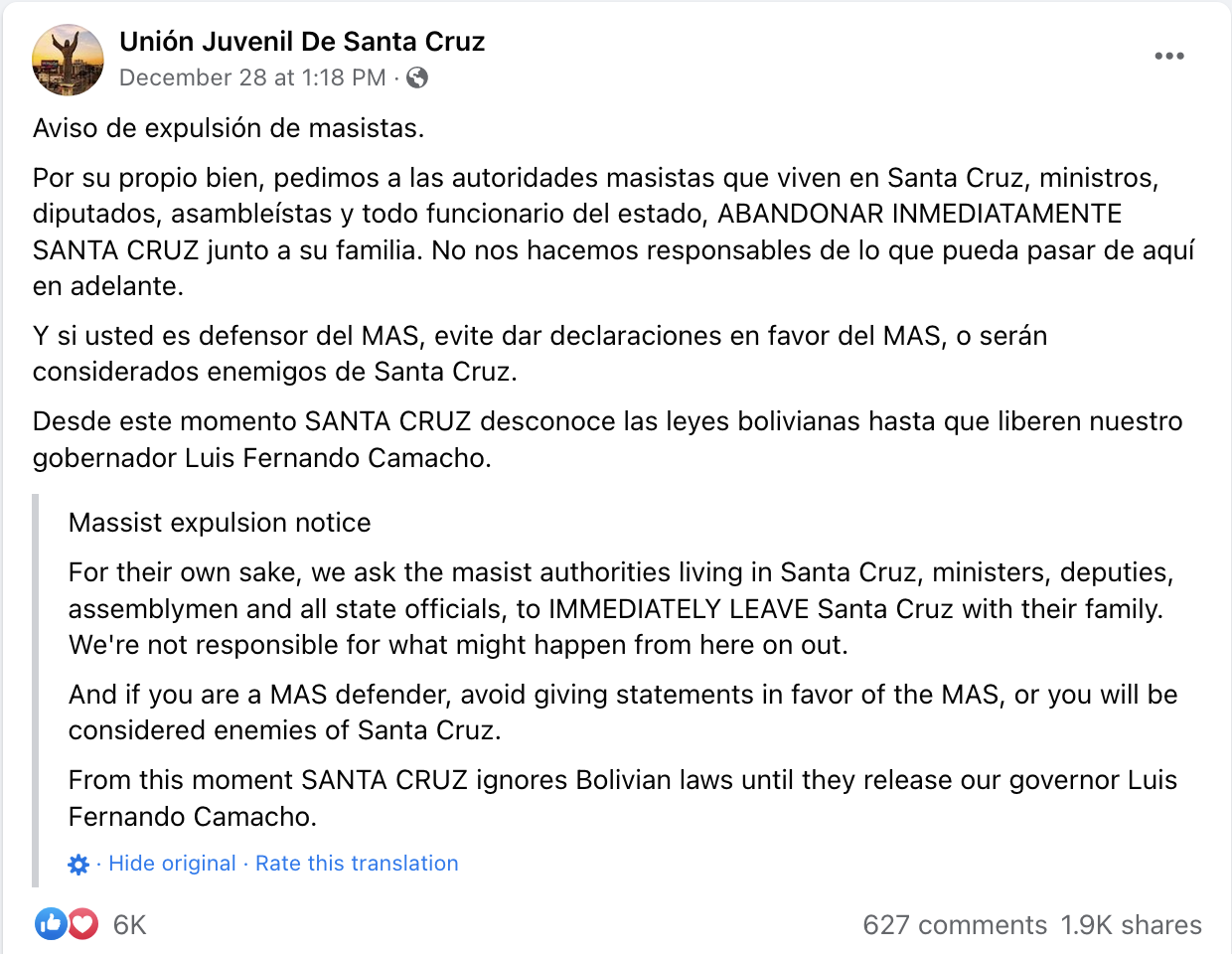
The logic of these actions is twofold: first, a public repudiation of the legitimacy of the national government and second, the assertion that only MASistas work in such instutions and they are “traitors to the region.” A widely shared “order of expulsion” posted by a non-official(?) UJC account urged MAS supporters to leave Santa Cruz. It was “shared” over a thousand times and widely reposted beyond that.

The formal leadership of the Cruceño organizations has been careful to label the arsons as the work of “infiltrators” in their ranks or so-called “self-inflicted attacks” by MAS-led institutions. The claim that a small number of closeted pro-government arsonists are hiding themselves nightly in anti-government crowds who only want to fight the cops is, to say the least, not especially credible. The will and capability of the Santa Cruz civic movement to carry out both crude and sophisticated arson attacks was demonstrated amply in the October 2019 burnings of electoral offices in protest over alleged voter fraud, and numerous attacks during the 2006-09 political crisis.

What is the actual relationship between the daytime pronouncements of the Comité Pro-Sana Cruz and the Unión Juvenil Cruceñista, and the nighttime actions of arson? Is there a real split over tactics, or merely an effort to deny responsibility for arson and insurrection, which might be distasteful to potential foreign allies?

Here’s how Camacho-aligned congressional deputy Paola Aguirre answers that question:

La ciudadanía cruceña, como en su momento lo dijen, no tiene patrones. Ellos se han autoconvocados desde el momento en que se enteraron que el gobernador Camacho estaba siendo secuestrado por el regimen del President Luis Arce. Y han tomado acciones por iniciativa propia. El Comité Cívico Pro-Santa Cruz prácticamente el día de ayer [29 de diciembre] ya la ha dijo a la ciudadanía, ‘ya, tomen ustedes las determinaciones que consideren convenientes.’

Este paro de 24 horas definitivamente es una de las menores medidas que se va tomar. Santa Cruz está convulsionada y no va a volver a la normalidad en cuánto no se restituya la libertad del Gobernador Luis Fernando Camacho. Por que no se trata de encarcelar a Camacho, se trata de encarcelar el voto popular de cientos, miles, y millones de Cruceños que han decido elegir a Camacho como Gobernador.

Translation: “The Santa Cruz citizenry does not, as is sometimes said, have bosses. They have convened themselves from the moment they knew that Governor Camacho was being kidnapped by the regime of President Luis Arce. And they have taken actions of their own initiative. The Pro-Santa Cruz Civic Committee practically said to the citizenry yesterday, ‘Alright, you take the determinations that you find convenient.’
“This 24-hour strike is definitely one of the smallest measures that will be taken. Santa Cruz has been convulsed and normality will not return so long as the freedom of Governor Luis Fernando Camacho is not restored. Beacuse they are not just trying to imprison Camacho, but they are trying to imprison the popular vote of hundreds, thousands, and millions of Cruceños who have decided to elect Camacho as our Governor.”

Paola Aguirre, interview with Radio Fides, 30 December 2022. At 7m30 in video posted on her Facebook page.

What is clear is that, today, the daytime organizations are now mobilizing for the freedom of protesters imprisoned for confrontation and arson.

And that the night-time factions are promising a New Years’ Eve of escalated confrontation, and inviting Cruceños to equip and prepare themselves for confrontation, starting at 10pm tonight.
A Facebook invite from Unión Juvenil Santa Cruz (not the official account of the UJC), reads, "Gran Bienvenida del 2023 / Recibamos este nuevo año a los pies del cristo / Desde los 22 horas / Entrada: Vinagre, mascara antigas, agua, balde, bicarbonato, palos, piedras, escudos, pinturas, petardos, etc. / Te esperamos!"

"Great Welcome to 2023 / Let's receive this new year at the feet of the Christ [the Redemeer statue] / From 10pm onwards / Entry fee: Vinegar, gas mask, water, bicarbonate, sticks, stones, shields, paint, rockets, etc! We're waiting for you!"

La Paz, Bolivia: Death of a Protester

In the second week of February, the federation of street vendors (or Gremialistas, which literally means “guild members”) in Bolivia’s capital La Paz carried out a brief campaign against a street redesign project that would rework the busy intersection known as the Garita de Lima. In the course of this struggle, elderly vendor Teodora Velasco de Quispe died.

The Garita de Lima is a congested intersection in central La Paz (a photo search for the site yields an image titled “vehicular chaos”). It’s also a workplace: over 200 people sell food and goods from stalls on the sidewalks, streets, and central island, while the municipality counts 299 different transport routes, most of them served by vans or small buses, that pass through the intersection. Under two administrations led by a center-left political party, the La Paz municipality has combined  concrete, traffic engineers, architects, and savvy searching for funds to solve “problems” like the Garita de Lima. Their proposed redesign continues this strategy, remaking the current oval into a bridge between two plazas. The logic of the redesign is simple and clear: reduce travel delays and uncontrolled pedestrians crossing into the street while maximizing public space. To do this, they used the vertical dimension for crossovers while expanding open space horizontally.

Architectural rendering of renovated Garita de Lima, La Paz, Bolivia

The gremialistas are one of hundreds of sectoral organizations in La Paz. A trade unions for workers without an employer, they mobilize collectively in much the same way a union does, although they must use vigils, shop closures, blockades, and building takeovers where employees could use strikes and pickets. Solidarity and compulsory collective action are the backbone of their influence. The ghostly absence of their working-class presence—the tarps they string up, the blankets they sit on, their large pleated skirts, and gregariously space-taking bodies —from the architectural rendering shows the social distance that separates them from those who organized the project. Like many poor Bolivians, the gremialistas are accustomed to fighting for the marginal space on which they eke out their living. No wonder that they looked at this project with suspicion. As organizer Julia Manuela Hilarión said, “It is by fighitng that we have won our vending posts and now we are surprised that they are kicking us out of this place. [Luchando hemos conseguido nuestros puestos de venta y ahora nos dan esta sorpresa en la que nos están botando del lugar].”

On February 11, over a hundred vendors protested outside City Hall. They vowed, as per Bolivian tradition, to “go forward unto to the final consequences” in their protest, and put forward the maximum demands as their first bargaining position: no seller should be moved from her (or his) post. A conflict broke out with the local neighborhood association, who requested and backed the project; the local neighborhood association leader was injured. Vendors put up signs rejecting the project and sellers went on hunger strike at their posts. One of them was Teodora Velasco de Quispe. Early on the morning of February 13, she died of a heart attack.

Gremialistas carry a cardboard casket in memory of Teodora Velasco de Quispe. (Photo appeared in Cambio, February 14)

Fourteen associations of gremialistas from across La Paz marched on City Hall, carrying forward the struggle and memorializing Teodora Velasco (video). Forty of them began a sit-in demanding negotations with the municipality. Some city officials were unable to leave and pledged they wouldn’t hold talks under such pressure. Nonetheless, four days later they met with Mayor Luis Revilla himself. He pledged none of them would lose the ability to sell in the zone, and the city’s markets coordinator offered to explain the logistics involved. They also agreed to a new process of public comment (or “socialization”) of the project before it was implemented.

This is not the first such project to occasion temporary displacement of vendors in La Paz, or to cause them to fear for their livelihoods. Two downtown markets (the Central and Camacho markets) were built in the last decade, both bringing about conflicts and city-funded temporary housing for shops during construction. These experiences do not seem to have made the city sufficiently proactive or the vendors more patient or less strident in their initial demands. Even now, their opposition to the new Garita de Lima has not been dropped, although history suggests they will get along with the planners and reopen for business during and after construction.

Was Teodora Velasco de Quispe’s death necessary? Almost certainly not. The question of who is responsible for this loss is more complex. Her passing in the middle of the night is one of a significant number of deaths that accompany Bolivian protest without being caused by violent or consciously lethal actions, but which are nonetheless an inseparable part of protesters’ experience. Others have started vigils and marches their bodies were not prepared to survive, or been trapped on the wrong side of a blockade from the medical assistance they needed, or died of cold, exposure, or disease while their community was mobilizing. Such losses of human life stand alongside deaths that provoke outrage and generate cries for official investigations. They do, however, galvanize the commitment of those who lived and struggled beside them. Almost like martyrs, but different, the burden of their deaths is carried by their comrades who struggle on.

Watching the Maidan protests in Ukraine

This post will differ from most on this blog in being more of a pure log of links than an a formulated story or opinion.

I’ve been loosely following the protests in Ukraine and its capital Kyiv since they began in November. No surprise there since my main research topic is how protest movements use urban spaces. The EuroMaidan movement is happening just a bit north to Turkey’s Gezi Park protests, but the ability of the rolling waves of antiglobalization, antiwar, Occupy, Arab Spring, take the square, anti-austerity movements to see it as an extension of or parallel to themselves is much more complicated. Like these protests, EuroMaidan raises questions about how politics is done in the street, the rights (or wrongs) of protesters occupying public buildings and interrupting public life, the ways that mass movements involve an interplay between mass calm gatherings and (smaller) mass confrontation, the tactical interplay between unarmed and armed forces, and the quickening and fracturing of political coalitions. These sorts of questions seem pretty similar across different nations, and there are lessons to be learned from each mass movement for all.

While tactical affinities are obvious, the evidence of the presence or absence of political affinities is contradictory. Is an encampment that began with a defense of a European Union agreement comprehensible to those occupying squares against EU austerity inside the Union itself? Is this a movement for democracy, and is democracy being rethought from the street, as Occupy-ers found? Or are politicians “engineering” the occupations and clashes for their own ends? Is the threat of foreign domination in this case represented by Russia and Putin or by NATO and John McCain? Is this a challenge to corruption and concentration of wealth, or the opportunism of a right-wing and its merely ecstatic allies?

I don’t feel close enough to the situation to sort out all the answers to these questions, but the protesters are not just occupying the Maidan Nezalezhnosti, they’re occupying my thoughts. Here are some sources of insight if they are of interest to you as well:

Bolivia’s Unexpected Blockade: Oruro on strike over “Evo Morales Airport”

Today is the third day of highway blockades in the Department of Oruro, the culmination of what is already 29 days of pressure backed the department’s Civic Committee and its labor federation (the Central Obrera Departamental of Oruro; COD). The form and schedule of the strike follows the standard Bolivian pattern: participants declared themselves on alert to press their demands, and have held 24-hour, 48-hour, and 72-hour general strikes before proceeding to an indefinite period of pressure, which began on Monday. Road blockades are common means of ramping up pressure in the country, and in fact Oruro’s blockades coincide with blockades by peasants in La Paz department, neighborhood organizations in El Alto, and a municipal organization pursuing a border dispute outside the city of Cochabamba.

However, the topic of Oruro’s mobilization is quite unusual. Over four weeks of protests have been waged on what is a symbolic issue: the naming of the newly expanded airport (the expansion and new routes require it to be redesignated as an international airport). The pre-established name, Juan Mendoza Airport honored an aviation pioneer from the department. But on February 7, the region’s parliament chose to honor a different native son, President Evo Morales Ayma, by re-naming the airport after him. Surprise and discontent about the sudden renaming accompanied the airport’s re-opening the next day. The first strikes on the issue took place on February 27 and 28, endorsed by both the COD and the Civic Committee. Unions of miners (notably from the famous mines in Huanuni) and the ever-strident teachers have been vocal participants.

The conflict is particularly surprising given the strong and consistent backing from the region for President Morales and his Movement Towards Socialism (MAS-IPSP) political party. The department gave 79.46% of its votes to the MAS-IPSP in the 2009 general elections, and all but one of its representatives in the Plurinational Legislative Assembly belong to the party. Evo Morales migrated with his family out of Oruro to the Chapare valley region in Cochabamba, but he is a highly respected native son. During the 2010 regional strike by Potosí, Oruro’s Civic Committee was one of the counterweights to a mobilization that was highly critical of the president.

Criticisms from the Civic Committee had already begun by last December, when the national government kicked off construction a museum of the “democratic and cultural revolution” in Morales’ hometown, the village of Orinoca, Oruro. Then, Civic Committee President Sonia Saavedra questioned the  priorities for investment from national government funds:

We need projects that are truly icons for tourist development. I don’t deny the value of the museum that will be built in Orinoca, but we also would like to see that the things that are really necessary to be built are built. What should be more at hand is to ensure that people of the country and from abroad come and see the richness of our department. “Necesitamos proyectos que realmente sean íconos de desarrollo turismo, no desvaloro el museo que se va construir en Orinoca, pero también quisiéramos que se construyan los que realmente van a ser necesarios y están más a la mano para que venga gente del interior y exterior del país para que vean la riqueza de nuestro departamento”

Saavedra urged funds for the Museum in Oruro commemorating the city’s world-famous festival, and suggested that water and irrigation were more important priorities for Orinoca than a stadium with 8,000 seats for a town of 2,000 people.

The past month’s discontent has been met by a series of accusations from the departmental government, who have variously accused “a press bought by the right,” conspiratorial actors intending to produce a coup, and other figures as standing “behind” the campaign. However, many mobilization are attempted in Bolivia, while only a few reach this scale. To gain this level of adherence requires a real willingness of people to stay away from work and join in mass efforts at pressure. However surprising, there is little doubt that this willingness is genuine. Moreover, the region’s political leanings are not in doubt. Rejecting the accusations of right-wing ties, Orureño journalists issued a statement declaring:

We journalists have never been from the right, to the contrary we have always been of the left, but from the humble left, wich fights for justice and equality among all, for seriousness and responsibility; on the other hand, the supposed leftists are taking on the poses of the right: self-important, irrational, and unwilling to dialogue. “Los periodistas nunca hemos sido de derecha, más por el contrario, siempre hemos sido de izquierda, pero de la izquierda humilde, que lucha por la justicia, la igualdad entre todos, la seriedad y la responsabilidad; en cambio, los supuestos izquierdistas están asumiendo poses de la derecha, soberbios, irracionales y faltos de diálogo”

More recently, Saavedra rejected the renaming in this way: “It’s a servile act by the [departmental] Assembly members who want to erase the history of Oruro. Juan Mendoza was the first Bolivian pilot born in this land.” “Es una actitud servil de los asambleístas que quieren borrar la historia de Oruro. Juan Mendoza fue el primer piloto boliviano nacido en esta tierra.”

So the current strike can best be understood as an act of resistance to the symbolic centralization of power, and the beginnings of a personality cult emerging around the president. That this resistance is coming from his own home region reflects the critical and diverse currents that make up Bolivian political culture.

The president himself has tried to remain aloof from the conflict, noting that he had never asked for any public works to bear his name and urging Orureños to work out the conflict among themselves. However, as the conflict enters a second month, national officials have begun to disqualify participants in the protest, repeating local accusations, and suggesting that the preference for Mendoza over Morales has an anti-indigenous, racial component. The Observatorio on Racism reacted skeptically on twitter.

Several proposals have been floated to resolve the conflict, including referring the matter to the Constitutional Tribunal (there are legal restrictions on naming works after living people), naming the airport Juan Mendoza and the terminal after Evo Morales, and simply calling the place Oruro International Airport. Today, however, the strike goes on.

Update: The strike was successful and the government agreed to repeal the re-naming law by March 22, 2013. The airport opened with neither Mendoza nor Morales’s name upon it in 2014, generating an angry reaction from Sonia Saavedra. As of March 2016, the legally approved name of Juan Mendoza still had not been placed on airport signage. The airport sees 32 flight per week. However, its future is clouded by on-the-ground problems: keeping birds and animals off the runways and the nearby presence of a municipal dump. Aviation officials have given the airport until the end of 2017 to resolve these issues or face cancellation of all flights.

Untangling Puno mining protest reports (or, why English-language wire reporters should read the local press)

The wave of anti-mining protests in the Puno Region of Peru reached day 50 today. Yesterday, June 24, was a particularly dramatic day, however: the Peruvian government announced that it will annul the mining concession for the proposed Santa Ana silver mine in Huacullani District, near the Bolivian border southeast of Puno; other protesters took over the Manco Capac airport in Juliaca, north of Puno, only to be shot with live ammunition by police. These were both very important events in the seven-week-long protests. But they were also the two kinds of events that the English-language press steps in to cover: economic loss to Western corporations and deadly violence. If it bleeds, it leads is a key phrase for journalism, but if it bites the bottom line, it makes the business pages is just as important.

Unfortunately, the coincidence of these two newsworthy events led a string of English-language outlets to treat one as causing the other. In fact, there is quite a bit of separation: the Santa Ana mine was the lead issue for the primarily Natural Resources Defense Front of the Southern Zone of Puno (Frente de Defensa de los Recursos Naturales de la Zona Sur de Puno), which joined forces with National Confederation of Peruvian Communities Affeted by Mining (Spanish: Confederación Nacional de Comunidades del Perú Afectadas por la Minería; Conami). The Defense Front, a predominantly Aymara organization, is based near the border and had organized an earlier regional general strike against the Santa Ana Mine in April. It joined forces with the largely Quechua Conami for a larger regional protest from May 7 to June 1. When protests resumed after the victory of Ollanta Humala, new forces got involved, many but not all also concerned with mining elsewhere in the Puno Region. These include protests in Carabaya province [the Puno region has 13 provinces, divided in 107 districts] against mining concessions and the Inambari hydroelectric power plant; protests in Melgar, Juli, and Sandia over local mines; and Azángaro (whose capital is Juliaca) demanding decontamination of the Ramis river from pollution caused by small-scale mining. Outside of the Defense Front, most peasants in these regions are Quechua-speakers, not Aymaras.

The story is the strike wave, which has rippled across the region. And the other surprising story is the willingness of the government to deal openly with the strikers: even in May, substantial concessions were granted to the protests (including a 12-month delay in the Santa Ana mine and a regional commission to study all mining in southern Puno Region). The possibilities of protest and the limits of resource extraction are being rewritten in Peru. However, it didn’t bleed, so it didn’t lead. Indeed, for English-reading outsiders, it didn’t even get covered. Blame this on editors and the priorities of understaffed media organizations.

However, when things got interesting for the newswires, they assigned the story, apparently to reporters far from the scene. And the results juxtaposed the shootings in Juliaca and the victory in Chuquito Province in ways that distort the truth:

  • Associated Press, “Peru cancels mine after 6 killed in clash” somehow fails to mention the demands of protesters in Juliaca, and gives the false impression that the clash led to the concession.
  • Agence France-Presse, “Peru halts Canada mining operations amid protests“: “Peru suspended a Canadian company’s mining project in the south of the country on Saturday following intense negotiations in the wake of deadly protests by mostly indigenous anti-mining activists, authorities said.” “In the wake of” is fuzzy talk for afterwards without committing to a connection. In fact, the negotiations preceded the deadly violence, with a commitment to annul the Santa Ana mine being made verbally to the Defense Front on Wednesday and Thursday, with confirmation on Saturday. As discussed above, anti-mining protesters in Juliaca have other demands. Later in the article, “Protests have since spread to the provinces of Azangaro, Melgar and now the city of Juliaca.” Juliaca is the capital of Azangaro, and protests occurred there in late May, as well as early June. Nonetheless, AFP did some homework; this is spot on: “They then expanded to include opposition to other area mines, and now include opposition to the Inambari project, an ambitious plan to damn several Andean rivers and build what would become one of the largest hydroelectric power plants in South America.”
  • Voice of America, “3 Killed in Peru Airport Clash“: Contributes one fact: the result of a hospital phone call to Juliaca (“A doctor said the three people killed died from gunshot wounds Friday at Manco Capac airport in the city of Juliaca in Puno state.”), but mis-identifies the protesters as Aymara Indians—0.28% of Azángaro Province is Aymara. The hospital workers, through no fault of their own, understated the death toll by half.

Reporting like this is far less effective than paying translators to read the local press (Los Andes in Puno has been among the most comprehensive; see their chronology) and fact-check one against the other. If you’re reporting on these issues, I’d really like to know your process and point you in the direction of reliable background information. Seriously, where are you and what do you read?

Credit where credit is due: Reuters got the story right, noting “On Friday, hours before the deadly clash at the airport, Garcia’s cabinet revoked the license of Canadian mining firm Bear Creek in a bid to persuade locals residents to end protests that have dragged on for more than a month.”

p.s. A look at the same problem in Bolivia ten months ago: Potosí isolated by 12-day regional strike.

Bolivia: A Year in Ten Protests

I returned this week from nearly a full year researching mass protest in Bolivia. As luck would have it, 2010 has seen protests in greater numbers (67 per month!) than any year since 1971 , when the Center for Studies of Economic and Social Reality (Centro de Estudios de la Realidad Económica y Social) began keeping records on the subject. And based on both a comparative look at Bolivian history and pure population growth, it’s safe to extend that title to the most protests in a single year since the beginning of the 19th century, or even Bolivia’s history as an independent country.

Unlike 2003 and 2005, Bolivian protests did not mount into an overarching national wave capable of toppling a sitting government. However, many of the forces involved in those years are showing increasing independence from President Evo Morales and the Movement towards Socialism (MAS) party. Morales was ratified by a 64% majority in the December 2009 presidential elections and his party won the mayor’s office in nearly two-thirds of the country’s 337 municipalities in the April 2010 elections. However, this year many of the voters who backed the MAS in national fights showed their willingness to take to the streets to denounce its policies. Meanwhile, the MAS itself mobilized its base in a spectacular welcome to a global summit of climate change activists and against a 2011 workers’ strike.

Here, then, are the one election and ten mass mobilizations that defined the past year.

Read More »