Recent political violence in Bolivia is happening between social movements, not against them

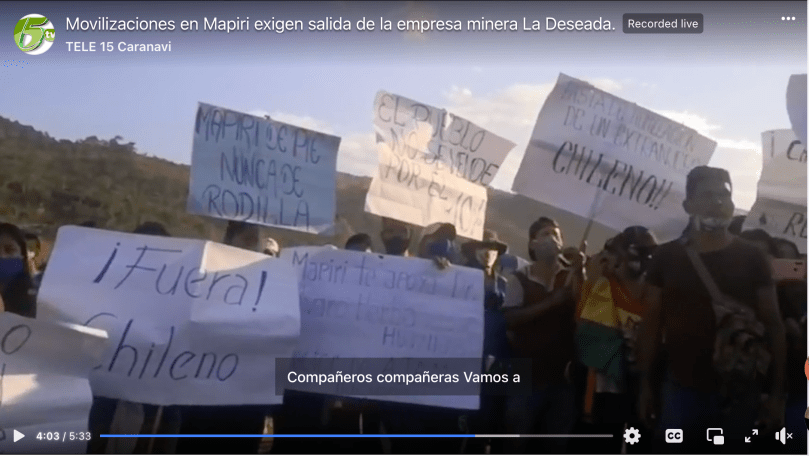
This review of lethal political conflict in Bolivia is cross-posted from the Ultimate Consequences research project website, where I’ll be archiving my commentary and analysis on political violence in the country. Featured photo above shows protesters against the La Deseada mine in Mapiri, in Larecaja Province, where mining conflict have claimed five lives in recent years.

Eleven people have died in social movement-related violence in Bolivia since the beginning of 2023, ten of them the victims of violence carried out by other social groups. These conflicts pitted rural community members against miners, as well as disputes within the same profession, be it mining cooperatives, urban transit drivers, or rival claimants to rural land. Only one death, in January 2023, was caused by security forces, who fired a projectile into the eye of a bystander during raucous protests over the arrest of right-wing governor Luis Fernando Camacho.

In addition, the government of Luis Arce attributed four deaths from medical causes to the side effects of pro-Evo Morales blockades in January 2024. (Per our codebook, we record such collateral consequences but exclude them from other analysis.) For more details on these events, visit Ultimate Consequences’s interactive directory (Spanish version) of all deaths recorded in the dataset. Type “Arce” into the search bar for presidents to just see events during the Arce administration.

Deadly protest events, January 2023–August 2024
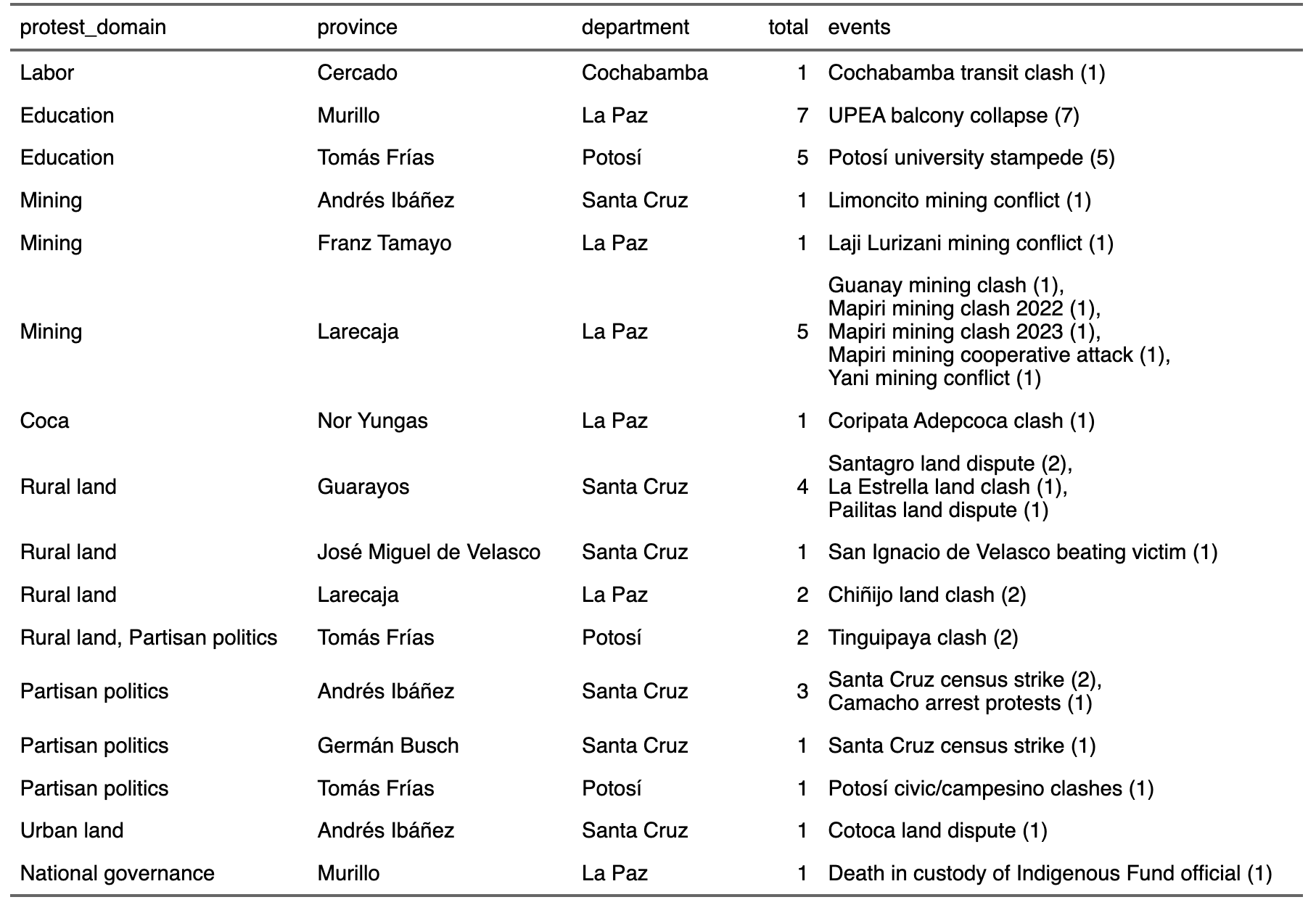
The recent events are as follows:

Camacho arrest protests: The December 28 arrest of Santa Cruz’s governor (and ex-presidential candidate) Luis Fernando Camacho touched off immediate protests in Santa Cruz de la Sierra, the regional capital. Following a one-day airport takeover, members of Camacho’s Civic Movement alternated between daytime blockades and nighttime property destruction. On New Year’s Day, police fired a projectile—likely a tear-gas canister—into the eye of Edwin Chávez Durán. The man enduring no fewer than seven surgeries over the next two weeks before succumbing to a heart attack on January 13.

Mapiri mining clash: Amid negotiations upon the filing of mining permits for a mine site located on the Merque river, confrontations began between prospective miners at the site and community members. The mining firm, Minera La Deseada, is described as Chilean, and the workers involed as arriving outsiders, some or all from Caranavi, according to the OTB of Mapiri, led by Ruddy Salcedo. Salcedo describes a Chilean business owner as present at the start of the confrontation, urging them to begin work by force. Community members occupied the disputed site, waiting for police to arrive. In the ensuing confrontation, stones, dynamite, and firearms were used, wounding ten people and killing Jhilmer Cuele Sompero. Community struggles challenging the La Deseada Mine have been ongoing for years; a 2020 mobilization shows leaders describing a five year struggle up to that point. In 2020, they were demanding the enforcement of a ruling by the national mining authority AJAM.

Limoncito mining conflict: On March 1, police accompanied an inspection visit by AJAM to document the stone-mining operation of the Dracruz company, in Limoncito, El Torno municipality. The delegation was confronted by mine workers who launched rockets and otherwise attacked the inspectors and police. Amid a retreat, Sub-Lieutenant Ronald Choque Mamani suffered a cardio-pulmonary arrest and collapsed to the ground. (Initial reports of bullet wounds to the officer proved unfounded.) He could not be revived. Five men were taken into custody for investigation by the FELCC and prosecutors. Subsequent inspection on March 10 revealed an unpermitted mining operation extending over 16 hectares of municipal land. Police then took both heavy equipment and documentation from the company. Local residents had complained of the operation, and have an ongoing campaign against other illegal mining operations.

Santagro rural land dispute: In El Puente municipality of Santa Cruz, conflict flared up between members of the Intercultural farmer federation, who established settlements there in December 2023, and the employees of the Santagro soy producing company, which works on the land. The armed confrontation on March 30 claimed the lives of two men, Francisco Morales and Jorge Pérez.

Cotoca land dispute: During a confrontation between established residents and squatters in Cotoca, Herland Salinas Añez was stabbed multiple times, first by a machete and then by a short blade knife (arma blanca) and killed. Several others suffered machete and bullet wounds during the confrontation. Witness reports describe the confrontation as continuing over several days. Police arrested 25 to 33 people, whom they investigated for the illegal land occupation. Per a more detailed report, the housing takeover was sudden and carried out by a group arriving in a van, making the squatters the attackers.

Laji Lurizani mining conflict: Wilmer Chambi Salcedo, 25, was shot and died while in an ambulance transporting him from Apolo to La Paz. He was one of four wounded in a conflict in the Santa Rosa community in the Laja sector of Apolo on September 13, 2023. The violence resulted from a conflict between illegal miners and community members in the protected Parque Nacional y Área Natural de Manejo Integrado Madidi (PN-ANMI Madidi). On September 15, the Autoridad Jurisdiccional Administrativa Minera (AJAM) reaffirmed that no mining rights were granted anywhere in the protected area. The same day, police arrived in the conflict zone and took control of the Laji Lurizani community. Bitza Delgado, the wife of the deceased Wilmer Chambi Salcedo, demanded that the authorities move to find those responsible for his death.

The death marked a continued worsening of violence due to mining conflicts in the Apolo region of northern La Paz. Illegal and informal mining thrives in the region. On September 18, community members of Laji Lurizani arrived in La Paz’s Plaza Murilo to protest the activities of illegal miners and their backers, and the absence of the state. Residents testified and presented photographic evidence of how illegal miners force them under threat of violence to allow them to do what they want in the area.

Pailitas land dispute: A week of armed confrontation between interculturales and peasants disputing land rights in the Forest Reserve of the Ascensión de Guarayos province resulted in the death of the intercultural Félix Ribera Bellido (23) of San Julían and the injury of 14 others. The death occurred early on the morning of December 2, when a conflict erupted between the communities of Pailitas and Santa María (in the Los Londras area). On December 6, the leader of the interculturales of San Julían, Tito Rokas, threatened the death of landowners in the province, claiming they were responsible for the violence. President Luis Arce announced that the violence would not be tolerated and summoned an emergency meeting of ministers to analyze the land conflict and propose structural solutions. The director of the National institute of Agrarian Reform (INRA) emphasized however that the lands being fought over were in fact property of the state, as all of the properties lie withing the Gurayos Forest Reserve. The Bolivian Ombudsman’s Office condemned the violence and called upon all actors to lower the temperature and to find peaceful solutions to the conflict. On January 16, 2024, Heber Sixto Canaza Sacaca (47), one of the leaders of the San Julían syndicate, was charged with homicide, for his role in inciting the violence on December 2, and for land trafficking, due to his promise to deliver properties in the municipality to intercultural groups. He was apprehended and taken into custody on January 15 and transferred to Santa Cruz by the FELCC. Sixto Canza had also been previously involved in another armed conflict in the Las Londras area in 2021, during which a group of journalists, police, and businessmen were kidnapped and tortured.

Cochabamba transit clash: A taxi driver suffered blunt force trauma while being attacked by drivers of a rival union of drivers disputing their line. One report indicates he and his brother were dragged out of their vehicle and held in another, possibly suffering the wound when jumping out of the vehicle. A doctor described blunt trauma inflicted by a large stone.

Guanay mining clash: Conflict among miners resulted in two injuries (both with metal shrapnel) and the trauma-induced heart attack of Mauricio Soliz Miranda.

Yani mining conflict: National Police intervened in the Yani community of Sorata municipality where two groups of cooperative miners were in open confrontation. This confrontation included injuries from firearms suffered inside the mine the night of July 25. Sent to accompany officials from AJAM and to de-escalate the conflict, the police were confronted by members of one side of the dispute. Reportedly, the miners threw rocks and dynamite at the arriving police, and set the hill on fire. Caught in the flames, two police officers suffered severe burns to 70% and 80% of their bodies respectively. One of those burned, Fabricio Reynoso Gutiérrez, succumbed to his injuries in a La Paz hospital. Altogether, four police were hospitalized. Two alleged perpetrators were arrested and held in preventative detention. One party to the dispute was the Cooperativa Minera “Señor de Mayo”, seemingly the side complaining of illegal occupation of their stake, while the other side (per a social media post circulated by Señor de Mayo) is known as Hijos de Ingenio. The latter allege further violence by Hijos de Ingenio, including a shooting on the following day.

Past annual reviews of political violence on Carwil without Borders: 2022 | 2021 | 2019 crisis | 2012. More tagged Lethal Conflict

The death of Bolivian mining leader Orlando Gutiérrez was accidental, investigators conclude.

The death of Bolivian mining leader Orlando Gutiérrez Luna remained a matter of dispute for a full year after his untimely death in October 2020, shortly after the electoral victory of Luis Arce and David Choquehuanca. While estranged from the inner circle of Evo Morales, Gutiérrez headed the pivotal miner’s union, Federación Sindical de Trabajadores Mineros de Bolivia (FSTMB), and campaigned hard for Arce and Choquehuanca. He also feared for his life and warned his wife not to accompany him on his final journey to La Paz. From such murky circumstances seems to have sprung the notion that he may have been the victim of foul play. His widow, Karen Calle, was the leading proponent of suspicions of an attack.

Gutiérrez’s death became a matter of public concern, both in Bolivia and for the international left, after a denunciation issued on social media by the FSTMB on October 23, 2020. (Detailed in previous coverage here) The statement, which has since been disavowed by the FSTMB leadership, spoke of “hired killers” and “street thugs” who “assassinated” Gutiérrez. In the wake of some three dozen deaths in 2019, this claim set off concern and more than a few sympathetic denunciations far beyond Bolivia’s borders.

Within Bolivia, however, conflicting evidence was easier to hear. Three friends of the deceased labor leader reported that he fell on stairs in his home when they were with him, causing his fatal injuries. This explanation matched that given by the clinic that cared for him. Karen Calle, too, heard Gutiérrez himself offer this explanation to the medics who cared for him. but felt sure her husband was concealing the real cause out of fear. Bolivian social movement, union, and political leaders, who initially reacted with shock and anger, shifted from calling for “justice” for Orlando Gutiérrez to “clarification” of the circumstances of his death.

And still, that clarification was slow to arrive.

In March 2021, prosecutors declined to treat the matter as a homicide. Their statement said, “While there is testimony from witnesses, there is no place or date of the events, nor an original cause of his death.” However, they did not attempt to clarify the cause of death.

Then in August 2021, a detailed investigation was restarted.

While a final report is still pending, Bolivian prosecutors have now told the independent news network Erbol the results, which confirm that writing on the wall since late 2020: Gutiérrez died of an accidental fall. Other conclusions:

  • Gutiérrez fell in a private residence after an evening out drinking.
  • Both criminal investigation and spatial reconstructions found the fall was accidental.
  • An autopsy found that he died of lesions to his upper nerve centers, cerebral hemorrhage, and cranioencephal trauma.
  • Gutiérrez also suffered from post-COVID pulmonary fibrosis and caridomegaly.
  • The Departmental Health Service audited Gutiérrez’s care during a prolonged clinic.

Hopefully the conclusions can put to rest the concerns of a grieving and fearful widow, concerned members of Bolivian movements, and activists worldwide who feared—for healthy reasons, but without sound evidence—that Gutiérrez was the victim of unknown agents of the Bolivian right wing.

Cooperative Mining Protest leaves Vice Minister, Five Protesters Dead in Bolivia

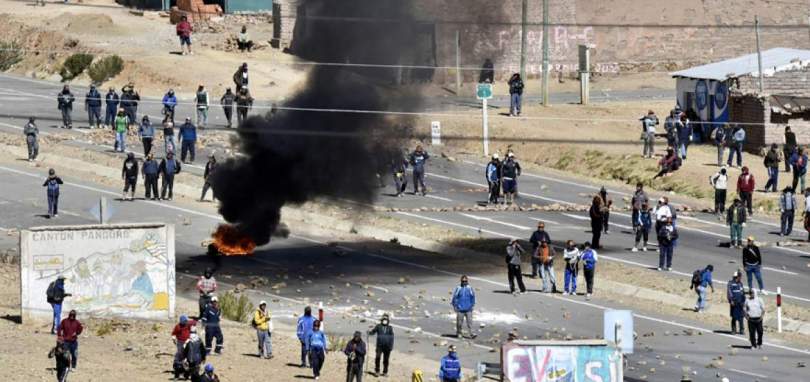
Vice Minister Rodolfo Illanes, in charge of Bolivian security forces within the Ministry of Government, was killed Thursday night after being held captive by protesting cooperative miners. Illanes was part of a negotiating team sent arrange talks with a national protest campaign. He went to Panduro, a town on the La Paz–Oruro highway, Thursday morning, where he was taken hostage by members of the Federation of Cooperative Miners (Fencomin). Later in the day, he was brutally beaten to death and then left on the side of the highway. His capture and death came on the second of two deadly days of confrontations between miners and police attempting to disperse their blockades of Bolivia’s principal highways.

Recent confrontations around the government’s effort to clear road blockades by cooperative miners have been unusually violent and intense. Two miners died of gunshot wounds on Wednesday at Sayari (on the Oruro–Cochabamba highway), Fermín Mamani (25 years old) and Severino Ichota (41), according to national government prosecutors who have opened investigations of their deaths. A third, Rubén Aparaya Pillco, was reportedly shot dead on Thursday at Panduro, near where Illanes was being held. At two more miner’s lives were cut short: Freddy Ambrosio Rojas (26) died on Saturday after suffering severe injuries while holding dynamite at the Panduro confrontation. Pedro Mamani Massi (41) suffered a gunshot to the head and suffered brain death in the hospital;  he remains on life support without prospect for recovery. he died on September 1 and was mourned by his family in El Alto.

As part of my research, I have been compiling a database of deaths in political conflict in Bolivia during the current (post-1982) democratic period. This work is still in process, but can help to put current events into context. This week’s events make 2016 the deadliest year since 2008, with 13 fatalities. In February, six municipal workers died in the city hall of El Alto (the nation’s second largest city) as the result of an arson attack by protesters. In January, soldiers beat a trucking worker to death during a pressure campaign by that sector.

Deaths in Bolivian protest have been less common under the presidency of Evo Morales than in the past and killings by state security forces (army and police) make up a smaller fraction of deaths than under Morales’ predecessors. We’ve identified 91 deaths during Morales’ ten years in office (including those this week), and fewer than a third of them were carried out by security forces. Meanwhile, at least twenty-one deaths under the Morales administration have come in conflicts among mineworkers or between mineworkers and community members: 16 in 2006, two in 2008; one in 2012; and two in 2015. Two cooperative miners were killed by police during 2014 protests in Cochabamba, during a confrontation in which police were also taken hostage. Altogether, four members of the police or military have died in political conflicts since 2006. Vice Minister Illanes is the first senior official to be killed.

This confrontation does not herald a general confrontation between state and society or among larger political forces. No other sectors have joined Fencomin’s protests and the group is at odds with waged mine workers who play a key role in the national labor movement. Cooperative miners are longtime allies of the MAS government, backed President Morales’ re-election in 2014, and endorsed another term for him as recently as May.

Since 2009, the most intense conflicts in Bolivian society have occurred within the broad grassroots left coalition that backed the rise of Evo Morales to power. The government has routinely alleged that protests from within the grassroots left have an anti-government political agenda, and did so again this week, but these claims are often unsubstantiated. The 2006-08 conflict between the Morales government and secession-oriented right-wing movements has long since concluded, and is unrelated to the current protests.Read More »

Evo’s extractivist dreams: Nuclear power and prospecting satellites

While facing an election next year, Bolivian President Evo Morales is thinking about his legacy. As the strong front-runner in national politics, his governing party, the Movement Towards Socialism—Political Instrument for the Sovereignty of the Peoples, feels confident it will be in power for a long time to come. This self-confidence is driving the drafting of a 2025 Patriotic Agenda. Alongside the formal process, the president has spoken off the cuff of his desires for the future. And like any dreams, they provide an insight into the mind and orientation of the dreamer. In his oratory, Morales long seemed to equally embrace two visions: sovereignty through claiming natural resources for the nation and reorientation of society towards ecological harmony with Mother Earth. Now, however, he has discarded the Pachamama-centered rethinking of exploitation and dreams of technologies long criticized for their environmental destructiveness.

At the end of October, Morales declared nuclear power to be a long-term goal of the Bolivian state. Speaking at a government-organized summit called Hydrocarbon Sovereignty by 2025, he revealed that he had asked the governments of Argentina and France for assistance in launching a Bolivian nuclear power program. “We are going to advance, dear students,* we are not far off, we have the raw materials. It is a political decision that has to be made. [Vamos a avanzar queridos estudiantes, no estamos lejos, tenemos materia prima (el óxido de uranio es la principal materia prima utilizada en los procesos radioactivos), es una decisión política que hay que tomar.]” Soon after, he called it a dream: “Bolivia has all the conditions to exploit this form of energy, there are raw materials and studies, and I want you to know that alongside our brother Vice President, I am already dreaming of having atomic energy, and we are not so far from it. [Bolivia tiene todas las condiciones para explotar esa energía, hay materia prima, hay estudios y quiero que sepan que con nuestro hermano vicepresidente ya soñamos contar con energía nuclear atómica y no estamos tan lejos.]” (El País) By the middle of November, Morales had convened thirty scientists to sketch out a Nuclear Energy Commission.Read More »

Alan García: Mining opponents must be educated out of their “absurd, pantheist ideologies”

While outgoing Peruvian President Alan García’s government negotiated major concessions to Aymara and Quechua protesters who led a 50-day regional strike against polluting mines, he didn’t back down in his rhetoric attacking the value they place on the land. Here’s an English translation of a widely circulating video of García accusing mining opponents of being absurd, uneducated, and backward:

And thirdly, to defeat the absurd pantheist ideologies that believe that the walls are gods and the air is a god. In the end, to return to such primitive forms of religiosity where one is told, “don’t touch this hill because it is an Apu and is filled with millennia-old spirit,” and who knows what else. Well, if we reach that point, we wouldn’t do anything, much less mining. Don’t touch those fish because they are creatures of god and expressions of the god Poseidon. We would return to this, let’s say, primitive animism. Right? I think that we need more education [of these people], but that is long-term work that just can’t be fixed right away.

You can go to whatever place where the population in good faith and in accordance with their education says “No! Don’t touch this here which is our sanctuary,” and one asks of what is this sanctuary, right? If it’s a sanctuary for the environment, fine and good! If it’s a sanctuary because here are the souls of the ancestors, watch out! The souls of the ancestors are surely in paradise; they’re not here! And let them allow you who are alive today to feed yourself and have work through the investment in those hills.

Untangling Puno mining protest reports (or, why English-language wire reporters should read the local press)

The wave of anti-mining protests in the Puno Region of Peru reached day 50 today. Yesterday, June 24, was a particularly dramatic day, however: the Peruvian government announced that it will annul the mining concession for the proposed Santa Ana silver mine in Huacullani District, near the Bolivian border southeast of Puno; other protesters took over the Manco Capac airport in Juliaca, north of Puno, only to be shot with live ammunition by police. These were both very important events in the seven-week-long protests. But they were also the two kinds of events that the English-language press steps in to cover: economic loss to Western corporations and deadly violence. If it bleeds, it leads is a key phrase for journalism, but if it bites the bottom line, it makes the business pages is just as important.

Unfortunately, the coincidence of these two newsworthy events led a string of English-language outlets to treat one as causing the other. In fact, there is quite a bit of separation: the Santa Ana mine was the lead issue for the primarily Natural Resources Defense Front of the Southern Zone of Puno (Frente de Defensa de los Recursos Naturales de la Zona Sur de Puno), which joined forces with National Confederation of Peruvian Communities Affeted by Mining (Spanish: Confederación Nacional de Comunidades del Perú Afectadas por la Minería; Conami). The Defense Front, a predominantly Aymara organization, is based near the border and had organized an earlier regional general strike against the Santa Ana Mine in April. It joined forces with the largely Quechua Conami for a larger regional protest from May 7 to June 1. When protests resumed after the victory of Ollanta Humala, new forces got involved, many but not all also concerned with mining elsewhere in the Puno Region. These include protests in Carabaya province [the Puno region has 13 provinces, divided in 107 districts] against mining concessions and the Inambari hydroelectric power plant; protests in Melgar, Juli, and Sandia over local mines; and Azángaro (whose capital is Juliaca) demanding decontamination of the Ramis river from pollution caused by small-scale mining. Outside of the Defense Front, most peasants in these regions are Quechua-speakers, not Aymaras.

The story is the strike wave, which has rippled across the region. And the other surprising story is the willingness of the government to deal openly with the strikers: even in May, substantial concessions were granted to the protests (including a 12-month delay in the Santa Ana mine and a regional commission to study all mining in southern Puno Region). The possibilities of protest and the limits of resource extraction are being rewritten in Peru. However, it didn’t bleed, so it didn’t lead. Indeed, for English-reading outsiders, it didn’t even get covered. Blame this on editors and the priorities of understaffed media organizations.

However, when things got interesting for the newswires, they assigned the story, apparently to reporters far from the scene. And the results juxtaposed the shootings in Juliaca and the victory in Chuquito Province in ways that distort the truth:

  • Associated Press, “Peru cancels mine after 6 killed in clash” somehow fails to mention the demands of protesters in Juliaca, and gives the false impression that the clash led to the concession.
  • Agence France-Presse, “Peru halts Canada mining operations amid protests“: “Peru suspended a Canadian company’s mining project in the south of the country on Saturday following intense negotiations in the wake of deadly protests by mostly indigenous anti-mining activists, authorities said.” “In the wake of” is fuzzy talk for afterwards without committing to a connection. In fact, the negotiations preceded the deadly violence, with a commitment to annul the Santa Ana mine being made verbally to the Defense Front on Wednesday and Thursday, with confirmation on Saturday. As discussed above, anti-mining protesters in Juliaca have other demands. Later in the article, “Protests have since spread to the provinces of Azangaro, Melgar and now the city of Juliaca.” Juliaca is the capital of Azangaro, and protests occurred there in late May, as well as early June. Nonetheless, AFP did some homework; this is spot on: “They then expanded to include opposition to other area mines, and now include opposition to the Inambari project, an ambitious plan to damn several Andean rivers and build what would become one of the largest hydroelectric power plants in South America.”
  • Voice of America, “3 Killed in Peru Airport Clash“: Contributes one fact: the result of a hospital phone call to Juliaca (“A doctor said the three people killed died from gunshot wounds Friday at Manco Capac airport in the city of Juliaca in Puno state.”), but mis-identifies the protesters as Aymara Indians—0.28% of Azángaro Province is Aymara. The hospital workers, through no fault of their own, understated the death toll by half.

Reporting like this is far less effective than paying translators to read the local press (Los Andes in Puno has been among the most comprehensive; see their chronology) and fact-check one against the other. If you’re reporting on these issues, I’d really like to know your process and point you in the direction of reliable background information. Seriously, where are you and what do you read?

Credit where credit is due: Reuters got the story right, noting “On Friday, hours before the deadly clash at the airport, Garcia’s cabinet revoked the license of Canadian mining firm Bear Creek in a bid to persuade locals residents to end protests that have dragged on for more than a month.”

p.s. A look at the same problem in Bolivia ten months ago: Potosí isolated by 12-day regional strike.