
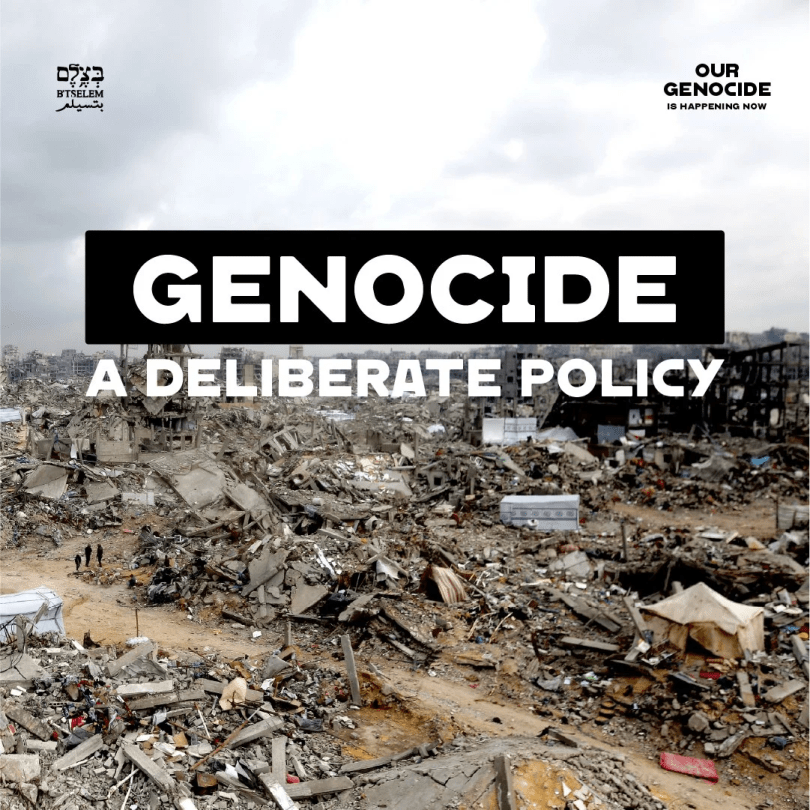
If you’ve taken a step back from the endless stream of video-documented destruction in Gaza, something even Israel-aligned political voices have been compelled to describe as “a wall of carnage,” perhaps it is time to re-engage with the political realities of the society that has waged war (at high and lower intensity) on the occupied territories of the Gaza Strip and West Bank for the last twenty-seven months. If so, let me recommend four videos and one podcast episode to catch up with Israeli politics, seventy-thousand violent deaths into the current period.
Israeli human rights groups: “Our Genocide”
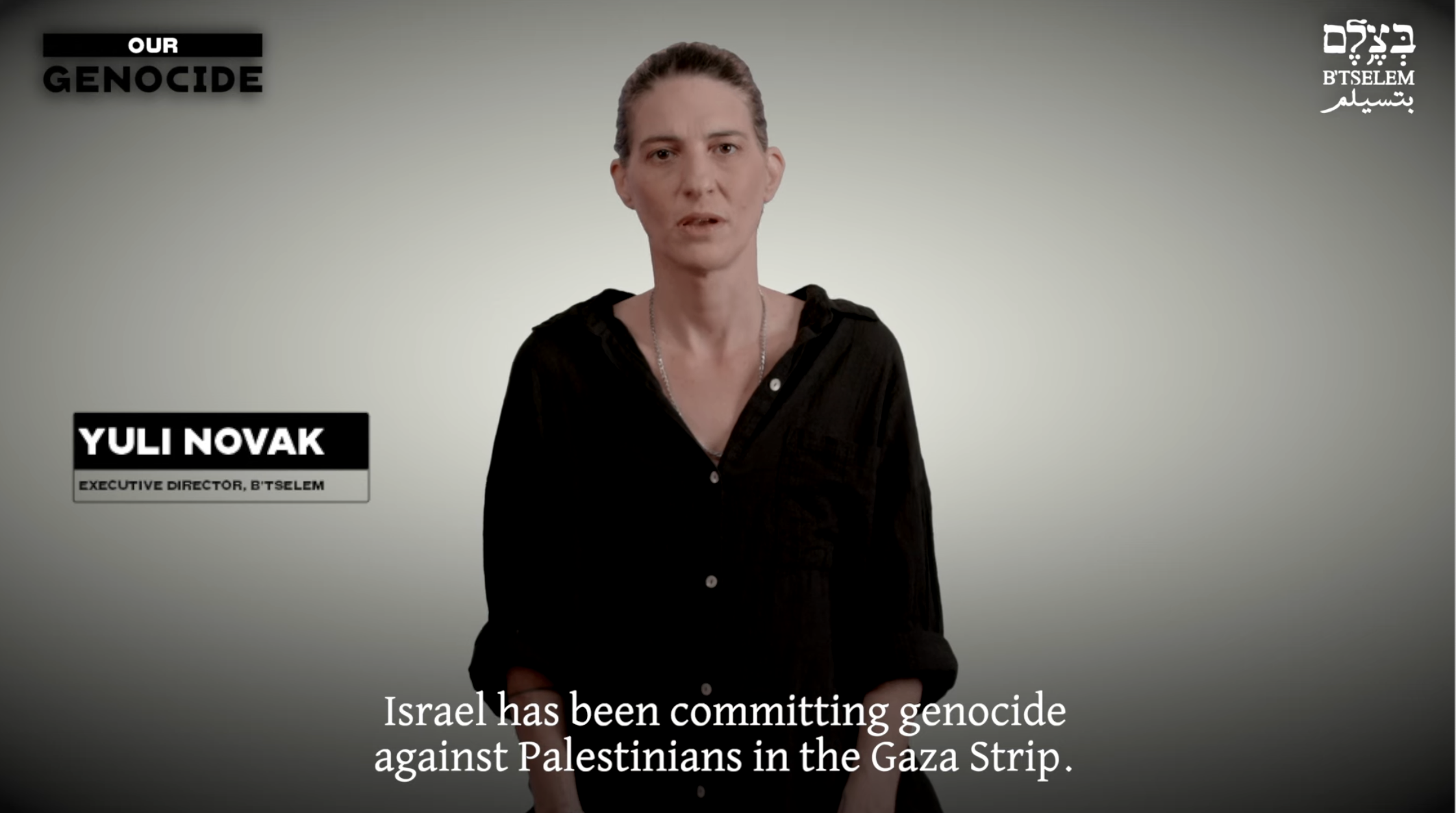
In July, the Israeli human rights organization B’Tselem issued a report concluding that Israeli policy had taken a decisive turn from a destructive military occupation to “coordinated, deliberate action to destroy Palestinian society in the Gaza Strip.” Checking each of the elements of the crime of genocide, they enumerate actions including:
“an intensive military campaign in the Gaza Strip that includes mass killing, both in direct attacks and through creating catastrophic conditions that increase the massive death toll; serious bodily or mental harm; large-scale destruction of infrastructure and living environments; destruction of the social fabric, including Palestinian educational institutions and cultural sites; mass arrests and abuse of Palestinians in Israeli prisons, which have effectively become torture camps; mass forced displacement, and making the ethnic cleansing of Gaza one of the official war goals; and an assault on Palestinian identity through the deliberate destruction of refugee camps and attempts to undermine the United Nations Relief and Works Agency for Palestine Refugees (UNRWA)”
B’Tselem was joined by Physicians for Human Rights Israel in denouncing the genocide in Gaza. Their conclusions came after many similar conclusions by Amnesty International, Human Rights Watch, United Nations human rights experts, and genocide, scholars, but they represent a crucial bridgehead in to Israeli Jewish society. (B’Tselem is a non-sectarian institution that includes Jewish Israelis, Palestinian citizens of Israel, and Palestinians from the Occupied Territories.) Their perspective very much remains a minority position in Israel, where a June 2025 poll found that 87% of the ruling coalition supporters, 67% of moderate voters, and even 30% of supporters of the left-wing opposition all agreed that there are “no innocents” in Gaza. (More recent polling confirms this.) Political supporters of equality between Palestinians and Israelis continue to navigate difficult strategic questions about how to represent themselves and enlarge their numbers.
In Jerusalem and Tel Aviv: Denial of Palestinian suffering
Guardian reporter Matthew Cassel’s three-part series “Along the Green Line” serves to illustrate the hardening line in Israeli society. Partisans of Israeli victory increasingly see the notion of Palestinian territory itself as a thing of the past. The first episode show such Israelis’ point of view including their ambitions to expel Palestinians and replace the Al-Aqsa mosque. Meanwhile Palestinians continue to narrate their historical presence.
In a separate video, Cassel meets with Israelis on the streets of Tel Aviv and asks them about the understanding of the war, in light of the reports of genocide. After meeting with B’Tselem, he finds many Israelis who hold tight to the notion that mass casualties in Gaza are a staged deception, a product of “Gazawood” film-making rather than grim reality. Even at an anti-Netanyahu demonstration, Cassel asks “why there is little mention of the Palestinian victims of this war in Gaza?” and manages to find just one person willing to prioritize Palestinian suffering.
Fifty miles south in the Israeli communities of the so-called ”Gaza envelope” there is little more sympathy for Gazans, but far less denial. A resident of a border town shows Cassel the remaining destruction from the three-day invasion of his town of Kfar Aza by Hamas in October 2023, leading to the deaths of 80 Israelis (including 19 taken hostage and 24 members of the security forces). A resident who leads tours of the wreckage for visiting Israelis speaks frankly about 50,000 Palestinian deaths as a possible recompense for the 1,200 Israelis killed in the attacks, and acceptable measure to deter future Palestinian violence. He narrates the violence as an almost clinical measure: “Clean it out and then bring in something good.” Meanwhile across the Green Line, Malak, a young Gazan woman fears that her journalism could lead to the deaths of her already-displaced family.
The West Bank: “The threshold of despair”
NPR radio show This American Life devoted an August 2025 episode to “The Other Territory,” the West Bank. In its opening it quotes from a plan drawn up by Bezalel Smotrich, now overseer of the occupied territory as Minister of Finance and a defense official. In this document from before his appointment, Smotrich wrote, “The point will come when [Palestinian] frustration will cross the threshold of despair and will lead to acceptance and understanding that their cause stands no chance. It simply isn’t going to happen.” The episode is in essence a chronicle of the forms that despair takes, both outside and inside Israeli prisons. This, of course, continues regardless of the partial ceasefire in Gaza. For those of us whose governments back this process, it is essential listening.

 Carwil without Borders