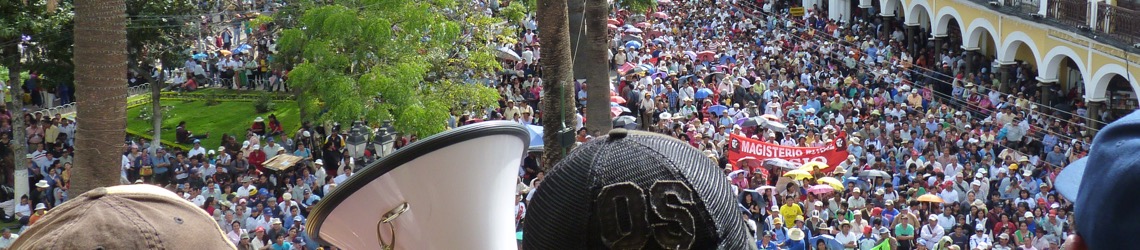
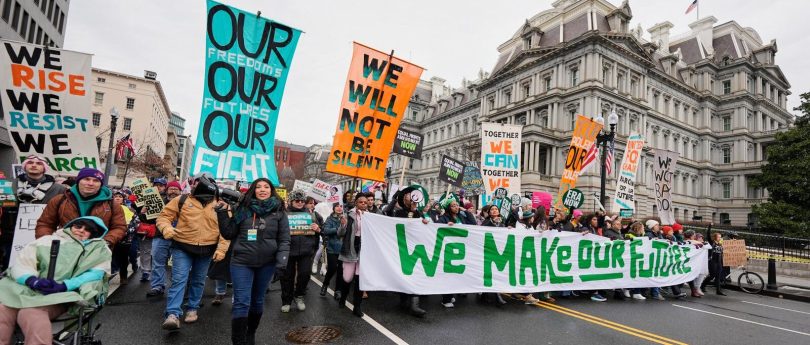
People's March, Saturday, Jan. 18, 2025, in Washington.(Mike Stewart | AP Photo/Mike Stewart)

Trump’s authoritarian turn is everyone’s problem

It’s May 2025, and it feels like every new conversation (in my circles? in the United States? far beyond that?) needs to start with an acknowledgement of the bleak bigger picture on the national and global stage. Like every How are you? could be personal, but could also be a How are you coping with these unfathomable times?

In my circles, a short phrase circulated in 2020–22: “Pandemic fine.” It was a way of addressing this uncertainty, this complication, this brokenness in brief, humane terms. With an unspoken subtext something like this: “My loved ones and I had a reasonably good day, though before bed I will be checking the charts that reveal that 2,592 of my countrymen have died yesterday of a disease that didn’t exist three years ago. And that reasonably good day was made as we navigate all the ways we know to live differently to make that number a bit smaller than it otherwise would be.”

Also in my circles, this attentiveness and yet also disconnect around the COVID pandemic was eventually displaced by the mounting horror of the Israeli genocide in Gaza. Which is something we didn’t have to plan our everyday behavior around. But which was present in our consciousness in a new and visceral way. The first live-streamed genocide brought us inches away from a tide of human suffering and calculated cruelty that was unimaginable. And while it felt like awareness of this new horror was uneven in the United States, the half or more of us who were aware could not look away. Our day-to-day lives coincided with both this atrocity, and with the broken promise of post–World War II life: “Never again.”

Less publicly, and I imagine among a smaller set of Americans than these last two, a dawning realization of the reality of massively disruptive climate change came up again and again in 2024. The city-shaking and sometimes city-shattering disasters that accompany the global rise in temperature knocked on more places I know in 2024, most memorably Asheville and Los Angeles. Those of us for whom climate is an area of expertise know the worst is still yet to come, and in the absence of rapid emissions reductions, the tempo and scale of these disasters will only rise. Among ourselves, we talk about the opposing demands for hope and clarity. and we mourn those places and lifeforms that can no longer be saved.

And for the United States, a further damaging shift came in with the Trump administration, and its dramatic efforts to take off the limits on repressive power; stigmatize and reverse efforts towards racial and gender inclusion; and dismantle a swath of institutions. We’ve see a former president who dreamed of being a dictator hire a phalanx of officials who are actually working to make him one. Moves from an authoritarian playbook are underway in the American state, even as crown jewels of that state — the Centers for Disease Control, PEPFAR, the National Endowment for the Arts , the list goes on — are cast aside. The White House directs a crackdown on the most vulnerable while also starting fights with pillars of its own power: the Ivy League, elite law firms, the Federal Bureau of Investigation.

Here there has been no silence. The details are too incredible, the variance with routine channels of action too extreme, the impacts too widespread for us to not bring these things up, just when we check in with each other. Public protests have popped up at a much faster pace this year than in 2017, with sustained regular demonstrating turning into a feature of the political landscape.
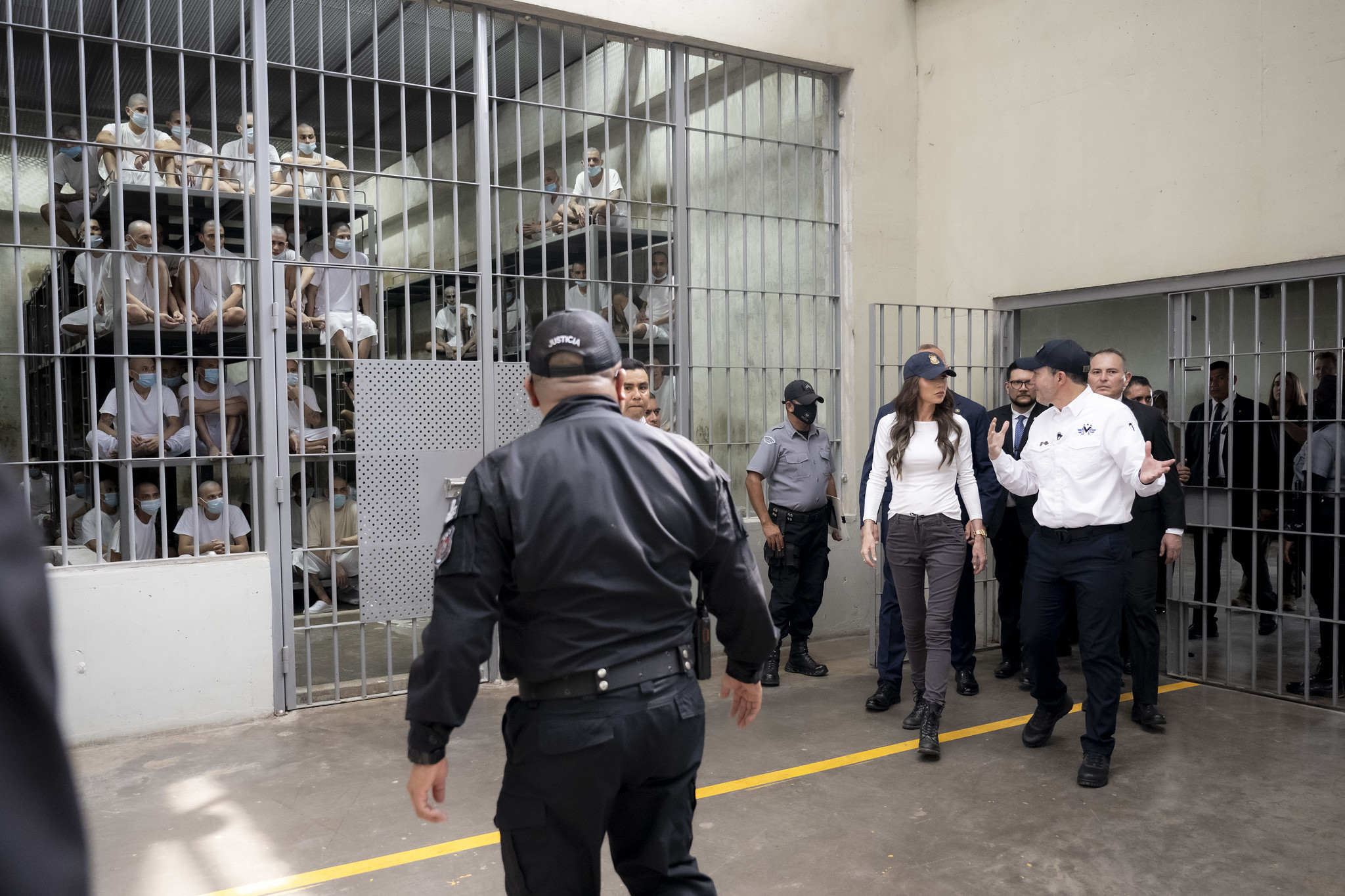
Department of Homeland Security (DHS) Secretary Kristi Noem receives a tour of the Terrorist Confinement Center CECOT with the Minister of Justice and Public Security Gustavo Villatoro in Tecoluca, El Salvador, March 26, 2025. (DHS photo by Tia Dufour)

But also, the warning signs of a more repressive turn are real and obvious: snatch squads targeting outspoken student activists; the use of immigration enforcement as political police; unaccountable detentions of lawfully arriving visitors; and the out-of-country imprisonments in El Salvador’s no-way-out prison CECOT. Again, those of us who have made our lives work studying such systems of power, as well as those who grew up living through authoritarian turns, are unified in seeing the dangers here.

Okay, so now what?

We’re up against a wildly ambitious White House intent on turning the US government into an authoritarian state, but also a White House that is doing so with self-weakening abandon. Starting from a bare plurality of voters, and the smallest possible majority in Congress, it is pursuing a maximalist agenda by largely ignoring the legislative process altogether. Its attacks on diversity, on queer rights, on opposition figures personally push otherwise moderate people into opposition. Its crudeness inspires more revulsion than it does participation. Trump’s absolutely Nixonian inability to treat powerful opponents differently than he does powerless ones continues to generate shock and outrage.

After a winter of cowardice, capitulation, and collaboration — with CBS, Columbia University, and the tech oligarchy as its most visible symbols — there’s a new balance of initiative. There will be battles in the courts, defiance from campuses, insubordination in federal offices and occasional bravery in state houses, and many, many reasons to get out in the streets.

Much of US activist practice is centered on raising awareness and visibility. But nothing could be more visible than the situation we confront. (We can retire the bumper stickers that say, “If you’re not outraged, you’re not paying attention.” Everyone is paying attention.) We’ll have to learn the forms of praxis that transform numbers into disruption, and disruption into power.

But I like our emerging coalition. And I like our chances.

Lead Photo: People’s March, Saturday, Jan. 18, 2025, in Washington.(Mike Stewart | AP Photo/Mike Stewart)

Inset Photo: Department of Homeland Security Secretary Kristi Noem receives a tour of the Terrorist Confinement Center CECOT with the Minister of Justice and Public Security Gustavo Villatoro in Tecoluca, El Salvador, March 26, 2025. (DHS photo by Tia Dufour)

Bolivia’s anti-racism law at the center of face-off with corporate press

Since August, one issue has generated more headlines here in Bolivia than any other: The Law Against Racism and All Forms of Discrimination, which was debated and passed by the Plurinational Legislative Assembly (aka, the parliament) in late September.

The remarkably short Law 045 is the Bolivian equivalent of more than a generation of civil rights law in the United States. It bans discrimination by public officials and private businessmen, criminalizes verbal and physical aggressions, charters educational efforts on discrimination, creates a national commission on issues of discrimination, and imposes sanctions on the media for circulating “racist ideas.” The scope of the law is broad, including discrimination on the basis of race, ethnicity, religion, language, age, sexual orientation, disability, and pregnancy, among other statuses. A such, it is parallel to American laws from the 1948 integration of the Armed Forces to the 1965 Civil Rights Act to the yet-to-be-passed Employment Non-Discrimination.

So, it would not be shocking if wide range of controversies had emerged over the manifold implications of the law. But this has not occurred. One single controversy, however, has risen to national prominence.

Two articles of the proposed legislation, Articles 16 and 23, have been roundly criticized by the mainstream, privately-owned press. Article 16 makes publications subject to economic fines and even closure for circulating racist ideas. And Article 23 removes any special immunity for members of the press from prosecution under the law. The mainstream press has characterized the articles as the rebirth of a 1980s proposal for prior press censorship, known as the Ley de Mordaza (the Jaws Law, for its ability to crush the press). They led marches across the country as the law was being considered, and coordinated a nationwide protest by in which newspaper covers all read only: “Without freedom of expression, there is no democracy.”

As an (US) American, of course, these provisions are shocking. Our Voltaire (“I detest what you have to say but will defend to the death your right to say it”)-to-American Civil Liberties Union tradition of free speech is, however, a globally extremely tolerant position. (I’ve written before about how our notion of the freedom of the press is, on the other hand, a highly restricted vision of public access to the media, essentially limited by press ownership.) Following the nightmares of World War II, the global human rights regime initiated by the Universal Declaration of Human Rights drew the line on free expression at racism and incitement to war, which it said should be prohibited. International conventions follow these lines by banning “racist incitement.” Germany bans Nazi parties, advocacy of and apology for genocide, and rallies by the racist right. Several other Latin American countries have restrictions on racist media which include prison terms, unlike the Bolivian law. Both the OAS president and the UN human rights representative who have visited in recent weeks have emphasized that the law is appropriate, although the line between racist incitement and free expression must be scrupulously drawn. They’ve also urged the private press to end their boycott of the rule-making process on the legislation.

Strangely, however, the American standard is irrelevant to the debate here. In three months, I have not heard or read a single defense of free *speech* as opposed to free *press* on these issues. No one is suggesting that criminalizing calling someone an “Indio de mierda” (“shitty Indian”) to their face is inappropriate. (Doing so in the United States would of course ignite a national firestorm over “thought police” and be overturned in short order by any competent Federal Court.) There has been a great deal of concern about whether the a TV station filming and disseminating that act would be liable to prosecution (the government regulations proposed on the issue now make it clear that such reporting of others’ speech will not be subject to sanction).

Aside from marches, the press and many media workers’ unions have used a one-day strike, hunger strikes in Santa Cruz, and an immense petition campaign to oppose the law, which sailed through the MAS-controlled parliament. On November 26, they submitted a sample selection of signatures to Vice President Álvaro García Linera. The press claims to have gathered one million signatures, although they are still being sent to a single place to be verified, and the eight books they handed over only come to some 32 thousand. Which brings us to the current impasse: while the new Constitution permits citizen initiatives as part Bolivian democracy, there is no enabling legislation yet to regulate the process. The press is depending on the moral weight of its gathered signatures (one million is a substantial portion of Bolivia’s 10.6 million inhabitants) to kickstart the initiative process. So far, the government seems resistant. And so, a policy controversy seems about to cross over to a crisis of democracy.

Meanwhile, the mainstream press is not the only voice on this issue. During the debate, a book was published on racism by the press over the last century in Bolivia. This racism runs up through the media’s overt collaboration with (really, rallying for) attacks on indigenous protesters in Cochabamba in January 2007 and Sucre in 2006, 2007, and 2008. The cocalero movement has declared itself on alert in defense of the law, and marched here in Cochabamba. And a stream of “alternative media” which includes indigenous radio producers, radical working-class publications, and (strangely given the name) workers in the government-owned media, has taken a distinct position calling for professional standards and arguing that racism and free expression are fundamentally different. They’ve also used the anti-racism law as an opportunity to argue for systematic coverage of indigenous issues and use of indigenous languages in the media.

For me, this storyline is a fascinating instance of public debate in the process of rights-making, an opportunity to see the shape of the Bolivian legislating process (very little of which takes place inside the walls of the Legislative Assembly), and another turn in the kaleidoscope of political alliances here in Bolivia. It’s also forcing me to reconsider (although not yet change) my ideas of what free expression is. I’ve conducted some interesting brief interviews with the alternative press on this, and hope to delve more as the story develops.

Local road blockade challenges Egyptian election fraud

On Sunday, Egypt held parliamentary elections which are widely known to be neither free nor fair (denunciation by the Carnegie Endowment for international peace). The elections were a demonstration of the government’s plans in advance of the 2011 elections, when long-time president Hosni Mubarak may make way for his son to rise as a successor. Unlike the media frenzy over the selection of Kim Jong-Il’s son to receive a special title, little mainstream outrage has been directed at Mubarak’s machinations. Egypt remains under its third decade of emergency rule (which ban demonstrations and some opposition parties), and is the largest non-democratic recipient of United States’ foreign aid by far. It’s also the largest undemocratic country in the Middle East, helped to remain so by our tax dollars, and military and diplomatic support. It’s the clearest sign that the alleged US policy to support democracy in the region is a joke.

In the absence of outside support, people in Egypt have made a number of challenges to this situation. One of the latest was the mid-day peaceful uprising on Sunday by residents of Balteem and Hamoul against voter fraud. Their actions were in defense of independent candidate Hamdeen Sabahy (profile). Since 1995, three of Sabahy’s voters have been killed by Egyptian riot police, while he won office in 2000 and 2005.

Blogger Baheyya has an hour-by-hour account of local resistance (h/t to The Arabist). Here are some highlights:

8:30 am. Sabahy’s representatives rush to photocopy the new certification papers required to gain access to polling stations. Early that morning at 12:30 am, Sabahy’s campaign was dumbfounded to learn of sudden new regulations for the papers, requiring that they be stamped from police precincts rather than notary publics as had been announced earlier. Certain that this is an 11th hour rule manipulation to bar Sabahy’s agents from accessing polling stations, campaign workers spend all night driving to police stations to get the necessary stamps.

9:10 am. The first reports of foul play trickle in. Candidate agents from 12 polling stations phone in that they have been kicked out of polling stations, and one says her certification papers were ripped up despite having the necessary police stamp.

1:00 pm. Sabahy’s representatives sent to Hamoul and agents of other candidates who are sympathetic to Sabahy begin to phone in reports of ballot-stuffing in favor of Abdel Ghaffar in villages surrounding Hamoul.

1:50 pm. Balteem’s main streets are lined with men congregating and sitting on the sidewalks, expressions somber and nerves frayed. A procession of cars and pickup trucks loaded with youth speed past in the direction of the highway. “They’re blockading the highway!” Spontaneously, Balteem and Borg youth decide to blockade the highway to protest what is now a certain sense of election rigging. The news travels like wildfire and some cars change route and head for the highway rather than Sabahy’s house. Frantic calls to campaign cars instructs them to make sure no women are headed to the highway, in anticipation of violence between protestors and riot police.

2-4 pm. Town youth blockade the highway with burning tires and clumps of tree branches and wooden sticks. Highway traffic comes to a standstill, with freight trucks backed up as far as the eye can see. A campaign worker says to no one in particular, “Didn’t I say that this morning was the quiet before the storm?”

4 pm. Townspeople converge on Sabahy’s courtyard and the candidate comes out to speak, standing on a pick-up truck. Livid, fiery youth and men climb on the pick-up truck and demand revenge. Sabahy struggles to control the crowd’s emotions, saying he’d rather withdraw and give up his seat than join this scandalously handpicked parliament. A fully veiled woman in black climbs on the truck and pulls the microphone from his hand, screaming, “Don’t you dare withdraw, Sabahy! Don’t you dare withdraw!”

The crowd chants, “Balteem boxes won’t leave! Balteem boxes won’t leave!” By law, counting stations for the entire district are located in Hamoul but since Hamoul was experiencing rigging, residents feared their ballots would be destroyed or disappeared en route to the counting station.

Ultimately, these efforts appear not to have saved the day. Instead it was the threat of further government violence that won. Al Ahram reported at 4:35 pm, “Police armored vehicles have stormed Balteem, in Kafr El-Sheikh, firing tear gas and live ammunition into the air.” Later, Sabahy himself convinced his supporters to stand down (again, the full day is here):

7:00 pm. Sabahy comes out and is immediately mobbed by the crowd, lifting him on their shoulders and giving him a hero’s welcome. He gives a rousing speech in which he denounces the government and several Amn al-Dawla officers by name for fixing the elections in Hamoul, and reiterates his position of withdrawing from the elections. The crowd presses him to authorize and lead a peaceful protest march to the police station to protest the rigging, but Sabahy fears security forces’ violent response and does not want injuries and casualties among his supporters, as in the past. The back-and-forth goes on for an hour that feels like an eternity, but in the end Sabahy prevails and the people are dejected, though none take matters into their own hands as some did that afternoon.

Somewhat obnoxiously, a government spokesman claimed, “The [governing] party’s careful selection of its candidates was a factor in defeating big opposition names such as Hamdeen Sabahi.” Sabahy withdrew from the race, and made these comments later: “The rigging proves that the [governing] NDP wants no opposition in parliament. With the new parliament, we will see increased restrictions on freedom of expression, including new restrictions on the media.” Whatever the wisdom of backing down (and no one should be too eager to second guess such moves when lives are at stake), residents’ willingness to take their anger to the streets are remarkable under so much pressure.

p.s. Apparently, Egyptian President Hosni Mubarak would like another dictatorship in Iraq, according to advice he gave to US officials (Thanks, Wikileaks).