Recent political violence in Bolivia is happening between social movements, not against them

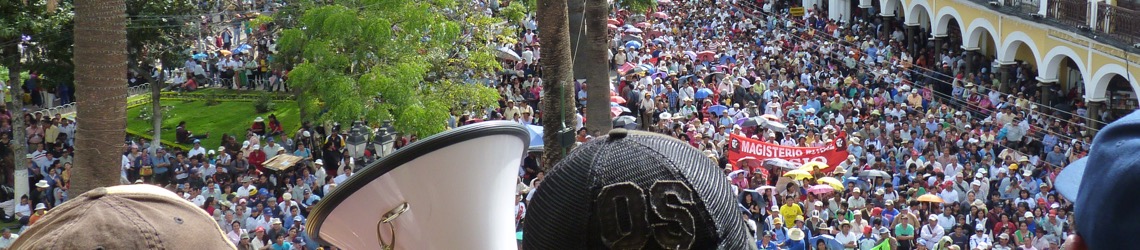
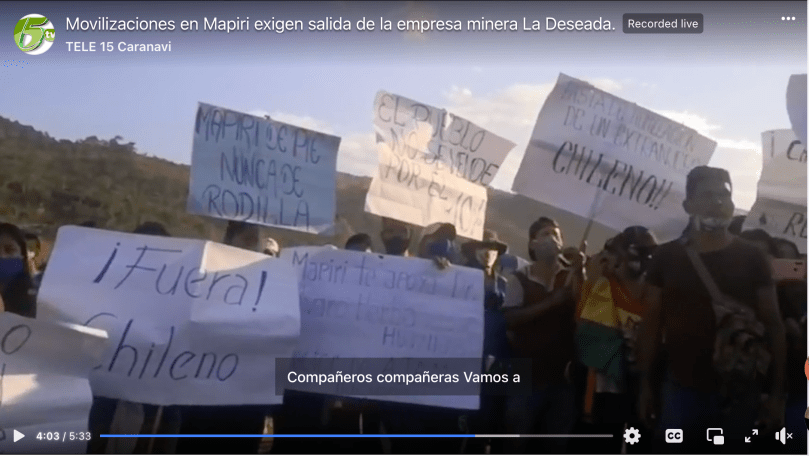
This review of lethal political conflict in Bolivia is cross-posted from the Ultimate Consequences research project website, where I’ll be archiving my commentary and analysis on political violence in the country. Featured photo above shows protesters against the La Deseada mine in Mapiri, in Larecaja Province, where mining conflict have claimed five lives in recent years.

Eleven people have died in social movement-related violence in Bolivia since the beginning of 2023, ten of them the victims of violence carried out by other social groups. These conflicts pitted rural community members against miners, as well as disputes within the same profession, be it mining cooperatives, urban transit drivers, or rival claimants to rural land. Only one death, in January 2023, was caused by security forces, who fired a projectile into the eye of a bystander during raucous protests over the arrest of right-wing governor Luis Fernando Camacho.

In addition, the government of Luis Arce attributed four deaths from medical causes to the side effects of pro-Evo Morales blockades in January 2024. (Per our codebook, we record such collateral consequences but exclude them from other analysis.) For more details on these events, visit Ultimate Consequences’s interactive directory (Spanish version) of all deaths recorded in the dataset. Type “Arce” into the search bar for presidents to just see events during the Arce administration.

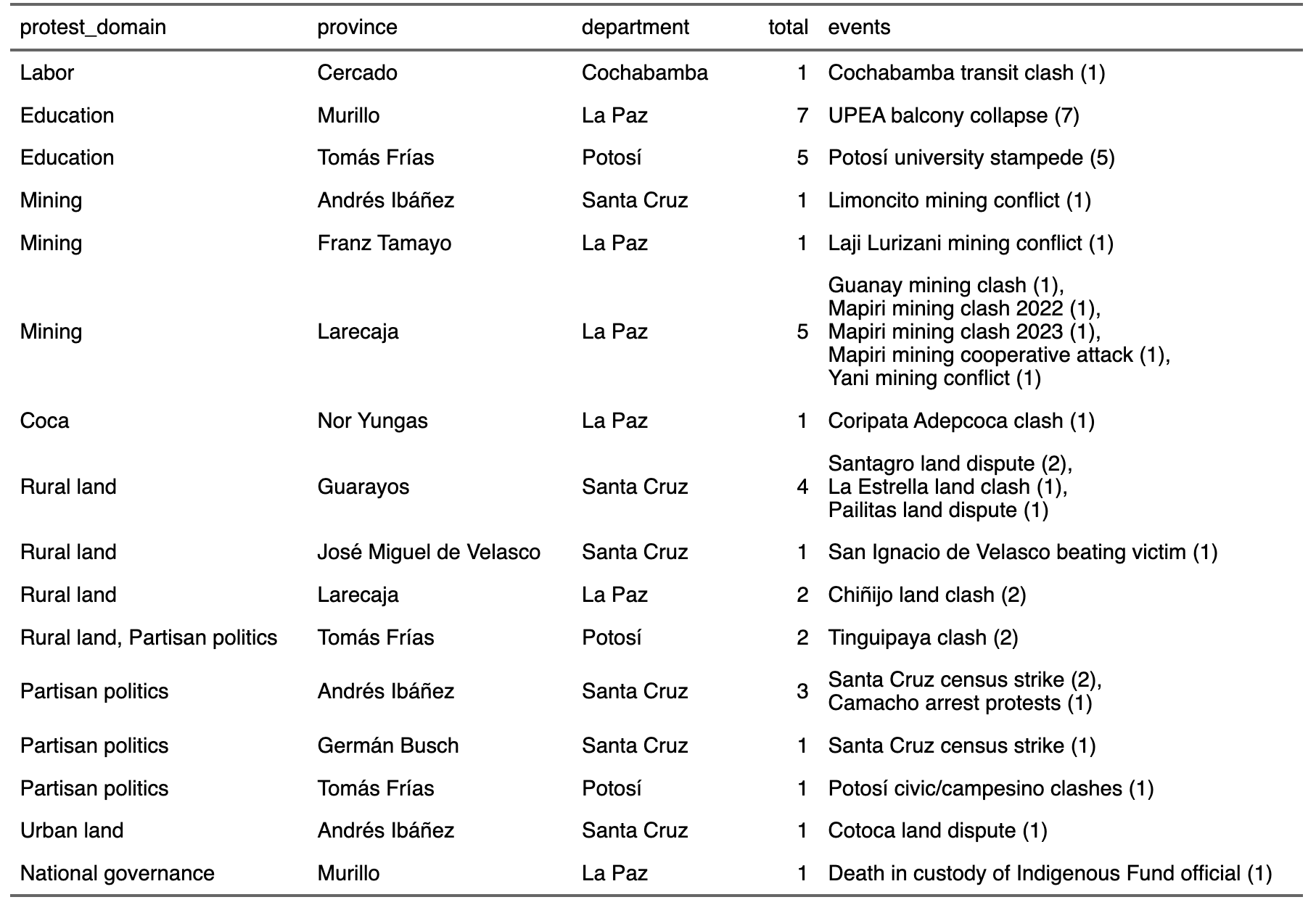
Deadly protest events, January 2023–August 2024

The recent events are as follows:

Camacho arrest protests: The December 28 arrest of Santa Cruz’s governor (and ex-presidential candidate) Luis Fernando Camacho touched off immediate protests in Santa Cruz de la Sierra, the regional capital. Following a one-day airport takeover, members of Camacho’s Civic Movement alternated between daytime blockades and nighttime property destruction. On New Year’s Day, police fired a projectile—likely a tear-gas canister—into the eye of Edwin Chávez Durán. The man enduring no fewer than seven surgeries over the next two weeks before succumbing to a heart attack on January 13.

Mapiri mining clash: Amid negotiations upon the filing of mining permits for a mine site located on the Merque river, confrontations began between prospective miners at the site and community members. The mining firm, Minera La Deseada, is described as Chilean, and the workers involed as arriving outsiders, some or all from Caranavi, according to the OTB of Mapiri, led by Ruddy Salcedo. Salcedo describes a Chilean business owner as present at the start of the confrontation, urging them to begin work by force. Community members occupied the disputed site, waiting for police to arrive. In the ensuing confrontation, stones, dynamite, and firearms were used, wounding ten people and killing Jhilmer Cuele Sompero. Community struggles challenging the La Deseada Mine have been ongoing for years; a 2020 mobilization shows leaders describing a five year struggle up to that point. In 2020, they were demanding the enforcement of a ruling by the national mining authority AJAM.

Limoncito mining conflict: On March 1, police accompanied an inspection visit by AJAM to document the stone-mining operation of the Dracruz company, in Limoncito, El Torno municipality. The delegation was confronted by mine workers who launched rockets and otherwise attacked the inspectors and police. Amid a retreat, Sub-Lieutenant Ronald Choque Mamani suffered a cardio-pulmonary arrest and collapsed to the ground. (Initial reports of bullet wounds to the officer proved unfounded.) He could not be revived. Five men were taken into custody for investigation by the FELCC and prosecutors. Subsequent inspection on March 10 revealed an unpermitted mining operation extending over 16 hectares of municipal land. Police then took both heavy equipment and documentation from the company. Local residents had complained of the operation, and have an ongoing campaign against other illegal mining operations.

Santagro rural land dispute: In El Puente municipality of Santa Cruz, conflict flared up between members of the Intercultural farmer federation, who established settlements there in December 2023, and the employees of the Santagro soy producing company, which works on the land. The armed confrontation on March 30 claimed the lives of two men, Francisco Morales and Jorge Pérez.

Cotoca land dispute: During a confrontation between established residents and squatters in Cotoca, Herland Salinas Añez was stabbed multiple times, first by a machete and then by a short blade knife (arma blanca) and killed. Several others suffered machete and bullet wounds during the confrontation. Witness reports describe the confrontation as continuing over several days. Police arrested 25 to 33 people, whom they investigated for the illegal land occupation. Per a more detailed report, the housing takeover was sudden and carried out by a group arriving in a van, making the squatters the attackers.

Laji Lurizani mining conflict: Wilmer Chambi Salcedo, 25, was shot and died while in an ambulance transporting him from Apolo to La Paz. He was one of four wounded in a conflict in the Santa Rosa community in the Laja sector of Apolo on September 13, 2023. The violence resulted from a conflict between illegal miners and community members in the protected Parque Nacional y Área Natural de Manejo Integrado Madidi (PN-ANMI Madidi). On September 15, the Autoridad Jurisdiccional Administrativa Minera (AJAM) reaffirmed that no mining rights were granted anywhere in the protected area. The same day, police arrived in the conflict zone and took control of the Laji Lurizani community. Bitza Delgado, the wife of the deceased Wilmer Chambi Salcedo, demanded that the authorities move to find those responsible for his death.

The death marked a continued worsening of violence due to mining conflicts in the Apolo region of northern La Paz. Illegal and informal mining thrives in the region. On September 18, community members of Laji Lurizani arrived in La Paz’s Plaza Murilo to protest the activities of illegal miners and their backers, and the absence of the state. Residents testified and presented photographic evidence of how illegal miners force them under threat of violence to allow them to do what they want in the area.

Pailitas land dispute: A week of armed confrontation between interculturales and peasants disputing land rights in the Forest Reserve of the Ascensión de Guarayos province resulted in the death of the intercultural Félix Ribera Bellido (23) of San Julían and the injury of 14 others. The death occurred early on the morning of December 2, when a conflict erupted between the communities of Pailitas and Santa María (in the Los Londras area). On December 6, the leader of the interculturales of San Julían, Tito Rokas, threatened the death of landowners in the province, claiming they were responsible for the violence. President Luis Arce announced that the violence would not be tolerated and summoned an emergency meeting of ministers to analyze the land conflict and propose structural solutions. The director of the National institute of Agrarian Reform (INRA) emphasized however that the lands being fought over were in fact property of the state, as all of the properties lie withing the Gurayos Forest Reserve. The Bolivian Ombudsman’s Office condemned the violence and called upon all actors to lower the temperature and to find peaceful solutions to the conflict. On January 16, 2024, Heber Sixto Canaza Sacaca (47), one of the leaders of the San Julían syndicate, was charged with homicide, for his role in inciting the violence on December 2, and for land trafficking, due to his promise to deliver properties in the municipality to intercultural groups. He was apprehended and taken into custody on January 15 and transferred to Santa Cruz by the FELCC. Sixto Canza had also been previously involved in another armed conflict in the Las Londras area in 2021, during which a group of journalists, police, and businessmen were kidnapped and tortured.

Cochabamba transit clash: A taxi driver suffered blunt force trauma while being attacked by drivers of a rival union of drivers disputing their line. One report indicates he and his brother were dragged out of their vehicle and held in another, possibly suffering the wound when jumping out of the vehicle. A doctor described blunt trauma inflicted by a large stone.

Guanay mining clash: Conflict among miners resulted in two injuries (both with metal shrapnel) and the trauma-induced heart attack of Mauricio Soliz Miranda.

Yani mining conflict: National Police intervened in the Yani community of Sorata municipality where two groups of cooperative miners were in open confrontation. This confrontation included injuries from firearms suffered inside the mine the night of July 25. Sent to accompany officials from AJAM and to de-escalate the conflict, the police were confronted by members of one side of the dispute. Reportedly, the miners threw rocks and dynamite at the arriving police, and set the hill on fire. Caught in the flames, two police officers suffered severe burns to 70% and 80% of their bodies respectively. One of those burned, Fabricio Reynoso Gutiérrez, succumbed to his injuries in a La Paz hospital. Altogether, four police were hospitalized. Two alleged perpetrators were arrested and held in preventative detention. One party to the dispute was the Cooperativa Minera “Señor de Mayo”, seemingly the side complaining of illegal occupation of their stake, while the other side (per a social media post circulated by Señor de Mayo) is known as Hijos de Ingenio. The latter allege further violence by Hijos de Ingenio, including a shooting on the following day.

Past annual reviews of political violence on Carwil without Borders: 2022 | 2021 | 2019 crisis | 2012. More tagged Lethal Conflict

Suwalki, 1937/2002

In the summer of 2002, I went on a winding journey from Berlin northwest to Mecklenburg–Western Pomerania in Germany, then east through Gdańsk and Białystok in Poland, to ultimately reach the town of Suwałki in northeast Poland. This route had been charted by my mother to follow our family tree, seeking out each place named among her Christian German ancestors (via her father Carl) and her Polish Jewish ancestors (via her mother Ruth). My fascination with the Polish labor-uprising-turned-democracy-movement Solidarity had added Gdańsk to the itinerary.

My mother’s genealogical travelogue for the journey is fabulously detailed, naming each place we visited, meal we had, and fruit we tasted. After sharing a dinner of bread, cheese, and fruit in a park, we took a late night train from Gdańsk at 12:50am. It being the Corpus Christi holiday, the train car was crowded with late-night revelers and we had to step off the train at another stop to find our sectioned-off sleeper car. Traveling no more than 35 miles per hour, and changing trains in Bialystok we made it Suwałki by midday.

My grandmother Ruth, her five sisters and one brother, were born in Cleveland to Kalmos Rubenstein and Minnie Gottlieb Rubenstein, from 1901 to 194. Their parents, in turn, had been born in the late 1870s in the Suwałki governorate, both Jewish subjects of the Russian Empire. The records my mom compiled indicate they married in Russia in 1900 before embarking on the journey across the Atlantic. A history of the Jews of Suwalki suggests many ups and downs as Jews surged into the area fleeing pogroms deeper in Russia, played a major role in the economy, and built dozens if not scores of community institutions in the town. South of Suwałki, the Russian Empire helped organize the vicious Białystok Pogrom of 1906. But the great looming disaster of the region was of course the Nazi invasion of 1939 and the extermination campaign against Jews that followed.

In Vorpommern, near the Baltic Sea, my mother and I had stopped in the churchyards of a handwritten list of towns. In their cemeteries, often small plots that were used again and again over the centuries, we scanned the gravestones for familiar surnames. Often we found these most by the low stone walls on the edge of the cemetery, where the oldest headstones were moved and stacked up once they were on the verge of being forgotten. In Suwałki, however, this was a different experience. As my mom recorded (all text is purple is hers),

In Kaletnik’s graveyard, all the graves we found were marked by crosses. The faces, their “blue eyes and blond hair” did not read as Jewish and seemed, as she wrote, confirmation that “Hitler achieved what he set out to do.” The rural lives we saw being lived didn’t match her expectations.

Four years earlier, we had sought out the town of Suwalki in a book of survivors’ names in Washington’s Holocaust Museum; there had been no entries beneath it.

At the furthest point of our travels, then, we reached the abyss, still craving some recognizable way to envision the lives we could never reach.

Until a few weeks ago, in my living room.

Read More »
Five formally dressed lawyers sit at a long brown wood table at the International Court of Justice. They are South Africa's delegation, each dressed in black suits: three men have dark African skin, one lighter skin woman in the middle, and one European-descent man on the left. Two of them, and many people seated behind them wear long cloths with the colors of the post-Apartheid South African flag. A South African Broadcast Corporation news chyron at the bottom reads: "South Africa presents its case against Israel at the ICJ"

Gratitude for South Africans at the ICJ

South Africa’s existence as the country it is now is the result of a remarkable global collective struggle that many US residents played a part in. This struggle was only in small measure a legal one, but it built on the ways democracy, anti-racism, and equality of all nations were built into the global legal architecture since 1945. Apartheid was overcome in part by UN institutions deeming apartheid itself a crime.

Perhaps some day, decades from now, Palestinians and Israelis will sit side-by-side and advocate for the rights of others (whether as representatives of two states or one), and will remember their own troubled history and how they overcame it by ending violence and ensuring equal rights for all. If so, it too will be in part because voices worldwide could not abide the violent present, and used every means they could, including courts and diplomacy, boycotts and arms embargoes to chart another path..

First Generation B(l)ack

In 2002, my mother Carolyn James (1936–2023) and I traveled to Berlin, to Mecklenburg–Western Pomerania, to Danzig, to Suwalki, to Warsaw, and to Auschwitz in search of our ancestors and relatives. This essay, from 2002, reflects on what I, a descendant of these lands but also of Africa, found.

There is a different view of Europe when you look at it as if it were North.  The month I spent this spring crisscrossing the continent was not my first encounter with semi-post-imperial Europe as an African.  But it was definitely the first time I was traveling to find my way home. 

The trip was something my mom had been dreaming of for a long time — back through months of Saturdays we spent tracing the pathways of our family before microfilm machines or hitchhiking her amazing record-keeping on my computer skills.  I inherited or learned the need for detail, for stories, for a map to the past, and threw in history, sociology, and mysticism. 

I needed these tools not just to assist my mother’s effort to create an almost-encyclopedic genealogy of both sides of my family, but to truly get a handle on what I inherited from the past.  Jewish, Polish, German, and African; Kabbalah and animism, goddess and Christ; resistances and fascisms: by high school I would summarize my background and then add “Most of them one of wanted to kill each other.”  When you know your most intimate identities are a battlefield, walking about on disputed territory is almost a sacred experience — pushing these forces out of your head and into history. 

Read More »

The scale and pace of death in Israel–Gaza war are staggering

This is not just another turn in the Israeli–Palestinian conflict.

The extraordinary attacks by Hamas on October 7 and the thirty-one days of bombardment and invasion by the Israeli military that followed have led to a loss of life on an historic scale in Israel and Palestine, respectively.

Researching and accounting for lethal political violence is a major part of my work, and I find myself staggered by this extraordinary and extraordinarily public burst of violence. Like climate scientists during this year’s record-breaking summer, I find myself frantically sharing statistics and re-posting and pointing out this is not normal. Not even against recent trends. That this is the threshold of something worse than what we’ve known.

That’s what I’m doing and feeling with these numbers coming out of Gaza. (And about October 7 in Israel, though it will be months before Hamas could credibly repeat that day of atrocity, while Israeli air strikes happen every day, and a prolonged occupation promises even worse.)

Making this graph is my attempt to show how this isn’t normal. To grapple with the historic significance of this moment. To not feel alone in seeing it.

Read More »

Three Palestinian photographers, three Israeli killings

In 2012, photographer and videographer Roshdi Sarraj (Twitter|Instagram) co-founded Ain Media with Yaser Murtaja (Instagram). Both used up-close and drone-mounted cameras to document the life of the everyday life, wartime suffering, and protest movements of Gaza. I became aware of Murtaja and Ain Media’s remarkable work through his last piece, documentary coverage of The Great March of Return, celebrated on this blog as the world’s most daring protest. In footage shot for an envisioned documentary, Murtaja captured the collective organizing, on-site medical care, patient journalism, and defiant risk-taking that made the protest possible.

And he was killed for that journalism, shot by an Israeli sniper beside his collaborator Roshdi Sarraj.

It was Sarraj who narrated Murtaja’s last moments to the world:

Read More »
Typewriter keys and hammers with letters from an early 20th-century typewriter

Why I’m banning AI-generated text from my indigenous rights course

Okay, so I did the research and thought about it.

This has been the leading exhortation for faculty on managing the likelihood that students will use generative AI tools to write papers in their classes: try it out, consider how it might be useful, and write a very nuanced policy.

As designed, large language models (LLMs) like ChatGPT produce intelligent-sounding responses to a wide variety of queries. To do so, they are trained on billions of pieces of writing and develop a predictive model for the relationship between words. Because of this underlying corpus, and the feedback provided by those millions of complete examples and extensive rating by paid human assessors, they generate pleasing content that often uncannily resembles comprehension.

I’ve maintained an open session to experiment with ChatGPT, poked and prodded at its limitations, explored how it remixed and regurgitated material I’ve written, took (most of) an online prompt engineering training by a colleague on Coursera, and entered my writing assignment prompts to see what it comes up with.

And my considered answer is basically, “No.”

No, they shouldn’t use LLMs to replace either search engines, library databases, or Google Scholar. No, they shouldn’t treat LLM output as a summary of the field of human knowledge. And no, students shouldn’t be submitting large language model-generated essays to my class.

In the end, the two main things I’m looking for in class essays are self-reflection and research. And while I can get the appearance of both from large-language model the first is a lie and the second an uncertain and fragile illusion. Allow me to illustrate…

Read More »

Anthropology in contemporary fiction: A reading list

Where do anthropologists find themselves reflected in fiction? Perhaps every good ethnography evokes the convention of a novel, and Kirin Narayan builds Alive in the Writing on the premise that Anton Chekhov’s ethnographic work informed his storytelling. Ursula Le Guin’s work shows how attention to the possibilities of radical experiential difference, cultural diversity, and intersecting morality are foundational to the entire genre of science fiction.

But fewer novels directly center on anthropological themes or anthropologists themselves.Here, in rough chronological order of their underlying anthropological referents, is a reading list for solitary summers or an escapist counterpoint to a required readings during the academic year.

  1. Sarah Moss, Ghost Wall (2019) — Experimental archeology, the effort to re-create a piece of the distant past and live within it, forms the setting for this novel of a daughter challenging the power structure of her nuclear family. The ancient village is a co-construction of her father, a layman ancient history buff fascinated by burials in the Big and an out-of-town professor supervising the inevitably partial experiment. Questions of professional vs. popular knowledge, authenticity and invention, and the license offered by fantasies of ancient societies for present-day power plays are all explored, culminating in a disturbing finale.
  2. Dana Schwartz, Anatomy: A Love Story (2022) — This YA novel combines a young woman’s empowerment and a young working-class man’s comeuppance, and retelling of the Burke & Hare murder-for-anatomical-body-snatching spree of 1820s Scotland. While technically only anthropology-adjacent, this scandalous killing spree spurred body-buyer Robert Knox to abandon his medical career and go on to write the influential (and obviously racist) The Races of Man (1850). So take Anatomy‘s ultimate antagonist’s fantasies of individual superiority as a Cypher for the collective fantasies of European colonialism. Or just enjoy the heroine’s masquerade as a male medical student in pursuit of her dreamed intellectual independence.
  3. Nisi Shawl’s Everfair (2016) — In this work of Afrofuturist steampunk, a coalition of African traditional rulers, savvy modernizers, and sympathetic outsiders collaborate to build a political refuge east of the the Belgian Congo. This is a work that details personal sympathies, socialist politics, dirigible engineering, intercultural diplomacy, spycraft, and geopolitics, while also offering balm to the historical wounds of Europe’s late 19th century resurrection of slavery on the African continent.
  4. Alix E. Harrow’s The Ten Thousand Doors of January — Traces the role of secret societies of late nineteenth century collectors in bringing about disenchantment of the world through magical realist means of their own. The fraught relationship between January, the adopted young woman-of-color protagonist and her collector father probes questions of power, science, and coloniality.
  5. Lily King’s Euphoria (2014) — A very thinly pseudonymized retelling of Margaret Mead, Reo Fortune, and Gregory Bateson in Papua New Guinea, Euphoria fleshes out these young Euro-Americans rethinking gender and community in the 1930s. Substantial attention is paid to Mead and Bateson’s ill-fated theory of the Squares among cultural personalities and individuals, and its entanglement with the love triangle of these three. // Pairs interestingly with Lise M. Dobrin and Ira Bashkow’s “The Truth in Anthropology Does Not Travel First Class,” which exposes the four-way correspondence behind Mead’s break with Fortune while defending the latter’s read of local mythology.
  6. Ursula K. Le Guin’s The Word for World is Forest — A hard-driving military captain and a mournful, but sometimes complicit, anthropologist are the two points of view animating this story of timber colonialism on a planetary scale. Colonial tropes and masculinity (in its military and frontier guises) take center stage in a LeGuin’s depiction of an odious enterprise that enslaves the diminutive Athsheans. Arising out of this scenario, the Athsheans’ reverence for their dreams births a religion of resistance that disrupts their traditional pacifism and brings the power of numbers to challenge the ecocide that threatens their home. LeGuin’s intimate knowledge of the anthroplogical project, as the child of Alfred and Theodora Kroeber, informs especially the regretful scientist’s narration. // Ben Passmore’s quick graphical synopsis. // If the colonialist rhetoric in The Word (1972) seems tinny and unreconstructed, consider reading it alongside Nick Turse’s Kill Anything That Moves, a thoroughly documented history of the Vietnam War that Le Guin was writing against. Or try The Telling (2000), which reprises the project of religion-mediated anti-colonial resistance again through the eyes of an outside ethnographer.
  7. Steve Tomasula and Stephen Farrell, VAS: An Opera in Flatland (2002) — If Edwin Abbott’s Flatland (1884) explored Victorian social hierarchy alongside the mathematics of imagining spatial dimensions, the equally visual and textual VAS peers into how eugenics haunts both science and social practice on the threshold of a new century. The family at the heart of the book, Square and Oval, is taken straight from a kinship diagram, yet spends much of the book meditating on the medical manipulation of reproduction, amidst a sprawling canvas of historical and technological materials, from heredity charts to genetic code to scientific diagrams to a long series of quotes disturbing the reader with the broad influence of hierarchical visions of humanity.
  8. Jennifer Egan’s The Candy House (2022) — Within a kaleidoscopic novel that is also a story of how media and technology shape relationships, and the rise and fall of ways of making popular music, a late twentieth-century anthropologist sees her theory of personality become the core of first social networking, then the electronic harvesting of human memories. The Candy House ponders what might happen if something like the Theory of the Squares proved to be biological fact. And if its discoverer was partnered not to anthropologists, but to a dealmaker who created music’s stars. What then, of the pair’s children? And of her greatest intellectual triumph, which unexpectedly enables a techno-dystopia? Within each idea in this novel, there is another character, and none of them prove one-dimensional or without true moments of realization and change in their lives, rendered here in decades not years.

P.S. For science fiction of the proximal and distant future inflected with anthropological speculation, I recommend Becky Chambers’ To Be Taught, if Fortunate (2019), on a tiny human community exploring radical biological difference and Annalee Newitz‘s story of deep interspecies communication and collaboration in The Terraformers (2023).

Photo above CC-BY-SA UNESCO / Dominique Roger

Fifteen Bolivians were killed in social movement conflicts in 2022

Violent death cast a shadow over multiple social movements in Bolivia during the third calendar year of President Luis Arce. Deliberate killings came in clashes over land, mining, and the planned census, claiming eight lives, while tear gas detonated in a student meeting led to a stampede in which five were killed. A government bureaucrat who exposed a major corruption scandal died of years of mistreatment in prison. A motorcyclist was killed by a wire strung as part of a road blockade. And a brutal stabbing killed another participant in road blockades. Altogether, fifteen Bolivians lost their lives in or around Bolivia’s often charged movement conflicts.

The deadly events were as follows:

  • La Estrella land clash, March 19: Intercultural farmers had moved on March 12 to occupy lands on the “La Estrella” ranch, owned by Jacob Ostreicher and subject to claims of money laundering in a 2011 case that attracted international attention. These land occupiers were attacked on March 19 by armed people, either farmworkers or hired attackers presumibly sponsored by in-country landowner Claudia Liliana Rodríguez. (Ostreicher remains in exile.) The attackers confronted the Intercultural squatters around 22:00, shooting rockets and firing firearms. Franklin Delgadillo, son of Intercultural leader Ricardo Delgadillo, was shot and killed. The Interculturales maintained a multiday blockade demanding justice afterwards. Police arrested at least nine people for the killing in March 2022.
  • Death of imprisoned Indigenous Fund official, April 19: Marco Antonio Aramayo, the former director of Bolivia’s Fondo Indígena, died in custody following seven years of detention under an abusive avalanche of investigations in a scandal he himself brought to light. The Fondo Indígena, which Aramayo headed from 2013 to 2015, was intended to provide independent funding to indigenous communities for development and self-representation. Aramayo denounced in 2016 that the Fund was instead used by Minister Nemesia Achacolla as a slush fund during an election year.
    While many have been accused of corrupt acts, Aramayo has borne the highest weight of prosecutions (over 250 investigations begun); he was convicted and sentenced to 5 years in 2017. ITEI, a Bolivian organization that supports victims of torture and state violence, issued a statement: Aramayo’s “death is the tragic conclusion of a series of violations of [his] fundamental rights,” “which affect [him] and also affect people deprived of liberty in general.” According to the ITEI, which has provided medical and psychological attention to him since 2017, police and penal authorities tortured Aramayo physically with beatings and stress positions; biologically by depriving him of food, water, or medicine; psychologically with threats, extortion, insults, and humiliation. Aramayo was repeatedly required to travel to attend new cases across the country, with the final one filed two weeks before his death. Exhausted from his ordeal, Aramayo died of multiple organ failure, aggravated by diabetes and hypertension.
    While police announced an investigation into his death, his legal representative denounced that no actions had been taken three weeks later.
  • Potosí university stampede, May 9: A nightmarish stampede ensued at Potosí’s Tomás Frías University after a tear gas grenade was set off during an indoor meeting to convene university federation elections. Some five thousand students were reportedly in the coliseum. Many were injured in the rush to flee, including four who were killed that day and one more who died on June 15. Reportedly two of the dead were mothers who leave behind children. Six were sent to intensive care. Between 71 and 83 were wounded. The tragedy was apparently amplified by the locking of the main exit doors.
    Bolivian student politics operates in close coordination with national political parities and is often highly contentious. The tragedy also put attention on student leaders who maintain student status over decades and accumulate patronage and power in on-campus political organization.Four students, at least two of them involved in student politics, have been arrested in connection with the gas release and its deadly consequences. The Minister of Justice names Manfred Flores Canaza as the “principal and material author” of the crime.
  • Tinguipaya clash, May 15: Two men died in fratricidal violence in the town of Tinguipaya, Potosí. The brawl between differently organized Indigenous people—ayllus vs. campesinos—followed a visit by Vice President Choquehuanca and involved stones, sticks, slingshots, and rockets. Ironically, Choquehuanca’s speech, marking the opening of a political training school, had called for cross-cultural unity and fearless speech. The cause of the conflict remains totally disputed: national MAS-IPSP official attributed it to a local land conflict, while some local figures and opposition politicians blamed internal partisan disputes within the MAS-IPSP linked to the local mayor. Police attempting to investigate the incident had difficulty entering the area in the following days.
  • Chiñijo land clash, June 23: On June 23 a confrontation over land ownership in the community of Tamiplaya Tolapampa in Chiñijo, Sorata resulted in the beating deaths of two local campesinos and injury to an additional five. A group of 60 land-grabbers, hired and led by Gabriel Callisaya Toledo, Mario Luque, and Genaro Quito attacked the community in attempt to take their land, intimidating them with dynamite, dogs, and firearms. The General Secretary of Chiñijo, Susana Silva, claimed that Sorata police refused to provide assistance or to remove the bodies of the victims and only arrived at the on the 26th. Communities members protested by taking the victims’ bodies to Sorata in a protest march in order to demand justice. The community members possessed a resolution from the National Institue of Agrarian Reform (INRA) that recognized their right to the property and instructed the police to forcefully evict unlawful occupants.
  • Mapiri mining cooperatives clash, June 24: A group of expelled members of the Hijos de Pueblo gold mining cooperative attacked the cooperative in the community of Charobamba, Mapiri, in an attempt to regain leadership. A local teacher, Faustino Nestor Maqui Chambi, was killed when he was hit in the head by a stone, causing him to fall from his boat and drown. Police arrested 7 or 8 of the agressors, but their convoy was attacked in Aguada while transporting the arrested persons to La Paz and one the arrestees escaped.
  • Santa Cruz census strike, deaths on October 22, November 9 and 10: The Santa Cruz Civic Movement mounted a 36-day department-wide strike in protest of the delay of the Census to 2024, and demanding it be held in 2023. Clash between supporters of Santa Cruz general strike and those attempting to open blockades. During an October 22 clash on the Amistad bridge that connects Santa Cruz with Brazil, a municipal employee of Arroyo Concepción, Julio Pablo Taborga, suffered injuries from blows to his head. He was transported to a hospital in Puerto Quijarro where his death was recorded early the next morning. According to Taborga’s wife, he was demonstrating against the blockade when supporters of the strike arrived with dynamite and homemade bombs and began to beat him. Video of the confrontation appeared to show victim succumbing to tear gas rather than a beating. The Santa Cruz Civic Committee released a statement blaming the MAS for the conflict.
    Eduardo Arancibia Barrancos was killed in the early morning of November 9 while driving a motorcycle to work. He attempted to drive through a blockade point in the Tres Lagunas neigborhood of Santa Cruz. He did not notice that a coaxial cable was stretched across the road between two poles. This cable cut through his upper neck as he drove, causing his death. Police arested five men who were maintaining the blockade point.
    Overning on November 11, a group of four or five people attacked two men who were maintaining a blockade in the Barrio Latino of the Los Lotes zone of Santa Cruz. The attackers assaulted Jairo Montero, 21, and José Eduardo Sosa, 28, with knives, leaving Montero hospitalized with criticall injuries and Eduardo Sosa dead. The Sosa’s heart was reportedly cut out of his chest by the attackers. Two of the attackers were arrested on November 15.
Read More »

Jean-Paul Sartre on his own anarchism

Iconic French philosopher Jean-Paul Sartre is best remembered for his existentialism and efforts to integrate radical individual freedom with a left politics committed to opposing both colonialism and capitalism. One of the most visible intellectuals of his generation, Sartre engaged personally with the Algerian independence movement and Frantz Fanon (whose The Wretched of the Earth was published with his introduction); with the Vietnam War by serving on the Russell Tribunal and writing a condemnation of the American war effort as genocidal; and with Che Guevara, Communist China, and the Soviet Union.

Yet the dramatic events of May 1968 in Paris, when first a student revolt then mass factory occupations raised banners of revolution in one of Europe’s major capitals, re-shaped Sartre’s politics. Even amid the protests, Sartre was attempting to rethink the role of revolutionary vanguards and communist parties in dialogue with student leader Daniel Cohn-Bendit (interview). By June, Sartre co-wrote an editorial in Le Temps Moderne arguing:

The taking of power can only result from revolutionary processes developing from the periphery toward the center. The State cannot be conquered through the confiscation, peaceful or otherwise, of its power apparatus so long as it has been kept intact. Its conquest will result from its own crumbling and paralysis following the rise of self-organized popular forces in the factories, administrations, public services, towns, cities, and regions. The taking of power in the decision-making centers; and in the centers of production, physically within the grasp of the organized workers, emptying the bourgeois state of its substance, thereby breaking its resistance.

“A Beginning,” editorial in Le Temps Moderne, June 6, 1968. Translation appeared in the SDS publication CAW #3, fall 1968.

Here, in a 1975 interview is Sartre framing his stance as, in the long-term, anarchist:

Michel Contat: After May 1968 you said to me: “If one rereads all my books, one will realize that I have not changed profoundly, and that I have always remained an anarchist.”

Jean-Paul Sartre: That is very true. And it will be evident in the television broadcasts I am preparing. Still, I have changed in the sense that I was an anarchist without knowing it when I wrote La Nausée: I did not realize that what I was writing there could have an anarchist interpretation; I saw only the relation with the metaphysical idea of “nausea,” the metaphysical idea of existence. Then, by way of philosophy, I discovered the anarchist being in me. But when I discovered it I did not call it that, because today’s anarchy no longer has anything to do with the anarchy of 1890.

Contat: Actually, you never identified yourself with the so-called anarchist movement!

Sartre: Never. On the contrary, I was very far from it. But I have never accepted any power over me, and I have always thought that anarchy, which is to say a society without powers, must be brought about.

Sartre: To express it another way, it is the experienced certainty of my own freedom, to the extent that it is everyone’s freedom, which gives me at the same time the need for a free life and the certainty that this need is felt in a more or less clear, more less conscious way by everyone.

The coming revolution will be very different from the previous ones. It will last much longer and will be much harsher, much more profound. I am not thinking only of France; today I identify myself with the revolutionary battles being fought throughout the world. … I can only say that at least fifty years of struggle will be necessary for the partial victory of the people’s power over bourgeois power. There will be advances and retreats, limited successes and reversible defeats, in order to finally bring into existence a new society in which all the powers have been done away with because each individual has full possession of himself. Revolution is not a single movement in which power is dismantled.

Portrait: CC-BY Arturo Espinosa, Jean Paul Sartre for PIFAL, 2012