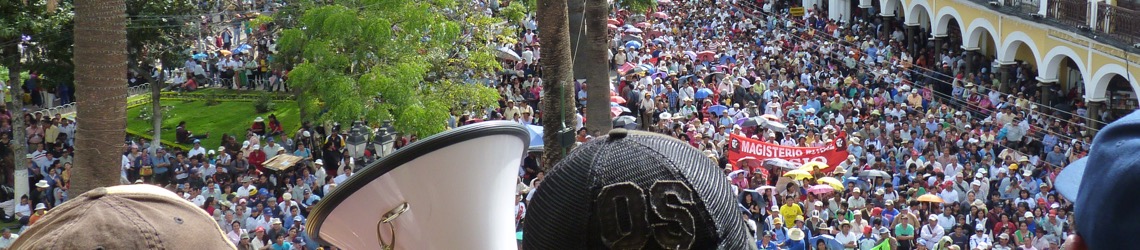
Bolivia’s Unexpected Blockade: Oruro on strike over “Evo Morales Airport”

Today is the third day of highway blockades in the Department of Oruro, the culmination of what is already 29 days of pressure backed the department’s Civic Committee and its labor federation (the Central Obrera Departamental of Oruro; COD). The form and schedule of the strike follows the standard Bolivian pattern: participants declared themselves on alert to press their demands, and have held 24-hour, 48-hour, and 72-hour general strikes before proceeding to an indefinite period of pressure, which began on Monday. Road blockades are common means of ramping up pressure in the country, and in fact Oruro’s blockades coincide with blockades by peasants in La Paz department, neighborhood organizations in El Alto, and a municipal organization pursuing a border dispute outside the city of Cochabamba.

However, the topic of Oruro’s mobilization is quite unusual. Over four weeks of protests have been waged on what is a symbolic issue: the naming of the newly expanded airport (the expansion and new routes require it to be redesignated as an international airport). The pre-established name, Juan Mendoza Airport honored an aviation pioneer from the department. But on February 7, the region’s parliament chose to honor a different native son, President Evo Morales Ayma, by re-naming the airport after him. Surprise and discontent about the sudden renaming accompanied the airport’s re-opening the next day. The first strikes on the issue took place on February 27 and 28, endorsed by both the COD and the Civic Committee. Unions of miners (notably from the famous mines in Huanuni) and the ever-strident teachers have been vocal participants.

The conflict is particularly surprising given the strong and consistent backing from the region for President Morales and his Movement Towards Socialism (MAS-IPSP) political party. The department gave 79.46% of its votes to the MAS-IPSP in the 2009 general elections, and all but one of its representatives in the Plurinational Legislative Assembly belong to the party. Evo Morales migrated with his family out of Oruro to the Chapare valley region in Cochabamba, but he is a highly respected native son. During the 2010 regional strike by Potosí, Oruro’s Civic Committee was one of the counterweights to a mobilization that was highly critical of the president.

Criticisms from the Civic Committee had already begun by last December, when the national government kicked off construction a museum of the “democratic and cultural revolution” in Morales’ hometown, the village of Orinoca, Oruro. Then, Civic Committee President Sonia Saavedra questioned the  priorities for investment from national government funds:

We need projects that are truly icons for tourist development. I don’t deny the value of the museum that will be built in Orinoca, but we also would like to see that the things that are really necessary to be built are built. What should be more at hand is to ensure that people of the country and from abroad come and see the richness of our department. “Necesitamos proyectos que realmente sean íconos de desarrollo turismo, no desvaloro el museo que se va construir en Orinoca, pero también quisiéramos que se construyan los que realmente van a ser necesarios y están más a la mano para que venga gente del interior y exterior del país para que vean la riqueza de nuestro departamento”

Saavedra urged funds for the Museum in Oruro commemorating the city’s world-famous festival, and suggested that water and irrigation were more important priorities for Orinoca than a stadium with 8,000 seats for a town of 2,000 people.

The past month’s discontent has been met by a series of accusations from the departmental government, who have variously accused “a press bought by the right,” conspiratorial actors intending to produce a coup, and other figures as standing “behind” the campaign. However, many mobilization are attempted in Bolivia, while only a few reach this scale. To gain this level of adherence requires a real willingness of people to stay away from work and join in mass efforts at pressure. However surprising, there is little doubt that this willingness is genuine. Moreover, the region’s political leanings are not in doubt. Rejecting the accusations of right-wing ties, Orureño journalists issued a statement declaring:

We journalists have never been from the right, to the contrary we have always been of the left, but from the humble left, wich fights for justice and equality among all, for seriousness and responsibility; on the other hand, the supposed leftists are taking on the poses of the right: self-important, irrational, and unwilling to dialogue. “Los periodistas nunca hemos sido de derecha, más por el contrario, siempre hemos sido de izquierda, pero de la izquierda humilde, que lucha por la justicia, la igualdad entre todos, la seriedad y la responsabilidad; en cambio, los supuestos izquierdistas están asumiendo poses de la derecha, soberbios, irracionales y faltos de diálogo”

More recently, Saavedra rejected the renaming in this way: “It’s a servile act by the [departmental] Assembly members who want to erase the history of Oruro. Juan Mendoza was the first Bolivian pilot born in this land.” “Es una actitud servil de los asambleístas que quieren borrar la historia de Oruro. Juan Mendoza fue el primer piloto boliviano nacido en esta tierra.”

So the current strike can best be understood as an act of resistance to the symbolic centralization of power, and the beginnings of a personality cult emerging around the president. That this resistance is coming from his own home region reflects the critical and diverse currents that make up Bolivian political culture.

The president himself has tried to remain aloof from the conflict, noting that he had never asked for any public works to bear his name and urging Orureños to work out the conflict among themselves. However, as the conflict enters a second month, national officials have begun to disqualify participants in the protest, repeating local accusations, and suggesting that the preference for Mendoza over Morales has an anti-indigenous, racial component. The Observatorio on Racism reacted skeptically on twitter.

Several proposals have been floated to resolve the conflict, including referring the matter to the Constitutional Tribunal (there are legal restrictions on naming works after living people), naming the airport Juan Mendoza and the terminal after Evo Morales, and simply calling the place Oruro International Airport. Today, however, the strike goes on.

Update: The strike was successful and the government agreed to repeal the re-naming law by March 22, 2013. The airport opened with neither Mendoza nor Morales’s name upon it in 2014, generating an angry reaction from Sonia Saavedra. As of March 2016, the legally approved name of Juan Mendoza still had not been placed on airport signage. The airport sees 32 flight per week. However, its future is clouded by on-the-ground problems: keeping birds and animals off the runways and the nearby presence of a municipal dump. Aviation officials have given the airport until the end of 2017 to resolve these issues or face cancellation of all flights.
Bolivia expects to celebrate diplomatic victory on coca chewing on January 10

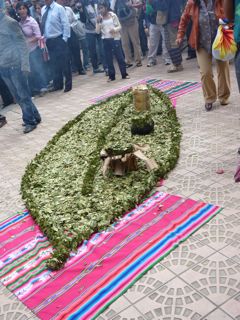
Massive coca leaf made out of coca leaves
A giant coca leaf made out of coca leaves built during January 2011 protest in support of global legalization of coca chewing

Update, January 11: It’s official. Bolivia’s stance has been accepted. Thirteen nations filed objections, far fewer than were needed to block Bolivia’s readmission: the United States, Canada, Finland, France, Germany, Ireland, Israel, Italy, the Netherlands, Portugal, Russia, and Sweden.

The Bolivian government campaign to alter the international legal status of chewing coca leaves (a practice known locally as acullicu) is expected to take its first major step forward later this week. On that day, unless 63 other countries step forward to block the move, the country’s objection to including the practice as a form of narcotic drug use under the 1961 Single Convention on Narcotic Drugs will be accepted as a reservation to the treaty. In effect, the country will stand relieved of a treaty obligation to criminalize coca chewing (which theoretically was required by 1989). Coca chewing remains a widely accepted and legal practice in Bolivia, and coca growers are an important constituency, organized into two regional unions.

The logical and more consequential step would be to remove coca chewing from the convention altogether, but this requires a consensus of parties to the convention. (Removing coca chewing from the convention would not have resulted in its global legalization, but rather left in place national laws on the substance.) A Bolivian effort to do just that failed in 2011 when the United States and 17 other countries filed objections. Anthropologists in the United States, along with drug policy and Latin American policy advocates, had urged the Obama administration to avoid taking this stance, signing on to a letter that argued, “Coca chewing is central to the cultural identity of millions of indigenous Andean people, and has been for many centuries. Rejecting Bolivia’s amendment conflicts with the 2007 UN Declaration on the Rights of Indigenous Peoples.” This effort at persuasion fell on deaf ears.

Stymied in the broader effort, Bolivian diplomats began a new approach in June 2011. They moved to temporarily leave the convention—while promising to uphold its other requirements—and rejoin with a reservation concerning coca chewing. Their re-adherence was formalized in January 2012, and other parties had twelve months to file objections. That period runs out Thursday, January 10, 2013. Again, the Obama administration has raised a complaint, so far joined only by the United Kingdom, Italy, and Sweden. For Bolivia to not be accepted, this total must rise to 62 by Thursday.

So, a small diplomatic victory over the criminalization of coca chewing seems likely this week. Evo Morales announced that Peru, among other countries, may follow in Bolivia’s footsteps. Last year, Ecuadorian President Rafael Correa called the criminalization “a genuine attack on collective rights and an insult to the ancestral peoples of Bolivia. un verdadero atentado a los derechos colectivos, insulto a los pueblos ancestrales bolivianos.” In Bolivia, a public celebration is planned for late this week.

Eight deaths in Bolivian political conflicts in 2012

Bolivia’s Human Rights Ombudsman’s Office (Defensor del Pueblo) reports that 2012 was another busy year for social conflict in Bolivia. The office compiled a list of 500 political disputes that were the subject of protests or direct actions since January 1. (coverage: Erbol). The year is the deadliest in the country’s political life since 2008 with eight people losing their lives in these conflicts. Six of them died from violence by state forces; by my count, this is the most people killed by police responses to political actions in any one year since Evo Morales took power in January 2006.*

Those who died in 2012 were as follows:

  • Abel Rocha Bustamante, 27, and Michael Sosa, 23. Shot by police in the January Yapacaní conflict. (This blog’s coverage: 1|2)
  • Eliseo Rojas, 22. Reportedly electrocuted on a fence while attempting to storm police barracks during the Yapacaní conflict.
  • José Mamani Mamani, protester in Mallku Khota mining dispute, died of bullet wounds to the neck apparently fired by police on July 5.
  • Ambrosio Gonzáles, 45. Died from a police bullet during the July 31 operation to retake the Caranda gas plant, in Buenavista, Santa Cruz, which was seized by protesters demanding that a roadway and bridge be built.
  • FSTMB member Héctor Choque. Killed by an explosion of dynamite during fratricidal protests in La Paz between his union of mining employees and cooperative miners over the disposition of the Mallku Khota mine following its nationalization.
  • Óscar Omar Cruz Mallku, 17, dead from a gunshot, and Oscar Ricardo Gómez Bertón, 27, dead from wounds after a police raid on illegal used car sellers in Challapata, Oruro faced public resistance by the sellers.

*Police killed four protesters in 2007 and 2010. If one excludes the October 2012 Challapata event as a confrontation with criminal entrepreneurs during a raid, then all three years have the same number of police killings in political situations.

From the archives: On Strike, USA, 1936

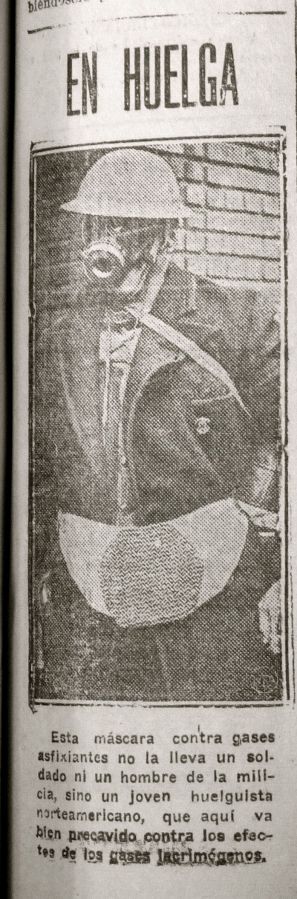
From the Bolivian press, May 1936, this captioned photo illustrates the use of tear gas against American strikers during that turbulent period. The caption reads:

 This mask to protect against suffocating gases is not worn by a soldier nor by a militiaman, but rather a youth in North America on strike, who goes forth here well protected from the effects of teargas.

No further details are provided about the strike or the source of the image.

EnHuelga1936

Bolivian Constitutional Tribunal shakes up MAS executive with rulings, comments

In a very busy Wednesday, Bolivia’s Plurinational Constitutional Tribunal struck down a longstanding law criminalizing “contempt” toward public officials and limited the scope of an anti-corruption law; rounding out the court’s surge into the headlines, justice Gualberto Cusi made biting comments on the government’s failure to abide by the court’s ruling on the TIPNIS consultation.

Contempt law ruled unconstitutional: The Tribunal found, in Judicial Ruling 1250/2012, that the law prohibiting contempt (“desacato” ) towards senior public officials through defamation is an unconstitutional violation of the freedom of expression. The court advised public officials that they may use civil court procedures to deal with slander, and nullified the law in its entirety. Numerous opposition figures, including the center-left Mayor of La Paz, Luis (Lucho) Revilla, and the right-wing Governor of Santa Cruz, Ruben Costas, have been indicted under this very broad statute following complaints from the governing Movement Towards Socialism party.

The “Marcelo Andrés Santa Cruz” Anti-corruption Law cannot be applied retroactively: In the first legislative session under the new Constitution, the Movement Towards Socialism supermajority wasted no time in approving a new law criminalizing corruption. The law allows for severe penalties against officials who took bribes or other compensation to change policies. It was designed to give the government room to revise contracts and licenses approved under improper influence, and to recover fortunes which had been pilfered from the government. However, it was also referred to as the “Guillotine Law” (including by the Vice President) for its ability to end the political careers of past government officials. On Wednesday, the court sharply limited this aspect, finding that the law may not be applied retroactively “when the sanction [it imposes] is more severe or the act being judged would not have constituted a crime when it was carried out.”

Gualberto Cusi speaks out on TIPNIS: The Constitutional Tribunal had already ruled on the TIPNIS consultation, insisting that any process establishing the will of the communities in the Isiboro-Sécure National Park and Indigenous Territory about the proposed Villa Tunari–San Ignacio de Moxos highway, which would cut through the region and accelerate already serious deforestation, must occur in a mutually agreed framework. Justice Gualberto Cusi—the judge who received the most votes in last year’s judicial election—denounced the current consultation process as a “disaster” that violates the indigenous inhabitants’ rights. Further, the justice suggested that the TIPNIS indigenous may need to look outside Bolivia for protection of their rights: “I believe that in Bolivia, no[, nothing can be done.] It will have to be the indigenous who appeal these acts to international tribunals. Yo creo que en Bolivia no (se puede hacer algo), tendrán que ser los indígenas quienes apelen a estos hechos en tribunales internacionales.” The most likely forum for international appeals is the Inter-American Court on Human Rights, which has been a pathbreaking forum for indigenous rights.

None of these rulings would be particularly exceptional for a high court around the world, but this particular high court is in its first year, and came out of a controversial nominating and election process which was boycotted by multiple opposition forces. For it to strike down major laws embraced by the governing party and publicly embrace human rights standards around freedom of expression, indigenous consultation, and ex post facto laws makes this something* of a Marbury v. Madison moment for the new court.

* The analogy is inexact since a Constitutional Tribunal began operation in 1999.

Bolivia’s new Mother Earth Law to sideline indigenous rights

Bolivia, the country that became synonymous with indigenous and environmental rights on the global diplomatic stage, is about to approve a Mother Earth Law that lacks the blessing of the country’s leading indigenous organizations and undermines indigenous communities’ rights to prior consultation. Thursday (August 23), the National Council of Ayllus and Markas of Qollasuyu (CONAMAQ) publicly walked out of the Chamber of Deputies’ drafting session on the “Framework Law on Mother Earth and Integral Development for Living Well” (Ley Marco de la Madre Tierra y Desarrollo Integral para Vivir Bien).  CONAMAQ Spokesman David Crispin explained the walk out: “We in CONAMAQ dave decided to withdraw from the drafting because we do not want to be complicit, alongside the Plurinational Assembly, in building a Law of Integral Development that will damage the Pachamama/Mother Earth. nosotros del CONAMAQ hemos decidido retirarnos del tratamiento porque no queremos ser cómplices, juntamente con la Asamblea Plurinacional, en construir una Ley de Desarrollo Integral que va dañar a la Pachamama” The government had already broken off contact with the Confederation of Indigenous Peoples of Bolivia (CIDOB) and the government-backed alternate leadership of the organization does not appear to be involved in the drafting process.

Readers of the English-language press may be thoroughly confused at this point. Doesn’t Bolivia already have a Mother Earth law, the strongest in the world? Many in the international environmental community know that Bolivia that introduced the concept of the Rights of Mother Earth to the world, hosted a global conference on Climate Change and the Rights of Mother Earth [past coverage: 1|2|3] in April 2010, and passed the Law on the Rights of Mother Earth [Wikipedia] in December 2010.

What is less widely known is that the law that was passed was only a rough statement of principles—a declaratory “short law”—with no legal force behind it. Even the short law featured just 10 of the 12 principles worked out by the grassroots organizations in Bolivia’s Pact of Unity: right of indigenous people’s to freely consent to or reject megaprojects on their lands was cut at the last minute. In April 2011, Senator Julio Salazar (MAS) who is in charge of the law’s progress, declared, “Our indigenous brothers cannot block taking advantage of natural resources.”

Bus ad at Cochabamba Climate Summit'
“We, the peoples, are the voice of Mother Earth” reads a bus placard at the Cochabamba eco-summit, sponsored by the state-owned gas company YPFB.

Salazar’s position, embraced by the Evo Morales government as a whole, has been influential over the past two years. As highlighted by the TIPNIS controversy, the Bolivian government has prioritized national economic development over local indigenous choices; publicly vowed to ignore local opposition to transport, hydrocarbon, and mining projects; and backtracked from guarantees of indigenous rights to free, prior, and informed consent regarding projects on their territories. Alongside other left governments in the region, these policies tie continued mining, drilling, and pumping of natural resources to greater social spending, a combination called “neo-extractivism.” The transformation of the Law on the Rights of Mother Earth into a Law on Mother Earth and Integral Development reflects all of these trends.

The draft law (complete text), already fully approved by the Bolivian Senate, declares a governmental obligation to “Promote the industrialization of the components of Mother Earth,” while surrounding this objective with extensive promises about respecting the rights and development of indigenous nations and peoples, safety monitoring, clean technologies, and so on. In short, “Integral Development” in the proposed Bolivian law is about conditioning industrial extraction on environmental compliance (the environmental policy framework embraced throughout the West, from the Clean Air Act to the World Bank), not about rethinking the extractive model.

In a letter to Rebecca Delgado, the President of Chamber of Deputies, CONAMAQ argues:

The draft only keeps “Living Well as an alternative civilizational horizon to capitalism” and “Equilibrium with Mother Earth” by way of proclamation (i.e., propaganda). The Draft Law does not propose a change in the structural basis of the capitalist system, nor reconfiguration of the nation-state.

El proyecto solo conserva el “Vivir Bien como horizonte civilizatorio alternativo al Capitalismo” y el “Equilibrio con la Madre Tierra” de manera enunciativa (propaganda). El Proyecto de ley no propone un cambio de las bases estructurales del sistema Capitalista, ni una reconfiguración del Estado nación.

In CONAMAQ’s analysis, “‘Integral Development’ is introduced as a framework of processes and rights” that conflict with one another. The rights of Mother Earth, rights of indigenous peoples, rights of peasants, right to development, and the right to escape from poverty are all intermixed. CONAMAQ argues the law “incorporates the ‘right to development and the right to esacape from poverty’ so as to justify a developmentalist, extractive, and industrializing vision. [Incorpora el “derecho al desarrollo y el derecho a salir de la pobreza” para justificar un visión desarrollista, extractiva e industrializadora]” In my analysis (and here I’ll put my environmental policy degree on the line), combining these rights into a single mix will allow future Bolivian governments to decide on which right gets prioritized. Under the aegis of “integral development,” governments can decide to value oil revenues spent on antipoverty programs over an indigenous people’s rights to refuse drilling on their territory. (And the public statements of the Morales government make it clear they have every intent to make just that choice.)

The proposed law is also weaker than its well-known (but inoperative) predecessor on three key points:

  • Legally enforceable rights of the Earth and “life systems” — These rights are first the responsibility of the government itself, although “affected persons and collectivities” may intervene in court as well. However, these rights are limited to “the framework of Integral Development for Living Well,” limiting any ecological rights independent of the overall economic plan. In cases where a government agency and a private entity both step in to defend these rights, the case will be consolidated, perhaps making it difficult for independent critics to gain the ear of the courts. (It’s worth noting that the  original law was weaker than realized. The concept “life systems” that include human societies and ecosystems in a single interwoven package sounds intellectually innovative, but makes ecosystem protection much more complicated than a straightforward law like the US’s Endangered Species Act.)
  • Mother Earth Defender’s Office unspecified — Both the new law and the December 2010 call for the creation of a Defensoría de la Madre Tierra, equivalent in rank to the Human Rights Defender’s Office (Defensoría del Pueblo, often called the Human Rights Ombudsman). However, other than a one-year deadline, no specifics are included in the new law.
  • Indigenous free, prior, and informed consent— As expected, the new law does not explicitly recognize indigenous communities’ right to approve or reject projects on their territories, as required by the UN Declaration on the Rights of Indigenous Peoples, which Bolivia incorporated into its national laws. The term ”free, prior, and informed consultation” does appear in a subordinate clause:“Generation of the necessary conditions for the use and appropriation of the components of Mother Earth in the framework of sustainable life systems which integrally develop the social, ecological, cultural and economic aspects of the Bolivian people, taking into account the knowledge of each indigenous, native, peasant, intercultural, and Afro-Bolivian nation and people, in the framework of free, prior, and informed consultation. Generación de condiciones necesarias para el uso y aprovechamiento de los componentes de la Madre Tierra en el marco de sistemas de vida sustentables que desarrollen integralmente los aspectos sociales, ecológicos, culturales y económicos del pueblo boliviano tomando en cuenta los saberes y conocimientos de cada nación y pueblo indígena originario campesino, comunidad intercultural y afro boliviana, en el marco de la consulta previa, libre e informada.

This verbiage makes indigenous consultation into just another phase of the approval process for “using and appropriating Mother Earth.” The protections for indigenous rights and the idea of a new relationship with the Earth and its ecosystems have been shelved for now in the Bolivian legislature.

Bolivian government bypasses local organizations, misrepresents facts in “agreement” on TIPNIS consultation

On July 3, as participants in the Ninth National Indigenous March remained camped outside the Vice Presidency, the Bolivian government flew a set of 45 residents in the Isiboro Sécure National Park and Indigenous Territory (TIPNIS) to La Paz. Once there, they met with a group of government ministers on live television. The government accepted these 45 people as representatives of TIPNIS and signed an agreement with them authorizing a consultation process for July 29 to September 2 to approve the segment of the Villa Tunari–San Ignacio de Moxos highway that passes through TIPNIS. According to the government, these 45 people are Corregidores (a community-level office common among indigenous peoples of the region) conveying the assent of their communities. (Some coverage of the event: La Razón)

TIPNIS representatives rejected the proposed process of consultation in a March 2012 summit of Corregidores and have repeatedly stated their opposition to the construction of the road. The Subcentral TIPNIS, which holds collective title to the indigenous territory, the Confederation of Indigenous Peoples of Bolivia (CIDOB) and many other observers (like Pablo Solón), have criticized the proposed consultation as deeply flawed. Many TIPNIS community members and CIDOB members walked 62 days to La Paz as part of the march to oppose the consultation, and they reacted with outrage to the agreement’s announcement. Meanwhile, CONISUR, a separate organization in the region that represents indigenous communities overrun and now intertwined with coca-growing settlers, has been openly advocating for the road and the new consultation process.

As with the recent maneuvers within CIDOB, which have created a parallel leadership vying for control of the organization, the orchestration of this new “agreement” raises major questions about government interference in the internal workings of grassroots organizations, and about the government’s commitment to make the process of informed consent both free and fair.

Alongside these questions of principle, however, are more troubling questions about who this group of TIPNIS community members are, which communities they represent, and how the government of Evo Morales won their assent to the consultation. While the specific facts of the matter are in sharp dispute, multiple accounts undermine the credibility of the government narrative around this agreement.

  •  The signatories include 18 representatives of CONISUR communities, located outside of the collective title that makes up the indigenous territory. Seven CONISUR communities were recognized as part of the Isiboro-Sécure National Park before, but had their titles divided into individual plots, leaving them outside of the Indigenous Territory. These 18 representatives seem to represent between 11 and 13 communities. (This point is made by Subcentral TIPNIS President Fernando Vargas here.) The government seems ready to treat 13 Conisur communities as part of the consultation, despite the dissent of its own Agrarian Reform Institute (the body charged with land titling in Bolivia). Source: Erbol.
  • Fernando Vargas also testified that only about 20 of the 45 community members are in fact Corregidores recognized by their own communities, while others are merely hand-picked community members selected by the government.
  • Those Corregidores signing in the agreement may have included both titulares (officeholders) and auxiliares or suplentes (alternates), most likely from the same communities. By the count of Benigno Noza, a Corregidor opposed to the road, there were just 18 officeholders among the group authorizing the consultation.

For these three reasons, government representations that “45 of the 63 communities” signed on to the consultation are lies, intended to deceive the media and the public about the situation in TIPNIS. The signers neither represent 45 communities, nor all they all from the 63 recognized communities within the collective title of the park, a number which excludes the CONISUR and coca-grower communities in Polygon 7, where farmers hold individual titles.

  • Adolfo Moye, past president of the Subcentral TIPNIS has also raised grave questions about the way the meeting was organized. Basing his account on family connections (his father-in-law was one of the 45), Moye reported: “The government met them in San Pablo, it was a gathering place from which to transport them. Supposedly, the corregidores had to hand in their [local development] project proposals to the Vice-Ministry of the Environment, but once they there, it became know that they would have to travel to La Paz. But there was resistance, so then the deceptions began with the [threat] of losing their projects and their outboard motors. [El gobierno los reunió en San Pablo, fue un lugar de concentración para llevárselos. Supuestamente los corregidores tenían que entregar proyectos a una comisión del Viceministerio de Medioambiente, pero cuando se encontraron ahí se enteraron que tenían que trasladarse a La Paz. Pero hubo una resistencia, entonces comenzó los chantajes con la pérdida de los proyectos y los motores fuera de borda.]” Later, according to Moye’s account, the government provided its meeting of leaders with alcohol and flew them to La Paz. Moye also claimed that isolation and deception were used to gain support of these community members.

While I cannot verify the details of these claims, it seems obvious that repeating the Morales government’s claim about “45 communities” is taking part in an intentional deception.

It is also clear that the consultation agreement was not representative, and bypassed the local democratic process in TIPNIS. Let me quote Xavier Albó, a Jesuit, intellectual, and anthropologist who worked closely with indigenous movements and the Morales government in crafting Bolivia’s plurinational constitution, on this issue:

It is not evident to me whether the denunciation of Fernando Vargas, that just 18 or 20 of the 45 who signed the agreement with the government are genuine, is true or not. But, having watched on television that entire mediatic ceremony, and all that occurred in the following days, it is clear to methat we are still very far from fulfilling those minimal conditions that would render constitutional this (prior, or justified-after-the-fact) consultation. When Evo and his ministers travel time and again through TIPNIS, laden with gifts (perhaps suitable for [their] development even without a highway) but deliberately avoid speaking as equals with the leaders on the march, and rather denigrate them, what is left of the “good faith” which is necessary for any agreement?  [No me consta si la denuncia de Fernando Vargas de que apenas 18 o 20 de los 45 que firmaron el acta con el gobierno son corregidores genuinos es o no real. Pero, habiendo visto por Tv toda aquella ceremonia mediática, y todo lo ocurrido en los días siguientes, sí me queda claro que estamos aún muy lejos de que se cumplan las condiciones mínimas que harían constitucional una consulta previa o de saneamiento posterior. Cuando Evo y sus ministros viajan una y otra vez por el TIPNIS, llenos de regalos (tal vez idóneos para un desarrollo incluso sin carretera) pero deliberadamente evitan hablar de igual a igual con esos dirigentes marchistas y más bien los denigran, ¿en qué queda la “buena fe” indispensable para cualquier concertación?] (“¿Consulta o cooptación en el TIPNIS?”)

Divides, Smoke, and Mirrors: The new chaotic scene around TIPNIS and CIDOB

  • Please forgive the past three months of quiet on this blog. My April and May were filled with organizing around May Day and the Free University in New York City. June saw a succession of alternately joyous and traumatic personal events. Through it all, I’ve been microblogging at @CarwilJ on Twitter; so please turn there for updates.
  • On two of this blog’s central fixations, Bolivian indigenous movements and contentious protests, this months have been anything but silent in the real world. It would be futile to try to summarize the past 90 days, but you might want to turn to these excellent English-language sources: Andean Information Network on the May protest wave (1 | 2) and on the police protests-turned-mutiny: May 30 | June 25. A compilation of coverage of the Ninth Indigenous March and the TIPNIS conflict is at Dario Kenner’s Bolivia Diary. The blog’s own articles on TIPNIS often provide a great deal of depth.

If there is one defining new aspect of Bolivian political protest in Evo Morales’ second term (since January 2010), it has been counter-mobilization. With the political right thoroughly defeated, many tensions emerged within the grand coalition of social movements that lent their votes and their marching feet to defend the government for the previous four years. When these groups took to the streets (or, as often happens, took over and shut down the streets) with demands that were unpalatable the government, one way for the Morales administration to resist has been to mobilize other sectors in return. Counter-mobilization within the grassroots is sometimes successful, and sometimes only delays negotiations and concession, but it always comes with a price, damaging previous alliances and increasing distrust among former allies.

Since last October’s Eighth National Indigenous March won a law prohibiting construction of the locally-opposed Villa Tunari–San Ignacio de Moxos Highway through the Isiboro–Sécure National Park and Indigenous Territory, the Morales government has shifted counter-mobilization into high gear on this issue. From December to February, the organization CONISUR—consisting of the now vastly outnumbered indigenous residents of Polygon 7, an area of TIPNIS colonized for coca—led its own march for the highway. Morales conceded to this march a new consultation process, which the Subcentral TIPNIS opposes. In the process, it became clear that CONISUR communities are themselves engaged in coca growing on private plots of land; the organization affiliated itself with the Six Federations of coca growers and was expelled from the lowland indigenous confederation CIDOB.

In March, local TIPNIS organizations rejected the “prior” consultation and began preparations with CIDOB and the highland traditionalist movement CONAMAQ for a Ninth National Indigenous March, in defense of TIPNIS and advancing other indigenous demands. The government began conceding local demands to regional indigenous organizations in April in a bid to lessen support for the march. Indigenous solidarity and the need to advance local agendas for territory, rights, and material support have been put at odds during this process. Still, of the eleven or twelve regionals that signed agreements, just five distanced themselves from the march (count per Emily Achtenberg) and some of their prominent leaders marched anyway.

Since the march began, however, divisions within the CIDOB umbrella have deepened into an institutional crisis. Led most visibly by Rosendo Alpiri, president of Central de Pueblos Étnicos de Santa Cruz (CPESC, the regional organization for Santa Cruz department), leaders who stayed at home during the march have begun a contest for power over CIDOB. In early June, nine regional leaders met and officially suspended CIDOB President Adolfo Chávez. Chávez deemed the meeting illegitimate and CIDOB Vice President Nelly Romero accused the government of intervening in CIDOB’s affairs.

This week, with over 1200 CIDOB and CONAMAQ marchers still encamped in La Paz, the pro-government CIDOB dissidents have begun a Grand National Assembly of Indigenous Peoples (GANPI), a congress that is traditionally the highest decisionmaking body in the organization. The Asssembly of the Guaraní People and the Indigenous Organization of Chiquitanos are both boycotting the gathering. Early signs indicate that the Assembly will fully adopt the government agenda: reintegrate CONISUR and its leader Gumercindo Pradel into the organization, and (one presumes) accept the government’s proposal for consultation in TIPNIS. Meanwhile, Adolfo Chávez and the camped marchers also continue to act as CIDOB. (Mass marches are a longstanding CIDOB tradition, and involve creating a self-organizing community that essentially represents the organization for the period of the march.) Chávez himself returned to Santa Cruz this week and (according to Santa Cruz daily El Día) is currently occupying his own headquarters along with a group of followers. Rosendo Alpiri pledges to install the new leadership in the headquarters and has invited President Morales to attend.

So, as of this week there will be a “new CIDOB” and an old one. Right on cue, the Morales government has demanded that the new CIDOB as well as CONISUR be present in any new negotiations with TIPNIS leaders. The government invitation to dialogue now extends to TIPNIS leader Fernando Vargas and Ninth March leader Bertha Bejarano, both of whom have voiced outrage at the recent maneuvers within CIDOB. As Bejarano puts it: The new Grand National Assembly of Indigenous Peoples “is not organic [i.e., representative of the organization] and is a response to the government’s intention to create parallel organizatins and disregard the organic structure of the principal indigenous organization in the country, for entirely political reasons: seeking to construct a highway through TIPNIS and destroy the largest ecological reserve in the country [es inorgánico  y responde a la intención gubernamental de crear organizaciones paralelas y desconocer la estructura orgánica de la principal organización indígena del país para fines enteramente políticos que buscan construir una carretera por el Tipnis y destruir la mayor reserva ecológica del país].”

It’s one thing to deploy a strategy of countermobilization when two groups have very different interests around an issue. For example, it’s no surprise that coca growers who hope to expand their plots into the Isiboro-Securé National Park and Indigenous Territory along the highly disputed Villa Tunari–San Ignacio de Moxos Highway have marched in support of it.  It’s something very different when countermobilization takes the form of attempting to split, or even break up organizations, bringing down any leader who challenges the government line. When governments stop taking seriously the independence of social movement organizations and instead demand that movement leaders toe the government line, you no longer have what Bolivian Vice President Álvaro García Linera promised would be “a government of social movements.” Instead, you have a corporatist system, a return to the days when presidents like Hugo Banzer headed the national peasant organization and essentially negotiated with themselves.

The tactics for outside control of grassroots organizations are such a big issue that protections against them are written into international indigenous rights standards. The right to “free, prior, and informed consent” by indigenous peoples over projects and  policies that affect them and their territories requires that indigenous peoples’ own freely chosen institutions be the vehicle for that consent. To waver from this requirement, to “persuade” with large gifts, to station troops within communities, or to implant leaders chosen from outside, invalidates the “free”-ness of any consultation process. (Those of us who have been involved in indigenous solidarity for a long time have seen this strategy deployed by governments hostile to indigenous rights and resource extraction companies seeking local cover for their projects. For a detailed example, it’s worth reading about how oil giant ARCO helped to create the indigenous organization DICIP when it grew tired of being criticized by the Organization of Indigenous Peoples of Pastaza, OPIP, in Suzana Sawyer’s book Crude Chronicles.) Unfortunately, tragically, the Evo Morales government, which has long identified with indigenous peoples, is now deploying every one of these tactics in the TIPNIS conflict.

Martin Luther King on riots and property destruction

Martin Luther King Jr. was an extremely committed proponent of nonviolent and nondestructive methods of protest. In his private strategic manifesto inside the Southern Christian Leadership Conference, A New Sense of Direction,* he advocated “militant” and “defiant” action to dislocate the function of American cities and enforce a popular demand for economic redistribution, but he did not deviate on this tactical direction. He even declared, “I, Martin Luther King, take thee, Non-violence, to be my wedded wife, for better or for worse, for richer or for poorer—this isn’t a bargaining experience—for richer or for poorer, in sickness and in health, until death do us part.”

Still, the King of 1967 and 1968 would hardly be at home among some of the critics of property destruction who often revere him. First, he draws a strong moral distinction between “violence against property” and “violence against persons.” And second, rather than prioritizing rooting out property destroyers for obscuring his message, he tries to explain their message. Third, he is careful to emphasize police responsibility for most violence against people during the riots.  I quote him here at length describing the Black urban riots of summer 1967, the third consecutive summer of riot waves, largely touched off by local police violence. The following was first published in The Trumpet of Conscience (1967).

This bloodlust interpretation ignores one of the most striking features of the city riots. Violent they certainly were. But the violence, to a startling degree, was focused against property rather than against people. There were very few cases of injury to persons, and the vast majority of the rioters were not involved at all in attacking people. The much publicized “death toll” that marked the riots, and the many injuries, were overwhelmingly inflicted on the rioters by the military. It is clear that the riots were exacerbated by police action that was designed to injure or even to kill people. As for the snipers, no account of the riots claims that more than one or two dozen people were involved in sniping. From the facts, and unmistakable pattern emerges: a handful of Negroes used gunfire substantially to intimidate, not to kill; and all of the other participants had a different target—property.

I am aware that there are many who wince at a distinction between property and persons—who hold both sacrosanct. My views are not so rigid. A life is sacred. Property is intended to serve life, and no matter how much we surround it with rights and respect, it has no personal being. It is part of the earth man walks on; it is not man.

The focus on property in the 1967 riots is not accidental. It has a message; it is saying something.

If hostility to whites were ever going to dominate a Negro’s attitude and reach murderous proportions, surely it would be during a riot. But this rare opportunity for bloodletting was sublimated into arson, or turned into a kind of stormy carnival of free-merchandise distribution. Why did the rioters avoid personal attacks? The explanation cannot be fear of retribution, because the physical risks incurred in the attacks on property were no less than for personal assaults. The military forces were treating acts of petty larceny as equal to murder. Far more rioters took chances with their own lives, in their attacks on property, than threatened the life of anyone else. Why were they so violent with property then? Because property represents the white power structure, which they were attacking and trying to destroy. A curious proof of the symbolic aspect of the looting for some who took part in it is the fact that, after the riots, police received hundreds of calls from Negroes trying to return merchandise they had taken. Those people wanted the experience of taking, of redressing the power imbalance that property represents. Possession, afterward, was secondary.

A deeper level of hostility came out in arson, which was far more dangerous than the looting. But it, too, was a demonstration and a warning. It was designed to express the depth of anger in the community.

King was not an proponent of these tactics, but he was a prominent voice (at times, the most prominent voice) of his community when they were carried out. Rather than devote attention to their ”obscuring the message,” he sought to analyze their message, even as he argued such tactics would not prove victorious. I wish those who follow in his strategic footsteps on these tactical choices, would also follow him in prioritizing such explanations.

* “A New Sense of Direction” was one of King’s last overall strategic reflections before his assassination. It was delivered at a SCLC staff meeting and its private audience allowed for additional candor. It should be required reading for people seeking to understand King’s strategic vision. For more on King’s late political evolution, see Michael Eric Dyson’s I May Not Get There With You.