What’s behind the Potosí regional strike?

As the department-wide strike in Potosí continues to edge into the international press (primarily through its effect on tourists and now upon mining companies that operate in the region), I want to give more of the background on the strike and its demands, so it’s at least understandable why people are blockading and hunger striking there.

“It can be summed up in one single thing: in misery. … We are fighting for a hill that as of yet is not a factory, just a hill; it’s raw material. For the dream that some time we, that the families that live there, might have something. They are places forgotten by the hand of God: they don’t have water. They are using up the water in the wells. There is no electricity. It is misery.”
Saúl Juarez, Potosino hunger striker in Cochabamba

If you are from North America, this use of misery might be unfamiliar to you, but it is common in the language of Latin America. We must first organize, then-Haitian president Jean Bertrand Aristide once said, to move from misery to poverty. Here in the hemisphere’s second-poorest country (after Haiti), Potosí is the poorest of nine departments. The rate of extreme poverty, which is falling nationwide, is still 66.7%; meaning that two-thirds of Potosinos cannot afford to buy their family’s basic necessities. Of every 1000 live births there, 101 children will die before their fifth birthday. Both of these figures are the highest in Bolivia; in the case of child mortality, the second place departments—La Paz and Chuquisaca—see 63 deaths per 1000 children. It is for this reason that Potosinos have spread to the rest of the country in search of better opportunities.

“We can say that we are fighting for the reactivation of the productive apparatus of Potosí.”
Claudia López, Potosino hunger striker in Cochabamba

Most of the demands advanced by the Potosí mobilization are focused on specific industrial or economic projects, which in the eyes of protesters, have languished for the lack of state interest. The boundary dispute with Oruro centers around two hills that contain limestone, a key ingredient for cement, and a second demand is for a cement plant to earn money and create jobs from that resource. Likewise, Potosinos are calling for the activation of a metallurgy plant and for the creation of an international airport to connect Uyuni and its phenomenal salt flats to international tourists.

Potosí, of course, is not poor for the simple lack of investment from the outside. It has never simply languished in the absence of foreign interest. Instead, it was once the largest the city in the Western world precisely because of the rich attraction its mineral wealth held for the Spanish state and its investors. Immense wealth was symbolized by the Cerro Rico which sits above the city, or simply by the phrase “it’s worth a Potosí.” Every Bolivian, rich or poor, left or right, knows how Bolivian wealth enriched Spain, and through it Europe. And every Bolivian understands that to take part in that wealth requires doing more than extracting minerals from the ground and shipping them out of the country.

More recently, Potosí was hit hard by the shock-therapy program of neoliberal economic restructuring that began in 1985. At the time, the miners who worked for COMIBOL—the national mining company that took over the mines run by three wealthy tin barons in 1952—were the strongest social movement in the country. The government of Paz Estenssoro aimed to break this power, and essentially shut down the government-run mining sector to do so, laying off tens of thousands of workers. Those miners who did not resettle elsewhere in the country became the backbone of the cooperative mining sector, a collection of small scale mining projects that engage in uncoordinated mining of the Cerro Rico, and other mountains like it, in search of rich veins of minerals. Decades of such drilling have brought the Cerro to the brink of structural collapse, posing the threat that the hill—recognized as a World Heritage Site by UNESCO—could become a ruin.

“They all come to promise and promise, and to say this and that could be done. The [current] government has done the same: it has promised. But after five years of their rule, of creating new laws and a new constitution, of re-electing them, there is nothing. … So, we want dates; we want concrete responses of when and how; we want specific studies; we want operational plans that establish dates for the processes that are going to happen.”
Claudia López

If one had to choose a symbol of the capacity for delay in pursuing development projects in Bolivia, it might well be Karachipampa, the metallurgical plant that the mobilization is demanding to be activated. This lead and silver smelter was built between 1985 and 1988. It has never operated.

Several years ago, in 2005, the Canadian firm Atlas Precious Metals Inc. entered a shared-risk agreement to invest in the plant. You can see on their web page an optimistic assessment of the plant’s production capacity. As of April, only 20% of the firm’s promised investment had been realized (article in Spanish). Currently, Atlas and COMIBOL are in a legal dispute in which Atlas demands its $12 million investment be repaid, and COMIBOL seeks compensation for the value of the plant, which remains unused. In a letter to the government (es), the Potosinista Civic Committee washes its hands of the whole dispute and demands:

The only thing the Potosí people want is to see, in an immediate manner, the effective functioning of the Karachipampa Plant, whether it is with the [foreign] company or through state intervention.

Beyond all these details, the strongest emotion visible here is simple, exhausted, impatience. Whether the timeline is 21 years for the plant, or 5 years for the MAS government, or three generations for the border dispute (more on that when I can provide a fuller background, or transcribe more of my interview with a Coroma resident), those who have thrown themselves into this protest have run out of patience. Against the experience of delay, they have enacted tactics based on urgency: extended blockades, hunger strikes, and so on. So far, Potosinos themselves, beginning with the hunger strikers have borne most of the costs of these urgent tactics themselves, or imposed them on the surrounding communities. However, they are increasingly enacting or talking about tactics that will cost companies operating in the region substantial losses on a daily basis.

Potosí isolated by 12-day regional protest

[There is, as of today, rising hope for negotiations to begin between the Government and Potosinos (and for three-way dialogue with Oruro on the border issue to take place as well) soon. More on that soon. This post comes as written yesterday. Also, I added a little bit on Pablo Solón’s comments on Democracy Now at the end.]

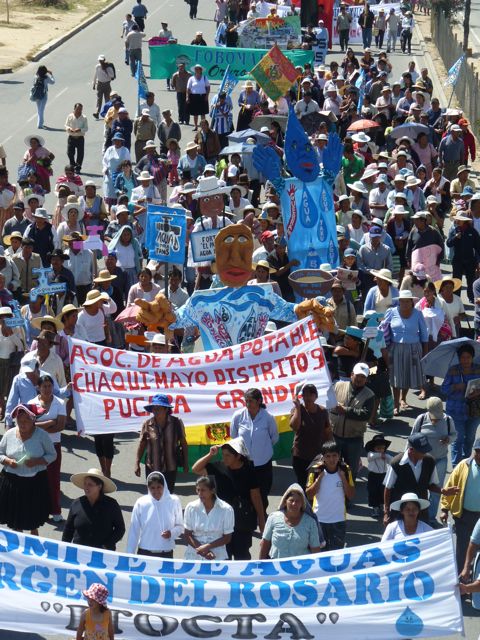
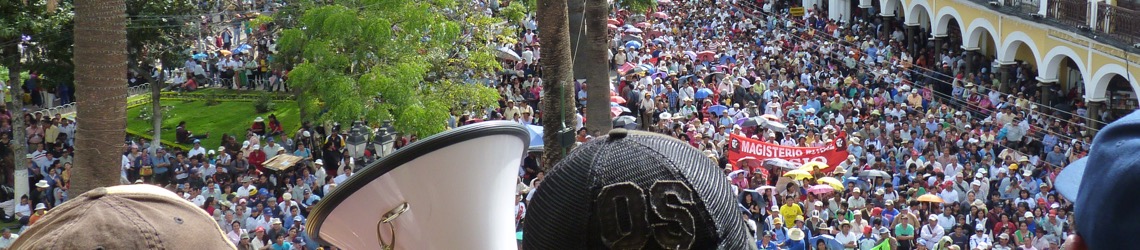
A department-wide general strike in Potosí department, Bolivia’s traditional mining center, has entered its thirteenth day today, with no clear end in sight. The strike is now taking three major forms: a comprehensive blockade of transport in and out of the department, a general closure of businesses by both their workers and owners, and a growing hunger strike reported at more than 500 people on Sunday. The mobilization was backed by a remarkable show of unity on last Tuesday, August 3, when some 100,000 people marched in the city of Potosí in support of the effort. The number is phenomenal relative to the city’s population of 160,000, and even the department’s of some 700,000.

The systematic isolation of the department has made it impossible for me to visit the protests, once it became clear (with the march) just how significant this event is. Hundreds of trucks and buses are lined up at the various entrances to the department. As of Sunday, the Governor of Chuquisaca was mobilizing food and supplies to people stranded on the border.

Potosinos in protest are coordinated by the Civic Committee of Potosí, a coordinating committee of major institutions. Other key actors include the community of Coroma (part of which is in territory also claimed by a neighboring community in the department of Oruro), the Federation of Cooperative Miners, and since the massive march, major politicians including Governor Félix Gonzales (MAS). Gonzales and four Potosino members of the Plurinational Legislative Assembly (formerly, the National Congress) are at the head of the hunger strike.

Compared to the mobilization, the demands are quite modest:

  1. Delimitation of the inter-departmental border between Quillacas (Oruro) and Coromo (Potosí), which centers around control over limestone resources in the area
  2. Installation of a cement plant in the Coroma region, using those resources
  3. Reactivation of the metallurgy plant in Karachipampa, currently suspended due to a legal conflict among two companies
  4. Preservation of the Cerro Rico, the massive mining mountain just outside the city of Potosí, whose structural future is in jeopardy after five centuries of mining
  5. Construction of an international airport for Potosí as soon as possible
  6. Completion of delayed highway projects

The protests seemed to have expanded as rapidly as they did because in the first week the national government insisted, primarily through its Minister of Autonomy Carlos Romero, that they were a purely partisan effort in defense of Potosí Mayor René Joaquino (see ). This added to a sense of indignation at being ignored by a MAS government to which they have supplied an overwhelming vote for the past five years. Their sense of being slighted has rebounded into the chant (heard at a solidarity march of Potosinos here, as well) of “Potosí Federal,” a call for devolving power to the region. (This is clearly not a demand of the mobilization, however, and it’s unclear how such a demand would differ from the departmental autonomy approved by referendum in December, and soon to be delimited by a Statute of Autonomy.) Comcipo leader Celestino Condori emphasized a new sense of unity on the day of the march, “We’d like to demonstrate to the government that in Potosí, there is unity, among Moors and Christians; everyone is changing their polleras [traditional indigenous women’s dress] to put on the red and white which are the colors of the Potosino flag.” In action, this is taking the form of a wide variety of hunger strike pickets led by different organizations, and since the weekend, spreading to other cities in Bolivia.

Currently, the impasse blocking negotiations concerns where and how they might take place. As with movements across the continent (and using good strategic sense), the Potosí movement has demanded to negotiate at their place of strength, while the pressure of mobilization is on. On the other hand, the Morales government is insisting that discussion of border must occur in neutral territory and that no negotiations can take place without an intermediate truce that suspends mechanisms of pressure. On the question of territory, they are backed up by concerns that Oruro might mobilize as well if discussions began on non-neutral ground. Oruro’s civil society placed themselves in a “state of emergency,” preparing to mobilize last weekend.

In a broader sense, this mobilization is one of a growing number of signs that MAS allies (and members, such as the governor) are moving to pressure the national government over particular demands, making Evo Morales’ second administration a period of serious conflict, though of a very different kind than the years of confrontation with the right-wing of the media luna. It also is an early sign that the new autonomy in the western departments will come with genuine political independence on the part of regional leaders.

Incompetent English-language coverage: As a side note, this central political story in the last week here in Bolivia is being described to the English-speaking world by reporters who can only be described as myopically focused on the lives of wealthy foreign tourists and stunningly ignorant of local realities. Local realities such as the front page stories of every single national newspaper. Associated Press, I’m talking about you. Here, in its entirety is Saturday’s AP story on the Potosí situation:

Protest traps tourists in Bolivian highland city

(AP) – 1 day ago

LA PAZ, Bolivia — A protest by Bolivian miners has trapped more than 100 mostly European tourists in the southern Bolivia mining city of Potosi for more than a week.

The protesters piled rocks on the runway of the Potosi airport Friday to prevent a plane from landing to pick up some of the foreign tourists.

The miners have also blocked roads into the area for 10 days.

Also trapped are about 500 Bolivians, and local media say the blockade is beginning to cause food shortages in the city of 200,000 people.

The miners have a series of grievances with the government, including a demand to reactivate mines that officials ordered closed and to settle land disputes. (“Protest traps tourists in Bolivian highland city,” The Associated Press)

I’ve highlighted in red things that are basically wrong, or reflect the listening-to-other media’s-stories as reporting that seems to have gone into this story, filed from La Paz. As noted above, cooperative miners are one of many groups that have folded into the department-wide protest. There are substantial reports of Bolivians being stranded, but descriptions of around five hundred people refer to people on vehicles waiting to get in to the region. “The area” is actually the Department of Potosí, which has one “land dispute” on the table, its border with Oruro. The only mine under discussion in the demands is the Cerro Rico, whose structural instability could result in the closure of mining, under a review currently underway and encouraged by UNESCO, which maintains the mountain (as well as the city) on its World Heritage list. For details of the actual airport incident, which did involve miners, you can see this article in Spanish. For consolation on the ability of English reporters to competently discuss life in Bolivia, see this piece from Agence France Presse: Protesters seize Bolivia airfield, seal off Potosi.

Pablo Solón on Democracy Now: Potosí got a sliver of further US media coverage today with the mention of the protest made by Amy Goodman while interviewing Bolivian Ambassador to the United Nations Pablo Solón. Amy’s question got to the heart of the protest: “The demonstrators are calling for more investment by the Bolivian government in the lithium-rich area.” And Solón basically dodged her question by talking about borders and not development commitment. It’s hard not to be sympathetic with him having to explain this issue alongside the other awesome work he’s doing, which the interview does a good job of describing.

Sucre’s political elite faces prosecution for May 2008 humiliations

The Bolivian government will be seeking to hold the political leadership of Sucre’s Inter-Institutional Committee responsible for the their role in coordinating the horrifying events of May 24, 2008. On Saturday, the Prosecutor’s Office issued its long anticipated indictments on the day of racist violence, street clashes, and public humiliation. Its conclusions were backed up by reports from the Defensoría del Pueblo and the Legislature’s Human Rights Commission. The allegations, which will serve as the basis for prosecutions of many members of Sucre’s right-wing political elite, ratify the assessment of responsibility put forward by Cesar Brie’s June 2008 documentary Humiliados y Ofendidos. [Background on this blog about that day and its aftermath: 1 | 2 | 3 ].

Peasants forced to kneel in Sucre
Captured peasants are forced to kneel by civic protesters in Sucre's central square. They were required to strip to the waist, hold the Chuquisaca flag, watch as the indigenous wiphala was burned, and shout political slogans as press cameras filmed.

The accused include:

  • Savina Cuéllar, Prefect of Chuquisaca from June 2008 to May 2010
  • Jaime Barrón Poveda, former rector of the Universidad San Francisco Xavier, and Mayor Elect of Sucre
  • Aydée Nava, former Mayor of Sucre.
  • Fidel Herrera, former council member of Sucre.
  • John Cava, expresident of the Comité Cívico and recent unsuccessful candidate for governor of Chuquisaca.
  • Epifania Terrazas, member of the the Constituent Assembly

The formal accusation will suspend Barrón from taking office as Mayor.

The MAS/State newspaper Cambio editorialized about the case on Monday under the headline “Racism out of time“:

The indignation of people who have arrived in the 21st century with the mentality of this new century will not accept racist acts like those that took place in the capital of the Plurinational State. … We are sure that the Prosecutor’s Office will fulfill its duty to put Bolivia back in tune with the times.

Cambio also noted the prominence of indigenous individuals among the actors on May 24:

Racism has been and is one of the practices upon which colonialism bases its power. Many times, like in Sucre in 2008, violent actions taken against the racil condition of its victims are carried out by those who share the victim’s blood, an old practice well known among the sepoys of English colonialism in India, the caporales, blacks who managed black slaves, and the so-called kapos, Jews who managed the Jews who would be killed in Hitler’s death camps. […]

What leads these people to act against their own origins? Perhaps, like the sepoys, caporales and kapos, to enjoy a rise in social and economic status, to be Mayor or Prefect, must imply a new social relationship with the representatives of the old regime that still has so much power in colonial cities like Sucre.

The enormously long lapse of time between the events and the beginning of prosecution is not atypical of the Bolivian justice system, especially in political cases. The trial of Leopoldo Fernández, former Prefect of Beni, for the Pando Massacre has yet to begin, and he is jailed awaiting trial (none of the Sucre defendants are currently jailed).  Women jailed at Cochabamba’s San Sebastián began a hunger strike picket against judicial delays on Saturday, according to a report in Tuesday’s La Prensa.

Full story available in Spanish from Los Tiempos.

Cochabamba’s water system since the Water War: DIY blooms, Public utility stalls

Cochabamba’s Water War in 2000 was the beginning of a long and upward climbing story of the country’s resistance to neoliberal policies. That story joins the defense of the right to grow coca leaves by farmers nearby in the Chapare and near La Paz in the Yungas, resistance to the privatization and export of Bolivia’s gas resources, demands for greater indigenous self-governance, and calls to rewrite the constitution. The forms of pressure pioneered or revived in the Water War played a key role in all of them.

But what became of the water? Bechtel’s demands for international arbitration after it was kicked out of Cochabamba dragged on from 2002 to 2006, when it was the first such international case to be withdrawn under popular pressure. Cochabambinos got a public water system, managed by a municipal company called SEMAPA. And Bolivia’s new constitution proclaims water as a human right.

Yet, on the ground, things are more complicated. The first, critical thing to understand is the massive role of neighborhood water associations play in supplying water here. The municipal water service only provides water to about half the city’s burgeoning population, mostly in the central area and the wealthy northern zone. In  the massive Zona Sur, few people have direct water connections. Instead, neighbors have organized themselves into associations to build their own tanks, pumps, wells, and cisterns that supply water locally. Nearly all these systems have some kind of holding tanks and distribution pipes, but not all have their own water sources. Those that don’t rely on outside water to be trucked in, and then distributed.

Much of this week’s Water Fair was an opportunity for these groups to network and also to showcase their operations. Three sides of a soccer field were surrounded by tents that hosted each of these associations, most with their own scale models of their neighborhood and the self-financed apparatuses that supplies its water. A great deal of ingenuity is going into repurposing automotive motors to run pumps, to finding water sources and maintaining wells, to keeping the neighborhood organized.

And it was these organizations members that blockaded the southern entrances to Cochabamba in 1999 and 2000 when they were threatened with privatization. (The concession owned by the Franco-American corporation Aguas de Tunari included the infrastructure created by numerous water committees.) Their members went from building and maintaining pipes or paying into a local cooperative to fighting in the streets to maintain what they built. And, most surely thought, to reclaim an accountable, publicly-owned water utility that would provide for all.

SEMAPA has fulfilled its half of that dream. The company has been plagued by mismanagement, failure to invest in major expansion, and internal corruption. Thursday night, a panel on SEMAPA since the Water War was primarily an opportunity for former directors, a former community board member, engineers, and investigative journalists to describe what has gone wrong. It was, to be fair, also a remarkable opportunity of the kind of transparency that a utility that was won by the public is subject to: the managers offered a level of internal detail that would be shockingly frank in the United States. But coverage of the city remains around 50%, while the company only bills about half the water it supplies, with much of the remainder clandestinely siphoned by industrial users or received without payment by parts of the municipality.

Nowadays, when the water committee members dream of the future, they do so outside of SEMAPA. There is an association of the committees called ASICA-SUR, engaged in running trucks with water to supply the source-less committees, maintaining water quality standards, facilitating new committees, and planning for universal access. Cochabamba uses more water than flows in its own valley, and an Italian-backed project is under construction to supply water from the Misicuni River. When that water is coming, ASICA-SUR would like its own direct connection, outside SEMAPA.

The idea of a universal public service, accountable to all, is not necessarily just a dream. But it has proved elusive here in Cochabamba. Small-scale alternatives based on community involvement have been a real, viable alternative, and the way that much of the Zona Sur receives its water. The bottom-up organization of ASICA-SUR has found a secure foundation in local groups that require the direct involvement of neighbors. Without economies of scale and piped connections, however, they do so at a higher price that other Cochabambinos, and that is when they don’t rely on trucks to move their water or private middlemen to supply it. Large-scale decisions remain to be made, and large infrastructure is a major part of the city’s water future. Meanwhile, the pollution of underground water sources is putting some of the community-based water systems at serious risk, particularly around the unregulated municipal dump Kara Kara. In the end, the Water War has to be fought again and again, in local organizations, in planning discussion, and in pressure on the streets.

Thursday’s march celebrates Water War, kicks off International Water Fair

Many here in Cochabamba are celebrating the tenth anniversary of the Water War, a series of protests against the newly-privatized water utility and its French and American owners in 2000. Back then, privatization was taken on faith as an all-purpose solution by Bolivia’s national government. Rate payers, who saw 40 to 200% hikes in their bills, and water supply committees that coordinate local water systems (which the new corporation claimed as its own) disagreed, strongly. Sectoral protests found a new form, a cross-movement coordinadora that brought them together, and caught fire. Two major confrontations in February and then April 2000 saw protesters take over the central streets of Bolivia’s third largest city. In Bolivia, the Water War came towards the beginning of a series of massive mobilizations that redefined politics. It was the first globally visible reversal of neoliberal policies imposed by the IMF and World Bank (the package of such policies, including privatization and “fast money” or easily reversible foreign investment, was called the Washington Consensus).

Thousands march in Cochabamba ten years after Water War

So, on Wednesday a march was held to celebrate the anniversary and to inaugurate a three-day conference on water rights activism globally. At the Factory Worker’s Union complex, speakers from four continents talked about the inspiration that the water war provided for their movements, doing such things as mobilizing against the privatization of municipal water systems in Italy, advancing a national referendum on public water in Uruguay, and protecting irreplaceable (in human lifetimes) aquifers from bottled water manufacturers in Maine.

More photos from Wednesday are on flickr here.

Exit Polls: Evo Morales & MAS win 62%, Absolute Senate majority

Bolivia’s television networks are reporting an overwhelming MAS victory in today’s elections, based on exit polls at “the mouth of the voting urns.” While the victory was not in much doubt, reports indicate that the MAS won a higher than expected 62-63% to Manfred Reyes Villa/PPB’s 23-24% (figures vary among the Red ATB, Unitel, and Los Tiempos). The MAS victory is reported to extend to 6 departments including Tarija (traditionally a part of the right-leaning Media Luna) and Chuquisaca (where MAS lost departmental elections, but won two national referenda in the last eighteen months). The television network Unitel is projecting that MAS will win 25 of the 36 seats in the Bolivian Senate, giving it an absolute and unblockable majority.

I may play at live blogging this over the next day…

14:40 PST Manfred Reyes Villa (PPB-CN), the leading opposition candidate has just made his first reaction. Reyes Villa is the former governor of Cochabamba, a post he was recalled from by referendum in August 2008. Speaking in Santa Cruz, he tried to reconfigure the national map to that of the height of the right-wing opposition, by noting that if Chuquisaca and Tarija, which joined the solidly pro-MAS departments in voting for Morales and the MAS today, were added to the remaining parts of the Media Luna, the overall five-province vote is projected to show a PPB-CN majority. This is an extreme and hard to justify geographic stretch.

14:50 PST ERBOL, a community radio network is passing on the ATB exit poll results, broken down by province. These shows a close vote in Santa Cruz and Pando in which the PPB-CN leads the MAS, but the margin is within the likely (but unstated) margin of error of the polls.

Bolivia to hold elections tomorrow

2009 has been a very different year for Bolivia than 2008, marked more by elections than by the intense street confrontations of late last year. The new Bolivian Constitution was sent to the polls in January 2009 after the referendum was approved under the influence of a march of more than 100,000 people to surround the Bolivian parliament in late 2008.

Now, eleven months later, general elections are being held tomorrow to elect the president, parliament and departmental governors. The MAS (Movement Towards Socialism) ticket of Evo Morales and Álvaro García Linera is polling well ahead, and is expected to receive a majority of votes. Their closest rival, led by recalled Cochabamba governor Manfred Reyes Villa, is polling around 24%.

The poll will be marked by two innovations: a “biometric” (fingerprints, signature, photo) identification system, demanded by the opposition to prevent alleged voter fraud; and the participants of Bolivians outside the country’s borders, including the United States. The biometric system raised a lot of questions, starting with: could it be implemented for the entire population? Six months ago, at the Bolivian Studies Association in Sucre, I heard several talks about the many rural residents who lack a formal identification card, and the costs (and occasional benefits) of being invisible to the state, such as inelegibility for formal land ownership and government service. Four months later, after a 76-day registration marathon (in which everyone had to re-register to the new standards), the largest electorate ever (es) was certified with 4,997,172 voters.

International monitors (such as those from Carter Center) are following closely, and it will be “the most heavily monitored election” in Bolivian history. Despite some recent street confrontations, the Organization of American States’ head obsever expects the elections to be “calm, peaceful, and transparent” (es).

Looking forward to next year, and my long trip to Bolivia, I’m keeping a close watch on tomorrow’s elections, comparing this year to last year, and imagining the consequences for the year to come. I’ll keep you posted.

Sucre/Chuquisaca election roundup

In the big news, definitely the headline: ACI candidate Savina Cuellar defeats MAS candidate Walter Valda. The final vote: 51.5% to 41.2%, far closer than the initial margin that reached the early national and international press. As expected, Sucre went for her heavily (67,38% to 26,57%), but the mostly rural provinces backed Valda in a big way. Final details en español.

So on to the experiences of the day. First the “act of good government” made for a silent city for much of the day: no vehicles on the streets except for the occasional motorbike and those cars granted a permit by electoral officials. Certain Bolivian election norms are better than the American ones: a period of reflection with no advertising before the vote, free transport for elderly voters, and an election held on a day when no one has to work. And with no one having to work, all the shops and restaurants were closed, save a small few servicing visiting gringos (which means all folks from the global North in Bolivia) and internet cafes connecting the less resourced reporters with the ‘Net.

As early reports from the city’s ballot boxes came in, Savina’s supporters gathered in the main square and rallied. Some of their chants reflected the months before, notably “Sucre de pie, Evo de rodillas! [Sucre on the march, Evo on his knees!]” Others talked of becoming the national capital and winning autonomy for the department.

Chatting with MAS election observers (each party is entitled to a representative in each precinct), it’s clear there was a legitimate ACI victory, although it was clouded by extra “observers” for the ACI in some precincts who belong to confrontation groups (read, street fighters).

The story of May 24 remains untold in Sucre’s mainstream media despite at least two attempts to show Cesar Brie’s documentary on TV. Both were interrupted by covert means–once the cable
company switched off the local channel showing it, and the other time, (and no, I’m not making this up), unknown parties pushed eucalyptus trees into the power lines that feed local broadcast transmitters.

If in the atmosphere of Sucre I’ve felt very partisan in my descriptions of what’s going on, which is quite frighteningly hostile to open organizing by the MAS, the left, etc., my personal feelings there were in fact very liberal. In the older sense of the word. While I know that the different performance of the parties contending for government will make a big difference to many in the department, probably a difference of life or death to those who depend on public services (Cesar Brie told me that infant mortality has been halved in the past few years), I couldn’t stop focusing on the absence of the ability organize openly, to do things like open an office.

I’m trying to collate all my thoughts on/experiences of the election, its national significance, and some photos. So stay tuned.

Saturday: Eve of Chuquisaca’s Election; Clandestine campaigning in Sucre

[Saturday, June 28] Walther Valda, the candidate for prefect from Evo Morales’ party, the MAS (Movement towards Socialism), in Sunday’s election in the Department of Chuquisaca, has been forced to run a largely word-of-mouth campaign in the city of Sucre. No campaign headquarters can announce itself in the all the usual ways you might expect.

So, as candidate Valdas described in yesterday’s paper, the campaign has gone underground, rooted itself in word of mouth campaigning and going door-to-door. Walking around one sees wheatpasted posters and graffiti for both candidates, but only the ACI has flags flying from windows. Those flying flags of the MAS, I was told last night, have faced attacks on their property and their person. This is an election in which one side has to campaign clandestinely.

This is not just a matter of excess precaution, or a careful reaction to the one day of violence on May 24. In fact, each of the two days before that, horrible violence was visited on supporters of the MAS as
they respectively opened a campaign office and held a fundraiser at a prominent officials home. The election is being held in the first place because the former prefect, David Sanchez, survived having his home looted and burned, and fled to Peru. A leading member of the party was attacked downtown.

Things are entirely different, of course, outside the city, although there’s no sign of similar violence in the reverse direction. The ACI-supporting paper quoted thier candidate, Savina Cuellar, as complaining about an incident in which several drunken MAS supporters in an outlying town stole stacks of posters from an office and burned them in the streeet. The perpetrators turned themselves in.

I had a long talk with one Valda supporter, who radiated seriousness but also optimism. He views the urban support for the ACI as a matter primarily of misinformation, and had all the conviction of a canvasser that reaching people directly will sway the outcome.