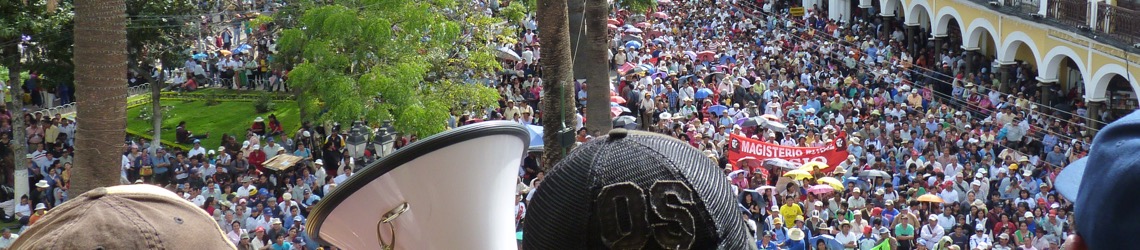
Tactical Gems from the Egyptian Uprising

As we cheer on Egypt’s anti-regime uprising, we should also be learning as much as possible how it worked. Some things, of course, are only important in a society that has lived under decades of emergency rule. But most, I think,  apply just about everywhere. Since we’ve seen government spying and storm trooper-style riot cops deployed in just about every country, it’s great when we can learn things that stop them.

Here are some of my favorites so far.

Open source protesting: Making its round in Egypt during the last days of January was a brilliant little pamphlet called “How to Protest Intelligently.” This easily reproducible, forwardable, xeroxable pamphlet brought together an open-ended set of tactics and strategies and widely distributed them. San Francisco bikers will be familiar with the well-distributed xeroxes that circulate at Critical Mass (some mockingly call this form of leadership “xerocracy”), but its relatively rare that protesters aim for mass distribution of their plans to the rest of society. When enough people are fed up, but might remain inactive without a plan, this can be strikingly effective.

By the way, open source is a metaphor here, that has relatively little to do with actual computers. It seems that e-mail and pdfs did actually help in Egypt, but mimeographs, printing presses, fax machines, or copiers would have functioned just as well in another era. (Non-blog-oriented hat-tip to the European collectives circulating open source windmill designs to put renewable energy into grassroots hands.)

You can read nine pages of the pamphlet at Indybay (the San Francisco Bay Independent Media Center), one of my favorite open media institutions.

Advice on gathering and mobilizing from “How to Protest Intelligently”

Gather where you is, Converge on where you ain’t:* One piece of simple advice from the pamphlet is this universally applicable tactical plan. Apparently, it actually happened this way. Ahdaf Soueif, for example, reports:

This is the scene that took place in every district of every city in Egypt today. The one I saw: we started off as about 20 activists, after Friday prayers in a small mosque in the interior of the popular Cairo district of Imbaba. “The people – demand – the fall of this regime!” Again and again the call went out. We started to walk: “Your security. Your policekilled our brothers in Suez.”

The numbers grew. Every balcony was full of people: women smiling, waving, dangling babies to the tune of the chants: “Bread! Freedom! Social justice!” Old women called: “God give you victory.”

For more than an hour the protest wound through the narrow lanes. Kids ran alongside. A woman picking through garbage and loading scraps into plastic bags paused and raised her hand in a salute. By the time we wound on to a flyover to head for downtown we were easily 3,000 people. (“An eyewitness account of the Egypt protests,” Guardian, January 28)

* “If you can’t organize where you is, you can’t organize where you ain’t” — received Saul Alinsky-style wisdom

Missing step, How to Defend a Public Plaza from Cops and Mobs of Hired Thugs: Seriously, I’m curious. And a lot of experience has been generated.

How to make demands from a giant crowd: Now that Tahrir Square has proclaimed itself an “autonomous republic,” and demands are flying from every corner of Egyptian society, not to mention every foreign government, the crowds whose effort has made change possible are trying to articulate their demands. Here’s how:

In Tahrir, the square that has become the focal point for the nationwide struggle against Mubarak’s three-decade dictatorship, groups of protesters have been debating what their precise goals should be in the face of their president’s continuing refusal to stand down.

The Guardian has learned that delegates from these mini-gatherings then come together to discuss the prevailing mood, before potential demands are read out over the square’s makeshift speaker system. The adoption of each proposal is based on the proportion of cheers or boos it receives from the crowd at large.

Delegates have arrived in Tahrir from other parts of the country that have declared themselves liberated from Mubarak’s rule, including the major cities of Alexandria and Suez, and are also providing input into the decisions.

“When the government shut down the web, politics moved on to the street, and that’s where it has stayed,” said one youth involved in the process. “It’s impossible to construct a perfect decision-making mechanism in such a fast-moving environment, but this is as democratic as we can possibly be.” (“Cairo’s biggest protest yet demands Mubarak’s immediate departure,” Guardian, February 5)

Local road blockade challenges Egyptian election fraud

On Sunday, Egypt held parliamentary elections which are widely known to be neither free nor fair (denunciation by the Carnegie Endowment for international peace). The elections were a demonstration of the government’s plans in advance of the 2011 elections, when long-time president Hosni Mubarak may make way for his son to rise as a successor. Unlike the media frenzy over the selection of Kim Jong-Il’s son to receive a special title, little mainstream outrage has been directed at Mubarak’s machinations. Egypt remains under its third decade of emergency rule (which ban demonstrations and some opposition parties), and is the largest non-democratic recipient of United States’ foreign aid by far. It’s also the largest undemocratic country in the Middle East, helped to remain so by our tax dollars, and military and diplomatic support. It’s the clearest sign that the alleged US policy to support democracy in the region is a joke.

In the absence of outside support, people in Egypt have made a number of challenges to this situation. One of the latest was the mid-day peaceful uprising on Sunday by residents of Balteem and Hamoul against voter fraud. Their actions were in defense of independent candidate Hamdeen Sabahy (profile). Since 1995, three of Sabahy’s voters have been killed by Egyptian riot police, while he won office in 2000 and 2005.

Blogger Baheyya has an hour-by-hour account of local resistance (h/t to The Arabist). Here are some highlights:

8:30 am. Sabahy’s representatives rush to photocopy the new certification papers required to gain access to polling stations. Early that morning at 12:30 am, Sabahy’s campaign was dumbfounded to learn of sudden new regulations for the papers, requiring that they be stamped from police precincts rather than notary publics as had been announced earlier. Certain that this is an 11th hour rule manipulation to bar Sabahy’s agents from accessing polling stations, campaign workers spend all night driving to police stations to get the necessary stamps.

9:10 am. The first reports of foul play trickle in. Candidate agents from 12 polling stations phone in that they have been kicked out of polling stations, and one says her certification papers were ripped up despite having the necessary police stamp.

1:00 pm. Sabahy’s representatives sent to Hamoul and agents of other candidates who are sympathetic to Sabahy begin to phone in reports of ballot-stuffing in favor of Abdel Ghaffar in villages surrounding Hamoul.

1:50 pm. Balteem’s main streets are lined with men congregating and sitting on the sidewalks, expressions somber and nerves frayed. A procession of cars and pickup trucks loaded with youth speed past in the direction of the highway. “They’re blockading the highway!” Spontaneously, Balteem and Borg youth decide to blockade the highway to protest what is now a certain sense of election rigging. The news travels like wildfire and some cars change route and head for the highway rather than Sabahy’s house. Frantic calls to campaign cars instructs them to make sure no women are headed to the highway, in anticipation of violence between protestors and riot police.

2-4 pm. Town youth blockade the highway with burning tires and clumps of tree branches and wooden sticks. Highway traffic comes to a standstill, with freight trucks backed up as far as the eye can see. A campaign worker says to no one in particular, “Didn’t I say that this morning was the quiet before the storm?”

4 pm. Townspeople converge on Sabahy’s courtyard and the candidate comes out to speak, standing on a pick-up truck. Livid, fiery youth and men climb on the pick-up truck and demand revenge. Sabahy struggles to control the crowd’s emotions, saying he’d rather withdraw and give up his seat than join this scandalously handpicked parliament. A fully veiled woman in black climbs on the truck and pulls the microphone from his hand, screaming, “Don’t you dare withdraw, Sabahy! Don’t you dare withdraw!”

The crowd chants, “Balteem boxes won’t leave! Balteem boxes won’t leave!” By law, counting stations for the entire district are located in Hamoul but since Hamoul was experiencing rigging, residents feared their ballots would be destroyed or disappeared en route to the counting station.

Ultimately, these efforts appear not to have saved the day. Instead it was the threat of further government violence that won. Al Ahram reported at 4:35 pm, “Police armored vehicles have stormed Balteem, in Kafr El-Sheikh, firing tear gas and live ammunition into the air.” Later, Sabahy himself convinced his supporters to stand down (again, the full day is here):

7:00 pm. Sabahy comes out and is immediately mobbed by the crowd, lifting him on their shoulders and giving him a hero’s welcome. He gives a rousing speech in which he denounces the government and several Amn al-Dawla officers by name for fixing the elections in Hamoul, and reiterates his position of withdrawing from the elections. The crowd presses him to authorize and lead a peaceful protest march to the police station to protest the rigging, but Sabahy fears security forces’ violent response and does not want injuries and casualties among his supporters, as in the past. The back-and-forth goes on for an hour that feels like an eternity, but in the end Sabahy prevails and the people are dejected, though none take matters into their own hands as some did that afternoon.

Somewhat obnoxiously, a government spokesman claimed, “The [governing] party’s careful selection of its candidates was a factor in defeating big opposition names such as Hamdeen Sabahi.” Sabahy withdrew from the race, and made these comments later: “The rigging proves that the [governing] NDP wants no opposition in parliament. With the new parliament, we will see increased restrictions on freedom of expression, including new restrictions on the media.” Whatever the wisdom of backing down (and no one should be too eager to second guess such moves when lives are at stake), residents’ willingness to take their anger to the streets are remarkable under so much pressure.

p.s. Apparently, Egyptian President Hosni Mubarak would like another dictatorship in Iraq, according to advice he gave to US officials (Thanks, Wikileaks).

What’s behind the Potosí regional strike?

As the department-wide strike in Potosí continues to edge into the international press (primarily through its effect on tourists and now upon mining companies that operate in the region), I want to give more of the background on the strike and its demands, so it’s at least understandable why people are blockading and hunger striking there.

“It can be summed up in one single thing: in misery. … We are fighting for a hill that as of yet is not a factory, just a hill; it’s raw material. For the dream that some time we, that the families that live there, might have something. They are places forgotten by the hand of God: they don’t have water. They are using up the water in the wells. There is no electricity. It is misery.”
Saúl Juarez, Potosino hunger striker in Cochabamba

If you are from North America, this use of misery might be unfamiliar to you, but it is common in the language of Latin America. We must first organize, then-Haitian president Jean Bertrand Aristide once said, to move from misery to poverty. Here in the hemisphere’s second-poorest country (after Haiti), Potosí is the poorest of nine departments. The rate of extreme poverty, which is falling nationwide, is still 66.7%; meaning that two-thirds of Potosinos cannot afford to buy their family’s basic necessities. Of every 1000 live births there, 101 children will die before their fifth birthday. Both of these figures are the highest in Bolivia; in the case of child mortality, the second place departments—La Paz and Chuquisaca—see 63 deaths per 1000 children. It is for this reason that Potosinos have spread to the rest of the country in search of better opportunities.

“We can say that we are fighting for the reactivation of the productive apparatus of Potosí.”
Claudia López, Potosino hunger striker in Cochabamba

Most of the demands advanced by the Potosí mobilization are focused on specific industrial or economic projects, which in the eyes of protesters, have languished for the lack of state interest. The boundary dispute with Oruro centers around two hills that contain limestone, a key ingredient for cement, and a second demand is for a cement plant to earn money and create jobs from that resource. Likewise, Potosinos are calling for the activation of a metallurgy plant and for the creation of an international airport to connect Uyuni and its phenomenal salt flats to international tourists.

Potosí, of course, is not poor for the simple lack of investment from the outside. It has never simply languished in the absence of foreign interest. Instead, it was once the largest the city in the Western world precisely because of the rich attraction its mineral wealth held for the Spanish state and its investors. Immense wealth was symbolized by the Cerro Rico which sits above the city, or simply by the phrase “it’s worth a Potosí.” Every Bolivian, rich or poor, left or right, knows how Bolivian wealth enriched Spain, and through it Europe. And every Bolivian understands that to take part in that wealth requires doing more than extracting minerals from the ground and shipping them out of the country.

More recently, Potosí was hit hard by the shock-therapy program of neoliberal economic restructuring that began in 1985. At the time, the miners who worked for COMIBOL—the national mining company that took over the mines run by three wealthy tin barons in 1952—were the strongest social movement in the country. The government of Paz Estenssoro aimed to break this power, and essentially shut down the government-run mining sector to do so, laying off tens of thousands of workers. Those miners who did not resettle elsewhere in the country became the backbone of the cooperative mining sector, a collection of small scale mining projects that engage in uncoordinated mining of the Cerro Rico, and other mountains like it, in search of rich veins of minerals. Decades of such drilling have brought the Cerro to the brink of structural collapse, posing the threat that the hill—recognized as a World Heritage Site by UNESCO—could become a ruin.

“They all come to promise and promise, and to say this and that could be done. The [current] government has done the same: it has promised. But after five years of their rule, of creating new laws and a new constitution, of re-electing them, there is nothing. … So, we want dates; we want concrete responses of when and how; we want specific studies; we want operational plans that establish dates for the processes that are going to happen.”
Claudia López

If one had to choose a symbol of the capacity for delay in pursuing development projects in Bolivia, it might well be Karachipampa, the metallurgical plant that the mobilization is demanding to be activated. This lead and silver smelter was built between 1985 and 1988. It has never operated.

Several years ago, in 2005, the Canadian firm Atlas Precious Metals Inc. entered a shared-risk agreement to invest in the plant. You can see on their web page an optimistic assessment of the plant’s production capacity. As of April, only 20% of the firm’s promised investment had been realized (article in Spanish). Currently, Atlas and COMIBOL are in a legal dispute in which Atlas demands its $12 million investment be repaid, and COMIBOL seeks compensation for the value of the plant, which remains unused. In a letter to the government (es), the Potosinista Civic Committee washes its hands of the whole dispute and demands:

The only thing the Potosí people want is to see, in an immediate manner, the effective functioning of the Karachipampa Plant, whether it is with the [foreign] company or through state intervention.

Beyond all these details, the strongest emotion visible here is simple, exhausted, impatience. Whether the timeline is 21 years for the plant, or 5 years for the MAS government, or three generations for the border dispute (more on that when I can provide a fuller background, or transcribe more of my interview with a Coroma resident), those who have thrown themselves into this protest have run out of patience. Against the experience of delay, they have enacted tactics based on urgency: extended blockades, hunger strikes, and so on. So far, Potosinos themselves, beginning with the hunger strikers have borne most of the costs of these urgent tactics themselves, or imposed them on the surrounding communities. However, they are increasingly enacting or talking about tactics that will cost companies operating in the region substantial losses on a daily basis.

Tactical experiments: New Jersey, Egypt, Thailand

Something that fascinates me is the continuing stream of innovative ways that people act collectively, and build power from the streets. To kick off a more “web-log”-ish side to this page, I want to share three stories worth following for their tactical innovation in New Jersey, Egypt, and Thailand. Rarely is a tactic really “new,” but innovation also comes when a tactic is brought into a new context, as well, suddenly empowering people who weren’t before. Also, while I’ve been vaguely following the protests in Thailand over the past couple years, I confess to not having any idea which side I would be on if I lived there, I’m just trying to learn vicariously from their experiences in the streets.

Social networking aids mass walkouts against statewide education budget cuts by New Jersey high school students: In New Jersey, a Civics Lesson in the Internet Age, New York Times

Sit-ins by labor activists in Egypt outside of Parliament.

Day after day, hundreds of workers from all over Egypt have staged demonstrations and sit-ins outside Parliament, turning sidewalks in the heart of the capital into makeshift camps and confounding government efforts to bring an end to the protests. Nearly every day since February, protesters have chanted demands outside Parliament during daylight and laid out bedrolls along the pavement at night. The government and its allies have been unable to silence the workers, who are angry about a range of issues, including low salaries.

These actions are vitally important because Egypt, the most populous country in the Middle East, has lived under an “Emergency” Law that suspends constitutional freedom since 1980 (and except for an eighteen month period, since 1967). Among the freedoms denied are freedom of the press, of speech, of assembly, and the rights to a public trial and to freedom from searches unauthorized by courts. The suppression of basic rights and democracy in Egypt (consistently one of the top three recipients of US military aid) has been one of the great silences of both American diplomacy and of US activists of all political persuasions who talk about the region. the AFL-CIO–funded Solidarity Center offers this report on how labor movements are getting active despite that silence.

Thai “Red Shirts”: Radio, Road Blockades, Mass Presence

Honking horns, singing folk songs and waving red flags, protesters converged on Abhisit’s house in an affluent Bangkok neighborhood where they splashed blood — a few spoonfuls donated by each — on the gates and fences amid pouring rain.

“We have washed Abhisit’s house with the blood of the common people to express our wish,” said Nattawut, as thousands of supporters rattled plastic clappers.

Protesters say the splashing of blood was a “symbolic sacrifice for democracy.” (Thai “red shirts” splatter blood at PM’s hom, Reuters, March 17)

A new red-shirt radio station went on air yesterday in the Rajprasong intersection protest-site area, in a move to counter the continued shutting down of red-shirt media by the government under emergency rule.

“They should allow us to criticise [the government], but instead they shut our ears and eyes,” Chinawat Haboonpak, a red-shirt leader told the crowd at the intersection yesterday morning. “We ask for just one television channel, but they have taken it away from us and shut our ears and eyes again.”  The new station – on FM 106.80 – broadcasts from a new tower installed near Lumpini Park and calls itself Rajprasong Community Radio. Its reception can be received all the way to Bang Na area, in eastern Bangkok. (Defiant red shirts put new radio station on air, The Nation [Bangkok], April 19)

A stubborn “red shirt” anti-government movement holding Bangkok hostage has its roots here in the country’s impoverished northeast, where Prime Minister Abhisit Vejjajiva is widely reviled. … The town that once supported a nearby air base where the U.S. military operated during the Vietnam war, and whose lively bars and hotels are a reminder of that time, has 400,000 registered members of the red shirt movement. …

Red shirts here and in at least six other provinces have blocked roads to stop convoys of armed troops and police from traveling to Bangkok, fearing an imminent crackdown on protesters occupying a Bangkok shopping district for 27 days.

In many of the provinces, the police and army are outnumbered and seem powerless — and apparently reluctant — to tackle them. (Protesters rule the roost in Thai “red shirt capital”, MSNBC, April 29)

Bailout Protest on Wall Street

Responding to an open call circulating in the city, some 300 protesters against the bailout plan gathered in New York’s financial district and marched to the New York Stock Exchange at Wall St. and Broad yesterday afternoon. The crowd was loud, diverse and fed up. Video coverage of the rally is part of today’s Democracy Now! The Indypendent has a live blog archive of the protest. Click on the picture below for more Indymedia photos.

Facing the New York Stock Exchange, protesters filled the intersection and the steps of Federal Hall

Apparently, we weren’t the only people pissed off, either. TrueMajority.com is hosting a bulletin board for coordinating protests, with over 250 planned or carried out already, as covered her by CNN.

Being on the streets, there was a happy thrill to be back in force, in a protest taking over Wall Street for my first time since the J18 protest against the G8,* when a Reclaim the Streets protest flooded that intersection for nearly an hour. Of course, this time, our connection to most Americans was much more organic, as everyone from New York anarchists to Montana’s governor are raising big questions about this handover of government loans for junk securities.

What was strange, though, was to look so many Wall Street traders in the eyes. While many waded into the crowd to snap photos with their IPhones, others were visibly unnerved at the display of public opposition. And is the unfortunate nature of public protests we weren’t being the most articulate in our chants (see Tom Tomorrow from 1992 below), even if we were some times hillarious saying things like: “You break it, you bought it” and “You fucked up. Suck it up.” Above all, we needed to be loud and unequivocal in just the right physical space. Thankfully the media was the outlet for my desire to be articulate, and apparently for others desire if you listen to Democracy Now!

How we have to protest when the media and the two parties speak in unison

*Some of you may remember I worked on another more recent protest there, but I spent the morning working phones off-site.

Now screening on the East Coast: In-depth look at Anti-war Shutdown of San Francisco

SF Chron Cover on Day X

SHUTDOWN: The Rise & Fall of Direct Action to Stop the War is an in-depth documentary exploration of a piece of the continuous struggle towards
social justice. Using the March 20, 2003 occupation and disruption of the San Francisco Financial District as a case study, the film casts a thoughtful eye on one of the most successful actions of the current anti-war movement, facilitated by Direct Action to Stop the War (DASW). Created to gain insight, inspire, and draw lessons the movie tells the story of how social justice organizers and everyday people came together to plan and shut down the financial district of a major US city.

Created by people directly involved with the organizing, SHUTDOWN utilizes on-the-street footage, news clips and interviews with 17 key participants. It is a people’s history made in support of the movement against war and
empire, aiming to galvanize resistance and further critical analysis in cities and towns throughout the country.

Join the film makers for a presentation & discussion on the future of mass direct action strategies to end the war.

**Upcoming East Coast Screenings**
Wednesday, July 09
7:00 PM
Bluestockings Booikstore, NYC
172 Allen Street between Stanton and Rivington

Thursday, July 10 7:00PM
St. Joseph’s House of Hospitality, Rochester
402 South Ave.

Saturday, July 12 7:30PM
Wooden Shoe Bookstore, Philadelphia
508 s. 5th street

Monday, July 14 6:00 – 9:00 PM
Hartford, CT
Location TBA

For a promotional flyer, preview, and more
check out the website at www.shutdownthemovie.com.
For more info or questions please send an email to daswvideo@riseup.net
[Full disclosure: I’m one of the “17 key participants” interviewed in the film]

More background on the SF antiwar movement in 2003-04: From Piece Movement to Peace Movement: San Francisco Self-Organizes to Implode Empire by Patrick Reinsborough