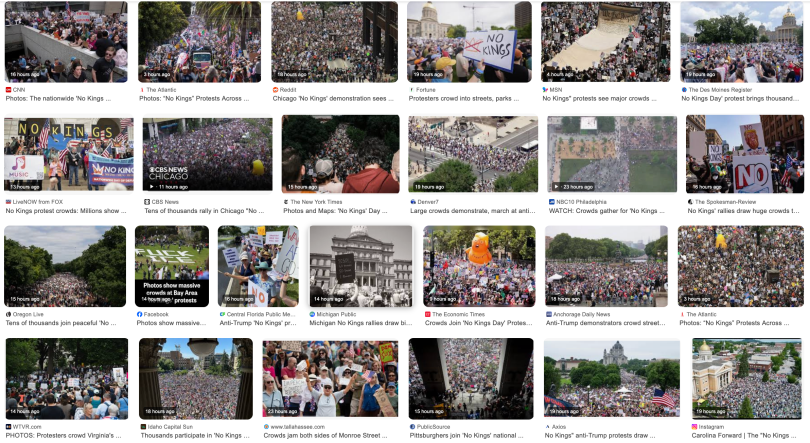
Grid of images of No Kings protests on June 14, 2025

No Kings protests were extraordinary. How exactly?

Americans, citizens and immigrants alike, protested on Saturday, June 14, in exceptional numbers as a wave of No Kings protests became the most widespread public repudiation of the second Donald Trump administration. These protests, which were undoubtedly energized by the standoff between Los Angeles-area communities and Federal troops, could mark a turning point from isolated protests to mass resistance.

Protests are called demonstrations for a reason. And these were displays of political strength for a movement that has a lot to prove: that it better represents the country than a president elected with a slim plurality in November 2020, that it is better able to capture public enthusiasm than an incipient fascist movement, and that it is undeterred by the state violence shown through military deployments, arrests of opposition leaders, and near-disappearances of a growing number of immigrants.

So what does success look like for a mass display of public will?

One simple metric is comparative: did a the anti-Trump movement out-organize and out-turnout their opponent. And here, the juxtaposition with Trump’s military parade — a celebration of the US Army’s 250th birthday on Trump’s 79th — will be unforgettable.

The King’s Parade vs No Kings Protest

News Eye (@newseye.bsky.social) 2025-06-14T22:36:16.034Z

But in a larger sense, protesters make a political statement through crowds (and yes, through many other kinds of actions, but June 14 was largely a day for crowds). When they succeed, that message is “indisputable in its overwhelmingness,” as Argentina’s Colectivo Situaciones described the protests that brought down three presidents on December 19 and 20, 2001. Through some alchemy of place, time, presence, voice, and action, crowds constitute themselves into the “The Voice of the People.” And assert that they, and not their government, will decide the future.

I want to use this occasion to share how those of us who study mass protest try to conceptualize just how protests achieve that kind of political impact.

Charles Tilly, who with various colleagues has probably done the most to examine the protest demonstration as political form, has a four-word summary of what protesters are actually demonstrating. And Tilly’s model is interesting in part because it situates demonstrations as just one form of collective political action (or “contentious politics”), alongside riots, strikes, revolutions, and among many other attempts at disruption or representation. Demonstrations are a social transaction where movements accept that a government system will persist, but where governments are moved to recalibrate their actions based on shifts in popular support and public mode. In that frame, Tilly et al. argue that protesters are engaged in displays of WUNC: worth, unity, numbers, and commitment.

  • Worth: Protesters present themselves as worthy of political participation, rather than exclusion from decisions about their own fate. This might be especially relevant for groups, from working-class laborers in the 19th century to women in the suffrage movements to minorities of various enfranchisement movements, who are formally excluded from participating in official politics. This is self-presentation as an argument that one deserves a place at the table.
  • Unity: Protesters come together and present a common voice. This may be the most basic element of what a common protest is, and everything from a speaker’s dais to roars of approval to marching side-by-side demonstrates this unity of purpose, both to participants themselves and to their audience.
  • Numbers: The size of a protest illustrates the larger capacity of a movement to catalyze political action, to show up again, and to influence democratic outcomes. When the 2006 immigrant protests promised, “Hoy marchamos, mañana votamos / Today we march, tomorrow we vote,” they were offering their quantitative weight to political actors that would accept their agenda.
  • Commitment: To a greater or lesser degree, protests demonstrate the willingness of participants to do hard things, to devote a share of their time to political action, and to make sacrifices for a cause. This is why long marches, gatherings in spite of rain or cold, and endurance of repressive violence—fire hoses, dogs, tear gas, projectile weapons—are so impactful. And why activists can create their own endurance tests—sit-ins, extended vigils, hunger strikes—to show others what they are willing to do.

What‘s great about this framework is that it doesn‘t just make sense of how movements have an impact, but also gives some sense of what goals organizers might have in choosing different protest forms.

But when I tried to understand the movements I have worked with, I came to feel that other dimensions were important as well. As I’ve written: “But what if grassroots movements see themselves not just as claimants before the state, but as a rival power to it? What if they claim a bit of sovereignty for themselves? The mobilized communities described here do use their unity and numbers to illustrate their claim to represent the public as a whole. To create the shared impression that “everyone” is part of a mobilization, however, they also highlight diversity among themselves and carry out geographically expansive protests. And they demonstrate effective practical sovereignty over urban spaces and persistence in the face of state violence.”

These are, I think, four new dimensions. A mobilization that claims sovereignty has worth, unity, numbers, and commitment, but is also diverse, widespread, irrepressible, and in control. What do these four adjectives mean?

  • Diverse: This includes and goes beyond the intersectional identities notion of diversity. Yes, it’s about including those oppressed, marginalized and excluded. It is those who were scorned claiming political voice. But also yes, it’s about joint action across lines of difference, showing people working together despite privilege and division. It is uniting to fight together. And yes again, it‘s about those sectors of society that have been pitted against each other finding common cause. It’s realized though unexpected juxtapositions: Teamsters and Turtles together at last, the office worker in a suit throwing back a tear-gas canister.
  • Widespread: Movements demonstrate their political significance by being ubiquitous: We are everywhere. At the height of their water privatization protests, Cochabambans moved to erect road blockades on every street they could find. And in the United States, we’ve seen a move since at least Occupy in 2011 to maximizing the number of protest locations. This was definitely a feature of the 2020 Black Lives Matter protests, possibly the most widespread protest mobilization in American history. Here in 2025, No Kings seems to have doubled down on this strategy, meaning that many metropolises could boast multiple urban and suburban protests on the same day: as many as fifty separate locations in the San Francisco Bay Area. Much of the celebratory sharing that happened yesterday was geographical, with images from places like Boise, Salt Lake City, or Hattiesburg (Mississippi) treated as mic drop moments.

Do you know how badly you have to screw up as a Republican to get this kind of turnout in IDAHO? #NOKINGS

Heather M. Collins🗽 (@heathersdesk.bsky.social) 2025-06-14T19:44:59.284Z

The last two elements of my list may just be at the horizon for the current protest wave in the USA, but they mark out where things could go as the protester–government standoff evolves.

  • Irrepressible: When a movement surges back in to the streets after repression, it showcases the limits of state power. This feeling is definitely significant right now, with these protests surging both in places where police and military violence was displayed over the past ten days, and showing up in new places in outraged reaction. Anyone who has been on the streets when police have backed down, or gave up their hold on even a block of the city to allow protesters to surge in, knows the electricity that goes through a crowd that has lost its fear and disempowerment. Finding ways to protest through, or in spite of, physical attempts to prevent you from doing so is a powerful political statement.
  • In control: Beyond that, lies the experience of protesters actually choosing what happens in the streets. Of public collective decisions on what happens next. This is why certain kinds of rallies and assemblies are uniquely empowering, because people choose on the spot what do, where to go, how to escalate, and whether to persist until their demands are one. The collective experience of direct action is its own unique form of self-empowerment.

The United States is a massive country with many cities, countless communities, and many, many places of gathering. It’s an exceptional challenge to walk forward through the different kinds of collective power sketched out here all at once. When face-to-face in one place we can get a sense of our potential, but we’ll need to find ways of keeping track of that across many settings.

Synthetic journalistic, movement media, and academic accounts can give us perspective, and I hope this outline of elements of power can help orient those accounts. Counting the number of locations, as being done by the Crowd Counting Consortium, is vital information. Yet summaries of crowd size and dispersion are useful, but also not enough. We need to thicken these accountings of where and how many with considerations of which alliances are emerging, which sectors of society are participating, and how daring and how contagious actions are. As well as what is working despite the kinds of force directed against it.

In the past, with thinner forms of communication and a greater reliance on centralized mass media, singular national protest gatherings may have been more important in building this shared sense of working together and achieving power. So did roving concentrated mobilizations, whether that was the trail from Birmingham to Freedom Rides to Selma to Chicago, or from Seattle to DC to Cancun to Miami. Now, in part because the adversary is more directly the national government, an Everything Everywhere strategy seems to be taking shape.

Front cover image from l'Humanité, a Paris newspaper. Shows a confrontation on a highway between black-clad soldiers and American civilians, one of them holding an American flag.

Resistance to Trump reaches its first turning point

“The Whole World Is Watching.” It’s been decades since American protesters chanted this sentence at American police in an effort to deter violence and brutality. But it has perhaps never been more true than right now. The political drama of the USA in 2025 has the world riveted, and I as I walked through the modern train station in Potsdammer Platz, built where the Berlin Wall once stood, the face offs, a pillar at the bottom of stairway brought the confrontation between Federal troops and Los Angeles protesters to life in the middle of Germans daily commute.

And without a doubt, Los Angeles marks a dramatic new turn in the authoritarian rollout of the second Trump Administration. After months of high-consequence policy changes and comparatively isolated forms of protest, the situation is shifting towards an open confrontation and nationwide resistance. The Immigration and Customs Enforcement (ICE) raids on everyday Angelenos have prompted a public reaction by a community that doesn’t have the luxury of waiting until November 2026. And the president’s long-advertised desire to confront protesters with the United States military is finally being realized.

Both the roundup of ordinary civilians and the militarization of American cities push beyond existing expectations. They embody the threat of a different country, one where freedom is utterly denied to a millions and dramatically curtailed for the rest of us.

Everything I’ve said so far is, I think, obvious whether one is within range of the tear gas, across town, across the state, or across the ocean. But that’s not why I write this post. Instead I want to share a bit of perspective as someone who spent a decade puzzling through the sometimes deadly and sometimes transformative dance between protest and repression, including how Bolivians flipped the most heavy-handed domestic military deployment into the forced end of a presidency.

First and foremost, state crackdowns like Trump’s deployment of the National Guard and the Marines are exceptionally risky moves for rulers. The repressor imagines that such a show of force will rapidly bring about a scene of submission: arrested or injured opponents, a fearful majority of the population, and a quieter country. But the truth is, there’s no single outcome when an unarmed populace faces down an armed military. And nothing demonstrates a government’s weakness more powerfully than when even its deliberately trained soldiers can not obtain compliance with its orders.

Second, a crackdown in one place can kick up either mass demonstrations of repudiation or many sparks of daring rebellion across the country. Or both, which is what the invasion of Los Angeles has appeared to do this week. Spreading out protests when repression is concentrated is a winning tactical approach.

Sometime in the coming days or weeks, American protesters will make the turn from a solidarity movement with Los Angeles to a national mobilization in defense of freedom and democracy.

Third — and these may be the two ideas I most want to share widely because they is not common sense to many Americans — widespread confrontational protest and massive shows of popular opinion are both essential, and need not be in competition with one another. In Bolivia, in Argentina, in Thailand, in Ukraine, in Egypt, and in Chile, people who succeeded in national political turns did both of these things. As seen this week, acts of confrontational action can deter or delay the mass detention and deportation of our neighbors; they also can hold space in times of protest. On the other hand, acts of mass participation literally demonstrate that the public rejects a government and its policies. They create moments of collective purpose that strengthen their participants and remind allies elsewhere that they are not alone, and that we can win. (See below the line for how I described them working together in Cochabamba, Bolivia.)

This month, and especially this weekend, people primarily oriented around one or the other of these goals will likely be side-by-side in the street. Those who define themselves around what I’ve called “The Tactical Argument of our time” (whether nonviolent action can/is better at/is necessary for/could never/is counterproductive to bringing about revolutionary change), may be primarily worried about whether their preferred tactical approach is being permitted or blocked. My suggestion instead is to consider how much more powerful this movement could be if both flourished. And then to do the work of both helping people stay safe(r) as they speak, act, and resist.

Solidarity from Berlin.


p.s. Here’s how I described these two sides of successful uprisings in my research on Bolivia:

To win, the Coordinadora had to wield mass pressure, establish its legitimacy, gain a seat at the bargaining table, and convince the government to completely reverse the privatization. The moment of mass pressure involved blockades and other disruptive actions to win the annulling of the contract. The moment of legitimacy consisted in convening assemblies, cabildos, and an unofficial referendum or consulta popular to register public opposition to water policies. … While pressure and legitimacy represent two distinct moments of the mobilization, they worked in tandem, like two legs walking: Road blockades organized across the city and the surrounding region built up into an overwhelming civic strike, while marches flowed together into large-scale meetings called cabildos, often held in the central plaza. The civic strike was the cabildo’s operative arm, its means of exerting pressure; and the cabildo was the strike’s brains and voice, the only place from which it could claim sovereignty. Without either, the Coordinadora and the Water War it fought, would have amounted to nothing.

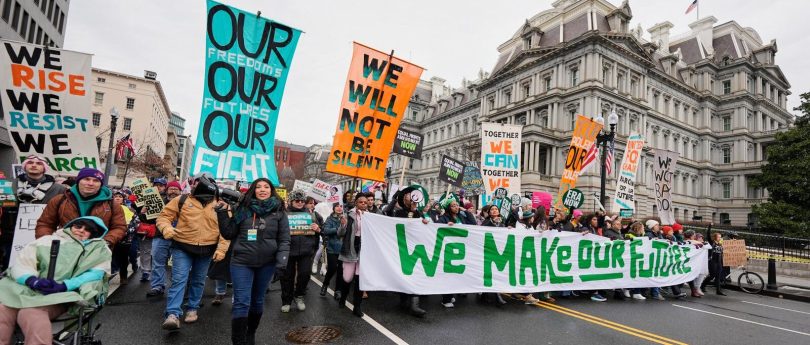
People's March, Saturday, Jan. 18, 2025, in Washington.(Mike Stewart | AP Photo/Mike Stewart)

Trump’s authoritarian turn is everyone’s problem

It’s May 2025, and it feels like every new conversation (in my circles? in the United States? far beyond that?) needs to start with an acknowledgement of the bleak bigger picture on the national and global stage. Like every How are you? could be personal, but could also be a How are you coping with these unfathomable times?

In my circles, a short phrase circulated in 2020–22: “Pandemic fine.” It was a way of addressing this uncertainty, this complication, this brokenness in brief, humane terms. With an unspoken subtext something like this: “My loved ones and I had a reasonably good day, though before bed I will be checking the charts that reveal that 2,592 of my countrymen have died yesterday of a disease that didn’t exist three years ago. And that reasonably good day was made as we navigate all the ways we know to live differently to make that number a bit smaller than it otherwise would be.”

Also in my circles, this attentiveness and yet also disconnect around the COVID pandemic was eventually displaced by the mounting horror of the Israeli genocide in Gaza. Which is something we didn’t have to plan our everyday behavior around. But which was present in our consciousness in a new and visceral way. The first live-streamed genocide brought us inches away from a tide of human suffering and calculated cruelty that was unimaginable. And while it felt like awareness of this new horror was uneven in the United States, the half or more of us who were aware could not look away. Our day-to-day lives coincided with both this atrocity, and with the broken promise of post–World War II life: “Never again.”

Less publicly, and I imagine among a smaller set of Americans than these last two, a dawning realization of the reality of massively disruptive climate change came up again and again in 2024. The city-shaking and sometimes city-shattering disasters that accompany the global rise in temperature knocked on more places I know in 2024, most memorably Asheville and Los Angeles. Those of us for whom climate is an area of expertise know the worst is still yet to come, and in the absence of rapid emissions reductions, the tempo and scale of these disasters will only rise. Among ourselves, we talk about the opposing demands for hope and clarity. and we mourn those places and lifeforms that can no longer be saved.

And for the United States, a further damaging shift came in with the Trump administration, and its dramatic efforts to take off the limits on repressive power; stigmatize and reverse efforts towards racial and gender inclusion; and dismantle a swath of institutions. We’ve see a former president who dreamed of being a dictator hire a phalanx of officials who are actually working to make him one. Moves from an authoritarian playbook are underway in the American state, even as crown jewels of that state — the Centers for Disease Control, PEPFAR, the National Endowment for the Arts , the list goes on — are cast aside. The White House directs a crackdown on the most vulnerable while also starting fights with pillars of its own power: the Ivy League, elite law firms, the Federal Bureau of Investigation.

Here there has been no silence. The details are too incredible, the variance with routine channels of action too extreme, the impacts too widespread for us to not bring these things up, just when we check in with each other. Public protests have popped up at a much faster pace this year than in 2017, with sustained regular demonstrating turning into a feature of the political landscape.

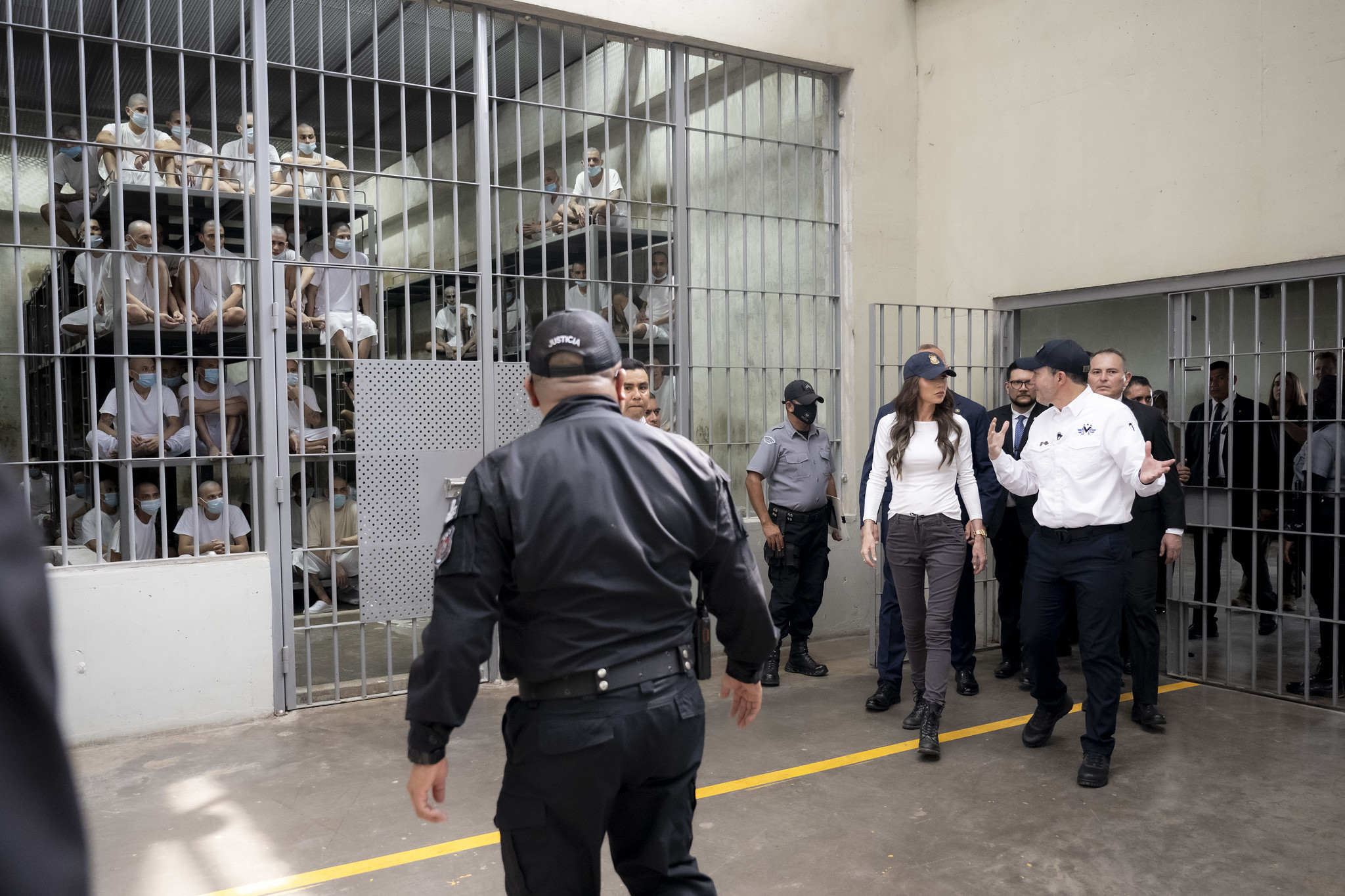
Department of Homeland Security (DHS) Secretary Kristi Noem receives a tour of the Terrorist Confinement Center CECOT with the Minister of Justice and Public Security Gustavo Villatoro in Tecoluca, El Salvador, March 26, 2025. (DHS photo by Tia Dufour)

But also, the warning signs of a more repressive turn are real and obvious: snatch squads targeting outspoken student activists; the use of immigration enforcement as political police; unaccountable detentions of lawfully arriving visitors; and the out-of-country imprisonments in El Salvador’s no-way-out prison CECOT. Again, those of us who have made our lives work studying such systems of power, as well as those who grew up living through authoritarian turns, are unified in seeing the dangers here.

Okay, so now what?

We’re up against a wildly ambitious White House intent on turning the US government into an authoritarian state, but also a White House that is doing so with self-weakening abandon. Starting from a bare plurality of voters, and the smallest possible majority in Congress, it is pursuing a maximalist agenda by largely ignoring the legislative process altogether. Its attacks on diversity, on queer rights, on opposition figures personally push otherwise moderate people into opposition. Its crudeness inspires more revulsion than it does participation. Trump’s absolutely Nixonian inability to treat powerful opponents differently than he does powerless ones continues to generate shock and outrage.

After a winter of cowardice, capitulation, and collaboration — with CBS, Columbia University, and the tech oligarchy as its most visible symbols — there’s a new balance of initiative. There will be battles in the courts, defiance from campuses, insubordination in federal offices and occasional bravery in state houses, and many, many reasons to get out in the streets.

Much of US activist practice is centered on raising awareness and visibility. But nothing could be more visible than the situation we confront. (We can retire the bumper stickers that say, “If you’re not outraged, you’re not paying attention.” Everyone is paying attention.) We’ll have to learn the forms of praxis that transform numbers into disruption, and disruption into power.

But I like our emerging coalition. And I like our chances.

Lead Photo: People’s March, Saturday, Jan. 18, 2025, in Washington.(Mike Stewart | AP Photo/Mike Stewart)

Inset Photo: Department of Homeland Security Secretary Kristi Noem receives a tour of the Terrorist Confinement Center CECOT with the Minister of Justice and Public Security Gustavo Villatoro in Tecoluca, El Salvador, March 26, 2025. (DHS photo by Tia Dufour)

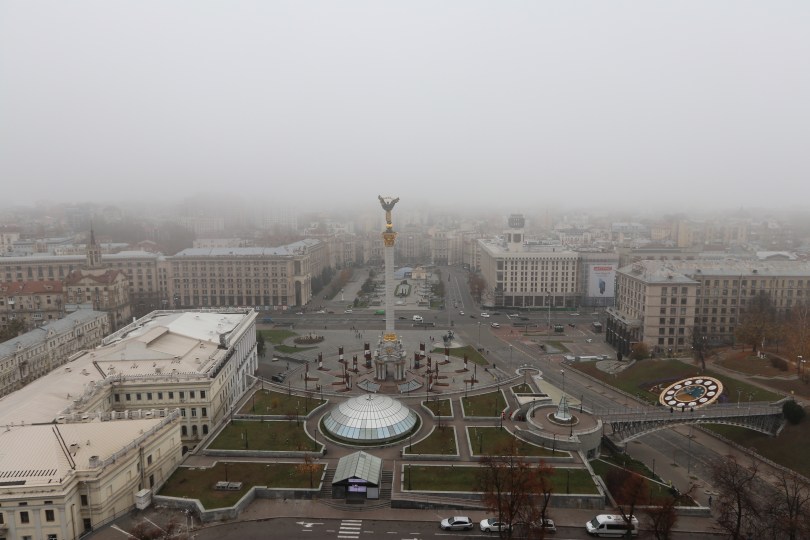
Maidan Square with mist, Kyiv. Ukraine

Finding our moral and political compass on Russia’s invasion of Ukraine

How should opponents of oppression, centralized power, militarism, and greed take a stance on the war begun by Russia’s invasion of Ukraine? Here’s a rundown of the (mostly aligned) factors people of good conscience and/or people on the political left ought to consider as they take a stand.

Note: This piece was born of a Twitter thread written as news of the Russian invasion of Ukraine broke on February 23. I’ve corrected a few things (mostly spelling, he said sheepishly) and enriched that thread with links to sources here.

Anti-imperialism

Anti-imperialism and self-determination are foundational values for looking at international conflicts.

Both are grounded in a refusal of the right to conquer territory by force. Since the 1928 Kellogg-Briand Pact and 1929 Litvinov Protocol, even imperial powers like the US and France, as well as the Soviet Union, are formally signed on to the inadmissibility of acquiring territory by force.

Legal condemnation of the Axis Powers in the Nuremberg and Tokyo trials are built on this foundation, so is modern international law. The UN Charter made this a treaty obligation of all states. Self-determination and decolonization built on this. Uprisings and resistance across the global South turned the UN framework, built by colonial powers, into an organization committed to decolonization.

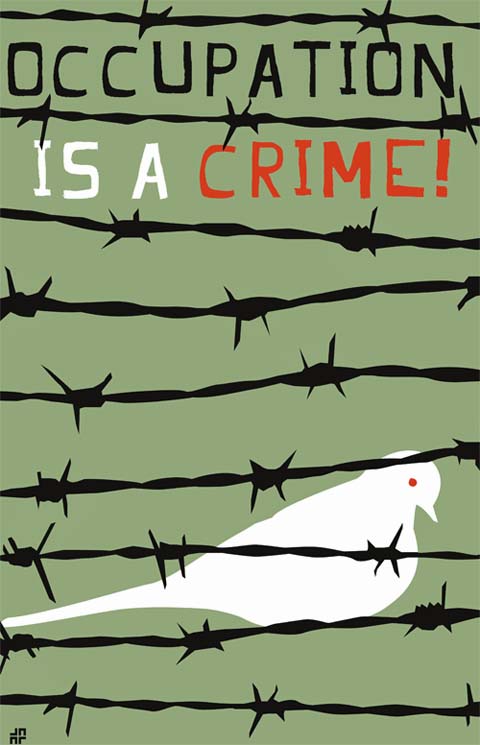
“Occupation Is A Crime“: Poster for Palestine by Jorge Arrieta.

This is what we invoke when we defend(ed) Algeria, Vietnam, Palestine, Western Sahara, East Timor.

While freedom of smaller countries from foreign powers has been an uphill climb, large and substantial regional, inter-state peace—notably in Europe, Latin America—has also emerged in this framework. Where the 19th century and early 20th century were full of invasions and border wars in both regions, the European Union and several Latin American forums offer an alternative. (This is why this new invasion is both one point in a long series globally, with Iraq 2003, Georgia 2008, Yemen 2015 as prior examples, and a shocking break in the European context.) So principles of international law are both close to causes of justice and elements that are routinely violated.

Those of us who live in imperial powers have ample opportunity to take stands in defense of international law by demanding that our governments abandon occupied territories and occupying allies… For US Americans, this includes ongoing wars/occupations in Yemen, W Sahara, Palestine. But that doesn’t mean that we have no ethical interest in the anti-imperial struggles, or rights for self-determination of people affected by rival imperial powers.

In the early 21st century, there are at least three independent great powers:
the US (& many allies), Russia, and China.

All are expansionist. All are capitalist.

Part of our ideological work as anti-imperialists is refusing the cognitive structures of empire. We should reject the Monroe doctrine and US domination of Latin America. They are not our backyard. We have no right to veto governments there, or put down opposition protests, much less invade and occupy them.

And for the same reason, we must reject the concept of a Russian near abroad, a sphere of influence where it has a veto over local movements and self-determination, where it can invade with impunity.

Our efforts should focus on alliances and empathy with anti-militarists and anti-imperialists in Russia, not with Russian fears of an independent Ukraine. Mutual recognition among imperialists is our enemy, whether it is Trump’s idolization of Putin or Germany’s commitment to a Russian gas pipeline.

“Occupation of the Crimea is a shame of Russia” (Photo CC-BY-SA Bogomolov.PL)

We should educate ourselves about, and cultivate solidarity around past forms of imperial domination in the Russian orbit, notably the coordinated starvation of Ukraine and the mass deportation of ethnic groups across the Soviet Union. We must listen to Ukrainian voices in a time when they are under attack.

Anti-militarism and the threat of nuclear war

Inter-state wars have been rare since 1946. (Peace Research Institute Oslo)

The next level, militarism, is more complex: Confrontations among countries with large militaries are disastrous. We’re witnessing the beginning of one of only a handful of military-military conflicts since 1945. (Most wars in that period were fought by irregular, non-state forces on at least one side.) Iran–Iraq and US–Iraq (1|2) both illustrate the horrifying toll that such conflicts can bring. De-escalation is a huge priority. As is global diplomatic and economic isolation of states that start such wars.

Between wars, US military alliances like NATO are massive export markets for weapons manufacturers. Each sale increases the risks and costs of future conflict. Despite its successful deterrence so far, then, NATO represents a gamble that could eventually make future conflicts far more deadly.

Separately, the involvement of nuclear powers represents both a severe risk and a mechanism that can cause military powers to think twice before escalating. For a mirror image example, consider Cuba in the 1960s… the Soviet Union developed an alliance with a former colony of the US, provoking a nuclear crisis, but also likely deterring a full-scale US invasion.

Ukraine would be a nuclear power too, were it not for a series of denuclearization agreements in which both Russia and the US promised to respect its sovereignty and territorial integrity. There are long-term implications of a world that reneges on protection for giving up nuclear weapons. Those of us who want a nuclear free world have an implicit stake in Ukrainian security.

Democracy

Last but not least, the conflict in Ukraine sees a democratic government facing invasion by a oligarchical and authoritarian one, whose leader has declared that it isn’t a real nation. Nothing good can come of that.

As anarchists in Russia put it: ”this will mean the further spread of the so-called ‘Russian world’: a crazy combination of neoliberal oligarchy, rigid centralized power, and patriarchal imperial propaganda. This consequence is not as obvious as the rise in the price of sausages and the sanctions on smartphones—but in the long run, it is even more dangerous.”

To sum up

In short, there are wide reasons for left sympathy with Ukraine in this conflict.

In the context of Russian threats, and violence, Ukraine’s practical refuge is engagement with the EU and future alliance with NATO, two institutions leftists have long questioned.

Leftists’ rightful rejection US imperial power should not cloud our moral rejection of Russia’s current imperial invasion.

We can simultaneously be a voice that highlights divisions and dissent in the invading power, builds cross-border alliances against imperial power, supports bold moves to undercut fossil fuel revenue to Russia, and urges caution on military actions.

Other left analyses:

Top photo: Maidan Square with mist, Kyiv, Ukraine. CC-BY Juan Antonio Segal.

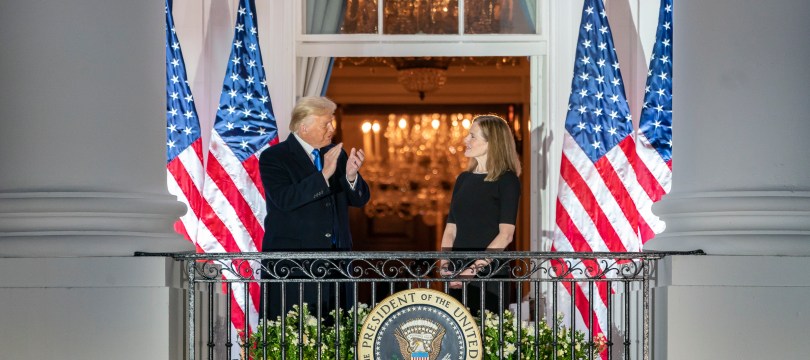
How to survive and outflank Justice Amy Coney Barrett

At 49, Amy Coney Barrett is four years older than me, and has just been given a lifetime appointment to the US Supreme Court. Her appointment is the culmination of a generation of efforts by the Federalist Society and allies to engineer the Supreme Court into a brake on the emerging social democratic politics of a multiracial and economically unequal America. It is the last act of an unprecedented decade of obstruction of Federal judiciary appointments by a Republican Senate majority that represents a minority of Americans. Barrett herself is the standard-bearer of a judicial philosophy that upholds the intentions of eighteenth century lawmakers in a twenty-first century society, as well as personally committed to religious and community politics that would roll back a half-century of feminist social transformation.

Despite all this, our existing institutional arrangements will give Amy Coney Barrett the power to review the laws of this country well into the 2060s, long after the United States has ceased to a majority-white country, and when Millennials and Generation Z will rightly be democratically shaping their own present and future.

I promise you that the Constitution itself is less sacred than the right of my children and children’s children to not have their freedom overseen by Amy Coney Barrett in 2060.

So how can we prevent that future? Here’s a list of strategic options, including those already in circulation, for the coming months and the years and decades beyond. We too can strategize in terms of decades, outflanking the regressive minority that brought us Justice Barrett.

  1. First, our mentality must change. We must divest ourselves of the notion that the current Constitution and the Supreme Court are sacred. Only rarely has the Court marched ahead of society in the fight for greater justice (notably, Brown v. Board of Education, Miranda); mostly it has played a role of cementing widespread changes already underway (Roe, Obergefell), or even worse standing in the way of transformative progress (Bakke) and rolling back critical protections (Shelby County v. Holder). If we want a visionary court again, we will have to fight for one, and not offer compromise justices that split the difference between the parties (looking at you, Merrick Garland) or between liberal identity politics and corporate power (Elana Kagan). With respect to the Constitution, virtually every other country in the world has written a new constitution since 1945, and collective notions of human rights have dramatically expanded worldwide. We’re overdue to catch up. The trifecta of an unrepresentative Senate, a majority-canceling Electoral College, and a lifetime-appointed Supreme Court is no holy trinity. Get over your allegiance to these institutions and the flawed, outdated and political document that created them.
  2. Supreme Court expansion: Comes in two flavors: partisan retribution (you got 3, we get 3) and fundamental rethink (let’s have many more justices and a less-partisan process). Biden seems down for legal scholars to sort this out.
  3. Impeach Brett Kavanaugh, who committed perjury in his nomination hearings. Congress could do this. Controversial, but not as controversial as having someone who lied about sexual assault sitting on the court for a generation.
  4. Expand and nominate to the Federal judiciary: There really is a backlog of cases in the Federal courts and plenty of candidates waiting.
  5. Amend the constitution and enshrine the rights Barrett doesn’t believe in. While constitutional amendment is an exhausting process, the Equal Rights Amendment has already been ratified by 38 states, and just needs formal acceptance and some legal defense. A Biden administration could do this unilaterally, though there will be legal wrangling to follow up.
  6. Legislate Roe. There’s draft legislation to do this, the Women’s Health Protection Act: “A health care provider has a statutory right under this Act to provide abortion services, and may provide abortion services… without any of the following limitations or requirements.” This legislation does away with a generation of debate as to whether the Constitution itself provides the right to abortion, by making that right a matter of law.
  7. Make human rights treaties legally enforceable in Federal Courts. The US is signatory to a raft of global and hemispheric treaties enshrining a variety of human rights, but their enacting legislation prohibits citizens from raising claims from them in court. Reverse this.
  8. Ratify the American Convention on Human Rights and thereby allow the Inter-American American Court on Human Rights to issue binding protections for human rights, reviewing Supreme Court rulings. This is the system that most of the hemisphere lives under, and it sets a high floor for human rights across Latin America.
  9. Incorporate radical transformations of our country’s identity, institutions, and constitution into mass movements. Much of my last dozen years has been spent documenting how social movements revolutionized Bolivian politics. One important ongoing demand of those movements was radical constitutional reform in which everyday people and grassroots leaders rewrote the constitution from top to bottom. New visions were inserted and old structures abolished. What made this process possible was that instead of thinking about a “movement to amend” the political structures of society, this was a movement to reconceptualize what Bolivia is, into a plurinational, autonomy-centered society in which indigenous peoples rule themselves. Everything from history to national identity sense of self was up for grabs. A new constitution was the by-product of far more radical transformation.
  10. Keep fighting for the world we want. Don’t get locked in a defensive crouch about Barrett and her five new best friends. When they come to say we can’t have universal health care, stabilize the Earth’s climate, remake criminal justice, or rethink our society, take those moments as opportunities to re-build the kinds of institutions we need to achieve these real goals.

As the United States’ overly romanticized Founding Fathers once wrote, “whenever any form of government becomes destructive of these ends, it is the right of the people to alter or to abolish it.”

Ecuadorian indigenous leaders gather in March to advocate null votes in the second round of presidential elections.

Parallels in Ecuador, Bolivia elections highlight growing role for independent and Indigenous politicians

Today’s New York Times is highlighting (with a quote from me) the growing number of Indigenous politicians and parties (en castellaño) claiming space in Andean politics. Different individuals and collectives are making the case for indigenous autonomy, post-extractivist economic models, accountability to the grassroots, and internal democracy (vs. centralized hyper-partisanship).

In Ecuador and Bolivia, this often means challenging the official standard-bearers of the left: Rafeal Correa’s chosen successor Andrés Arauz, and the Evo Morales/Luis Arce-led Movement Towards Socialism (MAS-IPSP).

Despite narrowly being shut out of today’s Ecuadorian presidential runoff, Pachakutik will be the second-largest party in the new parliament. As Pachakutik’s Yaku Pérez fought for second place in the first-round election in February, Correa’s party made it clear they would much rather face a neoliberal banker than debate extractivism, indigenous rights, and democracy in the general election. Pachakutik and the Ecuadorian Indigenous movement, which backed a late 2019 uprising against neoliberal policies, is calling for null votes in protest today and promises to continue its fight in parliament and through street protest no matter who wins. “We will permanently remain firm in our horizon of resistance,” the Confederation of Indigenous Nationalities of Ecuador declared in mid-March, “and we will establish other mechanisms of struggle to make a path for the social and popular demands of the country.”

Pachakutik and the Democratic Left (Izquierda Democrática) have agreed on an alliance in the National Assembly, where they won 27 and 18 seats respectively (32% of the body), have proposed a joint agenda, and are seeking independent allies. If they attract five additional legislators, they will comprise the largest delegation, and regardless will be essential votes for whoever wins today’s election.

Pachakutik and Democratic Left will hold the balance of power in Ecuador’s new parliament.

In Bolivia, regional elections wrap up today with four run-offs for governor. In three of those, independent Indigenous candidates are challenging the MAS from the left. Three independent left candidates also will govern El Alto, Trinidad, and Cobija as mayors: Eva Copa, Cristhian Cámara, and Ana Luisa Reis. These three mayors-elect were all former members of the MAS-IPSP passed over by the party’s centralized nomination process (known popularly as the dedazo). Damián Condori, a peasant leader who built an independent party when he was passed as MAS-IPSP candidate for governor in 2015, is facing a tight runoff today in Chuquisaca after winning a plurality in the first round. Santos Quispe, the son of renowned indigenous leader Felip Quispe (“El Mallku”), is challenging in La Paz. And Regis Richter, another candidate sidelined by this year‘s dedazo, is the challenger in Pando. A run-off in Tarija is a more conventional left–right contest in a deeply divided department.

Eva Copa’s advocacy for the MAS under the difficult circumstances of Áñez government made her a national figure, but she ran for mayor highlighting issues of local accountability. Condori and Quispe represent political in-roads for their department‘s rural Indigenous populations, following in the wake of outgoing La Paz governor Felix Patzi. Their rise shows demonstrates an ability to stake out political ground outside of the vertical power structure of the MAS-IPSP. However, the biggest debates in Bolivia about democracy, indigenous autonomy, and ecological sustainability in Bolivia are likely to continue to happen outside of electoral politics for now.

Three of the four gubernatorial runoffs in Bolivia feature MAS–independent left contests.

We dumped Trump. But now our struggles will feel harder

The playing field for changing American political life is about to shift dramatically.

If your agenda has included both resisting Trump and building a just, sustainable, antiracist, liberated world, you’ve just lived through a dramatic four years where one problem—the president of the United States—probably occupied a lot of your mental space. That space was crammed with a seemingly endless series of moral/political crises, from a sudden travel ban, to the attempted rollback of Obamacare, to racist mass shootings in Pittsburgh and El Paso, to the literal break-up of refugee families before our eyes, to the drastically mishandled COVID pandemic, and in a final burst of sparks both an attempt to grab power despite electoral defeat and a sheaf of last minute executive action, symbolized for me by the leasing of Arctic indigenous land to oil companies on January 6, 2021. Alongside all this has been a dumpster fire of a presidency marked by petty corruption, vindictiveness, foreign entanglements, and the endless, surreal production of belligerent tweets and speech.

Up til now, America has had a 2016 problem. How to manage the consequences of troubling (to say the least) president elected without even a plurality of votes, who showed no signs of seeking broaden that coalition, but instead focused on using the available levers of power to advance corporate power, a narrow-minded religious vision he evidently had little faith in, an authoritarian vision of state that attracted him greatly, and the nativist, racist, and antiqueer agendas that had hidden behind codewords and euphemisms for decades. The tools for dealing with that problem ranged from mass street protest to fights in the courts, but their leading edge was an electoral effort that reclaimed one house of Congress in 2018 (with an extraordinary 8% vote margin) and the White House in 2020 (with a more modest 4.4% vote margin). Despite temporary and quasi-permanent structural barriers to one-person/one-vote democracy—respectively, redistricting and disenfranchisment, and the Senate and Electoral College—this effort succeeded.

But as I said, the problem is about to change. And that change is going to be disorienting for many of us who have nothing but glee over the end of the Trump presidency.

I’m writing here to keep us—those who want more than a “return to normal”—oriented as the political world takes an Inception-like 90-degree turn and the forces of gravity seem to turn against us.

The compass I keep in the back of my mind is this: think about the scale of the problem you are confronting. How deep does it go? How far back in history are its origin points? How wicked in the problem, and what other problems are clustered around the same causes?

It helps that my adult political life began around the time of the Seattle global justice/antiglobalization protetss against the World Trade Organization. Adbusters magazine, one of the creative epicenters of that mobilization, circulated the image shown here. In the center is the kind of error message produced by 20th century Apple Macs when they crashed, with the text “System Error—Type 1945 (progress).” The end of World War II also marked the foundation of the global economy, through the World Trade Organization (then, the General Agreement on Tarriffs and Trade), the World Bank, and the International Monetary Fund. It was the handoff point from a war-time, state-organized economy to the era in which mass consumerism would accompany continuing militarism. And it was the debut of a United States-led global order incorporating the majority of countries into sometimes colonial and sometimes dictatorial, but self-branded “free” world.

In Seattle, we were confronting a process that was “writing the constitution for a single global economy,” as WTO head Renato Ruggiero put it, written behind close doors in the interest of corporate power. We were also confronting a process endorsed by both political parties. It was the culmination of a neoliberal vision of globalization, championed as much by Clinton’s New Democrats as by Ronald Reagan and Margaret Thatcher. (The Democratic party assumed that Seattle, a city then much more identified with Boeing than big tech, would be the perfect showplace for the debut of globalization.) When we surrounded the meetings with nonviolent blockades, a Democratic president, governor, and mayor collaborated in calling in the National Guard, flooding the streets with tear gas, and arresting six hundred demonstrators.

Flash forward three tumultuous years to the authorization of the War on Iraq. Fifty-eight percent of Democratic Senators and 39% of Democratic Representatives joined nearly all Republicans in backing the new war. The global antiwar coalition lacked a partisan home in the United States, but it built on the global justice movement’s transnational ties and experience in taking the streets. The media baptized global public opinion “a second superpower” that was challenging the unilateral US government. Within the United States, though, we never amassed the votes to block the war, but just as in Seattle, our protests gave other countries the space to step away from or denounce the war. Later, Barack Obama made opposition to the Iraq War a core part of his appeal in 2008.

The point is, whether confronting war or globalization, we knew we started from a point of institutional weakness within representative government, but potentially widespread support in the country at large. Protest was our natural arena since congressional votes and court cases would often run against us.

International arrivals as a protest space, SFO. Jan 2017.

The last four years have been different. I could feel this when people protesting the Muslim travel ban flooded airports, along with lawyers from the American Civil Liberties Union. Already in the first week of the Trump presidency, a range of institutional actors were shifting their stances around protest: local officials extended transit hours for people protesting at the airport, technology executives from Google’s Sergey Brin on down were showing up to back the protests, state attorneys general were filing for court injunctions against the ban. An exceptional wave of donations and subscriptions was rising to support advocacy organizations like the ACLU and journalistic outlets like the New York Times.

2017 and 2018 proved to be an experiment in what would happen when a radical faction controls the executive and legislative branch of the US government, but faces opposition from many other institutions, notably bastions of professionals. Journalism, Hollywood, and Silicon Valley were all filled with critical voices. Certain Federal courts issued injunctions limiting executive power. #MeToo emerged, a movement with extraordinarily broad participation and a target on the kinds of harrassment and abuse practiced by the president, but also elite men of all parties and sectors. Speeches by Meryl Streep and Oprah Winfrey at the Golden Globes, the not-necessarily-political awards ceremony of the Hollywood Foreign Press Association, frontally challenged the president. (These signs reassured me about the parallels to fascist authoritarianism in Europe: Hitler and Mussolini had succeeded in part because of the total moral collapse of major institutions. Ours held up by comparison.)

The broad alliances of the past few years have now done their work, pushing Donald Trump kicking and screaming to the edge of the political stage and to a now-inevitable exit from the White House. But they won’t last into the next round of struggles. Because we will no longer be confronting just 2016 problems. Some of the people we voted for will reinforce the structures of power we aim to dismantle. Some people who joined us in the streets since January 2017 will drift away now that they feel they have an ally in the White House. And some of those who fought with us against Trump will now see our visions as the real problem.

The Black Lives Matter protesters of 2020, perhaps our country’s most widespread protest mobilization, knew this already. As Trump has never stopped reminding us, these protests usually take place in “Democrat cities.” They face off with a bipartisan consensus around mass incarceration and militarizing the police—System Error Type 1969 (New Jim Crow)—and require uprooting the systemic racism built into our country the beginning. Call it System Error Type 1619. Active movements call into question settler colonialism (Type 1492). As disappointing Biden appointments come in, we will be reminded of our other long-term struggles against unwarranted corporate power, wealth inequality, mindless consumerism and its destruction of the planet. All of these will require acting beyond political parties and mainstream institutions, as well as leveraging them where we can.

One more thing: it’s not the case that the older a systemic problem is, the harder it is to fight. We’ve lived through extraordinary changes to order of gender, sex, and sexuality—systems who symbolic origins are lost to time and unidentifiable with a familiar date—in the past fifty and the past fifteen years. Fights that were once only imaginable in the streets and in our own families became fights in the courts and eventually were embraced by the lighting of the White House. Successful movements transform fundamental shifts into collective common sense. Let’s keep our eyes on horizon as the world shifts around us.

Top image by Riske Mustamu from Pixabay

Are we in the most widespread protest wave in US history?

As Black Lives Matter protests multiply across the country in the wake of the police murder of George Floyd, people are asking how to place the massive public reaction into historical context. Subjectively, the current protests can feel like another element in a long series of protests memorializing Black deaths at the hands of the state and private racist acts—“A decade of watching Black people die”—and simultaneously like “a watershed moment” that “changes everything,” as new and unexpected parts of US and world society are joining in the resistance to racism and police violence. It’s in that context that the first quantitative counts of the George Floyd protests are circulating now.

Writing in the Washington Post, Lara Putnam, Erica Chenoweth, and Jeremy Pressman call the current protest wave “the broadest in U.S. history” and note that, “People have held protests in all 50 states and D.C., including in hundreds of smaller, lesser-known towns and cities that have not been in the spotlight during previous nationwide protests.” Of course, “broad” is the a measure here because, so far, largest is off the table: many protest waves have involved larger overall numbers of participants and certainly there have been many larger single events than the impressive rallies this week, which have reached the tens of thousands in Minneapolis, Houston, Portland, San Francisco, Seattle, and Washington. And of course, no prior protest wave has had to overcome the challenge of pandemic-induced social distancing.

So the measure has become less about the sheer number of people involved, and more about the number and diversity of the locations we are showing up to protest. So how do we measure that and how can we be sure? Unfortunately, there is no single long-term data set on protest participation, despite the recent hard work of the Crowd Counting Consortium (CCC)—founded by Chenoweth and Pressman—since 2017. Before that time, we have to rely on historical and personal memory, which can often mean we forget the more distant past and discard events that don’t fit well into longer narratives.

The data from the CCC show events in 538 distinct US municipalities so far (and more are on the way). (To calculate this number, I ran a uniqueness filter on city and state from the May and June spreadsheets for George Floyd events.) A tracker from USA Today names 700 localities in the United States. These are very high numbers, but of course they reflect both the increased willingness and ability to rapidly organize protests and improved means for researchers to find them. Zeynep Tufekci makes a compelling call in her book Twitter and Tear Gas to avoid purely numerical comparisons across different decades: “seemingly similar outcomes

“seemingly similar outcomes and benchmarks—for example, a protest march attended by a hundred thousand people—do not necessarily signal the same underlying capacity to those in power when they are organized with the aid of digital technology as they do when they are organized without such supporting tools.

Tufekci, Zeynep. Twitter and Tear Gas: The Power and Fragility of Networked Protest. New Haven: Yale University Press, 2017, p. 192.

Instead of measuring outcomes, Tufekci urges us to look at the “onerous labor and deep organizational and logistical capacity to make things happen,” which had to be built before marches could exist in the 1960s, but which now tends to be constructed on site after a movement has gone viral and found one another in the streets. She proposes we should look at narrative capacity—“the ability of the movement to frame its story on its own terms, to spread its world view”; disruptive capacity to “interrupt the regular operations of a system of authority”; and electoral or institutional capacity “to keep politicians from being elected, reelected, or nominated unless they adopt and pursue” desired policies.

It may be too early to tell whether participation in 2020 is truly more widespread than in past events, or to measure the depth of commitment and sophistication of the current movement, but what I want to do here is lay out some other protest waves that we should have in mind when looking for comparisons:

Read More »

Binding Leaders to the Community: The Ethics of Bolivia’s Organic Grassroots

Just published in Journal of Latin American and Caribbean Anthropology. Bjork-James, Carwil. 2018. Binding Leaders to the Community: The Ethics of Boliva’s Organic Grassroots (full text). Journal of Latin American and Caribbean Anthropology 23, no. 2 (July): 363–82. Abstract: Bolivia’s largest social movement organizations—including its labor unions, rural communities, and neighborhood organizations—are bound together by a hierarchical […]

No, TIPNIS solidarity isn’t a “conveyor belt” for US-backed regime change

An article published Monday in CounterPunch has resurfaced a narrative that frames Bolivian indigenous and environmentalist movements (particularly the campaign in defense of TIPNIS) as a stalking horse for United States-backed efforts to remove and replace the Evo Morales government. The accusation is false, although like many conspiratorial narratives it weaves together facts, half-truths, inventions, and genuine moral feelings into a plausible narrative. Since the particular narrative involves a solidarity letter that I largely drafted, and it keeps cropping up even after six years, I will address it here.

The allegation that opposition to the Evo Morales government is coordinated by the United States (or the domestic right-wing opposition) is rooted in a real history. US government opposition is real and well-known. Morales’ Movement Towards Socialism–Political Instrument for the Sovereignty of the Peoples (MAS-IPSP) and Morales’ Chapare cocalero base were principal targets of a US-backed drug war, which they resisted. When the MAS-IPSP emerged as a political force, the United States government acted to resist its rise, supported his opponent in the 2005 presidential election, and encouraged establishment political forces when they regrouped in a separatist movement governing between four and six of Bolivia’s nine departments. That campaign fell apart in the September 2008 political crisis. So, wariness of the US government as a nexus of opposition is understandable.

However, the Bolivian government has indiscriminately accused large mass mobilizations from below and from the left of being right-wing- or US-controlled fronts. In 2010 and 2011 alone, the government alleged that the CIDOB indigenous confederation, the Potosí regional strike (in a region that voted over 70% for the MAS-IPSP), and the general strike by the Bolivian Workers Central (the national trade union confederation) were all covert attempts at a coup and fronts for anti-Evo conspiracies. A Google search for “Evo Morales” “ve conspiración” derecha reveals more recent examples of allegedly conspiring groups: cooperative miners, Achacachi peasants, opponents of the election procedures for the judiciary, and former Human Rights Ombudsman Rolando Villena.

Given the president’s life story, I empathize with his tendency to see a conspiracy behind every opponent. But empathy is not validation.

Here’s why these charges are baseless in this case:

The lowland indigenous movement was not, and is not engaged in regime change, nor has it ever posed an existential threat to the Morales government. This should go without saying, but a movement whose force is primarily moral self-sacrifice, demonstrated through arduous cross-country marches, hunger strikes, and vigils is not going to expel Morales from power. The solidarity efforts that paralyzed several regions of the country with general strikes in late September and early October 2011 were aimed at winning a protection law for TIPNIS, legislation that required votes from MAS-IPSP representatives. There’s no regime change here at all.

The notion of outside control over a highly arduous form of protest like the CIDOB/CONAMAQ marches has always been absurd. The risks and effort involved cannot be bought, certainly not by the kind of organizational training initiatives that USAID provided to CIDOB well before the march. The decision to begin the march, and to continue with the march in the face of tear gas and mass arrest, was made by these movements themselves.

The United States government, alleged by this narrative to be coordinating opposition to the road, has never opposed the TIPNIS highway, nor has it coordinated any significant press push around the issue.

The international solidarity campaign for TIPNIS was built around movement-to-movement contacts between activists outside Bolivia and inside Bolivia, drawing on a long tradition of solidarity with both the anti-imperial vision of grassroots protest in Bolivia and global efforts for environmental sustainability and indigenous rights. The September 2011 letter spoke directly from that position:

As supporters of justice, indigenous rights, and environmental sustainability on a global scale, we have closely watched events in Bolivia since the turn of the century. We have observed and supported Bolivian social movements’ challenges to neoliberal economic policies and to the privatization of water and other natural resources. We value the proactive diplomacy of the Plurinational State of Bolivia in
supporting the rights of indigenous peoples, meaningful and effective responses to climate change, recognition of the right to water and sanitation, and formal acknowledgement by the State of the rights of ecosystems and the biosphere as a whole.
We have also watched with great interest and respect as Bolivians sought to incorporate these principles into their Constitution of 2009 and their national laws, including the Law on the Rights of Mother Earth. We are pleased that Bolivia has proactively asserted the place of international civil society in the global debate on climate change, particularly in Copenhagen and by hosting the World Peoples’ Summit on Climate Change and the Rights of Mother Earth in Cochabamba in April 2010 and we look forward to participating in the 2nd Summit next spring. However, the country’s pioneering work on all these issues also comes with a great responsibility. Bolivia’s continued ability to press forward this vital agenda will
be affected by its consistency and moral credibility on matters of human rights and environmental protection.

Solidarity campaigns with TIPNIS have in all ways been much stronger and larger within Bolivia than outside of it. The letter’s 59 foreign signatories and two Bolivian signatories reflect nothing more than that it was an international solidarity letter. At the same time as we were finding signers for the letter, street protests occurred in eight of nine departmental capitals, a 24-hour general strike of the COB labor union confederation was held in solidarity, and department-wide strike was held in Beni. The Beni Civic Committee coordinated a general strike and coordinated road blockades in the capital Trinidad, Santa Rosa, San Borja, Riberalta, and Rurrenabaque. The Beni strike extended through a third day, with the participation of unions of teachers, bank workers, shopkeepers, and health workers. On that third day, September 28, the Bolivian Worker’s Central called for a general strike, which affected nearly all major cities and in the tradition of “mobilized strikes” generated large afternoon rallies. Attendance was estimated at over 10,000 in La Paz and in the town of Riberalta, Beni. In Cochabamba, teachers, university students, and municipal workers blockaded major avenues while the public transport system observed a general closure. When the march finally reached La Paz in mid-October, tens of thousands of Paceños lined the route or joined in, while the capital city’s Mayor gave the marchers a key to the city.

Stansfield Smith writes in Counterpunch that “all international issues can only be understood in the context of the role and the actions of the US Empire,” but what he effectively means is that all domestic issues in Bolivia are international issues. And, in his view, they can only be understood as struggles between an “anti-imperial” government and critics who are presumed to be tools of imperialism. We have seen that the government freely makes such accusations, often against former and future allies, without evidence. In the case of Bolivian lowland indigenous movement and critical domestic NGOs, accusations of conspiring with foreign powers have become a mechanism of control. Pretending that we are resisting imperialism by ignoring grassroots social movements does a disservice to the real work of solidarity.

Feature photo by @MiriamJemio