Lliquimuni drillsite arises out of a cleared area in a cloud-shrouded forest

Lliquimuni test well in Bolivian Amazon fails

The joint Bolivian-Venezuela state oil company Petroandina has announced that its exploratory drilling well Lliquimuni Centro X1 failed to find commercially viable quantities of oil after 440 days of drilling. As previously covered here, the Lliquimuni oil block is among those posing the greatest future environmental risk in Bolivia due to its location in the fragile Amazon rainforest and the lack of any reliable infrastructure to pump oil and gas extracted at the site to outside markets.

The government of Evo Morales has made extravagant claims about the potential of the block, located in northern La Paz department, suggesting that as many as 50 million barrels of oil and 1 trillion cubic feet of natural gas may be lie beneath the ground there. However, the $170-million dollar effort to find this oil has yet to produce a successful result. While oil and gas exist below the site, the quantities found would not be profitable to extract.

Undaunted, Minister of Hydrocarbons and Energy Luis Alberto Sánchez pledged to La Razón:

We will continue exploratory activities in the north of La Paz. We will not rest in the search for hydrocarbons; if the first well was not successful, the news isn’t discouraging since will will continue exploration in other wells until we find the reservoir that we know is there.

“Seguiremos las actividades exploratorias en el norte de La Paz. No vamos a descansar en la búsqueda de hidrocarburos; si bien el primer pozo no fue exitoso, la noticia no es desalentadora porque continuaremos la actividad exploratoria en otros pozos hasta encontrar el reservorio que sabemos que se encuentra ahí”

Despite his perseverance, the odds against a major oil complex in Lliquimuni have just gotten longer.

Bolivia’s climate pledge triples down on fossil fuels, megadams

Screen Shot 2015-11-30 at 1.01.55 PM

Last month, Bolivia submitted its pledge (English|Spanish) on addressing climate change to the UN FCCC, the body charged with overseeing global negotiations to prevent dangerous global warming. While much of the document is addressed towards global issues, the quantitative details show just how committed the Evo Morales government is to accelerated, and environmentally destructive, development.

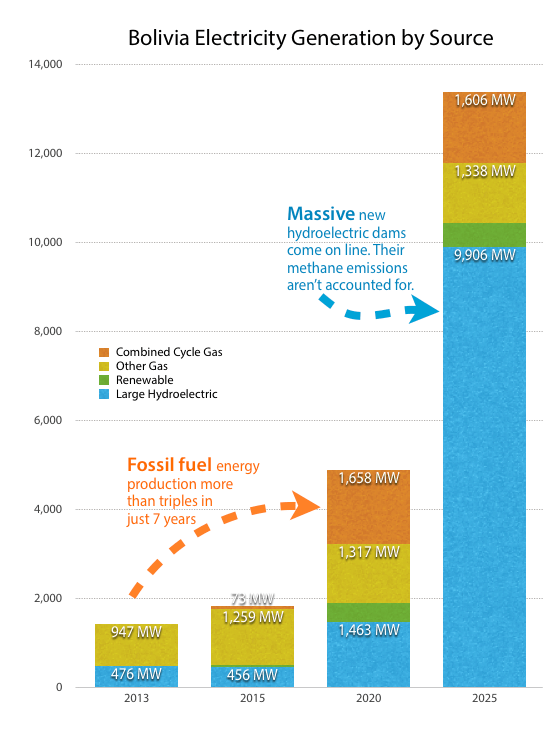
The document follows  ambitious government announcements this year about expanding agribusiness, gas and oil exports, and electricity generation. I isolated the electricity numbers, with help filling in the details from this October 2015 report covering the Ministry of Energy and Hydrocarbons.

As you can see from the graph above, there are two big stories to be told about Bolivia’s electricity production plans. First, over the next five years, the country plans to massively expand its domestic burning of natural gas, more than tripling the 947 megawatts (MW) supplied by gas in 2013. Second, in a series of larger-scale projects, the country plans to bring 9,450 MW of hydroelectric power on line by 2025. This enormous expansion would require megadams at Rositas, El Bala, Miguillas, Río Grande, and Cachuela Esperanza (to name just a few of the sixteen proposed). These dams are likely to have severely damaging environmental consequences, particularly since some are located in fragile or protected natural areas. A third story is just as important: the government predicts that domestic power demand will only reach 3,000 MW in 2025, meaning that the vast bulk of the new electricity is intended for foreign consumers, mostly in Brazil and Argentina.

Bolivia’s climate pledge or Intended Nationally Determined Contribution manages to misrepresent this shift as a green move in two ways. First, it deals only in percentages: “Increased participation of renewable energy to 79% by 2030 from 39% in 2010.” In fact, the smaller percentage of nonrenewable energy reflects a massive increase. Second, it counts large-scale hydroelectricity as renewable and the carbon emissions numbers seems to treat these dams as zero emissions, despite the fact that entire biomass flooded by new dams is gradually converted into methane and released to the atmosphere.

Other unlikely claims are advanced in the area of land use change and forestry, including a unexplained promise to reduce illegal deforestation to zero, and to somehow reforest 4.5 million hectares of the country. These pledges coexist with a government plan to expand agricultural land by 10 million hectares over the coming decade, with the most coveted land for planting located squarely in the Amazon rainforest.

On Allegra: Can a gas pipeline heal Bolivia’s wounded geo-body?

Screen Shot 2015-09-11 at 8.41.42 PMMy latest essay on Bolivia was published by Allegra Laboratory. It looks at the deeply felt woundedness around Bolivia’s loss of coastal territory to Chile, and the surprising notion that exporting natural gas from a Peruvian port could heal that wound.

Allegra is a fascinating site dedicated to the anthropology of politics, law, and art. You can read about them here, and check out their Academic Slow Food Manifesto on the same page.

Marchers raise their hands on first day of CONAIE March, Tundayme, Zamora Chinchipe

Demands from Ecuadorian indigenous movement CONAIE’s August mobilization

A major protest mobilization by Ecuador’s indigenous movement, led by the Confederation of Indigenous Nationalities of Ecuador (Confederación de Nacionalidades Indígenas del Ecuador, CONAIE | website facebook twitter) began on Sunday, August 2. The following is my translation the document produced by the organization’s July assembly spelling out its demands.

Resolutions of the Annual Ordinary Assembly of CONAIE
Salasaca, Tungurahua
July 17 and 18, 2015

The Confederation of Indigenous Nationalities of Ecuador, meeting in its General Assembly with the participation of official delegates from grassroots organizations and from the regional affiliates CONFENIAE, ECUARUNARI, and CONAICE, faced with current political conjuncture and the situation of the indigenous movement, resolve:

EcuadorMarchMap-Aug20151. To convene the grassroots of all the peoples and nationalities of Ecuador to the Great Indigenous Uprising, in unity with sectors of society and the Ecuadorian people in all the provinces of the country, on August 10, 2015. Putting forward the national demands of our people and our own agenda as an indigenous movement. We ratify our firm position of No to the Dialogue [as proposed] with the national government.

2. To recover the autonomy of Intercultural Bilingual Education and to demand the immediate reopening, instead of the closure, of intercultural bilingual education schools, teaching institutes, colleges, Childhood Centers for Good Living (Centro Infantil del Buen Vivir; [an early childhood education program for poor children]), and the Amawtay Wasi University [an indigenous university co-founded by CONAIE in 1989], free access to public education, as well as the creation of research centers at the regional level to strengthen the process of autonomous education on the part of the nationalities and peoples.

3. To halt the plunder of the land and territories that government promotes by means of the new land, water, and mining laws; and thus, we call for the land law to be shelved and for the repeal of the laws that affect the development and rights of indigenous peoples. To strengthen control over our territories and to not permit the entry of any government functionary nor of a single transnational corporation.

4. To shelve the proposal to amend the constitution, which promotes the restriction of the rights which we, by our struggle, managed to have included in the Constitution.

5. To stop political persecution and the judicialization [of politics; i.e., using court cases to pursue political opponents] implemented by the government of Rafael Correa against the leaders of social movements, and the leaders within indigenous peoples, students, doctors, retired people, defenders of nature, and of human rights, and other organized social sectors. To do away with institutionalized corruption and the state of repression so as to build plurinational democracy.

6. To strengthen a unified agenda together with the other sectors of society. To organize the mobilizing process that begins with the great march of the peoples from Tundayme-Zamora Chinchipe on August 2, the Indigenous and Popular Uprising on August 10, and the national strike organized by the Unitary National Collective on August 13.

7. To ratify our full commitment to defeat the capitalist economic model built upon oil and mining exploitation implemented by this government and to establish an alternative community-based economy coherent with the [concept of a] Plurinational State.
Lliquimuni drillsite arises out of a cleared area in a cloud-shrouded forest

Lliquimuni: The petroleum threat in Bolivia’s northern Amazon

The Lliquimuni oil block could be the beginning of oil extraction in the northern Bolivian Amazon. This video, circulated by Alerta Amazónica, surveys the environmental dangers that accompany the project:

That beginning could come sooner than expected. On June 22, the Bolivian–Venezuelan consortium Petroandina announced “encouraging results” partway through the exploratory drilling at well LQC-X1. Company representatives expect to deliver a full report on the test well, which is operated by in  September.

Seismic studies carried out from 2008 to 2010 provided an estimate of 50 million barrels of oil in the area. Already last December, President Evo Morales was naming the underground oil reserves as reason enough to develop a large-scale petroleum industry presence in the northern part of La Paz department, a forested and mountainous area that lies to the north of the capital city of the same name.
“One the study is done, then comes the exploitation. I have said, if we find oil in La Paz, it will be our obligation to install a refinery here in the north of La Paz. Una vez hecho el estudio, perforación, vendrá la explotación. Yo lo decía, si encontramos petróleo en La Paz, será nuestra obligación instalar una refinería acá en el Norte de La Paz.
LQC-X1, the current center of exploration is near the community of Inicua, in Alto Beni municipality, part of Caranavi province (the municipality of Teoponte, in Larecaja province is nearby, and a border conflict driven by possible royalties was already active in 2014). Creating even this bit of petroleum infrastructure required something of an epic effort, perhaps inspiring the cinematic soundtrack for a promotional video from Petroandina. (You can see the government-owned oil company’s rather more heroic view of the project in the first two videos shown here.) Building either a refinery or oil pipelines out of the region would be a far greater challenge, which is perhaps the greatest factor holding back the transformation of the northern Bolivia rainforest into an oil-producing region.

Map: Bolivian parks and protected areas opened to oil & gas drilling

This map, produced by the Bolivian Documentation and Information Center (CEDIB) shows the country’s national parks, biosphere reserves, and other protected areas in green, and both existing and planned oil and gas concessions. Oil and gas concessions are colored by the corporation involved, while light purple indicates blocks to be auctioned off in the future. The map appeared in CEDIB’s magazine PetroPress in 2013, where it accompanied a longer article.