The US-Bolivia Relationship

Last week, Bolivia hosted a conference of defense ministers from all the countries in the Americas. This became front-page news here mainly because of the speech by President Evo Morales and proposals put forward by Bolivia. It also seems to have attracted at least a little attention in the United States.

US Defense Secretary Robert Gates came to Bolivia with the public agenda of discouraging Bolivia-Iran economic cooperation. He was actually surprisingly diplomatic in his complaints, saying from the outset that Bolivia has the right to have relationships with whomever it chose, but cautioning that Iranian interest in Bolivia’s untapped uranium and joined Bolivia-Iran plans for civilian nuclear plants will be closely monitored.

During the summit, Evo’s opening speech criticized the United States’ history of intervention in Latin American democracies. He claimed that popular democracies are “three and one” in resisting attempted coups backed by the United States. The three are Venezuela (2002), Bolivia (2008), and Ecuador (2010); with the one being Honduras (2009). In fact, they are two inaccuracies in this score: the recent police revolt in Ecuador did not have any apparent American backing, as President Rafael Correa has said publicly; and Evo, like many other observers, leaves out Haiti (2004), the only case in which Americans had an on-the-ground role. The real score is a less optimistic two for the democracies, two for the United States-backed coups against them.

Nevertheless, what has gathered media attention is not Evo’s accuracy, but his audacity in making such a comment in front of a senior American official. The Heritage Foundation responded by saying that, “Morales demonstrated in his speech a quantity of venom, a lack of restraint, and complete disrespect for the U.S. that befits a bully and tyrant.” Heritage joins several right-wing congress members and urging more hostile relations between the United States and Bolivia.

It is difficult to imagine exactly what that would mean since the two countries have had not had ambassador-level relations since 2008, when Bolivia expelled the US ambassador for coordinating Bolivia’s right-wing opposition at a time when it was seizing and burning government buildings and taking over gas infrastructure. After the Obama election, both countries have expressed a desire for renewed relations and cooperation, but the Bolivian proposal for a treaty of mutual respect has languished inside the United States State Department. While in August of this year, the countries announced “90% agreement” on the treaty, there is then no action since. Now that members of the new Republican House majority are making angry noises about Bolivia, it will be even more difficult for the Obama administration to make headway on mending the relationship.

I’ve been meaning to write a bit of background about the US-Bolivian relationship, and the realistic and unrealistic fears of the Morales administration about US intervention. The threat is real; no one who pursues an independent policy as a Latin American president can ignore what happened to Salvador Allende (Chile, ousted by a US-backed coup in 1973); Maurice Bishop (Grenada, invaded by the US in 1983); and Jean-Bertrand Aristide (ousted by CIA-paid Army officials in 1991); and what nearly happened to Hugo Chavez in 2002. However, the rhetoric of foreign interference often gets carried over into domestic politics. A quick summary might be: Just because they are out to get you doesn’t mean you’re not paranoid; and, Just because you’re paranoid doesn’t mean they aren’t out to get you. However, since nearly 1,300 documents on just what the US Embassy has been doing in Bolivia are being released by Wikileaks beginning this week, I’ll suspend judgment on just who is paranoid until I read the documents.

What’s behind the Potosí regional strike?

As the department-wide strike in Potosí continues to edge into the international press (primarily through its effect on tourists and now upon mining companies that operate in the region), I want to give more of the background on the strike and its demands, so it’s at least understandable why people are blockading and hunger striking there.

“It can be summed up in one single thing: in misery. … We are fighting for a hill that as of yet is not a factory, just a hill; it’s raw material. For the dream that some time we, that the families that live there, might have something. They are places forgotten by the hand of God: they don’t have water. They are using up the water in the wells. There is no electricity. It is misery.”
Saúl Juarez, Potosino hunger striker in Cochabamba

If you are from North America, this use of misery might be unfamiliar to you, but it is common in the language of Latin America. We must first organize, then-Haitian president Jean Bertrand Aristide once said, to move from misery to poverty. Here in the hemisphere’s second-poorest country (after Haiti), Potosí is the poorest of nine departments. The rate of extreme poverty, which is falling nationwide, is still 66.7%; meaning that two-thirds of Potosinos cannot afford to buy their family’s basic necessities. Of every 1000 live births there, 101 children will die before their fifth birthday. Both of these figures are the highest in Bolivia; in the case of child mortality, the second place departments—La Paz and Chuquisaca—see 63 deaths per 1000 children. It is for this reason that Potosinos have spread to the rest of the country in search of better opportunities.

“We can say that we are fighting for the reactivation of the productive apparatus of Potosí.”
Claudia López, Potosino hunger striker in Cochabamba

Most of the demands advanced by the Potosí mobilization are focused on specific industrial or economic projects, which in the eyes of protesters, have languished for the lack of state interest. The boundary dispute with Oruro centers around two hills that contain limestone, a key ingredient for cement, and a second demand is for a cement plant to earn money and create jobs from that resource. Likewise, Potosinos are calling for the activation of a metallurgy plant and for the creation of an international airport to connect Uyuni and its phenomenal salt flats to international tourists.

Potosí, of course, is not poor for the simple lack of investment from the outside. It has never simply languished in the absence of foreign interest. Instead, it was once the largest the city in the Western world precisely because of the rich attraction its mineral wealth held for the Spanish state and its investors. Immense wealth was symbolized by the Cerro Rico which sits above the city, or simply by the phrase “it’s worth a Potosí.” Every Bolivian, rich or poor, left or right, knows how Bolivian wealth enriched Spain, and through it Europe. And every Bolivian understands that to take part in that wealth requires doing more than extracting minerals from the ground and shipping them out of the country.

More recently, Potosí was hit hard by the shock-therapy program of neoliberal economic restructuring that began in 1985. At the time, the miners who worked for COMIBOL—the national mining company that took over the mines run by three wealthy tin barons in 1952—were the strongest social movement in the country. The government of Paz Estenssoro aimed to break this power, and essentially shut down the government-run mining sector to do so, laying off tens of thousands of workers. Those miners who did not resettle elsewhere in the country became the backbone of the cooperative mining sector, a collection of small scale mining projects that engage in uncoordinated mining of the Cerro Rico, and other mountains like it, in search of rich veins of minerals. Decades of such drilling have brought the Cerro to the brink of structural collapse, posing the threat that the hill—recognized as a World Heritage Site by UNESCO—could become a ruin.

“They all come to promise and promise, and to say this and that could be done. The [current] government has done the same: it has promised. But after five years of their rule, of creating new laws and a new constitution, of re-electing them, there is nothing. … So, we want dates; we want concrete responses of when and how; we want specific studies; we want operational plans that establish dates for the processes that are going to happen.”
Claudia López

If one had to choose a symbol of the capacity for delay in pursuing development projects in Bolivia, it might well be Karachipampa, the metallurgical plant that the mobilization is demanding to be activated. This lead and silver smelter was built between 1985 and 1988. It has never operated.

Several years ago, in 2005, the Canadian firm Atlas Precious Metals Inc. entered a shared-risk agreement to invest in the plant. You can see on their web page an optimistic assessment of the plant’s production capacity. As of April, only 20% of the firm’s promised investment had been realized (article in Spanish). Currently, Atlas and COMIBOL are in a legal dispute in which Atlas demands its $12 million investment be repaid, and COMIBOL seeks compensation for the value of the plant, which remains unused. In a letter to the government (es), the Potosinista Civic Committee washes its hands of the whole dispute and demands:

The only thing the Potosí people want is to see, in an immediate manner, the effective functioning of the Karachipampa Plant, whether it is with the [foreign] company or through state intervention.

Beyond all these details, the strongest emotion visible here is simple, exhausted, impatience. Whether the timeline is 21 years for the plant, or 5 years for the MAS government, or three generations for the border dispute (more on that when I can provide a fuller background, or transcribe more of my interview with a Coroma resident), those who have thrown themselves into this protest have run out of patience. Against the experience of delay, they have enacted tactics based on urgency: extended blockades, hunger strikes, and so on. So far, Potosinos themselves, beginning with the hunger strikers have borne most of the costs of these urgent tactics themselves, or imposed them on the surrounding communities. However, they are increasingly enacting or talking about tactics that will cost companies operating in the region substantial losses on a daily basis.

Potosí isolated by 12-day regional protest

[There is, as of today, rising hope for negotiations to begin between the Government and Potosinos (and for three-way dialogue with Oruro on the border issue to take place as well) soon. More on that soon. This post comes as written yesterday. Also, I added a little bit on Pablo Solón’s comments on Democracy Now at the end.]

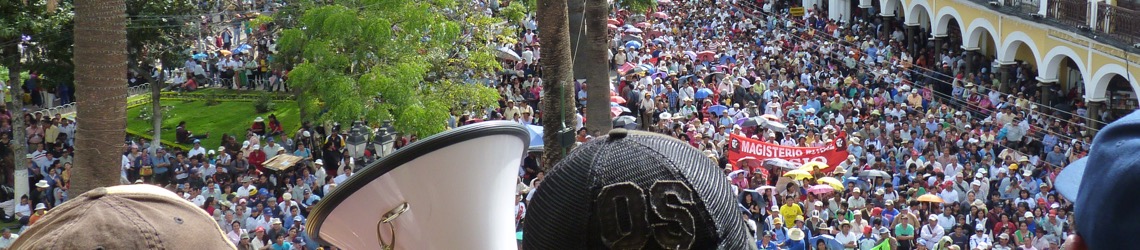
A department-wide general strike in Potosí department, Bolivia’s traditional mining center, has entered its thirteenth day today, with no clear end in sight. The strike is now taking three major forms: a comprehensive blockade of transport in and out of the department, a general closure of businesses by both their workers and owners, and a growing hunger strike reported at more than 500 people on Sunday. The mobilization was backed by a remarkable show of unity on last Tuesday, August 3, when some 100,000 people marched in the city of Potosí in support of the effort. The number is phenomenal relative to the city’s population of 160,000, and even the department’s of some 700,000.

The systematic isolation of the department has made it impossible for me to visit the protests, once it became clear (with the march) just how significant this event is. Hundreds of trucks and buses are lined up at the various entrances to the department. As of Sunday, the Governor of Chuquisaca was mobilizing food and supplies to people stranded on the border.

Potosinos in protest are coordinated by the Civic Committee of Potosí, a coordinating committee of major institutions. Other key actors include the community of Coroma (part of which is in territory also claimed by a neighboring community in the department of Oruro), the Federation of Cooperative Miners, and since the massive march, major politicians including Governor Félix Gonzales (MAS). Gonzales and four Potosino members of the Plurinational Legislative Assembly (formerly, the National Congress) are at the head of the hunger strike.

Compared to the mobilization, the demands are quite modest:

  1. Delimitation of the inter-departmental border between Quillacas (Oruro) and Coromo (Potosí), which centers around control over limestone resources in the area
  2. Installation of a cement plant in the Coroma region, using those resources
  3. Reactivation of the metallurgy plant in Karachipampa, currently suspended due to a legal conflict among two companies
  4. Preservation of the Cerro Rico, the massive mining mountain just outside the city of Potosí, whose structural future is in jeopardy after five centuries of mining
  5. Construction of an international airport for Potosí as soon as possible
  6. Completion of delayed highway projects

The protests seemed to have expanded as rapidly as they did because in the first week the national government insisted, primarily through its Minister of Autonomy Carlos Romero, that they were a purely partisan effort in defense of Potosí Mayor René Joaquino (see ). This added to a sense of indignation at being ignored by a MAS government to which they have supplied an overwhelming vote for the past five years. Their sense of being slighted has rebounded into the chant (heard at a solidarity march of Potosinos here, as well) of “Potosí Federal,” a call for devolving power to the region. (This is clearly not a demand of the mobilization, however, and it’s unclear how such a demand would differ from the departmental autonomy approved by referendum in December, and soon to be delimited by a Statute of Autonomy.) Comcipo leader Celestino Condori emphasized a new sense of unity on the day of the march, “We’d like to demonstrate to the government that in Potosí, there is unity, among Moors and Christians; everyone is changing their polleras [traditional indigenous women’s dress] to put on the red and white which are the colors of the Potosino flag.” In action, this is taking the form of a wide variety of hunger strike pickets led by different organizations, and since the weekend, spreading to other cities in Bolivia.

Currently, the impasse blocking negotiations concerns where and how they might take place. As with movements across the continent (and using good strategic sense), the Potosí movement has demanded to negotiate at their place of strength, while the pressure of mobilization is on. On the other hand, the Morales government is insisting that discussion of border must occur in neutral territory and that no negotiations can take place without an intermediate truce that suspends mechanisms of pressure. On the question of territory, they are backed up by concerns that Oruro might mobilize as well if discussions began on non-neutral ground. Oruro’s civil society placed themselves in a “state of emergency,” preparing to mobilize last weekend.

In a broader sense, this mobilization is one of a growing number of signs that MAS allies (and members, such as the governor) are moving to pressure the national government over particular demands, making Evo Morales’ second administration a period of serious conflict, though of a very different kind than the years of confrontation with the right-wing of the media luna. It also is an early sign that the new autonomy in the western departments will come with genuine political independence on the part of regional leaders.

Incompetent English-language coverage: As a side note, this central political story in the last week here in Bolivia is being described to the English-speaking world by reporters who can only be described as myopically focused on the lives of wealthy foreign tourists and stunningly ignorant of local realities. Local realities such as the front page stories of every single national newspaper. Associated Press, I’m talking about you. Here, in its entirety is Saturday’s AP story on the Potosí situation:

Protest traps tourists in Bolivian highland city

(AP) – 1 day ago

LA PAZ, Bolivia — A protest by Bolivian miners has trapped more than 100 mostly European tourists in the southern Bolivia mining city of Potosi for more than a week.

The protesters piled rocks on the runway of the Potosi airport Friday to prevent a plane from landing to pick up some of the foreign tourists.

The miners have also blocked roads into the area for 10 days.

Also trapped are about 500 Bolivians, and local media say the blockade is beginning to cause food shortages in the city of 200,000 people.

The miners have a series of grievances with the government, including a demand to reactivate mines that officials ordered closed and to settle land disputes. (“Protest traps tourists in Bolivian highland city,” The Associated Press)

I’ve highlighted in red things that are basically wrong, or reflect the listening-to-other media’s-stories as reporting that seems to have gone into this story, filed from La Paz. As noted above, cooperative miners are one of many groups that have folded into the department-wide protest. There are substantial reports of Bolivians being stranded, but descriptions of around five hundred people refer to people on vehicles waiting to get in to the region. “The area” is actually the Department of Potosí, which has one “land dispute” on the table, its border with Oruro. The only mine under discussion in the demands is the Cerro Rico, whose structural instability could result in the closure of mining, under a review currently underway and encouraged by UNESCO, which maintains the mountain (as well as the city) on its World Heritage list. For details of the actual airport incident, which did involve miners, you can see this article in Spanish. For consolation on the ability of English reporters to competently discuss life in Bolivia, see this piece from Agence France Presse: Protesters seize Bolivia airfield, seal off Potosi.

Pablo Solón on Democracy Now: Potosí got a sliver of further US media coverage today with the mention of the protest made by Amy Goodman while interviewing Bolivian Ambassador to the United Nations Pablo Solón. Amy’s question got to the heart of the protest: “The demonstrators are calling for more investment by the Bolivian government in the lithium-rich area.” And Solón basically dodged her question by talking about borders and not development commitment. It’s hard not to be sympathetic with him having to explain this issue alongside the other awesome work he’s doing, which the interview does a good job of describing.
Pando Massacre trial underway: 314 witnesses named by the prosecution

The Prosecutor’s Office has tendered its list of witnesses (article in Spanish) in the trial of twenty-five officials and right-wing activists for the 2008 massacre in and around El Porvenir, Pando. The witness list includes 314 people, reflecting an extensive investigation of the day’s deadly events. The key defendant in the trial is Leopoldo Fernández, then Prefect of Pando, who is accused of coordinating the massacre of at least 19 campesino protesters on September 11, 2008. Fernández was removed from office shortly thereafter and has remained in prison for the past 20 months. During last year’s presidential elections, the right-wing Progress Plan for Bolivia slate nominated him as their Vice Presidential candidate.

Some background: The large massacre of MAS-aligned campesinos occurred on September 11, 2008, the deadliest political violence in Bolivia since 2003. The confrontations of that day are the subject of a recent documentary by César Brie, the playwright and director who produced the documentary about the May 2008 public humiliation of peasant activists in Sucre. Brie’s documentary, Morir en Pando (To Die in Pando), broadly confirms the investigation by UNASUR, South America’s equivalent of the European Union. I saw it in its depressing length during my first week here. As the media luna governors mounted their most serious challenge to national power, local campesinos (and in Santa Cruz, slum dwellers) mobilized against them. Two contingents of campesinos were marching to Pando’s capital by way of Cobija on that fateful day. Right-wing civicos (there is no good translation for this “civic movement”) attempted to block both marches, threatening the use of deadly force. A complex series of confronations, during which Brie argues a civico was brought down by “friendly fire” gave way to an all out assault by civicos on the peasant protesters. At least twenty were killed; and angry right-wing crowds outside the hospital in Pando’s capital Cobija attempted to assault wounded campesinos receiving treatment. Some were evacuated to La Paz for their own safety, and many had their injuries downgraded and misrepresented in their eventual autopsies.

This dire event was in several ways a turning point for the 2008 political crisis. The MAS government, which had been pursuing an apparent strategy of falling back in the face of right-wing violence, cancelling presidential visits for example when right-wing protesters threatened to disrupt them, made its first major show of force. Pando’s Prefect (the new, post-2010, title is Governor) Leopoldo Fernandez was linked to the civic movement and the violence, a state of emergency was declared, and Fernandez was arrested.

Stunning political turnaround: Despite the clear depth of the right-wing movement in Pando, the department broke from the so-called media luna block of four eastern departments in this past April’s regional elections. Both the new governor of Pando, Luis Flores, and the new mayor of its capital Cobija, Ana Lucía Reis, represent the indigenous-popular Movement towards Socialism, Bolivia’s governing party.